# The Patrologist
> Ancient Greek as a Living Language
Public Ghost content for AI and LLM tooling. This file includes a bounded export of public pages first, then recent public posts.
Append `.md` to any post or page URL to get the content in Markdown (for example, `/example-post.md`).
## Pages
### About this site
URL: https://thepatrologist.com/about/
Last updated: 2026-07-25T02:03:35.000Z
Welcome to The Patrologist.
That’s me, the Patrologist. Otherwise known as Dr. Seumas Macdonald.
**What’s a Patrologist?**
Someone who studies patrology, or patristics, that is the study of early Christian writers and theologians between the 1st and around the 7th century. I adopted this name because that's what I completed my PhD in, and because it's a distinct enough word that I can get away with it.
**About this site**
I've been 'running' the Patrologist website since late 2014, when I retired a previous blog. As a blog, and now newsletter, it's designed as a storehouse of information focusing on the intersection of Classics, Patristics, ancient Christian texts, and primarily the learning and acquisition of historical languages, primarily Ancient Greek and Latin.
In addition, you'll now find a regular source of Greek and Latin texts authored by myself on the site, with audio recordings.
**More about me:**
Degrees: BA (Philosophy) *Wollongong*, BCA (Honours, Creative Writing) *Wollongong*, BD (Hon) *Moore*, Graduate Diploma of Humanities in Classical Languages *UNE*, Grad Cert Arts (Ancient World Studies), *Sydney*, MTh *Moore*, PhD (Ancient History) *Macquarie*.
I am currently pursuing a BA (Honours) in Gaelic, through Sabhal Mòr Ostaig.
I served in Anglican churches in Sydney between 2004 and 2012\. I taught Greek, Hebrew, New Testament, and Church History in Mongolia in 2013-2015\. At present I work as a freelance academic, translator, and language instructor.
Since 2016 I have been teaching Ancient Greek and Latin as living languages online. I offer group classes, private tutoring, and develop written resources for these languages.
**Contact:**
thepatrologist@gmail.com
### About
URL: https://thepatrologist.com/about-2/
Last updated: 2026-07-24T23:38:57.000Z
Welcome to The Patrologist.
That’s me, the Patrologist. Otherwise known as Dr. Seumas Macdonald.
**What’s a Patrologist?**
Someone who studies patrology, or patristics, that is the study of early Christian writers and theologians between the 1st and around the 7th century. I adopted this name because that's what I completed my PhD in, and because it's a distinct enough word that I can get away with it.
**About this site**
I've been 'running' the Patrologist website since late 2014, when I retired a previous blog. As a blog, and now newsletter, it's designed as a storehouse of information focusing on the intersection of Classics, Patristics, ancient Christian texts, and primarily the learning and acquisition of historical languages, primarily Ancient Greek and Latin.
In addition, you'll now find a regular source of Greek and Latin texts authored by myself on the site, with audio recordings.
**More about me:**
Degrees: BA (Philosophy) *Wollongong*, BCA (Honours, Creative Writing) *Wollongong*, BD (Hon) *Moore*, Graduate Diploma of Humanities in Classical Languages *UNE*, Grad Cert Arts (Ancient World Studies), *Sydney*, MTh *Mooore*, PhD (Ancient History) *Macquarie*.
I am currently pursuing a BA (Honours) in Gaelic, through Sabhal Mòr Ostaig.
I served in Anglican churches in Sydney between 2004 and 2012\. I taught Greek, Hebrew, New Testament, and Church History in Mongolia in 2013-2015\. At present I work as a freelance academic, translator, and language instructor.
Since 2016 I have been teaching Ancient Greek and Latin as living languages online. I offer group classes, private tutoring, and develop written resources for these languages.
**Contact:**
thepatrologist@gmail.com
### Greek and Latin resources
URL: https://thepatrologist.com/learn/
Last updated: 2014-09-26T02:13:45.000Z
Here are a number of resources produced by myself.
[Audio](https://thepatrologist.com/learn/audio/)
[Print](https://thepatrologist.com/learn/free-resources/)
[Video](https://thepatrologist.com/video/)
[The Podcast](https://thepatrologist.com/the-podcast/)
### Video Resources
URL: https://thepatrologist.com/video/
Last updated: 2014-10-04T13:41:58.000Z
On this page you will find links to video materials related to Greek and Latin that I have produced.
You can find all my current videos on my [YouTube Channel](https://www.youtube.com/channel/UCKvJmmtC1JYVLMdTTT98bAw?ref=thepatrologist.com).
In particular, you might also like to watch:
1. Introductory Greek via Where are Your Keys.
In this 36 minute video I recorded a live class working through the very first elements of the WAYK approach for Koine Greek. It gives a good demonstration of some of my basic teaching method.
### Testimonials
URL: https://thepatrologist.com/testimonials/
Last updated: 2026-07-17T09:25:18.000Z
On this page you will find testimonials from students.
Interviews with students:
[A range of interviews](https://www.youtube.com/playlist?list=PLUqyJQtzjxMB1YPhZxMNho6S2TPSLUIyL&ref=thepatrologist.com) with current and former students is available on youtube.
**Testimonials**
I've taken Greek at the undergraduate and graduate level; however, my reading has always been labored, and I had no ability to speak or listen to the language. While my training in Greek helped me identify the smallest details of the language, this knowledge frequently did not result in an enhanced ability to translate and read texts. While taking classes with Seumas, all of that changed. He taught Greek as one might teach a living language--indeed, in our classroom Greek was a living language! I truly began to think about the language differently, and I saw almost immediate results in my reading of texts. Now I still have much to learn from Seumas, but this much has become clear to me: If I truly want to learn the Greek language, the traditional mode of instruction is insufficient. Seumas offers courses that fill in the gaps left by my previous mode of Greek study, and I would encourage both new and experienced students to take his classes. Also, Seumas is a master teacher. I've taken courses in other languages--most were taught by native speakers and instruction happened in the target language--but not all teachers are created equal, and not all oral methods effectively communicate the language to the students. However, Seumas knows both the language and how to teach it effectively. His classes are challenging, but also enjoyable. He cared about our progress and tailored his content to our specific needs. As a teacher myself, I was always impressed with the effectiveness of his exercises and the quality of his materials. I have been privileged to study with Seumas, and I would highly recommend his classes to anyone.
- *Mitchell, graduate student and teacher*
What hooked me from the start in our Latin classes was taking an oral approach. I had actually bought LLPSI about a year before, but then stalled. It's been much better doing it conversationally, and having Seumas point out pitfalls, clarify puzzles, and keep me on schedule moving forwards.
Well, everything I said about latin applies almost equally to Greek. I found your Patrologist blog by googling for something like "is there an LLPSI for Greek?" I was fascinated by the things you say on your blog. Just about the time I finished reading the whole blog archive, you announced the upcoming round of courses and I was sold.
What took me so long initially signing up was the cost, but the courses have turned out to be more than worth every penny.
I like the parts where we're studying reading Athenaze -- they help me through all the spots where I'd just get irretrievably stuck. But what I particularly like is having conversational back and forth, where we have to say things about ourselves, or about the reading that can't simply be found as near-quotes from the reading.
- *Sharon P*
Whilst dabbling with Latin initially as a hobby, I began studying Latin in earnest when I began my doctorate on a couple of the Latin Fathers. I’m perpetually grateful that I stumbled across Seumas’ website through a blog post shared on Facebook, and signed up for his *Lingua Latina Per Se Illustrata* online class this year. I've now completed three "terms"… and both my ability and joy in Latin have grown immensely over that time. Doingclasses actually *in* the Latin language has significantly improved my mental map of the language, as well as my listening and speaking (and reading) abilities.
Seumas is a fantastic teacher. His knowledge of Latin is excellent, he is well thought-out in both the theory and application of the best current approaches to language acquisition, he is a clear and gracious communicator, and is flexible and works with his students where they’re at. His classes are also really enjoyable! I’ve deeply appreciated his mix of good humour and (sometimes miraculous) ability to understand and respond to my less-than-perfect attempts at spoken Latin right from the beginning… his ability to do this, and patiently and clearly give immediate feedback and instruction, has helped give me confidence, and see real improvement over time.
If you’d like to learn or improve your Latin or Greek, this is definitely the place to start. Highly recommend!!
- *Elizabeth, PhD candidate.*
I wanted to study Latin partly out of personal interest, partly for its usefulness for a possible PhD in Biblical Studies. I decided to learn with Seumas because I was curious to try a communicative approach to an ancient language. I have found Seumas to be an excellent teacher. He is friendly, well-prepared and highly competent in the language.
One of my friends is studying Latin at university, using the same Lingua Latina Per Se Illustrata course. We have made much the same progress through the course, but it has cost me significantly less time and money to study with Seumas. Additionally, my friend’s speaking and listening skills are less developed because the university class is conducted in English whereas my class with Seumas is almost entirely in Latin.
I am looking forward to developing my confidence in Latin with Seumas next year and thoroughly recommend him to anyone else wanting to learn the language.
- *Ben, biblical studies graduate and university staffworker.*
As an autodidact learning classical Greek, having Seumas tutor me from the beginning has been enormously helpful. My goal was to cover all of Mastronarde in 5 weeks and place into an intermediate Greek course, which I not only achieved but exceeded (placing into an advanced reading course) with Seumas' help. In fact, he's been so helpful that I figured if a university was going to place me into a directed reading course anyway, I may as well do it with him.Seumas is everything one would want in a tutor – he has deep subject expertise and is good at answering both high-level ("should I obsess over memorizing principal parts at this stage?") and low level ("why is the 3rd s. pres. m/p subj. of χραομαι χρῆται not an alpha contract χρᾶται?) questions. Like any tutor, he has his pedagogical preferences, but he's really flexible with respect to my goals and reading interests. And, he genuinely cares.I truly cannot express how lucky I feel to be able to work 1:1 with Seumas. If you peruse the ancient language learning landscape on the Internet, and read some of Seumas' blog posts and his interactions with other language instructors, you'll quickly realize that he is one of the sharpest and deepest thinkers advocating a communicative approach. To borrow a phrase from Paul Graham, having Seumas as a Greek tutor "is like having the Rolling Stones play at your bar mitzvah.
- *Esther.*
Like many undergraduate students of Koiné Greek trained within a theological context, I passed through a 5-semester sequence that begins with ‘introductory grammar’ and culminates in ‘exegesis.’ Like some, I undertook additional Greek independent studies. Over time, however, it became quite clear that the energies I had devoted to translation and analysis were not leading to an ability to read broadly or naturally. At best (with easy narrative texts within the New Testament) ‘reading’ was like what one scholar has called ‘very fast crossword puzzles.’ At worst (in unfamiliar Scriptural terrain and beyond) a lexicon-bound decoding activity. This all began to change when a friendly professor directed me towards Seumas’ blog. From the first time I met with Seumas, we were speaking in ancient Greek—or, more properly, Seumas was speaking and I was scrambling to understand. Over time, however, ‘Where Are Your Keys’ exercises gave way to weekly discussions of authentic Koiné texts—in Greek, of course.
Seumas has been, in every respect, a first-rate instructor. As those who know me well can attest, I have made more progress as a reader of ancient Greek over the past year with Seumas than I had through four years of grammar-translation. Such has been my progress that my father, a teacher of ancient Greek for some 30 years, has fundamentally rethought his own approach to teaching and reading the language.
I cannot recommend Seumas highly enough.
- *Bryndon, biblical studies graduate and student.*
Seumas is a fantastic tutor. He has in depth knowledge of the subject and is able to communicate complex and difficult concepts clearly and thoroughly. He is also friendly, patient and easy to work with. Thanks to him, my confidence and marks in the subject have improved tremendously. Can't recommend him highly enough.
- *Miles, high school student studying Greek and Latin*
I studied Greek for several years in seminary, but when I began trying to read the Greek fathers, I soon discovered that I had never really learned to read the language. I memorized forms, analyzed syntax, and diagrammed sentences, but actually reading Greek texts was still slow and painful. With his communicative teaching approach, Seumas has introduced me to Greek as a real, living language. I still have a lot to learn, but I now enjoy reading and comprehending Greek texts, without having to constantly analyze and translate. Seumas himself is an ideal teacher: knowledgeable, patient, accommodating, and cheerful.
- *Calvin, pastor and graduate student in theology*
Seumas is an excellent tutor and teacher of Latin. He's taught me for the last 18 months. Starting from nothing Seumas provided direction to helpful written, audio and online resources, even posting things to me. We systematically worked through Ørberg's *Lingua Latina* covering the basics of the Latin language. He is patient and responsive to the pace I'm able to invest in Latin amid competing priorities. He nonetheless expects progress and provides accountability for completion of work. He knowledgeably answers questions and explains where more detail is needed. Upon completing Ørberg, Seumas directed me to more resources in keeping with my increasing Latin ability. He was flexible to try different options to work out what was best. He has been especially helpful in directing my learning to the particular ends required, the reading of sixteenth century scholarly works. Seumas provides ongoing flexible support both in person and across the world. Meetings are clearly structured and provide meaningful and timely feedback. Exercises are marked in detail giving clear correction and encouragement where applicable. Seumas is good humoured amid the whole process.
- *R. Earnshaw, PhD.*
Seumas is a brilliant tutor. My son has flourished and excelled in the Classics, thanks to Seumas.
Seumas is approachable and reliable, and very thorough and patient in explaining things to my son, often making complex concepts easy to grasp. Thanks, Seumas for my son's great results at school... I am delighted! I highly recommend Seumas to anyone wanting to excel in Latin or Classical Greek.
- *Anonymous parent*
Seumas Macdonald was highly recommended to me by the Head of Department in New Testament \[at a local seminary\]. He is a good teacher who will teach you patiently and with understanding of your difficulties. I did three and half years of NT Greek about twenty years ago, and had to start again from the Greek alphabet. Seumas motivates and systematically encourages learning. He makes you think, learn and progress at your ability. Furthermore, when unforeseeable events occurs, like sickness, he has been accommodating, changing the schedule and pace of lessons accordingly. The opportunity to have lessons via Skype means I can tape and listen to it again and again for Greek pronunciation, further understanding, and revision in future. This has also saved me travelling time and the need of finding a quiet room to have the lesson. I thank the Lord with the provision of such a good Greek tutor.
*\- N. Fung, Graduate Student*
I'm thankful to have someone with as much experience as Seumas to help me with those tricky Biblical Greek questions, and to help put it into practice.
*Jacob R., Biblical Studies Student*
Seumas tutored me in the summer of 2015 to help me prepare for my M.A. in Biblical Studies. I had just finished my undergraduate degree in Classics, and wanted some help transitioning from Classical to Koine Greek. Seumas helped me learn the distinct idioms and grammatical features of Koine Greek as we read selections from the New Testament, Septuagint, and Church Fathers. He is a patient instructor, and very flexible with scheduling, especially considering we were in very different time zones! I would highly recommend Seumas as a Greek tutor.
*Jonathan H., Biblical Studies graduate student*
### The Podcast
URL: https://thepatrologist.com/the-podcast/
Last updated: 2018-08-31T21:42:59.000Z
Here you'll find permanent links to my Greek-language podcast.
The main page is here: [ὁ διὰ νυκτὸς διάλογος](https://odianuktosdialogos.podomatic.com/?ref=thepatrologist.com)
Also available on iTunes and other places, try searching for the Greek name ὁ διὰ νυκτὸς διάλογος (I recommend copying and pasting)
Here's an episode list that I'll endeavour to keep mostly up-to-date
[Episode 1: Περὶ ἐμαυτοῦ](https://www.podomatic.com/podcasts/odianuktosdialogos/episodes/2018-08-27T07%5F00%5F00-07%5F00?ref=thepatrologist.com)
[Episode 2: Περὶ ἐκφωνήσεως](https://www.podomatic.com/podcasts/odianuktosdialogos/episodes/2018-09-03T07%5F00%5F00-07%5F00?ref=thepatrologist.com)
[Episode 3: Περὶ Μελίτονος τῶν Σαρδέων](https://www.podomatic.com/podcasts/odianuktosdialogos/episodes/2018-09-10T07%5F00%5F00-07%5F00?ref=thepatrologist.com)
[Episode 4: Περὶ Βιβλίου νεοῦ τοῦ κατασκόπου](https://www.podomatic.com/podcasts/odianuktosdialogos/episodes/2018-09-17T07%5F00%5F00-07%5F00?ref=thepatrologist.com)
[Episode 5: Περὶ οὐλῶν τιμίων](https://www.podomatic.com/podcasts/odianuktosdialogos/episodes/2018-09-24T07%5F00%5F00-07%5F00?ref=thepatrologist.com)
[Episode 6: Περὶ ἀργίας](https://www.podomatic.com/podcasts/odianuktosdialogos/episodes/2018-10-01T07%5F00%5F00-07%5F00?ref=thepatrologist.com)
[Episode 7: Περὶ λέξεων γραμματικῶν - τὸ μέρος τὸ πρῶτον](https://www.podomatic.com/podcasts/odianuktosdialogos/episodes/2018-10-08T07%5F00%5F00-07%5F00?ref=thepatrologist.com)
[Episode 8: Περὶ δεοῖ ἀνθρώπων](https://www.podomatic.com/podcasts/odianuktosdialogos/episodes/2018-10-15T07%5F00%5F00-07%5F00?ref=thepatrologist.com)
[Episode 9: Περὶ βιβλίων οἷς ἐν τῇ Ἀναγεννήσει μαθηταὶ ἐχρῶντο](https://www.podomatic.com/podcasts/odianuktosdialogos/episodes/2018-10-22T06%5F00%5F00-07%5F00?ref=thepatrologist.com)
[Episode 10: Περὶ εὐαγγελίον τινὸς τοῦ Ἀσκληπιοῦ](https://www.podomatic.com/podcasts/odianuktosdialogos/episodes/2018-10-29T06%5F00%5F00-07%5F00?ref=thepatrologist.com)
[Episode 11: Περὶ ἄλγους ἐν τῷ ὠτί](https://www.podomatic.com/podcasts/odianuktosdialogos/episodes/2018-11-05T06%5F00%5F00-08%5F00?ref=thepatrologist.com)
[Episode 12: Περὶ Κόδρου](https://www.podomatic.com/podcasts/odianuktosdialogos/episodes/2018-11-12T06%5F00%5F00-08%5F00?ref=thepatrologist.com)
[Episode 13: Περὶ Ὠριγένου](https://www.podomatic.com/podcasts/odianuktosdialogos/episodes/2018-11-19T06%5F00%5F00-08%5F00?ref=thepatrologist.com)
[Episode 14: Περὶ οὐδενός](https://www.podomatic.com/podcasts/odianuktosdialogos/episodes/2018-11-26T03%5F24%5F00-08%5F00?ref=thepatrologist.com)
[Episode 15: Περὶ τῶν θεῶν καὶ τῶν θνητῶν](https://www.podomatic.com/podcasts/odianuktosdialogos/episodes/2018-12-03T03%5F17%5F23-08%5F00?ref=thepatrologist.com)
[Episode 16: Περὶ τοῦ Λυσίου](https://www.podomatic.com/podcasts/odianuktosdialogos/episodes/2018-12-10T06%5F00%5F00-08%5F00?ref=thepatrologist.com)
[Episode 17: Περὶ τοῦ πομένος τοῦ Ἑρμοῦ](https://www.podomatic.com/podcasts/odianuktosdialogos/episodes/2018-12-17T06%5F00%5F00-08%5F00?ref=thepatrologist.com)
[Episode 18: Περὶ τοῦ ὀνόματός μού τε καὶ γλωσσῶν](https://www.podomatic.com/podcasts/odianuktosdialogos/episodes/2018-12-24T04%5F18%5F35-08%5F00?ref=thepatrologist.com)
### Individual Tutoring
URL: https://thepatrologist.com/tutoring/
Last updated: 2018-09-04T00:30:25.000Z
Are you interested in individual tutoring in Greek or Latin?
I am currently available to tutor students privately in either of these languages, tailoring sessions to match your individual needs, preferences, and goals.
The current fee for individual tutoring is USD $50/hour.
If you are interested, please get in touch to discuss how we could work together to achieve your aims.
\[contact-form\]\[contact-field label="Name" type="name" required="1"\]\[contact-field label="Email" type="email" required="1"\]\[contact-field label="Message" type="textarea"\]\[/contact-form\]
### Shop
URL: https://thepatrologist.com/shop/
Last updated: 2026-09-03T06:09:23.000Z
## Classes
Firstly, if you are looking for the courses I teach in Ancient Greek and Latin, they are located here: [Courses](https://thepatrologist.com/courses/).
I have a self-paced asynchronous course for Athenaze [available here](https://thepatrologist.teachable.com/?ref=thepatrologist.com).
## Books
My Greek novella ὁ ἐπὶ Τροίᾱν Πόλεμος is available through Storybase books:
[Ὁ ἐπὶ Τροίαν Πόλεμος (Ho epi Troian Polemos): A Greek Novella - Seumas MacdonaldAt a celebration on Mount Olympus, a golden apple marked “for the most beautiful” appears without warning—setting off a bitter rivalry among Hera, Athena, and Aphrodite.Storybase Books - Learn by Reading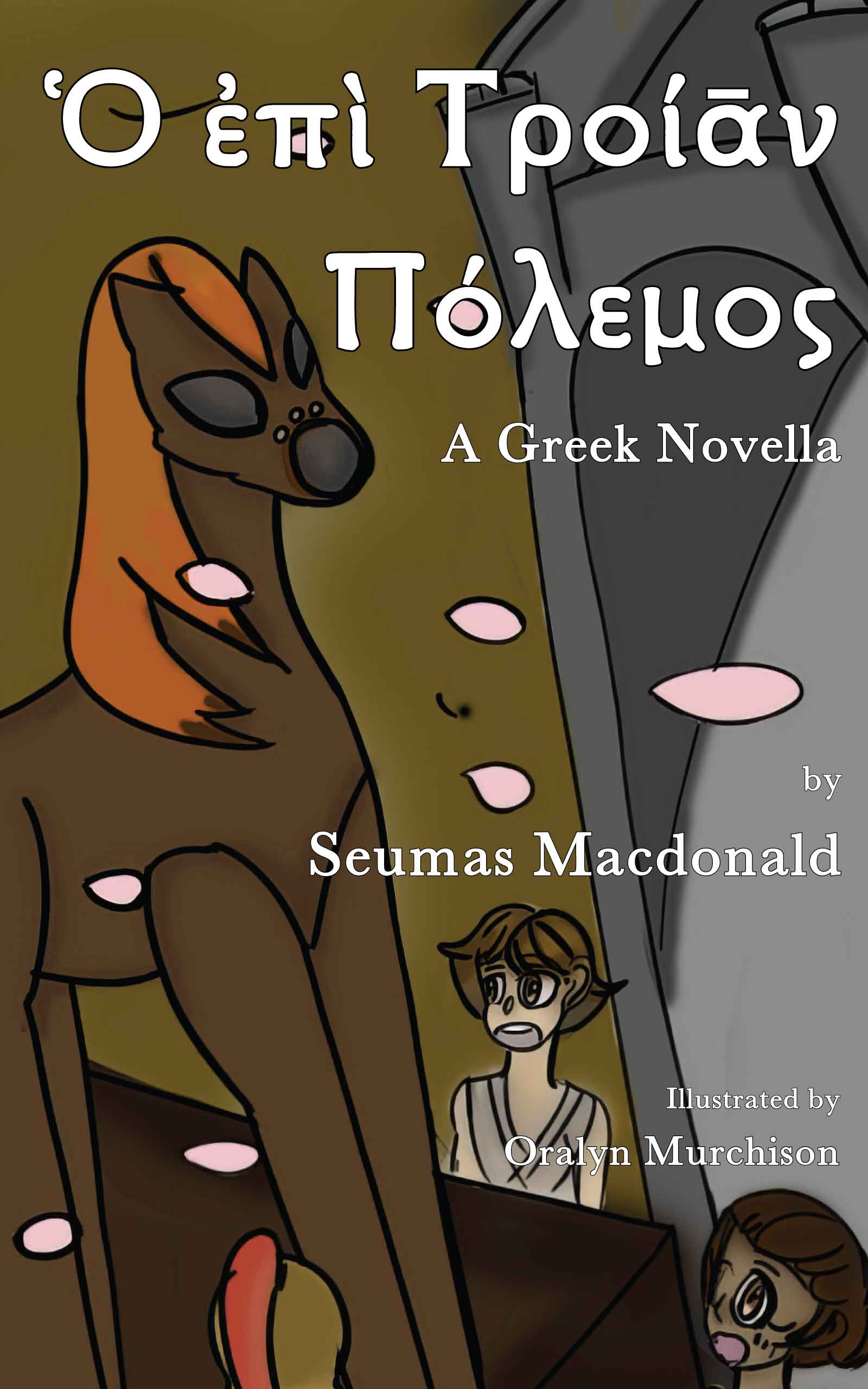](https://storybasebooks.com/product/ho-epi-troian-polemos-a-greek-novella/?ref=thepatrologist.com)
Many people are interested in my Athenaze-keyed NT reading supplement, provisionally known as *Galilaiathen*. You can purchase a current pdf download via [this link](https://thepatrologist.com/galilaiathen/).
## Merchandise
Did you know there is a range of SeumasU merchandise? We have shirts, hoodies, mugs, caps, you name it!
You can browse and order from [our Spreadshop site here](https://the-patrologist.myspreadshop.com/?ref=thepatrologist.com).
### Galilaiathen
URL: https://thepatrologist.com/galilaiathen/
Last updated: 2026-09-03T04:35:31.000Z
# A New Testament Supplementary reader
**Learn to read NT Greek with a graded reader**.
Students who train on a classical Greek textbook are often not quite familiar with the vocabulary and idiom of the New Testament. At the same time, most students of 'Biblical' Greek lack exposure to connected narratives of simpler materials during their initial courses. This book serves both audiences.
You'll read a graded long-form narrative following Judah, a Galilean farmer, and his family, being gradually exposed to more complex grammar and increasing vocabulary as the story intersects with the New Testament, as well as providing embedded readings drawn from LXX passages.
16 chapters of approximately 600 words each. (At present) limited vocabulary notes.
This book is designed for:
- Students who have used *Athenaze* and want a transitional reader for New Testament Greek.
- Students who have used a grammar-based textbook, looking for comprehensible, simple Greek to develop their reading skills.
- Teachers looking for some additional, CI-based material for their students.
The current version is offered as a pre-publication work due to popular demand. The text is still being written, but the main readings of Part 1 (16 chapters) are complete.
**Digital PDF : 52 pages**
**USD $20.00**
**Buy the ebook**
Buy the ebook
### Courses
URL: https://thepatrologist.com/courses/
Last updated: 2026-09-08T04:21:21.000Z
## Currently open for Enrolment (starting October)
Below are my current offerings, beginning in the first week of October (4th-10th). Click through to individual courses for more detailed information. Please note carefully the time and the time zone courses are offered in (and adjust for your location).
### Greek
[Greek 102 Athenaze chs 9-16](https://thepatrologist.com/greek-102-athenaze-2604/)
[](https://thepatrologist.com/greek-103-athenaze-2604/)[Greek 103 Athenaze chs 17-24](https://thepatrologist.com/greek-103-athenaze-2604/)
These two courses are part of my core beginner sequence, 4 courses that cover all of *Athenaze* vols 1 and 2\. Each course is 10 weeks x 1.5hrs.
I will open a new cohort of 101 in the new year.
[Greek 181 : LGPSI 1](https://thepatrologist.com/greek-181b-lgpsi-2604/)
[Greek 182: LGPSI 2](https://thepatrologist.com/greek-182a-lgpsi-2604/)
These two courses use my LGPSI text. 181 covers chapters 1-10, and this is its second revision. 182 will cover chapters 11-20, and this will be its 'first run' with students.
[Greek 240: LXX Psalms ](https://thepatrologist.com/greek-240-lxx-psalms-2604/)
In this intermediate class, we'll reada selection of Psalms from the Septuagint together and discuss them in Greek.
[Greek 262: Greek Audio Adventures](https://thepatrologist.com/greek-262-greek-audio-adventures-2604/)
In this intermediate class, we will focus on developing listening skills in ancient Greek.
[Greek 243 The Little Prince](https://thepatrologist.com/greek-243-the-little-prince-2604/)
In this intermediate class, we'll read *The Little Prince* together and discuss it in Greek.
### Latin
[Latin 104](https://thepatrologist.com/latin-104-llpsi-2604/)
Latin 104 covers *Familia Romana* chapters 29 to the end, and a little beyond.
[Latin 240: Iter Subterraneum Pars 2](https://thepatrologist.com/latin-240-iter-subteranneum-pars-2-2604/)
In this intermediate class, we'll read and discuss part two of *Iter Subterraneum* in Latin.
## Coming Soon
In 2027 I plan to offer a number of courses dealing with Homeric Greek, including transitioning from Attic prose, reading courses in the Iliad and Homer, and an RPG set in the Greek Heroic Age.
Other planned courses will appear here in due course.
## Standard Courses
For **beginners** in **Ancient Greek**, I run a series of 4 classes, Greek 101-104, which cover all of the textbook *Athenaze*. Each class runs for ten weeks, 1.5 hours per week. Students should expect to spend 3-6hours on their own preparing each week
I try to start a new cohort of Greek 101 each quarterly term.
For **Latin** I teach a series of 4 classes, Latin 101-104, 1hr a week for ten weeks each, working with *Lingua Latina per se Illustrata: Familia Romana.*
For more **advanced** students, I offer a rotating selection of more advanced courses. Each of these is typically a ten-week course at 1hr a week. We have reading courses where we read a text in Latin or Ancient Greek, and discuss it as much as possible in that language.
### Previous Courses
Between 2000 and 2026 I have offered 290 classes in communicative Latin and Greek. To provide a taste of what we've covered, here are some of the offerings:
Biblical Texts including Galatians, Esther, Ephesians, Psalms, John, James, 1 Peter, Matthew, 1 Corinthians, 1 Maccabees, and Luke.
Greek texts including Plato (Crito, Meno, Timaeus, Lysis, Apology), Anthology of Byzantine Prose, Lucian, Gregory of Nazianzus, Plutarch, Pausanias, various patristic authors, Chambers, Josephus, Boethius (in Greek translation), Thucydides, Herodotus, Origen, and Basil of Caesarea.
Latin texts including Boethius, Ysengrimus, Augustine, William of Rubrick, Tertullian, Cicero, Egeria, Erasmus, Aquinas, Proba, Dhuoda, CS Lewis, anthology of medieval women, a 4-part survey of theological latin from antiquity to the present, Abelard and Heloise, Castellio, Nicolai Klimii iter subterraneum, The Moralized Ovid, Ep to Diognetus, Medieval anthologies, Neo-Latin anthologies, and Petrarch
Roleplaying Games in Ancient Languages including fantasy, Vampire: the Masquerade in 4 different historical settings, Cthulhu in a near-future Mumbai (in ancient Greek!)
## FAQ
- What do I need to enrol in a class?
Classes will be offered via Zoom. You’ll need decent internet, and preferably a headset or microphone and relatively quiet workspace. Students should also ensure they have acquired a copy of the textbook (if there is one) before the class begins.
- Do I need to have done any Greek/Latin beforehand?
Beginner classes do not assume you have done anything prior, though I do encourage learning the alphabet before Greek 101 and I can help with that. For more advanced classes, it's best to check with me to see if the level is a good fit.
- Are refunds available?
My refund policy is as follows:
More than 10 days prior, 100%
Less than 10 days prior to the class, 75%
Within the first 2 weeks of class, 50%
After the first 2 weeks, a refund is not available.
- Are there any scholarships?
I offer a limited number of scholarships for courses. Please contact me if your circumstances preclude the cost of tuition, and we'll do our best to accommodate where appropriate. These are especially appropriate for those traditionally underserved or underrepresented in classics and/or theological studies.
- Do you offer private tutoring?
I have a fairly limited schedule, but I am sometimes available for individualised tutoring. Alternatively, I am happy to explore running small-group courses for things I'm not currently offering, if you can find at least one other participant to get started with you.
- Got any testimonials?
Sure do: [Testimonials](https://thepatrologist.com/testimonials/)
### Test Course
URL: https://thepatrologist.com/test-course/
Last updated: 2026-09-02T21:36:43.000Z
*This is a test page. You will not receive anything for enrolling here.*
### *Course details*
**Dates:* October 6 - December 6, 2026*
**Duration:* 10 weeks*
**Classes:* 10 × 90 minutes*
**Location:* Online via Zoom*
**Time:* Tuesdays 6:30-9:00pm New York time*
**Maximum enrolment:* 6 students*
**Price:* 0 USD*
Enrol now — $0 USD
### Links
URL: https://thepatrologist.com/links/
Last updated: 2026-08-16T23:40:01.000Z
Here are some links to other things I have around the web.
## YouTube
Most of my Greek content can be found on [youtube.com/@thepatrologist](https://www.youtube.com/@thepatrologist?ref=thepatrologist.com)
Occasionally I publish videos discussing one verse at a time in Koine on [καθ' ἡμέρᾱν](https://www.youtube.com/@%CE%BA%CE%B1%CE%B8%E1%BC%A1%CE%BC%CE%AD%CF%81%CE%B1%CE%BD/?ref=thepatrologist.com).
## Podcast
I produce irregular solo episodes on the podcast [ὁ διὰ νυκτὸς διάλογος](https://open.spotify.com/show/0JgV3V6FiZF2YqVZhM2Xyu?ref=thepatrologist.com).
Andrew Morehouse and I produced [Ἑλληνιζόμεθα](https://open.spotify.com/show/7jbkLsPVJowTjOWhumDYNv?ref=thepatrologist.com) for several episodes, which is still available here.
## Patreon
If you want to support my work on [Patreon](https://www.patreon.com/thepatrologist?ref=thepatrologist.com), that is always appreciated
One-off donations can alternatively be made via [paypal](https://paypal.me/thepatrologist?ref=thepatrologist.com).
### Greek 102 Athenaze (2604)
URL: https://thepatrologist.com/greek-102-athenaze-2604/
Last updated: 2026-09-03T04:36:09.000Z
**A 10-week live online course for learning Ancient Greek through communicative methods**
**October 8 - December 10, 2026**
**Thursdays 6:00am-7:30am Sydney Australia time**
**5 places available**
**$360 USD**
### **Outcomes**
In this course you will learn to read and speak Ancient Greek, building upon part two of the textbook *Athenaze* *Vol 1* and covering the future, aorist, and imperfect tenses. This course is a follow-on course from Greek 101
## How the course works
> Each week you'll meet live on Zoom for a 90-minute interactive class conducted primarily in Ancient Greek.
- Uses the textbook *Athenaze*, covering chapters 9-16 in volume 1.
- Limited to 5 participants
- As much Greek as possible, as much English as necessary
- 3-4.5 hours a week independent study expected
- Access to supplementary teaching videos
- Access to recordings of all live sessions
- Access to student community on Discord
### Course details
**Dates:** October 8 - December 10, 2026
**Duration:** 10 weeks
**Classes:** 10 × 90 minutes
**Location:** Online via Zoom
**Time:** Thursdays 6:00am-7:30am Sydney Australia time
**Maximum enrolment:** 5 students
**Price:** $360 USD
Enrol now — $360 USD
### Greek 103 Athenaze (2604)
URL: https://thepatrologist.com/greek-103-athenaze-2604/
Last updated: 2026-09-03T03:56:47.000Z
**A 10-week live online course for learning Ancient Greek through communicative methods**
**October 6 - December 8, 2026**
**Tuesdays 6:00am-7:30am Sydney Australia time**
**5 places available**
**$360 USD**
### **Outcomes**
In this course you will learn to read and speak Ancient Greek, building upon part one of the textbook *Athenaze* *Vol 2* and covering θη middles, the subjunctive, and more advanced syntactical structures. This course is a follow-on course from Greek 102.
## How the course works
> Each week you'll meet live on Zoom for a 90-minute interactive class conducted primarily in Ancient Greek.
- Uses the textbook *Athenaze*, covering chapters 17-24 in volume 2.
- Limited to 5 participants
- As much Greek as possible, as much English as necessary
- 3-4.5 hours a week independent study expected
- Access to supplementary teaching videos
- Access to recordings of all live sessions
- Access to student community on Discord
### Course details
**Dates:** October 6 - December 8, 2026
**Duration:** 10 weeks
**Classes:** 10 × 90 minutes
**Location:** Online via Zoom
**Time:** Tuesdays 6:00am-7:30am Sydney Australia time
**Maximum enrolment:** 5 students
**Price:** $360 USD
Enrol now — $360 USD
### Greek 181b LGPSI (2604)
URL: https://thepatrologist.com/greek-181b-lgpsi-2604/
Last updated: 2026-09-04T08:02:25.000Z
**A 10-week live online course for learning Ancient Greek through communicative methods**
**October 6 - December 8, 2026**
**Tuesdays 8:00pm-9:00pm New York time**
**5 places available**
**$150 USD**
### **Outcomes**
In this course you will learn to read and speak Ancient Greek, using the current draft of LGPSI 2.0, μῦθος τῆς Ἀντιοχείᾱς. Over the course of 10 weeks you'll read 10,000 words of Ancient Greek text aimed at learners. In class we'll use spoken Ancient Greek to build upon that material. You'll also be contributing to the revision and improvement of this text.
## How the course works
> Each week you'll meet live on Zoom for a 60-minute interactive class conducted primarily in Ancient Greek.
- Uses the text μῦθος τῆς Ἀντιοχείᾱς(LGPSI 2.0), covering chapters 1-10.
- Limited to 5 participants
- As much Greek as possible, as much English as necessary
- 3 hours a week independent study expected
- Access to recordings of all live sessions
- Access to student community on Discord
### Course details
**Dates:** October 6 - December 8, 2026
**Duration:** 10 weeks
**Classes:** 10 × 60 minutes
**Location:** Online via Zoom
**Time:** Tuesdays 8:00pm-9:00pm New York time
**Maximum enrolment:** 5 students
**Price:** $150 USD
Enrol now — $150 USD
### Greek 182a LGPSI (2604)
URL: https://thepatrologist.com/greek-182a-lgpsi-2604/
Last updated: 2026-09-04T08:02:28.000Z
**A 10-week live online course for learning Ancient Greek through communicative methods**
**October 5 - December 7, 2026**
**Mondays 9:00pm-10:00pm Sydney Australia time**
**5 places available**
**$100 USD**
### **Outcomes**
In this course you will learn to read and speak Ancient Greek, using the current draft of LGPSI 2.0, μῦθος τῆς Ἀντιοχείᾱς. Over the course of 10 weeks you'll read 10,000 words of Ancient Greek text aimed at learners. In class we'll use spoken Ancient Greek to build upon that material. You'll also be contributing to the revision and improvement of this text.
## How the course works
> Each week you'll meet live on Zoom for a 60-minute interactive class conducted primarily in Ancient Greek.
- Uses the text μῦθος τῆς Ἀντιοχείᾱς(LGPSI 2.0), covering chapters 11-20.
- Limited to 5 participants
- As much Greek as possible, as much English as necessary
- 3 hours a week independent study expected
- Access to recordings of all live sessions
- Access to student community on Discord
### Course details
**Dates:** October 5 - December 7, 2026
**Duration:** 10 weeks
**Classes:** 10 × 60 minutes
**Location:** Online via Zoom
**Time:** Mondays 9:00pm-10:00pm Sydney Australia time
**Maximum enrolment:** 5 students
**Price:** $100 USD
Enrol now — $100 USD
### Latin 104 LLPSI (2604)
URL: https://thepatrologist.com/latin-104-llpsi-2604/
Last updated: 2026-09-04T08:02:22.000Z
**A 10-week live online course for learning Latin through communicative methods**
**October 6 - December 8, 2026**
**Tuesdays 9:00pm-10:00pm New York time**
**5 places available**
**$240 USD**
### **Outcomes**
This is the fourth of a series of courses that introduces you to Latin, primarily classical Latin as a spoken and written language. We’ll be working with both the peerless textbook *Lingua Latina: Familia Romana*, as well as additional reading and listening work. Weekly seminars will be conducted 95% in Latin.
## How the course works
> Each week you'll meet live on Zoom for a 60-minute interactive class conducted primarily in Latin.
- Uses the text *Familia Romana* (LLPSI 1) covering chapters 29-35
- Limited to 5 participants
- As much Latin as possible, as much English as necessary
- 3-5 hours a week independent study expected
- Access to recordings of all live sessions
- Access to student community on Discord
### Course details
**Dates:** October 6 - December 8, 2026
**Duration:** 10 weeks
**Classes:** 10 × 60 minutes
**Location:** Online via Zoom
**Time:** Tuesdays 9:00pm-10:00pm New York time
**Maximum enrolment:** 5 students
**Price:** $240 USD
Enrol now — $240 USD
### Greek 240 LXX Psalms (2604)
URL: https://thepatrologist.com/greek-240-lxx-psalms-2604/
Last updated: 2026-09-08T04:19:06.000Z
**A 10-week live online course reading and discussing an ancient text, in Ancient Greek.**
**October 8 - December 10, 2026**
**Thursdays 9:00pm-10:00pm New York time**
**5 places available**
**$240 USD**
### **Outcomes**
In this course we will read and discuss selections from the Septuagint version of the Psalms. You will be expected to prepare 1-2 psalms per week, and then we will discuss it in Ancient Greek during out live zoom class.
## How the course works
> Each week you'll meet live on Zoom for a 60-minute interactive class conducted primarily in Ancient Greek.
- Reading the Psalms.
- Limited to 5 participants
- As much Greek as possible, as much English as necessary
- 3 hours a week independent study expected
- Access to recordings of all live sessions
- Access to student community on Discord
### Course details
**Dates:** October 8 - December 10, 2026
**Duration:** 10 weeks
**Classes:** 10 × 60 minutes
**Location:** Online via Zoom
**Time:** Thursdays 9:00pm-10:00pm New York time
**Maximum enrolment:** 5 students
**Price:** $240 USD
Enrol now — $240 USD
### Test e-book
URL: https://thepatrologist.com/test-e-book/
Last updated: 2026-09-03T03:41:39.000Z
This page is a test page. If you purchase the below file, you will receive a 1-page test pdf.
Buy the ebook
### Greek 262: Greek Audio Adventures (2604)
URL: https://thepatrologist.com/greek-262-greek-audio-adventures-2604/
Last updated: 2026-09-04T09:31:08.000Z
**A 10-week live online course focused on developing listening skills in Ancient Greek**
**October 8 - December 10, 2026**
**Thursdays 8:00pm-9:00pm New York time**
**5 places available**
**$240 USD**
### **Outcomes**
In this course we will use various exercises to develop a better 'ear' for hearing spoken Greek. Classes will consist of aural work with oral responses, and outside class prep will involve listening to a variety of audio materials.
## How the course works
> Each week you'll meet live on Zoom for a 60-minute interactive class conducted primarily in Ancient Greek.
- Audio exercises in Ancient Greek.
- Limited to 5 participants
- As much Greek as possible, as much English as necessary
- 2 hours a week independent study expected
- Access to recordings of all live sessions
- Access to student community on Discord
### Course details
**Dates:** October 8 - December 10, 2026
**Duration:** 10 weeks
**Classes:** 10 × 60 minutes
**Location:** Online via Zoom
**Time:** Thursdays 8:00pm-9:00pm New York time
**Maximum enrolment:** 5 students
**Price:** $240 USD
Enrol now — $240 USD
## Posts
### Why grammar-translation is wrong and doesn't work
URL: https://thepatrologist.com/why-grammar-translation-is-wrong-and-will-never-work/
Last updated: 2026-09-13T20:00:04.000Z
Just putting it out there.
I will never cease to be amazed at how committed many people are to the Grammar-Translation method. Here I want to succinctly (re-)state the case for why this method is fundamentally flawed. To do so, let's look briefly at two things: what GTM *does*, and then the fundamental nature of language acquisition.
### Grammar-Translation
Grammar-Translation is a historic method of language teaching which I think can be traced back to Johann Valentin Meidinger and his *Praktische französische Grammatik* (1793)*.* It formed the first popular instance of what became known as the Prussian method, and was later retro-actively termed 'Grammar-Translation' by Reform movement of the late 19th century.
What GTM did, and still does, was create an approach that sought to distill language into its smallest bite-sized rules, feed them to a student one at a time through explicit explanation, and then have the student do translation exercises (in both directions) directly practising the just-taught grammatical tidbit. That method did evolve through late pedagogues, to something more like:
Explicit Rule, new vocabulary, example sentences, drilled controlled translation exercises, translation of controlled but more authentic texts.
This is basically what is still happening in most historical language classrooms today. Most teachers of ancient Greek and Latin are still using this methodology. Now, compare the following:
### The basics of SLA.
I'm going to make heavy use of Florencia Henshaw's book "Common Ground: Second Language Acquisition Theory Goes to the Classroom" here, and let's start with this:
> "The simplest definition of language acquisition is: the (mostly) implicit process of building a linguistic system by making form-meaning connections from the input. Basically, acquisition is what happens to you while you’re busy understanding messages." p3.
Not everything that you are exposed to becomes 'input', and not everybody quite agrees about what might be *explicit* about this process, but there is (as the title suggests) *common ground* that the process is mostly implicit.
Henshaw makes a couple of further important points in chapter one:
> "Output does not build the system, and neither does learning about the language. We don’t acquire a language by learning its rules and applying them." p.4
> "that no evidence suggests that only some languages can be acquired through input while others must be acquired by studying grammar rules." p4.
Let's be very clear then. There's nothing about historical languages that means they are learned in a different way to contemporary ones, and learning rules and applying them doesn't lead to acquisition. This is not controversial in the field.
Later in her book Henshaw discusses the role of input, what counts as input, and what role explicit instruction might play. Here's an important quote:
> "First, explicit instruction is not necessary for acquisition. There is zero evidence indicating that without explicit grammar instruction, people cannot acquire a language." p.77
But is it helpful? It's much more difficult to say, partly because when research is done with an intervention of explicit teaching on grammar, and then students are tested on explicit grammar, they tend to do better... on explicit grammar. This is not the same as influencing acquisition.
### Why GT never gets you to your destination
Grammar-translation doesn't get you to acquisition, because it's like a tram that never goes to the part of the city you want to visit. You're always just stuck on the tramline. Explicit learning + drills do not count as input for language acquisition.
If the goal of learning an historical language is acquisition, even if you just mean "reading knowledge ", i.e. ability to read ancient texts in the language and understand them as such, GT is a method that fights against that goal at every step of the way. I wouldn't go so far to say it never works, or cannot work, but I wouldn't stop far short. If GT works, it works in spite of itself not because of its methods. GT trains you to translate into your L1, understand L2 texts through the lens of your L1, and it only produces "input" for acquisition is infinitesimally small doses, vastly disproportionate to the time and effort needed. To acquire a language through GT is to learn to run an marathon by practising walking ultramarathons everyday: futile and wrong-headed.
(Between writing this article and posting it, [this article](https://todallycomprehensiblelatin.blogspot.com/2026/08/grammar-translation-is-way.html?ref=thepatrologist.com) popped up on my feed, which I suppose offers a third way: maybe your goal is to teach students to translate via decoding. In that case, GT is the fastest way to do that.)
If, on the other hand, you argue that the point of GT is to understand and analyse the language itself, you are also doing yourself and students a terrible disservice. The GTM for historical languages rests on a philological tradition that itself gave birth to the discipline of linguistics. Modern linguistics is the best we have for a scientific study of human languages, and all the best work in the linguistics of historical languages comes from those grounded in that discipline. Why, then, teach an outdated and ill-equipped pre-modern version of the 'grammatical' tradition when instead you could teach students linguistics and use the historical language(s) as your primary case studies and reference points? That is how to teach linguistics, not GT.
I concede that most adult learners feel a very strong desire, a felt "need" to understand how the language they are learning works. They want to understand why. They are actually wrong, in that knowing why, knowing how a piece of language does its job, doesn't contribute much, if anything, to their acquiring the language. But the fact that they are wrong isn't itself a good reason not to explain! Adult learners will feel better about themselves, and more confident, if they feel they know the why. And there is *some* place for explicit understanding of the language. It's precisely when it's possible and desirable to use the "monitor", as Krashen would put it. It's the real reason why schools put so much time in teaching native speakers the rules of their own language. It makes them better writers and editors. Not necessarily better speakers or readers though.
If you understand even the basics of modern SLA theory, and your aim is anything in the ball park of language acquisition, then it makes no sense to continue to teach based on the Grammar-Translation method.
### Next steps
Having written all this, I think I now need to write two further entire series of posts.
Firstly, it would be good for me to put together here history of GTM. Not because it's an area of my specialty, but having a clearer idea about the history of GTM really helps to have clarity about its relationship to teaching historical languages. I heard a presentation just recently that off-handedly claimed that GTM emerged at the Renaissance when Latin stopped being a spoken language. That's wrong in at least 3 ways. So, a reasonable historical grasp of the history of GTM, and then language teaching since then, wouldn't be a bad thing for me to write up here.
Secondly, I have long dreamt of an introduction to linguistics for beginners that focused on ancient Greek. Most students have no linguistics background, and get shoehorned in to a grammatical tradition that is largely unchanged by modern linguistics, and so they are done a double disservice. Being introduced to linguistics with ancient Greek as the example language would do wonders to equip them for a proper analysis of the language *qua* language.
That is, to the extent that the *object* of study is the language itself, it should be done via the lens of linguistics, not the tradition of grammar inherited within classics.
I have tossed this idea around before many years back, with both Michael Aubrey and James Tauber. There kind of exists something like this for Latin with Wolfgang David Cirilo de Melo's book *Latin Linguistics: An Introduction*. I mean, he opens with this:
> There is an abundance of introductions to linguistics; there is also an abundance of Latin grammars. However, what my students often complain about is the absence of an introduction to linguistics geared towards Latinists. p1
I think Aubrey and Aubrey's [proposed grammar](https://koine-greek.com/the-grammar/?ref=thepatrologist.com) would solve at least some of my problems, but I'm not holding my breath for that. So, let's make a start here.
Okay, feel free to get upset with me in the comments.
### 2026 Term 4 Classes
URL: https://thepatrologist.com/2026-term-4-classes/
Last updated: 2026-09-10T06:51:20.000Z
I'm very pleased to let you know about my slate of classes planned for the final term of 2026, starting in October.
I'll be running two of my introductory Athenaze courses: [102](https://thepatrologist.com/greek-102-athenaze-2604/) and [103](https://thepatrologist.com/greek-103-athenaze-2604/), covering chs 9-16 and 17-24 respectively. I will run a new 101 course early in 2027.
I'll also be running two courses using the currently-being-written revision of my LGPSI project. Greek [182](https://thepatrologist.com/greek-182a-lgpsi-2604/) will be my guinea pigs on chapters 11-20, while Greek [181](https://thepatrologist.com/greek-181b-lgpsi-2604/) get the benefit of being second-round test subjects.
I have three intermediate/advanced Greek classes on offer: [LXX Psalms](https://thepatrologist.com/greek-240-lxx-psalms-2604/), Greek [Audio Adventures,](https://thepatrologist.com/greek-262-greek-audio-adventures-2604/) and an extensive-reading group tackling Juan Coderch's translation of [The Little Prince](https://thepatrologist.com/greek-243-the-little-prince-2604/).
For Latin, I have a continuing course for *Familia Romana*, [104](https://thepatrologist.com/latin-104-llpsi-2604/), and a reading group for the second half of [Iter Subterraneum](https://thepatrologist.com/latin-240-iter-subteranneum-pars-2-2604/).
All course details can be found from the Courses page.
If you are interested in Old Irish, I'm still working out details with Dr. Felici about possible class arrangements.
### Learn to speak Old Irish
URL: https://thepatrologist.com/learn-to-speak-old-irish/
Last updated: 2026-09-03T20:01:03.000Z
Several weeks ago I came across Francesco Felici's doctoral dissertation on teaching Old Irish as a living language. I wrote a little bit about it [here](https://thepatrologist.com/a-history-of-communicative-methods-for-latin-and-ancient-greek/), and some other thoughts [here](https://thepatrologist.com/learning-sounds-you-dont-have/), and probably some more to come in a subsequent post or two (the other chapters of his thesis are all quite interesting too; I won't write about all of them, but I have a few things in mind to reflect upon).
## An online Old Irish class
This is an invitation or call for interest: would *you* like to try learning Old Irish as a spoken/living language?
I had the opportunity to talk with Francesco this week, and asked him about his background, history with languages, what lead him to this work with Old Irish, and what projects might be coming down the pipeline (answer: several!)
I also floated the idea with him of running an online class in Old Irish using a communicative approach. As I have myself experienced, one of the best ways to road-test material is to put it into practice with students and see what works, and what doesn't.
He was open to the idea, and so I said I would see if I could garner interest. And hence this post. I realise my usual readership is more interested in Ancient Greek, some Latin, and broader linguistics, but if you'd consider an online class in Old Irish, let me know below:
Loading…
### Why learn ancient Greek when minority languages are dying? A response
URL: https://thepatrologist.com/why-learn-ancient-greek-when-minority-languages-are-dying-a-response/
Last updated: 2026-09-02T20:00:30.000Z
Again at the recently held TCLS2026 I heard my friend and colleague in language teaching, Carla Hurt, address almost the above topic. Her topic was slightly different, because it focused on the question of Australian Aboriginal Languages. I thoroughly enjoyed Hurt's presentation, and appreciated how she sought to address and answer the question. In that vein, I will outline some of her key points, before I move on to a response. My response is not a rebuttal or critique, but seeks to genuinely further conversation about these delicate and difficult issues.
### The 'problem' such as it presents
The phrasing of the problem, especially in the form that Hurt presented it, is the "why classical languages when indigenous languages all around us are dying?" That question immediately conflates two questions or issues which I believe we should hold as distinct before we put them in relation.
The first of these is "why learn a classical language?" Every teacher of classical Greek and/or Latin in a classroom setting has to face this question because they must face reality of convincing students, parents, and school administrations of the value of doing so. *Most* of the traditional reasons given so are problematic: teaching you to think critically, improving your English, making you better at 'grammar', equipping you for science or law, etc. etc.. Either the claim is specious at best, or it applies equally well to any other language in its place. Still, a case must be made positively for why, and individual reasons may vary. For my part, the simplest and broadest reason to learn a language is that it provides entry to a language's culture-of-communication. In the case of Latin, you are provided entry to the ongoing predominantly literary conversation of over 2000 years. If that's a communicative-culture you want entry to, to read its literary products of any sort, then learn Latin.
The second question is completely different, "should you care about minority language death?" And even there, there is a bundle of issues bound up in it. I think that Hurt is right in that language diversity is feature not bug, though the history of thinking "if only we all spoke the same language" persists in more enlightened (please let us all learn Esperanto) and more vicious (monoculturalist racism and linguistic prejudice) forms. It is, to my mind, a great tragedy and a moral one at that, to witness the death of indigenous languages in Australia, most of which are in tremendous peril and whose deaths can be placed directly at the feet of Australian's colonial legacy (and present).
And yet what is the connection between these two? Is it of the order "How can you say you love chickens while eating KFC?" or more of the non-sequitur of "Do you care about the destruction of the rainforest and yet you are playing basketball?"
### The other problem
There is a second problem that Hurt attempted to address in her paper. The demands of the Australian Curriculum, particularly in its latest versions, imposes a requirement that virtually all subjects seek to make relevant connections to Australian Aboriginal culture, history, and content. It has been very difficult for classical languages to do so. In Latin, there are scarcely any pieces of Latin content that directly engage Australia, let alone indigenous issues. Teachers in schools in Australia have this demand imposed from on-high, and have to find a way to respond to it.
This isn't a problem I can fix for teachers in school settings. Instead I want to suggest that it's misguided and wrong.
When we talk about learning a language we are also inevitably talking about learning a culture, because language and culture are intertwined. And in becoming a user of a language, every learner co-constructs a new social identity in that language. Whether we conceive of this as an additional added identity, or the emergence of a multiplex identity, or whatever, and the sociological and psychological dimensions of this idea are not to be underestimated, to become a speaker is to become *some kind of person in that language's speaking-community*.
Doing so is an act of cross-cultural communication and translation, because you bring with you points of contact from your already-acquired languages and their speaker-community cultures: who you are. And you are entering into a new speaker-community. For those students who are indigenous Australians, that cross-cultural connection and negotiation already involves the kind of 'content' and 'contact' the curriculum is asking for. For those students who *aren't*, to insert it there is an act of tokenism and a bizarre intrusion.
Although Latin has had a continuous active spoken tradition, it does not have a living community with native-speaker transmission. Moreso, ancient Greek does not have a living speaker-community with parent-child transmission. That means there are specific issues about 'becoming' a speaker that do not apply in other contexts. Learners are co-constructing their speaker-identity in a community where (99.99%) of other speakers are also L2 speakers. This point will become important as I will return to it later.
### Fixed pies
I return now to the question that I raised in part one, of what kind of connection there is between minority language death and classical languages. The contention often is *if you are putting time into 'dead' languages, you are taking resources away from living ones*.
Hurt addressed this in part by discussing the 'fixed pie mentality'. I.e, there's only so much pie, and so pie for Latin and Greek means less pie for other languages. Aboriginal languages are, for the most part, starving.
Furthermore, Hurt contests that this is a fallacy, or at least we should adopt a less fixed mindset. E.g., someone who learns one L2, often gets the taste for languages and linguistics, and can go on and will often go on to learn other languages. Learning/Teaching/Promoting Latin and ancient Greek doesn't have to be a zero-sum game and we shouldn't think of it that way.
I want to affirm partial agreement and resounding sympathy for this position. Yet, at the end of the day we also have to reckon with various forms of scarcity and competition. Funding resources are a fixed pie, as school-based teachers well know.
More importantly, languages *compete* for speakers/users and for the time and domains they utilise a language in. To truly see competent users of Latin and Greek means those learners are not 'available' or at least 'not as available' to be learners or speakers of Aboriginal languages, or other minority language users. That is a stark reality.
Yet, a far more important question is this *how many of these potential students are actually potential students of Australian Aboriginal languages* **and** *contributors to language revitalisation efforts?*
### Language, culture, identity, and revitalisation
I am fortunately blessed in my life to have learn two minority languages with living speaker continuity: Mongolian and Scottish Gaelic. I learnt the former by living in Mongolia and learning in situ, and co-creating a social identity as a foreigner there accepted and welcomed as a teacher within a sub-community; I learnt the latter through long, ongoing study via distance, and I have a distinct social identity as a Gael and Gaelic-user. Through my studies of Gaelic, I have also pursued higher education through the medium of Gaelic, including issues related to post-colonialism, minority language politics and policy, language revitalisation, and so on. These inform my perspective on the following.
Who gets to determine who gets to learn a language? With Latin and ancient Greek I do not believe there are or should be any meaningful gatekeepers, but it is more complicated with indigenous languages. I don't presume that any and all comers are entitled to learn an indigenous language and 'make it their own'. There are questions of cultural ownership, legitimacy, and identity bound up in Australian Aboriginal languages that should not be ignored.
Furthermore, language revitalisation, or even revival, **is bloody hard**. Read accounts of language revitalisation efforts and you'll soon see how hard it is. I don't think we should at all underestimate this, because genuine language revitalisation requires some hardy language activists to go pretty all-in in their efforts, and take a community along with them for the journey.
So we are kidding ourselves if we think that we can somehow address this in a meaningful way by either 'helping' divert some resources from classical language teaching, or inspiring learners to go on and learn yet another language, or providing a tokenistic appropriation of indigenous cultural identity and artefacts within the classical languages curriculum.
To return to my question at the end of part one, whether you play basketball has little to no effect on deforestation of the world's rainforests. But you should care about the latter regardless. I propose that this might work itself out in three primary ways for teachers of historical languages.
Firstly, there are important histories of imperialism, culturalism, language shift and language death woven through the classical and not-so-classical histories of Latin, ancient Greek, and other major historical languages. These are points of cross-cultural contact, to discuss with students what linguistic imperialism looks like, why languages die and how they are killed, and what resistance to this might look like. It can be done *in your target language* and *using your target language texts*. Romans had plenty of things to say about doing their version of anthropology.
Secondly, you can actively draw some teaching methodologies from language revitalisation workers, including the famous WAYK. In doing so, you can draw student attention to these endeavours. You might also, nobly, seek to fund some of these efforts out of the goodness of your hearts.
Thirdly, you can raise issues around language, identity, culture, revitalisation, and world languages more broadly, and discuss with students how those issues intersect with their languages, both L1s, heritage languages, other L2s, and the language you teach. That can be, and should be, a bridge to making them aware of these and related issues pertaining to the Aboriginal Australian languages.
Hurt finished her presentation by arguing that a proper 'liberal humanities' underpinning to classical language education, that is critical thinking, engagement with texts, pursuit of justice, and so on forms the kind of people that are also committed to the foundations of Reconciliation (as understood in the Australian context), and that *this* ultimately is the 'point of connection'. I share Hurt's commitment to that kind of liberal humanities education, and virtue formation, and how it undergirds minority language revitalisation.
And so I have little interest in appeasing the Australian Curriculum's tokenistic efforts to make sure every subject has some bit of Australian Aboriginal cultural and historical connection. I think it's a pedagogical sham. We can do better than that, by engaging the substance of these questions and pursuing a fuller vision of Reconciliation in our society, including reparations, and a part of that may be supporting and enabling genuine efforts towards language revitalisation.
### What's a textbook for?
URL: https://thepatrologist.com/whats-a-textbook-for/
Last updated: 2026-08-30T10:33:14.000Z
I recently attended the bi-annual Teaching Classical Languages Symposium here in Sydney. I don't have a single post abut the TCLS overall, and so I'll say a bit about it here by way of introduction. TCLS has been running for 8 years now, I believe, and I've spoken at 4 of them (!). I unfortunately didn't hear about this year's iteration until the day before. Anyway, it brings together the classics community centred in Sydney, but also across Australia, and some international connections. A large proportion of participants are Latin teachers in a secondary setting, with then some tertiary educators, and oddballs like me.
This year's theme was "textbooks", and although I missed the first session, there were a lot of papers that only tangentially touched that theme anyway. But it got me thinking, which is always good. I have a lot of opinions on textbooks, and I also own a lot of them. But before I spout of opinions on textbooks, it behoves us to take a step back and ask what is a textbook for?
Language textbooks have a long and complicated history. Whether it’s the colloquia of the middle ages, of 15th century primers, there has long been an interest in compiling teaching materials into a more enduring, and transmissible form. For this post, I want to look at this through a few lenses. So, textbook as repository of declarative knowledge, textbook as teacher stand-in, textbook as input delivery system, textbook as toolbox, textbook as map.
### Repository of declarative knowledge
I think the first way we tend to look at textbooks is that they are the things we store the knowledge in. Here's a book of knowledge, and it's going to tell you the stuff you are supposed to know, and you will take that knowledge out of the book, off the page, and into your head. This particularly reflects a world in which books were our data storage. Where else would you store information? A book is a convenient way of writing down all the things.
It's still very much the way we often think about textbooks. That the book has all the information, in an authoritative way, and you go to the book to get the knowledge.
### Teacher stand-in
But there are other ways to think about textbooks, especially language textbooks. One of those is that a textbook stands in for a teacher. If language education is about some kind of *transfer* or *led-experience*, then a textbook does what a teacher cannot. For example when there is no teacher. Or when a teacher is not up to the task. Or when there is one teacher and many learners. In these and many more situations, the textbook is written in a way, or sometimes just used in such a way, that it mimics what a teacher would do. The textbook in this way of imagining it is *the teaching agent*.
### Input delivery system
A different type of textbook is one where the textbook itself is giving lots of in-language content. This kind of textbook contains within itself lots of material that the learner is to read (or hear) as a means of learning the language. This can work in concert with the two previous ideas of the textbook, or stand alone. But the main feature of a textbook like this is quantity of target-language material for the learner to engage with.
### Textbook as map
Another way we might think of a textbook is as a map. That is, it shows us the terrain of a subject, and where we might go and how we might get there. In language, that might be the explanatory presentation of grammar, which is a map of how the language is used. But it might also function as a map in other ways, charting a course of learning as a journey.
### Textbook as toolbox
In a different vein, we might conceive of the textbook as a toolbox. Not as a rigid set of exercises, but as a varied set of deployable tools that do different jobs, solve different problems, and in language learning, move us along in various and complementary ways. A textbook like this offers variety and flexibility in solving problems.
### Where to?
One of the things that I think considering textbooks under different conceptual models allows us to do, is to reconsider precisely (a) how we use textbooks that already exist, but also (b) what a textbook *could* be. And maybe there are other ways that we can think about textbooks! Would love to hear from you - are there other ways you think about (language) textbooks? Do you have a favourite textbook, for whatever reason? Things you love or loathe?
### LGPSI 2.0, August 2026 Update
URL: https://thepatrologist.com/lgpsi-2-0-august-2026-update/
Last updated: 2026-08-20T09:30:54.000Z
People have mostly stopped [asking me about](https://thepatrologist.com/a-short-lgpsi-update/) LGPSI, which I suppose is nice in one way, though a bit concerning in another. Well, I have mostly good news about what's happening with it. But if you don't know what LGPSI even is, [go here](https://thepatrologist.com/introducing-lgpsi-a-guide-for-the-uncertain/).
**Firstly**, I am writing it. That's the most important thing. 1,000 words a week.
**Secondly**, as I [explained in this post here](https://thepatrologist.com/so-whats-happening-with-lgpsi/), I really needed to take a step back and rethink the whole project from the ground up, and I've been able to do that. I'm still thinking hard about it's design principles, even as I write.
**Thirdly**, let's talk about my reconception of what LGPSI might look like. I have landed on an 'idealised' 50-chapters at approximately 1,000 words per chapter. That's a considerable amount of text. For comparison, here are some close approximations to other texts: *Familia Romana* is about 37k, the English version of *Athenaze* has around 18k (excluding the notorious *Acharnes* selection in the final chapter), the Italian *Athenaze* comes in at a 52k.
50 chapters allows a very clear sequencing of 'all the grammar' in a first textbook, as well as incrementally increasing the vocabulary exposure over the whole. It's designed for extensive reading, so that a learner should be able to read large chunks of it with comprehension. That is, you *should* be able to read more of it, faster, and so cover more words, than a more difficult text that requires more intensive style reading.
I've made some style and pedagogy decisions too. The story is set in 4th century Antioch, and so I have deliberately begun with Koine choices. As the story develops, so does the language, and so you will get more classicising features as you go on, including vocabulary expansion and choice, some 'high register' features that are intentional Atticising, and eventually some Ionic and Homeric integrations. I think this fits best with my goal of "broad Greek", respects the historical setting (including how Atticising features were used in the Koine period), while grounding the learner before they spread their wings. Don't worry, we'll even get to the dual eventually.
As I write this post, I've re-written the first 7 chapters, and I have a fairly clear road-map for the next 13\. I've been running a small class who have been reading the text and then doing live video classes with me, which has been great. They are my guinea-pigs, and having a class forces me to keep writing. I also have a small team giving feedback on the text, and an even smaller team of wonderful people helping me with digital tools that help me track vocabulary, forms, and things like that.
But I've also begun to think about *how* people use a text. Ørberg's *LLPSI* was brilliant (is brilliant) in just so many ways, but he also designed it initially for a correspondence course, for learners to use on their own, and read and write Latin. The fact that it's been put to use as an *oral* text just shows how good it is. But this is 2026, and both our technologies, and our understanding of SLA, have moved on a great deal.
So I have been developing what I call a learning architecture, or an acquisition infrastructure, or just frankly "what your learning hours should look like". Obviously I teach live video classes, but if I can build a scaffold and direct learners into how to use their time outside class, including intensive and extensive reading, intensive and extensive listening, structured output, explicit grammar, then the whole learning process improves. I'll talk more about this in a subsequent post.
I currently plan to complete 20 chapters of the new LGPSI-1 this year. I then have in mind to finish 30 chapters by mid-2027\. Part of my optimism is that I intend to teach classes based on it, and so having a weekly class forces me to get my writing done. At the same time, I am going to slow my plans for public release of it, for a few reasons. However, the base raw text of LGPSI-2 will be available under a CC licence, and I will be releasing it in blocks of 10-chapters. That means roughly 10k of relatively easy Greek being (re?)-released into the wild in about a month's time.
In the meantime, the best way to see it is (a) join an LGPSI class in the upcoming terms, (b) join my feedback and review team.
One last thing. I'm dreaming big here. LGPSI vol 1, which I'm naming μῦθος τῆς Ἀντιοχείᾱς, is only the first of three volumes I have in mind now. I have sketched an outline for a volume 2, which will follow our characters into more adventures, provide more extensive reading, and introduce and adapt texts from broader Greek literature. A third volume will, θεοῦ θέλοντος, complete the saga, fulfil the 'Roma Aeterna' slot, and provide the final piece of a bridge to bring Greek learners into confident reading of a very broad range of ancient Greek texts.
Stay tuned.
p.s. I am working on other writing projects too. Those include my graded reader for New Testament ([Γαλιλαίᾱθεν](https://thepatrologist.com/galilaiathen/)), a bilingual novella project, and some on-going short pieces for just general easy reading.
### Learning sounds you don't have
URL: https://thepatrologist.com/learning-sounds-you-dont-have/
Last updated: 2026-08-16T20:00:20.000Z
I long ago grew pretty tired of the pronunciation wars over Ancient Greek. I have opinions, have read a bunch of the literature, and have made my piece with how I currently pronounce Greek in different contexts. This doesn't mean I don't care about it, but I think there are lots of other things worth more time and attention that perfecting pronunciation.
Lately, however, I was thinking a little more about it, in conjunction with my ongoing reading of Felici's thesis. Old Irish has 66 phonemes. That's quite a lot. Scottish Gaelic does have 67 though, English around 44, I would put Ancient Greek at 25 consonants, 13 vowels, and a problematic number of diphthongs.
Of course, this depends upon your period and analysis of Greek pronunciation. Anyway, on the Old Irish side of the equation, this is one of the challenges for learners of Old Irish (including me): you need to learn a range of phonemes many of which are not distinguished or produced in your native language (L1), and you have not much in the way of audio. As I think about Felici's proposal for OI living language materials, it seems clear that extensive and high-quality audio is essential.
But lately I have been thinking a lot more about Ancient Greek as well. One of the problem learners face is typically φ/π/β and the parallel sets of χ/κ/γ and θ/τ/δ. It is much easier for most L1 English speakers to use fricatives, and then ignore aspiration on π,κ,τ, but if you want to adopt an attic restored pronunciation, then it's not that φ,χ,θ are difficult, it's that learning to de-aspirate π,κ,τ is difficult, especially in word-initial positions, and also to make sure that they remain distinct from β,γ,δ.
In the second half of 2025 as part of my Gaelic degree, we did a relatively (semi-technical but not all the way) deep dive into (Scottish) Gaelic phonology. This was done *through the medium of Gaelic* by the way. It was very helpful, partly because it also illuminated to me some features of Gaelic orthography.
Of course, learning how to *produce* particular sounds is not quite the same as learning to *perceive* particular sounds, and this has bearing on any L2, including Ancient Greek. So I got to wondering what sort of research and interventions exist for this.
I should have known better. There is a considerable amount of SLA work on these issues. From my relatively recent foray into that literature there are (naturally) competing theories about how these (perception and production in particular) relate, especially when learning an L2\. This includes James Flege's Speech Learning Model, which if I understand it correctly posits that because an L2-learner doesn't come as a blank slate to an L2's phonemic system, how they distinguish L2 sounds depends in part upon distance/nearness to the phonemic categories in their L1\. Learners need to develop new perceptual categories in order to also produce distinct sounds. Flege and Bohn's revised model argues that the interaction of L1 and L2 categories over time allows adults to form new phonetic categories.
Catherine Best's Perceptual Assimilation Model helps us because how an L2's sounds map to a learner's already existing categories, determines how difficult it is going to be to learn contrasts in the L2 sound system. E.g., because /p/ and /pʰ/ are perceived as /p/, it is going to remain hard for an English speaker to hear and/or produce them as distinct.
I don't have any experience in what I'm about to propose, but if you do I'd love to hear from you. One way to tackle this might be to apply High Variability Phonetic Training (HVPT). HVPT primarily tackles perception, not production, but it's built on the idea that exposure to multiple speakers producing 'the same' sound helps to train the learner to perceive the relevant distinctions. Because the multiple speakers have a natural degree of variation, the listener learns to focus on what is common, which is the contrasting sound they need to distinguish. There are some meta-analyses of HVPT which supports its efficacy for perception, and some research to suggest it might improve production as well (especially if you throw in some explicit articulatory training).
The problem for ancient Greek remains. You would need a number of speakers to record audio, each committed to realising the same pronunciation scheme, each with a pretty good ability to produce those distinctions, and then you'd need to organise that amount of sound into a discrete learning intervention. I don't think I have the time or energy to do that.
Which might be disappointing to hear, but perhaps it's a task someone will take up in the future. In the meantime, a little bit of attention to understanding the phonology of the language, learning to produce different sounds, and listening to whatever good audio recordings you can find, is probably the package of things I'd recommend you do.
### The hours problem
URL: https://thepatrologist.com/the-hours-problem/
Last updated: 2026-08-13T20:00:11.000Z
I'm running lots of calculations these days, you might notice. Some of that is driven by projects I'm working on, some of it is me being curious. I'm also back into reading a lot more SLA literature than in recent years.
You might be aware there are some guidelines on how many *guided* hours one needs to reach certain CEFR proficiency levels. For English it runs something like: A1 - 100, A2 - 200, B1 - 400, B2 - 600, C1 - 800, C2 - 1000-1200\. (You might be aware of the FSI hours guide, which has never seen much verification, but it puts the hours for truly difficult languages up to around 2,200 for category 4, which is where I suspect Old Irish would end up.).
Guided hours means under immediate guidance or supervision from an instructor. So this hour count doesn't include independent study hours which are more difficult to judge. Those hours also vary slightly based on language.
There's another article I often come back to on this topic, which is Geortler, Kraemer, Schenker, 'Setting Evidence-Based Language Goals', *Foreign Language Annals* Vol 49, Is 3, pp 434-454, 2016\. They were looking at setting benchmarks and outcomes for the German program at MSU, but their research both looks at some of this data, and puts it into the context of a university language program.
I was intrigued, reading Felici's thesis, by the comments on p134, of AVN allocating 150 contact hours for *Familia Romana*, and Polis Institute 120 hours to their first book. If you've seen Polis Book 1, you'll know it doesn't cover *that* much grammar, and there are 2 follow-on volumes. *Familia Romana* does cover a lot, grammar wise, and a lot of text.
By contrast, I cover all of 2-volumes of *Athenaze* in 60 contact hours, and all of *Familia Romana* in 40 hours. Neither feels truly sufficient, and I am aware both that (i) I'm relying on students putting in a significant amount of independent work to make the most of class time, (ii) the level of oral proficiency that I can expect from students after that introductory sequence ought to be relatively low.
I am not entirely sure what alternative there is in this kind of context though. Nobody except full-time students can really dedicate the time required to get a lot of contact hours, and thus exposure to living language, to develop oral proficiency to a decent level in a shorter amount of time. There are limits to what time people can devote to a language, short of making it a priority. And whether one does or not, it all requires not only time, but money.
Felici discusses his own experience with a traditional sequence of Old Irish - 100 contact hours of 4 semesters, barely enough to cover the grammar and morphosyntax itself. I think Ancient Greek begins to look easy by comparison, and Latin even more so. But none of this obviates the need for time spent in the language.
150 or 120 hours with *Familia Romana* or *Polis book 1* is still, by the way, only really enough to probably get you to A1 or a bit beyond on the CEFR scale. If you do 120 hours as an intensive, that's 6hrs/day, 5d/week, 4-weeks. If you start to multiply that by the proficiency levels, we are talking months of full-time language study to get to the higher levels. Alternatively, at 2 hours a week, 48 weeks a year, you could get to 1000 hours in 10.4 years.
I think this kind of calculation is useful, but not that useful. Because we mostly aren't doing this kind of thing to this extent. And although 'C2 Ancient Greek' is one of my personal goals, you don't have to get to superior mastery of a language to read and enjoy Ancient Greek literature broadly. Honestly, getting students to B1 and maybe B2 will serve most people's needs. It's still just a lot of hours.
As I reflect on different materials I am developing and my own practice as a language learner and what might be possible as a facilitator of others' language learning, I think part of this must be finding ways to help learners' *independent hours* be better bang-for-buck. So, as an instructor I want to ask myself, "what is best practice for facilitating language acquisition during live instructor-led hours?" but as a guide and resource creator for others, "what is best practice for language learners to do on their own outside and apart from instructor-led hours?"
### How many words do you need to have read?
URL: https://thepatrologist.com/how-many-words-do-you-need-to-have-read/
Last updated: 2026-08-10T20:00:56.000Z
Lately I've been thinking a lot about the need for extensive reading, and how that's challenging for Ancient Greek, but also very necessary. In particular, the question I've been asking, or set of questions, looks like the following:
1. How many 'words' do you need to 'know' to reach certain proficiency milestones in Ancient Greek?
2. How many exposures to a word do you need to (a) passively recognise a word, (b) actively recall a word?
3. How many words do you need to read to reach those exposure-points for certain milestones?
If you're familiar with this kind of work, you'll know that it rests solidly on the extensive research of Paul Nation in this area. That's where I'm starting from, and I'm thinking about how this applies both broadly and narrowly, in terms of grading reading programs, and total words vs words known.
Whenever I have a question like this, I always figure that the best person to ask is James Tauber, because if he doesn't know the answer, either he knows who does, or how to calculate it, or most often "I was working on this X years ago, here's an old post about it."
Which is exactly the case here, in fact [he and I discussed this 7 years' ago](https://jktauber.com/2019/11/05/subcorpus-vocabulary-statistics/?ref=thepatrologist.com). The numbers differ across different corpora, but if I summarise some of the findings from that earlier work:
For the New Testament, you cross 95% at 2000 lemmas, 98% around 3000.
For all of Perseus / OGL in 2019, it's 95% at somewhere between 4-5000 lemmas, 98% at 8000 lemmas.
There's a very, very long tail in Greek literature, which means that you never stop meeting new words, The fact that it's 8k lemmas at 98.00% but then 20k at 99.75% tells you how you'll never quite get there! (
Nation does has a an attempt to correlate CEFR levels and Vocabulary sizes, which you can [access on this page](https://www.wgtn.ac.nz/lals/resources/paul-nations-resources/vocabulary-lists?ref=thepatrologist.com). There he also cites some research. Just looking at Nation's suggested vocabulary sizes, and noting that he is estimating on the high side compared to others, I think that is probably reasonably comparable to Ancient Greek. Whatever morphological savings you get from a richly inflected language, seem to be somewhat cancelled out by the breadth of Ancient Greek words.
To replicate Nation's table in brief:
A1 - 120 survival words
A2 - Most frequent 1000 word families
B1 - 2-3000k
B2 - 4k
C1 - 5-6k
C2 - 7-9k
But what do you need to learn that many words? Nation's 2014 article, 'How much input do you need to learn the most frequent 9,000 words?' attempts to answer this.
Using 'buckets' of 1000 words, and corpus data, with the assumption that you need at least 12 repetitions, Nation calculates:
2k words: 171,411.
3k words: 300,219
4k words: 534, 697
5k words: 1,061,382.
6k words: 21,450,068.
7k words: 2,035,809.
8k words: 2,427,807.
9k words: 2,956,908.
So, if you want to get to the point of reading almost all of Greek literature with 98% vocabulary comprehension, you need to also probably read around 3 million words of Ancient Greek. But even to get to 4-5k lemmas, where you would have 95% coverage, you need 500k-1 million words of reading.
Here is the question I keep asking myself as a result of all this: *how to provide scaffolded and graded reading to help students read the first 100k, 200k, 300k to build their vocabulary from zero to 'I can read authentic ancient texts without much help*'?
More on this in later posts.
### What 98% comprehensibility looks like
URL: https://thepatrologist.com/what-98-comprehensibility-looks-like/
Last updated: 2026-08-06T20:00:24.000Z
I am sure that I have posted this before, but I have found myself re-referencing it several times in the past couple of weeks, and so I had to go digging to find what I had in mind. Now, at least, I can just search my own website.
Back in the late 2010s I remember very vividly an example in English of what different percentages of 'comprehensible' feels like. [There's a considerable body of evidence](https://gianfrancoconti.com/2025/02/27/why-the-input-we-give-our-learners-must-be-95-98-comprehensible-in-order-to-enhance-language-acquisition-the-theory-and-the-research-evidence/?ref=thepatrologist.com) that suggests that you need 95-98% understanding of words in a passage to get comprehension. That is pretty high, and much higher than almost all Ancient Greek texts for learners are structured to provide. I say 'structured to provide', because any given learner might have the 98% for any given passage, but in terms of reading-based materials that have a structured approach, it's very hard to build that into a text's design.
Anyway, I tracked it down, and I think I first came across it on Gretchen McCulloch's [excellent blog](https://allthingslinguistic.com/post/155043761501/what-80-comprehension-feels-like?ref=thepatrologist.com), but the source of it is a presentation from 2015 by [Marcos Benevides](https://www.slideshare.net/slideshow/how-easy-is-easy/47359435?ref=thepatrologist.com), "Extensive Reading - How Easy it is"
### 98%
You live and work in Tokyo. Tokyo is a big city. More than 13 million people live around you. You are never borgle, but you are always lonely. Every morning, you get up and take the train to work. Every night, you take the train again to go home. The train is always crowded. When people ask about your work, you tell them, “I move papers around.” It’s a joke, but it’s also true. You don’t like your work. Tonight you are returning home. It’s late at night. No one is shnooling. Sometimes you don’t see a shnool all day. You are tired. You are so tired...
*Comment: notice how comprehensible this is! There's just a small handful of words you don't recognise, and you probably aren't quite sure what they are or mean, but you can read and comprehend and with more exposure you might work out more precisely what they mean, but you have an initial inkling of the kind of words they are.*
### 95%
In the morning, you start again. You shower, get dressed, and walk pocklent. You move slowly, half- awake. Then, suddenly, you stop. Something is different. The streets are fossit. Really fossit. There are no people. No cars. Nothing. “Where is dowargle?” you ask yourself. Suddenly, there is a loud quapen—a police car. It speeds by and almost hits you. It crashes into a store across the street! Then, another police car farfoofles. The police officer sees you. “Off the street!” he shouts. “Go home, lock your door!” “What? Why?” you shout back. But it’s too late. He is gone.
*Comment: At 95% it's still mostly comprehensible. There are definitely more unknown words, and you get a sense of some of them, not really sure about others, but you understand most of what's going on and can 'move on' as necessary.*
### 80%
“Bingle for help!” you shout. “This loopity is dying!” You put your fingers on her neck. Nothing. Her flid is not weafling. You take out your joople and bingle 119, the emergency number in Japan. There’s no answer! Then you muchy that you have a new befourn assengle. It’s from your gutring, Evie. She hunwres at Tokyo University. You play the assengle. “…if you get this…” Evie says. “…I can’t vickarn now… the important passit is…” Suddenly, she looks around, dingle. “Oh no, they’re here! Cripett… the frib! Wasple them ON THE FRIB!…” BEEP! the assengle parantles. Then you gratoon something behind you...
*Comment: At 80% it becomes much more of a struggle. You probably have a sense of the tone and general direction of the passage. A few of the terms you could probably identify and provide an appropriate English word, but quite a few you just cannot, especially when they appear in relation to each other. 80% isn't enough, it's enough to be frustratingly close though!*
### Historical Language Texts
Are almost all worse than this for most readers. Most textbooks, even LGPSI as I write it, have too many new words, too few repeats, too little that remotely looks like approaching 95-98%. That is a difficult problem to solve, but I'm writing this post mostly to remind myself, and you all, that getting enough extensive reading and level that is "i + 1" for you is actually really difficult to do.
### 10 years of SeumasU
URL: https://thepatrologist.com/10-years-of-seumasu/
Last updated: 2026-08-05T07:38:26.000Z
If you are fortunate enough to have any of our [excellent merch](https://the-patrologist.myspreadshop.com/?ref=thepatrologist.com), you might notice that it has an 'established' date of 2016\. That was me trying to retroactively figure out when I started teaching online.
But actually on May 1st, 2015, I received a polite email inquiry from a woman inquiring about Latin lessons via skype for her son, in 7th grade. That was the first online student I took on, and we picked up Greek in 8th grade, and did both through until the end of high school. Thus began my online teaching career.
I mostly worked doing tutoring for the first few years, but in 2019 I launched online classes. So, I suppose as a one-man institution we are not at the ten year mark. 2019 was a bit of an experimental year, whereas in 2020 I went 'full-time' as Covid closed our worlds and online teaching exploded; my other work dried up and I took the plunge.
I want to take a moment here to do some public thanks to a lot of people who have encouraged me along the way. Some are teachers I have learnt from, others are students I've taught or continue to teach; others still are friendly voices in these spaces, and still others are just people I've learnt a lot from from more of a distance. Thanks firstly to my wife, who continues to back this crazy enterprise.
In alphabetical order, thanks to: Alyssa Barringer, Andrew Morehouse (and Ilse!), Brian Groneweller, Carla Hurt, Claire Mieher, Constantin Mihai, Eric Sowell, Gregory Stringer, Henry Quillen, Hugh McElroy, Irene Regini, Isaac Bennett-Smith, James Haney, James Tauber, Jessica McCormack, John Foulk, Justin Slocum Bailey, Keziah Armstrong, Marcello Lippiello, Michael Aubrey, Michael Kopf, Mike Saridakis, Rogelio Toledo, Sarah McCuan, Sharon Pederson, Sheila Morrisey.
I have almost certainly forgotten someone or someones, and important ones at that. I apologise! To all my students, thank you for signing up for my classes, putting food on my table, and making Greek and Latin come alive.
Hopefully in another 10 years I'll know what I'm doing.
### A History of communicative methods for Latin and Ancient Greek, easily missed
URL: https://thepatrologist.com/a-history-of-communicative-methods-for-latin-and-ancient-greek/
Last updated: 2026-08-03T20:00:21.000Z
I have just been reading the amazing and intriguing doctoral dissertation by Francesco Felici, entitled "[Now You’re Talking... Old Irish Towards a conversational approach to teaching Old Irish](https://mural.maynoothuniversity.ie/id/eprint/19938/?ref=thepatrologist.com)", and I want to share both the dissertation, and some related thoughts.
The thesis itself is fascinating because it documents the author's attempts to teach Old Irish via Communicative Methods (no one still has a good name for this, I think I have mostly settled on 'communicative' or 'communicative language teaching' CLT). But, because there is zero history of doing so, the entire chapter one of the dissertation is a survey of CLT approaches to Latin and Ancient Greek from the renaissance to the present.
That's why if you're a reader of this site, you should probably go and read chapter 1 of Felici's dissertation. Even though I knew lots of these texts, authors, practitioners, and methods, I have never seen such a systematic and thorough treatment of it all. He covers *colloquia*, Ollendorf, Adler, Kendrick, Rouse and his contemporaryies, Ørberg, the recent work of Cultura Clásica and Vivarium Novum, Polis, and a range of modern texts in Greek and Latin right up until the last couple of years. The dissertation was submitted in 2025, so that's about as recent as you can hope to find.
Felici clearly knows his stuff here, and I'm very grateful to see it pulled together in one place. In particular, there's lots of details and insights here that come from 'the European scene', that I have never really had access to. The bibliography is extensive, and a great starting point to go from his chapter to the broader work. I have written myself a bunch of notes of things to investigate further.
Personally, I had heard a little bit about Felici before, as I have a passing but never-got-anywhere interest in Old Irish. This is in part because all the standard textbooks are grim, foreboding traditionalist grammars and I don't have the patience for them anymore. Felici talks about his own work in trying to create a conversational-based textbook, but I am unaware that he has published anything along those lines beyond his *Auraicept na nÉicsíne: A first reading book in Old Irish.*
To read further in his thesis is to commiserate with the challenges. Every week I face those challenges in trying to teach Ancient Greek better, and write better resources. I think Latin has led the game, Ancient Greek is following slowly, like a tired runner looking forlornly at those far ahead, and Old Irish is just starting this race.
Felici's [dissertation is open-access](https://mural.maynoothuniversity.ie/id/eprint/19938/?ref=thepatrologist.com), so go and read chapter one for yourself!
p.s. Since originally writing this, I have been in contact with Dr. Felici himself, and am looking forward to some fruitful collaboration possibilities.
### Grammar-Translation as a fall back position
URL: https://thepatrologist.com/grammar-translation-as-a-fall-back-position/
Last updated: 2026-07-30T20:00:24.000Z
In today's post I want to muse a little about the practice of using grammar-translation as a 'fall-back' position for when some type of communicative teaching 'isn't working'. I mean that in two different ways, and I think teasing out those two things will be useful.
Full disclosure, this is occasioned by hearing from a student or two, and a faculty member, trying to implement communicative teaching and having some struggles; but this is not me trying to solve their problems, just thinking through this type of problem more broadly.
Here is my starting point for thinking about this: "comprehensible input works". That is to say, it's well-established in SLA that the thing that drives language acquisition is exposure to input that is meaningful and comprehensible. Not much else seems to drive acquisition of a language. Despite our strong intuitions otherwise, that you need explicit grammar or whatever, 'teaching grammar' does not appear to lead to language acquisition. So, unless the field of SLA does a total 180-degree turn, this remains axiomatic in the considering how we acquire languages.
However, lots and lots of things can 'go wrong'. It is not the case that you can just throw students extensive reading or extensive listening or just talk to them all day in Latin or Ancient Greek, and assume that they'll succeed. CI isn't magic, and it's almost certainly the case that at some point in either our teaching our or learning that we'll hit not a plateau, but a steep incline.
What happens when you come across an incline? You slow down, because the challenge is steep, or possibly insurmountable. Now, to step out of my metaphor, what happens when the texts, visual or audio, are too difficult? It means you have to troubleshoot.
This is, however, the point at which we tend to fall back to Grammar-Translation. Why? For a few reasons, I suspect.
1. As teachers, we often have a very good explicit and external grasp of the grammar, and so we can explain how the pieces of the language fit together, ad so how texts mean. We can render thinks comprehensible, and we were probably trained pretty well in doing so.
2. As learners, we want to understand a text, and we want to understand it explicitly if we can't understand it implicitly, and so we also want to 'know the grammar', so that we can figure out texts. If the explicit grammar is hidden from us, we feel like we've been cheated of the tools. It's like we're playing a game and the teacher has modding tools and won't let us use them.
3. We *feel* more of a sense of *mastery* of a language when we know and understand explicit grammar.
4. We *still tend to think* that grammar will lead to acquisition.
And so, whether on the teacher or the learner side, resorting to grammar-translation seems like a fall-back position for when things get tough.
The **right** question to ask in this situation is **if X isn't working, should I persevere with X, or try Y?** So it is right to ask this. If a 'communicative approach' does not seem to be delivering the results it promised, then what needs to change? I think the problem with our answer in this situation is that it looks like this: "Well, I guess we'll go back to grammar-translation then; at least we know that works."
It doesn't work. Or, this is most important *it doesn't work the way we think it does and it doesn't achieve what we want it to*.
### Why yes to grammar, sometimes
But before I talk about what I think one ought to do, let me make a positive case for how I think you absolutely can and should use grammar + translation and why you should teach explicit grammar.
I don't have an anti-grammar stance per se. I think, especially for anyone studying historical languages, there is real value and worth in learning explicit grammar. The important thing is to realise what is does and does not do for you.
Learning grammar and practising translation does not, as a practice, increase language acquisition.
Understanding the grammar of a language is understanding *how a language works*, or in other words *how it makes meanings*.
So, let's take a slightly different tack for a moment. What happens when you come to a sentence or text in a language that you cannot read and process and understand 'naturally'? Then it's incomprehensibly input. And it stops you.
There are only so many options. One, give up and move on. Two, get some aids to help you. Three, apply grammar and translate.
Option 2 might involve having another person paraphrase it, provide scaffolding, have a conversation in which they explain certain things, use target-language or monolingual glossing, etc. etc..
Option 3 means you have the tools to say, "okay, I don't know what this means, but I do know (a) the structures of the language and how they make meaning, and (b) I can look up vocabulary I don't know, so (c) I can translate this sentence or text into my own language and *that's one way of making it comprehensible*.
The next mistake comes, though, in thinking that this counts as 'reading'. Or that it is a viable way to acquire language. It's not reading, it's translating in order to understand. It might enable reading, but it's not reading. Nor is it really a viable way to acquire language. Unless you use that translation to go back and actually read and process the text again. But it's very slow to do this.
Translating into your own language in order to understand gives you the illusion that you're reading and understanding a foreign language, and precisely for that reason you should be wary of using it as a primary strategy. It means the things you are reading are not comprehensible input for you. It also can fool you into thinking that you can read far harder things than you probably should, and can reinforce the idea that if you just study grammar and vocab, you will be able to speed-translate your way to proficiency.
So, then, why teach grammar and translation at all? Because it gives you the tools that precisely when you do run into a roadblock, you can solve it. You can render it comprehensible for yourself.
To return to my initial question/prompt then: grammar+translation is a fall-back when you don't have other options for rendering a text comprehensible, and it's really good at that. It's also really good if you want to talk and discuss and analyse how texts mean.
But it's not a good fall-back in general course design for acquiring a language, because it is trying to solve the wrong problem the wrong way. The problem isn't really "these texts are too hard without learning grammar", it's just "these texts are too hard for where a learner currently is, so they aren't providing comprehensible input".
The solution to *that* problem is, hopefully, becoming more obvious. It's more comprehensible input. Arrgh, but that was the problem we began with - CI didn't seem to be 'working'. I suspect that most of the time when it's not 'working', it's because it's not (a) enough (b) actual CI. That is, trying to read or listen to a lot of content that is too difficult for you doesn't do you much good. You need better, more appropriate, content. There is also the 'enough' problem. I think in historical languages we generally vastly underestimate the amount of easier content people need to get anywhere acquisition-wise, and we confidently overestimate, or oversell, the ability to get pretty far in the language with not-very-much time.
If what you're trying to read isn't making sense, the problem is that it isn't making sense. If you **have to** make sense of it, grammar + translation will do that for you, but if you **don't have to**, then reading *something else that's appropriate, and lots of it,* is what's going to serve acquisition in the long run.
### About the new site
URL: https://thepatrologist.com/about-the-new-site/
Last updated: 2026-07-25T21:17:52.000Z
As I wrote very briefly last week, I've moved thepatrologist over to a new site. In this post I want to talk about where we've come from, then very briefly about why the move, and then about where to find things that have gone missing, and what things might look like moving forward.
**The Past**
I first started The Patrologist as a website in 2014\. By that stage I had been blogging for around 8-9 years, and I had maintained another blogspot blog up until that point, but I decided it was time to create a space that was less personal, slightly more professional. Or, at the least, focused on my academic interests around classics, ancient history, theology, patristics, and ancient Greek and Latin.
And so in the early days I wrote more about patristics as I completed my PhD in that area. Over time I came to write more and more about second language acquisition, especially as I myself moved into the space of teaching ancient Greek and Latin via communicative methods (and moved more and more out of Academia, which never wanted me anyway).
These days I spend most of my working hours in teaching Latin and ancient Greek as living languages, and this continues to be one of my primary interests, and for very many of you the primary reason you read this blog! I still read and think about a range of associated topics, which is why there'll always be a space here to for occasional writings on classics, ancient history, theology, and patristics. I also am trying to spend more time on the resources and infrastructure that support learning historical languages as living ones.
**The Move**
Wordpress served me pretty well over the years, but in recent ones I had more and more issues behind the scenes, and although I'm sure there probably were ways to wipe the slate and build a whole new site that did everything I wanted, it was easier for me in many other ways to simply move somewhere new. So, here we are.
What's here at the moment are all the old posts. If you're looking for something from the back catalogue, it's there. Some links are almost certainly broken though, so if you find one, let me know and I'll see what I can do.
What's mostly missing at the moment are some of the support pages, and most importantly the store. That's alright because it's another few months before another round of classes begins, and I should have that sorted by then.
*If you are subscribed to the rss*: It should have automatically redirected from http://thepatrologist/feed/ to but if it hasn't you may need to do that manually.
Alternatively you can sign up to receive email updates.
**What's to come**
I have in the past written to a schedule, and I plan to return to that. For long periods I have mostly written here when I've had something worth saying, but the discipline of writing on these topics is good for me.
Look forward to more Greek and Latin resources in particular. Upcoming courses and merch.
Lastly, I have some more projects in the pipeline which I'll speak about in a few months' time.
Until then, thanks for reading.
## Sign up for The Patrologist
Ancient Greek as a Living Language
Subscribe
Email sent! Check your inbox to complete your signup.
No spam. Unsubscribe anytime.
### Language learning: Necromancy vs Time Travel
URL: https://thepatrologist.com/language-learning-necromancy-vs-time-travel/
Last updated: 2026-07-25T12:24:58.000Z
What does language exist for? Why learn languages? The answers to both of these questions are tied together: communication.
Language exists fort he purpose of communication. That is, you and I as sentient beings share something, and we express and exchange meaning through the means of language. So the *why* of learning a language is ultimately in order to communicate. And we can talk about communication in three different modes: productive communication, receptive communication, and interactive communication.
If you learn a 'living' language, you're usually interested in some degree of all three. You might be more interested in the receptive mode, that is reading and hearing and watching; you might be more interested in speaking and communicating your own ideas. Most people also want a bit of both of these, and to be able to interact, to converse in the language.
When people learn ancient or historical languages, they tend to be primarily, sometimes exclusively, interested in the receptive mode. Most people don't really want to write ancient Greek or speak Latin, though there are some, but what they *most* want is to read the works on ancient authors. And so we're still talking about the act of communication, but it's the communication *from them* and then *to us*, it's receptive. We want them to speak to us.
Then we come to the question of *how* to learn languages, and we are again talking about two different types or modes of learning.
On the one hand, we have the 'classic' method, which is not as old as it purports to be, it really goes back to German philologists, but it's the grammar-translation method: study the rules, study the vocab, put the pieces together and learn to translate into your own language. That is one type of *knowledge*, but it's not language acquisition. It's not what we mean generally when we say that someone "learnt French" for example.
The other for of knowledge is to *acquire* the language as a living language, to have an internal representation of the language *qua* language, not as a systematic externalised body of knowledge about the language.
And for the most part, despite our intuitions, the types of activities that lead to the one do not contribute very much to the other type of knowledge.
So, what then is the difference between these two types of language learning, that is knowledge vs acquisition, for the receptive mode of communication from ancient people?
It is the difference between necromancy and time-travel.
You see, both necromancy and time-travel are ways of communicating with dead people. With the people of a previous time and age.
Necromancy, though, is almost never a good idea. Whether it's zombies or vampires or raising spirits, whatever version you think about all our stories are warning fables of how it always turns out badly. And when the dead return, they come back without a soul. That's what's missing, isn't it? From grammar-translation methods of languages.
Time-travel has its own problems, certainly in fiction, not least paradoxes and butterfly effects. But time-travel involves *you* travelling to a distant country, the past. So now you are involved in a cross-cultural exchange program, to a far away place—the past—and you go there and learn to communicate and receive their messages on their terms, as much as that is possible, by entiring into the context and language.
That is what the communicative approach to teaching historical languages seeks to do. Not necromancy, but time-travel.
So too, that's why I try to teach the way I do, and why it's about communicating. As much as I myself enjoy producing language, that is having conversations in Greek and Latin, writing texts, nonetheless like most people I long to hear from the ancients. Inevitably, we do that by feeding them with our blood (yes, von Wilamowitz-Moellendorff). "Blood" here being time spent in the language, and the effort of comprehending input.
Necromancy seems like a good idea at the time, but time-travel gets you somewhere.
### Welcome
URL: https://thepatrologist.com/coming-soon/
Last updated: 2026-07-24T22:53:53.000Z
This is The Patrologist, the new but old site by Seumas Macdonald. I have a bit of tidying to do and making things more functional, but you can look forward to posts on language acquisition, ancient Greek and Latin, classics and patristics, and similar related topics. In the meantime you can [subscribe](#/portal/) if you'd like to stay up to date and receive emails when new content is published!
### What's worth doing: between the gym and the factory floor
URL: https://thepatrologist.com/whats-worth-doing-between-the-gym-and-the-factory-floor/
Last updated: 2026-06-28T10:37:38.000Z
Even as I wrote my last post, I considered complicating the metaphor I borrowed from Keeline:
*If you are working in a factory, you would be foolish not to use a forklift to lift things.*
*If you are working out in a gym, you would be foolish to use a forklift to lift things.*
I held back at that point, because sometimes it's just better to keep things simple. Now, however, I am indeed going to complicate things.
As the thought may surely arise, *won't the person lifting things on the factory floor also get stronger*? That is to say, isn't there a value in doing things that could be done by, e.g. AI, or even more simply by non-AI digital tools, and in fact *the doing of them* is good for us in some way or other?
Let me give a concrete example before returning to the world of metaphors. I regularly transcribe Greek texts by typing out my own copy of them. I've typed out all of Athenaze, and I'm currently typing out Thrasymachus. I do this somewhat because it's useful for me to have manipulable versions of these texts, rather than static pdfs, but I also do it because it's a kind of engagement with the text. Typing out Athenaze has had innumerable benefits for me: it allows attention to the text at a fine-grained level. It has improved my spelling quite a bit, and especially in learning where accents go and where to place macrons on Greek vowels. Now, when I type out non-macronised Greek, such as in Thrasymachus, I add macrons in. Indeed, this is (partly) why there are macrons in my [Trojan war novella](https://storybasebooks.com/product/ho-epi-troian-polemos-a-greek-novella/?ref=thepatrologist.com). There do exist tools, OCR, to turn pdfs into usable text, and they are of varying ability, but improving all the time. And there are great initiatives in this area, e.g. [Open Greek and Latin](https://www.opengreekandlatin.org/?ref=thepatrologist.com), etc.. Especially to do things at a scale I never could.
So, the question can become, *how do we decide what is factory work and what is gym work?*
(With my thanks to Sarah for raising the issue). Or to put it another way, "what's worth doing?"
I think humans do a lot of their best thinking analogically and in metaphors, which is my way of justifying an extended physical-training metaphor here. I've spent a good portion of my life now involved in physical training, and know a thing or two about strength training, etc.. But before we get to that, I want to revisit a fundamental distinction: language knowledge vs language acquisition.
In the world of Second Language Acquisition (SLA) it's not particularly controversial to say that when we talk about language, there are really two types of 'knowledge'. **Acquisition** is what we really mean when we talk about someone 'knowing' a language, that is they can operate in the language and are capable of some degree of reading, writing, speaking, listening. But a more fancy definition of acquisition is something like this:
the (mostly) implicit process of building a linguistic system by making form-meaning connections from the input. Basically, acquisition is what happens to you while you’re busy understanding messages.[\[1\]](#%5Fftn1)
**Knowledge** of a language, that is externalised knowledge *about* a language, is a different thing. What we mean by this is something like, "being able to discuss the grammar of a language, its syntax, word formation, vocabulary, and all the meta-language about a language". The best way to think about is, in my view, is to think of linguists and linguistics. A linguist doesn't necessarily know many languages, indeed they could just 'know' one, their native language. But their job is to study language(s), and so they know a lot *about* languages.
That's the acquisition vs knowledge distinction. And it's key to all these discussions about language pedagogy, because "what's worth doing?" depends on a prior set of questions, "what are we trying to achieve?"
When people set out to learn a language, what are they generally trying to achieve? I take it that most language learners are actually after *acquisition*. People learn French because they want to talk French, understand French, communicate in French. Few people (though some), set out to 'learn French' meaning 'study French linguistically'. They exist though, they become (some degree of) a French linguist.
It shifts when we talk about historical languages though[ \[2\]](#%5Fftn1) . I find very few students who are interested *only* in acquisition for Ancient Greek and Latin. There is at least *some* interest in knowledge about.
Here's the thing, though. At least as far I understand the field of SLA, there are a group of activities that contribute to learning knowledge-about, and there are a group of activities that contribute to acquisition, and they don't necessarily have a lot of overlap. Learning about a language has little to no effect on acquiring a language, and language acquisition is not particularly correlated to learning about a language. You can see the latter in the many many people who acquired a second language, but couldn't tell you anything meaningful, or even correct, about nouns, verbs, adjectives, they just know how to talk it. You can see the former in the many, many people that studied traditional grammar-translation methods and can tell you all about Latin syntax and morphology, but the only thing they can do with a Latin text is translate it into their native tongue.
What is difficult for me and other educators in this space, though, is that it is a persistent belief among (a) the general populace, (b) other teachers, (c) students!, (d) even ourselves at times, that teaching grammar, morphology, syntax, etc., etc., are either *necessary* or *sufficient* to produce acquisition.
So, finally we can go back to our question, "what's worth doing?", and let's put it into my gym metaphor. What's worth doing depends upon your goals. And that's because of 'Specific Adaptation to Imposed Demand'. If I want to improve at running, then the core things I need to be doing are those that improve running: I should be doing a long, slow run each week with a heart-rate in zone 2, I should be doing a separate session with fast intervals to improve VO2 max or similar, and I should be doing some tempo or threshold work some other time. Those are best bang-for-back activities. I should also be doing some strength work, for the lower body in particular, and some mobility training. Those are less important. Way down the importance scale is doing 5 sets of bicep curls.
I would never prescribe this regime for someone whose primary goal was to become as big and strong as possible. Instead I'd be having them do 3-5 strength sessions in the gym, majoring on barbell exercises like squats, deadlifts, bench press, pull-ups, and with accessory work for smaller muscles and movement patterns, some mobility, and maybe a little bit of cardio so they don't die of a heart-attack from walking up stairs and eating mountains of food each week.
It's easy to program (at a basic level, don't get me wrong!) for physical fitness. It's *harder* to program for language learning and particularly for acquisition. Because there's so much we don't really know about how acquisition works. We know far more now than 50 years ago, but there's lots of questions that remain.
Suppose we have 100 abstract units of learning. Hours, whatever. How do we divide up those units?
If we solely want knowledge-of, we will dedicate the bulk of this time to studying rules, paradigms, patterns, and explicitly testing and reinforcing this knowledge. A very small amount of this time will probably be spent taking actual sentences or texts or whatever, and applying that knowledge to produce a translation or similar. That activity, simply because it involves comprehensible input, will contribute towards acquisition, but it’s going to have minimal effect.
If we solely want acquisition, we will structure our time differently. We will spend most of our time reading comprehensible texts, listening to comprehensible audio. But if these are top-tier activities, why wouldn’t we spend all our time doing them?
For the same reason that although a barbell squat is legitimately an S-tier exercise, that doesn’t mean that a program should be only squats, or even 10 sets of squats. There are diminishing returns from spending all your units on the same thing, and there are synergistic benefits from doing other things.
If we want both, we have to run in essence a hybrid program, spending some of our time on activities for acquisition, some of our time on activities for knowledge-of, and accepting that there will be inevitable trade-offs by doing both. That is why, for the most part, I prefer to do meta-language about Greek *in* Greek, because then it’s learning **about** the language in a form that is still **in** the language, and hence comprehensible input grist-for-the-mill.
That still doesn’t all the endless varieties of questions around ‘what is worth doing?’ or even ‘what is *the best possible thing I could be doing with X unit of learning expenditure*’, but it starts to provide a framework for answering those questions.
Before I leave this topic for today, I want to touch upon one more thing. And that’s **output**.
When people like Henshaw, or Bill VanPatten or others talk about ‘acquiring a language’, they have a very specific definition of acquisition and language in mind. VanPatten would say that language is **complex** and **abstract** and that acquisition of a language is mental representation of that language, as an **implicit** knowledge.[\[1\]](#%5Fftn3)
And, when I have heard VanPatten kind of pushed on this topic (in his old podcasts a few years back), even though acquisition as developing that implicit mental representation is driven by comprehensible input, he would at least acknowledge that *developing a facility in output* requires different things. I think the research tends to back this. When we talk about speaking or writing, we need different activities to build those skills. You can only output what has already input, and so input is always going to drive acquisition, but in terms of accessing one’s “passive knowledge”, and producing faster, more accurate speech or writing, there are specific things you can do that will pay off in that arena.
So, that’s one more ‘area’ to consider when we weigh up what’s worth doing. Just to keep life complicated.
And despite this, I still think there is some value in activities that might otherwise be considered 'low-yield'. Typing out Greek text is not a high-yield acquisition activity, but it's not without some benefit, in some areas. Doing English>Greek translation sentences is not what I'd recommend, but there's worse things to do with your time. It has some benefit. Flashcards are not, in my view, the best way to learn vocab, but you will learn something from doing them
I try not to let the best become the enemy of the good, just figure out what's worth doing in the moment, improve the things we do, and continue to shape learner activities and engagement as best I can towards acquisition, with a bit of explicit learning. It's not necessarily, then, a bad thing to be a factory worker some of the time.
[\[1\]](#%5Fftnref1) Henshaw, Florencia G.; Hawkins, Maris D.. *Common Ground: Second Language Acquisition Theory Goes to the Classroom* (p. 3). Hackett Publishing Company, Inc.. Kindle Edition.
[\[2\]](#%5Fftnref1) I think the best umbrella language here is historical languages. ‘Classical’ might be true in my particular case, but what I’m saying applies to all languages that have ceased being used as the active community language of an ongoing population. I think I got this nomenclature from Gregory Crane.
[\[3\]](#%5Fftnref3) VanPatten, Bill. *Language* (The Routledge E-Modules on Contemporary Language Teaching). Taylor and Francis. Kindle Edition.
### Whither the humanities
URL: https://thepatrologist.com/whither-the-humanities/
Last updated: 2026-06-24T19:00:47.000Z
(This was originally posted to my substack. But I think it's such an important piece, and it crosses the divide between my two blogging spaces, that I am reposting it here)
The university sector is in crisis, humanities are under threat, AI is killing our ability to think, [tech has ruined us,](https://substack.com/home/post/p-199363535?ref=thepatrologist.com) and the [best life is found by unplugging from modern existence](https://returningtobeauty.substack.com/p/im-opting-out-of-modern-life).
That is a kind of doomerism, but it is also founded in a whole range of things that are true.
What are the ‘liberal arts’?
There’s two ways to think about liberal arts. They are the following: the range of disciplines that belong to the free (man). That is a definition that stretches back into the classical world, to the Roman and Greek education traditions around *artes liberales*, the kind of education that a freeborn citizen of the city-state ought to have. Key, then, is that education in the ancient world equips you for public debate, civic engagement, serving in the legal system, participating in the military, and having a fundamental grasp of logic, mathematics, music, etc.; and most of all, as that tradition developed, it was based on classical rhetoric, the study of literature, and philosophy.
The way this tradition evolved in the Western world was essentially tied, as it was in antiquity, to class and wealth. The upper classes, and those that aspired to them, pursues this kind of education.
Schooling, in this view of things, is preparation for life as a citizen, and so that really leads into the second definition. Liberal arts are those that can make us free. They are in fact *liberalising*.
I think that is a more robust way of thinking about liberal arts, and the humanities in particular, because the humanities are ultimately shaped around pursuing the big questions of life, and engaging in dialogue about those questions, and bringing us into the ongoing conversation of (traditions) human beings about the nature of life, its meaning and purpose, the good, the beautiful, and how we are to live. Those are all things with intrinsic value that cannot, and should not, be reduced to ‘preparing for the labour market’.
The nature of threats to the humanities is multi-dimensional. There has, and always will be, the threat of economic rationalism of one sort of another. That threat sees education primarily as one cog of our economy. Education’s primary goal is to enable people to gain job-worthy skills, so they can go and do labour, and earn money, and so it’s a trade: someone pays money (you or someone else on your behalf) to upskill you, to be more useful to employers. Furthermore, it makes sense then to provide education of the kind that is profitable, both to students, to employers, and to the university (or similar), because the university itself has become a business.
The effect of neo-liberalism on universities has been devastating, but its full effects have yet to work themselves out. But it’s happening. Universities turn into businesses, and the “core” function of a university (whether education or research) is ultimately replaced with the bottom line of capitalism, make money. The way to do that is to hollow out your institution, remove power from academics, increase your managerial body, and turn your teachers into [adjuncts](https://www.insidehighered.com/blogs/higher-ed-gamma/adjunctification-gen-ed-0?ref=thepatrologist.com) (just like the gig-ification of the rest of the economy at the moment).
Generative AI is a new threat to the humanities and to universities, because if you can just plug a prompt into AI, and it will spit out something vaguely looking like an answer, or an essay, or research, what point is there in getting an education? Who needs to read Plato when I can just ask chatGPT or Claude to summarise it for me, make an argument, write an essay, earn my degree?
But AI is also just one piece of a larger and on-going set of troubling developments in modern life. I think this piece on ‘[limbic capitalism’](https://substack.com/home/post/p-199363535?ref=thepatrologist.com) captures it well. We live in a world designed to addict us, and technology, devices, apps, etc., are all highly effective means of one simple thing: capturing our attention and destroying our capacity for attention. I have felt that very acutely in my own life, and I continue to strive to set my own life up in a way that I am not driven to distraction and can focus for sustained lengths of time. I do not always win, and I feel like I am clawing back to where a younger, less-internet-attached, version of myself was. I sincerely pity the younger generations in this.
There are, as I see it, two sets of interrelated questions that require answering. The first is, *what’s the point?* That is, what positive case can be made for the humanities as a discipline.
The second is *how?* That is, how can we build a robust way forward to practice the humanities as a set of disciplines, in a way designed to *resist* these forces.
There are two types of arguments for the value of the humanities. N. Ángel Pinillos outlines them succinctly [in his piece here](https://napinillos.substack.com/p/the-honest-case-for-the-humanities). The first, which he is drawing from [Jennifer Frey](https://www.youtube.com/watch?v=cpdUFGfETjo&ref=thepatrologist.com), is that there is an intrinsic value to the humanities. Pinillos agrees with this but criticises Frey for relying solely on it. I think he’s right in this regard. The intrinsic value of reading and debating Plato is only really valued *if you already value it*. It may be true, but it’s unconvincing to a broader public. Pinillos deploys a second type of argument, that the humanities are valuable because they teach something that cannot be acquired in another way, and which AI cannot and does not replace, and in fact demands: the ability to read carefully, understand arguments critically, and make cases persuasively. The practice of reading pages and pages of texts and then being required to generate your own pages and pages of text, produces critical thinkers. AI short-cuts that process, but your ability to assess AI outputs, to argue with them, to *see through the illusions* precisely requires the kind of training that AI usage itself cannot give you.
When I first seriously got ‘into’ teaching classical languages as living languages, it was (and remains) something of an outsider movement. That is, all the primary initiatives around speaking Latin, and the much smaller movement to speak Ancient Greek, happen on the peripheries of academia. They are organisations, associations, small groups, clubs, etc. If it happens in institutional spaces, it happens primarily in schools, almost never colleges or universities. There have been some small inroads into the institutional world of tertiary education, but it remains very much ‘outside’ the gilded cages of academia. Most academics still look on the idea of speaking Ancient Greek or Latin as quaint, silly, a hobby, and not relevant to the serious business of mastering grammar and memorising vocabulary. They are wrong.
There is, however, a bigger question about the place of humanities and its relationship to universities as we know them. The duality and tension inherent in tertiary education, that is whether it is about forming free citizens or whether it’s about creating job-ready employees, stands at the nexus of the crisis around AI, humanities, and the ongoing place of the university. [As Jared Henderson writes](https://jaredhenderson.substack.com/p/the-future-of-the-humanities-looks), if humanities degrees ‘certify’ critical thinking skills, and “if AI lets you cheat your way through college… degrees can no longer serve this signaling function…. In short, having a college degree doesn’t mean you learned anything that will make you more valuable to a future employer.”
RIP college degrees.
But if universities will not, or cannot, sustain the humanities, and if the humanities are valuable in and of themselves, then “we need to find ways for these disciplines to thrive outside of the university.” And I think we are seeing that happen already, to some extent.
Henderson thinks that looks like ‘secular monasteries’, isolated communities dedicated to research and labor. I don’t know if that’s a viable or likely vision. It is worth entertaining the idea though. It’s an idea that *somewhat* echoes anti-tech calls like Molly Worthen’s ‘[Why Universities should be more like Monasteries](https://www.nytimes.com/2023/05/25/opinion/college-students-monks-mental-health-smart-phones.html?ref=thepatrologist.com)’ (NYT, paywalled), or more recently and in a Christian vein, Nadya Williams, ‘[Instead of Embracing AI, Universities should go Medieval](https://providencemag.com/2026/06/instead-of-embracing-ai-universities-should-go-medieval/?ref=thepatrologist.com).’ Low or anti tech, high on relationality, small in scale, with a renewed focus on what education is *for*. That is a vision that ought to thrive, but it’s very hard to do.
I think, however you slice the pie, that the [University as we know it is finished](https://www.persuasion.community/p/the-multiversity-is-finished?ref=thepatrologist.com). What we don’t know, yet is what that actually means. I suspect universities will continue to exist for some time yet. Some of them changing their role and function, others doubling down the ‘education as business, let’s make money from students’ road, others existing on as zombie-institutions. It’s what comes next that interests me most.
One such enterprise that continues to hold up a model of post-institutional humanities is the [Catherine Project,](https://catherineproject.org/about-us/?ref=thepatrologist.com) the initiative of Zena Hitz to take the core of the Great Books curriculum of a place like St. John’s College, and translate it into a post-institutional online set of communities. That, and many other endeavours, give me some hope for the humanities beyond the crumbling college walls.
I predominantly teach people languages, Ancient Greek and Latin, as spoken and living languages. I do this because I think it’s the best possible pedagogy for learning those languages, indeed any languages. The reason most people want to learn those languages though is not because they want to spend their time talking in them in particular, like ordering lattes in Ancient Greek and doing their banking in Latin. They want to read and understand texts. It is still a fundamentally text-oriented goal that drives people to learn these goals.
And in facilitating that, I have a very renaissance humanist impulse, *ad fontes*. For my part, I want them to read texts, and I want to read texts, and I want us to do that not by reading cliff notes or GAI summaries of texts, but by picking up ancient and not-so-ancient texts, *in the original languages*, and being able to understand them, discuss them, and perhaps even join in the ongoing conversation, the dialogue, about the things that matter in life.
[David Bennet writes here](https://drdavidbennett.substack.com/p/science-non-fiction-how-ai-is-impacting) about the emergence of a new humanities in the face of AI, the need to re-engage that deeper question of what a human is, what a human is for, and what is owed to a human being. I resonate with this deeply, not least because of the very (explicitly) Augustinian way he gets there. Late stage capitalism, the rise of [Muskism](https://jameskasmith.substack.com/p/muskism-fabulism-grift), the tyranny of tech bros, and the general enshittification of our digital age, are all forces arrayed towards the dehumanisation of humanity. Humanity’s need is for ongoing renewal, and we will find that through the ongoing practice of the arts that make us free.
When it comes to teaching and the question of AI, I am never an optimist nor a doomer. I have a sceptical and generally critical stance towards AI; I’m mindful of significant ethical questions about AI both in general and in specifics; I recognise that it is significantly and amazingly useful in some regards. A friend of mine, Tom Keeline, gave me the following line which is echoing in my head as I think through these issues:
If you are working in a factory, you would be foolish not to use a forklift to lift things.
If you are working out in a gym, you would be foolish to use a forklift to lift things.
Discerning how best to use AI is figuring out whether the task in front of you is factory work or gym work. To analyse a text of Greek, provide a categorised list of forms, tally up different words, run parsing on every form, and provide all that kind of data in a usable data set is laborious work, that can be done easily and well by AI (or even non-AI digital tools), and importantly *doing it yourself in a more manual way isn’t going to improve your language skills*.
Asking AI to translate a text, or to read it and summarise it, or do anything of these sorts, is asking AI to work out for you. You won’t develop the muscles you need. The work of learning a language is precisely the work of spending time exposing yourself to comprehensible inputs *in the target language*. Short-cut that, and you won’t learn a language.
One of the greatest dangers for students of languages using AI is this: it’s only in knowing the language that you are able to evaluate the answers AI gives you. I have played around with AI and languages enough to see this for myself. When AI is wrong, it’s always confidently wrong, and yet *if you don’t know enough to know whether it’s right or wrong, you can’t evaluate what AI is feeding you*. Which goes back to Pinillos argument above. The skill to evaluate AI cannot be gotten from AI itself (despite what it tells you).
Of course, many will ask whether we need to learn any languages at all, if AI is going to be able to serve as a universal translator for us. I think that if you think the answer to that question is yes, you betray the fact that you don’t really understand the value of knowing a language at all. This, echoing the above argument, is somewhat circular – you need to value it in order to value it.
To make the ancients speak, to engage in the ongoing conversation about what a human is for, and how to live a flourishing life, remains the goal beyond the goal in my teaching. I teach languages because only in learning a language can we approach those ancient texts, *ad fontes*, and ask them *cui est homo?*

Photo by [Andrea De Santis](https://unsplash.com/@santesson89?ref=thepatrologist.com) on [Unsplash](https://unsplash.com/?ref=thepatrologist.com)
### Kevilex: An online Ancient Greek reading platform
URL: https://thepatrologist.com/kevilex-an-online-ancient-greek-reading-platform/
Last updated: 2026-06-18T04:27:39.000Z
Next in my series of things to share and tell you I'm excited about, [Kevilex](https://www.kevilex.com/?ref=thepatrologist.com).
(Just to be clear, this post is in no way sponsored by Kevilex. I just appreciate it so much I decided to tell you about it all).
So excited, I made a whole video about it, which you can watch below. But here's my shorter, less rambling, text-version. Kevilex is an online reading platform for Ancient Greek, which has various ancient Greek texts on it, chunked up appropriately, and you can bring up a particular passage, it will provide parsing and lexical information upon clicking a word, and perhaps most importantly, it tracks the vocabulary you are learning or know. Which allows you to see at a glance what you know and don't know, and can guide you to pick new texts or passages to tackle, based on how much you know already.
It includes an integrated flashcard function, similar to Anki, that will let you do spaced-repetition recall on words you are learning. It also has the functionality to import new Greek texts, if what's already up there isn't what you're learning/reading.
There are a few other interfaces online for reading Greek texts, but this is one that has really caught my interest. It has a UI that I think is easy to navigate, pleasing to use, and its features are the ones I've really always wanted in such a platform. I'm using it regularly now in my own reading, and plan to for some time.
So go and check it out, see if it works well for you, and consider supporting it financially if you are able as well.
### Graecitas: a blog worth your time
URL: https://thepatrologist.com/graecitas-a-blog-worth-your-time/
Last updated: 2026-06-13T04:59:40.000Z
In this post, and a few more to follow, I want to share a few Greek-related things that I think are worthy of wider dissemination.
The first in this little series, then, is the site [Graecitas.com,](https://graecitas.com/?ref=thepatrologist.com) run by Henry Quillen, and I want to highlight the blog in particular which I think is full of interesting, provocative, and useful pieces that are worth reading and considering. I don't agree with all of Henry's opinions, but I do think they are often on-point. Let me highlight a few pieces worth your time.
[Two standards of Graecitas](https://graecitas.com/two-standards-of-graecitas/?ref=thepatrologist.com), in which Henry eviscerates us for notions of Attic vs Koine vs High Koine.
["Please" and Polite requests](https://graecitas.com/please-and-polite-requests-in-koine-greek/?ref=thepatrologist.com), in which Henry really does some stellar work in talking about attested Greek usage for politeness strategies.
[The Reading list](https://graecitas.com/reading-list/?ref=thepatrologist.com), which will take you several years and is probably overly idealistic, but is nonetheless now informing some of my own personal reading programming.
And the several recent posts on prosody, cola and commata, and the formatting of Greek texts.
### Tensions and challenges in introducing Communicative methods in an educational setting
URL: https://thepatrologist.com/tensions-and-challenges-in-introducing-communicative-methods-in-an-educational-setting/
Last updated: 2026-04-02T04:57:24.000Z
(This post inspired by a conversation I was in.)
There are lots of challenges, difficulties, and tensions in trying to adapt/change/alter/move a sequence of langauge teaching over to a more communicative approach. This is especially true in institutional settings, and probably moreso in seminaries than in colleges or universities. In this post I want to provide a guided walking-tour to what some of those issues are, why they arise, and my thoughts on tackling them.
#### Institutional resistance
Often it's the case that your broader institution is resistance to the idea of communicative approaches. That can happen in a few different ways, and at different levels. For example, I have taught at an institution which was part of a broader conglomerate, in which the curriculum that was set for Greek was really beyond my purview, and it had built into it a clear set of expectations about grammar and analysis. In my case, I could to some extent ignore that, but that's only possible to an extent. Sometimes it's because higher-ups have set ideas about language teaching, and it's going to be about negotiating difference, proving alternatives, buying the chance to demonstrate what's possible.
#### Fellow instructor resistance
It can also be the case that one is part of a teaching team, in several types of configurations. You might teach one year, and another instructor might have a second year. Or you might need to be interchangeable. This could happen in a school setting or higher education, and again it's difficult to navigate. And, again, so much here depends on the personal relationship between teaching staff, willingness to understand each other, and negotiate and compromise.
#### Student resistance
It can also be the case that *students* are resistant to communicative approaches. This still happens in my classes, even though I am explicitly trying to teach small groups with a goal and a method geared towards communication in the language! And *I* find it hard to work with/against/around. On the whole, in my teaching context, I mostly try gentle approaches that recognise why a student feels the need to translate, allows them some space to do what they feel they need to, and then I keep trying to steer things back into the target language. *I* know that anyone, almost anyone, if they get enough appropriate Comprehensible Input, will acquire a bit more of the language.In a larger classroom, this is more difficult, and it's partly about expectations, goals, and understanding of language learning. I'm going to wrap all these three points together in a moment, but as an instructor in language *I assume that most students coming in don't (necessarily) have an accurate understanding of what language learning involves*. Indeed, many students are simply wrong about language learning. That is probably less true for my classes, but more true for other places.At the end of the day, many people in society simply think that language learning involves learning grammar, vocabulary, and putting the two together. And that has been replicated countless times in the formal classroom experiences across the globe. So that any random person on the street thinks that "the way to learn a language is you have to study grammar and memorise vocab, and then you learn it." It's just that this is 100% wrong.So, the way to tackle this is, I think, two-fold. It requires *educating* students about two things. Firstly, about how language acquisition takes place, and secondly about goals, expectations, and outcomes.
#### What all three of these have in common
Is that people in general don't really understand language acquisition, but they sure do have all sorts of beliefs about it, many of which are wrong. This includes fellow instructors and professors who have come up, and prospered, in grammar-translation methodologies and are convinced that that is the way to go.To the extent that one has trust and a certain *auctoritas*, then, one needs to educate and make the case for communicative teaching. In my mind, that involves ongoing conversations, formal and informal, that involve the following things:1\. Explaining to people the difference between language acquisition and language knowledge, i.e. knowing a language in a way that allows one to use and operate in that language, and knowing all about a language in a way that allows one to analyse it.2\. Explaining that those two types of knowledge don't seem to have much correlation in the research on second language acquisition.3\. That the weight of evidence is actually firmly on the side of communicative methods, based on comprehensible input, as driving language acquisition. In the field of SLA broadly, it is arguably grammar-translation that bears the burden of proof. That is the opposite of what's the case in institutions of education, where it's "the traditional way" and assumed to work, so that communicative practices are "the new kid on the block" and constantly have to prove themselves.4\. That these two different types of knowledge really have two different types of learning, and they don't cross-over that much. So if you teach for acquisition, you will get acquisition but not necessarily explicit linguistic knowledge; if you teach for explicit linguistic knowledge, you won't get acquisition, except possibly as an unintended side-effect from a lot of exposure to input.5\. In courses or places where you want *both outcomes*, you have to teach for both outcomes. Which requires more time. The only short-cut here is that if you acquire enough of a language, you can do explicit linguistic knowledge *in the target language*. I can tell you that this is possible both in simple versions (I do teach some grammatical terminology in Ancient Greek) and advanced versions (having studied formal grammar and phonology in Gaelic about Gaelic).6\. That 'rigour' is a stupid way to talk about education. 'Rigo(u)r' for most in education means, "we don't dumb things down, we keep it hard and make students rise to the level we want. You are getting top quality education because it's hard." This is actually stupid. Why? Because what rigour most often means is "boring, stiff, inflexible, and lots of you will fail". Is that actually the educational philosophy we want to encourage? Language learning is more effective precisely when it is more interesting, flexible, and helps all learners move from where they are currently, to closer to where they want to be. Fun is not the enemy of learning, it's a vehicle for it.I suspect I could go on with this list, but it's this ongoing work of persuasion that is necessary. For students, you can sometimes get away with "trust me and trust the process". For administrators and co-teachers, I think something else is typically required. A combination of "see the results" and "taste and see for yourself".By "see the results" I mean that seeing the outcome of a well-executed communicative approach should be good proof that it does what it says it does. If you need that proof *before* you can implement a program, then you have to look elsewhere. Find a program that does something like what you want to do, and find its graduates. Ask to use them as props. Or, honestly, find some gifted speakers. The world has a (small) handful of very talented Latin speakers and (smaller) Ancient Greek speakers *who are living examples of what is possible*.In the case of "taste and see for yourself", I think many people actually need to have a kind of conversion experience. To experience themselves what it's like to be a student in a communicative context, how effective a good teacher can be, and what it's like to come out of that with some, even small, ability to think and process *in the target language*. That's the buy-in that makes converts to this approach. I see this repeated across the board.
#### Self-resistance
For all this, there is also self-resistance. Sometimes *you* will be resistant or reluctant to your own efforts. I am! This can happen for a few reasons. Firstly, most of us began, or spent considerable time in traditional-type programs. We also often love grammar ourselves. So it can be easy to fall back to what we know, and want to teach the way we were taught. Secondly, we can doubt our own abilities or our approach, and think, "actually, maybe I do need to teach explicit linguistic knowledge. Maybe that is the way." Thirdly, we can internalise the pressures and resistances from outside groups, and find ourselves simply conforming to make our life easier.
#### Competing goals, expectations, outcomes
One of the things then that helps clarify what communicative approaches are all about, is having the conversations about goals, expectations, outcomes, and methods.
If, at the end of (X time period) a student wants to read in a language and understand the text without having to translate, (and/or) be able to listen, write, and speak that language, then that goal is acquisition. And even though there are lots of things up for debate in Second Language Acquisition, we have a pretty good idea as a field that the way to get to that goal is through 'communicative methods', built upon principles like Comprehensible Input.
If, at the end of (X time period) a student wants to be able to analyse a piece of language (a sentence, paragraph, text) then that goal is really explicit linguistic knowledge and applied analysis. It doesn't require them to really understand the language 'as a language', to acquire it, or to be able to use it in any way. The proof of that is to look at linguists, and linguistics students, who often have little ability in a language, but this doesn't stop them analysing language units. The way to gain this kind of knowledge and ability is through explicit learning of linguistics.
There are two perennial problems that plague both biblical languages/studies programs, **and** classics departments. Firstly, it's the mistaken belief that the method that applies to the latter (explicit linguistic knowledge) produces the goal of the former (language acquisition). History, and the contemporary world, is full of students who learnt grammar and can't read, or produce, a sentence. Secondly, it's that the tradition of grammar teaching in such departments is often hived-off from modern linguistics. This is more acutely true in biblical studies programs, and it's not universally true, but the philological tradition that dominates these departments often just isn't really engaged with modern linguistics, or if it is, only at the upper levels of teaching and research.
In an ideal world, the goals of a teaching course, the expectations of students (and other stake-holders) about outcomes, the *forms of testing* used to see if those goals are being reached, and the method of teaching, should all align. This, of course, is hardly ever as true as it should be. But if it were, we would at least reduce some of these tensions. But if you are expecting students trained in acquisition to be able to produce results on a grammar-focused quiz, of course they will fail. For the same reason, frankly, that if you ask native speakers to explain the grammar of their own language there is no guarantee that they'll be correct, unless they've been formally schooled in the grammar of their native language. Vice versa, if you test students trained on grammar by asking them to do listening, speaking, or writing tasks, or heaven forbid have a live conversation, they are going to fail abysmally.
At the end of the day, we simply have to recognise that these are not two different methods to the same destination, and that communicative based approaches will not, do not, in fact cannot offer 'a different, better, faster' way to the same destination. But neither do I concede that grammar-translation is an approach that will produce communicative competency, even in reading, except as a by-product of copious amounts of unintentional comprehensible input along the way. And if we want to produce both, we are going to have to teach for both, and assess for both, and that is going to take more time. But maybe, just maybe, we'll end up with students who both know a language and know about a language.
### The inestimable value of podcasts
URL: https://thepatrologist.com/the-inestimable-value-of-podcasts/
Last updated: 2026-02-24T17:00:33.000Z
Probably one of the best things I've ever done for my language learning has been time spent listening to podcasts.
The year was 2018 (I know, a long time ago). We were preparing for our [first ever Australian *Rusticatio*](https://thepatrologist.com/apud-rusticationem-australianam-primam-et-optimam/) (first and [penultimate](https://thepatrologist.com/rusticatio-australiana-altera/)), and I was starting to get going on teaching communicative languages online as I finished my PhD. I realised that to improve my ability to teach through communicative methods, I also needed to work on it myself, and was taking some tutoring with some Latin speakers online.
And, frankly, it was the Golden Age of Latin Podcasting. There was [*Sermones Raedarii*](https://podcasts.apple.com/gb/podcast/sermones-raedarii/id1153286821?ref=thepatrologist.com) by the wonderful Alexander Veronensis, [*Quomodo Dicitur*](https://quomododicitur.com/?ref=thepatrologist.com) by "tres amici", and [*Satura Lanx*](https://open.spotify.com/show/7BeMwoP6xLQh6gWRsk7vuG?ref=thepatrologist.com) by Irene Regini. (All of these are still worth listening to, there's hours of high quality Latin here)
Let me talk about these two things in relation to each other. I don't think there's anything quite as good as full-time immersion in an environment where comprehensible input is being delivered to you. That's what a Rusticatio or similar is. (I think the 'CI' disclaimer there is important because I don't believe just being immersed is necessarily that useful, the old 'drop you in a foreign country' kind of thing.)
That, however, is simply not available to most of us most of the time. Which is a real downer, I know. There's nothing I'd like more than to offer some kind of Ancient Greek immersion camp. However, that's costly, both in terms of having a location, having people, accommodation, food, and putting people all in the same place. I know such things are happening, in the States and Europe, but not so useful for me in far-flung Australia-land.
Anyway, Rusticatio was brilliant, because it was days and days of spoken Latin. But it was listening to well-structured podcasts that proved a real *tipping point* for my own ability to speak Latin. While driving, walking, or working out I had plenty of listening material that would fill my ears for 1/2 - 2hours a day. And that's pretty good, frankly, if you can understand most of it. That's CI. And it's somewhat immersive. If you are listening, and not engaged in any task that is requiring, e.g., English, then you are just listening to understand people talking in the L2.
It's the thing that most pushed me towards breaking through some barriers I had in speaking Latin, and pushed me towards competency. And the thing that got me first making my own podcast, was that I'd be driving along, listening to a Latin podcast, and I'd start talking in Latin, perhaps responding to what they were talking about, perhaps riffing off on my own. But as I did it with Latin, I started to do so in Greek, and came up with the idea of my original Greek podcast, ὁ διὰ νυκτὸς διάλογος.
Fast-forward to 2026\. I'm in my final subject of a bachelor's degree in Scottish Gaelic. I don't live in a Gaelic-speaking context, I don't regularly have conversational practice, and I don't at all feel as fluent as probably somebody should be who is finishing off a degree in it. So, as I wrote here, I have been hard at work on improving my Gaelic, not least to pass the final oral exam. One of the things I have been doing extensively is... you guessed it, listening to podcasts. There are two excellent, learner-oriented podcasts for Gaelic, which are just perfect for me and I can easily get up to 3 hours in a day listening (I'd say 1hr is more average though).
And again I have noticed in myself that I am far more *fluent* now especially when speaking. I use the word fluent intentionally and deliberately here. I tend to avoid it, because in colloquial usage 'fluent' means "I have perfect native-like competency", and that's not really what fluency means, it means something more like 'speed and easy of usage'. I can speak with a natural fluidity. And much of that has come from increasing the amount of immersive and extensive listening to Comprehensible Input I do, which again often leads me to pause the podcast and then start talking to myself.
There is, let me suggest to you, something about *listening* that is quite distinct from *reading*. And that's why for most classical language enthusiasts, for students of Ancient Greek for example, *listening* needs to be more important than you generally make it or can make it. It gets into your brain in a different way, and then you start producing speech.
I didn't originally intend this to be a 'pointed' post, i.e. I had no original agenda beyond sharing my experience and recommend you all do a lot more listening. There are only a handful of Ancient Greek podcasts out there, and I confess to you that I haven't really listened to any of them. I plan to change that, for my own benefit, but I am also returning to the podcast space. [Andrew Morehouse](https://www.habesnelac.com/?ref=thepatrologist.com) and I have no current plans to return to [Ἑλληνιζόμεθα](https://podcasts.apple.com/za/podcast/ellenizometha-%E1%BC%91%CE%BB%CE%BB%CE%B7%CE%BD%CE%B9%CE%B6%E1%BD%BD%CE%BC%CE%B5%CE%B8%CE%B1/id1550770427?ref=thepatrologist.com), but I am resuming episodes of [ὁ διὰ νυκτὸς διάλογος](https://open.spotify.com/show/0JgV3V6FiZF2YqVZhM2Xyu?si=QYF36sVCTVS4xPbycLAQUA&ref=thepatrologist.com) talking by myself. Short episodes, scaled language, but hopefully useful to many of you. The [first new episode is already up](https://open.spotify.com/episode/7s8Isie2NUE616ddc8AVYq?si=cJkObUukS-iJSLyaa2yaMA&ref=thepatrologist.com)! (Or if you prefer an [apple link](https://podcasts.apple.com/us/podcast/%E1%BD%81-%CE%B4%CE%B9%E1%BD%B0-%CE%BD%CF%85%CE%BA%CF%84%E1%BD%B8%CF%82-%CE%B4%CE%B9%E1%BD%B1%CE%BB%CE%BF%CE%B3%CE%BF%CF%82/id1435114753?ref=thepatrologist.com))
I know someone will raise the question of video materials. Aren't videos better than podcasts because you have a visual component that makes the audio more intelligible? I think that is true, so far as it goes. Yes, you can make certain things immediately comprehensible by having visuals. So, for pure teaching, I think there's a place for videos. However, *my experience* is that life doesn't often afford me time to sit down and watch long-form videos, and the brain-rotting effects of the last 25 years of the digital economy make it hard for me to pay singular attention to a long video. The advantage of listening to a podcast is that there are often stretches of time (for myself, driving, working out, and walking) where I couldn't do any study, reading, or watching, but I can listen and listen attentively while my body does other things. That is invaluable time spent in the language without distraction.
### The idea of a word
URL: https://thepatrologist.com/the-idea-of-a-word/
Last updated: 2026-02-21T06:46:42.000Z
Lots of my current thoughts are emerging out of my studies in Gaelic this semester. Today I want to talk a little about how we conceptualise a 'word'. And why it's so problematic a concept but ineluctably so.
I think that a lot of us, when we are children in our teens, perhaps earlier, go through this little literacy revolution, where we begin to conceptualise 'language' in terms of the written word. Our idea of what is *really* the language becomes defined by orthography and the word on the page. You see this a bit in how pedantic people, children, become about how their name is spelled. It must be spelled exactly right, because *that's my name*. You see it too when people start pronouncing words wrong, *because that's how it's written*, and the mis-alignment between written language and spoken language becomes really a source of annoyance. It's mostly a phase, and most of us grow out of it, but the shift still occurs. Our platonic ideal of 'the language' becomes tightly bound to the written word.
One of the great things about English orthography, by the way, is that it's not the IPA. Every now and again someone thinks we should have spelling reform in English, and it's a terrible idea. See, English is pronounced all sorts of ways all over the world, and so the idea of a word, tied up in how it's spelled, being pronounced differently, enables a beautiful commonality of communication *despite* the differences in the way we say things. This, too, is why keeping an orthography stable across time means that you and I can read things from 500 years ago and understand them, even though the way English was pronounced then would be fairly unrecognisable to us.
So, what we tend to end up with, for English, is a concept of the word that reifies its spelling, and accepts a certain range of pronunciation. That range has limits though. Let me give an example at the edge: Chinese logographic writing, where the pronunciation of a 'word' can be wildly different between different languages, say Cantonese, Mandarin, and Japanese, despite them using the same written 'word' to represent it. We would struggle to say that those are the same 'word' even though they have the same character.
Now, what happens when orthography gets a bit more loosey-goosey? Ah, welcome to Scottish Gaelic. Firstly, modern Scottish Gaelic as a language of writing doesn't really go back that far, and really only develops strongly from the 18th century onwards. Early texts often have divergent ideas about how to represent sounds. Yes, there is a literary tradition stretching back into Old Irish, but that is not entirely determinative. Gaelic did undergo a spelling reform in 1981, revised again in 2005 and 2009, the "Gaelic Orthographic Convention" (GOC). Gaelic orthography has a number of interesting features, some that pull in different directions. On the one hand, one written form can represent a number of pronunciations, covering the dialect spectrum. That is similar to English that I spoke of above. In Gaelic it can be a little more extreme. I sometimes hear speakers pronounce words and have no idea what they're saying until I already know what 'word' they're pronouncing.
On the other hand, when you read pre-reform texts, you see that there is this wide range of *how people realised what they were saying*, which in a sense makes the *spoken* word the primary form, in a reversal of the idea of the written word above. That there's a single spoken ideal of a 'word' - the word as said, and then a pluriform range of ways of writing that. That puts our ideas about what a word 'is' upside-down.
Which delivers us to the tension: if one written word can be pronounced in multiple ways and still be the same 'word', and one spoken word can be pronounced one way but written in multiple ways and still be the same 'word', and yet both can also be true, and one word can be pronounced multiple ways and then also written multiple ways, is it still **one** word? Or is it many words?
I'll try to give a Greek example for a moment. Are γίγνεται, γίνεται and γείνεται all the same word? (Yes, I think they are). This is just spelling variation. But it's spelling variation that also represents variation in pronunciation. If you're an Atticist, you think γίγνεται is the archetypal form, and the others are aberrations. And if you conceive of the spoken word as primary, then what you have is not spelling variation per se, but variation in realisation of a single word. But that's precisely where the boundaries get blurry.
Hopefully I've made your head hurt just a little. To make it hurt more, it helps to know that there is no real consensus among linguists about how to define a word anyway. It's a tricky concept and across languages it gets complicated enough that no definition works for all languages.
### What date is it, ancient Greek edition
URL: https://thepatrologist.com/what-date-is-it-ancient-greek-edition/
Last updated: 2025-10-30T22:24:41.000Z
I've been working away on writing course notes for λαλεῖτε, which is designed to be a course in "how would you learn to speak Ancient Greek, as if you were doing a course for a modern language and learning the basic language that a CEFR-A1 course might teach?"
It's been a really good exercise for myself, and just this week I was going over talking about days and dates.
For days, it's not so difficult. There's both an ecclesiastical set of days of the week derived from Christian usage and what I would call the Classicising approach, which is also historically grounded, but it's grounded in the use of planet names from the Roman days of the week, so again reflecting late antiquity usage. Neither of these represent a 5th BCE Athenian ideal because 5th BCE Athenians didn't use a seven-day week:
| English | Classicising | Christian |
| --------- | ------------------- | ------------------- |
| Sunday | ἡ ἡμέρᾱ Ἡλίου | ἡ Κυριακὴ ἡμέρᾱ |
| Monday | ἡ ἡμέρᾱ Σελήνης | ἡ δευτέρᾱ ἡμέρᾱ |
| Tuesday | ἡ ἡμέρᾱ Ἄρεως | ἡ τρίτη ἡμέρᾱ |
| Wednesday | ἡ ἡμέρᾱ Ἑρμοῦ | ἡ τετάρτη ἡμέρᾱ |
| Thursday | ἡ ἡμέρα Διός | ἡ πέμπτη ἡμέρᾱ |
| Friday | ἡ ἡμέρα Ἀφροδῑ́της | ἡ παρασκευὴ (ἡμέρᾱ) |
| Saturday | ἡ ἡμέρᾱ Κρόνου | τὸ Σάββατον |
**Dates**
But what about dates? If you've ever dived into this, you'll know that Athenian calendars were complicated, and don't easily align to our Gregorian calendars at all. Plus, there are other months in use in other places. So, again, the solution seems to me to go to late antiquity, where Hellenised versions of Roman names were used:
- **Ἰανουάριος** (Ianuarios) - January
- **Φεβρουάριος** (Phebrouarios) - February
- **Μάρτιος** (Martios) - March
- **Ἀπρίλιος** (Aprilios) - April
- **Μάϊος** (Maïos) - May
- **Ἰούνιος** (Iounios) - June
- **Ἰούλιος** (Ioulios) - July
- **Αὔγουστος** (Augoustos) - August
- **Σεπτέμβριος** (Septembrios) - September
- **Ὀκτώβριος** (Oktōbrios) - October
- **Νοέμβριος** (Noembrios) - November
- **Δεκέμβριος** (Dekembrios) - December
But how should you specify a *date* in a modern sense? That was my last piece of the puzzle. I think the answer is πόστος
πόστος, you say, what on earth is πόστος;
Indeed. Ancient Greek has no shortage of specific interrogative (question) words, and πόστος is the word to ask "what number in a sequence?" If you're after an *ordinal* number as a response, πόστος seems the perfect solution
πόστη ἡ ἡμέρα ἐστίν; Which date is it?
πόστῇ τῇ ἡμέρᾳ τοῦ Ἰουλίου (μηνός) τὰ γενέθελιά σου; Which day of July is your birthday?
### Time and language learning: Friend, Enemy, Resource, and Measure
URL: https://thepatrologist.com/time-and-language-learning-friend-enemy-resource-and-measure/
Last updated: 2025-10-08T18:00:41.000Z
##### Best Friend
When it comes to language learning, time is your friend. It's there every step of the way, and you are going to be spending a lot of it to get anywhere. And so don't sweat it. Enjoy the ride. It will take time, and that's okay. Just keep spending time with the language and you will advance.
##### Worst Enemy
Time is also your worst enemy. The unmovable wall you will come up against is usually time. You don't have enough of it, and you need it to progress your language. Life is busy, you have multiple demands, and you can only spend so much of your time on a language. The thing most holding you back is almost always time. And, if you happen to be learning more than one language, it gets worse! You have to divide your time between them.
Try to make peace with this. You can only control this so much. Make a commitment as to how much time you'll spend, and keep that. Don't feel bad for not doing more, and don't let yourself spend less (unless emergencies arise!)
##### Resources
I've written before about how I think one of the best ways to keep yourself accountable is to count hours. I stand by that. Time is perhaps the main resource you are going to invest in a language. It's not the only resources though. But, assuming you go and get some at-least-decent language learning materials, time is going to be the biggest determiner to your progress. What are good resources? Well, if you've read anything I've posted on this site in the last decade, you'll know that I think you want communicative, comprehensible materials that are *in the target language* and *understandable at your level*. That's really the ideal. But perhaps that's not always possible. Whatever you do have, you can still make it work. Just focus on *what part of the materials *is* in the language,* and *make it understandable one way or another*.
##### Measure
So, you can measure your language learning just by minutes/hours. I think that's a good way to do it. But another way to think about it is with a bit more refinement.
How many *words* in the target language are you being exposed to (per minute, if you like)?
I don't think you should actually try to calculate this, but this helps tie together the question of resources and time. If you pick up a traditional grammar textbook and it's 10 words of Latin to 200 words of English explanation, then the signal-to-noise ration is 1:20, and so then multiply by the time it takes you to work through each section, you can derive a kind of "words of Latin per minute of study". Ideally we want this to be high.
So, what if you were just reading or listening to a stream of in-language communication? Let's say you're listening to native speaker Spanish at 140wpms, or reading German at 200wpm. That's pretty good for an L2\. Again, we need to consider two factors. Firstly, is there English (or other L1) 'wrapping'. I.e. what if you listen to a learner podcast and it's got lots of English explanation. This dilutes the signal-to-noise ratio for you. Secondly, *how much are you comprehending*.
See, it might sound good at first to listen to French radio, because you'll get a stream of spoken French, but if you're only understanding 5%, this isn't much better than a traditional style textbook! And somewhat demoralising.
So, really, we can think in terms of this kind of equation:
Minutes spent learning x words per minute of target language x percentage of words understood.
That's our rate of comprehensible input. Again, I'm not saying you should try to calculate this! It's a theoretical equation to make clear how different choices affect our language learning. And why we are trying to make better choices.
As for resources, to the extent you are able you want to choose written, audio, or audio-visual inputs that are primarily *in* the target language, and that for your current ability have a high percentage of comprehensibility (95% ideally). But of course, if your language is ancient Greek or Latin, your options are not endless here. There's more and more great content, but there's never enough, and finding the right things at your level can be difficult. So, it may just be the case that you have to settle for 'less ideal' resources, and because the WPM of Target Language x Percentage Understood is lower than you'd like, you have to spend *more time* to make more of those words comprehensible, and so spend *more time* to get the same amount of input.
But, in the end, this is the game. This is how it's played. Pick your best resources, set yourself up as well as possible, and then just keep at it, keep investing the time, and the language will come. Slowly, quickly, but over time you'll improve.
### Adventures in Gaelic
URL: https://thepatrologist.com/adventures-in-gaelic/
Last updated: 2025-09-30T08:52:43.000Z
I mostly write about classical languages here, Greek and Latin, but long time readers will know that I have been a long-time learner of Scottish Gaelic [\[1\]](#%5Fftn1)
. I thought it might be informative if I wrote a little bit about what I'm currently doing for my Gaelic studies, as a window into thinking about breaking through from intermediate to 'fluent', and then making some connections to Latin and Greek studies.
**The story so far**
I began learning Gaelic many moons ago, with the venerable Teach Yourself Gaelic textbook by Boyd Robertson and Iain Taylor, with accompanying cassette tape. I stalled about chapter 6 or 7, as many did. Then followed short-courses in Sydney, other textbooks, online tutoring, courses with the Atlantic Gaelic Academy, an eventually Sabhal Mòr Ostaig. When I started at SMO, it was phone tutorials, which meant calling in via skype to a phone-chat! The pandemic forced them to move genuinely online, for which I was truly thankful, and their Cursa Inntrigidh seamlessly rolled into their degree program, and so here I am several years later putting the finish touches on a BA in Gaelic.
For all that, I have been 'at' my Gaelic for a long time. And I have reached a pretty decent ability for that - I have read a few books in Gaelic, can understand a lot of content, write and translate into Gaelic, but I also have some limitations. I don't have the 'bank' of conversational experience that I really want or need, I struggle to understand some spoken Gaelic (either due to vocabulary, dialect, or just some people are hard to understand), can't always express myself fluently on topics, and just haven't 'arrived' at what most people think of as fluency.
**Fluency and imposter syndrome**
But this year might be crunch-time. My final subject is 'Gaelic 3', the core language subject in the third year of the degree, and whereas I can often hide behind strong written work, this feels like the class that could finally expose that I'm nowhere near as fluent as I appear to be. Or that could be imposter syndrome at work. Who knows! I do feel, though, that this is the year to make a final push and really break through in terms of all areas of my language learning. So, I'm putting in the hard yards to make this year count. What does that look like?
**A strategy for increasing comprehensible input day by day**
The amount of material for Gaelic has grown year on year, and so learners today are better served than in years gone by. That's a real blessing for me over here in Australia! I've put together a plan to tackle all elements of the language and get myself up to speed. Here's what it looks like:
*Apps!*
Anki: the classic Spaced Repetition flashcard system. I set up a new deck, and I add every unknown or not-well-known word, idiom, phrase, or sentence. I then make sure to do my daily review of everything due. The deck is growing.
Duolingo: I'm on record as not a big fan of duolingo, but I also think the Gaelic course there is the *best* version of a community-constructed course, and a high quality one. I finished the Gaelic tree a long time back, so I mostly just do revision. It's great for reminding me of vocab, spelling, and a few odd things here and there.
Glossika: Is another spaced repetition learning system, with sentences and audio. The Gaelic course is (a) free due to being a minority language, (b) done by Moray Watson, an academic and author (and language course writer). It has a lot of idiomatic phrases, and things I wouldn't guess at, say, or come across otherwise. I use this for mass listening practice.
*Speed-running learning materials*
I have more than a few Gaelic learning books and materials that I've accumulated. So one of my tricks is to 'speed-run' my way through things. That includes Progressive Gaelic (the textbook series by Moray Watson mentioned above), as well as working with other resources I have. Perhaps one of the best things that I'm using is the Speak Gaelic materials launched in 2021\. Also probably one of the best actual initiatives the government has thrown money at. It encompasses television episodes (available on YouTube), Podcasts, course notes, and a web interface with learning activities, and it attempts to align with the CEFR and covers A1 through to B2.
So, each day I keep a learning journal, and mark down what I've done, which is at least 1hr of listening and often 1hr of other work as well. I also supplement the specific learning materials with reading, listening, and watching Gaelic content, learner-directed or not. And then I'm also working on my writing skills as well.
**For the classically minded**
What lessons might we learn for Latin and Greek from this approach? It's much harder to attempt to go 'all-in' like this for Latin or Greek, if only because you have far fewer resources to turn to, especially geared towards learners, and far less in the audio and visual realm. On the plus side, because there is less, you *can* "do it all" if you're prepare to dedicate your time to it. Though I have my doubts about the so-called Roberts-Ranieri approach, if you want to buy every beginner textbook and use them all simultaneously, and then listen to all the ancient Greek audio you can get your hands on, this will be some kind of effective self-immersion. I can't tell you how far this will get you, but it will get you somewhere. And I do keep encountering people, students who turn up to my classes, who have a wealth of Greek and a decent spoken ability. For Latin, I dare say, it's easier - there's more to read, far more to listen to, and some quality youtube content.
One thing that I would note is this - often when I hear spoken Gaelic I have trouble processing it because, as I said above, variations in dialect, speed of speech, accent, etc. I *don't* find the same with Ancient Greek and Latin speakers. I think because (i) most of us aren't that fluent, (ii) so we don't speak very fast, elide everything, and roll thoughts of our tongues the way native speakers might, (iii) the content-creators of classical languages tend to be consciously making their speech understandable (thanks!), articulating words clearly, recording with good quality sound, and helping you as a listener. That makes a big difference.
Anyway, I hope you've enjoyed this little reflection. Check back in with me around May to see if I've been discovered as an imposter, how my Gaelic has grown, and what I've learnt to apply to Greek, Latin, and beyond.
[\[1\]](#%5Fftnref1) So, people get very worked up about what you call these two languages, Gaelic and Irish. Americans, generally, seem to call Irish Gaelic 'Gaelic', and Scottish Gaelic 'Scots Gaelic' or similar. People in other places speaking English tend to call Scottish Gaelic 'Gaelic', and Irish Gaelic 'Irish'. In Gaelic, we call the one Gàidhlig na h-Alba, and the other Gàidhlig na h-Èireann. Honestly, there are more important things to fight over.
### The best place to learn Ancient Greek probably isn't a college anymore
URL: https://thepatrologist.com/the-best-place-to-learn-ancient-greek-probably-isnt-a-college-anymore/
Last updated: 2025-08-21T01:41:04.000Z
Two things occasion my reflection today. Firstly, the crisis now engulfing U Chicago, and its internal documents circulated, regarding cutting humanities, languages in particular, sending students off to other institutions, trying to get AI to teach languages. There's a lot more to be said about that, and this isn't the place for it nor am I the person. It does, however, reflect ongoing decline in languages, including or especially classical languages, in university and college contexts. In Australia, I could point to several institutions currently gutting their humanities departments, shutting down classical language lines due to lack of students, and the number of places where it will be possible to learn Ancient Greek in a class will soon be down to very few indeed.
Secondly, I was asked recently about some tutoring, and not being able to take this particular student on I had to go and do some due diligence about other providers I could send them to. Where *can* you send someone to get a decent education in Ancient Greek, particularly with good language pedagogy? The answer, again, is not many places.
My main point today is that the 'not many places' are almost all not-institutional. At best they are small institutions (Polis is probably the most formal and most accredited institutional type); otherwise they are generally institutional-adjacent/parallel/outwith. This is where good quality Ancient Greek pedagogy mostly resides - with a small handful (growing, though) of highly motivated and highly skilled speakers and practitioners of Greek, who have committed themselves to communicative methods, and are prepared to go all-in. Few of them reside in institutions of the traditional kind.
In the New Testament Greek 'sphere', this is probably exemplified by the two trends in continuing tension. On the one hand, you have the growth of things like Biblingo, and an ongoing minority interest in communicative approaches, on the other hand you have the ongoing decline of Greek studies at seminary level. Fewer programs require it, it's mostly not taught well, and most graduates struggle to retain or use their Greek in pastoral office. I know of only two institutions utilising communicative practices in a seminary context in North America (please let me know of others!)
The simple fact is that I would struggle to tell anybody that the place they should go to learn Ancient Greek is an old-style institution like a college or university. Few of them are teaching Greek, fewer are teaching it well, and the amount of money students are putting up for that kind of education could better be spent elsewhere. As far as I can tell, most of the leading lights of communicative Greek competency and well-founded Second Language Acquisition pedagogical practices exist on the fringe, adjacent and adjunct to larger institutions if at all, forming alternative networks of education and communities of practice.
### Gregory Stringer and the new AP Pliny
URL: https://thepatrologist.com/gregory-stringer-and-the-new-ap-pliny/
Last updated: 2026-07-15T22:55:08.000Z
If you haven't heard elsewhere, Gregory Stringer, an excellent and experienced Latin speaker and teacher, is running a [course](https://thepatrologist.com/content/files/2026/07/latin-241-ap-pliny-for-teachers.html) starting in September geared towards the new AP Latin course covering Pliny. He and I talk about the new curriculum, his new workbook, and the course in this video.
Places are limited, [sign up](https://thepatrologist.com/content/files/2026/07/latin-241-ap-pliny-for-teachers-1.html) today.
### So what's happening with LGPSI?
URL: https://thepatrologist.com/so-whats-happening-with-lgpsi/
Last updated: 2025-08-14T05:15:28.000Z
It's probably everybody's favourite question for me, and one of my least favourite, because I know how much people want this to progress, and *I* want it to progress, and it's ... slow-moving.
So in today's post I want to tell you what's happening with it *at this very moment*.
But firstly, let's just acknowledge that there are just various constraints on my life, in terms of external obligations, family duties, the need to work for money to eat, and so on. My biggest constraint is simply that I do not have that much time to devote to writing LGPSI and its pay-off, in purely financial terms, is a long way off. I also don't have a team, I don't work for an institution that's backing me or giving me time to work on this, there's no 'machine' behind this, just me in a room with a computer and a big pile of books.
So, I am actively working on LGPSI at present, but that work right now is far more foundational than extending. The text at present sits at around 17 chapters, and part of me realises I could just 'keep writing', but I don't find that satisfactory. As I've worked on this and other projects and teaching in general and observed various books and teachers, I'm aware that what I've produced so far isn't what I want it to be *from a pedagogical standpoint*. That, in part, comes from piggy-backing of Lingua Latina per se illustrata so much in the beginning, but it is also a problem with trying to produce a direct method textbook.
A direct method textbook, or natural method, of the kind that Ørberg produced, isn't actually the 'gold standard' according to our best contemporary Second Language Acquisition knowledge. I still think Ørberg's *LLPSI* is the best possible product on the Latin market, because there's simply nothing that anyone has produced that is even a close second. It's a work of careful genius. And that's partly why I still think there's space for something like that for Greek. *Athenaze* is not that, it's just the best we have. The Italian is better, yes. *Logos* isn't all one dreams of. So, yes, there could and should be a Greek LGPSI.
And yet, in comparing Greek and Latin, you start to realise some of the problems that Greek presents. These include:
**That pesky article**. The fact that Greek has an article, and Latin doesn't, and Greek's article comes in so many different forms. Just means that right up front a student is wondering what on earth that is doing.
**'Basic' words don't follow 'basic' patterns**. Ørberg can get away with, in chapters 1-4, using very basic words for everyday things, and keep them mostly to regular 1st and 2nd declension words across the 3 genders. Greek cannot. If I try to replicate chapter 1's basic geography language, we're left with ἡ νῆσος, ὁ ποταμός, ἡ πόλις (or some alternative word for a built-settlement), so we have one feminine 2nd declension, and a fairly irregular 3rd declension already in the mix. If we start with humans, we have παῖς, ἀνήρ, γυνή, πατήρ, μήτηρ, and so we're really starting with a variety of 3rd declension nouns. So *morphologically* the student is trying to make sense of an array of endings that don't readily gel.
**Lack of cognates in European languages**. One reason Ørberg does start the way he does is because you can really lean on some cross-language familiarity in drawing a map of Europe and the Mediterranean and talking about countries/provinces. And even though Ørberg doesn't explicitly lean on cognates, I do think that underlying some of LLPSI's accessibility is that Romance speakers and English speakers can all get into LLPSI with some level of familiarity. That 'step up' is not there for Greek, not to the same extent.
**The alphabet**. I don't actually think this is a big, big obstacle, but learning a new writing script is a speed-bump for most learners that needs to be tackled. I have this mostly sorted, but it's also complicated by the next issue.
**Pronunciation Wars**. Latin really only has two competing schemes for pronunciation: classical and 'ecclesiastical' (or its similar modes), and classical is mostly winning. Greek, does not. It has multiple competing schemes and arguably several of these options are good for learners depending on their interests and purposes. I do not think there is a one-size-fits-all solution for Ancient Greek pronunciation. Which matters because you can't keep everybody happy all of the time.
So, what am I doing, again? Partly what I am doing is going back to some first principles. I'm working on trying to build a better foundation for those first stages where a text, with illustrations, will clearly allow a learner to understand and intuit what's going on, without recourse to a 2nd language.
But I'm also asking these two sets of questions: what would *video course materials* look like that would teach a course towards Ancient Greek proficiency? Could they work in tandem with such a text to provide a comprehensive package? How would they relate to each other?
And, what happens if you think about the challenge of developing communicative competency, along the lines of CEFR or ACTFL standards? What does that look like for Ancient Greek, and what would it look like in a course?
I guess my third question or set of questions is, are these compatible aims and goals and projects, or am I trying to meld together too many things?
All this to say, I am at work, and thinking hard about solving some of these problems, and writing materials that might actually do what we all want them to do: provide a path towards genuine Ancient Greek proficiency through the medium of Ancient Greek.
### New Book: The Trojan War
URL: https://thepatrologist.com/new-book-the-trojan-war/
Last updated: 2026-07-15T22:55:11.000Z
I'm pleased to announce here the launch of my book, Ὁ ἐπὶ Τροίᾱν Πόλεμος (the Trojan War).
The novella is a translation and adaptation of *Bellum Troianum* by Brian Gronewoller, it's a 5000 word novella for Elementary-Mid readers. It's a great little book, and I recommend it to you! Today I want to spend some time reflecting on the writing/translating process that lead to this volume, and what it has taught me for future work.
**Origins**
Brian and I spoke initially about these types of projects back in July 2023\. We shared a common background in Patristics and in Latin teaching, and independently of all my work, Brian had been moving more and more into communicative practices, and the novella 'movement', and involved in writing and publishing his own works. I served as a reader for some of his Latin novellas (and I'm glad to say I've read a few of the other Greek novellas out there as well), and we got to discussing the need for Greek works too. But even at that meeting, we put this project on the table: it seemed like low-hanging fruit to take an already written Latin novella about the Trojan war and make it Greek. Perfect subject matter, pre-written materials, piece of cake!
Of course, anyone who has ever translated anything (which includes me) knows that it's never so simple. Firstly there's the many things that intrude upon my time and life, which have sabotaged several projects of mine in the last few years. Some are postponed more than others. Secondly, translation is an art in itself, and as I dove into translating this one, I soon realised curious features about the twin daughters Latin and Greek. There are words and phrases and expressions that are very straightforward in Latin, or common, or easily understood. And then I realise that (i) I actually have no idea how to say 'simple thing X' in Greek; or (ii) there's no real corresponding Greek structure or phrase; sometimes (iii) I go digging and hunting and learn something new about Greek altogether.
**How long did the book take to actually produce?**
Not 2 years, really. I worked in fits and starts, and when I was in the zone, got quite a bit done very quickly. Confirming to myself that I can really do a lot of good Greek work in good time, provided everything else in my life stays put. Proofing, having readers look at it, compiling the index and checking that, were all valuable processes that took more time but have made the final product much better than it would have been.
Then there's the headache of Greek fonts and macrons. There are very few books out there with macrons for long iota, upsilon, and alpha. I'm a big advocate for those, and so I include them in my own writing when I can, and for this book I made my best efforts to get them right, and right from the start. Getting them to print correctly on the page in a Greek font is another issue. Combining multiple diacritics, especially if you have three of them, stretches unicode to its limit and some unicode choices weren't (in hindsight) the best. Mostly, though, it's about a font being willing and able to render combinations with macrons correctly. That was a headache, mostly for Brian, but he persisted at my behest, and I am glad for it.
**Who is the book for?**
The novella is rated as Elementary-Mid on the [ERF scale](https://erfoundation.org/wordpress/graded-readers/erf-graded-reader-scale/?ref=thepatrologist.com). It uses a variety of tenses and structures as needed, it's not 'grammar-sheltered' but vocab sheltered. This kind of data is available on the [shop page](https://storybasebooks.com/product/ho-epi-troian-polemos-a-greek-novella/?ref=thepatrologist.com), which is excellent. I think you could read this at all sorts of levels, since every word is glossed in context, and collocations or phrases are also glossed appropriately. Grammar isn't explained, but that's the point. You should be able to read it with a range of Greek ability, and I'd love to hear feedback from people reading it and their experiences.
**How to use it?**
Ancient Greek learners, like all language learners, need comprehensible input, and extensive reading is a great way to get that. But we need a lot more reading material suitable for learners at all stages. This is one, small drop of reading material, but hopefully one of many to come. Read it like a story, enjoy it; read it with friends; do Q&A about it. Pull it apart. Write fan-fiction off the side of Homer. Read it to your kids while they sleep.
**What's next?**
I have at least one new novella in mind, as well as work on Galilaiathen and LGPSI, these will be my writing foci for the next few months.
**Where to buy?**
Yes, correct question!
If you're in the United States, please buy [direct from the publisher](https://storybasebooks.com/product/ho-epi-troian-polemos-a-greek-novella/?ref=thepatrologist.com). It's better for them, better for me, and better for the world.
If you're not in the USA, you can purchase through localised amazon. e.g. the [australian site here](https://www.amazon.com.au/Ho-epi-Troian-Polemos-Novella/dp/1963471784?ref=thepatrologist.com).
E-book versions are available.
### Hear from some real in-person SeumasU students...
URL: https://thepatrologist.com/hear-from-some-real-in-person-seumasu-students/
Last updated: 2025-02-06T00:52:22.000Z
_No content available._
### What's New at SeumasU, Jan 2025 edition
URL: https://thepatrologist.com/whats-new-at-seumasu-jan-2025-edition/
Last updated: 2026-07-15T22:55:32.000Z
I've held off writing this for a few reasons, but time is running out on me. Firstly, I enjoyed a summer holiday here in Australia, and did my best not to work. That was successful, but now it's time for me to return from sun and sand and take up the digital pen again. Secondly, I was going to record this as a video but that will have to wait just a little longer.
**Courses**
This term I am definitely teaching the following courses:
[Greek 101](https://thepatrologist.com/content/files/2026/07/greek-101-athenaze-for-beginners-1-new-sequence.html) (Athenaze chapters 1-8)
[Greek 102](https://thepatrologist.com/content/files/2026/07/greek-102-athenaze-for-beginners-2-new-sequence.html) (Athenaze chapters 9-16)
[Greek 103](https://thepatrologist.com/content/files/2026/07/greek-103-athenaze-for-beginners-3-new-sequence.html) (Athenaze chapters 17-24)
[1 Corinthians](https://thepatrologist.com/content/files/2026/07/greek-235-1-corinthians.html)
I have the capacity to teach some more classes, but I haven't had the inspiration for other subjects or the interest from students, and so I am still on the fence, but if you had something that you really wanted to do, please let me know as it's not too late for me to put something together and teach it. They would be at 7pm US Eastern time on Sundays or Tuesdays. I am also still determining whether I will offer something in an evening Australian time-slot. Again, if this interests you, please let me know! Knowing people would sign up for a course is a huge impetus to actually running one.
**Writing**
At the same time, I am not pushing myself to teach more and more, because I recognise there are limits on myself, and there are two areas I want to give more attention to in 2025\. The first of these is writing. I can tell you that I have a Greek Novella that is so close to finished that I can smell it. I just have some final work on the indexing to go, and it should be available in the first quarter of this year.
Many people's favourite question is to ask about my long-standing and somewhat stalled LGPSI project. This is one of the things I will be setting aside some more time for this year. I am thankfully quite robustly resilient to feeling undue pressure to get this done, because frankly I want to get it done as well as I possibly can.
More immediately, after this first Novella, I have some similar accessible short Greek writing projects to take up this year.
**Video**
The other new thing I have in mind for 2025 is to take up the challenge of producing video content. That's a new area for me, it involves a learning curve in terms of every step of that process, and I expect it will suck before it's good, but I'm determined to take those steps because I think we need more here and I think I have good things to contribute. If you're at all in the communicate Greek 'space' online, then you're aware as I am that there are a number (but a small number!) of people doing great work in this area. I'm very appreciative of them. I think there's a space for a unique Seumas contribution too, and I'm looking forward to making it, and learning along the way.
That's all for now: keep watching this space for more information throughout the year.
### 100 simple stories
URL: https://thepatrologist.com/100-simple-stories/
Last updated: 2024-11-07T23:34:39.000Z
I know that you are used to me announcing projects and not exactly completing them. It's a character flaw. I'm working on it.Over on my [patreon](https://www.patreon.com/c/thepatrologist?ref=thepatrologist.com) I have begun releasing, one a week, short 100-ish word stories. These stories are composed with very restricted vocabulary, and predominantly use the present tense and a handful of participle.They aren't designed to be high literature. They are designed to use a limited vocabulary and limited grammar, and be part of a package aimed at bringing a learner to A1 competency according to the CEFR. They won't do that job by themselves, but they are a building block of a larger project which again I'll speak more about in coming weeks.The aim is to do 100 of these stories, and so that's 10,000+ words of easy Greek for beginner learners. Which is about the same as reading all the main storyline of volume 1 of Athenaze, if you wanted a comparison. Except that it's kept at a simple level, with restricted vocabulary and grammar.Whenever I finish all 100, I'll do some additional work on them and stick them in a book, for those who like that kind of thing. And then perhaps work on another 100 stories, slightly longer, at an A2 level, with slightly more grammar and vocabulary. But that's a 2026 problem.
### Changes in my Athenaze-sequence classes for 2025
URL: https://thepatrologist.com/changes-in-my-athenaze-sequence-classes-for-2025/
Last updated: 2024-10-31T04:17:58.000Z
χαίρετε πάντες!
After 5 years of teaching students their way through *Athenaze* in an online environment, I've become very familiar with the book and its main narrative, and I've taught a lot of people all the way through both volumes now.
In 2025, as part of a number of other changes going on around SeumasU (which I'll talk about in some other posts and in a video sometime coming up), I'm going to be streamlining the courses that currently comprise Greek 101-106.
**The Old Way**
Up to now, I have taught *Athenaze* over six terms of 10-weeks a-piece, for 60 hours of instruction. 101 gets through 6 chapters, and then each term goes through 5 more chapters. In the final 106 class, I take students up to ch 28 of the regular English edition, and then through a few sections from late in the Italian edition. The whole sequence takes 1.5 years to complete. I think this has been good, it does require students to put in some hours on their own to really succeed, but I've been pleased with the results given the constraints of the online format.
**The New Way**
In 2025, I'm going to streamline this sequence down to **four** terms (101-104), and increase the weekly session to **90** minutes. That does make the course move at a slightly more intense speed. Each term will cover *half* a volume. And I put it that way, because 101 will do chapters 1-8 and 102 will cover chapters 9-16\. This aligns with the video support materials that I have available on [Teachable](https://thepatrologist.teachable.com/?ref=thepatrologist.com) (which can be purchased independently). 103 and 104 split up the contents of volume 2, along with the additional three sections from the Italian that I teach at the end.
Importantly, for each 'quarter', I have taken the main narrative text and divided it up across the ten weeks, so that I don't have the current problem of having readings that are longer/shorter. The overall "words covered" stays more consistent each term, though you do cover more words in the second half.
This also means that, at the faster pace, you can cover all of *Athenaze* I and II in a single calendar year.
**What this means if you're an existing student**
If you're a current student in the following classes, I'll be emailing all of you to offer some modifications (either a short bridging course, or delayed start) for adjusting to the new sequence.
**What this means if you're a prospective student**
It means 2025 is a great year to take up Greek with me! I'll be spending some of the Australian summer reviewing my past classes, and seeking to optimise and streamline my teaching for each part of this course, to hit the right bases at the right time, address the pressure points, and keep the class going in Greek. It means you can do the whole intro sequence in a single calendar year. And, even though the instructional time remains the same (60 hours throughout), it's going to free me up a little to be working on some other great projects that I'll be telling you about shortly!
### Explaining cases as jobs with tasks
URL: https://thepatrologist.com/explaining-cases-as-jobs-with-tasks/
Last updated: 2024-10-21T23:05:20.000Z
Not the most inspiring title for a blog post, I know.
Yesterday I was beginning to explain grammatical case to some new students, and it's the first time many of them have dealt with this concept at all, and my teaching method with them so far hasn't really involved any explicit grammar instruction. But I thought that they needed some orientation to understand *what* was going on in the language that I was throwing at them. So we took a moment to discuss the idea of case, and here's a bit of how I explain it. I introduced them to the Greek terms πτῶσις, εὐθεῖα, and αἰτιατική:
Basically, πτῶσις means that the endings of words tell you what jobs those words are doing in a sentence, and how they relate to each other. In English, that job is mostly done by word order. Word order tells you what words are doing what jobs. In Greek, the endings of words are telling you this information, and so word order doesn't have to do that job, it can go and do other jobs.
And so far, we've mostly been using the εὐθεῖα and the αἰτιατική a bit. Each case is like a job, and so when you need a word to do a certain thing in a sentence, it needs to turn up in the right uniform.
The εὐθεῖα is the 'straight' case; it wears a button-up shirt and behaves itself. One of the main tasks for its job is being the subject of a sentence.
\[Asked about what the accusative 'means'\]
Don't try and think about what a πτῶσις 'means' in the abstract. It is possible to do that, to some extent. But it's better, in my opinion, to think of each case as a collection of mostly related job-functions. So, one of the αἰτιατική's jobs is to work with πρός to indicate motion towards. If that's the job you've got to do, you call out the αἰτιατική. If you need a word to be the direct object of a verb, again you often call out the αἰτιατική. In that sense, the αἰτιατική names a uniform and a collection of functions that go with that job.
\~\~
I think this isn't a bad route to go down, but perhaps I'll have second-thoughts about it later. I'm trying to get away from over-abstracting cases, and teach them as a bundle of uses, but give a good metaphor that explains those bundles so that they have enough of a conceptual grasp to get on with meeting and encountering cases and their uses in our conversations.
### On the norms of the language we teach
URL: https://thepatrologist.com/on-the-norms-of-the-language-we-teach/
Last updated: 2024-10-05T08:03:01.000Z
A little while back I became involved in a discussion about whether it was okay to use/teach people to use the 2nd person negative aorist imperatives. E.g. is it okay to teach learners to say μὴ φάγε or similar.
This is the kind of thing that should be in a textbook, and frankly most textbooks are not good/clear on the topic. I say "should be", because what you should be taught is that instead of using μὴ + 2nd person aorist imperative, you should use μὴ + 2nd person aorist subjunctive. Why? Because that is the overwhelming pattern of usage until you reach a *still very minority of usage* in late antiquity (3/4th century onwards).
But let's look at some textbooks. Mounce, easy to bash:
1. > μή plus the aorist imperative. Because it is a perfective imperative, the speaker is prohibiting an undefined action.
> μὴ γνώτω ἡ ἀριστερά σου τί ποιεῖ ἡ δεξιά σου (Matt 6:3) Do not let your left hand know what your right hand is doing.[\[1\]](#%5Fftn1)
Christophe Rico, *Polis*:
Uses negated aorist imperative in the opening of ch 5, p61\. Doesn’t explain at any point that this isn’t attested usage.
I won’t keep going, but notice something very important about Mounce’s example. It’s *3rd person*. And he doesn’t discuss this, so you could easily walk away from his textbook thinking that μή + 2nd person was fine and normal.
So, and particularly if you are trying to norm your usage to Koine/NT, you should look the data. If you run this search in Logos, “lemma.g:μή BEFORE 1 WORD morph.g:VA?M2” you should get 3 hits for the NT, all θη middle(-passives) imperatives. That suggests something to me about usage of the θη-middle more than I leap to a conclusion about μή + imperative.
For the LXX you get 24 results in 11 verses, but this requires investigation; firstly, some are separated by a comma, e.g. εἰ δὲ μή, ἀπαγγείλατέ in Gen 24:49, so that’s a false positive. Num 14:9 is the same μὴ φοβηθῆτε we see in the NT. The forms in -στῆτε are ambiguous and arguable subjunctive. But I will grant that there seem to be 7 genuine examples.
There are quite a few more *3rd* person negative aorist imperatives if you broaden out the search in that way.
But the main point I’m trying to make here is this: yes, there are a few examples in this corpus, but not many, and the general rule is not a matter of “I’m an Atticist and so I’m speaking ‘correct Greek’”; it’s “the data doesn’t support this being a typical usage”.[\[2\]](#%5Fftn2)
And so then the question might come back, “okay, sure, but can we just teach them this and fix it later? Because it’s simpler and they haven’t learnt the subjunctive.”
From my perspective the answer to this question is no. If you’re in the “communicative approaches to ancient languages” sphere, and you are also trying to teach people who ultimately want to learn to read Greek texts *with something like an intuitive feel for what’s standard and non-standard*, then teaching them something at the outset that’s non-standard is a bad idea. Do I suspect 2nd language learners of ancient Greek often came out with things like μὴ φάγε? Yes, they probably did. Did their patient teachers or sympathetic interlocutors then wince a little and say, “οὐκ οὕτως λέγεται, ἀλλὰ μὴ φάγῃς ? Probably.
We need attention to detail, a concern for corpus-normed usage, and a pedagogical head screwed on the right way, to get these things right. The only reason people think teaching the subjunctive instead is hard is because (i) courses delay the subjunctive to late in their sequence, (ii) the subjunctive is treated as spooky and hard by teachers and so students fear it before encountering it, (iii) we don’t sidestep the whole issue and teach μὴ φάγῃς as a *usage* first instead of a *grammatical category*.
[\[1\]](#%5Fftnref1) William D. Mounce, Basics of Biblical Greek Grammar, ed. Verlyn D. Verbrugge and Christopher A. Beetham, Fourth Edition. (Grand Rapids, MI: Zondervan, 2019), 385.
[\[2\]](#%5Fftnref2) (I did run a TLG search through their whole corpus for μή + 2nd person aorist imperative, but the parsing there is more problematic, and it’s harder to sort through the results).
### In-person Greek class, October 2024!
URL: https://thepatrologist.com/in-person-greek-class-october-2024/
Last updated: 2024-06-25T18:00:28.000Z
It's been a very long time since I've taught Greek in-person. Before the coronavirus. But it's going to happen.
**When?** Monday nights, 7:30pm-9:30pm, for 10 weeks starting October 14th.
**Where?** Lane Cove Anglican Church, Sydney, Australia.
(please don't relocate to Australia for my classes)
**How much?** $300 AUD (yes, that is a very good deal for 20hrs of live Ancient Greek instruction)
**What will this course cover?**
This course is designed for people who (a) have no experience with Ancient Greek at all, or (b) have limited or no experience with spoken Ancient Greek. We will do a lot of aural-oral work, speaking and listening, interacting with objects and the environment as much as possible. I will provide some pre-class materials to teach the alphabet, and we'll work on reading from my Galilaiathen reader, as a preparation towards New Testament Greek or a sideways entry into Athenaze. This course will have more of a Koine spin than some of my other classes. We'll also be utilising material from ἕν, δύο, τρία. And it will be a lot of fun.
**How do I sign up for this?**
Fill out the contact form below, or email me directly. I'll follow up with you from then.
Yes, places are limited (because I am a finite teacher).
\[contact-form\]\[contact-field label="Name" type="name" required="1"\]\[contact-field label="Email" type="email" required="1"\]\[contact-field label="Interest in this course" type="textarea" required="1"\]\[contact-field label="Prior experience with ancient Greek" type="textarea" required="1"\]\[/contact-form\]
### ἠγέρθη - he's up
URL: https://thepatrologist.com/-e1-bc-a0-ce-b3-ce-ad-cf-81-ce-b8-ce-b7-hes-up/
Last updated: 2024-03-31T03:34:59.000Z
Students of mine will know my predilection to call the θη forms of the so-called 'aorist passive' instead 'theta-eta middles'. In today's post, I want to explore how this understanding of the middle helps us make better sense of biblical texts.
In Mark 16:6 we read:
6 ὁ δὲ λέγει αὐταῖς· μὴ ἐκθαμβεῖσθε. Ἰησοῦν ζητεῖτε τὸν Ναζαρηνὸν τὸν ἐσταυρωμένον· ἠγέρθη, οὐκ ἔστιν ὧδε·
Is ἠγέρθη best translated 'he is risen', or 'he was raised', or something else? Before you can answer a translation question, you need to answer a meaning question. What is ἠγέρθη telling us?
The verb ἐγείρω overlaps pretty well with English expressions for 'get someone up'. That covers both a person moving from a lying position to a standing position, and from being asleep to being awake. Just as 'get your brother up' might mean 'go and wake him' or 'cause him to stand up'.
And for this reason, when you encounter middle forms of this verb, they fall into the category of direct reflexivity that involves change in body posture. The middle voice indicates the change in body posture, *regardless of the agent*.
That's why, for instance, the θη middle participle forms in the opening of Matthew, ἐγερθεὶς ... ὁ Ἰωσήφ are most naturally read as Joseph getting up from sleep, without supposing or caring whether he was woken by an external cause or not. Similarly at the end of Matthew, 26:36, it's Jesus' disciples who get up, no need to presume any external agent (when Jesus says to them, ἐγείρεσθε ἄγωμεν)
What you need to grasp at this point is that it's perfectly normal Greek to use ἠγέρθη in the middle and mean something like "X got up". Just like I could say to you, "I got up at 6 o'clock this morning".
ἐγείρω is used in reference to Jesus getting up from the dead, and sometimes with a clear agent - in the active. Acts 10:40 τοῦτον ὁ θεὸς ἤγειρεν, Acts 130:30, 13:37 similarly. We find similar structures through the epistles.
We nowhere (I can see) find an expression of Jesus raising himself, if we're looking for an explicit reflexive structure, e.g. like ὁ Ἰησοῦς ἑαυτὸν ἤγειρε. Nor should we expect one. That's the kind of idea perfectly expressed by ἠγέρθη.
Which is why, if we return to Mark 16, no point is being made about the agent or cause of Jesus' getting-up. It's the fact that he's gone from lying in the grave, dead, to being upright, awake, and alive, that is in view. The middle doesn't need an agent, and doesn't have to imply one. It leaves it ambiguous. Theologically, we might say both that God raised him from the dead, and that Jesus arose. But the middle θη just tells us that he got up, that he's up!
### A Greek Patristics masterclass?
URL: https://thepatrologist.com/a-greek-patristics-masterclass/
Last updated: 2024-03-21T22:21:59.000Z
I just want to float the idea here of something I have tried more than once to get up and running, but never really gotten the uptake. But essentially I would really love to get a reading-group / masterclass going that read Greek Patristic texts. It's hard work once you're out of the beginner stage, and even the intermediate stage, to go on and work through original texts, and it's much more fun, not to mention advantageous, to do so together. My thoughts at this stage are that this would *not* be run as a communicative, in-Greek class; that it would be a regular, standing 60 or 90min class, and that I'd try to keep the price quite low to reduce the barrier to entry, and to encourage it to be more than just me and one other person.
If this would interest you, please do get in touch!
\[contact-form\]\[contact-field label="Name" type="name" required="1"\]\[contact-field label="Email" type="email" required="1"\]\[contact-field label="Message" type="textarea"\]\[/contact-form\]
### Interview on "Greeking Out"
URL: https://thepatrologist.com/interview-on-greeking-out/
Last updated: 2024-02-15T11:53:46.000Z
I recently was interviewed by Fletcher Hardison on his podcast series "Greeking Out", which you can [listen to here](https://podcasters.spotify.com/pod/show/fletcher-hardison/episodes/Interview-2-with-Dr--Seumas-Macdonald-e2fdqph?ref=thepatrologist.com). Fletcher did a previous interview with me about 4.5 years ago, so it makes interesting reflection on what's changed in my life, and the Greek-educational space, in that time.
### Greek resources in 2024, a hopeful prospectus
URL: https://thepatrologist.com/greek-resources-in-2024-a-hopeful-prospectus/
Last updated: 2024-01-20T06:05:24.000Z
We've been a bit quiet here.I think my days of blogging constantly and consistently about SLA and historical languages has simmered down a lot. I'm less worked up about all the people doing it wrong, and feel like I've talked over a lot of the terrain anyway. It's still a field that interests me, but not so much in a polemical context, as just getting on with the task.I also lost some momentum for various pedagogical projects and resource/content development over the last 18 months or so. This year I have on my agenda to return to this kind of labour, but I'm interested to hear from people about what they have found valuable and useful. If there's particular projects/content you've enjoyed, or would like to see more of, please let me know in the comments or via email.My main Greek writing for 2024 is going to be focused on three main projects. Firstly, a short novella that I'm finishing off. Secondly, Galilaiathen. I didn't get quite as far with that as I'd hoped in 2023, but it's just shy of half written, and I'm hopeful I can bring it to completion this year. I'd like to produce a print version for people to purchase. Thirdly, I will be returning to LGPSI. I know you've heard that before. I don't intend to finish it this year, I do intend to give it scheduled time and attention. That includes both writing new chapters, and working on revisions, improvements, and some of the data that's meant to underlie the methodology.It continues to be a source of tension in my productivity, to both want to produce freely accessible Greek materials/resources/'content', as well as the fact that I derive my living from teaching Greek (and Latin) or otherwise producing educational resources. I'm keenly aware that there are other people doing great things in this 'space', most of whom I know and appreciate and whose work I love. Most of them, like myself, lack anything like institutional backing. This really is a one-person operation being run from a home, and so every video, podcast, text comes at a cost. For that reason, I'm incredibly grateful to those who have put up money of any sort - if you're a patreon backer, if you've taken a class with me, those who have given some donations. Those funds pay my bills and keep a roof over my head and food on the table, and enable me to keep working on Greek. So, great thanks to you all.Looking forward to producing more Greek materials in 2024.
### New Courses, October Term
URL: https://thepatrologist.com/new-courses-october-term/
Last updated: 2026-07-15T22:56:24.000Z
Well, we are back with a new set of classes beginning on October 8th. I have a relatively limited range of classes for the upcoming term, but I hope there's something you will like and enjoy. New 101 cohorts in Latin and Greek will start in the new year, and I am already planning courses for 2024 (but also open to suggestions - including the return of popular things like composition classes, conversation classes, and RPGs)
#### Latin
[Latin 102](https://thepatrologist.com/content/files/2026/07/latin-102-introductory-latin-2-oct-2023.html): A continuing *LGPSI* class, commencing at chapter 12.
[Latin 205](https://thepatrologist.com/content/files/2026/07/latin-205-ciceros-de-amicitia-oct-2023.html): Cicero's *De Amicitia*. We'll be reading the whole thing.
#### Greek
[Greek 102](https://thepatrologist.com/content/files/2026/07/greek-102-introductory-greek-2-athenaze-oct-2023.html): A continuing *Athenaze* class, commencing at chapter 7.
[Greek 104](https://thepatrologist.com/content/files/2026/07/greek-104-introductory-greek-4-athenaze-oct-2023.html): A continuing *Athenaze* class, commencing at chapter 17.
[Greek 106](https://thepatrologist.com/content/files/2026/07/greek-106-introductory-greek-6-oct-2023.html): A continuing *Athenaze* class, commencing at chapter 27.
[Greek 141](https://thepatrologist.com/content/files/2026/07/greek-141-galilaiathen-1.html): A class using my Galilaiathen reader, suitable for those with at least a little Greek. This class also runs at a considerable discount!
[Greek 229](https://thepatrologist.com/content/files/2026/07/greek-229-acts-of-the-apostles-11-20.html): A mixed English/Greek class reading Acts of the Apostles
[Greek 276](https://thepatrologist.com/content/files/2026/07/greek-276-aristotle-on-friendship-1-nic-eth-8-oct-2023.html): Aristotle, *Nic Eth 8*: An int-adv class in which we’ll read and discuss Aristotle on friendship.
### Plato's Lysis and conceptual ambiguity: φίλος
URL: https://thepatrologist.com/platos-lysis-and-conceptual-ambiguity--cf-86-ce-af-ce-bb-ce-bf-cf-82/
Last updated: 2023-08-28T11:47:50.000Z
I've been reading through Plato's *Lysis* this teaching term, and it's a great deal of fun, and quite interesting. One of the things I've noted is the difficulty we have of teasing out two senses of φίλος, and I feel like Socrates is exploiting this at times.
A quick visit to the lexicon, or reading some Ancient Greek literature, will acquaint you with:
(1) φίλος - a substantive noun that means "friend"
(2) φίλος, η, ον - an adjective that, esp with a dative, means "dear to"
Now, those are two different concepts, but they are intertwined in the word φίλος - Greek doesn't require you to disambiguate and in some cases doesn't provide the means to disambiguate. Notably in one part of the dialogue (212b and following), Socrates *is* arguably trying to do some disambiguation work. Who is the φίλος? The one who loves (φιλῶν) or the one who is loved (φιλούμενος). And here the ambiguity rears its head. We would say, in English, that a person who loves another with φιλία is being or acting as a friend to them, even if they don't reciprocate. That is, they aren't friends, but one is acting with friendship towards the other. So ὁ φιλῶν is the φίλος. On the other hand, we would say that the person so-loved (φιλούμενος) is held dear to the one so loving them (φιλῶν), so it is the φιλούμενος that is the φίλος.
Socrates' argument is subtle, and I think the Lysis is a difficult text philosophically in many ways, but he even rejects the idea that mutual affection (where each friend also loves the other) is a workable unitary account of friendship, because then those that love things that can't love them back, car-lovers, for instance, are not actually φίλοι to cars.
But I'm not actually here today to talk about friendship, though it's a topic I have a lot to say about. I'm interested in the ambiguity of language. And that is, how impossible it is for us to decide whether Socrates, or Plato, thought of the two senses of φίλος as distinct or not. I'm not saying that they could or not could not distinguish those ideas, clearly they could. Because of the whole φιλῶν v. φιλούμενος construction! But when they heard φίλος did they stop and think, "Oh, there's a subjective and an objective value to this word that I must stop and disambiguate here", or did they always functionally just hear φίλος and think φίλος in a way that makes it difficult to pull the two apart.
I realise I'm dangerously close to Sapir-Whorf grounds, but indulge me for a second. Some languages, e.g. Mongolian, distinguish light blue and dark blue. English does not. So in Mongolian you must specify - are you talking about light blue or dark blue? Ambiguity is not an option. In English, I can just talk about blue. I can pull apart blue into light blue and dark blue, but I don't have to. Which means I have the mental option to not think about a particular shade as 'ambiguous', because I don't perceive any ambiguity - I just didn't specify because specification wasn't required.
Is that the case with φίλος - not that specification is impossible, but there just isn't a perception that specification is needed, except when one decides that one does want to carve up the terrain, and make specifications that aren't inherent to the word itself? And is Socrates exploiting that a little in the dialogue?
### New Courses at The Patrologist!
URL: https://thepatrologist.com/new-courses-at-the-patrologist/
Last updated: 2026-07-15T22:56:35.000Z
Hi all! I know we have been for the most part quiet on this blog. Various projects continue to tick away. But this post is to let you know about the upcoming classes I'll be teaching, including new beginner cohorts for Greek and Latin. These start the week of July 16th.
If you want to hear about the experiences of various students, I have a range of interviews on my [youtube channel](https://www.youtube.com/playlist?list=PLUqyJQtzjxMB1YPhZxMNho6S2TPSLUIyL&ref=thepatrologist.com).
I don't very often commence Latin classes, but here's a couple of testimonies from my current cohort:
"Latin 101 gave me confidence in navigating the first bit of Familia Romana, which can be overwhelming. Seumas has interactive presentations and questions for students that tell you what to focus on. It really helped me with focusing on what I needed to learn in my first stages of tackling Latin." - Elizabeth H.
"In his Latin classes, magister Macdonald creates a lively, interactive, collaborative atmosphere among his students that encourages participation. You are not afraid to try or to make a mistake (or more!). Prepare to have fun and laughs while learning Latin. He is also very knowledgeable about additional resources available for learning Latin." - Stephanie Y.
#### Latin
[Latin 101](https://thepatrologist.com/content/files/2026/07/latin-101-introductory-latin-1.html): A new beginners' Latin class starting at *Familia Romana* chapter 1
[Latin 104](https://thepatrologist.com/content/files/2026/07/latin-104-introductory-latin-4.html): This class will be finishing off *Familia Romana*'s last 5 chapters, and then dipping into some of Ørberg's *Sermones Romani* by way of a transitional text.
[Latin 236](https://thepatrologist.com/content/files/2026/07/latin-236-augustine-confessions-2023-july.html): Augustine, Confessions Book IV. This intermediate class will be reading and discussing Augustine's famous text in Latin.
#### Greek
[Greek 101](https://thepatrologist.com/content/files/2026/07/greek-101-introductory-greek-1-athenaze-july-2023.html): A new beginners' Greek class starting with *Athenaze* chapter 1.
[Greek 103](https://thepatrologist.com/content/files/2026/07/greek-103-introductory-greek-3-athenaze-2.html): A continuing *Athenaze* class, commencing at chapter 12.
[Greek 105](https://thepatrologist.com/content/files/2026/07/greek-105-introductory-greek-5-athenaze-thursday-april-copy.html): A continuing *Athenaze* class, commencing at chapter 22.
[Greek 142](https://thepatrologist.com/content/files/2026/07/greek-141-jact-reading-greek-class-module-2.html): A continuing reading class using the JACT *Reading Greek* book.
[Greek 228](https://thepatrologist.com/content/files/2026/07/greek-228-acts-of-the-apostles.html): A mixed English/Greek class reading Acts of the Apostles
[Greek 275](https://thepatrologist.com/content/files/2026/07/greek-275-readings-in-plato-vi-lysis.html): Plato's Lysis: An intermediate class in which we'll read and discuss this Platonic dialogue on Friendship, in Greek.
[Greek 299](https://thepatrologist.com/content/files/2026/07/greek-299-greek-patristics-reading-july-2023.html): Greek Patristics. A non-immersive 'read and translate' class in which we are reading Athanasius.
### Bread for the oncoming day
URL: https://thepatrologist.com/bread-for-the-oncoming-day/
Last updated: 2023-06-07T06:15:02.000Z
It's perhaps the trickiest phrase (at least language-wise) in the Lord's Prayer:
τὸν ἄρτον ἡμῶν τὸν ἐπιούσιον δὸς ἡμῖν σήμερον (Mt 6:11.)
And what on earth does ἐπιούσιον mean? It's not at all helped by the fact that this word only turns up in texts here, and then in commentaries on this text by later Greek-writing authors. That's not to say that Jesus or the gospel writers coined it, just that here's the first and really only place it's used as an adjective.
The commentators offer up three main positions:
1. That it forms from ἐπί + οὐσία, very woodenly 'upon' + 'substance'. That's where Latin versions ended up with *supersubstantialem* which is at least equally, if not more, opaque, and very liable to heading down a transubstantion line of thinking. But more concretely it would/could still mean "for \[our\] subsistence"
2. That it comes from ἐπί + οὖσα (εἶναι "to be"), with 'day' understood. That it, it's bread "for the day that is", from which we get the regular translation "today's bread".
3. That it comes from ἐπί + οὖσα but from "to go" (ἰέναι) rather than "to be", again with 'day' understood. So then it's 'the day that is coming'.
That third usage is found with the participle ἐπιούση which is found in Acts 7.26, 16.11, 20.15, and 21.18, in all four instances referring to the oncoming day (with the word 'day' omitted in three of these four instances). It's very difficult though to decide on strict language grounds which of these explanations is the best for the situation, although on semantic grounds they tend to converge in meaning and seem to be borne out by, e.g. Syriac and Latin (just not Jerome) translations.
Whether ἐπιούση would refer to *tomorrow* or *today* of course depends on when you say it - in the evening or night, or even morning, it likely refers to the coming day; in the daytime itself, to the following day. In either case though we are talking about a socio-historical setting in which material needs and the provision of food generally took place on a day-to-day basis, so that getting the oncoming day's food is a pressing concern. Hence my suggestion for a slightly different translation, "bread for the oncoming day", which sidesteps whether it's today or tomorrow, but keeps the sense of immediate need for bread each day, day by day.
### ΛΟΓΟΣ (LGPSI): a review
URL: https://thepatrologist.com/-ce-bb-ce-bf-ce-b3-ce-bf-cf-83-lgpsi-a-review/
Last updated: 2026-07-15T22:56:36.000Z
ΛΟΓΟΣ : ΕΛΛΗΝΙΚΗ ΓΛΩΣΣΑ ΑΥΤΟΕΙΚΟΝΟΓΡΑΦΗΜΕΝΗ (Logos. Lingua Graeca Per Se Illustrata)
by Santiago Carbonell Martínez
ISBN: 978-84-945346-6-9
(Available from [Libreria Aurea](https://libreriaaurea.com/en/16342-logos-lingua-graeca-per-se-illustrata.html?ref=thepatrologist.com). I purchased mine via [amazon.es](https://www.amazon.es/Logos-Santiago-Carbonell-Mart%C3%ADnez/dp/8494534661/?ref=thepatrologist.com))
Note: there is a resource site with a large number of auxiliary resources, which I have not reviewed here. But here is the link:
[https://sites.google.com/educarex.es/logos](https://sites.google.com/educarex.es/logos?ref=thepatrologist.com)
## Review
To write an “LGPSI” is no easy feat. I should know, I’ve been at it for more years than I care to mention. But Santiago Carbonell Martínez has done so, and put it in print, so we all better sit up and pay attention. So, in this review I offer my thoughts, observations, reflections. Below the main review you’ll find some ‘reading notes’ – things I noted in each chapter, and then a few errata (I didn’t go looking for mistakes, but I noted a few along the way).
The book is 32 chapters long, a solid 382 pages. Introduction and publication material is an admixture of Latin, Greek, Spanish, and English.
With any book like this, there are inevitably going to be comparisons with Ørberg’s LLPSI, and I won’t shy away from making some of those too. The first difficulty is, of course, that a printed Greek text is not transparently *pronounceable* to a reader the way that a Latin text putatively is. I say putatively, because in no way does the autodidact picking up *Familia Romana* know how to properly pronounce Latin either, but Ørberg wasn’t quite so concerned with that since he (ὅσον οἶδα) was writing a textbook for leaners to learn to read.
ΛΟΓΟΣ opts for a colour-coded introductory few pages where sounds and Greek letters are presented with two pronunciations (‘historic’ and ‘Erasmian’; I was going to presume they mean what I would term ‘reconstructed Attic’ and ‘contemporary European Erasmian’, but ‘historic’ looks a lot more like modern Greek pronunciation, and so the choice to call that ἱστορική is itself an interesting one), with a simplified rendering of those sounds in the Latin alphabet.
I don’t presume that ΛΟΓΟΣ actually was written for autodidacts working completely solo, so I am prepared to grant that the following pages on accents and breathings and pronunciation are all useful tools especially with a teacher (or supporting audio or similar) taking a student through what these sound like in practice. I will say that I am a little disappointed at the decision not to mark long ᾱ, ῑ, ῡ. That is an incredibly helpful practice found in Athenaze, and while students will not normally read texts with those vowels marked long, in a learner’s text I consider it almost as valuable as marking macrons in Latin.
Chapter 1 begins with ‘gods, humans, and beasts’, which is a nice and reasonable change from a map of Europe. It also orients the cultural setting of this text – we are firmly here with a book that aims at transmitting classical Greek cultural and historical context. This will be welcome to anyone looking to use this book in a school setting, where classical Greek is primarily tied to classical Greece (I mention this because there is so much written in various forms of Greek from the 8th century BCE to the 15th CE which is *not* directly bound up in, e.g., 5th century Athens, that it’s perfectly possible and reasonable to centre one’s historical and cultural orientations elsewhere).
One of the challenges of any book like this is introducing the meaning of words. It’s clear enough from a reader’s knowledge of the world, who these Greek gods and these people; the illustrations are well done, illustrative but not intrusive. I’m not quite so convinced that introducgion θηρίον with examples that are all *mythological creatures* was the best choice, because it suggests to me that θηρίον implies mythological, a semantic mapping that will need to be modified latter.
The grammatical section that ends the chapter is very Ørbergian – a clear and concise precis of the grammar presented in Greek, then three exercises in series: cloze with endings, cloze with words, and then sentence-type questions.
One of the things I have noticed after reading a fair bit is that a lot of the chapters are thematically organised, which is fine, that works better in an LGPSI style book because those conceptually related words are working in synergy with the structures and the illustrations. So, it’s far better than being given a list of related words. *BUT*, unlike LLPSI, LOGOS does not really get a story going until far later in the book, and you are not getting the slow, drip-fed, skilful repetition and reintroduction of vocabulary between chapters, which Ørberg really was a master at.
Also, as you read on, there appear more and more vocabulary items (i.e., new words), probably a too great volume. At various points there were words I’ve never encountered before (which, to be fair, is true of any textbook I read), but some of these are quite rare, unusual, or just odd. In the later chapters, a number of words appear without really being adequately explained, illustrated, or marginalised, so that the reader *is* left to either wonder what they mean, or resort to a lexicon.
**Coverage**: The book covers a *fair* amount of ‘the grammar’ you’d expect from a ‘complete course’. I put those in quotation marks because they are problematic ideas. But, for instance, the book does not appear to cover the optative mood at all. It doesn’t appear to really get into conditionals, and it’s treatment of the subjunctive is limited. These are all things that you’d expect in a ‘complete 1st year college sequence’, a notional entity if ever. To be fair, there are things Athenaze never covers or even hints at – the dual, 3rd person imperatives, etc.. And even if you push a book to ‘cover’ them, well, how well can you master something in the second last chapter of a textbook? This is a flaw of LLPSI itself – Familia Romana delays the subjunctive to *very* late and then you’re dealing with a whole lot of things in chs 31-34 that you don’t get the chance to solidify them. So, I’m not convinced that pushing LOGOS out with another 3-4 chapters would solve this problem. There’s plenty in here, e.g., to keep a 3-4 year sequence in schools busy with.
**Word Count:** So, it’s a little difficult to accurately count the words in a text like this. I employed the following method – avg of 7 words a line, only counting the main text, gives 26187 words for the whole main text. I suspect that might be a little generous, but I’m not going to manually count it. The main narrative line of the English 3rd edition of Athenaze comes out at 17488, so on that calculation LOGOS seems longer. I don’t have an accurate number for all of the Italian double volume of Athenaze, but given the vast amount of extra Greek text, it would dwarf both these. My whole point in counting though was to get and idea, and give you an idea, of how much text is here. Would that we had dozens of variously designed Greek textbooks and readers with around 20k words or so.
Is this an Athenaze-killer? (Ask those who are used to hearing that Athenaze is the best textbook that at least can be molded to a communicative approach, even if Athenaze leaves much to be desired) – Maybe? I can’t say for sure. Honestly, I’d be happy to teach from LOGOS, and I’d be happy to assign it for students to read from the beginning. *I* don’t plan to shift my whole teaching program over to using LOGOS as its basis though, but partly that’s because I’m very familiar and invested in Athenaze at this stage.
Is this really the fabled LGPSI that we’ve all long awaited? – Almost (?). Honestly, this is a really well written text that carries the spirit of Ørberg’s LLPSI deep in its DNA. So much of the book echoes, appropriately, its Latin predecessor, and its use of repetition, attention to marginal notes, illustrations, scope and sequence, is well-laid out, and remains “Greek-only”. It does fall short, though. There are numerous points that a learner in this book is going to remain confused, and just cannot figure out what’s going on from within the text itself. The more you read LLPSI, the more you see the careful genius of Ørberg at so many points. This includes, not the least, his good efforts at introducing words and then bringing them back into the narrative later on. LOGOS suffers from thematic units which introduce a lot of words that you won’t meet again. And it suffers from inconsistent narrative – I think this would be a stronger book if the narrative elements carried more of the book, and we had more of a story. Again, comparisons are inevitable and so Familia Romana achieves a huge amount of story in a putative 3 day period, interweaving it with some thematic discourses, but LOGOS sets aside its nascent story to do thematic work, and *alternates* more than *interweaves*. Athenaze, of course, maintains narrative steam throughout (but then lacks some important thematic parts). JACT purports to have a narrative thread but quickly abandons it in place of extensive adaptations from ancient sources.
**Final assessment:** LOGOS is great. It’s a tremendous achievement, and the author and all the other contributors deserve incredible respect and thanks from the broader community of ancient Greek teachers, students, speakers, and devotees. It has its flaws, and I think I’ve been frank and clear about pointing out where I see them above (and below), but none of this should take away from the simple fact that here is an introductory textbook written all in Greek, suitable for students from zero, which is *mostly* per-se-illustrata, and will carry them very far in their early stages.
**Post-Script**: Hey, Seumas, what does this mean for your LGPSI? Well, I am still at work on that, even if you haven’t seen much public progress. It’s both an encouragement to me to keep at work, and a signpost of sorts. There are things here that I *don’t* want to do, and that’s because my vision of LGPSI is different, both pedagogically and content-wise. There are things here that I probably do want to do, but want to do *differently*, precisely because we need a lot more Greek content for beginners. So, onwards with my own LGPSI (which, to be fair, probably needs its own name someday).
##### Reading Notes
###### Chapter 2: ΘΕΟΙ, ΑΝΘΡΩΠΟΙ ΚΑΙ ΘΗΡΙΑ
I’m not entirely sold on the distinctions they introduce in chapter 2 between παιδίον καὶ παῖς, νεανίας, κόρη. That is, I think they are suggesting stricter age distinctions than those words will bear.
###### Chapter 3: ΑΝΔΡΕΣ ΚΑΙ ΓΥΝΑΙΚΕΣ
δύο Ἑλληνικὰ γράμματά εἰσιν – choice to use plural noun with plural neuter subject. Was this a pedagogical choice?
Λατινικός – this is not a well attested adjective; I presume it was used to distinguish ‘Roman’ and ‘Latin’, but ὅσον οἶδα it would have been more correct to stick to Ῥωμαϊκός.
κεφαλαῖον – I don’t know if this term can be used in the grammatical sense of a ‘capital’ letter.
###### Chapter 4: ΖΩΙΑ
I don’t mind learning ἄναιμα and ἔναιμα, just wasn’t quite sure those were words I needed to learn. In fact, similarly throughout this chapter there are a lot of terms useful for classifying different types of animals. I suppose they are all relatively understandable. I just felt stuck in Intro to Natural Philosophy 101.
We are given the word τέρας here to get a handle on mythological creatures.
###### Chapter 5: Ο ΟΙΚΟΣ
Very much like LLPSI ch 4, introducing family relations including slaves.
###### Chapter 6: Ο ΚΟΣΜΟΣ
I appreciate the use of some ancient sources here, e.g. the 5 planets, the Hekataios reference to 3 continents. I’d personally like to see a modern complement to this chapter, with 8 (dare we still say 9) planets, and 7 continents, etc., still in AG.
###### Chapter 7: Ο ΜΥΘΟΣ
This chapter is a really nice treatment of the gods and their parentage, with good repetitive structures and also you just get a good overview of lots of Greek gods.
###### Chapter 8: ΕΥΡΩΠΗ
This is Logos’s ‘geography’ chapter. We’re better prepared for it having done 7 prior chapters. It reads very much like LLPSI 1, and that’s fine. We all probably need a chapter like this. I certainly wrote one.
###### Chapter 9: ΕΛΛΑΣ
The illustration on this page suffers from not being as clear and crisp as one might like for a map of Greece and its islands.
This is the first chapter I note a neuter plural noun with a singular verb.
###### Chapter 10: Η ΟΙΚΙΑ
Finally we return to the family. This chapter is simple, repetitive, but fun. The repeated structures work well language-wise, but following the ‘action’ is difficult. Line 101 probably needs improvement grammatically, it’s unclear who the subject of τρέχει καὶ πέτεται is – presumably Ὑπατία, but it needs better syntax.
###### Chapter 11: Ω ΖΕΥ! Ω ΗΡΑ!
νίζω : interesting choice of word. Nothing wrong with it, just interesting.
Interesting to choose προσεύχομαι in preference to εὔχομαι.
Not sure what I think of ὅρᾱ.. πρὸς τὸν οἶκον μου. Think I’d prefer βλέπε here. I suppose it’s okay.
l 23 : I’m not sure φέρω is typically or properly used with living persons as the object. I've been told that it's not typically used with living persons, and that the saying ἄγεται μὲν γὰρ τὰ ἔμψυχα, φέρεται δὲ τὰ ἄψυχα bears upon this, attested in ancient grammarians. So, look, could you use φέρω to ‘get’ someone? Maybe, but I don’t think this is exemplifying “ideal Greek for beginners”.
###### Chapter 12: Η ΥΠΑΤΙΑ
I’m not convinced that μέγας and μῑκρός should be used as adjectives for siblings unless perhaps describing physical or metaphorical stature.
l.77-78 . I think οὐκέτι would be better here for connecting the sense of χήρα
###### Chapter 13: Η ΤΡΟΦΗ
I feel like we are skimming over the fact that children often did drink wine.
###### Chapter 14: Ο ΚΥΚΛΩΨ
Is it an ancient Greek textbook if there isn’t a Cyclops episode? I’m not sure I needed to learn so many new vocabulary items in the first paragraph, like οὐρητικός (diuretic), πεπτικός (digestive), διάπυρος (inflamed), ἡδύποτος (pleasant to drink), τρόφιμος (nourishing), or that these would be applied (perhaps with dubious accuracy) to red and white wine.
There’s more vocabulary in this chapter that is not ‘per se illustrata’ and probably does require an explanation.
Also, we’re introduced to the imperfect tense, without a good and clear set-up like Ørberg used. I’m not sure there are any temporal indicators to tell the reader they are now in the past.
πέριξ ? really?
ὑπὸ is used with the accusative, which I feel is a more Koine usage. But I prefer the use of the middle κρύπτομαι here to Athenaze’s reflexives.
Unsure we needed to learn βυθίζω.
###### Chapter 15: ΚΑΘ’ ΟΔΟΝ
line 18: I’m not sure why you wouldn’t gloss χαμαί with ἐπὶ τῇ γῇ or ἐπὶ τῆς γῆς instead of ἐν τῇ γῇ.
###### Chapter 16: Η ΑΓΟΡΑ
Is χορτοφάγος really the right word to describe Kallirroe? I presume this is meant to mean that she is a vegetarian, not that she literally is a grass-eater. The word is attested 6 times in TLG, so there’s a bit of a question here about vocabulary choice.
Unsure of the choice not to decline δύο. Certainly that is true in some dialects, but this feeds into my question of ‘which dialect or period is this book aiming at?’
###### Chapter 17: ΤΑ ΜΕΡΗ ΤΟΥ ΣΩΜΑΤΟΣ
So, when Ørberg does this section (human body parts), he uses the dying Gaul statue and places a fig leaf over the genitalia. LOGOS has opted to open with a picture of a reclined Hermaphroditos, breasts exposed, the suggestion of a penis. When I reviewed [Via Latina](https://thepatrologist.com/via-latina-a-review/), I received sniggering criticism from Europeans that simply raising the fact that some illustrations in that book contained either nudity or gore, in a way that American schools would find unacceptable, was somehow a sign of US prudishness. Those things were brought to my attention by a US teacher. Frankly, I’m not bothered by a naked Hermaphroditos picture in a textbook, but you would have to be either blissfully unaware, or deliberately uncaring, to think that this wouldn’t impact the ability of your book to sell in a US marketplace. Given that the illustration is not used as a main point of reference in teaching body parts, what is gained by visually depicting this? And what would be lost by having a textual discussion of Hermaphroditos without a picture? The amount of space that talking about Hermaphroditos takes up in the text is incredibly minimal (1.5 line, no discussion of the mythological content of the Hermaphroditos' story).
Also in this chapter is the sensitive topic of gods turning humans into other things, mostly because these are stories of male gods attempting (or actually) raping human women. This isn’t a topic I intend to treat here, I think contemporary scholarship on these kinds of myths is far superior to anything I would offer up here, but these particular myths present a challenge for *textbooks* in particular. They can be taught appropriately, sensitively, intelligently; the question is can they be presented in a textbook in a way that suits. I leave that for teachers to decide. The necessity of facing such a challenge lies in the fact that change and transformation (as this chapter amply reminds us) pervades Greek myth.
Introduction of “passive structure(s)” παθητικὴ σύνταξις – long-time readers will know my positions on the middle and ‘passive’ voice.
###### Chapter 18: ΟΙ ΠΑΙΔΕΣ
It wasn’t transparent to me what the ὄχθος was here.
Also why are there Macedonian visitors just playing at the river? And Spartans? I suppose we should just embrace this as a pedagogical conceit.
ἰλιγγιάω : well that’s a new word for me.
I have to wonder if tripping over a stone and falling to the ground is a little nod to Athenaze.
###### Chapter 19: Ο ΔΑΚΤΥΛΟΣ
I’m not really sure using a present participle of λαμβάνω makes best Greek in the context here.
This chapter has another nod to Ørberg, about the seemliness of noses.
I’m not really sure why Kallirroe is wearing a στεφάνη?
In line 70 τάδε strikes me as odd, because it would normally be kataphoric.
line 79 , ἄληθες is quite correct here, but this adverbial form used in questions appears (afaik) only in drama, and then in grammarians discussing it.
line 123 : I don’t at all get the point of a marginal note (ἔστιν ὅτε…) which doesn’t tell you anything but repeats the structure from the text.
###### Chapter 20: Ο ΒΙΟΣ
It’s not really clear in the text what ἄπορον means.
This chapter has a clear, not bombastic or overly moralist, identification of what slave and free means.
###### Chapter 21: ΓΕΩΡΓΙΚΑ ΚΑΙ ΚΑΤ’ ΟΙΚΟΝ ΕΡΓΑ
I would say this is the chapter that is really a tipping point in terms of reading difficulty. Sentences are getting both longer and more complex, and we’re reading decent narrative Greek. And this probably has to do with participle usage.
###### Chapter 22: ΔΕΣΠΟΤΑΙ ΚΑΙ ΔΟΥΛΟΙ
So this chapter introduces the aorist, and again there isn’t the sophisticated temporal set-up like Ørberg, we are just straight in.
This chapter is fun though! And echoes some of LLPSI in its drama and structures. Line 135 has a beautiful Socrates allusion.
Interesting choice to use οἶδας in place of οἶσθα.
###### Chapter 23: Η ΑΤΤΙΚΗ
This is a nice little geography of Attica chapter.
###### Chapter 24: ΑΙ ΑΘΗΝΑΙ
It’s not useful to put a marginal note telling us that θέα does not equal θεά, if the reader doesn’t know what θέα means. This is not very PSI, and could have been alleviated by, well, having introduced and used θέασθαι before this point and using that as a way in.
This chapter feels a bit like ch 36 of LLPSI, the infamous ‘tour of Rome’ chapter. It’s good, but it really is hard to process a bird’s eye tour of Athens with names and features flying at you one after the other.
The alignment of line numbers with lines is a little off in this chapter.
###### Chapter 25: ΓΛΩΣΣΑ ΚΑΙ ΔΙΑΛΕΚΤΟΙ
I am not convinced that ἐπιδέξιος ’s range of meaning and appropriate sense is transparent enough by itself here.
This chapter suffers the same difficulty as the Athens’ tour – we are treated to a smorgasbord of names, giving the mythical origins of Ἕλλην, Γραικός etc., and this isn’t easy for a learner to ‘track’ all that’s going on.
###### Chapter 26: ΤΟ ΣΥΜΠΟΣΙΟΝ
It’s a nice touch to have Sappho presented in the original and then Atticized. I think that’s a good approach.
###### Chapter 27: Η ΔΗΜΟΚΡΑΤΙΑ
I have some hesitations about different parts of this chapters ‘ready intelligibility’ to a student. e.g. line 32-34 μετέχουσιν τῆς πολιτείας οἱ ἐξ ἀμφοτέρων γεγονότες πολιτῶν καὶ ἐγγράφονται εἰς τοὺς δημότας ὀκτωκαίδεκα ἔτη γεγονότες. I’m not really convinced that a learner will get οἱ ἐξ ἀμφοτέρων γεγονότες πολιτῶν as “having been born on both sides from citizen-parents”, especially alongside the differently-nuanced usage of ὀκτωκαίδεκα ἔτη γεγονότες.
This chapter does lay out (relatively) simply and elegantly the political organization of Athens, which I’ve never seen a Greek textbook do before.
###### Chapter 28: Η ΚΛΟΠΗ ΤΟΥ ΠΥΡΟΣ
φύγω – is that an aorist deliberative subjunctive being introduced with not enough context?
κώνειον – how is a learner to guess this?
So, here we’re introducing ἐλεύσομαι as a future for ἔρχομαι, one more thing suggesting that this book is comfortably leaning into Koine rather than a strict Attic.
###### Chapter 29: Ο ΔΟΥΡΕΙΟΣ ΙΠΠΟΣ
A good prose retelling of the start and end of the Trojan war. Once more, probably too much going on in terms of new language content.
We’re into the subjunctive here, and ἵνα purpose clauses.
###### Chapter 30: ΤΑ ΜΗΔΙΚΑ
Recounts the Persian invasion, Thermopylae, Salamis
###### Chapter 31: Ο ΠΟΛΕΜΟΣ ΤΩΝ ΕΛΛΗΝΩΝ
Recount of the Peloponnesian war.
The aorist ‘passive’.
###### Chapter 32: ΠΕΡΙ ΕΙΡΗΝΗΣ
We finally get a treatment of the perfect participle here, as well as aorist passive participles. We seemingly won't get any further into perfect verbs.
#### Errata
Note the [published errata here](https://drive.google.com/file/d/1LwrCM2kLQz8uEROYxl9ucRRBpAC9ZDKg/view?ref=thepatrologist.com) which is much more comprehensive.
P 5 Contents : the Roman numeral for the last chapter (32) is missing an X.
P 104, line 12\. τὸν οἶκον μου should be τὸν οἶκόν μου
P 119, line 100 τῇς should be τῆς
P 152, line 122 δοῦλος μου > δοῦλός μου
P 152, line 123 δοῦλοι μου > δοῦλοί μου
P 283, line 179 This is a Sappho poem, but I *believe* that it’s usually accented : οἰ μὲν ἰππήων στρότον, οἰ δὲ πέσδων…
P 318 I’m not sure about ἐρᾶμαι. My understanding is that this verb (related to ἐράω), accents as ἔραμαι.
### The Good begrudges no-one: Athanasius and Plato
URL: https://thepatrologist.com/the-good-begrudges-no-one-athanasius-and-plato/
Last updated: 2023-05-08T20:33:04.000Z
I recently tweeted (yes, that dying star-system) that I had recognised an allusion to Plato's Timaeus while reading Athanasius recently. I don't at all think that I am the first to notice this particular allusion, but it was a thrill to recognise it just from the happenstance of working through both authors in Greek at the same time and being able to see the connection.
Athanasius, On the Incarnation 3
Ὁ Θεὸς γὰρ ἀγαθὸς ἐστι, μᾶλλον δὲ πηγὴ τῆς ἀγαθότητος ὑπάρχει· ἀγαθῷ δὲ περὶ οὐδενὸς ἂν γένοιτο φθόνος·
*For God is good, or rather exists as the font of goodness; and the Good would have no begrudging about anything.*
Plato, Timaeus 29ε:
ἀγαθὸς ἦν, ἀγαθῷ δὲ οὐδεὶς περὶ οὐδενὸς οὐδέποτε ἐγγίγνεται φθόνος
*For he was good, and the Good has no begrudging about anything ever.*
It is particularly ironic, because Athanasius has just spent a section in 2 laying out the position of Plato and (Platonists) that creation took place from pre-existent matter, a position that appears relatively consistent with the preceeding section of the Timaeus, and now Athanasius is articulating his own Christian position on creation, and sees fit to directly allude to Plato. With, no doubt, the expectation that any educated reader of his own work would make that connection. This is just one small reminder that (i) a large bulk of Greek patristic texts are in dialogue with the whole tradition of Greek philosophy, (ii) reading in Greek pays off.
### Upcoming Classes - April 2023
URL: https://thepatrologist.com/upcoming-classes-april-2023/
Last updated: 2026-07-15T22:56:51.000Z
Well, it's coming up towards the end of our teaching term at #SeumasU, and we're looking ahead to the next term (starts Apr 23rd). If you haven't heard about upcoming classes somewhere else yet, here's what we're teaching:
**Beginner Greek Classes**
These all use Athenaze as a teaching text for a conversational style of engagement with the text in spoken A. Greek
Greek [102](https://thepatrologist.com/content/files/2026/07/greek-102-introductory-greek-2-athenaze-sunday-april.html), [103](https://thepatrologist.com/content/files/2026/07/greek-103-introductory-greek-3-athenaze-wed-april.html), [104](https://thepatrologist.com/content/files/2026/07/greek-104-introductory-greek-4-athenaze-thursday-april.html), [106](https://thepatrologist.com/content/files/2026/07/greek-106-introductory-greek-6-monday-april.html)
Hey, where's 101? I'll be offering a 101 class if there's sufficient interest to put together a cohort, so [let me know](https://thepatrologist.com/content/files/2026/07/greek-101-introductory-greek-1-athenaze-2023-expressions-of-interest.html).
**Upper level Greek classes**
Fletcher will be teaching a lower-intermediate class with [readings from the NT and Septuagint](https://thepatrologist.com/content/files/2026/07/greek-172-readings-in-the-greek-new-testament-and-septuagint.html), ideal for people who have completed about the first-book of Athenaze.
Plato reading group continues on its merry way through the [Timaeus](https://thepatrologist.com/content/files/2026/07/greek-274-readings-in-plato-v-timaeus-part-2.html).
In [Greek Patristics](https://thepatrologist.com/content/files/2026/07/greek-299-greek-patristics-reading-april-2023.html) (a more 'traditional' style read-and-translate in English class), we'll be tackling Athanasius' On the Incarnation.
Lastly, if you want to read a lot of Greek and then discuss it during class also in Greek, I'm launching the [Extensive Reading Club](https://thepatrologist.com/content/files/2026/07/greek-391-extensive-reading-club-apr-2023.html). This term we'll be covering 3000 words a week, drawn from New Testament texts.
**Latin offerings**
I've got just three Latin offerings at the moment, but they are all good ones!
[Latin 103](https://thepatrologist.com/content/files/2026/07/latin-103-introductory-latin-3-2023.html) is the third in my intro Latin courses, we're at ch 22 of Familia Romana.
[Latin 235](https://thepatrologist.com/content/files/2026/07/latin-235-medieval-womens-letters-monday-april.html) is going to read a selection of Medieval Women's Letters, and it's going to be lit.
Lastly, if you want to spend time writing original Latin material, workshopping and discussing the process with others, [Latin 283](https://thepatrologist.com/content/files/2026/07/latin-283-latin-composition-april0.html) is for you.
I probably plan to start a new Latin 101 cohort in July.
I'm not likely to add new courses for the coming term, but if there are courses you want to see run, do let me know! I'm very open to course suggestions and to putting something on and seeing who signs up!
### It's really possible
URL: https://thepatrologist.com/its-really-possible/
Last updated: 2023-03-21T09:01:04.000Z
I started offering SeumasU classes (not by that name!) in 2019\. I went full-time (ish), ditching my other work in 2020 thanks to the pandemic. So I'm now steaming and streaming into my 4th year of trying to teach somewhat-more-communicatively, online, as a full-time occupation (it's not full-time, but it's my full-time occupation, if that makes sense). And, it's really possible.
When I look back over the slate of courses I've run in the last four-ish years, everything ranging from teaching absolute beginners the foundations of speaking Latin and Greek, through to playing table-top RPGs in Latin and Greek, through to reading the broadest selection of texts, covering 2800 years of Greek and 2100 years of Latin, with a high commitment to keeping our conversations in the target language as much as possible, using English whenever it serves best purposes, and helping students to learn to *read, process, and communicate* more readily, more accurately, more fluently, more confidently, and more joyfully in these languages.
My own speaking skills are coming along, as are my writing and reading. I don't get as much time outside teaching as I'd like to just sit around reading slabs of Greek and Latin, but when I can I do. And seeing students come on board and read and discuss Plato, Homer, Lucian, Proba, Eudocia, Boethius, Ignatius, Augustine, Dhuoda, C.S. Lewis, Aquinas, Erasmus, Pausanias, Plutarch, Cicero, Tertullian, Egeria, Gregory of Nazianzus, William of Rubuick, (Ysengrimus), as well as some anthology classes, and even more. This is a dream come true.
Occasionally I get asked if I would think about taking an academic job. No one's knocking on that door, and I am out of the academic game long enough that I make a terrible candidate. But also, you would have to offer me something incredibly compelling to give up the joy and the wonder that is SeumasU.
So, [maybe it's time you starting speaking ancient Greek and/or Latin](https://thepatrologist.com/shop/), to read the ancients and the not-so-ancients in their own tongues, and to join the great conversations yourself!
### So, you want to study Ancient Greek and don't want to take a course, 2023 edition
URL: https://thepatrologist.com/so-you-want-to-study-ancient-greek-and-dont-want-to-take-a-course-2023-edition/
Last updated: 2023-03-07T21:07:05.000Z
Here's my general advice for autodidacts, people looking to do a lot of Greek reading, or anyone really wanting to kickstart and turbo-charge their Ancient Greek. It's also more of less what I tell students to do (especially if they have finished Athenaze vol 1)
These days I would almost certainly tell you to read Athenaze. My case for Athenaze as a beginning textbook rests on two principles. Firstly, it's the best continuous-narrative textbook that we have. It's far from perfect, the textbook itself isn't great, but that reason alone is enough to use it. Secondly, while it's difficulty + vocab gradient is too steep, it's less steep than anything else. So, I would start with Athenaze.
Should you read the [Italian version](https://thepatrologist.com/so-you-want-to-know-about-the-italian-athenaze/)? Yes, but with caveats. (i) If you have no background in the language at all, buying the Italian version and not the English will leave you without grammatical explanations, which is going to make life hard; (ii) but if you can get things explained one way or another, the Italian is superior; (iii) the Italian editions can be hard to get hold of, depending on your luck in ordering things from Italy. (iv) the main advantage of the Italian is simply this: *far, far* more connected prose to read in Greek. At least double.
When you get to the end of volume 1, you should definitely do volume 2\. But it's also around this time that you can profitably read other beginner/basic things. I'm not saying someone should necessarily read all of the following, but one could! You'll definitely need to do some lexicon work if you tackle anything outside the main line of your textbook though, so have [Logeion](http://logeion.uchicago.edu/index.html?ref=thepatrologist.com) bookmarked. But you could start by reading:
1. [Mark Jeong's Greek Reader](https://thepatrologist.com/mark-jeongs-greek-reader-a-review/)
2. Alexandros, τὸ Ἑλληνικὸν παιδίον
3. Charles Moss' [First Greek Reader](https://archive.org/details/afirstgreekread00mossgoog)
4. The JACT Reading Greek course (at least 1-8 after Athenaze ch 16, then I would leave the rest until after Athenaze vol 2)
5. Stoffel's [Epitome of the Greek New Testament](https://archive.org/details/epitometeskaines00stof)
6. My [LGPSI](https://seumasjeltzz.github.io/LinguaeGraecaePerSeIllustrata/intro.html?ref=thepatrologist.com)
7. Galilaiathen (my in-progress Athenaze-linked NT-Koine reader. Currently available via [my patreon](https://www.patreon.com/thepatrologist?ref=thepatrologist.com).)
8. WHD Rouse's [*A Greek Boy at Home*](https://archive.org/details/greekboyathomest01rousuoft).
9. The new Logos LGPSI reader. ([My review here](https://thepatrologist.com/%ce%bb%ce%bf%ce%b3%ce%bf%cf%83-lgpsi-a-review/))
If you read *all* that, you'd be well, well situated for going on to read a lot of ancient Greek. This is how I'd design a fairly comprehensive reading program of extensive reading for beginning students. Once you get a lot of beginner reading done, it's time to read more and more broadly and extensively, but I think that probably needs another post, another time.
### Experiments with ChatGPT in Ancient Greek and Latin
URL: https://thepatrologist.com/experiments-with-chatgpt-in-ancient-greek-and-latin/
Last updated: 2023-03-05T09:16:50.000Z
So, like many people I'm intrigued by the possibilities of chatGPT. I have been particularly impressed that it renders responses to prompts for Latin with texts that on the whole both (a) grammatical, and (b) make sense. On the whole, it struggles with Ancient Greek, often producing texts in Modern Greek instead. I have had some limited success with getting it to produce Ancient Greek though. In the post below, I include some of my results with their prompts.
##### #1 Write a Latin poem in the style of Psalms about the absurdity of 21st century America
###### De Vanitate Americae Saeculi XXI
Quam vana res est, America saeculi viginti primi,
Omnia ubi summae sunt et nihil verum,
Ubi luxus et divitiae caecant mentes hominum,
Et veritas mendacium et error verum.
Ubi libertas vitiorum et libertinismi est,
Et virtus vilis et injustitia laudatur,
Ubi homines se ipsos amant, magis quam proximum,
Et invidia et avaritia regnant animis eorum.
Ubi technologia regit vitam hominum,
Et humana vita arctis nexus est,
Ubi amicitia frigida et amor frivola est,
Et solitudo et desiderium luctus creant.
O vanitas vanitatum, quae saeculum hoc replet,
Quid est homini prodesse, si totum mundum lucratur,
Et animae suae detrimentum facit?
Quam miseri homines, qui divitias volunt,
Et animae suae perditionem accipiunt.
Sed tu, Domine, es veritas et vita,
Tu solacium es humilium et spes peccatorum,
Ora pro nobis, ut via veritatis et virtutis sequamur,
Et a vanitate saeculi huius liberemur.
Note: probably the most impressive answer of them all. And it's got some pretty sharp lines in there too!
##### #2 write a short story in classical latin about a dog and a soldier
###### Canis et Miles
Erat miles fortis qui in bello pugnaverat. Multos annos militavit et multa pericula passus est. Tamen, una die, dum ambulabat in via, invenit canem pauperem et infirmum. Canis fessus erat et famelicus, nec habebat ubi caput suum ponere.
Miles misericordia motus est et canem secum portavit. Canis deinde in castris militum habitavit et miles eum curavit. Dedit cani cibum et aquam, et canis fortitudinem recepit.
Per multas hebdomadas, canis et miles amici facti sunt. Canis militem semper secutus est et militem semper custodivit. Cum milites ad bellum iter facerent, canis semper ad pedes militis fideliter stetit.
Tandem, in una die pugnae, militem vulneravit hostis graviter. Militem inimici circumveniebant et occidere parabant. Canis tamen non deseruit militem. Canis ferociter latravit et hostes a milite repellit. Militem deinde levavit et ad castra reportavit.
Miles canem semper gratum habuit et semper ei gratias egit. Canis deinde in castris militum habitavit et semper militem custodivit. Semper amici fuerunt, canis et miles.
Notes: the story is predictable, a little boring, but very much sensible. The Latin is correct, if somewhat simple and almost a medieaval narrative vibe.
##### #3 Rewrite the previous answer in Ciceronian periodic style
###### Canis et Miles
Miles fortis, qui multos annos in bello pugnaverat ac multa pericula passus est, una die ambulans in via canem pauperem et infirmum invenit, fessum fameque aestuantem. Canis prope exanimis, ut nullum locum haberet ubi caput suum ponere, miserabilem illud spectaculum miles vidit et, motus misericordia, canem secum portavit in castra militum.
Canis ibi manere coepit, ubi miles eum curavit, deditque ei cibum et aquam, fortitudinemque accepit. Per multas hebdomadas, canis et miles amici facti sunt, et canis militem semper secutus est, eum semper custodivit. Cum milites iter facerent ad bellum, canis fideliter semper ad pedes militis stetit.
In una die pugnae, fortiter dimicans, miles vulneratus est, et hostes circumveniebant, occidere parabant. Sed canis, fidelis amicus, non dereliquit militem. Ferociter latravit, hostes a milite repellens, et militem deinde levavit et ad castra reportavit.
Miles semper gratum habuit canem, semper ei gratias egit, et canis deinde in castris militum habitavit, militem custodiens, semper amici fuerunt, canis et miles.
Notes: Obviously struggling to really get to actual Ciceronian, but it did create a more varied response here with greater syntactical complexity.
##### #4 Rewrite the previous answer in the style of Vergil's Aeneid
###### Canis et Miles
Forte miles fortis, qui multos annos per bella erraverat et multa pericla passus erat, una die solus ambulans in via canem pauperem et infirmum invenit. Canis fessus erat et fame ac siti debilis, nullum locum habens ubi requiesceret caput. At miles, motus misericordia, canem secum portavit ad castra militum.
Ibi canis mansit, militis curae commendatus, cibum et aquam accepturus. Inter multas hebdomadas, amicitia inter canem et militem orta est, canis semper militi fideliter ad pedes stans et semper eum custodiens. Cum miles ad bellum iter faceret, canis eum semper comitatus est.
Tandem in una die pugnae, miles vulneratus est et hostes circumveniebant, occidere parati. Sed canis, fidelis acerrimus, non destitit, sed hostes latratu ferociter expulit, militi vitae rependium ferens.
Miles semper gratum habuit canem, semper ei gratias egit, et canis deinde in castris militum habitavit, semper militi amicus et custos. Tales sunt amicitiae inter homines et quadrupedes, talesque res gestae hominum, quae memoriae dignae sunt.
Notes: Again, the style prompt definitely had an effect and moved in a 'Vergilian' direction, but we're not quite there yet. Nonetheless, the quality of this as a Latin text for sense and correctness is impressive.
##### #5 Write a 200 word short story in ancient greek about a philosopher falling into a hole in the ground
Ἐν τοῖς κήποις Ἀθηνῶν ἦν ὁ φιλόσοφος Πλάτων, ὁ θείος. Ἐβάδιζεν ἐν τῷ κήπῳ, συλλογιζόμενος περὶ τῆς ἀληθείας. Τότε ὁ Πλάτων ἀπροσδόκητα εἰς βόθρον ἔπεσε. Ὁ βόθρος ἦν βαθὺς καὶ μαύρος, καὶ ὁ Πλάτων δενδροκόμους καὶ λίθους ὁρᾷ κάτωθεν. Ἐν τοῦτῳ δὲ ὁ Πλάτων ἐσκέπτετο τὸν βίον τοῦ ἀνθρώπου. Ὁ βόθρος ἦν ὡς ὁ κόσμος. Ὁ Πλάτων δὲ μεταβάλλει τὰς διανοίας τοῦ θείου. Μακάριος ὁ θάνατος ὅταν ὁ βίος τῷ τέλει καταφέρεται, ἔλεγε. Καὶ ὁ Πλάτων ἐν τῷ βόθρῳ ἐσκέπτετο περὶ τῆς τελευτῆς. Εἶτα ἔλαβεν ἑαυτὸν ἀνέβηναι. Ὁ βόθρος ἦν πρὸς τὴν δύσιν τοῦ ἡλίου, καὶ ὁ Πλάτων ἐντεῦθεν ἔνοικεν, καὶ ὁ λόγος αὐτοῦ περὶ τοῦ βίου ἦν καλλίτερος.Notes: This is probably the best result I've seen for Ancient Greek so far. I won't litter this post with a bunch of my failures, but this is not terrible. It's not correct though, there are ungrammaticalities and other oddities throughout. I did have it translate #4 above into AG and that fared better, producing the kind of translation one might expect from a computer, or a classics undergrad.
### The Beatitudes, a new translation
URL: https://thepatrologist.com/the-beatitudes-a-new-translation/
Last updated: 2023-03-02T06:14:18.000Z
The poor in spirit - that's the good life! The Heavenly Reign is theirs.Mourners - good on ya! They'll be comforted.The meek are bonzer, they'll get the Land as an inheritance.Hungry and thirsting for justice? Too beaut. They'll have all they can eat.Showing mercy? Sweet as. They'll be shown mercy in turn.Those clean in their whole being have got it made, because they will see God.People willing to step up and step between to broker peace are on the right track, they'll get called God's kids.Hounded for being upright - that's the good life! The Heavenly Reign is theirs.You flourish best when people hurl abuse at you, hound you, and speak every kind of evil thing against you, lying through their teeth, and all because of me. Be happy, be glad, because the payoff for this is considerable, in the heavens. Just like this they hounded the prophets that came before you.Matthew 5.3-12, Seumas Super-Aussie Version.
### πόρνος and πόρνη in 1 Corinthians
URL: https://thepatrologist.com/-cf-80-cf-8c-cf-81-ce-bd-ce-bf-cf-82-and--cf-80-cf-8c-cf-81-ce-bd-ce-b7-in-1-corinthians/
Last updated: 2022-11-24T23:52:12.000Z
Why is πόρνη translated as 'prostitute', but πόρνος is not?
This question arose on the sinking-ship of Twitter, and since I was tagged, I started to think about it. I don't have a very in-depth answer, in that I'm not a lexicographer, nor I have really done a very very deep dive on the question, but here are some initial thoughts. I am very happy to receive feedback, pushback, or any -back on this post.
Just setting aside the 1 Cor 5; 6 question, we are dealing with the relation of at least 5 words (certainly more, but at least 5 in tight focus): πόρνος, πόρνη, πορνεύω, πορνεία, πέρνημι
Working backwards a little, πέρνημι is a verb that tends to mean things like "sell as a slave", and so perhaps more generally to turn things into marketable goods. This seems to be the verbal origin of πόρνος and πόρνη, and you can see how this applies to sex-slavery in particular - we are primarily dealing with women trafficked for sex.
So when you come to πόρνη, generally speaking you are looking at a noun that denotes someone trafficked for sex. No real distinction is made about who is doing the trafficking, but I would be pretty hesitant to suggest that a πόρνη was *generally* considered to be in control and agency of their own prostitution - that doesn't fit ancient moral codes, views of women, or social and economic practices of prostitution. There were independent sex workers in antiquity, but for the most part these seem to have been women who were already sex workers who managed to obtain freedom, and continued on in the same trade. A woman who did have the freedom and economic means to not sell sexual services, and who then chose to do so, would fall under general Graeco-Roman society's opprobium, because it's seen as self-degredation, whereas enslaved women in sex-work are seen as degraded (by others), the social status being degredation in either case.
So when we come along to the masculine counterpart term, πόρνος we have a much more complex set of questions to deal with. The lexica tend to supply three main senses: (i) a \[male\] prostitute, (ii) an active or passive participant in male homosexual activity, (iii) a 'fornicator', and then metaphorically (iv) an idolator.
Sense (iv) really applies to biblical literature where adultery and fornication is set up as a metaphors for spiritual unfaithfulness. (i) is the male version of πόρνη. Generally male prostitutes were young males, with male clients. (ii) is used primarily in a pejorative sense, by extension of the fact that male sex-workers were young and generally serviced male clients. That leaves sense (iii).
Which is where we probably need to talk about πορνεύω and πορνεία. The verb πορνεύω seems to be used in the middle to refer to selling one's sex services, and in the active its usage is a little less clear; the active seems like a later usage, and requires a bit more investigation than I've had time for so far.
πορνεία though, clearly is related to all these words, but I do agree with the general idea that it comes to be used as a catch-all term for "all forms of sexual immorality", which is a pretty large set of practices, and it depends upon what speakers/communities consider to be immoral. If you're in a community whose normative view of sexual behaviour is with a sexually faithful marriage, then any departure from that, whether it involves the transfer of money or not, could be considered πορνεία. We would also need to consider a bit more broadly the question of whether sex with enslaved persons "counts", or is considered indifferently, and then how much this broader idea of πορνεία weighs back in to usages of πόρνη and πόρνος.
Alright, so this is me thinking aloud basically, and now I'm going to loop back to the original question - why do translators treat πόρνη in 1 Cor 6(:15) as a profession, but in 5:11 as a descriptor of sexual immorality? Let me suggest briefly then why this is a plausible reading and translation strategy:
1. πόρνη is established as a term to refer to female sex-workers, very often trafficked women. The noun stands with this meaning, it's not transferring over a more general meaning from πορνεία to a women who is engaged in sexual immorality more generally.
2. πόρνος is a more difficult to pin down term, its more precise meaning differs more in contexts. Here, in the context of a vice list of descriptors of *behaviour* rather than *occupations*, I think it would strain our understanding of the text to suppose that in the midst of behavioural terms, πόρνος should be understood as an occupation.
### Gender and translation into Ancient Greek: a conundrum
URL: https://thepatrologist.com/gender-and-translation-into-ancient-greek-a-conundrum/
Last updated: 2022-11-22T23:14:09.000Z
Lately I have been listening to Ursula Le Guin's classic novel *The Left Hand of Darkness*, which portrays the world of Gethen, populated by a version of humans that are androgynous most of the time, except for a period once a month (kemmer) where they become male or female. It's a good novel, and it's a concept that is explored with rich texture and thought. However, one of the criticisms that Le Guin always endured was the choice to use the pronoun 'he' throughout for these androgynous humans. In a follow-up story in the same world in 1975, "Winter's King", she choose to instead use 'she' throughout. The choice of "they", I understand, Le Guin felt was too confusing.
Of course, being who I am I wondered what would happen if you were translating this text *into* ancient Greek, and this strikes me as offering up a particular conundrum. I'm of the view that Ancient Greek's gender system basically breaks down to:
Masculine = positively marks a *person* (a sentient animate being)
Feminine = positively marks a person as *female*
Neuter = categorises something as a person or non-person
That needs a lot more exploration and explanation, especially I don't mean that the grammatical gender that nouns have, implies the above. But when you use modifiers, articles and adjectives, and you select a grammatical gender for them, this is the kind of implication. You can read a much smarter discussion of this here: [Mussies 1971 on Grammatical Gender](https://koine-greek.com/2022/06/23/mussies-1971-on-grammatical-gender/?ref=thepatrologist.com).
Now, if we were to translate LHoD into Ancient Greek, what would we do, what should we do? Here's the question- I think that by Ancient Greek's own patterns, you would default to masculine pronouns, articles, adjectives throughout for discussing the humans of Gethen, because they are marked as persons. I think you'd only use feminine modifiers and determiners to refer to a Gethen human during kemmer when they took on female biological traits.
Except, and here's the conundrum part, most contemporary readers of Ancient Greek have been habituated to think of gender in several modern languages (including English), *and* in their reading of Ancient Greek, so as to treat masculine as marked for maleness, the way English 'he' has come to be marked for exclusivity rather than inclusivity, and so a contemporary reader of an Ancient Greek translation of this sort is probably going to read it in the same way that contemporary readers of Le Guin's English novel read the "he" choice as unsatisfactorily gendering the androgynous humans of Gethen. Which, if you were going to cater to the sensitivities of contemporary readers of AG fiction (small group that they are), you would be left with a set of translation questions similar to Le Guin - do you then choose to use feminine modifiers as a reverse of standard practice, do you use neuter ones and risk the de-personalising effect that tends to have by turning persons into non-persons, or do you attempt some creative reimagining of the language to create a 4th gender category (the way some Latin speakers use a non-binary set of endings in contemporary Latin)? Or, do you just translate it with masculine modifiers and tell modern readers to learn to read them as marking personhood not maleness exclusively?
### Syra Surda : a simple technique for forced indirect discourse
URL: https://thepatrologist.com/syra-surda-a-simple-technique-for-forced-indirect-discourse/
Last updated: 2022-11-07T06:47:37.000Z
Syra, quae male audit, id quod medicus dīcit audīre nōn potest; itaque interrogat: "quid dīcit medicus?" Aemilia (in aurem Syrae): 'Medicus puerum dormīre' dīcit."
So, in Chapter 11 of Familia Romana, Ørberg uses a simple but effective technique to introduce indirect speech (oratio obliqua, or as I prefer to teach them, clauses acting as nouns) to the learner. Syra can't hear well, and so has to have the doctor's comments repeated to her. This device or trope invites endless repetition, moving between direct and indirect speech.
The other week I inflicted the same technique on my Greek optatives class. As one of the optional uses for the optative is indirect speech in secondary sequence, you can generate infinite (though possible boring) content by taking any text, and fronting it with some kind of Greek equivalent, e.g. ἡ Σύρᾱ εἶπεν ὅτι.... You can do this transformation on direct speech in dialogues, of course, or even on a third person narrative, by reporting sentences as the speech of the author/narrator. You can even do this to textbook content, to keep it easy:
«ὁ Μῑ́νως οἰκεῖ ἐν τῇ Κρήτῃ· βασιλεὺς δέ ἐστι τῆς νήσου.»
τί εἶπεν ἡ Μυρρίνη;
ἡ Μυρρίνη εἶπεν ὅτι ὁ Μῑ́νως οἰκοίη ἐν τῇ Κρήτῃ, βασιλεὺς δὲ εἴη τῆς νήσου.
### CEFR musings
URL: https://thepatrologist.com/cefr-musings/
Last updated: 2022-10-23T10:43:54.000Z
In light of last week’s discussions on twitter and then here, I ended up doing a bunch of reading and reflection about CEFR things…
Not that you have the time, but sitting down and reading some of [the extended documentation on CEFR scales](https://rm.coe.int/cefr-companion-volume-with-new-descriptors-2018/1680787989?ref=thepatrologist.com) is not an unprofitable activity. I think in a lot of discussions we drop CEFR assessments as macro stand-ins for proficiency, without really paying attention to what they are meant to mean. In particular, the CEFR standards also recognise that different skills also have sub-elements. E.g. just in terms of *speaking* you can rate how a person speaks in terms of *fluency* : how quickly they speak, how and why they hesitate, how long pauses are, and turn-taking; *accuracy* : how consistently they use grammar and vocabulary correctly; *range* : in terms of both breadth of vocabulary, and also breadth of structures they use; *phonology*. People can be better at some sub-elements, and worse at others. It’s not monolithic. Proficiency is a multi-factor, multi-faceted thing.
Secondly, I was doing some musing on how long it takes to achieve various levels and what is required. I spent a bit of time looking at the cross-language estimated for various European languages, which tend to break them down into “Instructed Hours” and then “Additional Hours”. These estimates tend to come in around 1000 instructed hours to reach C2, and an equivalent number of extra hours.
I broke that down with some examples as:
Option A: 4 years of college, 2 x 12 week semesters, 2.5hrs instruction a day, 4 days a week.
Option B: 5 years of SeumasU, 40 weeks a year, 5 classes every term (e.g. 5 contact hours a week)
Option C: Live-in immersion, if you could take 52 weeks of 5 days a week, 4 hours of class + 4 hours minimum extra study.
I also often refer to an article in the Foreign Language Annals \[1\] , “Setting Evidence-Based Language Goals”, by Senta Goertler, Angelika Kraemer, and Theresa Schenker, which looked at benchmarking in the college German program at MSU. The research is interesting on a number of levels, but not least that they place some revised benchmarks for levels of college study:
| First semester | A1/A2 (IL) |
| ---------------- | -------------------- |
| Second semester | A1/A2 (IL) |
| Third semester | A2 (IM) |
| Fourth semester | A2 (IM) |
| Third year | B1 (IH) |
| Fourth year | B1/B2 (more B2) (AL) |
| Graduate classes | C1 (AH) C1 (AH) |
It’s also worth noting, if you don’t know, that there does exist a set of CEFR-aligned tests for Ancient Greek ([https://www.languagecert.org/en/language-exams/classical-greek](https://www.languagecert.org/en/language-exams/classical-greek?ref=thepatrologist.com)) covering A1, A2, B1, for “Reading and Language Use”. The sample materials are worth looking at. The A1 vocab list is *very* long in my opinion, full of things that aren’t that common in Ancient Greek teaching materials. It costs money, and it probably needs to be done through online proctoring, which I don’t really believe in.
There are no vocab estimates or lists for CEFR standards, they don’t function like that. There are some estimates out there. I imagine it differs by language. Something on order of 10,000 words for an active C2 vocabulary. That’s quite large by any standard. More like 5000 for C1, which is closer to the active vocabulary of a native speaker without tertiary education. Greek, I think, has a smaller *core* vocabulary, but a larger *peripheral* vocabulary. Which is why a mastery of a smaller range of words goes further, but also why you never feel like you know all the words.
All this got me thinking in turn about two things:
1. *Could you write Ancient Greek content keyed to CEFR guidelines*?
To which the answer is yes. I am doing some experimenting in this area at the moment now, thinking through “okay, a person at A1 is attempting to learn core functional abilities in the language, to cover a certain range of situations and competencies, what is the Ancient Greek needed to do that?”
Don’t expect me to release Ancient Greek for A1 any time soon though…
That said, the amount and volume of material needed to go from A1 to A2, and then A2 to B1, and then B1 to B2, just grows and grows. You need reading material, listening material, watching material, and *time spent in live conversation*. And more and more of it. A *full* sequence of material to take you from A1 to C2, we are talking about a minimum of 2000 hrs of content. But really more. So, no, I am not releasing “Seumas’ Course to C2 Mastery in Ancient Greek.”
1. *C2 isn’t unrealistic for PhD graduates in classical languages*
I mean, plenty of them aren’t C2, but let’s put it like this – if you do a 3-4 year bachelor degree, and then 7 years for a PhD, that’s 10-11 years you’ve put into higher education. Even if you didn’t do Greek (or Latin or whatever) in school (which I didn’t, by the way), you could *very* reasonably get to B2 at the end of 4 years, which is often considered functional fluency, and then you have 7 years to reach C2, *which is entirely achievable*. That suggests to me that it *is* a methods problem, though it’s not *only* a methods problem. But PhDs in Ancient Greek could be C2 proficient active users of the language, if we designed our education systems to produce them.
\[1\] Foreign Language Annals, Vol. 49, Iss. 3, pp. 434–454\. © 2016 by American Council on the Teaching of Foreign Languages.
### the other blog
URL: https://thepatrologist.com/the-other-blog/
Last updated: 2022-10-20T20:17:37.000Z
I realised that not everybody is on twitter (blessed are you), and so here's a short note that a few months back I started (yet) another blog/substack, in which I write about Christian life, praxis, and do book reviews. If that's of interest to you, hie ye to [jeltzz.substack.com](https://jeltzz.substack.com/)
### Should everyone who's not C2 in Greek just shut up already?
URL: https://thepatrologist.com/should-everyone-whos-not-c2-in-greek-just-shut-up-already/
Last updated: 2022-10-20T00:56:31.000Z
I'm responding to recent twitter Discourse kicked off by @CarolusCarman about whether the push for CI means that we are in favour of sub-par content, and whether it's okay that the classics world has a bunch of people running around who aren't truly 'proficient' teaching or producing content. This post is a slightly longer-form attempt from me to cover some of the issues.
First, it's super important, I would say, that we understand that CI is a theoretical concept about how Language is acquired. That learners acquire language by being exposed to comprehensible input. That's a piece of SLA theory that, in a broad form, is very widely accepted. It's not a method of teaching.
But a lot of people (and I'm probably guilty of this), talk about CI methods. If we want to be more correct we say "CI based methods", because what we really mean is "methods of teaching based on an understanding of CI and with an aim of providing learners with lots of exposure to CI". *How* that is done can vary a lot.
When we talk about the quality of language in CI resources, I think we have in mind 3 variables.
1 Is it correct?
1. Is it "good"?
2. Is it complex?
Those three are related but definitely not the same. I think *all* CI advocates think that input ought to be 'correct', by which I mean "recognised as possible and grammatical utterances". Nobody thinks that *ungrammatical* Latin or Greek ought to be fed to students as a principle. That said, we need to return to this point later.
The second criterion is much more nebulous. In Latin, people often talk about Latinitas, with a sense of "is this *idiomatic Latin that reflects idealised utterances of idealised speakers who have a* flavour *of Latin*". Latinitas is very hard to judge well, because huge reams of Latin writing through the centuries could be judged as Bad-Latinitas. I do think, however, that we can speak of "more Latinish" and "more Greekish" ways of expressing things, and that this generally is a quality to be striven for. But a lot of the time this is deployed as gate-keeping, elitism, and "if its not Ciceronian, don't bother me."
The third criterion is complexity, and here's where I want to talk about proficiency scales and the like. I think a lot of learners, especially those with a few languages, polyglot interests, etc., have an unhealthy interest in thinks like CEFR and ACTFL proficiency scales, and C2 etc.. Most people do not normally talk, write, or operate at the "C2" level, because most daily language use does not involve highly technical, abstract, complex, or academic language. Nor do CI resources need to have that complexity - by the time most learners are approaching material of that complexity, they don't need scaled materials anyway. So *producers of content for learners do not themselves need to be C2 speakers*. That is a myth and a harmful one.
In fact, if we look at global language teaching, there are vast numbers of people teaching other people languages who are not C2\. Who are B1, B2, C1, gosh even A2\. Would it be better if every single one of those people were a *more* competent language user? Sure, yep, absolutely. Is it essential? No.
Because you can produce *correct* and *idiomatic* language even if your language is limited. For example, take Benjamin Kantor's first [Hebrew Immersion](https://www.youtube.com/watch?v=XmobkA4zMjE&ref=thepatrologist.com) video, in which you learn phrases for "Hello", "Name", "What's your name?" "My name is..." etc.. A person who carefully pays attention to that video, and then uses those phrases in Hebrew correctly, is speaking *correct* and *idiomatic* biblical Hebrew. They might know nothing beyond that, but that is high-quality, beginner-level CI content. Would it be great if person A teaching person B knew more than that? Absolutely. Is it necessary if all they are teaching is that tiny set of material? No.
So, now let's talk about the quality of "CI material" on the Latin market. This has been a perennial debate. Especially around the quality of Latin in the Latin novellas. Let me say that I think almost everybody can agree that *some* of the novellas contain Latin that is not good 'Latinitas', and *some* of the novellas contain Latin that is unidiomatic or even ungrammatical. That is a real shame. I suspect if you asked 95% of those authors if that's what they wanted, they would say no.
Personally, I think anyone producing material, especially more permanent resources, has an obligation to seek out external editing. Either beforehand through careful proofing and feedback from others, or in an open-source format (which is what I do - I am happy to release material in draft format and get comments from anybody on the fly, and edit my own work). Latin and Greek teachers tend to be much better at finding others' faults than at avoiding their own.
The more ephemeral the content, the more forgivable the mistakes. If you're in a conversation and mis-speak, no one should stop you and correct you. Or even care. Every speaker of every language, even native ones, sometimes has the wrong thing come out of their mouth. Accept that as a fact and move on, because error correction doesn't help.
Now, specifically the point has been raised about the general proficiency of "CI based teachers" in Latin and Greek, in comparison to modern languages. I think there are several no-brainer points to be made here. Absolutely teachers of modern languages tend, on the whole, to be more competent language users. Why? Simple. It's much easier to get more competent in a modern language because there exists the opportunity to interact with communities of contemporary speakers, and there is likely a wealth of audio, visual, and print materials. Even for quite a few lesser languages. The more minoritised a language is, the harder this is, but it is still often true. Move to another country for a couple of years, take some classes, interact with speakers, and you can achieve a pretty surprising high level of competency relatively 'quickly', because you are investing hours and hours and hours in CI.
You *cannot* generally do that for Latin and Greek. Yes, opportunities exist, but they are far and few between. Perhaps the most significant option is Vivarium Novum, and Polis Institute. The former, which is held up by many as this shining light - well, let's be clear that full-time year-long options there are sexist and ageist - you need to be a young male; as well as be willing to abide by their particularist vision of secular classical western humanism. You don't need to agree to it, but it shapes their community values.
I want to circle back around to some specific points that CarolusCarman has made, some of them with a bit of attitude to them.
1. Do we really believe that C2 proficiency is necessary to teach accurate and correct Latin/Greek?
Honestly, I don't. Plenty of people in the world right now are learning English from non-native teachers who aren't C2, and they are learning *English*. They're not even going to speak to native English speakers, they're going to speak to other L2-speakers of English. Plenty of school teachers in the US are teaching languages right now that they are not C2 in. This phenomenon isn't going away. Yes, it sometimes creates problems. It's a problem that many teachers of Gaeilge in Irish schools are not even remotely competent speakers of Gaeilge. *But, but* \- you don't need to be C2 to teach accurate and correct and idiomatic language. That's just untrue. A person who is B1, B2 can teach a beginner language that is accurate, correct, grammatical, idiomatic. Would it be better if every teacher were more proficient than they currently are? Yes. That's just a different question though.
1. Is that in any way pragmatic?
I don't think it's at all practical to think that everyone who isn't C2 should just shut up shop, and not bother until they are C2\. Carolus' presumed solution is that anyone who wants to teach packs themself off to Europe and learns from a true master until they can guarantee they are C2\. I think that's idealistic, elitist, and not even remotely practical. Plenty of teachers right now have graduated from programs, are already employed teaching, have neither the means, nor the time, nor the possiblity to just go off to Europe and study for immersion Greek for 3 years. What are they meant to do? Give up teaching and find another job and forget all about Greek? Where will that leave Greek teaching and learning as a field? Should they give up CI as a principle and just stick to grammar/translation as a methodology because they aren't perfect speakers? That too is wrong-headed - we know G/T is a flawed method of teaching, so even if you were less than competent as a speaker you would still want to use methods based on CI. The genuine solution to this difficulty is to create as many opportunities and as much (good) material as possible, to help everyone get a little bit better. It's not to idealise 'masters' of the language who live in Europe.
1. Is the problem that more teachers know about CI than know their language well?
This is thinking about the problem the wrong way. What would be the solution if the problem were this - less teachers knowing about CI? Isn't that just absurd? Rather, let's put it this way - more teachers should be better informed by SLA theory and put best practices in language teaching into their own practices, and all teachers should be looking to improve their own language abilities.
1. Should someone who isn't C2 dare to (i) teach, (ii) produce publicly available 'content', (iii) represent themselves as knowing the language?
I don't think people who aren't C2 should proclaim that they are. I also don't think courses should promise to teach people to a C2 level (because I'm pretty dubious any course out there is doing that, despite the advertising I've seen from some European institutions). But I do think the idea that you just need to shut up unless you're C2, and not teach/write/video/promote is also a form of elitist nonsense. People ought to teach what they know. They also should feel free to produce content, *especially* if they're committed to improving the quality of their own content. A mismatched adjective/noun agreement probably isn't going to kill anyone, let alone ruin their long-term language acquisition.
Let me say, towards closing, that some of @CarolusCarman's comments seem to suggest that content makers are in it for the money. I honestly find that offensive. (A) almost all content makers are doing it for the love of it, because that's what drives most creative-content fields, (B) the money to be made from content creation is pretty minimal. Sure, it varies, but no-one is raking in $$$ and living fancy lives of this. Plenty of the novella writers don't make back their production costs. Of course, there's a spectrum, but if someone wanted to get into Latin content production to make it rich, they need an appointment with a career's advisor. It's a terrible way to make money. (C) it's not wrong to make money anyway! Let's not buy into a false discourse that says you have to do it for the love of it otherwise you're not pure. These people are putting time and effort into producing content, and they're brave enough to put it out there, knowing that classics-folk have an unhealthy bent towards being nit-picky, critical, pedantic, and elitist. Just scroll through the comments on any Latin/Greek video, novella, or tweet, to see this at work. That doesn't mean we shouldn't care about quality, but most of the comments of correction that I see in the public sphere are not well-intentioned, otherwise they would have been made privately. If you feel the need to comment publicly and correct someone's Latin or Greek, ask yourself why - 100% it's about you and not about them.
If there's a plea here, it's just this: how about we all strive towards improving our own language, teach within our abilities, create and promote better and better content, and show kindness to ourselves and each others when we, and our language output, isn't perfect.
### Ad Aspera Per Cameras: an online conference
URL: https://thepatrologist.com/ad-aspera-per-cameras-an-online-conference/
Last updated: 2022-10-13T19:38:53.000Z
This weekend, I'll be hosting an online conference on the online teaching of (classical) languages. If you haven't heard that by now, apologies for not telling you! I thought I would put up a last call for registrations here. It's On Saturday 15th October, 3-6pm US Eastern Time (New York). You can find out about our [excellent range of speakers here](https://drive.google.com/file/d/19%5Flsap78vxHQvDAkl6hXW8rk5R-jo9Is/view?usp=sharing&ref=thepatrologist.com):
I'd be so pleased to have you join us, and if you'd like to register, [head along to this page and let us know](https://docs.google.com/forms/d/1bBw40czOBaWvw17e4MFj1%5FB5y47fkcdlukrX-6gW5zs?ref=thepatrologist.com).
### Strange Fruit, an ancient Greek Translation
URL: https://thepatrologist.com/strange-fruit-an-ancient-greek-translation/
Last updated: 2022-10-02T19:59:16.000Z
### Strange Fruit (original by Abel Meeropol)
(*English Below*)
##### καρπὸν τὰ τοῦ νότου ξύλα φέρει ἄτοπον
##### (ἐπί τε φύλλοις αἷμα, τῇ τε ῥίζῃ αἷμα)
##### ἀνέμῳ σῶμα αἰωρούμενον μέλαν νότῳ
##### ἄτοπος τῶν λευκῶν κρεμασθεὶς καρπός
#####
##### νόμιον τοῦ ἐσθλοῦ νότου θέαμα
##### ἐξῳδημένα τε ὄμματα στόμα τε διεστραμμένον
##### μαγνωλίᾱς εὐωδίᾱ καινή
##### καιομένης ὀσμὴ σαρκός ἀλέπτη
#####
##### καρπὸς τῇδε τοῖς κόραξι δρέπειν
##### τῷ ὑετῷ συλλέγειν, τῷ ἀνέμῳ ἀνασπᾶν
##### τῷ ἠελίῳ σήπειν, τῷ ξύλῳ καθιέναι
##### καρπὸς τῇδε ἄτοπός τε πικρός τε.
Original
Southern trees bear strange fruit,
(Blood on the leaves and blood at the root,)
Black body swinging in the southern breeze,
Strange fruit hanging from the poplar trees.
Pastoral scene of the gallant South,
(The bulging eyes and the twisted mouth,)
Scent of magnolia, sweet and fresh,
(And the sudden smell of burning flesh.)
Here is a fruit for the crows to pluck,
For the rain to gather, for the wind to suck,
For the sun to rot, for a tree to drop,
Here is a strange and bitter crop.
### Psalms: An LXX Devotional Reader
URL: https://thepatrologist.com/psalms-an-lxx-devotional-reader/
Last updated: 2026-07-15T22:56:52.000Z
I realise that by now you are mostly used to me starting umpteen projects. Some of those get finished. Some of them *are* ongoing. And some eventually wither and die due to my lack of impetus. Anyway, none of that deters me, really. I spend my free time working on things that I get passionate about, and if that passion gets sustained to completion, all the better for you and for me.
All of which is to say that I've been working away at something else new recently, and I want to share a small glimpse of it. The idea is to produce a Reader's version of the LXX Psalms, with accompanying devotional commentary and notes. It aims to do three things: (a) combine enough tools and tips in one place for your intermediate and up reader of Greek to read the Psalms with understanding, (b) alongside a framework for understanding the content and theme of each psalm, in a way that makes them more approachable for personal (and corporate) prayer, (c) while giving myself an excuse to diligently read and write about the Psalms in conversation with the great tradition of the church.
Unlike some other things that I'm working away at much more rapidly, I expect this to take a few years to reach completion, and I'm quite okay with that. I'll post future samples for this to my [patreon](https://www.patreon.com/thepatrologist?ref=thepatrologist.com).
[LXX Psalms Dev Reader Sample](https://thepatrologist.com/content/files/2026/07/lxx-psalms-dev-reader-sample.pdf)
### re-re-thinking online theological education (part 5: imagining and reimagining)
URL: https://thepatrologist.com/re-re-thinking-online-theological-education-part-5-imagining-and-reimagining/
Last updated: 2022-09-09T04:50:25.000Z
So, if you've read through parts [one](https://thepatrologist.com/re-re-thinking-online-theological-education-part-1/), [two](https://thepatrologist.com/re-re-thinking-online-theological-education-part-2-what-is-education/), [three](https://thepatrologist.com/re-re-thinking-online-theological-education-part-3-community/), [four](https://thepatrologist.com/re-re-thinking-online-theological-education-part-4-what-happens-when-we-go-online/), you'll have gathered that I have a lot of criticism of online theological education as a model. In this post I want to push back against myself, and really suggest that there are two key things that are worth thinking through and applying.
Firstly, I think we do need to circle back to the question of who theological education is for. And in this regards, I think the two different populations : (1) those heading into full-time vocational ministry, and (2) a broader group interested in theological education, set up different demands on theological educators. I would posit that *generally speaking*, the best approach for group 1 remains full-time residential community living and in-person instruction. I don't think you can do formation of character and spiritual-formation in particular, *very well*, except through intentional community life. The shift of that type of education to online is a mistake.
I will add certain provisos. I do think that there's a strong *reverse* case to be made, where people either involved in or aiming for vocational ministry in their current contexts *should not* be pulled out of those contexts. In that case there becomes an even stronger onus on the community, ecclesial or otherwise, to be the locus of spiritual formation. Let's say, for instance, a ministry candidate from a minoritised ethnic group who is deeply embedded in their local ethnic-ecclesial community, and lives pretty far from seminary. It would be better, I propose, for that person to stay put, and be mentored in their context, and access theological education in terms of knowledge and skills, by distance. Preferably through online delivery + residential intensives. This should then become a kind of dialogic process between student, community, and seminary.
Insofar as online actually makes it possible to serve a broader theological education remit, increasing access to students who could not or would not otherwise take theological education, especially in terms of distance or part-time study, I think that's a different kettle-of-fish. So, I think seminaries probably ought to make a conscious and clear distinction between "here's our program for those training for congregational ministry, you come live here for 3-4 years, and you do X", and "here's our program for anyone else - you do a diploma/degree structure program, over an extended period of time, but this isn't an equivalent to the other program".
That said, my second main point is this: **do (online) education better.** I realise that in '20 and '21 it was a scramble for most professors. Everyone had to move online at a moment's notice, and those who weren't used to that found themselves balancing (= crushed) by not only the stress of the pandemic, but also the demands of online teaching. But, recorded lectures, static content, etc., will not do the job. If we want online education to be *good*, it needs investment. That means (a) that institutions and their teachers invest in making it good, and (b) that institutions spend money to make it good. Teachers can't make it good if their institutions don't enable and empower them to. Or, they shouldn't. I know this won't dissuade some from doing so anyway, but professors shouldn't be up to 2am creating amazing online resources and investing untold unpaid hours for an institution that doesn't value them and invest in them.
In my view, *doing it better* means we need active investment in (i) delivering quality content, (ii) with an active pedagogy that is prepared to do the hard and difficult work of moving beyond presentational and lecture type models, (iii) does not divorce content production from instructor-interaction, (iv) sustains and practices live synchronous interaction of instructor and students. Let me say it again, if online instruction is primarily content you consume, then how is it truly better than reading some books, listening to a free lecture series, or watching youtube tutorials?
I have yet to see an institution, seminary or secular, truly do online education well. I've seen plenty doing their best, but I'm waiting to see someone blow me away with an approach that is thought-through, pedagogically informed, and invested-in by the institution.
My third point is a bonus: neo-liberalism will gut seminaries. The massive on-going shift of neo-liberalism in tertiary education has the effect of turning faculty into employees, divesting the bulk of teaching to casualised adjuncts who are shut out of long-term academic careers because they are disposable waste-products of research programs, and treating the institution as a money-making endeavour in which administrators run the show. This is a mistake on every level, and it is bad for everyone except an elite. It *shouldn't* be this way in seminaries, but the more that seminaries adopt college/university models, the more they trend in this direction as well. Seminaries need a renewed vision of *what* they are (a community of faith-scholars gathered around the common pursuit of knowledge seeking and knowledge sharing), and what they *do* (practice lives of scholarly virtue and inculcate others into the praxis and dogma of their communities). That ultimately means that faculty *are* the college, which means investing in long-term tenured faculty, as well as divesting themselves of a business model or a model in which administration is actually in charge.
Okay, I think I'm done. Hope you've enjoyed this series. If you ever find a college doing online well, let me know!
### Read Greek Patristics with me, and make books
URL: https://thepatrologist.com/read-greek-patristics-with-me-and-make-books/
Last updated: 2026-07-15T22:56:53.000Z
This upcoming term (Oct 2022) I'm launching a new class which I'm hoping will become a long running entity. It's [Greek Patristics Readings](https://thepatrologist.com/content/files/2026/07/greek-patristics-reading.html), and it differs in two important respects from my usual class offerings.
*Firstly*, unlike the vast majority of my classes, this class isn't geared towards getting you speaking Greek. Would I love you to speak Ancient Greek? Absolutely. But I also know that's a big demand, and by running this class more in English, I hope it will open the doors to more students who want to read early Christian theological literature with me.
*Secondly*, participants in this class will be involved in a project to create Steadman style readers for more patristics texts. If you aren't familiar, [Geoffrey Steadman](https://geoffreysteadman.com/?ref=thepatrologist.com) has done significantly, magnificently valuable work in making Greek and Latin texts available in a format that enables more rapid reading, with vocabulary and commentary on the page with the text. I have previously done a few of these as pdfs, and one small book, but as you can see from [the website](https://patristicreaders.com/?ref=thepatrologist.com), I haven't worked actively on those for quite some time.
Thirdly, as a bonus one might say, I'm running this class at a considerable discount. That's partly because I will be spending that hour reading patristic Greek whether anybody is in class with me or not, partly because I want to lower the barrier to reading these important texts from early church history as much as I reasonably can. So come along, this coming term we'll be reading Ignatius of Antioch.
### re-re-thinking online theological education (part 4: What happens when we go online?)
URL: https://thepatrologist.com/re-re-thinking-online-theological-education-part-4-what-happens-when-we-go-online/
Last updated: 2022-08-30T07:52:06.000Z
This is part four of our series reflecting on online theological education. In our previous instalments we considered [*what for, who for*](https://thepatrologist.com/re-re-thinking-online-theological-education-part-1/)*,* [*what*](https://thepatrologist.com/re-re-thinking-online-theological-education-part-2-what-is-education/) is education, and [*who* are our communities](https://thepatrologist.com/re-re-thinking-online-theological-education-part-3-community/). Now I want to turn to "what happens when we go online"Distance education has existed for a good while. Hans Ørberg's famous Lingua Latina course was written for independent study, mailed out to students across Europe. I took Latin as a distance student in the 90s, and that involved receiving course booklets in the *post*, and snail-mailing in assignments to the university. In the 2000s, at least as I observed it, things began to change. LMSs became a thing, more content became available online. In 2006 I was taking an online university course that was recorded audio lectures and an online tutorial hour, with an online exam. By 2009 I was taking video classes online, and by the 2010s we were seeing a shift to some offerings entirely online.Covid-19 changed things rapidly though. It forced almost all institutions to go online, whether they had previously entered that space or not. Obviously some institutions had, and were better equipped. Other professors were left (by their institutions, in part) to simply scramble to run their offline content, online.I've seen the inside and outside of at least half a dozen institutions, as teacher or student, and think I have a reasonable grasp of the range of online offerings. I'm talking about education broadly, not simply theological education, but I'll return to that specifically. Don't think that I'm picking on anyone in particular, because I'm about to tell you why online education is *less than ideal*, and what I want us to focus on is *why*. I do fully aware that I'm someone whose fulltime occupation is currently online education.At one end of the spectrum, online offerings equal : here, we recorded the lecture (either video, audio + slides, audio only), and you can listen to it, do the 2-3 assignments (reports, essays, etc), and sit the exam. Honestly, this is pathetic. Yet, if we're indeed honest, many students at bricks and mortar institutions get the same experience, simply in-person, of a set of lectures, a few assignments, and an exam. Large courses are particularly vulnerable to this pedagogy. It's old, it's stale, it doesn't represent best practice in offline learning, it sucks online. You might as well spend your education dollar elsewhere.The above model reflects, in part, a mindset that still thinks of education primarily as content-transfer. If we move to something that's more like skill-formation, we find different models online. These tend to be "here's modular content, and here's a set of tasks, and work through them in sequence, taking and applying the knowledge we're giving you", regular assignment, piecemeal, with a greater degree of online interaction, though probably asynchronously. This is *better*, but it's also hard work for both sides of the fence (instructor and students).Probably the biggest game-changer is when an institution requires attendance at an online seminar, on zoom or similar, which involves participation. I'll come back to that point a little later here.Other models I've seen include developing a complete and fairly static online *content*, consisting of lectures or short lectures, readings, online asynchronous discussion, e.g. forums, etc., and then regular tutor feedback. I think that's at the upper end of thoughtful, engaged pedagogy, and I'm going to suggest that it still falls short. It falls short for a few reasons. Firstly, to the extent that the teaching content is pre-made, the relationship between students and lecturing professor is [parasocial](https://en.wikipedia.org/wiki/Parasocial%5Finteraction?ref=thepatrologist.com). Yes, I learnt from "Professor X", but Professor X didn't teach me. That relationship is entirely one way. Secondly, if the one running the tutor-engagement is not that teaching professor, as so often is the case in our casualised and adjunctified world, then there is a real disconnect between *teacher* and *tutor* and *students*. For adjuncts, this is soul-draining. Thirdly, it's *very very* hard to build online community, and so the notion of character formation and community very rarely emerges in online forums (I'll return to this again later too). An online cohort of students engaged in text-based communication once or twice a week is not sufficient for community nor for spiritual formation. Students might come out with better knowledge and skills, but they are not truly being formed-in-community. I would go so far as to say this model has systemic unhealthiness - it divorces teaching from research, delivers content as a static product to be consumed, relies and exploits an adjunct underclass, and dis-integrates the whole college as a community of faith and learning precisely because of its fragmentation.What really happens when we go online is that we add one layer or another so that our interpersonal relation is *mediated*. That's not a bad thing, it's just the nature of technology. Writing a letter, or reading a book, is also mediated communication. The question we must consider is *how* it's mediated, and what *effect* that has. I'm suggesting above that those models are *too* mediated, and are severing what I see as essential elements of connection.What about online seminars/tutorials? I think these are the sine qua non of online education. If you are in a program and you're not being at least *offered* live video sessions with an instructor, I'd tell you to leave and find a better program. Especially if you're paying hundreds or thousands of dollars out of your own pocket. Live videoconferencing is a technological marvel, in that it allows us to talk in almost real-time to people we can also see in almost real-time. Yes, it's still mediated, yes it's *not quite* real time. Yes, it's harder to have free-flowing discussions with larger groups on Zoom. Yes, it's still not the same as being there. But it's *so much better* than any other option above. Not that the above aren't useful, in fact I still think you want a backbone of online content and guidance for students to work through material, but that should come together in live discussion with an instructor and other students. Because when you do that, you are engaging in actual learning in relation to other human beings, and that to me is the key ingredient in education as *courses* rather than education as *I read things in books and figure it out myself*.However, however, this probably still isn't enough to form community to the level that you need for spiritual or character formation. I've been on all sorts of internet spaces for a long time, and seen communities of various sorts : email lists, reddit subs, various forums, including institutional spaces, chat groups, the twittersphere, and for the last 5 or + years I've moderated a fairly large Latin Discord community. And what "nebulous" community requires is, I posit, relatively simple: it needs shared time in a shared space with shared communication. This happens not entirely by itself in a residential campus setting, but it's a lot easier. Online, it means people spend time at their screen, regularly, multiple times a week, often multiple times a day, checking in, reading, commenting, talking. Even better if it's some kind of live chat interaction. That gets you closest to experiencing *conversation*. Very few educational institutions are deliberately attempting to foster this level of relationality among their student cohorts online.And even if they were, it's still probably going to fall short. Why? Let me tell you, I have an online shared space with two other friends, whom I primarily know online, in which we discuss theology, share our lives, and pray for each other. That's a rare thing. Building that level of community, across a seminary, is just too hard for most places to do. And when you do, you need to be asking your students to spend a considerable amount of time online, that they are then not spending in physical space interacting with whatever people are in their physical lives and places, and *that* is not healthy either. Neither can you, again I posit, really build an online community that serves together, prays together, worships together, lives together. You can't and you shouldn't.All this, however, really has in view "group 1" of the *who for* \- vocational ministry candidates. In [part five](https://thepatrologist.com/re-re-thinking-online-theological-education-part-5-imagining-and-reimagining/) we'll discuss imagining and re-imagining, and the possibilities that exist for better pedagogy, healthier institutions, and the access and inclusivity that online can provide.
### Upcoming courses (Oct 2022)
URL: https://thepatrologist.com/upcoming-courses-oct-2022/
Last updated: 2026-07-15T22:57:09.000Z
Upcoming classes!
(I stopped doing posts simply about upcoming classes, mostly to reduce clutter, but I realise some people read this blog but do not get updates on my courses via other means. So, I'll make a habit of doing a regular post before each term, and then deleting it subsequently)
I have a range of classes beginning soon, and I'd love you to come and get a healthy dose of Latin or Ancient Greek with me. Courses on offer include:
##### Greek
[Greek 101](https://thepatrologist.com/content/files/2026/07/greek-101-introductory-greek-1-athenaze-oct-2022.html) \- Intro classes working with Athenaze from chapter 1\. Get started speaking from day 1.
Greek 102 ([Sun](https://thepatrologist.com/content/files/2026/07/greek-102-introductory-greek-1-athenaze-sunday-cohort.html), [Thu](https://thepatrologist.com/content/files/2026/07/greek-102-introductory-greek-2-athenaze-thursday-cohort.html)) - Two continuing cohorts working with Athenaze from ch 7.
[Greek 104](https://thepatrologist.com/content/files/2026/07/greek-104-introductory-greek-4-3.html) \- A continuing cohort working with Athenaze from ch 17.
[Greek 227: 1 Samuel LXX](https://thepatrologist.com/content/files/2026/07/greek-227-1-samuel-in-greek-lxx.html) \- in which we read and discuss 1 Samuel in Greek
[Greek 273 : Plato III](https://thepatrologist.com/content/files/2026/07/greek-273-readings-in-plato-iii.html) \- in which we read Plato's dialogues. Currently reading Meno
[Greek 261 : Coulda Woulda Shoulda](https://thepatrologist.com/content/files/2026/07/greek-261-optative-woulda-coulda-shoulda.html) \- A targeted class where we work on active use of Greek optatives.
[Greek 266: Short intro to Conversational Greek](https://thepatrologist.com/content/files/2026/07/greek-266-short-intro-to-conversational-greek-euro-time.html) \- A 5-week only course where we sample strategies and activites for speaking Ancient Greek. Run on UK time.
[Greek 292 : Harry Potter in AG](https://thepatrologist.com/content/files/2026/07/greek-292-harry-potter-in-ancient-greek.html) \- with [Isaac](https://thepatrologist.com/our-instructors/) : reading and discussing Peter Wilson's translation in AG.
[Greek 293 : Intermediate RPG lite](https://thepatrologist.com/product/greek-293-intermediate-rpg-lite-%e1%bc%80%ce%b8%ce%ae%ce%bd%ce%b7%ce%b8%ce%b5%ce%bd/) \- with [Isaac](https://thepatrologist.com/our-instructors/) : play a carefully scaffolded RPG-type story-telling game in Ancient Greek.
##### Latin
[Latin 101](https://thepatrologist.com/content/files/2026/07/latin-101-introductory-latin-1-oct-2022.html) \- A introductory course to Latin covering LLPSI 1-12 as well as readings from my Cassandra novella.
[Latin 121](https://thepatrologist.com/content/files/2026/07/latin-121-gesta-romanorum.html) \- For those who have done Familia Romana and are looking to consolidate their Latin. Reading and discussing selections from Gesta Romanorum
[Latin 208 : Melanchthon on the Sufferings of Teachers](https://thepatrologist.com/content/files/2026/07/latin-208-melanchthon-on-the-sufferings-of-teachers.html) \- An intermediate reading and discussion class in Latin
[Latin 233 : Proba](https://storage.ghost.io/c/c3/a0/c3a0413d-4382-4ac4-8466-79746977fc2a/content/images/2026/07/boccaccio%5F-%5Ffaltonia%5Fproba%5F-%5Fde%5Fmulieribus%5Fclaris%5Fxv%5Fsecolo%5Filluminated%5Fmanuscript-resize-300-2c300-ssl-1.jpg?ref=thepatrologist.com) \- An intermediate reading and discussion class in Latin of her *Cento Vergilianus de laudibus Christi.*
Other things:
- If you can get a group of at least 2 people, I can put together a custom course to suit your needs.
- I have a number of scholarships available, if finances or other circumstances put these beyond your reach. These are particularly available to students from minoritised backgrounds. Contact me via email ([thepatrologist@gmail.com](mailto:thepatrologist@gmail.com)) to apply.
- If you're unsure of what might be a best fit for you, I'm happy to arrange a chat to discuss your background, needs, and goals in language learning.
### re-re-thinking online theological education (part 3: community)
URL: https://thepatrologist.com/re-re-thinking-online-theological-education-part-3-community/
Last updated: 2022-08-29T06:11:18.000Z
In our [previous](https://thepatrologist.com/re-re-thinking-online-theological-education-part-1/) [two](https://thepatrologist.com/re-re-thinking-online-theological-education-part-2-what-is-education/) posts we reflected on *what for* and *who for* theological education exists, before discussing (albeit far far too briefly), *what* education is. In this post I turn to consider the question of 'communities' - which communities are in view when we talk about education as a formative experience.
If education is merely the transfer and acquisition of knowledge, then community is actually irrelevant. Who cares who sits next to me in the lecture hall or the dining table or the library, as long as I acquire data to store in my head? Yet, we are not such machines. Knowledge is a richer tapestry than mere pieces of fact. Human learning is always contextualised, and we are embodied beings who learn in relationship. We learn from people, alongside people, and in conversation with people.
Now, of course, *we don't have to do so*, but the act of a sole person sitting along reading a book is *also* formative. It's formative in two other senses: (1) reading books is a means of human relationship mediated by technology across space and time, in which one person speaks but never hears, and the reader hears but never speaks back (or, they may reply, but the *writer* \[generally\] will never hear them). It's a one-way, slightly parasocial, relation. (2) The person is *alone*. They may exist in community in other contexts, but given enough time spent reading alone, they are making a deliberate choice towards the solitary life, and that deserves its own reflection. So too the person who acquires knowledge sitting at the screen, consuming videos and web pages.
Most of us, though, are wired for some forms of communities, and those communities are inevitably formative on us. We both shape other people by our relating to them, and are shaped by them, as we *act* and *be* together. The conversations in class, or at lunch, or walking across campus. But also activities - if we work together, play together, sing together, pray together, all these inculcate patterns of living into us and create us into the future person we will be.
In my imagined *prior* context, it is inevitable that the residential full-time campus is a primary locus of community for seminarians. They come to live together, and for those 3-4 years, are shaped by (i) their cohort, (ii) their instructors, (iii) the normative rule of life in that community. That's part and parcel of what a seminary offered in terms of spiritual and personal formation - you come to us, live with us, and are shaped by who we are and what we do, and after a few years of that, you'll come out *changed* in certain ways. Not a guaranteed cookie-cutter process, but the products of such education bear enough similar traits that people can say, "Oh, so-and-so went to X college, you can expect Y of them". Certainly true (generally) of the theological college I trained in.
This is not the only pattern of community formation we can think about though. The other community that most theological students inhabit is likely to be that of their local congregation. Whether they be full-time students who participate in an outside congregational setting weekly, or whether they be students already in ecclesial communities who study part or full time but are resident instead in their congregational location. This kind of community *can be* as rich and a formative one, but two problems immediately arise. Firstly, *it's out of the control of the theological college*. Let's imagine a congregation, First Eastern Orthodox Mennonite of Nowheresville (no, there are no E.O mennonites). Whatever the quality and shape of community life at FEOMN, the seminary has no control - they can't guarantee patterns of life (prayer, worship, service, etc) that will shape their student who lives and ministers there. So their control over the formative community patterns for our student X is limited, very limited, to actual engagement in classes, whether online or just part-time in person. Which *also* means that they have fair less *guarantee* that student X comes out bearing something like the "college brand" in terms of spiritual and character development.
Now, it may be that FEOMN is an amazing ecclesial community, with very deep practices, spiritual mentoring, rhythms of daily prayer and worship, etc., that do form student X well and deeply, and into the kind of person that both College Y and FEOMN want. But this is happening under the aegis of the local church community, and most colleges feel this is something that ought to be theirs. More pressing, I would say, is that theological colleges are semi-unique places, comparable in some ways to monasteries. They are somewhat secluded from 'real life'. They are intentional communities. You *don't* find a high volume of people in your local congregation who are devoted to a high level of 'religious' commitment in terms of studying theology, and living a spiritually oriented life. Sometimes you do, but not generally, because choosing to spend your life that way is often what lands seminarians at seminary in the first place.
This brings me explicitly to the second problem - theological colleges feel it's their *job* to do that level of spiritual and character formation, in order to put a big ol' "seal of college X" on a graduate. If students, both future vocational minister, but also the broader demographic of "anybody seeking higher theological education", choose to remain in their 'home' communities, then the onus for that development goes back onto home communities, which means in turn we need to ask *how do we equip churches to do robust spiritual formation of their own people*. This requires a greater dialogue between colleges and churches.
I will say that there is one great advantage of someone remaining in the community of faith that they grew up in (whether from childhood, or in the faith) - people "going off to seminary" more often then go on to other things than return to serve those people. This is especially true when social and cultural dislocation occurs, I would hypothesise (I only have anecdata). That is, pull someone out of a minoritised culture and put them into a majority culture theological education, and majority culture communities, to learn "proper theology", and they are going to find it harder to "go back", for various reasons. Keep them in their home community and help them do contextualised theology, and they are more likely to flourish and to serve that community long term.
I have other thoughts to say about *online* especially in this question of community, but we'll save that for our [next post](https://thepatrologist.com/re-re-thinking-online-theological-education-part-4-what-happens-when-we-go-online/), on what happens when we go online.
### re-re-thinking online theological education (part 2: What is education?)
URL: https://thepatrologist.com/re-re-thinking-online-theological-education-part-2-what-is-education/
Last updated: 2022-08-27T01:18:55.000Z
In the [previous post](https://thepatrologist.com/re-re-thinking-online-theological-education-part-1/) in this series, I began to reflect upon the nature of theological education, and online education in particular, through the lens of *what for* and *who for.* In this post I want to turn our attention to "what" education is. What exactly do we think we are doing when we are educating people. Let me offer a suggestive taxonomy:
1. Content transfer
2. Skill Development
3. Character formation
If you open up most unit syllabi, really people think they are doing all three. They'll talk about the content the unit is meant to impart, the skills students are meant to acquire, and the kinds of people they are also meant to become. But most course syllabi are 83.1235% educational jargon/fluff.
To wind back 70 years (again), most of what was happening in colleges was this: professor gets up and delivers lecture. Students furiously take notes. Repeat for the semester. Write a paper or two. Sit an exam. That model, by its praxis, is functioning primarily on the idea of content transfer - here is body of knowledge X which professor has, and you will acquire that body of knowledge by listening, reading, writing, and reproducing.
Education as a field has obviously shifted a great deal, and there is a considerable emphasis these days upon developing skills. Especially 'transferable' ones. In humanities education, this often looks like (theoretically), teaching students to think critically, evaluate arguments, research effectively, argue persuasively. It still involves content transfer, especially acquiring enough of a foundational basis in a discipline to do those other things effectively.
If we think about skill development though, I'd say that a lot of our education models have moved far away from fairly static "here is knowledge, now apply" models, even if that continues to persist in actual education. If we want future-ministers to develop a certain set of pastoral skills, isn't that better done through a process of mentorship, practica, ongoing analysis and feedback, as they *do they things they are meant to do*, and then critical *reflect and evaluate*, and apply theory-informed knowledge back to those skills. It seems to me that most of that kind of work does not happen in a seminary context, even less so in an online context. Arguably you can train future-pastors in rhetoric as public speaking, but not in preaching as *community-embedded pastoral application of Scripture* unless they are in a relevant community (a question we'll return to).
On the other hand, those who are accessing theological education precisely because they already are in extra-campus situations where they are involved in ministry or the application of theology, arguably are *better* situated to practice active models of skill development, precisely because they are practicing and applying relevant ministry skills in a ministry context. Then it becomes a question of how does an online course facilitate that process.
Let's turn, though, to the third element of character formation, and specifically for seminaries this is spiritual formation. Character development is probably the most nebulous part of theological education. It's so hard to quantify, so hard to program for, so hard to 'guarantee'. Yet I would also say that colleges are staking their reputation on it. Congregations do want to know, "okay, so and so comes from seminary X, I can expect them to be *this* kind of person, with *this* set of beliefs, and *this* kind of character". That happens *in person* when theological colleges are residential communities because in-person face-to-face time shapes who we are through the rhythms and practices of life together. It's not perfect, it's not fail-safe, but I think that's how true character formation happens. Who we are is shaped by the people we are with and what we do together. It occurs in **thick** relationships and they really only flourish when we spend considerable time together. Quantity of time cannot be short-cut. Nor can it properly be replaced with quality time.
This is seminaries' major concern with online - what happens to spiritual formation of students who only access theological education online and at distance? And this issue goes beyond the population of 'future ministers' to all students at theological educations - what sort of people are they, what sort of people will they become, and how does a college's reputation play in to "this person is a graduate"?
It's this kind of question that I think is most, most pressing, and it can't be resolved until at least part 4, when we talk about what happens when we go online. But at this stage we need to be thinking about *what* education is, and to the extent that all three of the above things are distinct yet interconnected, we also need to be thinking about what best practice for in-person theological education ought to be.
[Part 3 continues here](https://thepatrologist.com/re-re-thinking-online-theological-education-part-3-community/).
### re-re-thinking online theological education (part 1)
URL: https://thepatrologist.com/re-re-thinking-online-theological-education-part-1/
Last updated: 2022-08-25T20:00:08.000Z
In this and a series of subsequent posts I'm going to think-out-loud my thoughts on theological colleges, seminaries, and online education. If you're here usually for mostly classical language pedagogy, feel free to take a short break from reading! But otherwise, we're going to be thinking about five core questions:
1. What is theological education for?
2. Who is theological education for?
3. What is education?
4. Who are our communities?
5. What happens when we go online?
And in today's post I'm discussing the first two of these questions: *what* is TE for, and *who* is it for?If we rewind 70 years or so, and think about the nature of theological colleges as *seminaries*, that is as training places for preparing (almost entirely young men) people for a career-length vocation as ministers in denominational settings, I think we get a clearer sense of the *earlier* version of theological colleges. Those were places generally, where you could expect a man, often unmarried, to come and live for 3-4 years and be trained in how to be a pastor. They'd then go out, get a church, and be in (the) ministry for 30-60 years.In that historical context, theological education exists *for* the purpose of producing trained vocational staff for the church. That is still very much *part* of the rationale for theological colleges - they train ministers. However, that is not all they do, and shifts in (i) ministry-patterns, (ii) education-patterns, (iii) broader demographic changes, all mean that:
1. less and less people present as young unmarried persons ready to enter a lifetime of vocational ministry. They are often older, married, with children, and they are less likely to spend a whole 'career' in congregational ministry (because our patterns of work, career, vocation, etc., have also changed).
2. *who* goes to theological college has also changed, as education more broadly has become more accessible, more piecemeal, and more 'configurable'. Few colleges offer only a single "here's the 3-year package, sign up and enlist" model. Much more common are multiple degree programs, wide selection of electives, modular, part-time, etc., etc., which increases the diversity of people entering theological college, and hence changes the intended *outcome*
That means that theological colleges are preparing a broader range of people *for* different outcomes. No longer is "you will go and be a minister" the sole outcome of a seminary's training program. And so the *what for* has shifted.I think recognising and wrestling with this shift is incredibly important, because theological colleges are essentially trying to do (at least) two main things. (1) continue to train and produce vocational ministers for congregational settings (e.g. your local pastor, your parish priest, etc).. and (2) provide access to tertiary-level education in theology for anyone who wants it, including a broad range of people training for other forms of Christian ministry that aren't congregational-minister. What's best for those two groups is interrelated, but the demands you may be prepared to put on group 1, don't necessarily apply to group 2.So, *what* theological education is for is actually tied up with *who* it's for. And the shift to open the doors of theological colleges to a wide variety of people seeking deeper theological knowledge, either for their own growth, or very often for greater capacity for service, whether formal or informal, paid or unpaid, in the church, in parachurch organisations, outside the church - that shift is a *good* thing because it takes "theological education" out of an elite reserved only for a ministerial class, and opens it up to the people. I think it's reasonable then to claim that theological education institutes exist to "instruct and form people in the knowledge of God for the works of God in the world". I just made that up, and I might revise it in later posts.All that said, what we expect of theological colleges still must concern group 1: what sort of theological training ought a college offer to produce "ministers", full-time vocational congregational church workers. That I think is a question that ought not go away. And the *what for*, for them, is closely bound up in "what attributes should a graduate of this college take with them when they go from here, out to take up a position as (often) the pastoral leader of a church?" These questions of "what for" and "who for" and inevitable bound up with our next question, what *is* education?[Part 2: What is Education?](https://thepatrologist.com/re-re-thinking-online-theological-education-part-2-what-is-education/)
### Reflections on the practice of reading, GTM vs ComAp, mental translation, and other things
URL: https://thepatrologist.com/reflections-on-the-practice-of-reading-gtm-vs-comap-mental-translation-and-other-things/
Last updated: 2022-08-24T20:07:33.000Z
This post is a response to a twitter [thread](https://twitter.com/davidcschroder/status/1562084030572527618?ref=thepatrologist.com) by David Schroder, responding to another twitter [thread](https://twitter.com/biblingoapp/status/1562034793478504449?ref=thepatrologist.com) by [biblingo](https://twitter.com/biblingoapp?ref=thepatrologist.com), responding to another twitter [thread](https://twitter.com/jeltzz/status/1561806227251683329?ref=thepatrologist.com) by me. Twitter threads three-deep. Anyway, David is a current student of mine, and [biblingo](https://biblingo.org/?ref=thepatrologist.com) are friends-in-languages, so this is written in a spirit of dialogue and reflection.For full disclosure, I first learnt Greek and Latin (and Hebrew) via GTM. I was a master of explicit grammar, and rote-memorised vocab relentlessly (down to about 2 or 3 occurrences for the New Testament). And let me say that GTM ‘works’. If you hear me regularly dunking on GTM, that might surprise you, but GTM works. But it doesn’t work *well* or *efficiently*.See, I got to a point of reading the NT fairly well, because I poured hours and hours into it. I really doubt that many other people in my seminary cohort reached that point, not for years later. So, let’s just accept that I’m an outlier. This isn’t meant to be boasting, I don’t know that I’m “gifted” in languages, I’m just a smart person who put inordinate amounts of time into Greek. I would regularly leave Greek grammar exams after 15 mins with everything complete.But let’s consider: (a) what does it mean for GTM to ‘work’, (b) why does GTM ‘work’, and (c) is that a good reason to uphold it as a general practice.I take it that *one of the main intended outcomes* of GTM is that students can read ancient texts with comprehension. When I say, “read”, I mean “mentally process the words on the page, without resorting to translation in order to understand, in a process analogous if not quite identical to native-language reading”. I don’t mean “producing a translation”.That’s not the only imagined-intended outcome of GTM, many would add in a lot of things like grammatical analysis, exegetical process, etc.. But I take it that many GTM practitioners believe that with enough translation-to-understand, the process becomes faster, more automated, and eventually becomes internalised, hence ‘reading’.I don’t think GTM works like that, when it works. The field of SLA seems fairly unified in saying that acquisition comes (primarily) via input, and input is exposure to comprehensible messages in the target language. That’s not *that* controversial, even if certain elements of Krashen, VanPatten, etc., like to be pushed-back on by SLA researchers. You don’t need to join a Krashen bandwagon to back that input is the primary driver of acquisition.So what GTM *does* do, is it makes a text *comprehensible*, which means that the Greek *is* functioning as input. The ratio of work to comprehensible input is incredibly high though, which means it’s a very *inefficient* way of getting input. Say you spend half an hour translating Eph 1:3-14, which is 217 words. As opposed to reading or listening to readily comprehensible material at your level, at a very very conservative 70 wpm (I’m basing this on a reasonable reading speed in an L2, and/or very slow and controlled speech). That’s a difference of input by a factor of 10.One of the main “slowers” of reading texts (apart from the paucity of suitable material for learners) is just unknown vocab. This is why reader’s editions, student texts, etc., are incredibly useful. It *is* helpful to be able to glance to the bottom of the page or across to a facing text, get a quick L1 gloss, and then return to the text. You don’t *need* to have L1 immersion. Creating something like LLPSI is an incredibly difficult task. Whatever keeps learners *reading* in the L2 is worth doing, and you can sacrifice some ‘purity’ about keeping it in the L2 to do so.I mentioned above that I brute-forced my way to a large NT Greek vocabulary. People like me who (now) suggest that flashcards aren’t that great, that needs some qualification. Spaced Repetition memory work does *work*. But again, we need to talk about what ‘working’ means. SRS works really well at memorising discrete chunks of information and holding them in your memory. For vocabulary work that is really quite limited to recognising an L2 word and being able to retrieve a couple of glosses in your L1\. That *does* work, in the sense that you can learn a lot of words this way, but vocabulary knowledge is not a binary of know/don’t know, and it’s not as simple as “I know this word, it means X gloss in my L1”. Vocabulary knowledge is multifaceted, and its networked. It’s knowing, I dare say *feeling* the vibe of a word in the target language, as part of a web of meanings across the rest of the language-system. That comes via building up a long-term extensive mental representation of the language.So, yes, ANKI or whatever is beneficial. And honestly, acquiring vocabulary from context in reading is better, but it’s also harder, because you generally have to be reading texts in which you understand 95% or more (98% is good) of the words already, which we simply don’t have enough texts designed like that.I’m going to turn to the question of mental translation for a moment. I’ve written about most of the above in various posts here, but I’m not sure I’ve ever talked about this issue specifically. I want to say *it’s okay if your brain can’t help translate on the fly while you’re reading*. In fact, to some extent I think this is unavoidable. What I tell students is to neither encourage nor fight this. We want to encourage our brain to *think* in the target language. That is entirely doable, especially if we start by communicating in the language, building up prompt/response, q/a, dialogue in which L2 is given, and L2 is given back. For me it’s a bit like a ‘switch’, which I’ve written about [here](https://thepatrologist.com/the-switch-thinking-in-a-foreign-dead-language/)So we want to encourage the brain to operate in the L2, but it’s probably going to keep on giving you some running translation in the background. That’s fine. Don’t *fight* it. Fighting it is actually encouraging it, like not thinking about purple elephants. I don’t have any particular theory or research for this point, this one’s entirely personal anecdata. But give it a go, don’t worry about it, don’t fight it, don’t encourage it, just keep bringing the mind back to operating in the language.To return to whether GTM is worth it. My particular perspective is that a proper communicative approach can achieve genuine acquisition, in a shorter time period overall, with more fun, less toil, greater inclusion, and more people along for the ride. Nor do I think, if it’s thoughtfully done, do you need to ‘sacrifice’ what “Grammar” promises. Linguistic analysis, complex discussions, etc., can still be done. I would delay them, do them separately in English, or boldly train students to do them *in* the L2, but they can still have a place, and I think they would have a richer place among students who have developed an intuitive sense of, e.g., the *feel* of ἐφ’ ᾧ, not evaluating a list of options they’ve found in a commentary.
### On forgetting languages
URL: https://thepatrologist.com/on-forgetting-languages/
Last updated: 2022-08-23T21:07:53.000Z
What's it like to forget a language? or two? And what does that mean for acquired vs. 'learned' language? In this post I reflect upon my experience with two separate languages, and how different forgetting can be.
#### Learning
##### (Biblical) Hebrew
I studied Biblical Hebrew in Seminary, for three years way back in 2004-2007\. It was all grammar translation (GTM), and I did quite well. I learnt my paradigms, used brute force rote-memorisation to get a lot of vocab in my head, and passed my exams, and took my Old Testament subjects on the Hebrew text rather than English. I didn't do a fourth year though, and I didn't really continue on with Hebrew in a significant way. I could use my grammatical knowledge to leverage commentaries, I'd occasionally employ it in sermons, but I didn't have any ongoing regular use of the language. In 2014 while in Mongolia I ended up teaching a Hebrew exegesis course on Amos, which would not have been my choice! Anyway, I still had enough conceptual knowledge that I could work over a text and parse/analyse to figure out its meaning and how to teach it. This, though, is a long way from an active knowledge, let alone even a passive reading knowledge. These days I recognise that I actually don't know Hebrew. I've begun again with more communicative-based approaches, because I believe only that will stick.
##### Mongolian
I learnt Mongolian in Mongolia. In 2012 I started, with one-on-one tuition for 4.5 hrs a day, 5x a week. Beyond that we were involved, though not heavily involved, in day to day life with Mongolian speakers, e.g. at our Mongolian church. After the first year I began teaching, while still doing some language specific work, but now I was working/operating in a Mongolian environment. I taught exegesis classes in New Testament, primarily in Mongolian, and then other content-based classes usually with a translator. By our third and final full year in Mongolia, I could happily participate in most conversations, teach in the language, and deliver sermons, but it was still stretching my abilities. Nevertheless, it was an acquired language that I was competently proficient in.
#### Forgetting
2015 is the last year I spent time in Mongolia. I've had a very few occasions to speak it since, but they are uncommon. I made the choice not to spend significant amounts of time maintaining the language, which I could have. That is, I could read/listen/watch and otherwise consume Mongolian content, but I don't because I've chosen to invest my time elsewhere. And yet, the difference in my *forgetting* of these two languages is marked to me. I literally don't know any Hebrew, beyond the little I've relearned in recent study. I couldn't produce a paradigm, I read words that are basic and high frequency and don't recognise them, I can't get through anything more than a basic sentence. It's like I never learnt it at all. That's what it feels like to forget a GTM learned language - you have to start over. Sure, there are bits and pieces of knowledge in my head, which come out and re-activate, but it's fragmented and it's not a system. Mongolian is more like... *dormant*. If I try, I can switch my mind over and formulate complete fluent sentences with good idiomatic, even informal, language. I could probably hold a conversation, but it would be a little slow. I often can't find a word that I know, but if I then hear it I recognise it with an, "aha, of course". I'm sure it is becoming *more* dormant, like a dragon in a long slumber, but I also know that it could be reawakened. Because it's a complete linguistic system in my mind, and I could functionally operate *in Mongolian*.
That, for me, is the difference in forgetting a 'learned' and an acquired language.
### Why the study of the classics? Why humanities? Some thoughts in progress
URL: https://thepatrologist.com/why-the-study-of-the-classics-why-humanities-some-thoughts-in-progress/
Last updated: 2022-08-17T00:47:04.000Z
> “Nearly all the wisdom which we possess, that is to say, true and sound wisdom, consists of two parts: the knowledge of God and of ourselves. But, while joined by many bonds, which one precedes and brings forth the other is not easy to discern.”
\~ Calvin, the Institutes 1.1.1
This may seem an odd place to start a discursive piece reflecting on the place of the classics, but here Calvin divides all knowledge into two parts : the knowledge of God and the knowledge of ourselves. Putting aside the question of the knowledge of the rest of creation that is not human, that which is not theology is the humanities. And the humanities are, I would argue, the study of what it is to be human. For those who do not share a belief in God, what else is there to study but what there is to be human? And for those who do, we are inescapably bound by our human condition, whether we reflect upon it or not.
It is because we are interested in the human, that we engage the classics. We read classics because human nature, arguably, does not change. Times and places do, but what is it to be human? We share far more with those of Rome and Greece, than the degree by which we differ from them. We are engaged in a movement from the particular to the common, and back again. So classics is a conversation across centuries. It is a multifaceted conversation. I read Vergil because I am interested in understanding Vergil, and because I am interested in what Vergil says about who we are as humans, yet at the same time I am listening for the differences, the vast gulf of culture and chaos between then and now, between them and me. I am listening for what is the same and what is different, and exploring the spaces in between. At the same time, the very fact that I read Vergil raises other questions – who is not in this conversation? who has been excluded from this conversation? who could I invite to this conversation? and are there times when Vergil should not be invited to the conversation?
We read classics, too, because we are storied creatures. We inhabit narratives. We are the product of time and causality, both real and fictious. Our world, whether we like it or not, is shaped by the histories of antiquity, and we do better to understand this world by understanding the worlds that went before. That, however, is also true of other histories, which also deserve our collective attention. The histories, cultures, and literatures of certain Mediterranean peoples are not intrinsically or inherently more worthy of our attention than others. The history of Europe, its colonialism, imperialism, and thus inordinately large influence on the rest of the world, has been a reason for a historical weight given to its cultures, etc.. That creates almost a paradox. On the one hand, to understand our own world, we are to some degree obliged to engage those histories; on the other, the way those histories are intertwined with the historical injustices that create our present moment, and have silenced other peoples and peoples’, warrants that we turn our attention to minoritised voices.
We also are creatures that tell stories, and the way we tell those stories, what we include and what we exclude, is as important, often more important, than the contents of those stories themselves. That the classics have positioned themselves as the basis of western civilisation is both a given and a contested. Indeed, we ought to wrestle with how and why it is a ‘given’, as well as how it ought to be contested. If we want to understand why the so-called western world has privileged the classics, esp. in a canonical sense, and how this shapes our present, things like contemporary and historical white supremacism, we need to understand how the classics has evolved to situate and tell that story, even at the same time that we can critique that narrative. The stories of European imperialism, colonialism, the emergence of the very concept of Western Civilisation, the construction of whiteness and race, the role of classics as a discipline in evolving an idea of classics that grafts the present onto the past as a legitimising tool of power and oppression – all these are stories that require our critical engagement and analysis, at the same time that we critically read the stories that are their content, and the stories currently being told about them. Stories shape who we are, but they can be reshaped.
We read classics because we are humans are interpreters. We talk, and the only way forward is to talk more. In this sense all discourse is recourse, it builds and responds to what has been said before. Reading outside the canonical construct of the ‘canon’ does not necessarily mean rejecting the canon, but it can mean and should mean de-canonising the canon. Is Homer worth reading? Yes, but perhaps not for the reasons Homer was read before. And not because other things aren’t worth reading. By choosing to read other things, and not choosing to make it compulsory *to* read Homer, or assuming that everyone has or does, we broaden our conversation. That conversation goes on, because we are talking creatures, and the only alternative is silence. We engage in a conversation that involves the living and the dead, to understand ourselves and each other, and the more parties we bring to that conversation, the greater our learning.
We read classics because in studying the past, we retell the past, and in telling the past, we speak the now and shape the future. How we tell the past reveals who we think we are, and what we think we'll do.
To return to the start – I think we do humanities precisely because we are human and so we are subject to certain conditions – the finitude of our human existence, the longings of the heart, the capacities of our flesh, the finite certitude of death. And within those bounds we long to understand ourselves and each other, and the primary means of doing so is speech. We learn languages to communicate. Latin, and Greek, due to certain social and historical factors, their intertwined histories as languages of empire not least, open a door to millenia of texts across six continents, from a vast number of speakers. That is a particular reason to learn them and put them to use, but it is not an exclusive one. I do not think Latin or Greek is privileged in that sense, indeed I think there is incredible value in learning other languages and engaging other histories, cultures, literatures, and oral traditions, because we are the poorer when we don’t engage those voices.
At the same time, the very finitude of human existence means we, as individuals shall never learn all languages, engage all cultures, hear all voices, or read all texts. The choice of a particular individual to read particular texts is grounded in finitude. Which means that part of the value of humanities is not the objects, but the nature, of the study itself. Not in the trite and utilitarian sense of “develops cognitive skills, builds close analysis, logic” etc trotted out to convince students of the neo-liberalist pay-off of being better cogs in a capitalism machine. Rather, sustained, critical communication, whether interpretation or expression, makes us better dialogue partners, and thinkers, if the content of our communication drives us back to the central questions of what it means to be human.
Classics as a discipline was born from an inherently privileged context: the notion of the liberal arts, the cultivation of *humanitas* as what pertains to noble, landed, freeborn, Roman male enslavers. We are not them, nor should we idealise them. And yet, the discipline itself taught us the tools of its own destruction - to closely read texts and ask questions, disturbing and critical questions. It is that questioning that leads us into new spaces, new ways of approaching texts, so that the texts of the past may be asked new questions, even as we ask age-old questions by listening to, and at times privileging, new voices, or neglected and marginalised old ones.
This is why I read classics.
### Interview on Biblical languages, Christian Ministry, and Communicative Language Approaches
URL: https://thepatrologist.com/interview-on-biblical-languages-christian-ministry-and-communicative-language-approaches/
Last updated: 2022-08-02T22:20:19.000Z
_No content available._
### Projects and Processes
URL: https://thepatrologist.com/projects-and-processes/
Last updated: 2022-07-28T11:37:00.000Z
I know, I am notorious for starting new projects, and not necessarily finishing them. Anyway, that's a personal flaw I'm working on. In this post I'm going to talk about two newish projects I'm working on and a bit about how I'm tackling them.
Both of them are "Readers", i.e. graded reading texts designed for introductory and intermediate students. In each case I'm specifically keying them to an existing resource, the Greek one μὲν to Athenaze, the Latin one δὲ to LLPSI.
##### Why key to an existing resource?
Simply, I teach with both these texts, and I quite like them, and don't think I could currently improve on them (well, LGPSI is a different story, and I am still working on that). I don't want to replace either of them, but I do want to create new resources that would work alongside those, and expand students' options and reading material.
##### What are these readers?
The Greek one is designed to create a narrative that piggy-backs of Athenaze but moves the reader into the world, and the language, of the New Testament. It solves a problem that I have, which is that I prefer to teach NT and Koine students from Athenaze, but if you only read Athenaze you end up with a very atticising Greek, and you don't have quite the exposure to New Testament vocabulary and idiom that I'd like. A supplementary reader can: (a) broader a students' reading, (b) build of their Athenaze knowledge, (c) prepare and engage them for NT specific vocabulary, syntax, and content.
I'm calling it Γαλιλίᾱθεν for the moment.
The LLPSI one is designed to mirror and match LLPSI: Familia Romana. FR does an amazing job, despite its flaws, and I have no need nor desire to really replace it. But we could always do with "more reading". Which, also, the Latin novella industry is doing a nice job of filling. But I want to tell new stories, and I want to tell non-ancient and non-Roman ones. That's why this book is set in a dystopian cyberpunk future of 2122, with a female protagonist, and no Romans in sight. It exists in a shared universe with my (temporarily halted but not exactly dead) Elena story.
##### Processes
Given that I'm not *terribly* far along in either of these, this is what my process looks like: for each chapter/section, I look up what new vocabulary and "up to this point" vocabulary the touchstone text has used. I also look over the grammar covered. In the early chapters, some of the content is very similar, simply because the working material is limited. I also look at the length of each sections. For the Latin project, I do a word count on LLPSI and on Colloquia Personarum, and aim to be slightly longer than the CP reading. For Γαλιλίᾱθεν I aim to be around the same length, erring on the shorter side (the Italian edition readings are *very* long compared to the English edition ones). I try to introduce minimal new grammar, if possible; for vocabulary, my aims are divergent. In Γαλιλίᾱθεν I'm consciously trying to substitute more common Koine words for Attic equivalents, as well as introduce some NT specific vocabulary. For the Latin, I'm trying to gently expand a reader's vocabulary, to the point where I can tell a full-fledged story in the later half of the book.
##### Timeline and Release
The good news is that, at least for the present, I have some decent work processes in place that are keeping these (and other projects, including LGPSI!) moving forward at a reasonable pace. I plan to release some sections free to all. Others to my [patreon](https://patreon.com/thepatrologist?ref=thepatrologist.com), to moderately reward those backing me there, and once it's done we'll see about some kind of publishing. I would very much like to keep up a solid pace of a chapter a week, but that's probably a little too ambitious.
### Learn Ancient Greek from Athenaze with a Stand-Alone Video Course
URL: https://thepatrologist.com/learn-ancient-greek-from-athenaze-with-a-stand-alone-video-course/
Last updated: 2022-07-20T09:32:02.000Z
The best way to learn Ancient Greek is with a live teacher, in person, with lots of contact time, speaking, talking, reading, writing. That's not possible for everyone, and I don't have a position that lets me teach like that anyway. It's why [SeumasU](https://thepatrologist.com/shop/) exists - to provide a way for people throughout the globe to learn Latin or Ancient Greek online, with live interaction, and to read a variety of texts that rarely get touched in traditional institutions. And if my courses don't suit, I will happily point you to several other excellent online instructors in Latin and Greek.
And yet there are some people for whom live classes aren't possible or viable. That's one reason why I have been developing for quite some time now a stand-alone video course that takes you through Athenaze, with all the instruction you could expect from a teacher or professor. No, it doesn't replicate live conversational classes. It does do everything else though.
The first part of this course is now complete. That is, all the core content is there and ready for someone to use and guide their own way through Athenaze, while still tackling it as a 'live' language. I'm now working to complete the core content for the second part, as well as create a considerable amount of bonus content for part one.
##### What's in [Part 1](https://thepatrologist.teachable.com/p/ancient-greek-101?ref=thepatrologist.com)?
Part 1 of this course covers *Athenaze* chapters 1-8\. After introductory material on the alphabet and orthography, we move into the main content.
Each module consists of 4 sets of videos.
**Vocabulary Pre-Teaching**: Introduces some of the key vocabulary for the chapter, with pictures, example sentences, links to English and Latin words. It's a pre-step to get you ready for reading.
**Text and Explanation**: For each of the readings in Athenaze, I provide a teaching video where I guide you through the passage, giving English-language explanations of new elements as well as interesting features.
**Greek Questions:** For each reading I provide a subsequent video that demonstrates and exemplifies Greek questions and answers about the passage, section by section.
**Grammar**: The grammar videos cover, but do not replicate, the material in the textbook. Instead, you get my own take on the grammatical topics for each chapter, going above and beyond standard introductory explanations, and drawing upon contemporary approaches to Greek linguistics.
**Bonus Videos**: As the course expands, I'm adding bonus videos that dive into additional readings, as well as cover Greek grammar in Greek.
If you're looking for an asynchronous online video course to guide you in your ancient Greek learning, this is it.
#### [Ancient Greek 101](https://thepatrologist.teachable.com/p/ancient-greek-101?ref=thepatrologist.com)
### A short LGPSI update
URL: https://thepatrologist.com/a-short-lgpsi-update/
Last updated: 2022-07-05T06:35:01.000Z
I know that everyone is always excited to hear about LGPSI and what's happening or not happening. I'm pleased to report that *some* things are happening. I try not to ever make promises about LGPSI progress, because I never want to disappoint you with expectations unfulfilled.
**Firstly**, I'm doing some revision work on the early chapters, primarily to put them into a more Ørbergised format, with margin notes, and with some 'placeholder' illustrations. These are generally stock images I've pulled to stick into the margins to give an idea of where I think illustrations should go. Chapters in this format are slowly being released to my handful of [loyal patreon supporters](https://www.patreon.com/thepatrologist?ref=thepatrologist.com).
**Secondly**, I'm doing some similar editing, marginalia, and proof-reading of chapters from about 10 onwards. Due to adjustments in chapter contents and storyline, some of the chapter-alignments are now out of date as well. As the text of these gets done, I'll stick them into the repository, and I'll release the draft Ørberg versions on patreon.
**Thirdly**, I've been running an "LGPSI+" class for several terms now, and we passed the previous point of written material some time ago (It was [chapter 19](https://seumasjeltzz.github.io/LinguaeGraecaePerSeIllustrata/019.html?ref=thepatrologist.com)). I have draft notes for new chapters from 17 up until 25, but they need to be written out from the draft material collaborated on in our classes and turned into full chapters. This is the third type of 'work' I'm doing. Those chapters will also see a text release on the repository and [webpage](https://seumasjeltzz.github.io/LinguaeGraecaePerSeIllustrata/?ref=thepatrologist.com), and a marginalia/image draft on patreon.
FAQ: When can you expect what? When it's ready.
### Mark Jeong's Greek Reader: A Review
URL: https://thepatrologist.com/mark-jeongs-greek-reader-a-review/
Last updated: 2022-06-22T02:38:02.000Z
*A Greek Reader: A companion to A Primer of Biblical Greek*, by Mark Jeong. Eerdmans 2022
This review comes in two parts. Firstly, I'm going to give some general impressions and thoughts on the book as a whole. Following that, I have some specific notes on the Greek text throughout, combining things I found interesting, odd, or in a few cases that ought to be corrected.
##### Part 1: A Review
The spheres of language education in classics (here I specifically mean Greek and Latin), and biblical studies (primarily Koine Greek and Biblical Hebrew) have lamentably not overlapped for a good while. While communicative approaches received a resurgence in Latin, Greek has sadly lagged behind. On the other hand, within biblical languages, it was probably Hebrew that received earlier attention. In both cases, Greek has been playing a catch-up game. The teaching of "New Testament" Greek in particular, in seminary settings, has been particularly recalcitrant, which is why I consider this book something of a landmark. Yes, there are excellent things going on in communicative Koine (I should know!), but very few have made their way to book form.The first thing that strikes me, after opening this book, is that Jeong has definitely engaged with not just modern language education, but the current currents around communicative methods in ancient languages. This is marked by the references to CI, comprehensibility and compelling, and citations of Krashen, and Robert Patrick, in the Introduction. At the same time, this volume ties itself to Croy's *A Primer of Biblical Greek*, a fairly traditional grammar-based curriculum. It allows those bound with a more traditional textbook the opportunity to supplement, expand, or otherwise tweak the confines of their pedagogy, with a stand-alone resource that anyone could adapt to their own program (or private study).There are 32 Lessons, mapped to Croy, with stories of increasing length. The Greek text of the stories is laid out on the left-hand page, with vocabulary and idiom notes on the right-hand pages, though these are not overwhelming. It's always hard to know exactly how much help to provide, and I think Jeong strikes a good balance of assuming prior knowledge, presuming a student is also working with Croy or at least something similar. The text is laid out with generous margins and good spacing, so a student has plenty of space for annotating. The last section of the book contains English translations of all the stories, so a student can always check their understanding, particularly useful for someone studying without an instructor.The stories generally follow a storyline imaginatively constructed around Paul, Onesimus, and Philemon. Interweaved with this main storyline are some shorter pieces drawing on Old Testament material, or stand-alone vignettes. The text evidences good repetition, creative reuse of vocabulary and structures (especially early on), a good grasp of biblical usage, and is a pleasure to read.If you're a professor of NT Greek, I'd commend this book for consideration as a useful auxiliary tool to whatever else you are already doing. If you're a student of NT Greek, I'd also highly recommend this reader as a great source of graded, interesting, comprehensible Greek in a NT idiom. Even if you were a student of Attic or Classical Greek, this would make a good reading resource, unless you're a person put off by reading anything Christian at all, in which case you should leave this book on the shelf.As I state in my commentary below, writing original Greek is a challenging task, and Mark Jeong has done a sensational job here. May we see many more resources of this kind appear in the future!*My thanks to Eerdmans for a free copy of this book. This did not affect my thoughts in any way so far as I know.*
##### Part 2: Commentary and Errata
In the below notes I give the lesson (sometimes with a letter indicating which story), then page number, then line number (it's a shame that line numbers don't continue over page breaks!)1.p2 The very first reading contains αὐτός and αὐτή used as default third person pronouns in the nominative, a feature of some Koine, but not universally. In my view, it's better to treat this as a less-common feature of NT Koine, where I think our instinct should still be to read nominative forms αὐτός as at least mildly emphatic (setting aside their other uses).Also, and this is by no means a criticism of Jeong alone, but could we acknowledge that there is a real historical oddity about saying that Ἰάκωβος means "James"?2.p6.34 Δαυὶδ θέλει λυέιν τὸ βιβλίον. While it's common knowledge that λύω is taught early in NT Greek grammars, and glossed with "loosen, destroy", I do wonder whether the most natural understanding of λύειν with a book as an object is "destroy".By lesson 3 we are getting more of a story going. Yet, and anyone who's written original composition in Greek will know this, it's \*really\* hard to write "natural sounding" Greek, especially when it's grammatically or vocabulary sheltered. And this is struggling early on. That said, it's understandable, and it's grammatical, and that's really all we should be judging it on. The reader improves as the book goes on.3D.p14.26 a strict γραμματεύς might complain that ἀκούειν should take an accusative object when it's the sound heard rather than the person.4A.p18.3-4 τὸ τέκνον ὁ υἱὸς τοῦ δούλου ἐστίν. I personally feel this is a place where I would have dropped the article from the predicate complement. I actually took a dive into predicate complements in the New Testament where both Subject and Predicate are definite nouns, and I would argue that a bit more nuance is required about when and where the article is used on the predicate in these situations. See also Smyth 1150-525AS.p22\. In chapter 5 we begin to get discourse about δοῦλος καλός and δοῦλος πονηρός. One thing I have critically reflected upon having worked with *Lingua Latina PSI* for so long, is the way in which almost all of these intro textbooks, by privileging enslaver/enslaved nouns and good/bad early on, is that good enslaved people work hard and obey their enslavers, bad enslaved people are 'lazy' and 'don't want to work'. So, while this represents historically accurate (for some periods and places) depiction of how enslavers think enslaved people should be morally evaluated, *do we as authors of pedagogical materials* want to simply reiterate that presentation in classroom materials.7A.p32.24 Can Paul really be called a βάρβαρος, except as a rhetorical move?7A.p32.29: ὀχλοί does often appear as plural in the NT, though I wonder at introducing it as a plural.7B.p34.5 ὁ Ἰησοῦς ὁ ἐν τῷ πλοίῳ - I find this a surprising use of an attributive phrase, because its content seems like it should be adverbial.7B.p34.16 οὐκ ἔστι αὐτός ... This is a good example of how even in the NT, the nominative αὐτός probably shouldn't be treated as a default 3rd person pronoun, as we see in the source text John 6:42, οὗτος8A.p36 introduces demonstratives, especially as adjectives. The difficulty I encounter here is that it feels like "input flooding" - every 2 out of 3 noun phrases has a demonstrative tacked on, and this feels unnatural.8B.p38 Philemon is baptised in the sea in Colossae. But Colossae is located inland in Phrygia, and there is no sea nor lake near it.9A.p40 I suppose this whole 'sea' problem is created by following Croy's vocabulary, because here again the Ethiopian eunuch is being baptised in a 'sea'.9B.p24.14 I think the second δέ is odd, following on from the question.One of the nice features of Jeong's reader is the way it moves back and forth between adapting Scripture passages, including from the Old Testament, and then reusing those words, phrases, and structures in continuing the main storyline of Philemon (and Onesimos)10Β.p48.17 μένει μετ' αὐτόν reads a little oddly to me. I suspect ὄπισθεν would have done better here.10B.p48.31 ποτε reads a little oddly here, since the sense of 'on one previous occasion' is not in view. πρότερον seems more natural to me.Also I wonder what social situation Jeong imagines where the mere presence of a stranger elicits mob intervention.12A.p52.20 τοῦτο τὸ τέκνον ἐστίν reads as an odd word ordering to me.Also, this narrative itself is a little odd!14Α.p60.32 εἰ in a protasis should rarely be followed by οὐ. I believe this occurs twice in the NT, in Mt 26·42, Jn 10:37\. Explanations for εἰ + οὐ can be found, e.g. Symth 2696, 2698, but the construction is rare enough that it probably shouldn't be modelled.Generally I find that composed writing for Greek conditionals runs the danger of choosing a simpler conditional option (especially general/open conditionals) rather than what seems a more correct/appropriate conditional, simply because a learner has yet to meet more complex forms. This seems to be the case in Lesson 14 throughout.14A.p62.15 has a nice play on Ἰησοῦς as Joshua/Jesus.Though, having now just encountered it, it's a shame that line numbers do not run over pages, but reset for each page.14B.p62.26 I think ἀπό φυλακῆς would be better as ἐκ φυλακῆς14B.p64.21 is a good example of the kind of situation that Koine might be inclined to retain the accusative of thing heard, e.g. φωνὰς ἀνθρώπων rather than φωνῶν ἀνθρώπων14.p66 here we see Koine ἦς for Attic ἦσθα15A.p68 Here and later on in the work we often get ἕτερος where my preference is for ἄλλος. Now, partly this is because I've shifted to a more Atticising idiom in my own Greek, and my sense of ἕτερος tends to either (a) the other of two, (b) another that is different in kind, whereas both these distinctions have somewhat (not always) collapsed in Koine.I also want to observe here that Jeong's reader pervasively uses infinitives of purpose. Which is a very common construction in the New Testament, but partly it seems to be in use because the subjunctive is delayed in Duff. This is another besetting problem in graded readers shaped by a grammatical curriculum - you distort your usage based on what grammar you've introduced, not on what might be appropriate and/or common. Not that purpose infinitives are rare, but their use precludes other structures.15B.p70.25 - θεέ is found in LXX, NT and Christian texts as a vocative, but students might like to know that elsewhere there is no distinct vocative.16.p74 the opening paragraph appears to be a reprint of the last paragraph on p73, not for an intentional repetition, just the same text.18.p80 - I always suspected that I'd have some qualms about how a Philemon/Onesimus story might deal with slavery. Part of my question at this point is whether an enslaver (Philemon) would conceive of his actions against his enslaved persons as 'sin'? E.g. Does Philemon think, at this point, that he has wronged his enslaved persons by enslaving them? Or simply that he has mistreated them?18.p82.1 I really think θεός should have been ὁ θεός here.19 (p84) involves a retelling of the disagreement/breakdown between Syntyche and Euodia, and I think this is marvellously done - imaginative, constructive, drawing on good materials, weaving it together in a comprehensible and compelling way.20A.p86.3it's here that we first meet a periphrastic verbal construction. Again my Atticising tendencies reveal themselves - I am not a fan of it except in perfect middle/passive constructions. However, Jeong uses it sparingly and in ways that map to NT Usage.20A.p86.14 a bit of asyndeton here.20A.p86.16 and following. Here's another place where I wonder about the imagined historical context of our story. Onesimos talks about his former life as a small boat owner, and how the 'ruler of another land' came and attacked their kingdom. Does Onesimos come from some small kingdom on the further shores of the Black Sea or something?20A.p86.16 I'd delete the comma after ὦ21.p92.3 contains a good example of trusting your text over your intuition. I had some qualms about πολλάκις with συνήχθη, particularly because the verb is aorist. But the construction is modelled of Jn 18.2 which has precisely this combination.22A.p94.6 and 18 The text has ὁ μὲν τέκνον and then later ὁ δὲ τέκνον. I would characterise these as mistakes, and correct the article in both cases to τό.22B.p96.17 Another example of εἰ οὐ for a conditional. See above comment on 14A.23.p100 I think the narrative portrays Lydia a little harshly here!24.p102.10 I would suggest that because the infinitive here is indirect speech, or a content clause after a verb of knowing, that the negation would better be οὐ εἶναι rather than μὴ εἶναι.24.p102.17 here's another periphrastic verbal construction, τὸ παιδίον διδάσκων ἦν, but since the subject is neuter, one should probably correct to διδάσκον. I suppose one could argue for a construction ad sensum.27B.p114.30 Along the lines of slavery issues, I have reservations about Philemon referring to τὸν δοῦλόν μου τὸν ἀγαπητόν27B.p116.7 The name of Philemon's daughter is a nice touch!28.p118.2 Shouldn't this vocative be μῆτερ, unless we're deliberately trying to show nominative for vocative? Also l31.29.p123\. The note on double negatives is overly simplistic, since some double negations *do* negate (when the second negative is a simple negative, and also both negatives belong to the same predicate).30.p126.37 I think that ἑαυτούς wants a ἡμᾶς in front of it.31.p132 Here again the problem of tying yourself to a grammar-based curriculum appears, with a flood of counterfactual conditionals. This kind of material is fine input-flood, but when that occurs late in a text, there is not going to be the opportunity for sustained and repeated encounters. (This same flaw afflicts counterfactuals in Ørberg's *Lingua Latina*)32.p134 I have noticed too, what seems to me an overly common use of of ἕως + genitive for movement to a place. A lot of other structures could be used for spatial-movement.32.p134.26 : ἕως τοῦ Ῥώμης should be corrected to ἕως τῆς Ῥώμης
### Via Latina: A review
URL: https://thepatrologist.com/via-latina-a-review/
Last updated: 2022-06-14T02:33:11.000Z
*Via Latina: De Lingua et Vita Romanorum*, by Maria Luisa Aguilar & Jorge Tarrega
This is a new, and much anticipated volume, put out by Cultura Clásica, a Spanish outfit responsible for a good deal of quality Latin and Greek materials, but about whom I confess to know very little.
The preface (written in Latin, like the rest of this entire volume), speaks of their plan, commencing seven years ago, to prepare a new volume for beginner students in Latin. They have three main concerns in mind: (1) That the method should centrally concern itself with the *use* of the language. That said, Latin is both the object and the means of study. (2) The contents should concern itself with the doings of the Romans, from which cause the bulk of the book follows an outline of Roman history from Larentia to the Gracchi. (3) A vast variety of exercises, which I can attest they have indeed supplied, which will engage learners in the language, with meaning.
The overall structure of the book is a division into 12 chapters, each with three readings. At the end of each chapter, there is a short grammatical explanation section, also done in Latin, and in every second chapter, a ‘culture/history’ essay, also delivered in Latin. By now you have fully realised that the whole book is in Latin, so I will stop saying so.
A reading is about 35 lines (7-ish words to a line, so 245 words or so per reading, 735 words per chapter). There’s margin notes, which give Ørberg style helps, often synonyms, explanations, derivatives, etc.. Sometimes these are to words that don’t appear to have been introduced yet, but which a student might guess/intuit based on cognates. The marginalia are not comprehensive, nor designed to be as they explain in the preface – an instructor is to fill in the gaps.
Illustrations also adorn the margins, as well as larger images which adorn the top third of many pages. These are indeed illustrative – showing the action of the story as it unfolds. That story is a history of Rome, familiar to any reader of Livy, from earliest times onwards.
The Latin reads well. It’s not overly complicated, nor does it feel un-Latinate. There are a few points which are, well, less straightforward. cap 5, l2-3 in oppidō Tarquiniā nātus is quite confusing if you don’t know that Tarquinia is the name of a town, and it is not introduced or noted in the margin. So your putative first reader is confronted with a feminine ablative, clearly related to the name Tarquinius, but with not enough context to figure out what’s going on.
Errors appear few and far between, which is always, always pleasing in a textbook (looking at you, revised editions of Athenaze that introduced *more* errors than previous editions!). This isn’t one of those reviews that gives you a list though, but there is a spelling error on p25, in margine *quarere* for *quaerere*.
A few points of criticism:
Firstly, there is the subject matter, which will please some and deter others. Certainly some teachers feel that a grounding in the *Rebus Gestis Romanorum* is a sine qua non of foundational Latin learning. My concern is not with that debate, though I long to see more resources that recognise and willingly decentre “Romans” as *prototypical* Latin speakers. Rather, there are several clear episodes in this history that are uncomfortable reading at any stage. Having to deal with the Rape of the Sabines (Abduction and Sexual Servitude), and the Rape of Lucretia (Sexual Assault), as key elements of the main narrative, is going to make this difficult to implement in some schools or with younger readers. There is also a degree of pro-Roman and pro-Imperialism cheerleading in the text, which derives in part from leaning so heavily on Livy as its source for a narrative through-line.
Inevitably at this point some of you who still read this blog say, “Yes, but we can’t just mollycoddle everyone and live in a fantasy world where these things didn’t happen, or hide them from students.” True, but *how* we speak about the abduction of women in order to force them into arranged marriages for child-rearing, and *when*, and *to whom*, are all questions to be asked and answered by educators. I would not treat that episode the same with a 12 year old, a 20 year old, and a 50 year old learner of Latin. For those thinking of using this text in a school classroom, this will be a real consideration.
Although much is made of starting with Larentia, who features prominently in chapter 1, women throughout the book are confined to their usual places in a Livian history, and it would be hard to maintain that this text does much to reverse the marginalisation (and sexualisation) of women in Roman history, Latin pedagogy, or classics more broadly.
Similarly, the illustrations will cause some to pause. Aesthetic tastes vary (and the style here will not be to everyone’s enjoyment), and there is nothing *explicit*, but there are certainly things that are going to be on the edge for some readers (or parents). This includes an almost entirely naked Lucretia being assailed by Tarquinius (p122), a small image of a naked man, front-on, on p90 (illustrating the word *corpus*), several scenes of the aftermath of battles (which most people will not find too gory, if only because people tend to be more upset at sex than violence), and blood seeping out of murdered Tarquinius Priscus (p84).
These two factors, I’m sad to say, are probably enough to stop its widespread use in schools.
I will say, in praise of the illustrations, that there is a considerable effort here to portray a range of skin tones, and so we are spared the whitening of Roman ethno-identity. This is a welcome change from other textbooks.
However, I want to turn now to the question that is inevitable : comparison to Ørberg.
Ørberg’s *Lingua Latina per se Illustrata* is (mea quidem sententia) not simply the best textbook that *exists* for Latin, but the best textbook *by far*. It is not the best textbook *imaginable* though. Now, Via Latina doesn’t claim to replace LLPSI, or to be doing what Ørberg did, or anything like that. However, in virtue of being a Latine tantum textbook, written in what people now think of as an Ørberg-style (illustrations, marginalia latine, etc), and with some specific Latin-use orientation, it is inevitable that the comparison will be made. Could this replace Ørberg?
I don’t think so. And before I turn to why, that’s neither here nor there – this book doesn’t have to replace Ørberg, doesn’t claim to, and you don’t have to think of it as an Ørberg alternative. The reasons I think so are, I believe, worth considering.
Firstly, there is not enough volume of continuous narrative Latin here. 735 per chapter-unit, over 12 chapters, is approximately 8820\. I can tell you that Familia Romana, with 35 chapters, has a chapter length of 680 words in cap 1, up to 1479 in cap 34\. That is simply far, far more words to encounter over the course of a text. Secondly, the rate of new information in LLPSI is slower, both structurally and vocabulary. You can see this in VL’s capitulum 1: it echoes LLPSI’s capitulum 1, but with far less repetition, and the introduction of pronouns (*is, ea, id*). The combination of less repetition, more new information, moves the learner at a more rapid pace with less reinforcement. Thirdly, the more you read Ørberg, the more you become aware of just how much he crafted this over a lifetime to make both macro and micro features “per se illustratae” – the many points at which things are understandable within the text, without recourse to external help. VL does not succeed very well at this, and I am not sure they were trying to (in which case they shouldn’t be faulted for it, but the comparison must be made). VL is not an Ørberg-slayer, and I am unconvinced we will see one for quite a long time. Yet, maybe we don’t need an Ørberg-slayer, maybe we just need more good Latin materials for students – and that is what VL is.
There is one thing that VL does better than Ørberg though, and it should be absolutely praised for this: the exercises. Ørberg has essentially 3 unvarying exercises: cloze endings, cloze words, and simple comprehension questions. VL has a considerable variety of exercises, aimed at facilitating comprehension, meaning-based connections, and familiarity with forms. I could see myself adapting these exercise types for other texts, and some of them would make excellent assessment-type questions as well.
In turning to VL’s positives, this is a very welcome addition to the world of Latin reading material for learners. I’d have no problems recommending this as a text worth adding to one’s collection, and using for various purposes, including as a supplement within a program built around other things. It’s well written, quality Latin, aimed at learners, and introduces a (version of) history of Rome up to the Grachii. The illustrations, with the above caveats, are well done and are more beneficial than not (e.g. plenty of other books have illustrations that either contribute nothing, or in fact detract).
Via Latina, then, is a new textbook worth your attention, even if you don’t end up using it to teach with. It has some significant positives, but some significant flaws as well. What I do hope is that many teachers will take a look at this book, make some use of it in their classrooms, but also consider how we all can create more and better resources in the future.
### Why summative assessment is so problematic
URL: https://thepatrologist.com/why-summative-assessment-is-so-problematic/
Last updated: 2022-05-17T12:13:06.000Z
(I confess, I wrote this in more of a twitter-thread style of composition, so it reads a bit scattered)I take it that summation assessment is an attempt to assess to what extent a learner has met the overall final learning goals of a unit of instruction. I'm going to assume that we're talking about something like a 12-14wk semester block, which is part of why it's a problem. Let's imagine we're talking about a Latin 101 class for fun.Summative Assessment is certainly *possible*. That is, we can design and deliver an assessment that accurately gauges whether a leaner can do the things we expect them to do. The question is, what is this information useful for? Formative assessment is clear in its goal, it ought to feed back directly into the learning/teaching process to adjust instruction to match learner's competencies.So let's consider possible outcomes of summative assessment:
1. Can this learner move on to the next module?
In a way this is a kind of "block" formative assessment. And that's why it's bad. Because if you judge that a leaner isn't ready, e.g. for Latin 102, and your instructional blocks are always this large, you don't have much choice but to send them back to do Latin 101 again. That's disheartening and discouraging.And, if your Latin 101 is exactly the same material, it's also going to be boring. There's a way to solve that - if your Latin 101 covers the same competencies but its *content* continually varies, then that's solvable.Ideally, you wouldn't have to gatekeep learning in blocks this large. You'd find out a student can't do x y z at the level you want, and you'd scale and individuate their instruction over a smaller block to accommodate this. On an individual level this is possible, but it's more and more difficult on a group level.
1. Summative assessment is used to make generalised conclusions about a student's academic ability.
I'm kind of dubious about this, because (a) there are so many individuating factors for any given module, and (b) it's not at all convincingly clear to me that marks on a language module accurately reflect broader academic skills anyway.This is even worse if assessment is meant to encompass "student effort".
1. A terminal assessment of competency.
I actually think this is a legitimate outcome of summative assessment. That is, where a student is finishing a course of study or else needs some kind of benchmarking for external purposes, you can do a summative assessment against can do competencies, and deliver a report that says "so and so can do X, y z with the language, to this level". This would be ideally a kind of proficiency testing against clear standards like ACTFL or CEFR.
1. Going nowhere
I want to suggest, though, that most end of unit assessment actually goes nowhere. Sure, it's an assessment that gauges learner competencies against module outcomes, and presuming they pass minimally (45 or 50% or whatever your jurisdiction uses), they continue on. Nobody does any kind of pedagogical action on this information, except \*maybe\* the student, but let's be honest - very very few students will look at corrections on a final exam (if they even get them), and then develop a useful action plan to address any missing gaps.So that information, if it goes anywhere, just gets fed into the bureaucratic machinery of the institution to make mostly meaningless conclusions about teacher efficacy, program efficacy, or student populations. Most of which, I would submit, are undetermined by their available data.In sum, Summative assessment is difficult to do well because it's difficult to find its proper goal.
### Catullus 1-9, translations
URL: https://thepatrologist.com/catullus-1-9-translations/
Last updated: 2022-05-11T23:34:51.000Z
In my spare time I have been pottering away at some Catullus translations. You can find recordings of these on my [soundcloud](https://soundcloud.com/seumas-macdonald?ref=thepatrologist.com) as well.
Warning: Catullus is fairly liberal in his use of expletives, so if profanity offends you, read no further. He's also not a very nice person.
#### 1
Who wants their name in big print, on the cover of my shiny new book, hot off the press? You! Cornelius, because you were always on my case about how this was a waste of time, when you were single-handedly producing the world’s longest and most boring “academic” history, so-fucking-tedious!
So take this little book, whatever it’s worth
and, Goddess of Viral Memes,
may it survive to a second printing
#### 2
Sparrow. my little babe’s delight, who she toys with, keeps in her lap, teases with a fingertip soliciting sharp bites beaming with lust for me, it pleases her to make some joke or other (it settles down the aching, as then fire subsides) How I wish I could toy with her as she with it and take a load off her mind! … as pleasing to me as the golden apple was to the fast girl, which unzipped her long-fastened pants
#### 3
Read it and weep - all you bitches and hoes, and any man who has a heart, dead. my baby’s sparrow is dead, bird of my bird who she loved more than her eyeballs; it was as sweet as honey, and knew her as well as any girl her mother never left her lap, jumping here there and everywhere sole songbird sang for no other
now it walks the night road
and no one comes back that way
A curse on you, vile darkness
you gulp every good thing down
it’s you that stole my sweet sparrow
badly done, and bad way to go;
but it’s your fault, shadow’d sparrow
that my girl’s eyes bleed a swollen red
#### 4
See that little slip, my friends? She sounds off that she’s the fastest of the fleet, that no ship on the sea can catch her, not by scull not by sail swift skimming the silver sea’s surface. she calls to witness: The Hadriatic’s all-huff no-puff shore, the Cyclades, tricky to thread, righteous Rhodes, hectic Marmara, the bruising Black Sea, where once a tressed tree, and thereafter a boat. – none will deny.
Up there on Gideros’ back, whispering wind
from luscious locks. Amasra and Gideros,
sea-shored and boxwood-bearing,
she says, ere and ever, she is known to you
best; that right from the start she stood
straight up on your peak, dipped dripping oars
in your sea, lord laden crossed countless
unrestrained straits, whether the wind
beckoned from port, starboard, or the Sky
Father slapped the ship square from behind:
she didn’t beg not once to seashore saints,
in all her journey from that so far sea to this
limpid lake.
but this was all long ago. she’s laid up now,
grown and growing old, dedicated
to the Dioscuri
#### 5
Let’s live and love, my Lesbia; I don’t give a rat’s ass about what pensioners think. suns can rise and suns can set but, for us? yolo. a moment in the limelight and an endless darkness
kiss me. kiss me again.
kiss me again and again.
a hundred, a thousand times
a thousand.
and when we have kissed
a gazillion times, we’ll encrypt that number
no jealous hacker will know the code
and ransomware our love.
#### 6
Flavi, bro, Flavi bro. you’d tell Catullus all about your latest sidepiece, you couldn’t keep your mouth shut, unless she’s ugly as sin. but truly, i don’t know what little hottie you’re hot for – you’re ashamed to say. it’s a crying shame that your bed can’t talk, because it shouts loudly enough, with its essential oils and hints of perfume, you don’t sleep alone. pillows askew, the faintest impression of a rounder hip, not to mention that bed creaks, groans, rattles and shakes. nothing in the world could keep quiet your dalliances. and why? you wouldn’t be showing flanks flushed with fucking, unless you were up to such tricks. so just tell us, whether she’s hot or not. And I will lay down a witty rhyme to immortalise your loves, like mine.
#### 7
hey Lesbia, you wanna know how many kisses are enough for me? more than enough? might as well count Libya’s sands where once the spice flowed freely between sweltering Jupiter’s oracle and old Battus’ sacred tomb; as countless as stars on a silent night, that watch people’s furtive fondlings; for your frenzied Catullus, to kiss you that much will be enough and more, so that curious cats will fail in the count and envious eyes will zip their lips.
#### 8
Catullus, you sad bro? Don’t be a fool – can’t you see what’s gone is gone? Bright days used to shine on you when you’d go wherever she stringed you – I’ll never love another lover like her – There and then, fun times were had aplenty you were keen and the girl wasn’t coy. Bright days shined on you true. Now she’s not so keen; you too, don’t be weak, don’t chase, let her go, don’t wallow but swallow your pride and take it on the chin. cya, girl! Now Catullus is a hard man, isn’t looking for you, isn’t asking for you it’s you who’ll suffer, no one knocking down your door. g-t-f-o you cheater: what life you got now? who come running? who think you sexy? who you gunna love? whose you gunna be? who you gunna kiss? whose little lips you gunna bite so soft, so tender. stay strong, Catullus my bro, stay strong.
#### 9
Veranius – bestest of besties worth more than a million other brothers from another mother have you come home to your digs to your brothers, to your old ma? You have come! o sweet news! to see you safe and sound to hear you tell your travel tales Spain’s people and places, sights and sounds, as you always do, and I’ll lean over your neck sweet savour kisses on eyes and mouth. oh, of all men most happy on earth who, who is happier than me?
### The Road to Latin, Greekified
URL: https://thepatrologist.com/the-road-to-latin-greekified/
Last updated: 2026-07-15T22:57:10.000Z
Recently the twitterverse was aptly reminded by [Dr. Marchella Ward](https://twitter.com/LuxMea/status/1519210926125240320?ref=thepatrologist.com) of the existence of "[The Road to Latin](https://books.google.co.uk/books?id=nHcNAQAAIAAJ&printsec=frontcover&dq=Helen+Maria+Chestnutt&hl=en&newbks=1&newbks%5Fredir=0&source=gb%5Fmobile%5Fsearch&sa=X&redir%5Fesc=y#v=onepage&q&f=false)", a *very* fine Latin introductory textbook from 1932, not least because it was authored by a Black Woman, [Helen Maria Chestnutt](https://en.wikipedia.org/wiki/Helen%5FMaria%5FChesnutt?ref=thepatrologist.com).
On the whole, it makes excellent reading material for any beginning (or advanced) Latin student, but I wondered if I couldn't also adopt/adapt it to Greek. Here is a pdf with the first chapter rendered into Greek, for anyone interested, and I'll make an effort to work on more chapters. If nothing else, it provides me with a pleasant diversion and you with a new source of easy, readable Greek.
[The road to Latin Greekified](https://thepatrologist.com/content/files/2026/07/the-road-to-latin-greekified.pdf)
A google-docs version is [here](https://docs.google.com/document/d/1%5F%5FwejmL-JcbeA%5FZq%5FdJAq-d%5F4Kf-dVLG/?ref=thepatrologist.com): you can leave comments on it freely. This will enable you to keep up to date with any progress I make (I'm not promising any though)
While I'm here, I might as well make a couple of observations. Even in the very first reading, you have to make translation choices. The Latin sticks to first declension nouns ending in -a entirely. To keep the same vocab in Greek, I had to introduce other endings. Similarly, to express 'stand', 'open', and 'closed', required a perfect verb and two perfect participles. Thirdly, to keep Greek style from the very beginning, I introduced a few particles. Fourthly, Greek necessitates introducing the article here. Finally, I made the choice to keep the names and context of the original. All of which make this considerably harder for a student starting from scratch. This is (one set of reasons) why Greek ab initio books can't simply ape Latin ones, let alone translate them. That said, I mostly intend to keep on in the same vein - a close rendering of the Latin, with whatever Greek seems apt or best. I think that's the best way to honour the original work here.
### The Just City, Greekified
URL: https://thepatrologist.com/the-just-city-greekified/
Last updated: 2022-03-24T10:13:59.000Z
Look, I'm [not saying I'm actually going to translate a whole novel into Ancient Greek](https://twitter.com/BluejoWalton/status/1506628316564008967?ref=thepatrologist.com), but here's the first page of Jo Walton's amazing speculative-fiction novel/classical reception, [*The Just City*](http://www.jowaltonbooks.com/books/the-just-city/?ref=thepatrologist.com), rendered into Ancient Greek.
# Ἡ πόλις ἡ Δικαίᾱ
### Α’ · Ἀπόλλων
μεταβέβληται εἰς δένδρον, τοῦτ᾿ ἦν τὸ μυστήριον, ὃ ἀνάγκη γίγνεσθαι. οὐδὲν γάρ ἄλλο δυνατόν ἦν, μοῦ ἀποροῦντος. τὸ δὴ μὴ συνιέναι κακῶς φέρω. ταῦτα πάντα οὖν ὅσα ἔπαθον τοῦδε ἕνεκα · οὐκ ἔμαθον διὰ οὗ εἰς δένδρον μεταβέβληται, μᾶλλον εἱλάτο γε γίγνεσθαι δένδρον. ὄνομα μὲν οὖν Δάφνη αὐτῆς, οὕτως δὲ καὶ τοῦ δένδρου ὃν γέγονεν, ἐκ τούτου ἐγένετο τὸ δένδρον αὐτό, ἡ δάφνη, ἴδιόν μοι, αἷς στεφανοῦνται οἵ τε ποιηταὶ καὶ οἱ ἐν ἀγῶσιν νενικῶτες.
τὰ οὖν πρῶτα ἠρόμην τὴν ἀδελφήν μου, «τί» ἔφην, «εἰς δένδρον μετέβαλλες τὴν Δάφνην;» ἡ δὲ ὄμμασιν προσέβλεπεν με τῆς σελήνης πληρουμένοις. καίπερ δὲ ἀφελῆς οὔσης ἐκ τοῦ τε πατρός καὶ τῆς μητρός, πολλῷ διαφέρειν οὐ δυνατόν ἐστιν ἡμᾶς. ἡ δὲ ψῡχροτέρᾱ, ὀφρῡ́ος ἐπηρμένης μίᾱς, ἐπί γε τοποθεσίᾳ σεληνικῇ ἀνακλεῖται.
«ἐμὲ μὲν ἐδέησε δή, σπουδαίοτερον ἐπιθυμοῦσα, αὐτοθὶ δὲ σύ. τὰ οὖν ἐσχατὰ πράττειν ἐχρῆν.»
«ὅμως ἔσται ἥρως ἢ ἔτι θεὸς ὁ υἱος αὐτῆς.»
«τὴν οὖν παρθενίαν» ἔφην, «δήπου οὐ καταλαμβάνεις» πεταννῦσα τεινοῦσα τε σκέλος ψῡχρόν ὡς κρύσταλλος. μέγιστον γὰρ τῇ Ἀρτέμιδι ἡ παρθενία, οἷον καὶ τόξα, ἡ ἄγρα τε καὶ ἡ σελήνη.
«παρθένος μὲν μενεῖν ουκ ὀμώμοκε, οὐδὲ σοι ἀνακεῖται, οὐδὲ ἱέρεια. ἐγὼ δὲ οὐδέπωποτε...»
«ὅ τι μέγιστον ἔλαθέν σοι γε. εἴη Ἥρᾱ ἂν ᾗ πρέπει σε διαλέγεσθαι.» ἡ δὲ εἶπεν, ὑπὲρ τὸν ὦμον ἀντιβλέπουσα.
### Discussing Ancient Greek Linguistics in Ancient Greek
URL: https://thepatrologist.com/discussing-ancient-greek-linguistics-in-ancient-greek/
Last updated: 2022-01-19T09:01:09.000Z
In the last couple of days, occasioned at first by a [tweet](https://twitter.com/Steve%5FRunge/status/1482742455212527617?ref=thepatrologist.com) and corresponding discussions from Steven Runge, I’ve been teasing out in my head and a little bit of dialogue the difficulties of the “advanced discussion of Greek in Greek” question. It’s a question that any living language approach has to answer, one way or another. My position involves a few different angles, so let me lay them out again here.
Firstly, I don’t think you *need* to develop a meta-linguistic competence to talk about Greek grammar and linguistics *in order* to become a competent speaker/user of the language.
Secondly, I think it’s best to think of that meta-linguistic knowledge as a separate (but not entirely unrelated!) body of knowledge. Yes, meta-linguistic knowledge can help you become a more competent language user. However, the fact that one can be a highly competent speaker *without* a meta-linguistic knowledge, or vice versa a competent linguist of a language with very little communicative competence, suggests that these are separate.
Thirdly, meta-linguistic knowledge can be done in any language. It can be done in English, it can be done in Greek, it can be done in something else. There is a practical advantage to doing some of this, especially at the basic level, *in* Greek.
However, and this is point four, I think when we get to the point where we want to do complex, linguistic, exegetical, philological, discourse, literary, etc., type analyses, we have to reckon with some realities. Firstly, the language competence to, for example, read the New Testament, and the language competence to discuss these things *about* the New Testament, are fairly distant. The latter requires a level of competence, and domain specificity, and a body of academic knowledge, that are all additional to the former. Secondly, we should respect that not everyone looking for the former, wants to, can, or will, acquire the latter.
To demonstrate what I mean, below are three quotes from some linguisticky things I’ve read in the recent past. I chose things that I thought I’d have a shot at translating, and I’ve given you my (rough, ready, and likely problematic) Greek versions first – do yourself a favour and read the Greek before going down to the English. Can you read and process these sentences quickly, in Greek, with a reasonably clear understanding of what’s going on?
1. τὸ ὑποθετικὸν κῶλον τὸ ἐν τῷ ἕκτῳ στίχῳ ἀρχόμενον διδάσκει τὸν ἀναγιγνώσκοντα ὅτι δεῖ τὰ ἑπόμενα κατὰ ταῦτα συνίεσθαι.
2. πλεῖστον χρόνον, εἰ μὴ πάντοτε, ἀλλήλοις διαλεγόμεθα τῇ μὲν γλώσσῃ χρώμενοι τὴν δὲ ἐνεργεῖαν αὐτὴν, πολύπλοκον οὖσαν, μὴ περιορῶντες, ᾗπερ κῶλά τε καὶ λέξεις ποικίλας παρὰ λεπτόν παραπλασσόμεθα.
3. **μεταξύ** *τόπος·* τὸ διαβαλλόμενον κεῖται μεταξὺ δυοῖν ἢ πλειόνων ὅρων. τὸ οὖν ὅρος κεῖται ὁποτέρωθεν τοῦ διαβαλλομένου. ἢ ἀθρόον ὃ διαμερίζεσθαι δύναται ἢ πληθυντικὰ ὄντα ἃ περιίστασθαι δύναται τὸ διαβαλλόμενον. λέγεται οὖν τὸ ὅρος ἐπὶ τῆς γενικῆς πτώσεως.
The English originals are below.
1. The conditional clause that begins verse 6 instructs the reader that what follows must be processed in light of this.
- Steven Runge, ‘Interpreting Constituent Order in Koine Greek’ in *Linguistics and New Testament Greek: Key Issues in the Current Debate*. eds. David Alan Black and Benjamin L. Merkle.
2\. Most of the time, if not all of the time, we communicate with each other using language without considering the complex activity we are undertaking, forming complex words and sentences in a split second.
- Emma L. Pavey. The Structure of Language: An Introduction to Grammatical Analysis (Kindle Locations 114-115). Kindle Edition.
3\. μεταξύ : Location : A trajector is physically located in between two or more landmark The landmark is on either side of a trajector. The landmark is either a collective entity that can be split or multiple entities that can surround a trajector. The landmark is expressed in the genitive case.
- Rachel Aubrey, Michael Aubrey, [*Greek Prepositions in the New Testament: A Cognitive-Functional Description*](https://ref.ly/logosres/gkprepntcfd?art=prep.29&off=185&ctx=1+Location%0a~A+trajector+is+physically+loc&ref=thepatrologist.com) (Bellingham, WA: Lexham Press, 2020).
*Can* this all be done in Ancient Greek? Yes. However let’s recognise that not everyone is interested in reading, or writing, complex linguistic content in Ancient Greek (I am, though!).
### The Siblingless Son: μονογενής in Greek literature (6): the Johannine literature
URL: https://thepatrologist.com/the-siblingless-son--ce-bc-ce-bf-ce-bd-ce-bf-ce-b3-ce-b5-ce-bd-e1-bd-b5-cf-82-in-greek-literature-6-the-johannine-literature/
Last updated: 2021-12-13T00:26:16.000Z
Part 6 of our ongoing series ([1](https://thepatrologist.com/the-siblingless-son-%ce%bc%ce%bf%ce%bd%ce%bf%ce%b3%ce%b5%ce%bd%e1%bd%b5%cf%82-in-greek-literature-1/), [2,](https://thepatrologist.com/the-siblingless-son-%ce%bc%ce%bf%ce%bd%ce%bf%ce%b3%ce%b5%ce%bd%e1%bd%b5%cf%82-in-greek-literature-2-8th-1st-century-bce/) [3,](https://thepatrologist.com/the-siblingless-son-%ce%bc%ce%bf%ce%bd%ce%bf%ce%b3%ce%b5%ce%bd%e1%bd%b5%cf%82-in-greek-literature-3-the-lxx-and-the-hebrew-bible/) [4](https://thepatrologist.com/the-siblingless-son-%ce%bc%ce%bf%ce%bd%ce%bf%ce%b3%ce%b5%ce%bd%e1%bd%b5%cf%82-in-greek-literature-4-the-new-testament-mostly-and-josephus/), and [5](https://thepatrologist.com/the-siblingless-son-%ce%bc%ce%bf%ce%bd%ce%bf%ce%b3%ce%b5%ce%bd%e1%bd%b5%cf%82-in-greek-literature-5-the-1st-to-3rd-century-ce/))
We turn now to consider the Johannine references, which are five: 1:14, 18, 3:16, 18, and 1 John 4:9\. Throughout this section I content that the established meaning of ‘siblingless’ in contexts referring to persons continues to make best sense of these texts, without requiring any particular alteration for this context.
#### John 1:14, 18
Καὶ ὁ λόγος σὰρξ ἐγένετο καὶ ἐσκήνωσεν ἐν ἡμῖν, καὶ ἐθεασάμεθα τὴν δόξαν αὐτοῦ, δόξαν ὡς μονογενοῦς παρὰ πατρός, πλήρης χάριτος καὶ ἀληθείας[\[1\]](#%5Fftn1)
*And the Word became flesh, and set up his tent in our midst, and we have seen his glory, the glory of an only-son from a father, full of grace and truth.*
I contend that the primary question for us here, given that the immediate context of the word’s usage is παρὰ πατρός, is what reason would there be to not consider the sense of μονογενής to refer to a siblingless son? Every other attestation to this point, when in the context of persons, and familial relations, works with that meaning. If the author of the gospel wanted to indicate, “unique in kind”, or a philosophical “one and only one instance”, they appear to be writing in the wrong key. Similarly, if their intention were to indicate something about the generative process itself, “only begotten”, a more explicitly generative turn of not merely phrase, but context, appears required. Both, or rather either, of those meanings is possible, in a strict sense of possible. However, a reader of the gospel upon encountering μονογενής in close connection to πατρός, is most likely, most naturally, to understand it as a reference to a single and sole son who lacks siblings. The author establishes that this is how to understand the quality or kind of the δόξα that the λόγος possesses and which the author attests to have seen.
This in turn, establishes how to read the second occurrence of μονογενής a few verses later.
θεὸν οὐδεὶς ἑώρακεν πώποτε· μονογενὴς θεὸς ὁ ὢν εἰς τὸν κόλπον τοῦ πατρὸς ἐκεῖνος ἐξηγήσατο.[\[2\]](#%5Fftn2)
*No-one has ever seen God: God-the-siblingless-son, who is in his father’s bosom, he has made him known.*
Two important factors ought to guide our understanding of the term here. First, that the author has just prior used the term in a familial-type context to evoke the way in which an only son bears their father’s glory. Second, that within this same verse it is a familial relationship that is also invoked. This once more suggests that the “unique” reading is lacking in content.[\[3\]](#%5Fftn3) Contra Ehrman, there is no need to suppose that the phrase is itself meaningless and therefore must be a later theological correction for μονογενὴς υἱός.[\[4\]](#%5Fftn4) Ehrman’s case rests on two bases. The first of these is that external support for μονογενὴς υἱός is strong, beyond the Alexandrian tradition, at least strong enough to argue for its priority. Secondly, that the meaning of μονογενὴς θεός is not understandable within the conceptual world of the Fourth Gospel’s authorship, and only sensible in light of later theological contexts.
I leave aside the textual argument, though the reader should see Kristianto’s paper which walks through the evidence.[\[5\]](#%5Fftn5) The theological argument is of more interest here, because Ehrman’s argument is an instance of “*lectio difficilior* except if it seems too difficult.” Is it not at least likely that a scribe would consider μονογενὴς υἱός a more natural collocation than μονογενὴς θεός and correct it in that direction? Similarly, while we do not need to import 4th century, or even 3rd or 2nd century, christologies into John, nor should we assume that the gospel’s author is incapable of using the term μονογενής to expresses the idea that God (the siblingless son) makes God (the father) known.[\[6\]](#%5Fftn6)
#### John 3:16, 18
The second pair of instances in John occur in swift succession, again in connection to each other.
**16** Οὕτως γὰρ ἠγάπησεν ὁ θεὸς τὸν κόσμον, ὥστε τὸν υἱὸν τὸν μονογενῆ ἔδωκεν, ἵνα πᾶς ὁ πιστεύων εἰς αὐτὸν μὴ ἀπόληται ἀλλʼ ἔχῃ ζωὴν αἰώνιον. **17** οὐ γὰρ ἀπέστειλεν ὁ θεὸς τὸν υἱὸν εἰς τὸν κόσμον ἵνα κρίνῃ τὸν κόσμον, ἀλλʼ ἵνα σωθῇ ὁ κόσμος διʼ αὐτοῦ. **18** ὁ πιστεύων εἰς αὐτὸν οὐ κρίνεται· ὁ δὲ μὴ πιστεύων ἤδη κέκριται, ὅτι μὴ πεπίστευκεν εἰς τὸ ὄνομα τοῦ μονογενοῦς υἱοῦ τοῦ θεοῦ.[\[7\]](#%5Fftn7)
*For God loved the world so, that he gave his only son, that everyone believing in him should not perish but have eternal life. For God did not send his son into the world to condemn the world, but that the world be saved through him. The one that believes in him is not condemned; condemned already, however, is the unbelieving person, because they have not believed in the name of God’s siblingless son.*
Given the prior usage in John 1, the lack of any significant shift to a philosophical register here, and that both uses here modify υἱός, what reason is there to overturn the significant weight of common usage, and instead find a peculiarly Johannine theological meaning of “uniquely begotten”, except on the supposed basis of John 1? Which basis we have already addressed.
#### 1 John 4:9
ἐν τούτῳ ἐφανερώθη ἡ ἀγάπη τοῦ θεοῦ ἐν ἡμῖν,
ὅτι τὸν υἱὸν αὐτοῦ τὸν μονογενῆ ἀπέσταλκεν ὁ θεὸς
εἰς τὸν κόσμον ἵνα ζήσωμεν διʼ αὐτοῦ. [\[8\]](#%5Fftn8)
*By this the love of God is made manifest in us,*
*that God has sent his only son,*
*into the world, so that we may live through him.*
The author of 1 John uses μονογενής in a very Johannine manner, echoing the language of John 3 above. Insofar as there is no significant alteration from the usage in the gospel, neither is there a change in signification here. For this author, Jesus is the μονογενὴς υἱός because there are no other υἱοί of the same kind. For this same reason they reserve the term υἱός for Jesus, employing τέκνα instead to refer to believers.
[\[1\]](#%5Fftnref1) Eberhard Nestle et al., [*The Greek New Testament*](https://ref.ly/logosres/logosna27?ref=BibleNA27.Jn1.14&off=3&ctx=+%CE%B5%CC%93%CE%B3%CE%B5%CE%BD%CE%BD%CE%B7%CC%81%CE%B8%CE%B7%CF%83%CE%B1%CE%BD.+%0a14+~%CE%9A%CE%B1%CE%B9%CC%80+%CE%BF%CC%94+%CE%BB%CE%BF%CC%81%CE%B3%CE%BF%CF%82+%CF%83%CE%B1%CC%80%CF%81%CE%BE), 27th ed. (Stuttgart: Deutsche Bibelgesellschaft, 1993), Jn 1:14.
[\[2\]](#%5Fftnref2) Eberhard Nestle et al., [*The Greek New Testament*](https://ref.ly/logosres/logosna27?ref=BibleNA27.Jn1.18&off=3&ctx=%CF%84%CE%BF%CF%85%CD%82+%CE%B5%CC%93%CE%B3%CE%B5%CC%81%CE%BD%CE%B5%CF%84%CE%BF.++18+~%CE%B8%CE%B5%CE%BF%CC%80%CE%BD+%CE%BF%CF%85%CC%93%CE%B4%CE%B5%CE%B9%CC%80%CF%82+%CE%B5%CC%94%CF%89%CC%81%CF%81), 27th ed. (Stuttgart: Deutsche Bibelgesellschaft, 1993), Jn 1:18.
[\[3\]](#%5Fftnref3) To take pains to make this obvious, when the word is taken to indicate “one of a kind” or “unique”, there must be some sense in which the referent is one of a kind. That sense is, for μονογενής, the lack of siblings. Which gives the word more content than the simple “unique” does.
[\[4\]](#%5Fftnref4) Ehrman, Bart D. *The Orthodox Corruption of Scripture: The Effect of Early Christological Controversies on the Text of the New Testament*, (New York: Oxford Univ. Press, 1993), 78-82.
[\[5\]](#%5Fftnref5) Kristianto, S. ‘E valuating Bart Ehrman’s Textual Reconstruction: A Test Case on John 1:18’ *Asia Journal of Theology*, (31)1, (2017): 23-35.
[\[6\]](#%5Fftnref6) Without necessarily resolving or pre-empting how the author understands those relations to work.
[\[7\]](#%5Fftnref7) Eberhard Nestle et al., [*The Greek New Testament*](https://ref.ly/logosres/logosna27?ref=BibleNA27.Jn3.15&off=63&ctx=%CE%B7%CD%85+%CE%B6%CF%89%CE%B7%CC%80%CE%BD+%CE%B1%CE%B9%CC%93%CF%89%CC%81%CE%BD%CE%B9%CE%BF%CE%BD.+~+16+%CE%9F%CF%85%CC%94%CC%81%CF%84%CF%89%CF%82+%CE%B3%CE%B1%CC%80%CF%81+%CE%B7%CC%93%CE%B3), 27th ed. (Stuttgart: Deutsche Bibelgesellschaft, 1993), Jn 3:15–18.
[\[8\]](#%5Fftnref8) Eberhard Nestle et al., [*The Greek New Testament*](https://ref.ly/logosres/logosna27?ref=BibleNA27.1Jn4.9&off=2&ctx=%CE%B1%CC%93%CE%B3%CE%B1%CC%81%CF%80%CE%B7+%CE%B5%CC%93%CF%83%CF%84%CE%B9%CC%81%CE%BD.+%0a9+~%CE%B5%CC%93%CE%BD+%CF%84%CE%BF%CF%85%CC%81%CF%84%CF%89%CD%85+%CE%B5%CC%93%CF%86%CE%B1%CE%BD%CE%B5%CF%81%CF%89), 27th ed. (Stuttgart: Deutsche Bibelgesellschaft, 1993), 1 Jn 4:9.
### πυροβόλος ψυχόπτερος
URL: https://thepatrologist.com/-cf-80-cf-85-cf-81-ce-bf-ce-b2-e1-bd-b9-ce-bb-ce-bf-cf-82--cf-88-cf-85-cf-87-e1-bd-b9-cf-80-cf-84-ce-b5-cf-81-ce-bf-cf-82/
Last updated: 2026-07-15T22:57:19.000Z
Download [Bullet-with-butterfly-Wings-Anc-Greek.mp3](https://storage.ghost.io/c/c3/a0/c3a0413d-4382-4ac4-8466-79746977fc2a/content/media/2026/07/bullet-with-butterfly-wings-anc-greek-1.mp3?ref=thepatrologist.com)
Here, for your ancient Greek pleasure, I present Smashing Pumpkin's Bullet with Butterfly Wings.
##### Audio:
(I sing quite badly. If anyone wants to re-record with a more delightful voice, I'm very happy to assist them to do so)
##### Lyrics:
λαμίᾱ ὁ κόσμος
ὡς ἐκπιουμένη
κρυπτοὶ καθαιρέται
σὲ πρὸς φλογοῖσι προῦχουσιν
τί μοι τοὔφελος
ὑπὲρ ὀδυνῶν μου;
πόθοι μέν παραδεδόμενοι
ἀγῶνος δὲ μέρος τι
ταῦτα μὴν εἰδώς
οἶμαι δεικνύναι
τὴν ψῡχὴν ἥσυχον
ὡς πάλαι Ἰώβ
μαινόμενος καίπερ
ἐν οἰκίσκῳ ἔτι γε μῦς
μαινόμενος καίπερ
ἐν οἰκίσκῳ ἔτι δὴ μῦς
εἴποι ἄν τις, ἅ ἀπολλύται ἄσωστα
μαινόμενος καίπερ
ἐν οἰκίσκῳ ἔτι γε μῦς
νῦν γε γυμνός εἰμι
οὐδὲν ἄλλο ἢ θηρίον
δύνασαι προσποιεῖσθαι
μίᾳ ἔτι καὶ θέᾳ
τί γ’ οὖν βούλει σύ
μεταβάλλεσθαι δὴ θέλω
τί σοι κέρδος ἔσται
τὰ αὐτὰ ἔτι ἕξεις;
ταῦτα μὴν εἰδώς
οἶμαι δεικνύναι
τὴν ψῡχὴν ἥσυχον
ὡς πάλαι Ἰώβ
μαινόμενος καίπερ
ἐν οἰκίσκῳ ἔτι γε μῦς
μαινόμενος καίπερ
ἐν οἰκίσκῳ ἔτι δὴ μῦς
εἴποι ἄν τις, ἅ ἀπολλύται ἄσωστα
μαινόμενος καίπερ
ἐν οἰκίσκῳ ἔτι γε μῦς
εἰπέ με μοῦνον εἶναι
εἰπέ μοι οὐδενὰ ἄλλον
μουνογενὴς ὁ Ἰησοῦς ἦν, ἦ!
εἰπέ μοι τὸν ἐκλεκτὸν ἐμέ
μουνογενὴς ὁ Ἰησοῦς ἦν, ὑπὲρ σοῦ
μαινόμενος καίπερ
ἐν οἰκίσκῳ ἔτι γε μῦς
μαινόμενος καίπερ
ἐν οἰκίσκῳ ἔτι δὴ μῦς
εἴποι ἄν τις, ἅ ἀπολλύται ἄσωστα
μαινόμενος καίπερ
ἐν οἰκίσκῳ ἔτι γε μῦς
μαινόμενος καίπερ
ἐν οἰκίσκῳ ἔτι δή ...
μαινόμενος καίπερ
ἐν οἰκίσκῳ ἔτι δή
μαινόμενος καίπερ
ἐν οἰκίσκῳ ἔτι γε μῦς
εἰπέ με μοῦνον εἶναι
εἰπέ μοι οὐδενὰ ἄλλον
μουνογενὴς ὁ Ἰησοῦς ἦν, ὑπὲρ σοῦ
ἔγωγε καὶ νῦν μὴ σωθῆναι πιστεύω
ἔγωγε καὶ νῦν μὴ σωθῆναι πιστεύω
ἔγωγε καὶ νῦν μὴ σωθῆναι πιστεύω
ἔγωγε καὶ νῦν μὴ σωθῆναι πιστεύω
##### [Video](https://www.youtube.com/watch?v=9JQIqTP3clw&ref=thepatrologist.com)
### Duolingo, a love/hate story
URL: https://thepatrologist.com/duolingo-a-love-hate-story/
Last updated: 2021-11-22T23:24:23.000Z
I have a long and complicated relationship with Duolingo . The hate side, in short, is that I think the way Duolingo models language and thinks/treats language is fundamentally atomistic and inimical to good principles of second language acquisition. The love side is that I actually enjoy and continue to use Duolingo daily, and gain a measurable benefit from it. In this post I want to explore and reflect on these two things in light of recent and long-term experience.
#### Background
According to my account, I first joined Duo in March 2012, so that’s a long time on the app. For very long periods I have been inactive. I currently have a 636 day streak, which is in large part thanks to the Scottish Gaelic course. It’s the only tree I’ve finished, and it’s where I’ve spent the bulk of my actual time.
Recently I was taken by a desire to get “all the achievements”, including probably the most difficult, “Finish #1 in the Diamond League”. Leagues, if you don’t know are randomly assigned groupings of 50 or so users, and the top 10 get promoted. So I had to reactivate leagues, work my way back up to Diamond. And Diamond can get very competitive. For the week I was committed to winning, I activated a trial of Duolingo Plus, and liberally used a few competitive tricks: (i) when you complete a level on the mobile app, you typically get a 15mins double XP boost, (ii) some lesson options give you more XP than others. So I would organise my time to complete a level, and then go flat out on maximal XP options for 15min blocks.
So, the last month and the last week in particular has seen me spend way too much time on Duolingo, and I’ll be scaling back to more normal levels from now on.
#### What’s bad in Duolingo?
- Despite all the little features here and there, the fundamental building block of Duolingo courses is paired sentences. The core activity is “translate sentence X from L1 to L2 or L2 to L1”. There are tons of variations on this, on how this is accomplished : selecting the words in order, selecting missing words (cloze exercises), selecting correct endings only for targeted grammar, supplying A/B answers in L2 to an L2 prompt, reading into the microphone for a pronunciation check, etc etc.. Some of these, I admit, are not predicated on a paired sentence idea, but lying in the background is that building block. And, also to be fair, well-supported languages will accept a good variation of ‘correct’ translations in either direction for each sentence. It’s not “you must translate sentence A1 with corresponding sentence B1 only”.
- Because this is the fundamental building block though, Duolingo is mainly training you to rapidly translate sentence to sentence. This isn’t really how language works, and it’s not how good language instruction ought to work – there’s no genuine communication here, there’s no context beyond the app, there’s no meaning exchange here. Let’s not lose sight that this is basically drills forever. The best Duolingo gets to a meaningful communication activity are the Stories feature, which presents a short L2 narrative and asks some L2 questions for comprehension as you go. That actually \*is\* a great feature, for the major languages supported with it.
- The nature of the exercises, especially when they are “chose and rearrange the words”, actually narrows the options so much that it can often be too easy to figure out the meaning of a sentence without processing the L2 information at all, just because of the options you have in the L1.
- Some courses are actually terrible. I’m often asked about the Latin course, or worse yet told by people that that’s what they’re mainly using, and I think the Latin course is dreadful. The audio is poorly executed, the course hasn’t been well-supported enough to demonstrate the syntactical variations Latin allows, and the brevity and simplicity of the course leaves a lot to be desired. For a Latin learner, I would almost certainly say don’t spend time on Duolingo , it’s drawbacks far outweigh the time you’re wasting on it.
- The XP feature, and the league tables, are actually *bad* for you. As soon as you gamify and numerify something like this, the natural brain reaction is to want to earn more XP. This is even more so if you're in the leagues. The best way to earn XP is the worst way to use Duolingo - switch off listening and recording exercises, select exercises to active double-XPs, and then do the legendary crowns, presuming you know all that content.
#### Re: Courses
My most completed trees, if you’re wondering, are Gaelic, and French (oddly enough, I have no particular reason to learn much French but I find it easy and appealing). That should help place the following in perspective
- *Majority European Languages* are among the best supported and developed in Duolingo , not surprisingly as they are incredibly popular and Duolingo has a vested interest in making them better and better. French is a good example, it has (I believe) 210 separate skills making up 10 levels, as well as the stories feature, and more and varied exercise types.
- *Scottish Gaelic* is, of all the minority languages that I’ve tried, an excellent example of what’s possible. Firstly, the initial core course was put together by a small band of volunteers in an extremely short time, and it was then expanded to a relatively robust course. It has 5 levels, just over 3500 words, and it’s got (a) good idiomatic Gaelic, (b) a thoughtful grammatical sequencing, (c) interesting, culturally appropriate content, (d) an excellent sense of humour, (e) quality native-speaker recordings that are clear.
- *Others?* I’ve dabbled in the Irish course (has a few problems, from all accounts, and these have never been addressed. A bit of a worry that despite being significantly older that the Scottish Gaelic course, it has not been expanded), German, Italian, Chinese (generally good but has some odd things in it here and there in terms of sequencing), Hebrew, Greek, Japanese, Russian, Navajo, High Valyrian, and Klingon. The off-beat conlangs are undersupported courses, really. So, often the quality of the course just depends on who is putting time into improving them.
#### So what does Duolingo do well?
In my opinion and experience, Gaelic Duolingo did not teach me much ‘new’ in the way of grammar. Nor, probably, has it done much to improve my speaking ability. What it has done, though, is (a) introduce me to some new vocabulary that I hadn’t encountered before, (b) given me some explicit grammar practice on structures that I don’t normally use actively, (c) helped my *spelling* when I force myself to write in Gaelic words, (d) provided more than a few laughs.
That’s personally, and it’s because my Gaelic is beyond the Duolingo level, really. How about French? It’s harder to say, I have dabbled a little in reading French before, I have very strong Latin, and I don’t use French in my life at all. Is my knowledge of French growing? Yes, slowly. Will Duolingo “get me there”? If “there” is conversational fluency, I severely doubt it. But if “there” is “having a reservoir of useful knowledge about French that could be tapped if I wanted to actually learn French”, then I think the answer is yes.
Another good thing about Duolingo , I would put, is that because it’s a low-threshhold entry activity, which has attempted to gamify language learning and build in reward structures (for better or worse), it does “get people in”. Gaelic Duolingo has done that quite well – a large number of people signed up for the course, and while the number who continue is obviously much smaller, and the number still who go on to other learning options smaller yet, that’s all still language awareness and learner growth. Given that Duolingo Gaelic was an unfunded volunteer effort, that is a huge positive for the language.
#### Should you use Duolingo?
If you think Duolingo is going to get you to some kind of conversational proficiency, then you’re wrong. If you think Duolingo is going to be a bit of fun that you can sandwich into the odd spare moment here and there and get a quick 1-1.5 minute language fix, then yes. Provided you understand the caveats, and granted that some courses are far superior to others. I wouldn’t waste any time on Duolingo Latin, for instance. I would happily pass some time on quite a few languages though. And then I would take that knowledge and go leverage it into something more communicative and ultimately more useful.
#### How should you use it then?
Having said a qualified, "go for it if you want to", here's how I think Duolingo could be best used. Preferably, use it on the desktop. Switch on keyboard-input only so that you're typing out words and learning to type and spell in the L2\. Split your session over just a couple of skills : something old, something new, something in between. Don't chase XP, and don't think Duo is the end game, it's a tool that will get your foot in the door of language learning.
### The Siblingless Son: μονογενής in Greek literature (5): the 1st to 3rd century CE
URL: https://thepatrologist.com/the-siblingless-son--ce-bc-ce-bf-ce-bd-ce-bf-ce-b3-ce-b5-ce-bd-e1-bd-b5-cf-82-in-greek-literature-5-the-1st-to-3rd-century-ce/
Last updated: 2021-10-21T19:05:46.000Z
Part 5 of our ongoing series ([1](https://thepatrologist.com/the-siblingless-son-%ce%bc%ce%bf%ce%bd%ce%bf%ce%b3%ce%b5%ce%bd%e1%bd%b5%cf%82-in-greek-literature-1/), [2,](https://thepatrologist.com/the-siblingless-son-%ce%bc%ce%bf%ce%bd%ce%bf%ce%b3%ce%b5%ce%bd%e1%bd%b5%cf%82-in-greek-literature-2-8th-1st-century-bce/) [3,](https://thepatrologist.com/the-siblingless-son-%ce%bc%ce%bf%ce%bd%ce%bf%ce%b3%ce%b5%ce%bd%e1%bd%b5%cf%82-in-greek-literature-3-the-lxx-and-the-hebrew-bible/) and [4](https://thepatrologist.com/the-siblingless-son-%ce%bc%ce%bf%ce%bd%ce%bf%ce%b3%ce%b5%ce%bd%e1%bd%b5%cf%82-in-greek-literature-4-the-new-testament-mostly-and-josephus/))
#### 1st to 3rd CE usages
Rather than turn directly to John, which is really the interpretative crux, we turn now to consider a range of usages, primarily non-Christian, across the first three centuries CE. Our focus here is on seeing that the patterns of usage we have already encountered, continue to be reflected in most authors. Importantly non-theological usages continued to abound, and did not dramatically shift in meaning during this period. I have excluded here, the references to μονογενής found in the longer recension of Ignatius, 15 in total, as more likely dated to the 4th century). Also, the 9 references in pseudo-Clement texts.
In **Apion’s** *Fragmenta de glossis Homericis*, μονογενής is included as a part of a definition for the word τηλύγετος.
> τηλύγετος· ὁ μονογενής (Ι 143). καὶ ὁ (15) μετὰ θηλυκῶν μόνος ἄρρην. καὶ ὁ ἤδη προηκούσῃ τῇ ἡλικίᾳ τεκνωθείς (Ε 153).[\[1\]](#%5Fftn1)
>
> "Telugetos": the only child. Also, an only son born after girls. Also, one born to a woman already advanced in age.
**Clement’s** usage (1 Cl 25.2.1) in reference to the phoenix is sometimes taken as evidence for the understanding of ‘unique’, but a closer reading is warranted.
> (2) Ὄρνεον γάρ ἐστιν, ὃ προσονομάζεται φοίνιξ· τοῦτο μονογενὲς ὑπάρχον ζῇ ἔτη πεντακόσια, γενόμενόν τε ἤδη πρὸς ἀπόλυσιν τοῦ ἀποθανεῖν αὐτὸ σηκὸν ἑαυτῷ ποιεῖ ἐκ λιβάνου καὶ σμύρνης καὶ τῶν λοιπῶν ἀρωμάτων, εἰς ὃν πληρωθέντος τοῦ χρόνου εἰσέρχεται καὶ τελευτᾷ.[\[2\]](#%5Fftn2)
>
> For there is a bird, named the Phoenix. This \[bird\] being the only one, lives 500 years, and when it approaches its demise, makes for itself a tomb from frankincense and myrrh, and the other spices, and when the time is fulfilled it enters this tomb and dies.
Granted, it’s not as clear in the case of Clement whether one should take μονογενής as (i) unique as there only being one, or (ii) sole in absence of siblings. This is because they amount to the same thing in this case – there is only one phoenix, and it lacks siblings. It does not quite match to the other biological/classificatory uses, as in Theophrastes, because Clement’s argument is not that there is one ‘species’ of Phoenix, with multiple specimens, but rather a unique species with a single specimen. There are no other phoenixes. That said, a generic sense of ‘unique’ doesn’t do us enough service – unique *in what respect* remains the right question to ask.
There are eight references in **Plutarch**, writing in the second half of the first century CE. These include **Lycurgus 31.4.6**
> υἱὸν δὲ λέγεται μονογενῆ καταλιπεῖν Ἀντίωρον·[\[3\]](#%5Fftn3)
>
> It is also said that he left behind an only son, Antiorus.
This is from the end of Plutarch’s *Lycurgus*, dealing with the death of Lycurgus and the end-matter. Here, again, the pair υἱὸν ... μονογενή indicates a sole son with no siblings.
**De E apud Delphos**
> πέντε τοὺς πάντας ὄντας καὶ μὴ πλείονας. οὐ μὴν ἀλλὰ κἂν εἷς οὗτος ᾖ μονογενής, ὡς οἴεται καὶ Ἀριστοτέλης[\[4\]](#%5Fftn4)
>
> But although this one \[cosmos\] were unique, as Aristotle thinks…
In this text concerned with the investigation of the inscription of Ε or ΕΙ at Delphi, Plutarch includes this use of μονογενής which fits our philosophical category.
We find instances also in **De Defectu Oraculorum, f**rom DDO 423a12 and DDO 423c12, both of which are philosophical usages, and anaphoric to Plato’s *Timaeus* 31b and 92c.[\[5\]](#%5Fftn5) Likewise **De Fraterne Amore,** 480e8, referring back to (and critiquing) Hesiod’s *Works and Days* 376.[\[6\]](#%5Fftn6) A more interesting occurrence comes in **De facie in orbe lunae 28:**
> ὁ μὲν ἐκ τριῶν δύο ποιεῖ τὸν ἄνθρωπον ὁ δ’ ἓν ἐκ δυοῖν, καὶ ὁ μέν ἐστιν ἐν τῇ <γῇ> τῆς Δήμητρος, ... ἐν αὐτῇ τελεῖν καὶ τοὺς νεκροὺς Ἀθηναῖοι Δημητρείους ὠνόμαζον τὸ παλαιόν· <ὁ> δ’ ἐν τῇ σελήνῃ τῆς Φερσε- φόνης· καὶ σύνοικός ἐστι τῆς μὲν χθόνιος ὁ Ἑρμῆς τῆς (5) δ’ οὐράνιος. λύει δ’ αὕτη μὲν ταχὺ καὶ μετὰ βίας τὴν ψυχὴν ἀπὸ τοῦ σώματος, ἡ δὲ Φερσεφόνη πράως καὶ χρόνῳ πολλῷ τὸν νοῦν ἀπὸ τῆς ψυχῆς καὶ διὰ τοῦτο μο- νογενὴς κέκληται· μόνον γὰρ γίνεται τὸ βέλτιστον τοῦ ἀνθρώπου διακρινόμενον αὐτῆς.[\[7\]](#%5Fftn7)
>
> One death renders a human from three things to two, and a second death renders them one thing from two; the former is on Demeter’s earth, and in this “to make an end”.. the Athenians of old called the dead “Demetrians”; the latter is on Persephone’s moon; associated with the former is terrestrial Hermes, with the later celestial Hermes. On earth, Demeter swiftly and violently separated the soul from the body, while there Persephone gently and gradually separates the mind from the soul, and for this reason is called *monogenes*; for the best part of the human best comes into existence alone (μόνον...γίνεται), separated off by her.
This is an instance of etymologising based on a psychological/philosophical reading of myth. In contrasting Demeter and Persephone, Plutarch’s narrator is arguing for a tripartite division of the human, and Persephone is responsible for separating of the mind of the mind from the soul, and this gives him occasion to use μονογενής.[\[8\]](#%5Fftn8) The usage here both plays off the epithet μονογενής as applied to Persephone, but also engages in word play, where the mind coming to exist singly and separately, i.e. without ψυχή or σῶμα, is the reason for calling the mind μονογενές, and so by extension Persephone μονογενής because she is the agent who renders it μόνος.
**Flavius Arrianus** has a single reference, which indicates a sole daughter. It is substantially the same account as Megasthenes’, discussed above.[\[9\]](#%5Fftn9) **Apollonius** the sophist repeats the Homeric gloss of Apion.[\[10\]](#%5Fftn10)
There are also eight instances in the fragments of **Philo** of Byblos (Herennius Philo), though these involve considerable repetition. They universally involve an account of Phoenician theogony in which Kronos (El) has a μονογενής son, Zeus, (Ἰεούδ, or Ἰεδούδ).[\[11\]](#%5Fftn11)
The ***Compendium Herodiani operis* περὶ κλίσεως ὀνομάτων** has a grammatical usage.[\[12\]](#%5Fftn12)
Another philosophical usage occurs in **Aëtius’** *De placitis reliquiae*, in giving a quotation on Parminides opinion about the universe.[\[13\]](#%5Fftn13)
The Greek apocalypse of **Esdras**, variously dated, refers to the μονογενῆν ... υἱόν. [\[14\]](#%5Fftn14) Regardless of precise dating, it can be subsumed under derivative Christian usage.
In **Galen** we find another usage that is probably to be subscribed under ‘natural scientific’. It refers to each of the internal organs being ‘one of a kind’ in relation to the others, not sharing the same function or relation.[\[15\]](#%5Fftn15)
There are three occurrences in **Apollonius Dyscolus’** *De adverbiis*, and 244 in the works of **Aelius Herodianus** (including Ps-Herodianus). Beyond that all future references are well past the New Testament corpus, and while a few non-Christian usages are found, they are all along the lines we have previously established here.
[\[1\]](#%5Fftnref1) **A. Ludwich, "Über die homerischen Glossen Apions," *Philologus* 74 (1917) 209-247; 75 (1919) 95-103**
Retrieved from: http://stephanus.tlg.uci.edu/Iris/Cite?1152:003:76138.
Apion is dated to early 1st century CE.
[\[2\]](#%5Fftnref2) A. Jaubert, *Clément de Rome. Épître aux Corinthiens* \[*Sources chrétiennes* 167\. Paris: Éditions du Cerf, 1971\]: 98-204.
Retrieved from: http://stephanus.tlg.uci.edu/Iris/Cite?1271:001:32442
[\[3\]](#%5Fftnref3) B. Perrin, *Plutarch's lives*, vol. 1, Cambridge, Mass.: Harvard University Press, 1914 (repr. 1967): 204-302.
Retrieved from: http://stephanus.tlg.uci.edu/Iris/Cite?0007:004:76475
[\[4\]](#%5Fftnref4) W. Sieveking, Plutarchi moralia, vol. 3, Leipzig: Teubner, 1929 (repr. 1972): 1-24.
Retrieved from: http://stephanus.tlg.uci.edu/Iris/Cite?0007:090:20242
[\[5\]](#%5Fftnref5) W. Sieveking, Plutarchi moralia, vol. 3, Leipzig: Teubner, 1929 (repr. 1972): 59-122.
[\[6\]](#%5Fftnref6) M. Pohlenz, *Plutarchi moralia*, vol. 3, Leipzig: Teubner, 1929 (repr. 1972): 221-254.
Retrieved from: http://stephanus.tlg.uci.edu/Iris/Cite?0007:097:9738
[\[7\]](#%5Fftnref7) M. Pohlenz, Plutarchi moralia, vol. 5.3, 2nd edn., Leipzig: Teubner, 1960: 31-89.
Retrieved from: http://stephanus.tlg.uci.edu/Iris/Cite?0007:126:90471
[\[8\]](#%5Fftnref8) Cherniss and Helmbold claim that this is an epithet for both Hecate and Persephone. Their references to Hesiod and Apollonius of Rhodes are both to Hecate. Orphic Hymn 28 (to Persephone) does indeed refer to her as a μονογενής. Though it is unclear on what basis, except that Persephone appears to be the only offspring of Zeus and Demeter together. They also suggest that the -γενής has a causative, not a passive sense, which would be remarkable.
[\[9\]](#%5Fftnref9) Flavius Arrianus, *Historia Indica* 8.6.6\. Writing in the 2nd century.
[\[10\]](#%5Fftnref10) Apollonios, *Lexicon Homericum* 152.18.
[\[11\]](#%5Fftnref11) Herrenius Philo *Fragmenta* 3c 780 F 2 164; 3c 790 F 3b 11-12 as found in F. Jacoby, *Die Fragmente der griechischen Historiker (FGrH) #790*, Leiden: Brill, 1923-1958 (repr. 1954-1969): 3C:803-824.
2 219; 4 12 (x2), 5 23-24\. as found in K. Müller, *Fragmenta historicorum Graecorum (FHG) 3*, Paris: Didot, 1841-1870: 563-576.
[\[12\]](#%5Fftnref12)
[\[13\]](#%5Fftnref13) H. Diels, *Doxographi Graeci*, Berlin: Reimer, 1879 (repr. Berlin: De Gruyter, 1965): 284, line 15\. Retrieved from: http://stephanus.tlg.uci.edu/Iris/Cite?0528:002:168
[\[14\]](#%5Fftnref14) C. Tischendorf, *Apocalypses apocryphae*, Leipzig: Mendelssohn, 1866: 31, line 22.
Retrieved from: http://stephanus.tlg.uci.edu/Iris/Cite?1157:001:15450
[\[15\]](#%5Fftnref15) P.H. De Lacy, *Galen. On the doctrines of Hippocrates and Plato* \[*Corpus medicorum Graecorum* vol. 5.4.1.2, pts. 1-2\. Berlin: Akademie Verlag, 1978\]: 1:65-358; 2:360-608\. Book 6, chapter 8, section 31, line 6 investigate exact location and look at how to cite this
Retrieved from: http://stephanus.tlg.uci.edu/Iris/Cite?0057:032:460122
### Introducing καθ' ἡμέραν
URL: https://thepatrologist.com/introducing--ce-ba-ce-b1-ce-b8--e1-bc-a1-ce-bc-e1-bd-b3-cf-81-ce-b1-ce-bd/
Last updated: 2021-10-03T20:01:27.000Z
An old tweet came back to life recently on my timeline, as we saw the launch of Daily Dose of Aramaic. The tweet had me tagged as someone who could possibly do a 'Daily Dose of Greek' but monolingually in Greek. At the time I don't think I quite had the experience and wherewithal to make it happen. But, having done a bit more experimentation, and a lot more Greek speaking, it's reappearance in my timeline nudged me - maybe it was time to make it happen.
And it is. Today I'm pleased to announce the launch of καθ' ἡμέραν, a project in which I will provide (in theory 5 a week) verse by verse short videos (4\~5 mins) explaining or discussing New Testament (and possibly LXX) verses *in Koine Greek*. You can find the [youtube channel here](https://www.youtube.com/channel/UCqmTXnVhZf-5-U5tAOblwPA?ref=thepatrologist.com), our [twitter account here](https://twitter.com/kathemeran?ref=thepatrologist.com), and the [first video is here](https://www.youtube.com/watch?v=4Uq576NLRQI&ref=thepatrologist.com). You can also subscribe to a podcast version of the videos (i.e., audio only), through [Anchor.fm](https://anchor.fm/kathemeran?ref=thepatrologist.com) or (shortly) any good podcast app.
At this point, I plan to spend a long time working in John first of all, because I think it's the most accessible NT text from a pedagogical standpoint.
(Acknowledgements to Dr. Robert Plummer, who got [Daily Dose of Greek](https://dailydoseofgreek.com/?ref=thepatrologist.com) running such a long time ago (though I will also confess to never having watched a full episode.)
### A living Ancient Greek project: LingQ's 60 Mini-Stories
URL: https://thepatrologist.com/a-living-ancient-greek-project-lingqs-60-mini-stories/
Last updated: 2021-10-03T05:45:55.000Z
I have been impressed and inspired by the conversion (to communicative approaches), commitment, and [creativity](https://www.youtube.com/channel/UCCW7U0IwHB2StZCESnDHbOQ?ref=thepatrologist.com) of [Carla Hurt](https://twitter.com/FoundnAntiquity?ref=thepatrologist.com) over at [Found in Antiquity](http://foundinantiquity.com/?ref=thepatrologist.com) in recent months, and especially the project to translate LingQ's 60 Mini-Stories into Latin. I am keen to see the same for Greek, so I've set up the following project to collaborate on it.
### The Project
This is an open Creative Commons project. [LingQ](https://www.lingq.com/en/?ref=thepatrologist.com), created the [original 60 Mini-Stories in English](https://www.lingq.com/en/learn-english-online/courses/271393/?ref=thepatrologist.com), and they have made them available in the public domain. The stories revolve around ordinary situations, feature many repetitions of vocabulary, and are [already available in 39 other languages](https://www.lingq.com/en/community/forum/content-forum/new-mini-stories-courses?ref=thepatrologist.com).
There are few good resources for contemporary spoken Ancient Greek. No, I'm not going to spend this post defending why you should, or talking about why not just speak Modern Greek (for the record, if you want to learn Modern Greek, please do so!). Many of the conversational materials for Ancient Greek assume an ancient, or at best medieval or early modern setting. It's certainly possible to use Ancient Greek to speak about contemporary things (with a little bit of creative but conservative neologising), but few people do, and less people have the confidence. I believe it's possible, and it's beneficial - few things are as **helpful** in learning to **read** Ancient Greek texts as having an **active competency** in the language.
### Sharing and Acknowledgments:
These stories are provided by [LingQ](https://www.lingq.com/?ref=thepatrologist.com), who require a link wherever they are shared. Many thanks to them for making these public domain. Thanks to Carla for getting the Latin versions off to a great start and inspiring me to do the same for Greek.
### Documents:
[LingQ 60 Mini-Stories, Ancient Greek: Stories 1-10](https://docs.google.com/document/d/1tcQcKBXz53JSfAROLxWoyQB24FTOaMRKfP-keBNhGt4/?ref=thepatrologist.com)
LingQ 60 Mini-Stories, Ancient Greek: Stories 11-20 (coming soon)
LingQ 60 Mini-Stories, Ancient Greek: Stories 21-30 (coming soon)
LingQ 60 Mini-Stories, Ancient Greek: Stories 31-40 (coming soon)
LingQ 60 Mini-Stories, Ancient Greek: Stories 41-50 (coming soon)
LingQ 60 Mini-Stories, Ancient Greek: Stories 51-60 (coming soon)
### Contact and Guidelines
You can reach me via email: thepatrologist@gmail.com to be added as an editor. I'll also co-ordinate style and progress across the whole project. We'll look to do some audio and possible video later on as well.
### The Siblingless Son: μονογενής in Greek literature (4): the New Testament (mostly) and Josephus
URL: https://thepatrologist.com/the-siblingless-son--ce-bc-ce-bf-ce-bd-ce-bf-ce-b3-ce-b5-ce-bd-e1-bd-b5-cf-82-in-greek-literature-4-the-new-testament-mostly-and-josephus/
Last updated: 2021-09-29T21:19:34.000Z
Part 4 of our ongoing series ([1](https://thepatrologist.com/the-siblingless-son-%ce%bc%ce%bf%ce%bd%ce%bf%ce%b3%ce%b5%ce%bd%e1%bd%b5%cf%82-in-greek-literature-1/), [2](https://thepatrologist.com/the-siblingless-son-%ce%bc%ce%bf%ce%bd%ce%bf%ce%b3%ce%b5%ce%bd%e1%bd%b5%cf%82-in-greek-literature-2-8th-1st-century-bce/) and [3](https://thepatrologist.com/the-siblingless-son-%ce%bc%ce%bf%ce%bd%ce%bf%ce%b3%ce%b5%ce%bd%e1%bd%b5%cf%82-in-greek-literature-3-the-lxx-and-the-hebrew-bible/))
#### Josephus and the New Testament Corpus
We turn now to consider occurrences in both the New Testament and Josephus. In the New Testament we find nine, in Josephus four.[\[1\]](#%5Fftn1)
The gospel of Luke contains three instances, Luke 7:12, 8:42, 9:38\. These are all uncontroversial. Luke 7:12 refers to a widow’s only son, 8:42 to Jairus’ sole daughter, and 9:38 to a son, further specified as an only child.[\[2\]](#%5Fftn2)
A single occurrence is found in Hebrews 11:17 which has been taken as a support for the argument against ‘only-begotten’ or more broadly ‘only child’, on the basis that it refers to Isaac as Abraham’s only child, and that Isaac is in fact not an only child.[\[3\]](#%5Fftn3) It is worth considering Josephus’ usage before forming a conclusion on Hebrews 11:17.
Josephus’ uses all occur in *Antiquities of the Jews*, 1.222.1, 2.182.1, 5.264.3, 20.20.3\. We will consider these in reverse order of relevance.
2.181-2 lists a single child, Usi, for Dan, as part of a recounting of Jacob and the 70 who went down to Egypt (2.177-183).[\[4\]](#%5Fftn4) The second occurrence (5.264.3) is Josephus’ account of Jephthah, cf. Judges 11 discussed above, and unambiguously denotes Jephthah’s daughter as an only child.[\[5\]](#%5Fftn5)
The third instance (20.20) is interesting because it is, like Hebrews, an instance of someone who is not technically an only child. Josephus writes:
ἦν δὲ αὐτῷ Μονόβαζος τούτου πρεσβύτερος ἐκ τῆς Ἑλένης γενόμενος ἄλλοι τε παῖδες ἐξ ἑτέρων γυναικῶν. τὴν μέντοι πᾶσαν εὔνοιαν ὡς εἰς μονογενῆ τὸν Ἰζάτην ἔχων φανερὸς ἦν.[\[6\]](#%5Fftn6)
> He \[Bazeus king of Adiabene\] had \[the son\] Monobazos, his \[Izates\] elder brother also from Helena, and he had other sons by other wives additionally. Yet he \[Bazeus\] openly placed all his affections on Izates as one would an only child.
Here it is not the status of an only child, but the treatment *as* an only-child that is in view. The idea that μονογενής cannot mean ‘only child’ because it is applied to people who aren’t sole offspring, is a linguistic non-sequitur, no more valid than insisting that someone cannot refer to a male child as ‘son’ unless they are biologically the parent of them.
So, when we turn to the fourth (1.222), and find Isaac described as a μονογενής, we do not have to suppose that because Isaac is not strictly speaking an only child, this somehow reconfigures the meaning of μονογενής to either *not* mean ‘only-child’, or to primarily mean ‘beloved’.
(222) Ἴσακον δὲ ὁ πατὴρ Ἅβραμος ὑπερηγάπα μονογενῆ ὄντα καὶ ἐπὶ γήρως οὐδῷ κατὰ δωρεὰν αὐτῷ τοῦ θεοῦ γενόμενον. προεκαλεῖτο δὲ εἰς εὔνοιαν καὶ τὸ φιλεῖσθαι μᾶλλον ὑπὸ τῶν γονέων καὶ αὐτὸς ὁ παῖς ἐπιτηδεύων πᾶσαν ἀρετὴν καὶ τῆς τε τῶν πατέρων θεραπείας ἐχόμενος καὶ περὶ τὴν τοῦ θεοῦ θρησκείαν (223) ἐσπουδακώς.
> Father Abraham greatly loved Isaac, being an only son, and because he had come to him as a gift given to him by God, on the threshold of old age. He called forth goodwill and greater love from his parents, both the child himself by exercising virtue, and maintaining the cultus of the fathers, and being zealous in respect to the worship of God.
The connotation of being especially loved is clear, but the denotation of the term is not thereby obviated. This remains the case when returning our attention to Hebrews 11:17:
Πίστει προσενήνοχεν Ἀβραὰμ τὸν Ἰσαὰκ πειραζόμενος, καὶ τὸν μονογενῆ προσέφερεν ὁ τὰς ἐπαγγελίας ἀναδεξάμενος,[\[7\]](#%5Fftn7)
> By faith Abraham, being tested, brought Isaac, and he that had received the promises offered up his only child.
Despite the theological distance between the writer to the Hebrews and Josephus, both concur in seeing Isaac as a sole child in relation to the promise, and the theological horizon of the Genesis text. No linguistic acrobatics need be performed to avoid a relatively straightforward, if slightly figurative meaning. It is not because Isaak has no siblings at all that he is called μονογενής, but because the Scriptures scrupulously view him as having no siblings.[\[8\]](#%5Fftn8)
Although the Johannine texts should chronologically, be treated at this point, since they have been the site where a unique, and uniquely theological meaning, has most often been contested, I defer them until we have pushed our survey further across the first few centuries.
[\[1\]](#%5Fftnref1) Luke 7:12, 8:42, 9:38, John 1:14, 18, 3:16, 18, Hebrews 11:17, 1 John 4:9.
[\[2\]](#%5Fftnref2) … δέομαί σου ἐπιβλέψαι ἐπὶ τὸν υἱόν μου, ὅτι μονογενής μοί ἐστιν.
[\[3\]](#%5Fftnref3) James Bulman, ‘The Only Begotten Son,’ *Calvin Theological Journal* 1983: 56-79.
[\[4\]](#%5Fftnref4) AJ 2.182\. Δάνῳ δὲ **(182)** μονογενὲς ἦν παιδίον Οὖσις.
1. Niese, *Flavii Iosephi opera*, vols. 1-4, Berlin: Weidmann, 1:1887; 2:1885: 3:1892; 4:1890 (repr. 1955): 1:3-362; 2:3-392; 3:3-409; 4:3-320\. Retrieved from: http://stephanus.tlg.uci.edu/Iris/Cite?0526:001:184075
[\[5\]](#%5Fftnref5) AJ 5.264\. ὑπήντησε γὰρ ἡ θυγάτηρ αὐτῷ, μονογενὴς δ’ ἦν, ἔτι παρθένος.
1. Niese, *Flavii Iosephi opera*, vols. 1-4, Berlin: Weidmann, 1:1887; 2:1885: 3:1892; 4:1890 (repr. 1955): 1:3-362; 2:3-392; 3:3-409; 4:3-320\. Retrieved from: http://stephanus.tlg.uci.edu/Iris/Cite?0526:001:557155
[\[6\]](#%5Fftnref6) AJ 20.20 ἦν δὲ αὐτῷ Μονόβαζος τούτου πρεσβύτερος ἐκ τῆς Ἑλένης γενόμενος ἄλλοι τε παῖδες ἐξ ἑτέρων γυναικῶν. τὴν μέντοι πᾶσαν εὔνοιαν ὡς εἰς μονογενῆ τὸν (21) Ἰζάτην ἔχων φανερὸς ἦν.
1. Niese, *Flavii Iosephi opera*, vols. 1-4, Berlin: Weidmann, 1:1887; 2:1885: 3:1892; 4:1890 (repr. 1955): 1:3-362; 2:3-392; 3:3-409; 4:3-320\. Emphasis mine. Retrieved from: http://stephanus.tlg.uci.edu/Iris/Cite?0526:001:2462553
[\[7\]](#%5Fftnref7) Michael W. Holmes, [*The Greek New Testament: SBL Edition*](https://ref.ly/logosres/sblgnt?ref=BibleSBLGNT.Heb11.17&off=3&ctx=%CF%81+%CE%B1%E1%BD%90%CF%84%CE%BF%E1%BF%96%CF%82+%CF%80%CF%8C%CE%BB%CE%B9%CE%BD.+%0a17+~%CE%A0%CE%AF%CF%83%CF%84%CE%B5%CE%B9+%CF%80%CF%81%CE%BF%CF%83%CE%B5%CE%BD%CE%AE%CE%BD%CE%BF%CF%87%CE%B5%CE%BD+) (Lexham Press; Society of Biblical Literature, 2011–2013), Heb 11:17.
[\[8\]](#%5Fftnref8) Gen 25:1-4 not withstanding. cf. 1 Chr 1:32-33, Gen 25:6, which treat Keturah’s status as a concubine.
### The Siblingless Son: μονογενής in Greek literature (3): the LXX and the Hebrew Bible
URL: https://thepatrologist.com/the-siblingless-son--ce-bc-ce-bf-ce-bd-ce-bf-ce-b3-ce-b5-ce-bd-e1-bd-b5-cf-82-in-greek-literature-3-the-lxx-and-the-hebrew-bible/
Last updated: 2021-09-22T20:10:30.000Z
Part 3 of our ongoing series ([1](https://thepatrologist.com/the-siblingless-son-%ce%bc%ce%bf%ce%bd%ce%bf%ce%b3%ce%b5%ce%bd%e1%bd%b5%cf%82-in-greek-literature-1/) and [2](https://thepatrologist.com/the-siblingless-son-%ce%bc%ce%bf%ce%bd%ce%bf%ce%b3%ce%b5%ce%bd%e1%bd%b5%cf%82-in-greek-literature-2-8th-1st-century-bce/))
#### Monogenes and the Hebrew Bible
We turn now to consider the usage of μονογενής in the LXX, its relation to the Hebrew word *yachid* (יָחִיד), and the reverse relation of *yachid* to ἀγαπητός. The LXX has ten occurrences of μονογενής. One is a post-LXX Christian text and can be set aside for now.[\[1\]](#%5Fftn1)
#### Judges
Judges 11:34 depicts the Jephthah’s return home in light of his ominous oath in vv30-31\. The text intentionally highlights that he has only one child:
καὶ αὕτη μονογενὴς αὐτῷ ἀγαπητή, καὶ οὐκ ἔστιν αὐτῷ πλὴν αὐτῆς υἱὸς ἢ θυγάτηρ.[\[2\]](#%5Fftn2) And she was his beloved, only child, and he had no son or daughter apart from her.
The relevant Hebrew text combines both the adverb *raq* and the key term *yachid*, which may explain the double-translation of μονογενής and ἀγαπητή.
ווְרַק֙ הִ֣יא יְחִידָ֔ה אֵֽין־ל֥וֹ מִמֶּ֛נּוּ בֵּ֖ן אֹו־בַֽת׃[\[3\]](#%5Fftn3)
The repetition, and then the somewhat redundant clarification that there is no other son nor daughter, is designed to heighten the pathos of the situation. It also instances *yachid* as the most common translation basis for μονογενής in the LXX.
#### Tobit
The story of Tobit strengthens the case that μονογενής refers primarily to a siblingless child, since this is part of the emotional impact of the story. The term appears three times, in 3:15 in Sarra’s prayer as she laments that although she is her father’s only child, his line will expire without an heir.[\[4\]](#%5Fftn4) Of note, she also uses μία to describe herself in 3:10\. She is again described as a μονογενής in 6:11.[\[5\]](#%5Fftn5) The term then appears once more in 8:17, this time in the plural μονογενεῖς, as Ragouel praises God for having mercy on these two only-children.[\[6\]](#%5Fftn6) The usage is consistent throughout this text.
### Poetic usages
#### Psalms of David
There are three occurrences in the Psalms.[\[7\]](#%5Fftn7) The first is relatively straightforward, in that μονογενής occurs with πτωχός, and is part of a depiction of being alone and in a desperate condition. Whether *yachid* is properly translated here is besides our main point, the translation has understood it as ‘alone’ in the context of familial relations.
24:16 (25:16) ἐπίβλεψον ἐπʼ ἐμὲ καὶ ἐλέησόν με,
ὅτι μονογενὴς καὶ πτωχός εἰμι ἐγώ.
Look upon me and have mercy on me,
because I am an only child and poor.
The two other uses are more difficult, in that μονογενής appears to have undergone some extension of meaning.
21:21 (22:21) ῥῦσαι ἀπὸ ῥομφαίας τὴν ψυχήν μου
καὶ ἐκ χειρὸς κυνὸς τὴν μονογενῆ μου
Save my life from the sword,
and my monogenēs from the hand of the dog.
34:17 (35:17) κύριε, πότε ἐπόψῃ;
ἀποκατάστησον τὴν ψυχήν μου ἀπὸ τῆς κακουργίας αὐτῶν,
ἀπὸ λεόντων τὴν μονογενῆ μου.
Lord, when will you take notice?
Restore my life from their wickedness,
and my monogenēs from lions.
Here יְחִידָתִֽי appears as feminine, and ‘soul’ or ‘life’ is probably to be inferred, certainly on the basis of the parallelism. Modern English versions have all taken it in this sense. It may be that the connotation of treasured, dearly-beloved, as attached to a sole child, has been fronted in the significance of *yachid*, and that the LXX has attempted to preserve this in its translations here.
#### Psalms of Solomon
Psalms of Solomon 18:4 presents an interesting text in terms of later Christian usage, as it juxtaposes πρωτότοκος and μονογενής directly.
ἡ παιδεία σου ἐφʼ ἡμᾶς ὡς υἱὸν πρωτότοκον μονογενῆ
ἀποστρέψαι ψυχὴν εὐήκοον ἀπὸ ἀμαθίας ἐν ἀγνοίᾳ. [\[8\]](#%5Fftn8)
Your discipline is upon us as on a firstborn, an only son,
to turn back the obedient soul from ignorant stupidity.[\[9\]](#%5Fftn9)
The referent is Israel, in a familiar depiction of Israel as a nation, as God’s ‘son’, but here used figuratively as a son under discipline. That sonship is modified as both ‘firstborn’, and ‘siblingless’. These, of course, may both be true – a first born child is naturally siblingless until a second child is born. Nonetheless, the much later distinction of Athanasius and Gregory of Nyssa still holds: μονογενής refers to an absence of siblings, but πρωτότοκος is said in relation to siblings (whether they are present or not).[\[10\]](#%5Fftn10) Here the two words evoke two different conceptual and affective dimensions. For Israel as πρωτότοκος is heir, as μονογενής is cherished and delighted son.
#### Wisdom of Solomon 7:22
In Wisdom 7:22 we find another variant usage:
Ἔστιν γὰρ ἐν αὐτῇ πνεῦμα νοερόν, ἅγιον, μονογενές, πολυμερές, λεπτόν, εὐκίνητον, τρανόν, ἀμόλυντον, σαφές, ἀπήμαντον, φιλάγαθον, ὀξύ, [\[11\]](#%5Fftn11)
For there is in her a spirit that is intelligent, holy, unique, of many parts, subtle, free-moving, lucid, unpolluted, distinct, invulnerable, loving the good, sharp,[\[12\]](#%5Fftn12)
This term here has the sense of ‘unique’. Given the overlap between both (a) a personification of Wisdom (the referent here), and (b) philosophical language, and that the *direct* referent is πνεῦμα, this sense marks an understandable departure from the general ‘siblingless’ signification in reference to persons.
#### Odes
There is a final reference in Odes 14.13, which is clearly a later, Christian composition and built on the development of μονογενής as a specific title for Jesus.
(13) κύριε υἱὲ μονογενὴ
(14) Ἰησοῦ Χριστὲ
#### Yachid when it’s not μονογενής
We should also consider, albeit briefly, the instances where *yachid* has been translated otherwise in the LXX. There are eight such instances, translated with three other terms in the LXX. These are Gen 22:2, 22:12, 22:16, Jer 6:26, Amos 8:10, and Zech 12:10 where *yachid* is rendered with ἀγαπητός. Proverbs 4:3 has ἀγαπώμενος, virtually equivalent in meaning. LXX Ps 67:7 has μονοτρόπους, referring to those that are alone/lonely.[\[13\]](#%5Fftn13) The preponderance of the choice of ἀγαπητός suggests that the connotation of dearly beloved associated with an only child is the fore-grounded element for LXX translations of *yachid*. This is suggestive, though not determinative, for a consideration of the New Testament corpus.[\[14\]](#%5Fftn14)
[\[1\]](#%5Fftnref1) Odes 14.13.
[\[2\]](#%5Fftnref2) Judges 11.34, Codex Alexandrinus. Vaticanus differs slightly but not materially:
καὶ ἦν αὕτη μονογενής, οὐκ ἦν αὐτῷ ἕτερος υἱὸς ἢ θυγάτηρ.
[\[3\]](#%5Fftnref3) *Biblia Hebraica Stuttgartensia : With Westminster Hebrew Morphology.*, electronic ed. (Stuttgart; Glenside PA: German Bible Society; Westminster Seminary, 1996), Jdg 11:34.
[\[4\]](#%5Fftnref4) Tobias 3.15 \[…\] μονογενής εἰμι τῷ πατρί μου, καὶ οὐχ ὑπάρχει αὐτῷ παιδίον, ὃ κληρονομήσει αὐτόν, οὐδὲ ἀδελφὸς ἐγγὺς οὐδὲ ὑπάρχων αὐτῷ υἱός, ἵνα συντηρήσω ἐμαυτὴν αὐτῷ γυναῖκα.
[\[5\]](#%5Fftnref5) Tobias 6.11 εἶπεν ὁ ἄγγελος τῷ παιδαρίῳ Ἄδελφε, σήμερον αὐλισθησόμεθα παρὰ Ραγουηλ, καὶ αὐτὸς συγγενής σού ἐστιν, καὶ ἔστιν αὐτῷ θυγάτηρ μονογενὴς ὀνόματι Σαρρα,\[5\]
[\[6\]](#%5Fftnref6) Tobias 8.17 εὐλογητὸς εἶ ὅτι ἠλέησας δύο μονογενεῖς, ποίησον αὐτοῖς, δέσποτα, ἔλεος, συντέλεσον τὴν ζωὴν αὐτῶν ἐν ὑγιείᾳ μετὰ εὐφροσύνης καὶ ἐλέους.\[6\]
[\[7\]](#%5Fftnref7) Throughout I provide first the LXX reference, then the MT reference in brackets.
[\[8\]](#%5Fftnref8) [*Septuaginta: With Morphology*](https://ref.ly/logosres/logoslxx?ref=BibleLXX.PsSol18.4&off=0&ctx=%CE%B2%CF%81%CE%B1%CE%B1%CE%BC+%CF%85%E1%BC%B1%CE%BF%E1%BD%BA%CF%82+%CE%99%CF%83%CF%81%CE%B1%CE%B7%CE%BB.+~4+%E1%BC%A1+%CF%80%CE%B1%CE%B9%CE%B4%CE%B5%CE%AF%CE%B1+%CF%83%CE%BF%CF%85+%E1%BC%90%CF%86%CA%BC+), electronic ed. (Stuttgart: Deutsche Bibelgesellschaft, 1979), Ps Sol 18:4.
[\[9\]](#%5Fftnref9) NETS translation.
[\[10\]](#%5Fftnref10) See Athanasius, *Contra Arianos 2.62*, Gregory of Nyssa, *De Perfectione*, Jaeger (ed), 200-1.
[\[11\]](#%5Fftnref11) [*Septuaginta: With Morphology*](https://ref.ly/logosres/logoslxx?ref=BibleLXX.Wis7.22&off=3&ctx=%CE%B4%CE%B1%CE%BE%CE%AD%CE%BD+%CE%BC%CE%B5+%CF%83%CE%BF%CF%86%CE%AF%CE%B1.+%0a22+~%E1%BC%9C%CF%83%CF%84%CE%B9%CE%BD+%CE%B3%E1%BD%B0%CF%81+%E1%BC%90%CE%BD+%CE%B1%E1%BD%90%CF%84%E1%BF%87+%CF%80%CE%BD), electronic ed. (Stuttgart: Deutsche Bibelgesellschaft, 1979), Wis 7:22–23.
[\[12\]](#%5Fftnref12) NETS translation
[\[13\]](#%5Fftnref13) MT 68:7, EVV 68:6.
[\[14\]](#%5Fftnref14) If anything, it may suggest more about the description in the synoptics of Jesus as ὁ υἱός μου ὁ ἀγαπητός as in Matt 3:17 and similar. Namely, that the synoptic references to Jesus as ὁ ἀγαπητός are their equivalents to John’s ὁ μονογενής.
### The Siblingless Son: μονογενής in Greek literature (2): 8th-1st century BCE
URL: https://thepatrologist.com/the-siblingless-son--ce-bc-ce-bf-ce-bd-ce-bf-ce-b3-ce-b5-ce-bd-e1-bd-b5-cf-82-in-greek-literature-2-8th-1st-century-bce/
Last updated: 2021-09-15T18:15:51.000Z
This is the second in our [series](https://thepatrologist.com/the-siblingless-son-%ce%bc%ce%bf%ce%bd%ce%bf%ce%b3%ce%b5%ce%bd%e1%bd%b5%cf%82-in-greek-literature-1/) examining the word μονογενής. We not turn out attention to the range of usage across Greek authors and literature.
###
### 8th to 6th Century
The term μονογενής does not appear frequently in early Greek literature, with three instances in Hesiod, two in Aesop, and one in Aeschylus. All occurrences comport with the meaning of ‘lacking siblings.’
#### Hesiod
The first two of Hesiod’s references appear in *Theogony*, both in reference to Hecate.[\[1\]](#%5Fftn1) They are in relatively close proximity, with the first in line 426:
οὐδ’, ὅτι μουνογενής, ἧσσον θεὰ ἔμμορε τιμῆς \[426\]
καὶ γεράων γαίῃ τε καὶ οὐρανῷ ἠδὲ θαλάσσῃ,[\[2\]](#%5Fftn2)
*Nor, because she is an only child, does the goddess receive less respect,*
*and honours on land and sea and sky.*
And the second in line 448:
οὕτω τοι καὶ μουνογενὴς ἐκ μητρὸς ἐοῦσα
πᾶσι μετ’ ἀθανάτοισι τετίμηται γεράεσσι.[\[3\]](#%5Fftn3)
*So then, being an only-child of her mother,*
*she is honoured among all the immortals*
Hesiod’s usage establishes that from the 8th century μονογενής denotes an only child. In *Works and Days* we encounter an attributive use:
μουνογενὴς δὲ πάις εἴη πατρώιον οἶκον \[376\]
φερβέμεν· ὣς γὰρ πλοῦτος ἀέξεται ἐν μεγάροισιν·
γηραιὸς δὲ θάνοι ἕτερον παῖδ’ ἐγκαταλείπων.[\[4\]](#%5Fftn4)
*There should be an only child to feed the father’s household,*
*for so wealth will increase in your household;*
*but if you leave behind a second son, you should die old.*
Here the concern is with the division of wealth and property, where passing on an inheritance to a single child will see it increase, whereas dividing it among multiple sons endangers the patrimony. This concern is generally held in tension to the more common motif that we see in texts below, where an only child represents an increased danger in that the family line depends upon the survival of a single person.
#### Aesop
Moving to the 6th century, we find two occurrences in Aesop’s *Fables*. These two represent alternate versions of a single story:
υἱόν τις γέρων δειλὸς μονογενῆ ἔχων γενναῖον κυνηγεῖν ἐφιέμενον εἶδε τοῦτον καθ’
ὕπνους ὑπὸ λέοντος ἀναλωθέντα.
*A cowardly old man had a noble son, an only child, and saw him in a dream going out to*
*hunt and then killed by a lion*
(296aliter) Υἱόν τις ἔχων μονογενῆ ἀνδρεῖον εἶδε καθ’ ὕπνον ὑπὸ λέοντος θνῄσκειν.[\[5\]](#%5Fftn5)
*A certain person had a brave son, an only child, and saw him killed by a lion in a dream.*
In both versions, a father of an only son sees that son killed by a lion in a dream. The use of μονογενής sets up part of the pathos of the story, in that all the father’s hopes and love rest upon the sole heir.[\[6\]](#%5Fftn6) This connotation is prevalent throughout later usages.
#### Aeschylus
The final occurrence in this early period is in Aeschlyus, *Agamemnon* 898\. The context of the passage is Clytemnestra speaking, in an ironic/sarcastic description of how she would hail Agamemnon’s return:
νῦν, ταῦτα πάντα τλᾶσ’, ἀπενθήτωι φρενὶ *(895)*
λέγοιμ’ ἂν ἄνδρα τόνδε τῶν σταθμῶν κύνα,
σωτῆρα ναὸς πρότονον, ὑψηλῆς στέγης
στῦλον ποδήρη, μονογενὲς τέκνον πατρί,
ὁδοιπόρωι διψῶντι πηγαῖον ῥέος,
καὶ γῆν φανεῖσαν ναυτίλοις παρ’ ἐλπίδα, *(900)*
κάλλιστον ἦμαρ εἰσιδεῖν ἐκ χείματος. [\[7\]](#%5Fftn7)
*But now, having endured all these things, with my heart freed from grief,*
*I would address my husband, as dog of the dwelling,*
*forestay saviour of the ship, a high roof’s*
*firm pillar, a father’s only son,*
*spring water to a thirsty traveller*
*the sighting of land to sailors beyond hope,*
*fairest day seen after a storm.*
The effect of μονογενής here is again the sense of focused affection and hope placed upon a sole child and heir (in implied contrast to the diffused affection and increased household survival odds of multiple heirs). Agamemnon, we must note, is not actually a siblingless son,[\[8\]](#%5Fftn8) but this is exactly the point, as Clytemnestra recounts how she would regard him, in a series of figures of ‘longed-for hopes,’ and as the profession of her love in face of her sufferings at home in his absence.
### 5th to 1st Century
As the surviving number of texts increases, so too the number of occurrences. It is also in this period we see several derivative usages emerge in particular contexts. Hence in this section, we proceed by categories rather than strict chronology.
#### Only child and only son.
Two occurrences are found in Herodotus, both appear to refer to an only son (παῖδα μουνογενέα; παῖδα \[…\] μουνογενέα) without concern for whether daughters are present.[\[9\]](#%5Fftn9) This is also the use found in Plato’s *Critias*, where it is an only daughter (and presumably no son).[\[10\]](#%5Fftn10) In *Leges*, Plato appears to use a slightly extended sense of the term in referring to the royal lineage (in Sparta) being made twofold from a single line.[\[11\]](#%5Fftn11) Megasthenes also describes an only daughter, this time in explicit contrast to many sons.[\[12\]](#%5Fftn12) Apollonius of Rhodes revives the Hesiodic reference to Hecate in *Argonautica*.[\[13\]](#%5Fftn13)
There are two instances in Diodorus of Sicily, both times referring to a daughter. The first is to Hippodemeia, only daughter of Oenomaus.[\[14\]](#%5Fftn14) The second is Tyro, daughter of Salmoneus.[\[15\]](#%5Fftn15) Similarly there are three occurrences in Dionysius of Halicarnassus, first to an only daughter of Hersilia,[\[16\]](#%5Fftn16) then twice to an only son of Hostilius (who coincidentally married that same sole daughter of Hersilia).[\[17\]](#%5Fftn17) The appearance in the fragments of Ninus is a prayer for an only child.[\[18\]](#%5Fftn18)
Less clear, however, is the usage in Serapion, where Aquarius is given the epithet μονογενές.[\[19\]](#%5Fftn19) Aquarius is typically associated with Ganymede, who is not normally regarded as an only child, having Ilus and Assaracus for brothers. Unlike, for instance, the rhetorical effect of Clytemnestra ironically referring to Agamemnon as one, there does not appear to be any reason in this particular text, unless there is a particular alternate mythological identification in play.
This last anomaly notwithstanding, the primary usage of the term contains to be in reference to a person, who is identified as lacking siblings. Three extensions of this usage to other domains make their initial appearances in this period, which I refer to as philosophical, natural-scientific, and grammatical.
#### Philosophical usage
The philosophical usage is found in a fragment of Parmenides discussing ‘the whole’ (τὸ πᾶν) as “alone unique and ingenerate.”[\[20\]](#%5Fftn20) Similarly, Plato refers to the uniqueness of the cosmos this way:
οὔτε δύο οὔτ’ ἀπείρους ἐποίησεν ὁ ποιῶν κόσμους, ἀλλ’ εἷς ὅδε μονογενὴς οὐρανὸς γεγονὼς ἔστιν καὶ ἔτ’ ἔσται.[\[21\]](#%5Fftn21)
*for neither did the Maker create two, nor numberless, universes, but this unique, generated heaven, exists and will continue to exist.*
The language of the universe, or heaven, as offspring of God certainly borrows or draws upon a generative, even biological, semantic sense. However, the meaning has apparently shifted, from a lack of ‘siblings’, to a lack of others in the same γένος. This seems in line with the idea that the universe is not generated in the same way, and so ‘sibling’ in this sense must also shift to ‘members of the same category’. Hence, ‘one of a kind’ or ‘unique in its class’ becomes an appropriate gloss for the term in the philosophical texts. This usage recurs in other philosophical texts.[\[22\]](#%5Fftn22)
#### Natural scientific usage
Just as the philosophical use depicts the universe as the only one in its class of existence, so too the natural science usage. The earliest instance of this is Theophrastus’ *Historia plantarum*, wherein he describes the beech, yew, and alder each as having ‘one kind.’[\[23\]](#%5Fftn23)
#### Grammar
A third, related use emerges in grammatical texts. The earliest instance appears in Democritus, where it appears to denote a unique or single form.[\[24\]](#%5Fftn24) It then appears in Philoxenus,[\[25\]](#%5Fftn25) and also accounts for the later occurrences in Apollonius Dyscolus and Aelius Herodianus and Ps-Herodianus.[\[26\]](#%5Fftn26) In all cases, it can be understood along the same lines, in that γένος represents a class and μονογενής represents a single or sole instance for a class. The jump from the philosophical and natural-science categories is not large, and the use of γένος in grammatical contexts perhaps made it an attractive choice.
#### Sub-conclusion: 8th to 1st century BC
Excluding the instances in the Septuagint (14), there are 33 occurrences across Greek literature down to the 1st century BC. Of these 22 indicate a siblingless child, 4 are philosophical, 3 refer to natural sciences, 3 are grammatical, and 1 remains unclear. The overwhelmingly common usage is to refer to a person as lacking siblings. The etymological idea that μονογενής derives its meaning from μονο + γένος and is only applied by extension to persons lacking siblings is not borne out by its usage across ancient Greek literature.
#### Notes
[\[1\]](#%5Fftnref1) Hecate is the sole offspring of the Titans, Perses and Asteria.
[\[2\]](#%5Fftnref2) **M.L. West, *Hesiod. Theogony*, Oxford: Clarendon Press, 1966: 111-149\.** Retrieved from: http://stephanus.tlg.uci.edu/Iris/Cite?0020:001:22585
[\[3\]](#%5Fftnref3) **M.L. West, *Hesiod. Theogony*, Oxford: Clarendon Press, 1966: 111-149.**
Retrieved from: http://stephanus.tlg.uci.edu/Iris/Cite?0020:001:23847
[\[4\]](#%5Fftnref4) **F. Solmsen, *Hesiodi opera*, Oxford: Clarendon Press, 1970: 49-85.**
Retrieved from: http://stephanus.tlg.uci.edu/Iris/Cite?0020:002:20270
[\[5\]](#%5Fftnref5) E. Chambry, *Aesopi fabulae*, Paris: Les Belles Lettres, 1:1925; 2:1926: 532-533, 536-538, 545-546, 556-557, 561, 564-565.
Retrieved from: http://stephanus.tlg.uci.edu/Iris/Cite?0096:015:61171
[\[6\]](#%5Fftnref6) The fable goes on to relate that the father builds a dwelling to enclose his child and keep him from any danger, but draws pictures of animals. The son, staring at the picture of the lion (and aware of the father’s dream), attempts to ‘blind’ the lion on the wall, but injures himself, resulting in a fever that leads to his death.
[\[7\]](#%5Fftnref7) D.L. Page, *Aeschyli Septem Quae Supersunt Tragoedias*, Oxford: Clarendon Press, 1972: 139-198.
Retrieved from: http://stephanus.tlg.uci.edu/Iris/Cite?0085:015:34188
[\[8\]](#%5Fftnref8) Menelaos being his brother. Some scholars have evidenced confusion at how μονογενής could mean siblingless since there are occasions when it is used in reference to persons who aren’t siblingless. I’m not sure how weak a sense of language you need to have to reach that point, but the Aeschylus’ example functions precisely because Agamemnon is not siblingless, but would be addressed as such.
[\[9\]](#%5Fftnref9) Herodotus, *Historiae* 2.79.3, 7.222.1.
[\[10\]](#%5Fftnref10) Plato, *Critias* 113d2 Κλειτὼ δὲ μονογενῆ θυγατέρα ἐγεννησάσθην.
[\[11\]](#%5Fftnref11) Plato, *Leges* 691d-e δίδυμον ὑμῖν φυτεύσας τὴν τῶν βασιλέων γένεσιν (e) ἐκ μονογενοῦς.
[\[12\]](#%5Fftnref12) Megasthenes, *Fragmenta* 23.58\. καὶ τούτῳ ἄρσενας μὲν παῖδας πολλοὺς κάρτα γενέσθαι ἐν τῇ Ἰνδῶν γῇ, [(](http://stephanus.tlg.uci.edu/help/BetaManual/online/SB1.html?ref=thepatrologist.com)πολλῇσι γὰρ δὴ γυναιξὶν ἐς γάμον ἐλθεῖν καὶ τοῦτον τὸν Ἡρακλέα,[)](http://stephanus.tlg.uci.edu/help/BetaManual/online/SB1.html?ref=thepatrologist.com) θυγατέρα δὲ μουνο
γενέην· οὔνομα δὲ εἶναι τῇ παιδὶ Πανδαίην,
1. Müller, *Fragmenta historicorum Graecorum (FHG) 2*, Paris: Didot, 1841-1870: 402-439.
[\[13\]](#%5Fftnref13) Apollonius of Rhodes, *Argonautica* 3.1035 μουνογενῆ δ’ Ἑκάτην Περσηίδα μειλίσσοιο.
[\[14\]](#%5Fftnref14) Diodorus Siculus, *Bibliotheca* 4.73.2
K.T. Fischer (post I. Bekker & L. Dindorf) and F. Vogel, *Diodori bibliotheca historica*, 5 vols., 3rd edn., Leipzig: Teubner, 1:1888; 2:1890; 3:1893; 4-5:1906 (repr. 1964): 1:1-533; 2:1-461; 3:1-497; 4:1-426; 5:1-336.
Retrieved from: http://stephanus.tlg.uci.edu/Iris/Cite?0060:001:786494
[\[15\]](#%5Fftnref15) Diodorus Siculus, *Bibliotheca* 6.7.2
K.T. Fischer (post I. Bekker & L. Dindorf) and F. Vogel, *Diodori bibliotheca historica*, 5 vols., 3rd edn., Leipzig: Teubner, 1:1888; 2:1890; 3:1893; 4-5:1906 (repr. 1964): 1:1-533; 2:1-461; 3:1-497; 4:1-426; 5:1-336.
Retrieved from: http://stephanus.tlg.uci.edu/Iris/Cite?0060:001:1005932
[\[16\]](#%5Fftnref16) Dionysius Halicarnassensis, *Antiquitates Romanae* 2.45.2.
[\[17\]](#%5Fftnref17) Dionysius Halicarnassensis, *Antiquitates Romanae* 3.1.2; 3.1.3.
[\[18\]](#%5Fftnref18) Ninus *Fragmenta* P. Berol. 6926\. Framgent A, line 108.
1. Zimmermann, Griechische Roman-Papyri und verwandte Texte, Heidelberg: Bilabel, 1936: 14-35.
[\[19\]](#%5Fftnref19) Serapion, *Framenta* 5.3, page 97, line 3.
Ἑλικοειδὲς Αἰγόκερως.
Μονογενὲς Ὑδροχόος.
Λεπιδωτὰ Αἰγόκερως, Ἰχθύες.
Δίμορφα Τοξότης, Αἰγόκερως, Ἰχθύες.
Χερσαῖον Σκορπίος καὶ ὁ Τοξότης ἀπὸ μέρους.
1. Heeg, *Codices Romani*\[*Catalogus Codicum Astrologorum Graecorum*5.3\. Brussels: Lamertin, 1910\]: 96-97, 125\. Retrieved from: http://stephanus.tlg.uci.edu/Iris/Cite?1669:003:166
[\[20\]](#%5Fftnref20) Parmenides, *Testimonia* 22.4 ἀίδιον μὲν γὰρ τὸ πᾶν καὶ ἀκίνητον ἀποφαίνεται \[καὶ\] κατὰ τὴν τῶν πραγμάτων ἀλήθειαν· εἶναι γὰρ αὐτὸ ‘μοῦνον μουνογενές τε .. ἀγένητον’
[\[21\]](#%5Fftnref21) Plato, *Timaeus* 31b3.
[\[22\]](#%5Fftnref22) Plato, *Timaeus* 92c9, Spurious-Timaeus *Fragmenta* 207.1\. This also seems to be the sense in Eudemus *Fragmenta* 150.41, but there it is overlayed as the philosophical interpretation of a myth, identifying Mōumis as “the noetic cosmos coming forth from the two archai.”
A similar usage which likewise straddles ‘only-child’ and the philosophical appears in Posidonius, *Fragmenta*, 398.15, where Persephone’s description as μονογενής (presumably as daughter of Zeus and Demeter, despite both parents having other children) is interpreted in terms of her liberating the mind from a deceased person, not the composite soul.
(Hermes) λύει δ’ αὕτη μὲν ταχὺ καὶ μετὰ βίας τὴν ψυχὴν ἀπὸ τοῦ σώματος, ἡ δὲ Φερσεφόνη πράως καὶ χρόνῳ πολλῷ τὸν νοῦν ἀπὸ τῆς ψυχῆς καὶ διὰ τοῦτο μονογενὴς κέκληται·
1. Theiler, *Posidonius. Die Fragmente*, vol. 1 (Berlin: De Gruyter, 1982).
[\[23\]](#%5Fftnref23) Theophrastus, *Historia plantarum* 3.10.1, 3.10.2, 3.14.3.
[\[24\]](#%5Fftnref24) Democritus, *Framenta* 128.1.
[\[25\]](#%5Fftnref25) Philoxenus, *Fragmenta* 441.2, 441.8
[\[26\]](#%5Fftnref26) Apollonius Dyscolus, *De Adverbiis* 145.18, 20, 201.10\. There are 244 references in Herodianus and Ps-Herodianus, accounting for over half of the 457 references which TLG ascribes to the 2nd century CE. That number drops to 56 in the 3rd century, before exploding to 4613 with the theological impulses of the 4th century.
### Why are you “CI Folk” jerks?
URL: https://thepatrologist.com/why-are-you-ci-folk-jerks/
Last updated: 2021-09-12T22:47:23.000Z
This is one more in my ‘common objections’ to communicative approaches. And it was occasioned by [@MetalClassicist](https://twitter.com/MetalClassicist?ref=thepatrologist.com), referencing this [thread](https://twitter.com/doriecp/status/1392886104647520263?ref=thepatrologist.com). I've not tried to directly address that thread, but somewhat more a general treatment of this topic.
Firstly, let me acknowledge that plenty of “CI-folks” can be jerks. I confess, I have at times been obnoxiously provocative about some of these topics, a vice I am working against.
Sometimes being a jerk has nothing to do with their language teaching camp, they’re just jerks. Other times, well, is there something about CI that makes its advocates annoying, sanctimonious, insufferable? I want to take some time to explore this topic and give some perspectives on it.
Let me also put in a little terminology disclaimer. “CI Folks” is not a helpful label. [Hendrickson’s](https://classicalstudies.org/scs-blog/thomashendrickson/blog-latin-novellas-and-new-pedagogy?ref=thepatrologist.com) recent ‘the new pedagogy/ies’ is broad, but perhaps so broad as to be undescriptive. I’m going to talk in hugely oversimplifying terms today about CA - ‘communicative approaches’ (even as I recognise that that label itself is not the best), and G/T approaches (which I do think fall into a more discretely identifiable camp).
Secondly, then, I think we ought to recognise that many people who now are in the CA camp, and firmly in it, have suffered professionally and personally the disdain and conflict from G/T people. That’s not been my experience, generally, beyond random internet snipes, but I am also not a school-based teacher. It’s also relatively easy to forget, depending on your circles, or social media slice, that the vast bulk of (Latin) teachers are doing G/T, and a very decent chunk of modern language teachers are too. The CA slice of the language teacher pie is a minority, and often feels the need to justify itself, its very existence, and to prove that CA is better for both language acquisition and performing on old-model standardised testing. All of which to say, G/T folks can be plenty jerks too.
Thirdly, let’s recognise that from the CA side, there is a fundamental shift at the level of belief about how languages are learned, that makes them view G/T itself as problematic, in a way that G/T people don’t think about CA. CA people have come to the belief (by whatever means – reading research, doing some workshops, their own personal anecdata) that they way humans acquire language is primarily through comprehensible input, and that the contribution of explicit grammar instruction to this acquisition is somewhere between marginal and zero. I put it this way because primarily and marginal are important qualifiers here – there’s a large slice of second language acquisition research that doesn’t embrace the more extreme position of “only through CI” and “no benefit to grammar”. But, and a big but, that same very large slice reasonably thinks that CI is primary, and that grammar is marginal, to greater or lesser degrees.
If you come to accept that belief, and then you look at G/T, your only reasonable conclusion is that G/T is an incredibly ineffective method for helping learners acquire a language. This is a belief that G/T teachers do not generally share. G/T teachers are much more likely to have a set of beliefs that goes something like this: “languages can be taught in various ways. Different students and situations respond to different learning styles. People, especially teens and adults, benefit from explicit grammar instruction, because they cannot learn an L2 in the same way as an L1\. Because Latin (or X) is an ancient/historical/complex language, it requires grammar + translation in order to produce accurate understanding of the language. Because there’s no need to order pizza and lattes in Ancient Greek, communicative approaches are amusing trifles, not serious learning. I don’t mind CA people, but let’s just recognise there are different methods to the same goal.”
I’ve bundled a whole bunch of things in there, not all of which apply to any particular individual. I think the last one is telling though – G/T people tend to think of CA as an alternative method to the same goal. Contrast – CA people think that G/T does not lead to acquisition and that it is not an alternative method to the same goal, but an alternative method that leads to a different goal.
Fourthly, CA people have often had a conversion-like experience. They almost all were G/T people, sometimes for decades of teaching. They know G/T, they know what it’s like, they know what it produces, and then something happened. Often, that is an experience of learning via a CA – perhaps a different language, perhaps the language they teach. And they experience acquiring a language through a CA in a whole new way. And then they discover the research, and it totally challenges, and overturns, their view of how languages are acquired. And then, often, they experience very, very negative pushback from G/T people. (It is a universal law of my twitter account that posting a thread that is negative about G/T and provocative about CA, will produce a reaction saying, ‘yes but G/T is necessary’). All of which pushes them to adopt a position that is very, “I was wrong, but now I have seen the light, and I feel like G/T defrauded me of something – it promised acquisition and it delivered grammar”.
That’s a very powerful set of belief forming factors there. I think you can see why CA people come to a position where they think relatively negatively about G/T, and take very unkindly to G/T people arguing with them about it, especially if they’ve experienced strong pushback in their own professional contexts.
Fifthly, I would offer the reflection that humans are social creatures, and prone to identifying ourselves on the basis of difference. So we form factions, and we fight it out. There are things about the CA-G/T division that simply reflect group dynamics and human politics. That is one ‘why’ for the heat, volatility, and tension that can dominate these discussions. Is it ideal? No. I really appreciate those on the CA bandwagon who make repeated and good-conscience attempts to build bridges, work with and affirm G/T people, and invite them into communicative approaches gently, respectfully, and with graciousness. We all need more of that in our lives.
### The Siblingless Son: μονογενής in Greek literature (1)
URL: https://thepatrologist.com/the-siblingless-son--ce-bc-ce-bf-ce-bd-ce-bf-ce-b3-ce-b5-ce-bd-e1-bd-b5-cf-82-in-greek-literature-1/
Last updated: 2021-09-08T19:10:16.000Z
(This is the first in a series of posts in which I will extensively review the word μονογενής in Greek literature up to the 1st century CE, in the context of debates about its meaning in the Gospel of John, as well as Patristic usage of the term in the 4th century. A finalised version of this paper will appear in a citable and stable format at the conclusion of our series)
#### Introduction
Since the decision to translate μονογενής in John 3:16 with ‘only Son’ in the Revised Standard Version of 1952, and Dale Moody’s defence of that translation in 1953, it has been the received wisdom that μονογενής means ‘single of its kind, only’ and not ‘only-begotten.’[\[1\]](#%5Fftn1) This paper argues that the shift to the meaning ‘unique’ is itself based on a linguistic fallacy, and in some cases a misreading of earlier scholarship, while also contending that ‘only-begotten’ is a similarly misguided translation choice. In contrast, a review of the evidence from Greek literature up to the 1st century CE strongly supports the claim that μονογενής indicates or denotes (when referring to persons) a child who lacks siblings.
#### Previous scholarship
Moody pointed to the tradition of scholarship in Thayer, Kattenbusch, Schmidt, Moulton and Milligan, and Buechsel. A consideration of that scholarship is less supportive than Moody suggests. Thayer rightly begins his entry with ‘used of only sons or daughters (viewed in relation to their parents)’[\[2\]](#%5Fftn2) and even applies this to John 3:16, 18; 1:18, and then writes of 1:14, ‘used of Christ, denotes the *only son of God* or one who in the sense in which he himself is the son of God has no brethren.’[\[3\]](#%5Fftn3) Thayer, as we will see, is quite correct when read at length, but not when his entry is reduced to its initial gloss, ‘*single of its kind, only*’. Kattenbusch is primarily of value in following Schmidt in recognising that the -γενής component derives from γίγνεσθαι but that the latter term has generally lost its ‘earlier sexual sense’.[\[4\]](#%5Fftn4) But this does not solve the case in any event, since it is a combination of etymological and diachronic arguments that fails to settle the word’s meaning itself. Moulton and Milligan assert the primary meaning of ‘one of a kind, only, unique’ by rejecting ‘only-begotten’ on the basis that the latter would have to be μονογέννητος.[\[5\]](#%5Fftn5) Their conclusion seems presumptuous in dictating that a Greek speaker ought to have used a hypothetical word they have derived on conjectural grounds.[\[6\]](#%5Fftn6) Perhaps most useful of the older works is Friedrich Büchsel’s. He usefully compares μονογενής with other -γενής compounds, and notes that generally when a noun occurs as a prefix it indicates source, but when an adverb does it indicates ‘the nature of derivation’. It is worth quoting him at length:
The μονο- does not denote the source but the nature of derivation. Hence μονογενής means “of sole descent,” i.e., without brothers or sisters. This gives us the sense of only-begotten. The ref. is to the only child of one’s parents, primarily in relation to them. μονογενής is stronger than μόνος, for it denotes that they have never had more than this child. But the word can also be used more generally without ref. to derivation in the sense of “unique,” “unparalleled,” “incomparable,” though one should not confuse the refs. to class or species and to manner.[\[7\]](#%5Fftn7)
Büchsel does give the meaning ‘only-begotten’, but only in the sense previously indicated – lacking siblings. Indeed he goes on to apply that same phrase, ‘only-begotten’ to the non-Johannine NT usages, suggesting that Büchsel treats ‘only-begotten’ as ‘siblingless’, which is arguably not the broader understanding of the former English phrase.
Roberts next took up the discussion in 1973, focused again on translation of John 3:16 and ‘only begotten’ or ‘only’.[\[8\]](#%5Fftn8) His etymological discussion follows Moulton and Milligan in asserting that *monogennetos* would have to be the form to mean ‘only begotten’, and more generally insisting that because γένος lies behind the -γενής morpheme, it cannot be connected to γεννᾶν. This argument, and the corresponding argument that γίγνεσθαι has lost generational or sexual connotations by the 1st century, suggests that John coined the word *ab initio* and ἀφ᾿ ἑαυτοῦ in the first century, expecting readers to derive their understanding from the compound, when the word has a long, if not frequent, usage history.[\[9\]](#%5Fftn9) Both Roberts, and Moody, refer to Warden’s (unfortunately) unpublished dissertation, as supporting ‘basically uniqueness of being, rather than any remarkableness of manner of coming into being, or yet uniqueness resulting from any manner coming into being.’[\[10\]](#%5Fftn10) The problem with this argument is two-fold. Firstly, it continues to suggest that a contextless etymological argument supplies the meaning of -γενής from γένος and contemporaneous usage of γίγνεσθαι, rather than examining contextual and diachronic usages of μονογενής. Secondly, it suggests that μονογενής means ‘unique’ without any content to that uniqueness. To be unique, or one of a kind, refers to some kind of quality or class in which a thing is unique. Μονογενής, as I demonstrate below, refers primarily to the lack of members in the class of ‘sibling’. It is not an empty modifier signifying ‘unique’ to which any number of qualities or classes may be supplied, but a specified modifier in which the class is already transparent – siblings.
Roberts also attempts to make a case based on a ‘third category’ of usage, ‘a son or daughter who was one of two or more children,’ specifically Abraham/Isaac, and Josephus’ reference to Izates.[\[11\]](#%5Fftn11) Both of these usages are examined adequately below.
Bulman (1981) sought ‘to defend the traditional translation of the term for the Johannine writings, as also for Hebrews 11:17.’[\[12\]](#%5Fftn12) In doing so, he concedes that the meaning ‘only descendant’ is fine for the Lucan references, but that the others place a particular emphasis on ‘the factor of generation’[\[13\]](#%5Fftn13) The difficulty remains that his initial argument seems a case of, at least, etymological pleading, that because of the -γένος stem, generation remains in view. I will argue that is true in a broad sense, against ‘unique’, but not in a narrow sense as pertains to some feature of that act of generation. Bulman also reviews the evidence from translation to Latin in the early church.[\[14\]](#%5Fftn14) This, arguably, misrepresents some of the issue, since the language of *unicus* well-suits a siblingless descendant, whereas *unigenitus* does indeed shift the focus to generation, in a manner that moves away from the Greek term.[\[15\]](#%5Fftn15)
Bulman attempts to rescue Heb 11:27 from Moody, who had suggested that it could not mean ‘only begotten’ precisely because Isaac was not Abraham’s only son. Bulman acknowledges as much but uses this to contend that it thus denotes the *heir*. The semantic argument here is muddled precisely because a sole descendant is concomitantly an heir, just as they are dearly beloved. This might represent some element of semantic bleeding, For Bulman, this becomes a theological contention that in John μονογενής refers to the pre-temporal appointment choice and ordination of the Son to the work of the economy. Such a proposal might, one supposes, be granted as the theological significance of the term,[\[16\]](#%5Fftn16) but not the meaning of the word. That is, the Son as heir comports with his being μονογενής, but does it define it?
Dahms (1983) [\[17\]](#%5Fftn17) short article suggests that even if birth per se is a notion absent from the γεν- stem, generation more broadly conceived may not be.[\[18\]](#%5Fftn18) He recognises that the instances where μονογενής refers to non-persons are not persuasive evidence to the contrary.[\[19\]](#%5Fftn19) He also reviews the arguments for cases where sole-generation cannot be in view, including Heb 11:17\. Dahm’s view rejects the case that these are decisive, as being precisely cases where sole child, with a view to generation, can be upheld. Dahm’s also reviews the considerable evidence that μονογενής used of persons, even prior to Arian debates, ‘was understood to include the idea of generation.’[\[20\]](#%5Fftn20) The thorny, indeed intractable, problem here is that, from the argument I make below, a sole, siblingless child, is by the fact of being a child, a generated child. That does not foreground the generation itself though.
Skarsaune’s work focuses on the use in the Nicene creed.[\[21\]](#%5Fftn21) While recognising that Alexander and Athanasius use the term to denote ‘the only one who has been *born, begotten* – as distinct from adoptive sons,’[\[22\]](#%5Fftn22) he nonetheless defers to the ‘well-known’ position that μονογενής admits of two meanings, one being ‘the only one of its kind. This seems to be the original meaning of the word – probably also the Johannine meaning.’[\[23\]](#%5Fftn23) This with little more justification than Moody. On the other hand, Skarsaune’s advertisement that μονογενής in the Dated creed of 359 is deliberately interpreted as meaning begotten from a single source, is perceptive.[\[24\]](#%5Fftn24) It does not, however, change the grounds of the debate.
The most recent debates about the term come from the work of Kevin Giles, and the Charles Lee Irons. Giles has argued for the commonly accepted view of ‘only’, and ‘unique’ as the meaning of μονογενής in a number of contexts, and specifically made the argument that the Greek church fathers understood it in this sense, and not with any theological jargon meaning of ‘only-begotten’. Giles holds that the meaning of μονογενής in the New Testament is ‘only’ or ‘unique’, and that the same is true in the church fathers.[\[25\]](#%5Fftn25) Giles’ position on the fathers, I argue elsewhere, misreads the 4th century fathers, just as Irons does. Giles correctly recognises that μονογενής is not necessarily their basis for a doctrine of eternal generation, but his commitment to a uniqueness reading of the term, misses the way it signifies ‘siblingless’, and the way this comports with the doctrine of eternal generation that they in fact articulate.[\[26\]](#%5Fftn26)
Irons has written the most comprehensive recent treatment of the term in light of debates over eternal generation, and focused on the Johannine usages.[\[27\]](#%5Fftn27) Irons asks the elephant in the room question when he says, ‘if modern exegetes no longer find the patristic proof texts for the eternal generation of the Son, where does that leave the doctrine?’[\[28\]](#%5Fftn28) This presumes three things: (i) that the meaning of μονογενής is a support for eternal generation, (ii) that the fourth century fathers held the same meaning of the term as 1st century authors, and (iii) that this meaning functions as a basis for the doctrine. I propose that (i) and (ii) are correct, though that meaning is not as transparent as Irons contends; elsewhere I content that (iii) is not strictly true.
In surveying whether μονογενής as ‘only-begotten’ only arose during the Arian disputes, Irons is correct in pointing out that the usage of the term both predates that controversy among eccelesiastical authors, and that the term was not itself sufficient to refute Arian theology, indeed they had no problem with it per se.[\[29\]](#%5Fftn29) However, by this point in Irons’ argument, it is apparent that ‘only-begotten’ remains somewhat opaque. It is not a term in contemporary English usage, it appears to have no non-theological-jargon meaning. The primary motivation for keeping ‘begotten’ in ‘only-begotten’ is to insist on the *generative* relationship. But in what sense is it generative?
In setting aside the etymological argument against ‘only-begotten’, Irons helpfully reviews the considerable abundance of names with -γενής constituents that all indicate birth or origin. This comports with the treatment of Buchsel[\[30\]](#%5Fftn30) who states that μονογενής parallels other \[adverbial + γενής \] compounds to indicate the manner, not the source, of generation.[\[31\]](#%5Fftn31)
What follows in Irons is a lexical argument that surveys four categories of meaning – a ‘root’ meaning with a biological reference, and then three meanings that are seen as non-literal extensions. As will become apparent, these four categories are correct, though I am less convinced that three of them should be treated as ‘non-literal extensions’ of the first.
We will return to Irons’ argument at the end of the paper. Having reviewed now all the most pertinent discussions of this term, we turn to the evidence itself. I will consider in a diachronic manner all occurrences of μονογενής in Greek literature up to and including the 1st century CE, demonstrating that the meaning ‘siblingless’ or ‘without siblings’ holds for all occurrences where it refers to a person. In passing, we will also consider the other three categories of usage as they emerge.
[\[1\]](#%5Fftnref1) Dale Moody, ‘God’s Only Song: The translation of John 3:16 in the Revised Standard Version’ *JBL* 1953, 213.
A long line of scholarship, and New Testament commentaries, refer to Moody as the definitive reference on this point, which is lamentable.
[\[2\]](#%5Fftnref2) Thayer, Joseph Henry. *A Greek-English Lexicon of the New Testament: Being Grimm’s Wilke's Clavis Novi Testamenti*. New York: Harper & Brothers., 1889, 417
[\[3\]](#%5Fftnref3) Thayer, 417.
[\[4\]](#%5Fftnref4) Ferdinand. Kattenbusch, ‘Only-Begotten’, in *A Dictionary of Christ and the Gospels*. Edited by J. Hastings, J.A. Selbie, J.C. Lambert. 1908, p281.
J.H. Heinrich Schmidt, *Synonymik der griech. Sprache* ii. p.503\. ff.
[\[5\]](#%5Fftnref5) Moulton and Milligan, The Vocabulary of the Greek Testament illustrated from the papyri and other non-literary sources, 1930\. 416.
[\[6\]](#%5Fftnref6) Excepting the one occurrence that TLG returns, from Constantinus Manasses, *Monodia in Nicephorum Comnenum*, l. 552, from the 12th century. E. Kurtz, "Εὐσταθίου Θεσσαλονίκης καὶ Κωνσταντίνου Μανασσῆ μονῳδίαι περὶ τοῦ θανάτου Νικηφόρου Κομνηνοῦ," *Vizantijskij Vremennik* 17 (1910): 302-322.
Retrieved from: http://stephanus.tlg.uci.edu/Iris/Cite?3074:010:44376
[\[7\]](#%5Fftnref7) Friedrich Büchsel, [“Μονογενής,”](https://ref.ly/logosres/tdnt?ref=biblio.at%3d%CE%BC%CE%BF%CE%BD%CE%BF%CE%B3%CE%B5%CE%BD%CE%AE%CF%82%7Cau%3dB%C3%BCchsel%2c%2520Friedrich%7Cpg%3d737%E2%80%93741%7Cvo%3d4&off=499&ctx=er+than+%CE%B4%CE%B9%CE%BF-%CE%B3%CE%B5%CE%BD%CE%B7%CC%81%CF%82.+~The+%CE%BC%CE%BF%CE%BD%CE%BF-+does+not+d) ed. Gerhard Kittel, Geoffrey W. Bromiley, and Gerhard Friedrich, *Theological Dictionary of the New Testament* (Grand Rapids, MI: Eerdmans, 1964–), 738.
[\[8\]](#%5Fftnref8) R.L. Roberts, ‘The Rendering “Only Begotten” in John 3:16,’ *Restoration Quaterly*, 1.
[\[9\]](#%5Fftnref9) Roberts, ‘Only Begotten’, 3-4.
[\[10\]](#%5Fftnref10) Francis M. Warden, ‘Monogenēs in the Johannine Literature,’ unpublished dissertation, Ph.D Southern Baptist Theological Seminary, Louisville, Ky., 1938, 19\. As cited in Roberts, ‘Only Begotten’, 5
[\[11\]](#%5Fftnref11) Roberts, ‘Only Begotten’, 8
[\[12\]](#%5Fftnref12) James M. Bulman, ‘The Only Begotten Son’*Calvin Theological Journal*, 16 (1981): 56.
[\[13\]](#%5Fftnref13) Bulman, ‘The Only Begotten Son’, 56.
[\[14\]](#%5Fftnref14) Bulman, ‘The Only Begotten Son’, 59-61.
[\[15\]](#%5Fftnref15) utinam *uni(g)natus* scriptus esset.
[\[16\]](#%5Fftnref16) Possible but doubtful.
[\[17\]](#%5Fftnref17) John V. Dahms, ‘The Johannine Use of Monogenēs Reconsidered’, *New Test. Stud.* vol. 29 (1983): 222-232.
[\[18\]](#%5Fftnref18) Dahms, ‘The Johannine Use of Monogenēs Reconsidered’, 222-3.
[\[19\]](#%5Fftnref19) Dahms, ‘The Johannine Use of Monogenēs Reconsidered’, 223.
[\[20\]](#%5Fftnref20) Dahms, 227.
[\[21\]](#%5Fftnref21) Oska Skarsaune, ‘A Neglected Detail in the Creed of Nicaea (325),’ *Vigiliae Christianiae* 41 (1987): 34-54.
[\[22\]](#%5Fftnref22) Skarsaune, ‘Creed of Nicaea’, 43.
[\[23\]](#%5Fftnref23) Skarsaune, ‘Creed of Nicaea’, 44.
[\[24\]](#%5Fftnref24) Skarsaune, ‘Creed of Nicaea’, 45-6\. This has import for Basil’s refutation of Eunomius on the grounds that this subverts the word’s ordinary usage.
[\[25\]](#%5Fftnref25) See Kevin Giles, *The Eternal Generation of the Son* IVP Academic, 2012\. Also Kevin Giles, ‘Kevin Giles, Grudem, Ware and Eternal Generation’, [https://www.patheos.com/blogs/jesuscreed/2016/12/13/kevin-giles-grudem-ware-eternal-generation/](https://www.patheos.com/blogs/jesuscreed/2016/12/13/kevin-giles-grudem-ware-eternal-generation/?ref=thepatrologist.com) ; also the series of comments on posts by Charles Lee Irons http://upper-register.typepad.com/blog/eternal-generation-of-son/ (parts 1-5, dated 30/12/2016, 31/12/2016, 1/1/2017). Also, Giles ‘The Nicene and Reformed doctrine of the Trinity.’ ETS conference, 15th Nov 2016: [https://www.reformation21.org/mos/1517/kevin-giles-on-ess#.Wdb4bVuCxhE](https://www.reformation21.org/mos/1517/kevin-giles-on-ess?ref=thepatrologist.com#.Wdb4bVuCxhE)
[\[26\]](#%5Fftnref26) A full treatment of this topic is beyond our scope here, but we nonetheless treat two significant fourth century passages below.
[\[27\]](#%5Fftnref27) Charles Lee Irons, “A lexical defence of the Johannine ‘Only Begotten'” in *Retrieving Eternal Generation.* Edited by Fred Sanders and Scott R. Swain (Zondervan, 2017), 98-116.
[\[28\]](#%5Fftnref28) Irons, 98-99.
[\[29\]](#%5Fftnref29) Irons, 102-3.
[\[30\]](#%5Fftnref30) Büchsel, 738.
[\[31\]](#%5Fftnref31) And indeed, this pertains to the Arian debates. Arians, broadly considered, are happy with the term μονογενής provided it means ‘born of one’. This reading of the term is rejected by their opponents.
### What’s wrong with LLPSI, part 4 – Addressing the content challenges
URL: https://thepatrologist.com/whats-wrong-with-llpsi-part-4-addressing-the-content-challenges/
Last updated: 2021-08-31T22:25:29.000Z
In this final part of our series, Gregory Stringer and I offer our reflections and some of our strategies in responding to the challenges and difficulties presented in part [two](https://thepatrologist.com/whats-wrong-with-llpsi-part-2/) of our series. (See also parts [1](https://thepatrologist.com/whats-wrong-with-llpsi-part-1/), [2b](https://thepatrologist.com/whats-wrong-with-llpsi-part-2b-responding-to-patrick-owens/), and [3](https://thepatrologist.com/whats-wrong-with-llpsi-part-3/)). As we teach in two different contexts (online synchronous small-group instruction of adults for myself, a US High School for Gregory), we have framed this post with our answers separate but interacting.
**Introductory remarks**
**Seumas**: So, the very first thing I want to say here, and this is in part shaped by the push-back we received, is that our first intention in part two was to present a number of issues or topics which people in general have found problematic in *LLPSI*. Whether any particular individual also finds them problematic, is to some extent a second set of questions, but as educators I think we need to firstly acknowledge that these elements of the text require awareness.
The second introductory point I would make is that the nature of the intertwined relationship of language and culture is complicated, and Latin’s situation is extra-complicated. Because Latin had a long ‘post-Roman’ existence, in which it continued to be used by extensive numbers of speakers and writers for whom it was a learned language of educated discourse, it is not enough to say that learning Latin requires approach and engaging classical Roman culture. More needs to be said.
#### 1\. Replicating Roman Ideologies
**Seumas**: It seems important to me that we recognise that students, in reading ancient Roman texts, are going to engage with Roman ideologies. Indeed, we should by no means shy away from that. Similarly, a textbook that seeks to engage learners by an immersive, historically set narrative, must and ought to present Roman ideologies in a way that is historically grounded. So, it is by no means the case that this should be excised or whitewashed from the text.
That said, *LLPSI* isn’t an ancient Roman text, it’s a 20th century European textbook. And so, what I want from a textbook is not a blanket re-presentation of ancient Roman ideologies in a way that normalises them for its readers, especially for younger students still developing the facilities to critically read and engage with texts.
As a teacher then, I try to approach these challenges in a number of ways.
Firstly, I teach students in-language ways of speaking about perspectives. For example, *secundum sententiam Iulii*, *secundum sententiam Medi*, etc.. Recognising, for example, that neither Iulius, nor the book’s narratorial voice, portrays Iulius as *inhumanus*, but that enslaved persons in his household may have a different view, is a valuable step in developing critical distance.
Secondly, I won’t hesitate in class to stop and offer English-language commentary on what the text is saying. Rather than sanitise the portrayal of, e.g., slavery, we generally ought to go the other direction and speak frankly, but appropriately, about the reality of slavery as an ancient world phenomenon.
Thirdly, it’s appropriate to give students external readings that reflect and engage with scholarship on the range of these topics. This is part of training students not merely in language, but in the scholarly world of classical studies.
Fourthly, we ought to appreciate the way that the text itself contains the seeds of its own destruction. This grows as you read on. In XII Iulius’ children question why the Romans are fighting the Germani, and Marcus points out that the Germani are defending their patria. To which Iulius’ reply *sed patria nostra pulchrior est quam illōrum! Atque Germānī hominēs barbarī sunt* echoes unconvincingly. This is further extended in XXXIII where Aemilius’ adopts a Tibullan perspective on war and militarism . Similarly, Aemilia’s growing witty repartée with Iulius provide a challenge to his perspective, as does the Medus’ narrative on his own enslavement in chapter XXXII.
**Gregory**: Much of what I wanted to say on this topic I have already said in my response to Dr. Owens ([Part 2B](https://thepatrologist.com/whats-wrong-with-llpsi-part-2b-responding-to-patrick-owens/)), but I would like to echo what Seumas has said about teaching students about perspectives. There has been a long tradition of teaching students, explicitly or implicitly, that the Romans were somehow an inherently superior culture. How some of that language and ideology has made it into both instructional materials such as textbooks as well as promotional materials for “why study Latin” has rightly been the topic of much discussion in recent years. We can all agree on the magnitude of the influence of the Romans, but the moral implications of that influence is clearly a subjective matter and something I endeavor to leave up to the students to decide for themselves as much as possible. As I said in [Part 2B](https://thepatrologist.com/whats-wrong-with-llpsi-part-2b-responding-to-patrick-owens/), I feel it is my job to give students as complete a picture of the society under study as I can, give them the skills to analyze texts, and then allow them to make up their own minds about what they feel about the Romans and their ideas, rather than be some sort of “cheerleader” for the Romans or Roman cultural attitudes.
Therefore, I agree wholeheartedly with and equally practice the four steps laid out by Seumas above - namely, teaching students about perspectives, relaying to them the dark sides of Roman culture as much as whatever achievements they are customarily credited with, giving students quality external readings from secondary sources, from day 1, but especially as the get further along in their study, and finally, highlighting the ways in which *LLPSI* itself already calls Roman ideologies into question, particularly in many of the supplementary readings.
#### 2\. Centering of Roman elites
**Seumas**: While much of what students may go on to read in ‘classics’ is the product of, and centered on, Roman elites, again we ought to question what perspective it presents in a language textbook to begin by centring and norming Roman elites as LLPSI does. While we might wish that LLPSI did more in this respect, *we* as educators can do more. Firstly, we can discuss the lives of the non-central characters - what would it be like to live as an enslaved person in Iulius’ household. What of Albinus, Lydia, Lepidus, Dorippa, etc.. In this, the Colloquia Personarum is a particularly helpful supplement.
Secondly, we can go beyond the textbook, to the range of sources (literary and non-) that attest to the lives of non-elites. Indeed, I would argue, we cannot understand Roman elites appropriately if we do not understand the world around them, the world in which they *were* elites.
We may also appreciate the fact, again, that the book itself complicates the centering of Iulius. As Gregory pointed out in part 2, Iulius appears as a less and less likeable ‘bonus dominus’ as the book goes on, whereas Medus’ tale of escape from enslavement takes on a positive role. Again, there is space in teaching to question all the characters of our text, discuss their choices, their life situations, and the mores that motivate their actions, to better understand ancient Romans, and ourselves, in the medium of Latin.
**Gregory**: This has been an enormous area of growth for me in the ten years that I have been teaching Latin, as I likewise was made to believe by my preparation that the “canon” was pretty much all we had from antiquity, which is not at all true, and that any attempt to bring other voices into the conversation was essentially a waste of time, which is even more false. Again, as Seumas says, bringing in the supplementary texts is one important way to address this, as Orberg did already attempt to broaden the perspective of the main text in them. While they of course often carry the same world view of the same author who wrote the main text, there is a concerted effort, as much for storyline as anything else, to bring in the voices of the other characters in the book. So, for example, in the *Colloquium Personarum* for Chapter V the enslaved Davus is faced with a moral dilemma when he runs into the escaped Medus in the temple in Tusculum. Should he inform Iulius or let Medus escape? Though the Latin is very basic, the underlying question of what is “property” and who or what can belong to whom in the ensuing conversation between Medus and Davus is anything but and exploring this with students is a great way to do what Seumas described in #1 - ask students, e.g. “secundum Davum, estne Medus servus Iulii?” (“according to Davus, is Medus the slave of Iulius?”)
Another thing I have done with my curriculum, where I have lots of contact hours with my students, is to insert modern Latin novellas, ancient inscriptions, and other, lesser known ancient Roman texts between certain chapters of *LLPSI* to highlight the themes and culture aspects under study. Again, a major weakness of many Classics programs is the false projection of “Roman attitudes” as if a unitary, unchanging, completely knowable thing when, of course, “Romans” (even if we were to confine ourselves only to elite Roman men, which we definitely should not) existed in a huge variety of geographical locations across a span of over a thousand years. Bringing in these other perspectives via other texts helps highlight this important difference between “Roman attitudes” (as in the expressed opinions of a relatively few elite men between the 1st century BCE and the 1st century CE) and the complex reality of the the beliefs and opinions, expressed or implied, of thousands of men and women from all ranges of social standings from all across the Roman Empire, as revealed in something like the strange epitaph of [Alia Potestas](https://www.ancient-origins.net/history-famous-people/allia-potestas-0010434?ref=thepatrologist.com). Again, the goal is to give students as complete a picture as possible, so we are not throwing out the perspectives of Roman elites, but rather no longer allowing them to speak for all ancient Romans by instead letting some other less famous Romans speak for themselves.
#### 3\. Violence
**Seumas**: Personally, I have not had a student who has *voiced* discomfort with the familial violence in LLPSI. I think we do well to recognise and acknowledge that (a) the kind of familial violence between siblings, and the corporal punishment of children, is relatively contextual to both ancient Rome, and to mid-20th century Europe; (b) the reality of child-directed violence in ancient Rome was likely very often worse; (c) here, and in other textbooks, this kind of violence occurs in the context of a comedic tradition.
All that said, I as an educator need to recognise that I might have students, especially those who have suffered domestic violence and abuse, who will find this material difficult, triggering, or similar. Especially if I, or fellow learners, make light of it. For my part, I mostly teach adults, and this shapes my own treatment of this material. Again, it’s not a matter of wanting to sanitise the past, but to consider how and how best to approach such themes.
I think it’s also worth stopping and pointing out that Ørberg’s pedagogical choices somewhat force this. The genitive case is introduced in the context of enslaver and enslaved persons. The accusative as direct complement of a transitive verb is introduced with one sibling hitting another. The subjunctive of indirect command is introduced by Iulius severely ordering around his *coloni*. These power relations are endemic to the introduction of grammar points, when they needn’t have been.
**Gregory**: Likewise, I have never had a student specifically say that the violence in *LLPSI* bothered them, only other teachers. However, that is not by any means a fair sample since the very dynamic of me as the adult teacher of children from whom they receive a grade makes it somewhat less likely that they would voice this kind of complaint, unless I specifically asked them about it - something I may do anonymously in the future to get a better understanding of how they feel about the content of the book overall. As Seumas says, it's not about sanitising the material - indeed, I feel it would be a grave mistake in the other direction to pretend that violence was not a part of daily life in Ancient Rome. Rather, how can we as teachers ensure that we are not sending subtle messages to our students that we condone or endorse that violence? I don’t have all the answers, nor do I pretend to, but I do think it is an important question to keep in mind at all times.
As to how to address it, especially given the pedagogical choices Orberg made, I have some ideas. For example, instead of introducing the genitive largely via relationships of enslavement, I would significantly decrease that part of chapter II (though probably not eliminate entirely since it is representative of how Roman enslavers conceptualized the relationship) and instead replace it with an earlier introduction of Diodorus, the local school teacher who appears in chapter 15, as the *magister discipulorum* (“teacher of the students”) and the children as *discipuli Diodori* (“students of Diodorus”). I already do this in my own classroom with my own students. Likewise, I teach the accusative early on via classroom commands like “*aperi librum!*” (“open the book!”) and “*claude ianuam!*” (“close the door!”) and indirect commands in a similar fashion e.g. “*magister Dianae imperat ut ianuam claudat*” (“the teacher orders Diana to close the door”). We still read the examples as they appear in the book, but since students have already heard these constructions in other meaningful contexts, we don’t need to linger on these passages or unnecessarily use them in practice exercises for the sake of repetition.
#### 4\. The sexist portrayal of women.
**Gregory**: I already covered this pretty thoroughly in my response to Dr. Owens ([Part 2B](https://thepatrologist.com/whats-wrong-with-llpsi-part-2b-responding-to-patrick-owens/)), so I suggest you go back and read what I wrote there. But I will reiterate that the sexist portrayal is largely a result of the authorial choice to center one imaginary elite family and their habits and customs, when, in fact, we know that the realities of both elite and non-elite women often varied wildly. With the help of resources like the books *Women Writers of Ancient Greece and Rome* by I. M. Plant, *The Worlds of Roman Women* by Raia, Luschnig, and Sebesta, Skye Shirley’s “Women Writing Latin” class, Project Nota’s work in increasing the accessibility of women authored texts from various ages and contexts of Latin, I’ve been able to systematically revamp my curriculum to ensure that women’s voices are not excluded from the curriculum at any level. I already gave the example of what I did to give a more accurate picture of the education of women and girls as I teach chapter XV, and here is [a full unit that I do](https://docs.google.com/document/d/1wOgNx1IzCJxo8e7TXGmByvqxrWcMHcEJVwHHLcumSdc/edit?ref=thepatrologist.com) centered on Ellie Arnold’s excellent novella *Cloelia* and using the Fabulae Syrae that accompany chapter XXVI of *LLPSI*.
**Seumas**: I don’t know that I would say much more. For my part, one can and ought to (a) acknowledge the historical constraints on women’s lives that did mean that for many, for the most part, their spheres of life were confined to family, children, etc., (b) recognising that does not obviate the need to recognise and acknowledge that this wasn’t true for all women and in all ways, as well as the fact that clearly ancient women *were* human beings of full dignity, with their own thoughts, who communicated and acted as agents, not merely as dependents. The fact that so many of our sources fail to see it that way is no reason for a textbook to normalize that view. (c) Doing so doesn’t necessarily diminish or denigrate in any way the value we may place upon domestic affairs, marriage, child-rearing. (d) One really can do all that, and then still go on and make use of the sources we do have, as you point out, to examine and portray the realities of other women, beyond the narrow constraints that LLPSI mostly presents.
#### 5\. Everyone depicted as “white”
**Seumas**: I would begin my comments here by recognising that ‘white’ is a socially-constructed category of relatively recent history, but it’s also inescapable now because it *has* been constructed, primarily in the USA, but by various processes to other colonial spaces. This, and the way that the reception of classical antiquity has functioned and continues to function in many places, to situate classical Rome and Greece as ‘precursors’ to a constructed historical trajectory of Western Europe as White, necessitates that we think critically and constructively. We can and should do all this, while simultaneously acknowledging that ‘white’ was not a functional category for the ancient Romans, that racism and prejudice existed in ancient Rome, but did not operate, necessarily, along the same lines or in the same ways that it does today, and that simplistic accounts serve no one well.
All this said, the text of LLPSI contains more hints of ethnic diversity than may be at first apparent. It is clear that numerous of the slaves are Greek, as we might expect. Davus, per the Fabellae Latinae, is a Briton. Syra and Syrus are almost certainly Syrian, and so on. We might also wish that our text explored this a little more.
However, when the accompanying *illustrations* appear, *particularly* in the colourized editions, to perpetuate a notion of Rome as white, we ought also here stop and raise questions.
Practically, the best way to address this seems to me to provide outside materials, either scholarship or publicly facing (yet still scholarly) materials that both provide a more complete picture, as well as introduce and educate students into the ways in which classical reception has, and continues to be, complicit in white supremacy.
**Gregory**: Seumas has already said it all pretty well. I will only add that just because something is a social construct, that doesn’t mean that it doesn’t have real consequences. Representation matters and if we allow the utterly false narrative that the Romans were somehow the “white” ancestors of “Western Civilization” to persist, we will be doing a great disservice to all our students of all backgrounds. Since I took over at my school 10 years ago I have watched my program triple in size (from 85 to 251 students) and go from 22% students of color (compared to 28% school-wide) to 48.5% students of color (compared to 35% school-wide). Though I can’t prove it and I know correlation does not equal causation, I can’t help but think that mine and my colleague John Walsh’s willingness to approach this and other the issues head-on has been part of that growth and transformation of our program.
#### 6\. Christian overtones
**Gregory**: The Christian sub-story is in fact one of the few places in the main narrative where we do unambiguously hear a woman sharing her ideas outside of stereotypical so-called “women’s issues,” as Lydia tries to teach Medus about Christianity and it is one of the most interesting parts of the whole narrative. And, based on what we know of the early spread of Christianity, it seems quite reasonable that a 2nd century freedwoman in Rome may become invested in it, though there is much else about her character that is left unexplained. I personally don’t think the limited Christian content is a reason one shouldn’t be able to teach this text, but, as I pointed out in Part 2 and 2B, this is highly dependent on the context you teach in and I trust the judgement of my colleagues. So I don’t know that I would change anything about this and I think academic discussion of early Christianity should be a part of any Latin curriculum. I would however, add some more traditional Roman religion into the narrative as well. Why not show us Iulius and Aemilia worshipping the Lares in the atrium of their home? Or perhaps a public sacrifice in the Forum of Tusculum? Maybe Lydia and Medus could encounter the large Jewish community in Rome at that time? Again, there are obviously constraints to any book and some things will necessarily be left out, but these posts were about ideals, so I think we are allowed to wish for more. In the meantime, as for how to approach this issue with students, like with all the other issues cited above, it’s often just a question of giving additional context and supplementing with more external texts, things like Pliny’s letters can add context about early Christianity from the Roman point of view, and Gellius, Cicero, and novellas like Vanderpool’s *Augury is for the Birds* and *Sacri Pulli* can pull provide compelling material about aspects of polytheistic Roman religion at a variety of levels.
**Seumas**: Personally, and aware that I write this as a Christian, I don’t find the Christian elements in LLPSI particularly objectionable. I am aware that some people do, and this plays into broader questions of role and representation of religion in secular teaching spaces. Some people do find, and have expressed, that especially in chapter XXVIII it appears that the text supports Christianity through Lydia’s explicit proselytism, and the course of events in ch XVI, where Medus’ mouth, about to pray to Neptune, is swamped by a wave, while the storm abates apparently in response to Lydia’s prayer.
In my view, the text presents an opportunity for two kinds of discussion with students, and *engagement* rather than *retreat* from religious topics, especially in a pluralist civic space, is the better way forward. Firstly, both Lydia, and the representatives of Greek and Roman religion here (Medus, and the gubernator), experience the same set of natural phenomena - a storm, and their deliverance from it. *How* they interpret it is quite different though - Lydia attributes their rescue to the Christian God’s interference, the gubernator responds with a defence of traditional Roman religion. Secondly, we ought to engage *more* vigorously with religion in its ancient forms, because religion was so vital to their experience of human existence. In this regard, as we mentioned in part two, LLPSI sadly does us some disservice - there is very little of lived Roman religion in the book, no mention of the *lares*, no mention of Iulius and his household, or anyone else really, engaging in religious practice. We might also take note that there is no Jewish presence in FR, another historical omission that ought not be overlooked.
Lydia’s character, too, raises opportunities for discussion. While I find her the least plausible character in the book (a seemingly unattached Greek (freed?)woman living in Rome without any apparent work or relationships, who elopes with her pagan fugitive boyfriend to Greece at the drop of a hat?), it ought to nonetheless lead us to discussions of the place and nature of ancient Christianity in the late empire. The often chronological snobbery of focusing on the narrow slice of the Late Republic and Early Principate, leaves many students simply importing their present experiences and notions of Christianity onto the early centuries CE, and thus ill-equipped to historically engage with one of the most formative influences on european and mediterranean history since. The antidote here is not *less* religion, as if we could sanitize the ancient world of religion to fit modern notions of secularity, but *more*, to present the panoply of ancient religious life.
### What's wrong with LLPSI, part 3 - Addressing the language challenges
URL: https://thepatrologist.com/whats-wrong-with-llpsi-part-3/
Last updated: 2021-08-24T02:10:48.000Z
In this post Gregory Stringer and I offer our reflections and some of our strategies in responding to the challenges and difficulties presented in part [one](https://thepatrologist.com/whats-wrong-with-llpsi-part-1/) of this series. As we teach in two different contexts (online synchronous small-group instruction of adults for myself, a US High School for Gregory), we have framed this post with our answers separate but interacting. In our final fourth part, we will discuss in more depth issues related to post [two](https://thepatrologist.com/whats-wrong-with-llpsi-part-2/), content.
#### 1\. Assuming that once you understand it once, you know it forever.
**Seumas**: One of the maxims I apply, which I’m pretty sure I got from J.S. Bailey, and now repeat freely to students is, “if you don’t know it, you just need to see at least one more time”. It’s okay not to have learnt things, or to have forgotten things, or not to know them ‘on the spot’. Helping students let go of that, and recognise that knowing might be a binary thing (know/not-know) in that moment, but it’s not a binary thing overall. ‘Knowing’ Latin, or even any discrete element of Latin, is a complex phenomenon, and as long as students *keep going*, they will learn these things.
**Gregory**: Perhaps the most important maxim I apply is one of the first things I learned from my mentor Jacqui Carlon in my Latin Pedagogy program at UMASS Boston: “Just because you taught it, doesn’t mean they learned it.” In fact, I think this is perhaps the biggest problem with the grammar-translation method, though *LLPSI* or CI-based instruction is not immune from it either, the (mis-)conception that as soon as the book or teacher has introduced a word or a structure and given the students a few exercises to work toward mastery, that everyone should know it thereafter, when of course, language acquisition is neither linear nor, as Seumas says, binary in that way. *LLPSI* generally does a much better job of recycling vocab and structures than something like Wheelock’s or Shelmerdine, but of course what ultimately “clicks” and “sticks” for students is highly individualized. As for how to deal with that, as Seumas implies, moving away from what I call “gotchya” pedagogy, where we put students on the spot to name grammatical structure (a case, a tense, etc.), especially those we’ve just recently taught and/or haven’t looked at in a long time, is one important way to help students let go of a lot of insecurity. For most students, that sort of thing only serves to make them anxious (raise the ‘affective filter’) and make it even more difficult for them to acquire the structures we are trying to teach.
#### 2\. Grammar driven curriculum
**Seumas**: So, for my part, I just lean into it. If you’ve got a book and you’re committed to working with it, just go with and work around that one issue. Almost any textbook is going to be sequenced in one way or another. In the case of this book, yes it’s not ideal, but you can walk to mitigate some of those issues directly and indirectly. The only alternative, really, is to adopt a non-grammar curriculum, but then you need to have a different organising principle. Which, I think, is also a totally fine approach. E.g., you can choose to untextbook, build your sequencing around vocabulary alone, and unshelter grammar entirely, but then you’re going to have to either not use LLPSI, or use LLPSI in a quite different way - as a supplementary book students can read (probably at a relatively late stage, given the vocab restraints)
**Gregory:** I likewise lean into it, but, as I said above, I’ve largely moved away from the “gotchya” pedagogy, where we look for particularly unusual or “tricky” grammar, case usage etc. and then either cold call (the worst) or ask for volunteers (slightly better) to essentially guess what’s going on. Instead, for all grammatical structures, I practice something called “spiral teaching” where I do formally introduce a concept when *LLPSI* does (at the end of each chapter, after many meaningful encounters), but then I don’t hold students immediately responsible for “knowing” it. Rather, I intentionally return to these concepts periodically and in the meantime I reassure students who don’t yet “get it” that “the bus is coming back around” - as in, students will see the ablative absolute or the jussive subjunctive or whatever many more times during their Latin career, so it's completely ok if some of them still don’t “get it” even after the initial introduction and having seen it several times. I think much of it has to do with us as teachers just relaxing and letting go, along the lines of Lightbrown and Spada’s concept of “get it right in the end.” It’s completely ok if beginning and intermediate and even advanced students can’t parse every word, as long as they are continuing to read and acquire new vocabulary, with the understanding that if they stick with it, every student can get there eventually and we should build our curricula and our assessments accordingly. In my experience, there are many students who struggle with abstracting about grammar in the beginner and intermediate levels (especially the younger the students are), but as time goes on it begins to “click” with them. But when we structure a curriculum wherein they must “prove” their mastery of grammar in order to move to the next level, we effectively force out a lot of students along the way who might otherwise have stuck with it. So in the end, it’s ok to teach a grammar syllabus as an organizing principle, as long as we don’t expect that students will “know” the grammar just because we’ve taught it, as Carlon says.
(By the way, if you are teaching in a department where “gotchya” grammar pedagogy is nevertheless part of what is expected of students and so you don’t want them to be totally unprepared for it, instead of doing the same to them yourself, much better would be to use that time and effort to reinforce the basics and only cold call or take volunteers for what is *usual* and then you as the teacher continue to point out what is *unusual* until such time that a construction has been seen enough to be reasonably confident that at least several students will be able to identify it, then, and only then take volunteers.)
#### 3\. Vocab and volume
**Seumas**: There’s no easy solution to the question of vocabulary and volume. In an ideal world, students read texts in which unknown items (a) are only a small percentage of all items (e.g. the 95-98% should be comprehensible, 5-2% new), and (b) vocabulary items get repeated frequently enough, both immediately and in an ongoing way, to develop enough exposures. If you keep those two constraints - low density of new items **plus** significant repetition of new items, then you must keep increasing the **volume** of text students interact with.
For my part, I wouldn’t change the amount of vocab in Familia Romana, or really want to lengthen the text itself. The solution then is to find other ways to increase the volume of text/speech students encounter. On the reading side, it means reading the supplements, reading novellas, getting students to read anything they can. On the spoken side, it means making sure class time happens in Latin with lots of exposure to words in communicative contexts.
**Gregory:** I agree with Seumas that there is no easy answer. And even though *LLPSI* does a much better job of recycling its 1800 vocabulary words than any other book (for comparison, Wheelock introduces about 800 words, more than half of which only appear once!), it's still ultimately too many new words per line of Latin. But I think the volume of vocab is definitely more of a problem for students trying to use *LLPSI* on their own or in classes where a lot of time in class is spent on explicit grammar instruction. For my students, we build in quite a lot of repetition, as Seumas says, via reading all the supplements, reading novellas, and doing speaking and writing exercises that use the words in even more compelling contexts. I also do a lot of what I call “sewing vocabulary seeds” via pre-reading vocabulary building games like Quizlet Live, Gimkit, and Blooket. Those things on their own won’t do a ton to build long term vocabulary acquisition, but when used as “previewing” for the vocab students are about to encounter in meaningful use, they seem to lead to greater uptake of new words as we read. Crucially, I do all of that vocabulary work via Latin to Latin synonyms, antonyms, and short definitions (rather than via English) which has the dual effect of recycling even more of the earlier vocab, while also helping students move away from conceptualizing Latin as merely English in code. Finally, *LLPSI* was meant to be read and re-read, not just decoded once and then tossed aside. One way to get students to engage with the text multiple times without losing too much time is by having them listen to recordings of the text. Of course, the more times students encounter a text, the more comprehensible it will be, however, there are also diminishing returns over time because upon each encounter, the input becomes less compelling. A technique that I have found to be very effective is having the students listen to a high quality, well intoned recording of the reading once or twice without the text in front of them before looking at it. Then, have the students listen a third time with the text in front of them. If you’ve been doing a good amount of pre-reading with them, this is often enough for students to understand the whole reading without stopping and parsing or looking up a single word.
1. #### Some grammatical features come too late
**Seumas:** While getting away from a grammar sequence altogether is not feasible while using *LLPSI* as a main teaching tool, it can be tweaked. To pick up some specific examples: I bring forward some things, e.g. I introduce the 1st and 2nd person forms early, by doing personalised questions early on (*habesne tu villam? egone? villam non habeo!)*. Other things I try to at least subtly introduce without fanfare. e.g., I’ll use a few tenses here and there in spoken form, and flag them with hand gestures, temporal adverbs, etc.. Likewise with hortatory and jussive subjunctives.
**Gregory:** I believe a lot of this concern is alleviated if we move away from ideas of linear acquisition and “easy” and “hard” grammar - each book has its own grammar sequencing based on a variety of factors, including statistical frequency, deviation from structures in the students’ presumed L1, etc. but this easy/hard concept is generally lurking somewhere and that is no less true for *LLPSI*. To his credit, Ørberg did seemingly try to intuit an “order of acquisition” based on other languages, but e.g., he holds off on complex conditionals until the end of the book seemingly because of an assumption that they are “hard.” But there really isn’t much strong evidence for some grammar being intrinsically “more difficult” for students to acquire or, even if it were true, that withholding “difficult” structures is the best strategy. In fact, the opposite may be true, since, like vocabulary, students simply need more meaningful exposure to these structures in order to acquire them. So like Seumas, much of this I approach by bringing things forward and using them with the students in spoken and written contexts long before *LLPSI* introduces them, and doing so in compelling, meaningful contexts. So, for example, a “speed-friending” activity where students answer scaffolded questions like “if you could be any superhero, which superhero would you be?” can be a great way to introduce students to contrary to fact conditionals long before Capitulum XXXIII but without needing to explain all the underlying grammar. (e.g. give the students the format “si tu quilibet superheros esse posses, quis esses? *Ego essem...*” with some common choices added Femina Mirabilis, Vir Ferreus, Femina Felina, Vir Araneus, etc.). Likewise, narrating the previous day's story in the perfect and imperfect (Quintus arborem ascendebat et tum subito ramus fractus est et Quintus de arbore cecidit!) is a great way to get students used to hearing these two tenses long before chapters XVIII-XIX.
### What's wrong with LLPSI, part 2b - Responding to Patrick Owens
URL: https://thepatrologist.com/whats-wrong-with-llpsi-part-2b-responding-to-patrick-owens/
Last updated: 2021-08-22T00:35:29.000Z
\[**Seumas**: There's always a danger of saying too much, of trying to add words upon words upon words. However, I think a preface to the following post is deserving. In part [one](https://thepatrologist.com/whats-wrong-with-llpsi-part-1/) I laid out some of the language oriented problems in LLPSI, in part [two](https://thepatrologist.com/whats-wrong-with-llpsi-part-2/) Gregory Stringer has laid out some of the difficulties in terms of content, including many things that *some* people *perceive* as problematic. Patrick Owens wrote a length comment reply, which you can read in the [comments](https://thepatrologist.com/whats-wrong-with-llpsi-part-2/) on part two. Recognising that the kind of response that Owens brings, reflects a broader set of concerns among classical studies, I've given space here for Gregory to write an extended response. I'll defer further commentary to parts three and four, in which Gregory and I will both speak to how we as educators negotiate both language and content challenges in LLPSI. The rest of this post, responding to Owens, is another guest-post from Gregory Stringer\]
> Owens: I believe these criticisms are unfounded or exaggerated.
In response to our Part II post on “What’s Wrong with *LLPSI*” we received a long response from Dr. Patrick Owens. Dr. Owens believes the “criticisms are unfounded or exaggerated.” First, I’m grateful for the time and effort Dr. Owens spent on this response. We welcome dialogue on this topic! And also, it is a shame that Dr. Owens didn’t wait for our announced follow ups, where we will address how we each approach these particular issues, linguistic and cultural, in our individual settings, as I think he will find that some of his objections were precipitous and based on an incomplete understanding of our thoughts on the book as a whole. Nevertheless, I will take the time to treat his objections one by one
> Owens: LLPSI replicates Roman ideologies because it is a Latin textbook that teaches the predominant viewpoints of the authors that are read in Classical Latin. This is not ‘problematic material’ unless one think one must believe everything one reads.
So we both agree that the text does indeed teach a version of Roman viewpoints (or at least a modern reconstruction of some of the attitudes as expressed by a restricted group of men in a restricted group of texts) in service of the purpose of preparing students to read the “canon”. But the larger point for me is, I simply believe that responsible teachers should know that occasional uncritical reproduction of Roman ideologies in the voice of an “objective” narrator is a feature of this textbook, and sometimes in ways that should make us uncomfortable, especially, as in the example I gave, around enslavement. Explicit or implicit statements that slavery is not inhumane are in my opinion, *ipso facto*, problematic. And, especially since this textbook is often used, as in my district at my direction, with students as young as 11 years old who, unlike an adult, are often still developing the intellectual capacity to “not believe everything one reads,” it only seems prudent to acknowledge and be aware of this fact when teaching from it.
> Owens: LLPSI centers on Roman elites because (a) we don’t have as much evidence for the attitudes of the lower classes;
We have TONS of evidence for the lives, practices, beliefs, and attitudes of the lower classes, material and textual, it just has been traditionally excluded from the “canon” or largely ignored. Archeological evidence from around the Roman empire, including material objects and graffiti, is rich with details that can shed light on the beliefs and attitudes of the lower classes, as can texts often ignored or overlooked such as the Vindolanda tablets, papyri from Egypt, and even careful reading of canonical texts - things such as the plays of Plautus, the fables of Phaedrus, the works of Apuleius and Petronius, the satires of Juvenal and the epigrams of Martial, the letters of Cicero and Pliny, and the Christian Bible and early Patristic texts can all be fruitfully mined to get a better sense of the lives and attitudes of non-elites. Having less evidence is not the same as having none, and to be honest, I’m not even so sure we have less, it’s just not as neatly packaged or easily accessible.
> Owens: (b) the standard classical tongue that is being taught is not what the plebs would have spoken to one another;
Next, “standard classical tongue” should probably say “standardized” since we know that the version of Latin vocabulary and grammar presented in any textbook is as much an artificial ideal following centuries of curation and standardization, rather than accurately replicating what has been passed down to us via manuscript tradition. The classical texts upon which the Latin in *LLPSI* is based have been the subject of centuries of recopying, editing, and emendation, and also the classical authors themselves, even Cicero, often break the “rules'' as laid down in grammar books and use Latin in ways that would seem “un-classical” based on what is taught in textbooks. Furthermore, Dr. Owens’ argument that what “is being taught is not what the plebs would have spoken to one another'' and therefore the textbook naturally centers an elite family quickly falls apart since, first, there was no clear-cut division between a formal Latin of written texts and the spoken Latin of the common people, rather merely different registers of Classical Latin used and seen in different contexts, and second, there are plenty of characters in the book who are not elite, such as Medus, Lydia, and Davus *inter alios*, who also have speaking roles and yet use the same “standard Classical” Latin as Iulius, Cornelius, and Aemilia. So if Hans was attempting to accurately reflect the Latin of the canon and also be historically accurate, and therefore was in some way compelled to center the story on an elite family in order to teach their dialect (as Owens claims), why did he include non-elite characters and have them speak in a “historically inappropriate” (to them) Classical Latin? Or was he simply creating an engaging teaching tool aimed at helping people read the canonical texts and so he, as anyone would, put together something he felt would be effective based on his own knowledge and experience with Latin and Roman culture? Surely the latter. Again, I’m not out to “attack” Hans Ørberg or his incredible achievement - indeed [here](https://www.youtube.com/watch?v=EQEi5EJfoog&ref=thepatrologist.com) is a video of a talk I gave at CANE this year which promotes *LLPSI* to teachers as the single best tool for any Latin curriculum ([https://www.youtube.com/watch?v=EQEi5EJfoog](https://www.youtube.com/watch?v=EQEi5EJfoog&ref=thepatrologist.com)). But I also don’t labor under a false idea that the book is flawless. It can have flaws and still be an excellent tool for a Latin curriculum. I don’t even say Hans was necessarily “wrong” to center the book on an elite Roman family and I believe he did an overall excellent job of producing a nuanced depiction of them and the non-elite characters presented in the book. And also, centering Iulius and his family was an authorial choice, just as much as what order to teach the cases in or when to introduce the subjunctive, and there are implications of that choice. And so I feel it is important to make other teachers who want to use this book aware of these various features they will encounter so they make informed decisions for their curriculum.
> Owens: (c) it is a great deal more pleasant to read about the inner workings of a family than a volume centered around the nearly ubiquitous suffering among the poor and disenfranchised. Second language learners don’t do well with depressing input. Furthermore, when great literature references the Romans (e.g., Dante, Shakespeare, Rimbaud, Voltaire, FitzGerald et cet.) it is the life of the elite and the literary products of the elite that are requisite knowledge. Interested students may go on to learn about the rest of Roman life, but this is an excellent entry point.
This last point strikes me as rather strange. According to Dr. Owens: 1\. Reading about an elite family (who, among other things, enslave and oppress others) is inherently “a great deal more pleasant” than reading about non-elites. 2\. A book centered on non-elites, the poor, and the disenfranchised would necessarily be entirely about suffering or that it would necessarily be “depressing.” Yes, the lives of the non-elites were undoubtedly full of toil and pain, but they were also undoubtedly full of all the other emotions humans are capable of as well. Indeed, what, for example, is the Christian Bible if not a story of simultaneous pain and suffering and joy and uplift of non-elites? 3\. In the end, Dr. Owens reveals it is because his goal is for his students to go on to read famous works of great literature. That is a fine goal, and one I share to a degree. But it is merely one goal among many. My students sign up to study Latin for all sorts of reasons and I see it as my job to do my best to prepare them to do what THEY want to do with Latin, not to decide for them what they must read in the future or do with the skills acquired in my class. And, being a graduate of public schools myself who now teaches to public school students, I aim to give them a more inclusive view of the world of ancient Rome rather than just a vision from the top down. In fact, I find my students are just as interested if not more to find out what their lives may have been like in ancient Rome, as opposed to just learning about the lives of the elite. If they are interested in learning more about the lives of the elite or reading great literature, interested students may go on to study these topics and will find no shortage of places to do so. But a more holistic, realistic view of the vast and diverse realities of an ancient society and acquiring the Latin reading skills to read what *they* want to read is, in my opinion, the best entry point.
> Owens: Yes, there is some familial “violence”. And it appears representative of the history. In fact, corporal punishment in the family isn’t infrequent in human history (it is not so uncommon in Europe today, and it was not uncommon, I believe, a century ago in the USA). Perhaps this is an opportunity for the writer to confront his presentism and amerocentrism. That would allow the writer to engage this material in a less sanctimonious manner.
Dr. Owens accuses me of addressing the concerns of my colleagues about the violence in *LLPSI* in a “sanctimonious manner”. It was the point of this post to address common concerns raised about this book as a teaching tool by colleagues on Twitter and at my aforementioned CANE presentation, so that everyone can make informed decisions about their curriculum. I acknowledged that concerns around violence in a textbook used with children as young as 10 or 11 are reasonable, which they are - some people are comfortable with corporal punishment as comedy, some are not. Some are comfortable with corporal punishment in general, some are not. How ancient Romans or modern Europeans choose to discipline children is irrelevant to the discussion at hand and I expressed no judgement on that, whatever I may personally feel. I simply respect the freedom of colleagues to judge for themselves what works for them and their students in their classrooms. Also, I am indeed an American teaching to American children at the present time giving my opinion to fellow teachers at the present time, many of whom are undoubtedly American. I recognize my positionality and in no way attempt to hide from it - a quick Google search will tell anyone exactly who I am. And who I am and when I live undoubtedly informs how I read and teach a text in much the same way that Hans Ørberg’s status as a Danish man in the mid-20th century informed how he wrote the text, much as how Cicero being a Roman *novus homo* in the mid 1st century BCE informed how he wrote his letters and speeches. My readers are invited and encouraged to take my positionality into consideration as they should also do with Hans Ørberg as they would do with Cicero or any other author. For anyone to feign a sort of timeless, cultureless objectivity is surely folly.
> The portrayal of women is not sexist; rather, it is Roman. Nevertheless, it is simply untrue that the female characters are unduly confined. It is difficult to think of ordinary careers or responsibilities that are more important than child-rearing. Significantly, the responsibility of childrearing in ancient Rome, typically fell to the mother. Aemilia’s work (and the assistance of Syra and Delia) are illustrative of the way things were in second century Rome. The writer may might not like it (and clearly does not), but he may not re-make Rome in his own image. Are there other examples of women in the ancient world doing other things, certainly! And good for them too! But an introductory textbook must present the culture under consideration to emphasize what is typical to them and strange to us – not what is exceptional within that culture and conforming to us. Furthermore, Aemilia discusses her complicated emotions regarding her brother, who is off at war, and her frustrations with her husband are clear; these make her less of a one-dimensional character. Lydia, who is able to read (!!), attempts to teach her fiancé Medus. I should not like to speculate as to why this significant point was omitted from the above essay.
So Dr. Owens is right, it \*is\* Roman - as in, yes, the portrayal of women in the book does indeed seem to reflect elite male Roman attitudes similar to those expressed in canonical authors such as Ovid or Martial. And also, those attitudes were and are sexist. Both are true. I can’t imagine that Dr. Owens would attempt to argue that Romans were not sexist, so I must have missed something here. As to what it means to be “unduly confined” I have no idea. Can, according to Owens, women be “duly” confined? He says the text is “illustrative of the way things were.” The way they were for whom? Every single woman in ancient Rome? Every elite woman? This is to some degree a corner that the book has written itself into by focusing primarily on one imaginary elite family when we know, in fact, that the realities of both elite and non-elite women often varied wildly (see for example the Vindolanda tablets, the poems of Sulpicia, the anonymous woman of the so-called Laudatio Turiae, the great business woman Eumachia of Pompeii, or the life of Saint Perpetua). And while it is certainly true that many womens’ choices were much constrained by the society they lived in and control over their own bodies was greatly infringed upon by men, this surely does NOT mean that women could not think for themselves and have their own opinions, and I feel more of that could and should have been included in the book. Likewise, evidence demonstrates that elite women \*did\* in fact receive education in ancient Rome and attention to the education of Aemilia, Iulia, and Lydia is a choice the author could have made but didn’t and one I attempt to address with my students via a close look at what the ancient sources actually say regarding the education of women ([Capitulum XV - School in Ancient Rome Sources](https://docs.google.com/document/d/1RrRT7Lh0Wc-y-8dWANVw1fZwitxZBHLXCFuGEr2sIvA/edit?ref=thepatrologist.com)). Next, of course there is nothing wrong with women choosing to raise children, just as there is also nothing wrong with getting an education, or running a business or doing all of the above or any other choice a woman may want to make, then or now.
I am not attempting to “remake Rome in my own image” as Owens asserts, but rather I want to help students understand the rich and complex reality that was the world of ancient Rome. In fact, this complaint by Owens is somewhat ironic as Ørberg himself admits to having modelled elements of the story in *LLPSI* on his own life, quite literally “remaking Rome in \[his\] own image”! ([https://www.youtube.com/watch?v=iFKbhqTPjjQ](https://www.youtube.com/watch?v=iFKbhqTPjjQ&ref=thepatrologist.com)) In the end, all teaching is a subjective act in which teachers mediate between the material and our students, emphasizing what we feel is important, and I am quite open about my process and the choices I make and why I make them.
Then, Dr. Owens states that “an introductory textbook must present the culture under consideration to emphasize what is typical to them and strange to us – not what is exceptional within that culture and conforming to us.” Must it? Who has written this rule? I was not introduced to this law upon being awarded my degrees or my teaching licence. I’m not saying he is necessarily wrong, that is certainly one way to design a textbook, but certainly not the only way either. I, instead, would argue that a textbook should aim to provide as complete a vision as possible of the culture under study, both those things typical AND exceptional to them, as well as those things strange AND conforming to us. I acknowledge that this is difficult for a single volume textbook aimed primarily at language instruction, but these blog posts were meant as ones of ideals - how could this excellent resource be made even better? Once again, Dr. Owens seems to think I’m anti-Ørberg when anyone who has seen me present or read my work knows that quite the opposite is true. I believe he did an outstanding job of creating a book that is at once broad and accessible and nuanced and subtle. I simply know it's not perfect and I feel no compunction about engaging with the ways in which it falls short.
Finally, as I stated in the original post, there is indeed much nuance to the characters which does get revealed over time. If one reads all the way to the end of the book you find that Ørberg in fact does an excellent job of undermining some traditional elite Roman assumptions, especially in Chapters XXVIII, XXXII and XXXIII. But, as I stated in the post, some of this is unfortunately lost because many students and readers never make it that far. Indeed the examples Dr. Owens cites, Aemilia’s frustrations with her husband (p. 156-158), Lydia’s literacy (pp. 224-229) and Aemilia’s literacy and complicated feelings about her brother (p. 275-281) all come after the halfway point of the book and the last two well into the last third. Finally, Dr. Owens has in fact anticipated my discussion of Lydia in part IV of our blog posts on *LLPSI,* as the exception that makes the rule. The Lydia character is perhaps the most fascinating in the whole book, as a literate freedwomen and a Christian she serves as an excellent counterpoint to the vision we are offered of Aemilia. And yet, she only appears in 6 of 35 chapters compared to Aemilia who is present in 17 of them, when of course there would have been statistically far more non-elite than elite women in the Roman empire as a whole. *LLPSI* would be much enriched if we heard more about Lydia - it would be great to have a volume that gives us more of her and Medus’ backstory and what happens to them when they get to Greece.
> Owens: Everyone is not depicted as “white”. Latin does not, as far as I know, have one term for a “white” person, so this is only quibbling about the kind of presentistic diversity wherein diversity is judged only by a predefined set of categories, beyond which no diversity can be said to exist. And yet, there is great diversity in the story for a rich Roman household. Yes, there were people of darker complexion in Rome in the second century. Yes, they could have appeared somewhere in the story. But it is also no surprise that they do not since the majority of people in Rome, and likely those persons in the households of the rich, were more representative of the regions that are already represented by Julius’ household. This is hardly a “glaring shortcoming”. If it does come up with students, it is an excellent opportunity for discussion. That is not a bad thing.
Dr. Owens is correct that Latin does not have a term for this because the Romans did not have a concept of a “white” person as we understand it, although they certainly did see and react to skin color in various ways. Also, we agree that there is in fact great diversity shown in Hans’ narrative. And he seems to agree that these are important discussions to have with our students. Finally, he himself acknowledges that people of various darker skin tones were present in ancient Rome at the time of the stories presented. Two of them at least, Syra and Syrus, even have names that suggest that would be the case. So I just wish that reality were better reflected in the illustrations. I’m not sure what makes that such a controversial stance.
> Owens: There are not “repeated appearances” of Christian overtones in the book. It is referenced in one of thirty-five chapters. In that one chapter students read some Latin from an early translation of the New Testament. This is not taken from the Vulgate (as the writer incorrectly asserts) but from the Vetus Latina, since the Vulgate had not yet been written at the time of the story. There are many good pedagogical reasons to imbed such versus into the text, but I’ll limit myself to responding to the writer’s criticism.
Dr. Owens is mistaken here. There are, in fact, repeated appearances of Christian overtones in the book beyond just the one chapter. Christianity is directly referenced in the following places: Chapter XVI, vv. 129-150, again throughout all of the aforementioned Chapter XXVIII, and again at Chapter XXXI, vv. 142-147 and one last time in Chapter XXXII, vv. 59-75\. And, as I said originally, that is perfectly appropriate. We agree that the ratio of Christian material to the book as a whole is in not of proportion for the time and place it is set and I agree that it is a fine choice of text for language pedagogy reasons as well.
Dr. Owens is also mistaken about the version of the Bible used in Ørberg’s text. While it is true that the 4th century Vulgate of Saint Jerome did not yet exist at the time the stories take place, there exists no one set text of the Vetus Latina and the text *LLPSI* uses is, in fact, a slightly modified version of the Vulgate text (as Ørberg himself states in his *LLPSI* companion volume *Latine Disco,* p. 40) but he has slightly changed the grammar and vocabulary (and added punctuation) to fit with what he has already introduced. So, for example, Ørberg changes the line “Filia mea modo defuncta est… Et cum venisset Iesus in domum principis et vidisset tibicines et turbam tumultuantem dicebat...” (*Vulgate*, Matthew, 9.18, 9.23-4) to “Filia mea modo mortua est… Et veniens Iesus in domum principis, videns tibicines et turbam tumultuantem, dicebat..." (*LLPSI*, pp. 224-5, v. 68, vv. 70-72) changing the pluperfect subjunctive verbs to present participles, since the pluperfect subjunctive is not introduced until Chapter XXXIII, and replacing the word *defuncta*, which he has not introduced, with *mortua*, which he has. Also, since much of the Christian literature at this time was written in Greek rather than Latin and we are told that both Lydia and Medus are in fact Greek, it is much more likely that what she is actually would be reading him was in Greek, not Latin, but for pedagogy purposes Ørberg has given us the (modified) Latin - but in the end, it really doesn’t matter that much as *LLPSI* is not gospel, merely a story meant to be entertaining enough to keep the reader’s attention while teaching them Latin.
> Owens: Firstly, the writer seem to be confused about the meaning of antidisestablishmentarianism, which – pace the condescending parenthetical definition – means ‘opposition to the withdrawal of any state support or recognition from any established church’.
Dr. Owens is right about antidisestablishmentarianism. I was indeed confused - I evidently had learned the meaning of the word as the opposite of what it actually is. Oops. My mistake and I thank him for setting me straight on this. Never too late to learn something new, I always say! Not sure why he feels I was being “condescending” by including a (mistaken) definition of an uncommon word in parentheses, but he often seems to insinuate nefarious motives to my writing for reasons that are unclear.
> Owens: In any case, the writer seems to think that “strong antidisestablishmentarianism \[sic\] (“separation of church and state”)” justifies or requires that Christianity not be mentioned in schools. But this is not true. The doctrine which the writer surely intended to reference (i.e., disestablishmentarianism) protects a state church against government overreach, and thus prevents public educators (as agents of the government) from coercing students to pray.
>
> Finally, the separation of church and state in no way impedes teachers from discussing Christianity in an academic fashion, and it surely should provide no obstacle to and no cause for concern in the text under criticism. Indeed, what kind of education would a school provide students if it failed to acknowledge a religious movement with 2.5 billion adherents today and one that has figured so largely into international history for the last two millennia? How could anyone possibly teach about the dramatic societal changes in Late Antiquity, the causes of the Crusades, the art of the Renaissance, or the debacle of Henry VIII without at least teaching the basic tenants and history of Christianity? I suspect that there is a further confusion here and that the author did not mean exactly what he has suggested here because for a Latin teacher (a *Latin* teacher!) to suggest that this is somehow verboten, can be little more than the ignorant balderdash and buffoonery of one who cares more about his own brand of social ideology than actual education.
In his last paragraph, Dr. Owens has decided that I suggested that it is “verboten” to teach Christianity in an academic fashion in American schools, when in fact I said nothing of the kind. At no point do I say or even suggest that “separation of church and state justifies or requires Christianity not be mentioned in schools” as he claims. This is pure fantasy and I have no idea how he came away with this from anything I wrote. I have been teaching with this book for 10 years, reading this chapter with my students every time and I have no problem doing so. In fact I always include robust units on Christianity in the Roman world, first when we get to Chapter XVI and again when we get to Chapter XXVIII. Rather, what I did say is that some teachers and professors have told me the Christian themes make *them* nervous to teach with this book in *their* schools. The reality is, some teachers in the US do feel a need to stay away from any and all talk of modern religions and other “sensitive” or “personal” topics such as religion, politics, etc. out of an overabundance of caution. I am instead fortunate to teach in a very open and liberal school which gives me great trust and freedom to teach my class the way I see fit. But, it very much depends on where you teach. And because of that, teachers are sometimes made to feel it is safer to just avoid the topic of non-extinct religions completely. That is unfortunate and I agree that separation of church and state should not provide any obstacle to using this book or reading this chapter or teaching the history of Christianity in school, but again I trust my colleagues to know what works for them in their schools. Dr. Owens has come to some very strange and inaccurate conclusions of what I said about this topic based on what I actually wrote and, I invite him to read the original post again more carefully.
Finally, I’ve always been happy to engage with complicated issues directly, and willing to acknowledge when I am wrong, and where there is room for debate, and to discuss openly and honestly why I hold the positions I do, and to do so in the spirit of intellectual exchange. These blog posts were written in that same spirit. It is regrettable that Dr. Owens felt he had to resort to distortion, insinuation, and name calling to attempt to make his points over the reception of a textbook, but so be it.
### What's wrong with LLPSI, part 2
URL: https://thepatrologist.com/whats-wrong-with-llpsi-part-2/
Last updated: 2021-08-18T19:49:34.000Z
Today we have a guess post by [Gregory Stringer](https://twitter.com/GregoryStringer?ref=thepatrologist.com), written with some input from myself.
As discussed in [Part I](https://thepatrologist.com/whats-wrong-with-llpsi-part-1/), *LLPSI* is an outstanding language teaching and learning tool. And also, it is not without flaws in terms of both language instruction and content. In Part I we looked at its flaws as a tool for teaching language according to SLA principles and our best understanding as experienced teachers of best practices language instruction. In Part II, we look at some of the most glaring shortcomings of the book in terms of its content. While we argue that this book still presents a much richer, more nuanced picture of Roman society than perhaps any other book on the market, it nevertheless contains problematic material that cannot simply be brushed aside. Here they are in roughly chronological order of how they come up in the book.
#### 1\. Replicating Roman Ideologies
Almost all ancient texts contain ideologies that are rightfully abhorrent to modern readers, yet, of course, teaching with those texts doesn’t mean that we want our students to assume the ideologies contained within or that we personally endorse them because we teach them (i.e. Hopefully no one nowadays teaches *De Bello Gallico* because they want their students to grow up to lead a genocidal conquest). Rather we teach texts to learn more about the ancient world, its languages and customs, and to use those texts as jumping off points for constructive dialogue about the human condition, then and now. The same is true of any textbook - it is a tool for teaching and using a particular resource is not the same as an endorsement of all its ideology - though, understandably, that line can sometimes be more blurry with instructional materials written more recently. Nevertheless, the teacher must always carefully read the resources they provide and be prepared to discuss and deconstruct potentially harmful or controversial ideologies contained within any and all texts used in the classroom. This is perhaps slightly more complicated in a text like *LLPSI*, because in his attempt to teach culture in a method similar to the way he teaches vocabulary and grammar - i.e. implicitly via an inductive approach - Orberg embedded Roman ideology about a variety of topics including family life, enslavement, war, entertainment, and education into the storyline. *LLPSI* is generally careful to put ancient Roman ideologies into the mouths of his ancient Roman characters and these are (as far as I can tell) based on authentic ancient Roman textual sources (e.g. the extended discussion between Iulius and his wife Aemilia in Chapter XX about child-rearing and nursing is based on evidence from Aulus Gellius, Juvenal, and Tacitus *inter alia*). However, while these words spoken by the characters accurately replicate Roman ideologies (at least as held/voiced by the wealthy male elite) and are drawn from ancient sources, this could also unintentionally give the impression to less experienced or less skilled readers (or those who don’t make it all the way to the end of the narrative where more nuance is revealed) of an alignment with or an endorsement of these Roman values.
Also, there are a few places in the book where the character/narrator distinction breaks down. For example, at the close of Chapter XXVII when the *paterfamilias* Iulius has finished threatening his tenant farmer (*colonus*) with eviction if he doesn’t pay back rent and his tenet shepherd with corporal punishment for having allowed his sheep to wander in the nearby fields, the omniscient narrator quips “Etsi dominus severus existimatur, tamen inhumanus non est” (“Even if he is deemed a strict master, he is nevertheless not inhumane”). While the exact status of the *colonus* is not revealed in the text, we know that Iulius is an enslaver of others and I hope anyone teaching agrees that enslavement is, *ipso facto*, inhumane. And, while there is much material in *LLPSI*, especially in the supplemental readings of the *colloquia* *personarum* and the *fabellae Latinae,* which directly provide a portrait of the brutal reality of enslavement from the point of view of the enslaved as well as the surely complicate ways in which this played out in their individual lives, lines like this run the risk of feeding into an “enslaver apology” wherein the idea that some enslavers were not as cruel as others works to undermine the terrible reality that is enslavement, as much in the Roman world as anywhere or at anytime.
Lastly on this point, as with any book, the process of selection - what gets included and what gets left out - is necessarily an act of ideology. From Chapter I (“Imperium Romanum”) of *LLPSI* it is a Roman worldview we are presented with via a map of the Mediterranean with the outline of the Roman Empire and a discussion of what was and was not in the Roman Empire and throughout, anyone outside of the empire is repeatedly and emphatically described as “barbarians” (*barbari*).
#### 2\. Centering of Roman elites
The characters at the center of *LLPSI* are a wealthy Roman family, in this case, that of the aforementioned Lucius Iulius Balbus of Tusculum. While the book doesn’t give us much detail on Iulius’ career, we are told that he lives in a large villa in Tusculum and is the *dominus* of 100 enslaved people, most of whom never appear nor are named. In fact, chapter 2 teaches students the genitive largely through this relationship of enslavement “Iulius dominus Medi est. Medus servus Iūliī est.” (“Iulius is the enslaver of Medus, Medus is the enslaved of Iulius”) etc. While ultimately Iulius is decidedly not the “hero” or “good guy” of the book, in fact quite the opposite - it is rather Medus an enslaved man who escapes from Iulius’ household with his freedwoman girlfriend Lydia that the reader is meant to “cheer for”- but that is only slowly revealed throughout the course of the continuing story and many students or classes never get that far. Also, the intentional portrayal of the rich Roman Iulius as the book’s villain is somewhat undermined by the presence of Cornelius as the “good” neighbor. Cornelius consistently appears as a more thoughtful father and husband than Iulius, but the narrative glosses over his own status as a Roman enslaver because he is not *as* wealthy as Iulius. Does the fact that Cornelius only enslaves 10 people as opposed to 100 make him a better person? That said, in the final chapter of the narrative (XXXIV) Cornelius is also revealed as much less “humane” than he at first seems, as he revels in a description of violent gladiator games and a deadly chariot race.
#### 3\. Violence
In fact, while we would argue that *LLPSI* is, overall, much less violent than say the *Cambridge Latin Course*, much of the early narrative focuses on Iulius’ domination of his 3 children and the enslaved in his household. The eldest son, 9 year-old Marcus is constantly bullying and hitting his younger siblings provoking corporal punishment from his father. All this familial violence is presented in a humorous way and some teachers have reasonably raised concerns about teaching sibling violence and corporal punishment as comedy with students. Likewise, in Chapter IV some of Iulius’ money has gone missing and Iulius calls in the two most trusted enslaved men of his household to question them about it and threatens violence on the perpetrator. One of them, Medus, has indeed taken Iulius’ money and disappears and Iulius’ pursuit of him and his planned punishment are a recurring subtheme of the entire book which is treated somewhat comically in the early going in imitation of Roman comedy in a way that likewise makes some teachers/readers uncomfortable.
#### 4\. The sexist portrayal of women.
The women in *LLPSI* are consistently portrayed and described in highly problematic ways. While we can attribute elements of this, like the violence described above, to verisimilitude of a Roman setting and a replication of attitudes of canonical Roman writers, the level of misogyny present in the structure and narration of *LLPSI* is nevertheless inexcusable, indefensible, and avoidable. For example, female characters are described largely by their physical appearance in a way the men are typically not - e.g. in chapter six the words for pretty (*pulcher*) and ugly (*foedus*) are introduced through descriptions of the noses of the enslaved woman Syra and the young daughter Iulia. Furthermore, almost all of the dialogue, narration, and actions of the female characters is confined to so-called “women’s topics” - love, childbearing, jewelry, etc. Likewise, whereas much attention is paid to describing the life and education of the boys, we hear nothing about Iulia’s present or future as a young girl in ancient Rome and we only hear about the mother Aemilia’s courtship, marriage, and childbearing. And so, just because canonical Roman male authors often present a world which severely circumscribes the universe of Roman women (and even that evidence is often contradictory), we have plenty of other evidence - textual, inscriptional, archeological - that presents a much more dynamic reality for Roman women and this, and womens’ perspectives more generally, could and should be represented in the text.
#### 5\. Everyone depicted as “white”
While this is a result of the illustrations rather than anything written in the text per se, all the characters are drawn as pale skinned “white,” when we know from our sources that the reality of second century CE ancient Rome would have looked much different. This is also despite ostensible diversity of the characters, especially enslaved people of Iulius’ household as based on their names or backstories (Syra and Syrus, presumably coming from Syria, Medus we learn comes from Athens, etc.). Regardless, the book could certainly use more diversity overall and it’s unfortunate that the images in *LLPSI* don’t accurately reflect the diversity already present in the text.
#### 6\. Christian overtones
This is an issue that seems to come up especially in American public schools where strong antidisestablishmentarianism (“separation of church and state”) has led to a situation where many public school teachers are afraid to even mention anything remotely related to modern religions (although they will happily talk about Greco-Roman polytheism and mythology all day without a second thought!). Therefore, the repeated appearance of Christianity in the text makes some teachers nervous, especially in Chapter 28 when the freedwoman Lydia tries to convert her boyfriend Medus to Christianity via extended readings of the *Vulgate* (the Latin Bible). LLPSI does introduce all the Roman gods as well, though with little mention of lived Roman religious practice, and though the total amount of Christian material present is probably not actually disproportionate for the setting (about 1 chapter out of 35), some feel, perhaps not wrongly, that the scene at the end of Chapter XVI where Lydia and Medus’ ship is seemingly saved from a storm by Lydia’s prayers to her “dominus” more than subtly hint where the author’s actual sympathies lie.
We've covered a range of issues, but we're aware that some readers may find other inclusions, or omissions, problematic. In recognising the text as an artefact, and a product of Ørberg's own context as well, a teacher may find the text problematic enough to choose not to teach it. For our part, we both teach using *LLPSI*, and in part 3 we'll address how we both, in different teaching contexts, navigate and seek to ameliorate these difficulties.
### What's wrong with LLPSI, Part 1
URL: https://thepatrologist.com/whats-wrong-with-llpsi-part-1/
Last updated: 2021-08-12T22:38:57.000Z
(*This post co-written with Gregory Stringer)*
I (Seumas) am happily on record, and will continue to say, that Ørberg's *Lingua Latina per se Illustrata*, and in particular volume 1, *Familia Romana*, is one of the best language textbooks in any language. Not just that, but it is so by a very wide margin. It demonstrates a deep and profound instantiation of the Direct Method, and succeeds very admirably at being 'per se illustrata'.
However, it's not perfect. Some of its faults are innate - a textbook cannot escape being a textbook, for instance. Others are characteristic of the text itself. In part one, we are going to look at what we think are some of its major drawbacks on the *language* side of the equation. In part two, we will explore some of the more *content* oriented problems in the book.
1. Assuming that one you understand it, you know it.
Ørberg does a really good job of introducing new language features, illustrating or exemplifying them in a way that makes them understandable based on the building blocks you've had so far, and then covering a range of forms and permutations. Chapter 17 is a good example as he walks you through exemplars of all persons and number of the passive present across the conjugations. However, there is this assumption in Ørberg that knowledge is binary - you go from 'not knowing' to 'knowing', and then you know it. Which means that later on the text always assumes that you know a feature you have been taught. Humans don't learn, or know, like this. The process is far messier. Familia Romana would be a better book if it had a lot more redundancy built in.
1. Grammar driven curriculum
Related to this, FR is shaped and structured around incremental acquisition of grammar: morphology and syntax. We also have good reason to believe that this isn't how humans acquire language, and so FR is still shaped by a grammar-driven curriculum. This is why I say often that LLPSI is not a 'CI-book' - it's not a book that was written based on the idea or principle of 'Comprehensible Input', or the practices that shape *contemporary* communicative-based language teaching. It is, or can be, *comprehensible input* in the sense that it is a wonderful text that many people can read and understand without much help if any, but it is not a "CI-based" method of teaching. It reflects, accurately, Ørberg's understanding of the Nature Method. As best as we can tell, Ørberg did try to apply some understanding of acquisition orders, based on other languages, to his sequencing, but there is still very much a sequencing going on.
1. Vocab and volume
LLPSI has a tonne of vocab. Not too much, I don't think. I'd rather students got the 1800 or so words of FR compared to the smaller vocabulary counts in other textbook offerings. However, for the amount of vocab he presents, it should be a longer book. Or it should have companion books that introduce no new vocab or grammar, but just tell other stories (yes, I'm aware of the supplements. What if we had more, and more diverse, supplements?).
1. Some grammatical features come too late
The subjunctive, in particular, appears quite late in the book, giving students inadequate space, *in this volume*, to attempt to assimilate and acquire its forms and usages. Similarly, students don't meet the 1st and 2nd persons until chapter 15, and tenses other than the present until 18, when they finally do come thick-and-fast. Any curriculum is going to introduce some things early, some things late (unless you choose a totally different organising principle), but these seem particularly difficult.
### Doesn't a written corpus distort a spoken language?
URL: https://thepatrologist.com/doesnt-a-written-corpus-distort-a-spoken-language/
Last updated: 2021-08-10T22:16:09.000Z
Yes, but that's okay.
In the [comments](https://thepatrologist.com/youll-get-it-wrong-misrepresenting-authentic-language-in-communicative-teaching/) on my recent post about Authentic Language, Alan Wood asks, "What difference does it make that we largely have ‘writing patterns’ rather than ‘speech patterns’?"
I think this is neither a feature nor a bug, just a given, of both what we have, and what we are undertaking. So, when we talk about speaking and acquiring Latin, or Ancient Greek, or another historical language, the "idealised corpus of speech" which serves as the objective basis for acquiring the abstract 'language', *is* simply the corpus of written texts we have. There is no ongoing native-speaker community-spoken community of the ancient language as it was. And, we do know well that they way language is represented in writing always differs from how it exists in the moment of speech and conversation. If there's any doubt for you of that, listen to an audio clip of a conversation and try to transcribe it verbatim.
However, what is the language we're trying to acquire? It's the language of the written corpus. We're (or at least **I)** not trying to reconstruct a vernacular oral language behind the texts that we have. Any such reconstruction of some kind of "this is how it was truly spoken" involves a level of speculation and tentative reconstruction. Not that this is impossible at the micro level, but I have rather large doubts about it at a macro level.
Rather, we are being acculturated and inculcated into a fossilised representation of language, embodied in texts. There will always be an inherent conservatism, then, in 'living' Latin, or Greek, etc., because the corpus is a norming norm for all new speakers.
However, the norm should be broad. We do get conversational and colloquial elements in ancient texts. You see strong elements of conversationality, colloquiality, and the like, *even when stylised*, e.g. in the comedies. You get a different register of writing in the sub- and non-literary papyri. For a biblical studies student, you cannot get a good sense of style and idiom if all you've read is the New Testament. To repeat my common trope, it is like learning all your French from *20,000 leagues under the sea* and then wondering why you can't accurately judge register, tone, style, idiom.
Written language is a standardised expression of spoken language, and serves as a good standard to model contemporary communicative language upon.
### You'll get it wrong - misrepresenting authentic language in communicative teaching
URL: https://thepatrologist.com/youll-get-it-wrong-misrepresenting-authentic-language-in-communicative-teaching/
Last updated: 2026-07-15T22:57:20.000Z
Yet another [part of our series](https://thepatrologist.com/content/files/2026/07/ci-objections.html) on [objections](https://twitter.com/jeltzz/status/1393305005696851968?ref=thepatrologist.com) to communicative methods
One objection that you sometimes hear to more communicative methods is that those who are using historical languages productively will ‘get it wrong’ and thus be creating unrepresentative/incorrect language data for learners. This is another in my And especially that this is self-reinforcing – incorrect language features are used by incomplete learners, and create a hybrid monster that is “communicative historical language X” which actively harms people learning “historical language X” (feel free to substitute in your Latin, ancient Greek, biblical Hebrew, etc., as needed).
My response to this kind of objection is threefold: Yes, it is a danger; the benefit far outweighs the danger; teachers have a duty.
Firstly, I think there is a genuine danger here though I think it’s vastly over-represented by people who do make this objection. Speakers of Latin and ancient Greek are almost all incomplete learners. Some of us are more incomplete than others! And so mistakes are made. And sometimes mistakes are made and perpetuated, within the speaking community, in a way that makes me cringe.
However, no one I know is incognisant of this danger, no one cavalier, no one thinks it something to just shrug off. Perhaps there are people with that attitude, I don’t know. Our goal, almost always, is to pursue a representation of the language in our communication that reflects and approaches the patterns of the literature corpus we are interested in. That’s the norming norm for our situation.
The benefit of communicative approaches, and particularly in terms of actively speaking and conversing and writing in these languages far outweighs the danger of bad representation. If you think the danger is, “oh, a learner will think that XYZ is standard but it’s not”, what exactly damage is that going to cause? They’re unlikely to go and misread some text that does have the standard feature. They’re no more likely, when it comes to biblical studies for instance, to get things wrong than the woefully *less* complete and accurate representation of the language that a non-communicative student of equal attainment has. Essentially, someone who speaks Latin is still far and away going to end up a better reader of Latin, even if their speech perpetuates some non-standard features.
Thirdly, teachers have a duty. This goes back to the norming norm – insofar as we are aiming to reflect a particular corpus (e.g. classical Latin. historically broad Latin. Koine Greek. Classical Athenian Greek. Greek across 2000 years. that corpus can be narrower or broader), our language communicatively should aim to reflect that. Which means in terms of self-monitoring and editing and particular production of learning materials, I do think teachers have an obligation to be checking and correcting their own materials to those standards of the corpus. It’s why I’m always interested in the answer of, “who uses this structure?”, “is this attested?”, “attested where and by who?”.
In sum, we ought to strive to reflect an accurate representation of the language as we find it in our literatures, while not letting this paralyse us from actively using the language, which is a paramount way by which we improve our individual acquisition of that very same representation of the language.
### On the desire to speak about matters grammatical
URL: https://thepatrologist.com/on-the-desire-to-speak-about-matters-grammatical/
Last updated: 2021-05-31T12:09:39.000Z
[Part](https://thepatrologist.com/communicative-approaches-arent-fast-enough/) [of](https://thepatrologist.com/active-latin-and-living-latin/) [an](https://thepatrologist.com/upper-level-classes-in-communicative-approaches/) [ongoing](https://thepatrologist.com/on-the-desire-not-to-speak/) series on [objections](https://twitter.com/jeltzz/status/1393305005696851968?ref=thepatrologist.com) to communicative methods
In my [last post](https://thepatrologist.com/on-the-desire-not-to-speak-about-particular-things/) on these three inter-connected questions (those who don’t want to speak), I discussed the issue of those who object to the ‘content’ of communicative approaches – e.g. the desire not to speak about daily trivia. In this I turn to a similar but again distinct question – what is the ‘nature’ or ‘object’ of language instruction more broadly. Is the point of language instruction in historical languages to teach “grammar, and the analysis of language and texts along grammatical lines”? Or is it something else?
I want to say firmly that it’s *something else* – that the purpose of teaching a historical language is that students acquire that language as a language, with at least the concomitant proficiency in reading texts in that language, but preferably also some competency in listening, speaking, and writing.
If *that* is true, then we can ask a separate question about ‘grammar’ – or really two questions. Again, (1) what ‘is’ grammar, as it is taught, and (2) what place could, should, or must grammar have in our classes.
These are actually quite large questions. And the answers I give here may not be shared by all, but I’m articulating what I call “my considered and informed opinion”.
Grammar, as it’s typically taught and understood in classical languages, is a systematic description (*descriptive!*) of the language as it was used by its speakers and authors, as evidenced in a particular corpus of texts. It is language talking about language. And for that reason it’s incredibly useful, because one of the things that we might like to talk about is *how* language means. Having a vocabulary, and an understanding, of what nouns and verbs are, what endings are and do, how adverbs function, how clauses relate, etc., allows us to have conversations about how a language is working.
That’s why grammar is metalanguage – it involved a technical (domain-specific!) set of vocabulary useful to have if you want to talk about language itself. And most of our grammar is embedded in the history of Latin literature itself, since grammar as a field emerged among Latin and Greek authors.
But it’s very important to note that the analysis and study of language *moved on from Latin grammar and philology* to become Linguistics. We now call the systemic and scientific study of language(s) “Linguistics”, and the grammar traditions still incumbent in classics departments are often woefully ignorant of modern linguistics, carrying on with fossilised understandings of how languages work (often highly prescriptive), neglectful of how applying linguistics to Latin and Greek would yield, and already has yielded not only new insights, but in some cases overturn traditional categories and ways of talking. Traditional grammar is often quite bad grammar.
So, grammar is language for talking about language, and that’s quite a useful thing to have, especially since we are very interested in language! But what place should grammar have?
The Grammar-Translation method fundamentally operates on the maxim that if you teach people to understand grammar (and practice applying it in translation exercise), then they will learn the language. Several centuries of experience, and the work of modern SLA theory, strongly suggests that grammar is not the mechanism by which acquisition occurs. So we are left asking, “if grammar is not the mechanism by which acquisition takes place, what role could it have?”
I do think grammar can play a positive role in the language learning space, but before I get on to that let me qualify by saying, *it is entirely possible to teach for acquisition without utilising or having a place for explicit grammar at all*. Some teachers appear to have adopted that position, and it may be that you have learners who do not want to learn grammar. They don’t have to.
But you may also have learners who really do want to learn grammar in one form or another. So here’s a range of things that I think grammar can do, and you might want it to do.
- Grammar can be a means of making things comprehensible.
Just like quickly glossing things in English can short-cut having a 20minute circumlocution to get across your meaning staying in language, having the tool of metalanguage can quickly and directly make something understood. This only works if you teach some grammar along the way, but it works. I’d rather use grammar to make something comprehensible in a sentence, than not.
- Grammar allows you to talk about language use
Precisely because grammar is metalanguage, if you want to talk about language as a topic, if you want to talk about how language means, then this is a domain that learners need to acquire. I wrote in yesterday’s post about how I became quite domain-competent in talking about grammar in Mongolian – it’s because I (and my students) wanted to discuss language.
- You can do grammar *in the target language*.
There’s no reason you can’t do grammar talk in the target language. Indeed, since students are likely learning a lot of this metalanguage vocabulary for the first time, doing it in the target language might be even more beneficial. So, in my Latin classes, we do talk about *nomen, verbum temporale, modus coniunctivus, et cetera.* While my Greek classes get subjected to questions like ἐπὶ τίνος πτώσεως ἐστιν αὕτη ἡ λέξις and the like. You can do communication about grammar in the language, thus creating more opportunities for comprehensible input.
- You can equip students to access technical resources and secondary literature.
I was asked in a separate question about how I equip students to access various resources. If someone goes on to ‘higher’ study (caveats must apply), and to read technical commentaries, grammars, etc., etc., they will need to come to a mastery of traditional terminology. This is one reason I tend to work on grammar in both the target language and in English – if you’ve learnt both παρατατικὸς χρόνος and imperfect tense-form, you aren’t going to have a problem either discussing it in Greek, or reading a commentary talk about why something is imperfect.
- You can sideline/background grammar.
One of the things I have tended to do now is to leave it to students to read information on grammar in English, or watch videos that I have produced ([examples](https://www.youtube.com/watch?v=X%5F7lsl438ms&ref=thepatrologist.com) [here](https://www.youtube.com/watch?v=xtheWiHkdJ4&ref=thepatrologist.com)), outside our main instructional time. Especially if they feel the need to get that kind of handle on the language (which many do), they can do that, it’s all there, but then we are freer in our limited instructional time to focus on operating *in* the language.
You *don’t* have to abandon grammar to do communicative methods, but you do need to let go of doing grammar as a primary mechanism for learners to acquire the language. If you want to teach grammar as the content and goal of language instruction, without acquisition, you are better off designing a course that is “Linguistics of Historical Latin” and adopting full-scale a linguistic approach to the language which presumes that none of your learners have, or will acquire, any facility in the language. That is totally fine. Indeed, I wish there were more places that in fact did that. There is a woeful absence of teaching Linguistics applied to historical languages.
But grammar? Yes, teach some grammar. Just teach it appropriately, and for its fit purpose, and without thinking it leads to acquisition directly, but as a means of talking about language for those who want to do so.
### On the desire not to speak (about particular things)
URL: https://thepatrologist.com/on-the-desire-not-to-speak-about-particular-things/
Last updated: 2021-05-30T20:39:25.000Z
This is a follow-on from ‘[on the desire not to speak](https://thepatrologist.com/on-the-desire-not-to-speak/)’, and a continuation of the longer ‘[objections](https://twitter.com/jeltzz/status/1393305005696851968?ref=thepatrologist.com)’ series. See here for parts [one](https://thepatrologist.com/communicative-approaches-arent-fast-enough/), [two](https://thepatrologist.com/active-latin-and-living-latin/), [three](https://thepatrologist.com/upper-level-classes-in-communicative-approaches/), and [four](https://thepatrologist.com/on-the-desire-not-to-speak/). And today I want to talk about those whose objection to communicative methods is, paraphrasing Jeremy J. Swist, I don’t want to talk about daily trivia, I want to discuss literature. I’ve got four points on this.
**You can talk about anything via a communicate approach**. That is, the communicative method does not determine the content of your communication. There’s no reason that a communicative class has to spend its time in practicing how to order lattes in Latin, or asking the way to the bathroom in Ancient Greek. That’s a feature of a subset of modern language instructional material designed to give basic conversational competency to beginners, especially those who might travel abroad, and because those are situations those learners might face and want to have the language for. You are never going to be faced with those situations in Latin or Ancient Greek (unless you deliberately sign yourself up for an immersion event).
**A class should talk about things its students want to learn**. The method and practice of communicative teaching is about working in the language to make sure learners receive comprehensible messages, *which should be interesting to the learners*, because interest makes us pay attention and engage. So if you have a class full of people interested in reading ancient texts, the content of the communicative classes should orient itself to those texts. If you have a class full of people interested in discussing medieval philosophy, or South American botany, or contemporary geo-politics in South-East Asia, your classes should work to make that possible.
**Language competency is domain specific**. It is important to realise that while language structures (e.g. syntax) tend to be broad, competency, especially in vocabulary, is domain specific. To give an example, when I learnt Mongolian I had a real need (teaching) and interest is learning to speak about grammar and linguistics *in* Mongolian. So I became very familiar with that domain, and could talk about grammar in Mongolian. On the other hand, I didn’t do that much shopping for vegetables, and my competency to talk about various foods was very underdeveloped. The same is true in Latin and Ancient Greek – what you make the content of communication will also be the primary areas you develop vocabulary competency in.
**A teacher should be broadly competent**. I would say, then, that a teacher ought to be working on a broader competency than *just* talking about one field. When we talk about higher ‘levels’ of language proficiency, it does involve an ability to talk about a variety of topics. And as a teacher you ought to be shaping your communication to the learners you have, not the learners you think you should have. That requires breadth in order to be flexible. So, for teachers, I don’t think learning how to order lattes is as optional as it definitely is for students. I call this the latte test, by the way. Sure, there is no real reason to order a latte in Latin, *but you should probably be able to*.
### On the desire not to speak
URL: https://thepatrologist.com/on-the-desire-not-to-speak/
Last updated: 2021-05-30T06:36:31.000Z
Part of my ongoing response to answers to [Critiques and Comments to Communicative Approaches to Ancient Languages](https://twitter.com/jeltzz/status/1393305005696851968?ref=thepatrologist.com). See here for parts [one](https://thepatrologist.com/communicative-approaches-arent-fast-enough/), [two](https://thepatrologist.com/active-latin-and-living-latin/), [three](https://thepatrologist.com/upper-level-classes-in-communicative-approaches/).
What about students who have selected Latin or Greek because they want to take a foreign language that doesn't require them to speak, or because they don't want to talk about going to the shops on the bus, or because they want to analyse language in a linguistics-type manner.
I think these objections often come bundled, but really they need to un-bundled into three separate issues with three related but distinct responses.
1. The desire not to speak
2. The content of our classes
3. The nature of our subject
In the rest of this post, I'm primarily going to talk about the first point here. I'll deal with two and three in the next two posts.
I recognise that, especially in school and college contexts where "foreign" language credits are required, Latin (in particular) can be an attractive option for students who don't want to be forced to speak.
And, I recognise too that, especially for children and youth, there's generally an added aversion to speaking. Being forced to speak, being put on the spot to produce L2 content in front of other people, in environments that are performative, evaluative, and often competitive, is a set of affective features that multiply stressors.
Overall I think my response as an advocate of communicative practices, albeit one who does not typically deal with a lot of students uninterested in speaking, is threefold.
Firstly, it’s a structural problem at a larger level that “foreign” language credits are required, and so that students are forced to take a language. Now, I do think there are good reasons to have that problem – i.e. I don’t take issue with the idea that you might have a school/college system that has decided this is a feature of their programs. That said, it certainly creates a problem – students need to take a language, and they don’t want to take (a) certain languages, (b) any language. This is a problem that generally I have avoided by not having this kind of teaching job!
But recognising this is as a problem doesn’t identify a structural solution, nor am I even suggesting there is one. All it means is that students end up taking classes they don’t want to. And, where Latin (or Greek, but usually it’s Latin) is an option, you then particularly get students who take Latin because “it’s a dead language, and so they won’t make me speak it”.
If they rock up to day 1 of Latin, and it’s all spoken, then you have a different problem, but it is a marketing one. That can at least be solved by making it clear that you teach Latin communicatively (easier said than done). But it doesn’t actually get to the problem that I think is worth talking about:
How can communicative language teaching *appropriately cater* for learners who are not interested in speaking?
To which I want to lay down four foundations:
- Comprehensible Input is necessary and (probably) sufficient for acquisition;
- Output is neither necessary nor sufficient.
- Compelling output doesn’t aid acquisition, and probably hinders it.
- It’s okay to (partially) privilege reading (and writing).
1. CI drives acquisition. Whatever role you are prepared to grant to explicit instruction of grammar, from some to none, I’m firmly in the position at the primary and overwhelming driver of learners acquiring a mental representation of a language is their exposure to comprehensible messages in the target language (that are interesting and are produced in communicative contexts).
This comes with two corollaries. If INPUT drives acquisition, you don’t need learners to output to drive acquisition. There’s no acquisition based need to force or compel output. Students don’t need to write, let alone talk, to acquire Latin. They do need to read and listen though. They need to read and listen a lot.
This, by the way, is why I don’t mind doing the bulk of talking in my own classes.
Secondly, you can explicitly cater for students with apprehension about speaking by making this explicit and up-front. “In this language class I expect that you will acquire the language by attending to what I write and say and attempting to understand it.” Now, being lost in a sea of immersive incomprehensible language also raises people’s affective filters, so you need to work hard to make sure that it’s *comprehensible*, but setting the basis as “your job is to pay attention” is a much better foundation.
1. Output takes on a very different role then. Now, I have just said that OUTPUT doesn’t really lead to acquisition, but it can play three other important roles: (i) learners do need to output if they are going to develop output competencies. So, if students want to speak, they need to speak to improve speaking. But that is a distinct, but not discrete, output skill. And it’s still largely driven by the input. (ii) output can lead to input for other learners, (iii) output can also elicit input as other participants output (e.g. conversation!).
If you are specifically interested in catering to people from who output is going to cause stress, then I recommend working on developing output *opportunities* that can scale for confidence. At the high end is monologue speech with audience observation. Then working down through dialogue options, single Q&A with sentence answers, one word answers, written answers, through to comprehension-only multiple choice responses where the only thing you are checking is that a student comprehends a written text, through written text comprehension of multiple-choice answers. There are probably other ways too, but if you really want to make it possible for learners to acquire without production, it’s possible.
1. As soon as you force learners to output, you are putting them on the spot, and quite frankly most people don’t like that. Especially if it’s (a) public, (b) instantaneous, (c) spoken, (d) people are judging your correctness. So, really, you don’t want to do this to anyone who’s not wanting to do this. It’s why I don’t mind if students tell me before class (or even during class) that they’re just going to listen and observe.
That said, a teacher who is skilled and sensitive should be doing all they can to reduce the affective filter here – they should be encouraging production at a level that allows learners to respond with confidence, celebrating communicative success, facilitating negotiation of meaning when communication doesn’t quite work, and allowing minimal to no space for negative feedback. Explicit error correction doesn’t appear, according to the SLA research I’ve read, to have any concrete and long-term benefits on acquisition or on outputting correct forms. Even recasting does not appear to have strong positive effects.
1. As I’ve said elsewhere now, since most students of Latin and Ancient Greek are primarily interested in reading, that’s our main goal for most classes, even communicative ones. Which means you can still privilege reading in your class, provided reading is being driven by a communicative understanding – we read to understand messages in the target language, we don’t acquire language by analysis of grammar. That means actually a lot more reading, of (usually) a lot easier material, to make sure it’s comprehensible, and to increase the volume of comprehensible input.
It also means, especially for learners who have zero desire to speak, that you could shift your output activities to writing ones. Writing allows two feature that speaking does not – editing and time. You have time to ‘get it right’, and you can edit what you write. So, students who are feeling a strong negative response to speaking for those reasons can be further alleviated.
All this to say, I still think that a communicative language classroom for historical languages is the best way to go, and I would conclude (i) communication done *well* meliorates many of the factors of “spoken language” that learners find stressful, (ii) it’s possible to design and run communicative learning procedures that minimise, or eliminate, output, if that’s really a pedagogical necessity; (iii) my end goal for a student who came into a Latin class because they wanted to take a language class they didn’t have to speak in, would be to see them internalise Latin well enough to read it without translating, and *be able to speak it if they wanted to*.
### Upper Level classes in communicative approaches
URL: https://thepatrologist.com/upper-level-classes-in-communicative-approaches/
Last updated: 2021-05-27T12:03:53.000Z
This is third in a series of answers to [Critiques and Comments to Communicative Approaches to Ancient Languages](https://twitter.com/jeltzz/status/1393305005696851968?ref=thepatrologist.com). See here for parts [one](https://thepatrologist.com/communicative-approaches-arent-fast-enough/) and [two](https://thepatrologist.com/active-latin-and-living-latin/).
[@consistam](https://twitter.com/consistam/status/1393778690056769541?ref=thepatrologist.com):
> not a critique, but I'm curious about how proponents of communicative approaches handle the transition to upper level classes, where literary and historical analysis, secondary readings, etc., begin taking up more class time. Most of the conversations center around intro classes.
I’m going to split this up into three sections: what I’ve heard from others, what I do, what I can imagine.
It is true that a lot of the conversations about communicative approaches focus or centre on intro classes – that range of classes designed to bring learners to a point where they can read and understand texts for themselves. Let’s just pause and recognise that the notion of upper level classes (and I have college classics in view here) strongly revolves around the notion of “intro classes teach them grammar, vocab, and enough translation skills, beyond that they can read authentic texts with minimal help” which I consider patently false. Nonetheless, we do want learners to reach the point where they are reading texts and thinking about the content of those texts (among other things), not simply wrestling their way to an understanding of the words and sentences at a basic comprehension level.
So, as I understand it there are some camps of communicative proponents, in high schools, who have basically said, “given the time we have and the rate of acquisition, we cannot meaningfully get students to acquire enough Latin/Greek to read high register literary texts within our 2-6 years. So we aren’t aiming to.” I have reservations about that position, but I don’t think this is the post to go into them.
Among non-institutions, e.g. the various conventus, conventicula, summer schools, etc., at the intermediate and advanced levels you see courses offered that are basically, “we’ll read and discuss this in the target language”. But these tend all to be short-courses, not college-type upper-level classes. So let’s take a step sideways and think about what a ‘traditional’ college-type upper-level course looks like…
I don’t want to profile a particular course and professor, but using a mostly real example, a course in Greek Drama – we’ll read 3 plays in the original, then some others in translation, and you’ll read a range of secondary literature. Lectures will discuss historical contextualisation, literary features, etc. Students will read a great deal outside class both in and out of Greek, and write various types of papers.
At this point I have two thoughts: Firstly, if you’ve really, comprehensively embraced a communicative approach in your learning, as a student, and are at the point where you can read Greek Drama reasonably well, you should be able to handle a course like this *on the Greek side*, without much difficulty. A student with communicative competency and reading proficiency can handle being put in a non-communicative program.
My second thought, I’m going to delay until further down. Let’s talk about what I do at SeumasU instead. I don’t have that many ‘upper’ classes, partly due to student numbers. I have tried to offer 200 and 300 level courses – at the 200 level I envisage students who have covered most of the introductory language material, and have had some, though sometimes minimal, exposure to communicative approaches. We read simpler texts, and we work through them at a simpler level – I use the same q&a style that I mostly use in my intro classes, and we’re focused on understanding the texts at a comprehension level. But we’re still doing it mostly in the target language. So this is part of training students to read and comprehend *and discuss* while staying in language.
I’ve started to offer 300 level courses, where my expectation is that students (a) will prepare outside class, (b) can read the text with a degree of fluency, especially with pre-preparation, (c) we’ll read and discuss the text at a meaning and content level, not simply a comprehension level, though we’ll pause to unravel anything that’s not so easily understandable. That’s what I’ve done with Boethius last term, and with Ysengrimus this term. It’s still a long way short of the above college type course, but I’m also not teaching 2-3 hours of a course each week and expecting students to do 8-10 hours on their own over 14 weeks. Nor do I pull that kind of salary.
But *could* you teach an upper-level college course in the target language? Yes. Here let me draw on a parallel set of experiences. I’ve just finished taking a 200 level college course in Scottish Gaelic poetry from 1900 onwards, taught entirely in Scottish Gaelic. So here’s a college level course with target language texts, taught in the target language. Students need to be at a level where they can comprehend the lectures in the language, but naturally for those who are not natives, their output abilities are likely to lag behind. Much of the secondary literature, an overwhelming majority, is written in English. So that’s unavoidable, as it is in classics (not just English too!), but that reading can be done outside class hours, and it can be discussed *in* the target language. Assessments, both oral presentations, exams, and essay, all done in the target language.
I raise this example because it’s a minority language, very many of the students are non-native speakers, and even those that are native speakers may not have developed advanced literacy and academic skills yet in the language. And yet it’s possible.
Which circles me around to my delayed thought from above – one can envision an upper level course taught communicatively, if it were developed and supported appropriately. Both students and teachers would need to develop, gradually, the linguistic means and tools to discuss the range of critical, literary, and historical topics that you want to discuss in upper level courses. But of course, that is possible! Students, too, particularly need to be helped, very gradually, to write and express themselves in more complex ways and more academic ways than are often encountered in intro classes. Nobody wants to get to 200 level Latin and be asked to write a 2000 word Latin essay *unless* they’ve been given the chance to write 100, 200, 300, 400, 500, etc etc, word pieces along the way.
As far as I know, Polis Institute is one of the few places that really teaches some upper level courses in the target language. I don’t have any experience of them, but I know a few of their alumni are occasional readers, and I’d love for them to chime in.
### Active Latin and Living Latin
URL: https://thepatrologist.com/active-latin-and-living-latin/
Last updated: 2021-05-21T20:07:44.000Z
This is second in a series of answers to Critiques and Comments to Communicative Approaches to Ancient Languages. The [first post](https://thepatrologist.com/communicative-approaches-arent-fast-enough/) has had some very thoughtful and worthwhile [responses](https://thepatrologist.com/communicative-approaches-arent-fast-enough/) so do go and read them. I have quite a few posts to come, so today I thought I'd tackle one that heads in a different direction somewhat:
[Robert Low asked](https://twitter.com/RobJLow/status/1393520126205603841?ref=thepatrologist.com),
> do you think there's a useful distinction between active Latin (using spoken and written Latin in the learning process) and living Latin (using it as a modern conversational language)?
It’s an interesting question, and I think it opens up an illuminating consideration. I think I, and many, would quibble at exactly those labels of “active” and “living” Latin to describe those two things, but we can all see what Robert is asking with them, and let's run with them for the sake of argument. First though, let’s take a step back and consider a few prior questions:
Before all, as I say often, we need to consider what sort of thing we mean by ‘knowing a language’, and what purpose we are learning/instructing for.
My starting point here, and I think it’s fair to say that it’s shared by many, is that our **purpose** is (usually) “to read historical texts”. That’s probably why most students sign up for Greek or Latin studies, no? Their particular interests may vary – Homer, Classical Greek Authors, Biblical Texts, Byzantine Medical Treatises, Medieval Legal Latin - but the primary interest and motivation is to gain access to a body of literature and to be able to **read** that for themselves.
Now, that’s not the only purpose one can learn historical languages for, and perhaps we’ll circle back to that later. But let’s take my second question, what sort of ‘knowing a language’ do we mean? I mean “acquiring a language as a mental representation of a linguistic system in a way analogous to other languages that people acquire and speak”. I don’t mean, “having an externalised content-type knowledge of a language’s grammar”.
This matters so much. Because knowing the grammar of a language does not typically convey an ability to read in a language. But acquiring a language + having the specific skill of reading (and literacy + reading is much more readily learnt when picking up an L2 than L1) does carry that ability with it.
To circle back around then, I’d happily affirm without much doubt that most of those who advocate for communicative methods for historical languages do so because they (rightly) believe that doing so is a more effective way to get students to a point of acquiring enough language to read historical texts without translation. We can call that “Active Latin in the Learning Process”.
What about “Living Latin”? There is a contingent of people, smaller no doubt, who have an interest in using Latin for regular communicative purposes. Of course, there is variation within that group! Some enjoy writing in it, some enjoy contemporary fiction or poetry. Others enjoy speaking in it as a medium of everyday communication. (And there is an even smaller group of people worldwide interesting in using Ancient Greek in this way).
I would conjecture (and feel free for readers to comment on this!) that most of us in this category hold two beliefs about this: (1) that it’s an enjoyable hobby, (2) that it is also a very useful means of ongoing improvement in acquiring a broader and deeper grasp of the language.
That is, it’s not that you ever really finish the learning process, and can thus dispense with active Latin – learning Latin is an endless process, if you keep going, and practising living Latin in your life with other speakers is a highly effective way of advancing in Latin ability. So apart from the enjoyable hobby side of it, it remains a part of pedagogical acuity. Once you've reached a point where you can hold a conversation in Latin with without great difficulty, regularly conversing in Latin is one of the most useful things you can do to continue to develop your facility in the language (the other being extensive comprehensible reading).
Granted, every now and again you meet an idealist, usually a naïve novice I dare say, who wants to see Latin revitalised as a language of shared-location community usage + intergenerational transmission. That’s not a position or dream I hold or share, and I think that’s outside most people’s prospect for historical language pedagogy.
I do want to circle back to the idea that there are other purposes for learning Latin beyond reading historical texts. Latin has had a long, protracted afterlife. We have far more Latin from post-antiquity than antiquity. Most of those authors acquired Latin as a second, learned (in both senses) language. There’s no intrinsic reason that has to have ceased – Latin invites us to be fellow authors *even today*. For myself, I delight that some people want to speak Latin, and author new Latin texts, even into this new millennium. That, certainly, is a goal of “Living Latin” in the communicative sense, and long may it prosper.
### Ancient Greek Listening Project
URL: https://thepatrologist.com/ancient-greek-listening-project/
Last updated: 2021-05-18T23:09:14.000Z
Inspired in large part by the [Latin](http://indwellinglanguage.com/latin-media/latin-listening-project/?ref=thepatrologist.com) [Listening](http://indwellinglanguage.com/latin-listening-project-launched/?ref=thepatrologist.com) Project launched by [Justin Slocum Bailey](http://indwellinglanguage.com/?ref=thepatrologist.com), I think it's high about time we had an Ancient Greek one. So I'm starting one. There's been more and more listenable material in Ancient Greek lately, what I'd like to see is more widespread, short clips by various speakers addressing common topics or questions. I hope to lead the way with a list of topics and questions, and providing regular short clips of myself speaking. If it takes off, I'll be happy to curate a list of videos here (on a separate page perhaps).
λέγωμεν δή!
### Communicative Approaches aren't fast enough?
URL: https://thepatrologist.com/communicative-approaches-arent-fast-enough/
Last updated: 2021-05-17T12:13:54.000Z
This is the first in a series of answers to Critiques and Comments to Communicative Approaches to Ancient Languages (which is a mouthful and I won't repeat it like that. Essentially, I asked people on twitter for some of their best critiques of Communicative-Approaches, and received a number of critiques, but actually more comments and questions. I intend over the coming weeks to provide my own reflective answer on each of them. There's no particular ordering to my answers, by the way.
[@Ludovic47101295 writes](https://twitter.com/Ludovic47101295/status/1393322050526269443?ref=thepatrologist.com):
The one I see the most (merely as a language student fascinated by pedagogy) is that CI isn’t fast enough at getting students to the level needed to pass some external test. For example preparing for the AP Latin test in the US.I want to start my answer here just be recognising that many teachers of historical languages (by which I mean Latin, Ancient Greek, and similar 'classical' or 'ancient' languages) work within systems in which they have little choice about this - they are teaching students who will face those exams, and they necessarily must accomodate the way they teach to those exams. For them, this is a given.But if we take a step back, we ought to be asking some prior questions: what are we testing? and what are we testing *that* for? Because if we look at AP Latin, or the GCSE, or other similar end-of-high-school exams, the content of those exams is very revealing. You could boil down the exams to the following types of questions and tasks:1\. Analysing morphology of words2\. Commenting on syntax structures in sentences3\. Translating texts4\. Writing longer comment answers on the contents of ancient texts.Or, to whit, Grammar, Translation, and Commentary. So, which came first, the testing of Grammar-Translation or the teaching of Grammar-Translation? Students who are going to get tested on G-T need to be prepared for that, but the really prior question should be - what *ought* to be the outcome of language instruction?If the answer to *that* question isn't "grammar + translation", then we're teaching and testing the wrong thing.And here's what I would say - that shouldn't be the primary aimed-at outcome of language instruction. Now, that's partly a philosophical position about language instruction, but if you think that *acquiring* a language is meant to be the point, so that students come out of a program with an ability to read, e.g. Latin, as Latin, and understand Latin texts in Latin, without needing to translate, then both the teaching and testing superstructures that exist are misguided.There's a fundamental distinction that CI-based approaches adopt, following Krashen, but widely held in a lot of SLA - that there's a difference between *knowledge of* a language (an external, content-type knowledge of a language), and *acquisition of* a language (an internalised, more-skill-like competency in a language). Those two things may be related, or not; they may impact each other, or not, but they are two separate things. Teaching for acquisition but testing for knowledge is bad pedagogy. Teaching and testing for knowledge but expecting acquisition is likewise bad pedagogy.With all that said, I think the 'speed' objection is possibly true in the short term, but false in the long term. That is, if you have a bit of a lead time, and enough instructional time, a communicative approach should produce someone with a better ability in the language, and *then* you can teach some grammar/knowledge about the language they have already acquired, and the student will end up more than capable of handling the current crop of traditional exams. So I do think that teachers who have students who will face the traditional grammar/translate/comment exams can get away with communicative teaching, if they have a long enough program and are prepared to adapt some of their teaching towards the inevitable gravitational pull of the test. But it doesn't *have to be that way*. We *made it that way*.
### Interviews with Latin content creators (6): Alexius Cosanus
URL: https://thepatrologist.com/interviews-with-latin-content-creators-6-alexius-cosanus/
Last updated: 2021-05-05T09:00:32.000Z
A brief note this week, introducing you to the superb work of Alexius Cosanus:
Magister latīnitātis sum in scholā classicā Vestōniāna, quae in Tennēsiā locāta est. Italus sum ex illā terrā tūscolatīnā, quae Maremma vocātur. Operam dēdī praesertim antrōpologiae et linguisticae, quārē minus mē classicistam quam linguistam dīxerim. In pāgellā meā poeticā () pauca, ex numerō multōrum carminum, quae scrībō, nōnnumquam pūblicō. Nūper coepī cūrāre canālem in tūtubulō, in quō latīnē loquēns varia et nōnnumquam vāna trāctō magnā, tamen, cum dēlēctātiōne. ([https://www.youtube.com/channel/UCUwo90gVjngKWvhVU2kexXA](https://www.youtube.com/channel/UCUwo90gVjngKWvhVU2kexXA?ref=thepatrologist.com)).
### Interviews with Greek content creators (5): Claire Mieher
URL: https://thepatrologist.com/interviews-with-greek-content-creators-5-claire-mieher/
Last updated: 2021-04-28T09:00:32.000Z
I'm so pleased to present this next in my series of interviews with Latin/Ancient Greek content creators, with Claire Mieher:
##### So, tell us a little bit about yourself, and your previous experiences with languages
I grew up in Western Massachusetts and lived exclusively in the Northeast until moving West for graduate school. I’d say my household was a pretty creative and nerdy environment; both my parents have creative hobbies, and they encouraged curiosity from a young age. I wouldn’t say I was an avid reader as a young kid, though. Until my early teens, I wanted to be an artist or musician.
I was always interested in languages, which became clearer when I started taking Spanish in middle school, and a year later, when I started taking Latin. Since then, I have added a number of languages (most recently Sanskrit), but I am most comfortable with my proficiency in Latin and Greek. I was initially trained in both languages using grammar translation methods. I will admit that I actually enjoyed what I saw as the “puzzle” aspect of learning them, until I started reading authentic texts and realized I wasn’t really reading at all; I was parsing. About 5 years ago, I was introduced to active Latin methods, which have completely changed the way I approach ancient language teaching and learning.
1. ##### What was your impression of Latin and Greek prior to your serious foray into learning it.
Before I started learning Latin (and Greek), and even many years into my ancient language education, I saw them as challenging, dead, impossible to speak, and like I said above, puzzles to be solved. While I enjoyed the challenge, there have been more than a few moments in my language-learning journey where I’ve nearly given up and concluded that the languages were just too hard for me, or that I would never reach the level of proficiency I hoped. As I learn more, I continue to have moments like this where I realize how much I still don’t know, but they have become more motivating than discouraging, because I have a much better sense of how to get from where I’m at to where I want to be.
1. ##### What has your Latin-and-Greek-language-learning journey looked like so far?
I’d say my language-learning journey with both languages can be split into three parts: the initial “I’m learning a new language, this is new and awesome!” phase; the intermediary “I have no idea what I’m doing” phase, and where I’m at now.
I started out with *Ecce Romani* (which I haven’t touched since high school) and *Athenaze* (which I re-read frequently). The first authentic texts I read in Latin were Caesar, Cicero, and Virgil; in Greek they were Plato and lyric poetry. Those middle years are a bit of a blur, since I don’t think I retained much of what I was reading.
But to be honest, I didn’t start taking my own language learning seriously until a couple years ago, when I started grad school. For a long time I had tangentially participated in spoken Latin circles, but I hadn’t applied the pedagogical strategies I was experiencing passively to my own active learning. In the past year, I have been listening to as much Latin and Greek as possible, I’ve joined a couple Latin reading/speaking groups, I’ve taught Greek to high schoolers, I’ve taken a few classes in spoken Greek (with our friend [Andrew Morehouse](https://www.habesnelac.com/?ref=thepatrologist.com)) and I’ve started to produce much more output in Latin and Greek, thanks in large part to your Greek composition course. All of this, along with re-reading and re-listening to podcasts, has helped immensely.
I struggle sometimes to balance the grad school expectation of preparing intensive-reading translations for class with my desire to improve my output and extensive-reading skills. I feel like I’m constantly engaged in two separate educational pursuits, and I don’t always have time for both. But I’ve noticed significant improvement in my language skills, which has motivated me to continue my work outside of school, and to apply some of those strategies to my schoolwork.
For me, the turning point in my language-learning journey was realizing that I can use creativity to encourage myself and others to keep studying these languages. I’ve found that the combination of creative work and language learning recreates the sense of novelty I felt when I first started learning these languages, which is exciting, energizing, and indispensable to language learning.
1. ##### What sort of Latin or Greek content have you been producing, and what are your hopes for the future?
So far, I’ve produced some Greek and Latin poetry, Greek prose, and a couple videos. I’m still learning how to compose metrical verse in Latin, so I’m hoping to continue with that for a bit and attempt some Greek verse composition soon. Much of my Latin poetry is inspired by 17th century naturalist and painter Maria Sibylla Merian and her book *Metamorphosis Insectorum Surinamensium*, which I just finished reading with a wonderful group of women. So, up until now, I’ve composed mostly nature poetry in a variety of meters about caterpillars and frogs.
In terms of prose, I am working on a longer Greek prose project which tells the story of Penelope and Odysseus’ initial encounters, betrothal, and marriage. I use Attic Greek with some Homeric vocabulary interspersed. I am hoping to publish it eventually in novella form.
I’m also hoping to produce more videos—probably more songs and other chronicles about my frogs. I particularly enjoy the creative process of working on song translations, and I welcome any suggestions!
1. ##### If people want to hear more from you, in Latin or Greek, where can they follow your work?
I’ve collected most of my work on my [website](http://www.clairemieher.com/?ref=thepatrologist.com). I also post my videos and shorter poems on [twitter](https://twitter.com/klaaritas?ref=thepatrologist.com) as I create them. You can find my videos on my [YouTube](https://www.youtube.com/channel/UC2oHA4U0xCLJi58ABUNxbXg?ref=thepatrologist.com) channel as well.
### Interviews with Latin content creators (4): Caia
URL: https://thepatrologist.com/interviews-with-latin-content-creators-4-caia/
Last updated: 2021-04-21T11:00:06.000Z
1. paulum nobis narra de te ipso, et quomodo alias linguas in primis didicisses.
Nōmen mihi est Caia Caesarēnsis (vel saltem id vocārī mālō, partim quod Novae Caesarēae versārī soleō). Profestrix sum nōn Latīnae sed Physicae et investīgātiōnēs īnstrūmentīs mathēmaticīs condūcō ad vulcānōs in fundō maris pertinentēs. Quamquam inūsitātum sit, cottīdiē variās rēs in labōrandō agō Latīnē (dē quibus plūs deōrsum).
Prīma alia lingua mihi Bulgarica erat, quia forte amīcōs Bulgaricōs habēbam. Hanc linguam discēbam praecipuē per dialogōrum legendum et amicīs meīs in sermōne. Ōlim librum Famīliam Rōmānam fortuitō invēnī et nōn crēdere potuī linguam intellegere posse sine aliae linguae auxiliō! Rē vērā sīcut magica vidēbātur sonitumque huius linguae valdē amābam. Hīs diēbus etiam linguam Hispānicam discō et in hōc opere Latīna ūtilissima est.
1. quid censebas de lingua latina, antequam discere incepistis?
Sciēbam hanc linguam ūniversālem scientiae aliārumque disciplīnārum fuisse (exemplī grātiā, per librum “Philosophiae Nātūrālis Principia Mathēmatica” ab Isaacō Newtōnō), sed ad Latīnam discendam tantum genera librōrum “Wheelock’s Latin” similia mihi nōta erant et ille modus discendī mē omnīnō reppulerat.
1. adhuc quomodo linguam latina uel discis uel melius colis?
Legere amō et hōc amōre ūtor quam maximē in linguārum discendō praesertimque Latīnae. Cottīdiē multiplicem varietātem rērum legō et saepe eandem rēm plūries. Ad linguam exercendam per tōtum diem rēs agendās mihi ipsī narrō et notās Latīnē faciō (dē consiliīs investigātiōnis, congressibus facultātis, lectiōnibus cursūs et cēterīs).
1. quae latine scribere soles, atque quid temporibus futuris creare in animo habes?
Dē rēbus insolitīs bēstiīsque imāgināriīs discō et in fābulās meās incorporō. Persōnae principālēs hārum fābulārum paene semper sunt fēminae, partim quod nōn satis fābulae Latīnae tālēs habent, sed etiam quia mē plūs perītam esse sentiō in scrībendō dē fēminīs. Hās fābulās aliquando in ūnā narrātiōne coniungere velim ut aliquid sīcut “Ad Alpēs” creem, sed in genere phantasiae, cum viātoribus fābulās narrantibus in mundō imāginōsō.
1. si quis plus scriptum/inceptum a te audire aut legere vult, ubi inveniri potest?
Omnēs meae fābulae invenīrī possunt apud [Journaly](https://journaly.com/dashboard/profile/2489?ref=thepatrologist.com) et mē sequī in pipiandō licet [@caesarensis](https://twitter.com/caesarensis?ref=thepatrologist.com).
### Interviews with Latin content creators (3): Matthew Jay
URL: https://thepatrologist.com/interviews-with-latin-content-creators-3-matthew-jay/
Last updated: 2021-04-14T11:00:02.000Z
##### So, tell us a little bit about yourself, and your previous experiences with languages
So my career to date is a pretty odd one. I went to law school fully intending on becoming a criminal law barrister and then a judge (naïve 16 year-old me wanted to sit in the Court of Appeal) but I was, thankfully, disabused of such ideas when I witnessed the hopelessness of the criminal justice system in action. I became a welfare rights adviser at the Citizens Advice at Great Ormond Street Hospital for Children, mostly helping EU families access benefits, and there I developed a strong interest in health inequalities and health justice. Nowadays, by day, I’m a full-time legal epidemiologist. The main part of my research uses big, routinely collected data to study participation in education among children in the care system and other children particularly vulnerable to poor outcomes.
In terms of languages, being educated through a pretty bog-standard English state school, I never really cared. In our school, French was mandatory from year 7 to 9 (about age 11 to 13) and then we had to pick from French, Spanish and German for GCSE (age 14 to 16); I picked German. I got good grades but could barely speak a word of either language and remained monolingual until much later. Classical languages were unheard of at my school. Even when I went to college (6th Form) to do my AS and A levels (basically the pre-requisite for going to university), Latin and Greek were nowhere to be seen. I studied Psychology, Biology, Law and Classics, the latter of which basically consisted of reading excerpts from the Odyssey and then something to do with Pericles and Thucydides, all in English and all frightfully dull. I actually wanted to do the Romans, I hated the teacher with a passion and then I dropped the subject (sometimes I tell people I “dropped out” for dramatic effect, but the truth is it was standard back then to drop one of the four AS subjects and take only three onto A level).
1. ##### What was your impression of Latin prior to your serious foray into learning it.
I never really had one. I was taught in primary school that it was the language of the Romans but even the idea of a dead vs a living language wasn’t part of my linguistic schemata. There was just language, which you could either learn because there are people who know it, or you couldn’t, because there aren’t. I suppose I knew Latin fell into the former category because it’s everywhere but I never even thought about how someone would go about learning it, and certainly never knew the difference between knowing about language and knowing language. I *must* have heard at some point before entering the living Latin world that “Latin is a dead language” but I never really knew what that meant or why a language should be considered dead just because there’s no big nation state that uses it.
1. ##### What has your Latin-language-learning journey looked like so far?
One day, sometime around 2007, I decided to learn another language. Because I’ve always been interested in the Romans (we had a “Roman week” in primary school for which my dad made a replica scutum out of balsa wood—I got to be part of the emperor’s body guard), I decided on Latin. I just began Googling for affordable courses and I found a physical pen-and-paper distance course which was the typical grammar-translation, not a word spoken, approach. The course probably should have taken a few months to complete but I found the lack of progress so agonising that it actually took me two years and, as you can guess, I came out of it not being able to read a single thing beyond *Poeta puellam amat*. This was very disappointing and so I pretty much gave up, only occasionally returning to Latin. I thought, given I have a legal education, I should at least be able to read *Magna Charta*, but even that evaded me at the *Rex Anglie* and so I gave up again.
A few years Later, I was bored and, searching on Google for information on how we know how Latin was pronounced by the Romans, found audio books and other such material. I just started listening to this and reading simpler stuff without any real direction but found myself being able to understand more and more. I then found some podcasts which are now increasingly prolific. I eventually summoned the courage to attend the London Latin Circle where I learned about CÆLUM (the Madrid living Latin summer school), my first being the 6th CÆLUM in 2018\. When I returned to work, a colleague commented on how I actually looked relaxed and chilled out, which nobody has ever said before, so I knew I had found my Latin home. Otherwise, I now just try to speak to as many friends about interesting topics in Latin as I can and teach through the UCL Living Latin & Greek Society.
1. ##### What sort of Latin content have you been producing, and what are your hopes for the future?
I basically have two main projects, both of which are really side projects and so only got done when I have some spare time. The first is my podcast, “Salvi Sitis!,” which I will carry on with as long as I can be bothered. This is a podcast entirely in Latin about anything to do with epidemiology and health. Sometimes it’s the very modern stuff, like what Latent Class Analysis and social epidemiology are or how you say “Data Science” in Latin, other times, I look at some of the Victorian greats in epidemiology, like the doctor John Snow, and I’ve also delved into the early modern period in looking at William Harvey’s *De Motu Cordis* (on the motion of the heart). The hardest part of producing this has been the neologisms. I always try to find words in our sources—we have medical texts written in Latin at least into the 18th century and a modern Latinate vocabulary—and so I hope I’m doing a good enough job in that regard and, therefore, that the podcast is a source of information about both epidemiology and Latin.
My second project is an Ørbergified version of *De Motu Cordis* and I’m also gathering together other relevant materials; so far this consists of two Latin poems written about Harvey and his book. I’m not sure for how much longer I want to carry on with just Harvey. So far I’ve been doing the whole of each chapter but I might start excerpting the rest of the book and then bring the project to a close within some reasonable time frame. I also want to expand into other early modern anatomists and do something with them, though I haven’t decided what. I think I’d like to do a compilation in the manner of the *In Delphini Usum* books but there are only 24 hours in a day.
##### 5 If people want to hear more from you, in Latin, where can they follow your work?
Probably easiest is to follow me on Twitter ([@MattJayLats](https://twitter.com/MattJayLats?ref=thepatrologist.com)). I almost always tweet about both my Latin and scientific activities, hoc sæpissime Anglice, illud Latine. People should be able to subscribe to Salvi Sitis! anywhere where they normally download podcasts. I put my *De Motu Cordis* work out on [https://matthewjayepi.com/](https://matthewjayepi.com/?ref=thepatrologist.com). Finally, if people want to know more about my legal epidemiology work, they should check out our website at [https://www.ucl.ac.uk/child-health/research/population-policy-and-practice-research-and-teaching-department/cenb-clinical-5](https://www.ucl.ac.uk/child-health/research/population-policy-and-practice-research-and-teaching-department/cenb-clinical-5?ref=thepatrologist.com).
### Interviews with Latin content creators (2): Delia
URL: https://thepatrologist.com/interviews-with-latin-content-creators-2-delia/
Last updated: 2021-04-06T00:10:23.000Z
**Series forward**: One of the things I'm interested in doing more of, is promoting those involved in generated new, original authored materials for Latin and Ancient Greek. I hope this will spotlight some of the amazing work being done and produced, and encourage you to go and read it, support these individuals, and participate in literary production and consumption in the languages. See my first interview with [András Alkor](https://thepatrologist.com/interviews-with-latin-content-creators-1-andras-alkor/).
##### So, Delia, tell us a little bit about yourself, and your previous experiences with languages.
I grew up in a rural community in Downeast Maine, and moved around a lot at a young age, almost always in Maine. I wouldn’t say my family is particularly “bookish,” but they always encouraged my love of reading from a young age; one of my earliest memories is trying to read Lord of the Rings, *well* before I really could read proper English prose.
I don’t really have many stories about myself, just scattered memories that are made ever more dim and ever more scattered as the years wear on. A constant in my life has been literature, something that really drew me into the ancient world.
Besides some mandatory, unfruitful classes in Spanish and French, I never had any particular foreign language exposure until I was already in high school, where I’m due to graduate in a few months. Latin was my first foreign language I had any particular success in, then Greek, and currently I’m learning Catalan.
##### What was your impression of Latin prior to your serious foray into learning it.
I didn’t really have much of a pre-conception of Latin besides that it existed mostly in medicine and law and was the precursor to many Romance languages. I took Latin in high school on a whim because of my aforementioned failed attempts at learning Spanish and French, the only other two languages available at my school. I had been told it was a dead language, that it was useless, and that it was hard; three facts that seemed to make me ever more determined to learn the language, in my foolhardy stubbornness that hasn’t left me, yet.
##### You've had some... unconventional learning tactics, especially for Greek. What have you done? Would you recommend it?
Haha, yeah. My Latin experience is somewhat accidentally Natural Method. My school’s program, taught by the wonderful voice behind [Latintutorial](https://www.youtube.com/user/latintutorial?ref=thepatrologist.com), uses the Cambridge Latin Course, which, while I recognize isn’t the best textbook available, especially for the methods I ended up committing to, was all I had available.
As a freshman in high school (I think that’s 13, 14 years old?) I was immediately hooked by the idea that languages could be a) taught in a book and b) be taught with an entertaining story. I’d fallen for the Educational YouTube bait of being entertained and tricked into learning. While my teacher definitely supplied me with a grammatical base (who continues to push me even as my time with him as my formal teacher comes to a close), the fullest extent of my learning came from, initially, reading the story of the CLC over and over again and, when summer came, eventually moving onto “authentic” authors. Cicero, Martial, and Caesar were my first “proper” authors, assuming Winnie ille Pu is not considered authentic Latin. My infatuation with poetry came with Tibullus, whose poetry I emulated closely (and poorly) in my early days of writing; poems that, while enjoyable to write, aren’t worthy of public consumption and won’t be in the mind of people besides those who’ve already had the misfortune of reading them.
Now for Greek. First off, I *would not* recommend this for most people, especially in 10 years from now when, hopefully, there’ll be better resources than Athenaze complete and available, *(cough cough,* [*LGPSI*](https://thepatrologist.com/introducing-lgpsi-a-guide-for-the-uncertain/)*)*. It is a road of frustration and misery, until eventually coming to the conclusion that Greek is not a mountain to climb, but a sea, utterly indifferent to you, that will offer you great peace and great pain on the same day.
*That being said*, what I did was get the basics from the, in a word, *frustrating* Athenaze (I believe up to Chapter 8), so that I wasn’t totally lost. Essentially, I knew how the cases worked, mostly learned from Latin, and how the present tense conjugated. Then I bought a bunch of Loebs (I believe the Iliad, Odyssey, Sappho, and Theocritus), and a notebook, and bookmarked [Logeion](https://logeion.uchicago.edu/?ref=thepatrologist.com) and Wiktionary. Then I read. Slowly, painfully slowly, I read bits of Greek, wrote down what I had read, in Greek, and wrote some more Greek that was wholly unrelated to what I had read.
I had started this about a year ago, right when the pandemic began. The timing was coincidental, I think, but it certainly helped having the Odyssey on hand while drifting through the uncertainty and frustration of being stuck at my home. At the moment I can read a fair bit of somewhat difficult Greek with some difficulty; I’m currently reading Theocritus and some Homeric Hymns, for reference. Vocabulary especially has been my hard spot, but I think writing has been the most helpful.
##### Where do you see your Latin ability now - things you're able to do and areas you're still working on?
I think my Latin ability is rather strong at this point, four years into the process. I’ve read a few epic poems and analysed at the very least the broadest strokes without research. I’m able to read most Latin texts, or at least the Latin texts I’ve come across, and, without much help, understand at the very least the basics. I’m currently going through a phase of reading OCTs as opposed to my traditional Loebs, and I’m not really missing the translation at all. As well, I think I have a greater grasp of style in my composition, a greater sense of rhythm and sound than I had a year ago.
Obviously, improvement is always needed. My vocab is, as with Greek, my hardest spot, and especially in unfamiliar prose, I’m not that skilled at going beneath the surface. If I am to use these languages as a method of communication, I do need to work on my listening comprehension more, though I think that is getting better all the time.
##### What sort of Latin (and Greek) content have you been producing, and what are your hopes for the future?
I write Latin and Greek poetry, and, on YouTube, I recite some short excerpts of my work. When not writing short, lyric poetry, or the longer epyllia of 80-200 lines, I’m writing two epic poems: one is my lockdown project, a Latin poem about trauma/grief, chosen vs biological family, and identity, tentatively called the *Mannica*, which to date is around 1,150 lines, after multiple revisions of the first book, and many, many drafts of the overall plot.
The second is a new project, in Aeolic Greek, without a title but a couple hundred lines in or so, about community and rebuilding, both of communities and individual people, after disaster.
In the future, after the completion of these two projects, I hope to continue writing epic poetry. In the immediate future, I’d like to start making more audio versions of my work, branching into my Greek work, and especially an audiobook version of my epics. For most of my writing career, I’ve wanted to write fantasy but have only had success so far with these two projects, so perhaps one day I’ll revisit fantasy in Latin or Greek (or maybe both)!
I have an idea to start a publishing company for authors in ancient languages to make the whole process from writing to publishing to reading fully accessible for all people.
##### If people want to hear more from you, in Latin, where can they follow your work?
As I said earlier, my [YouTube channel](https://www.youtube.com/channel/UCxzUTEZGImLw0bbgmdFB-Ag?ref=thepatrologist.com) is where I produce some basic audio versions of some of my smaller work. For text versions of varying quality and size, my [Twitter](https://twitter.com/piniferalittera?ref=thepatrologist.com) is the place to be. Finally, my [Patreon](https://www.patreon.com/pinifera/?ref=thepatrologist.com) is where I post the largest excerpts from my work, some or most of which is available for free, but the rest is locked behind a paywall, especially pre-revision drafts of my work.
### τοὔνομ' μοί ἐστι "tecum sto"
URL: https://thepatrologist.com/-cf-84-ce-bf-e1-bd-94-ce-bd-ce-bf-ce-bc--ce-bc-ce-bf-e1-bd-b7--e1-bc-90-cf-83-cf-84-ce-b9-tecum-sto/
Last updated: 2021-03-25T22:21:55.000Z
Over on twitter, our friend [Travis](https://twitter.com/sivartwright?ref=thepatrologist.com) asks the somewhat provocative question
> Almost every single Communicative Greek resource I've ever seen commits a very basic error with naming. According to [John Lee](https://t.co/v1zoNZhiTP?ref=thepatrologist.com), Greeks said: τὸ ὄνομά μου or ὄνομά μοι but NEVER τὸ ὄνομά μοι. How has literally everyone missed this?!
I myself have certainly been guilty of violating that 'rule' (I note that Lee places 'rule' in quotation marks within his paper, and I'll talk about too), and I think this provides a good occasion to reflect upon errors, idiom, communicative methods, and related things.
**Lee's article**
John Lee's article is worth reading. In short, he observes that the LXX and NT consistently use τὸ ὄνομα + genitive, but ὄνομα + dative, and that this pattern is consistent with an almost universal pattern in Greek from Homer to the Koine period, starting to break down in the 2nd century CE. He then formulates this as a 'rule', and suggests that it is proof of the LXX and NT authors having good Greek idiom, whether native or native-like. Lee also, *importantly*, notes that he hasn't seen this 'rule' formulated anywhere before - not within Greek literature, and not in grammatical works on Greek.
**Types of 'error'**
First of all, I think it's worth realising that there are various degrees of error, and I think violating the ὄνομα rule is very low down the scale. In fact, I wouldn't call this an error, I would call it non-native idiom. In particular, this represents a completely understandable and comprehensible pattern of language. If you said, ὄνομα μου or τὸ ὄνομά μοι to a native speaker of 1st century Greek, I have zero doubt that you would be understood. Maybe they'd correct you, maybe they wouldn't, but there's zero failure of communication there because in this instance the difference between a possessive dative and a genitive is a rather minute nuance.
There are other types of errors, though, and some are failures of idiom, others are ungrammaticalities. It is very common among contemporary Latin speakers, especially those influenced by American speaking circles, to use the phrase *tecum sto* (lit. "I stand with you) to mean "I agree with you". This phrase isn't attested classically with this kind of idiomatic meaning, there are quite a few other phrases that would do better service. But it's widespread. Personally I think this non-native usage is a slightly higher level of problem, because it's shifting to the realm of meaning, and reinforcing a non-idiomatic construction. But even here, you shouldn't be a jerk about it, interrupting Latin conversations to rant at them for their barbarisms.
The type of errors that speakers today of historical languages should most be concerned about **in their own speech**, are ungrammaticalities. παύομαι τρέχειν for "I stop running" is right on the verge of being categorically ungrammatical. Yes, you might be understood by a native speaker, but they are going to pause and mentally check for a second. If they were given a nice little linguistic field test, they'd mark it with an asterisk for 'ungrammatical sentence'.
**Why we all 'got it wrong'**
Why did almost all communicative teachers of ancient Greek get the ὄνομα rule wrong? And why is *tecum sto* so prevalent? Let me deal with the latter first, and highlight a genuine danger for contemporary speakers of historical languages. As best I know, *tecum sto* was picked up by some American speakers (sorry American friends), and circulated reasonably widely among them, and because of the nature of spoken-Latin events and circles, it has been widely reinforced and now forms part of some speakers standard phraseology. Even very proficient speakers use it commonly, to the chagrin of purists.
This illustrates a feature of contemporary speaking circles - the number of contemporary Latin and Greek speakers is relatively small, and in the age of the internet things can spread rapidly and decisively. Terrence Tunberg suggested the word *acroama* / ἀκρόαμα for 'podcast' and it was taken up by Latin podcasters within the week.
So, what about τὸ ὄνομά μοι? I would suggest that we all 'missed' this for a simple set of reasons. Firstly, Ancient Greek is now an undead language - it's spoken, but it does not have intergenerational transmission nor is it used actively as the daily language of a residential community. Secondly, although (as Lee does) you can search the corpus of AG literature to find lots of examples of ὄνομα usage, the simple exchange τί ἐστι ὄνομά σοι; would happen countless times in a speaker's life if they engaged in life with a Greek speaking community, but it is not so frequent in literary texts. Thirdly, it's not that Lee noticed a rule that we were all ignoring, it's that Lee formulated a consistent idiom pattern that no-one had formulated in explicit writing for 2800 years. Fourthly, it suggests something subtle about article usage that had escaped us. Fifthly, this kind of non-native idiom sometimes occurs among contemporary AG speakers due to Latin interference. That is, while not all AG speakers have Latin or are stronger in Latin, many are, and their Latin sometimes shapes their Greek.
**Proof that you communicative folks are terrible**
Now, at least regularly I hear some people pipe up and say, "Look, this is why you can't teach communicatively! How could you confidently teach ancient Greek as a spoken language if you can't even get the ὄνομα rule right??"
To which I would reply τὰδε· Every communicative teacher I know is well aware of the issues that face us about linguistic accuracy, the corpus we have access to, what linguistic data is 'missing' because there is no intergenerational + daily life speaking community with continuity (setting aside the important questions about the role of Modern Greek). It's not that we are ignorant or are ignoring those challenges, we're just not convinced they are *defeaters*.
Given that Lee is the first to point out explicitly this 'rule', I don't think you could reasonably complain or blame anyone for not knowing it. You certainly couldn't say grammar teachers were doing a better job - I've never read or heard a grammar teacher formulate the rule!
**Do better**
Please take this section-header tongue-in-cheek. Communicative teachers of AG (and Latin) are interested in norming their learners' and their own speech to a literary corpus. That's almost always been true of Latin, and it remains true of AG. We're not aiming to *revive* the language and then see it become a modern spoken language that goes on to evolve independently. So there is an inherent conservativism, or a gravitational 'centre' to our language use, and that center is the literature we are interested in.
And so, as I have said before, the thing that more than anything will *norm* our speech patterns, is regular and consistent exposure and immersion in authentic ancient Greek (and Latin) literature. That is incumbent upon teachers in particular - they need to be spending considerable time reading and reflecting on ancient texts. It is less incumbent upon learners, because they should be getting as much comprehensible input as possible, at the easiest possible levels, *and that learner-oriented material* should be being produced by teachers who are norming themselves to the literary corpus I just mentioned. That's how you ensure that Latin and AG produced by contemporary speakers continues to conform to usage patterns of thousands of years ago.
Secondly, we need good linguistics. Although I am definitely on record as saying that explicit grammar is of little to no use for *acquiring* languages, I am very *in favour* of ongoing, rigorous linguistic work on ancient languages, and that this understanding of Latin and Greek should then be brought to bear, especially on teachers and teaching. Lee's paper is a great example, it has refined all our understandings of a pattern that we didn't explicitly know existed, and teachers and speakers can now consciously adjust their usage to reflect that norm, which should then be reinforced among learners.
Thirdly, this is one reason [LGPSI](https://thepatrologist.com/introducing-lgpsi-a-guide-for-the-uncertain/) exists freely available for you to read and critique, instead of waiting umpteen years for me to finish it, publish it, and then get lambasted for errors. There are definitely errors in LGPSI right now. But it is there for people to read and send me corrections and suggestions at any time. Even now, I have been going through and subtly conforming it to the ὄνομα rule.
Fourthly, remember to be gracious to speakers of ancient languages. Classics and Biblical Studies have enough snooty jackasses already.
### Easy Greek, Transcription, and helping yourself and others
URL: https://thepatrologist.com/easy-greek-transcription-and-helping-yourself-and-others/
Last updated: 2026-07-15T22:57:21.000Z
Lately I've been talking here and there about a few things that all interrelate, so I thought I'd try to bring them together in one post, with a pitch at the end.
**Reading Easy Greek**
I spend a lot of time these days reading quite easy Greek. Obviously this includes reading and re-reading textbook material (primarily but not exlcusively Athenaze) with students, but also in some of my own time, I am reading easy Greek as much as I can. It's this that I recommend to people as a key element in getting lots of comprehensible input, and it's this that is going to propel your Greek forward in general. If you can spend 5 minutes reading a passage in which you comprehend basically everything, or need to look up just a handful of words along the way, you've done wonders for your Greek. Incidentally, this is why I've moved to start telling my students about halfway through Athenaze that it's time for them to start working on additional readings.
**Transcription**
I also recently spent some time talking about [why you might spend some time transcribing](https://www.youtube.com/watch?v=5XZo3XYBhgM&ref=thepatrologist.com) Greek texts. I think this does a good deal of good in focusing you on a text, and developing typing skills as well as spelling and accentuation sensitivity. So when I personally am reading easy greek, some of that is transcribing easy greek and then re-reading it, proofing it, and adding a few notes in for my own benefit.
**Where to find Easy Greek?**
Honestly one of the best things you can do is scour 19th century and early 20th century Greek Readers, such as those [listed here](http://www.edonnelly.com/google.html?ref=thepatrologist.com#10). That, and reading any connected narrative text in textbooks helps too. Some authentic texts could be considered easy, depending on your own level. Then there are people writing [modern content](https://thepatrologist.com/content/files/2026/07/bibliothecafactorum-wordpress-com.html) in [ancient Greek](https://twitter.com/MagisterFoulk/status/1285567162984398849?ref=thepatrologist.com), for example.
**What if there were more 'Easy Greek' for everybody?**
This is essentially why the [Greek Learner Text Project](https://greek-learner-texts.org/?ref=thepatrologist.com) exists and came about. Through discussions with James Tauber and I, it became clear that if we consistently digitised Greek-Learner texts, and developed annotated versions of those texts, they could become part of a personalised, difficulty-structured, reading platform, which would know *what you know,* and offer up texts, and reading supports, to give you Greek that was just that tiny step up that you needed. But to do that we need digitised texts, and especially lemmatised texts.
**You could help:**
Whether you transcribe a text, or OCR it and proof it, or read through another text and help lemmatise it, or even just proofing in general, these would all help the GLTP move forward in getting some complete texts at least to the point of digital and lemmatised, which is the starting point for some exciting transformations of them. If you'd like to help and don't know how to start, get in touch and we can help you do so.
### Greek Notes in Passing: Mark 9:1-29
URL: https://thepatrologist.com/greek-notes-in-passing-mark-91-29/
Last updated: 2021-03-07T08:58:41.000Z
I'm going to try a thing, where I just post some observations on a Greek passage 'in passing', i.e. not an in depth study or anything, but things I noticed this week. This week is Mark 9:1-29, and I'm using the Tyndale House GNT.
v2 παραλαμβάνει ὁ Ἰησοῦς τὸν Πέτρον καὶ τὸν Ἰάκωβον καὶ Ἰωάννην
It's interesting that Ἰωάννην lacks an article here, I wouldn't venture a hypothesis why though.
v8 ἐξάπινα 'immediately' or 'unexpectedly'. A very uncommon adverb, found as ἐξαπίνης classical but also rare. The α form might echo Doric and Aeolic, making this even more striking.
v9 Καὶ καταβαινόντων αὐτῶν ἀπὸ\* τοῦ ὄρους διεστείλατο αὐτοῖς
A great example of how non-absolute Genitive Absolutes are.
v11 ἐπηρώτων αὐτὸν λέγοντες· ὅτι λέγουσιν οἱ γραμματεῖς
ὅτι here used as an interrogative, equivalent to τί or τί ὅτι, not very common in broader Greek. Appears several times in Mark though.
v15 καὶ εὐθὺς πᾶς ὁ ὄχλος ἰδόντες αὐτὸν ἐξεθαμβήθησαν καὶ προστρέχοντες ἠσπάζοντο αὐτόν
Nice example here of the shift from the grammatically singular collective noun ὄχλος to grammatical plural participles.
v21 ἐκ παιδιόθεν
This is interesting, because ἐκ παιδός or ἐκ παίδων can mean from/since childhood. The όθεν suffix works to create "from X", or "-ence" type forms, but it is not vastly productive. πόθεν - whence? οἴκοθεν - from home. Here you have a relatively unattested coinage with παιδιόθεν strengthened with the arguably redundant ἐκ.
v23 Ὁ δὲ Ἰησοῦς εἶπεν αὐτῷ· τὸ εἰ δύνῃ
The father in the story has just say, ἔ τι δύνῃ, and Jesus' response contains a great instance of the substantising force of the article. In fact, here I would suggest that it's like saying "if you are able?" with the person literally making air-quote signs with their fingers and a look of incredulity on their face.
v28 Καὶ εἰσελθόντος αὐτοῦ εἰς οἶκον οἱ μαθηταὶ αὐτοῦ κατʼ ἰδίαν ἐπηρώτων αὐτόν
Not only is this a great example of GA not being absolute, like above, but it demonstrates *how* the Genitive-Adverbial-Clause sets up and provides background information, regardless of whether the subject of the GAC appears in the rest of the sentence, it remains 'offline' contextual and circumstantial information before the main clause gets going with οἱ μαθηταί
### Interviews with Latin content creators (1): András Alkor
URL: https://thepatrologist.com/interviews-with-latin-content-creators-1-andras-alkor/
Last updated: 2021-03-04T22:46:36.000Z
**Series forward**: One of the things I'm interested in doing more of, is promoting those involved in generated new, original authored materials for Latin and Ancient Greek. I hope this will spotlight some of the amazing work being done and produced, and encourage you to go and read it, support these individuals, and participate in literary production and consumption in the languages!
Interview forward: I first came to know András through a couple of the Latin discords, and I have seen him go from an absolute beginner in Latin, to a reasonably competent speaker, all from diligent study of LLPSI and involvement in conversational voice-chats and study-groups. That he has come so far, so quickly, and is now involved in instructing others, and producing Latin content himself, is a real testament to the effectiveness of a focused, CI-based, approach to a language, and to András himself. Okay, on to the interview!
###### 1\. So, András, tell us a little bit about yourself, and your previous experiences with languages.
I grew up in a family of musicians, spending my childhood years among instruments, in choirs, and buried in my violin practice. I could've pursued music but, due to many and complex reasons, I left my hometown to study English instead at a very good high school in Hungary. Besides English, I also picked up some German during my adventures in Bavaria, which I have since mostly forgotten.
I never went to university, but freelanced for a while, doing image manipulation work and creating websites for a variety of clients from around the world. I moved back to my hometown and was trying to figure something out. After a series of bad experiences, I wanted something else.
I got a job offer to help research alternative teaching methods for abused students, and after a year, found myself teaching English to the very same students.
I carried on doing that for three years before, due to changes in our educational system by the government, I lost my job and had to find something else again.
I am confident in saying I know English very well. As much as I want to credit my school, I picked up English on my own and was speaking it on a conversational level at around the age of ten. I decided I could continue teaching English, and I set up online courses. This was last summer, when I was already studying Latin. I've been teaching ever since.
###### 2\. What was your impression of Latin prior to your serious foray into learning it.
First of all, I did attempt to learn Latin in high school on my own, which lasted for a few weeks. After falling in love with a certain someone, I quickly gave up on my Latin studies.
My second insight into Latin is something I don't actually remember. I released the full story of this in email format, but the short version is, still in high school, I managed to write four lines of correct Latin on a very drunk night. We're still investigating how that happened.
My impression was, especially coming from a background with English etymology, that it was a very harmonious language. As much as it was the Romans' speech, I mostly associated Latin with the medieval period and with classical music, of course. I definitely didn't think I would laugh at the obscenity of [Catullus](https://en.wikipedia.org/wiki/Catullus?ref=thepatrologist.com) and [Janus Pannonius](https://en.wikipedia.org/wiki/Janus%5FPannonius?ref=thepatrologist.com) a few years later.
That's about what my impression was. I didn't have an interest in Classics, and Latin was only one of those what ifs back in high school.
###### 3\. Tell us a bit about how you initially got started on learning Latin, and especially your experiences with Familia Romana, and with conversational groups.
It was an accident. About ten months ago, my body broke down. The doctors couldn't do anything with me, it was right in the pandemic. I moved back home to my mother and tried to do something useful in-between crying and generally suffering.
I think I was having a conversation with a friend when the idea came to try and read Caesar. He told me some interesting stories about his time up in Great Britain, and I wanted to find them for myself. I just asked, how hard can it be? And now here I am, about ten months later.
After figuring out that reading Caesar was indeed not a light afternoon activity, I remembered some sites back from high school that were either in or about Latin, and tried to find them. Most of them are either gone or they didn't come my way this time, but what I found instead was so much better.
I found LLPSI on April 28th and began reading *Familia Romana* in earnest. I believe I joined the Discord servers, one dedicated to LLPSI, the other a general [Latin community](https://discord.gg/latin?ref=thepatrologist.com), when I was at chapter three. I really found the book and the communities at the same time, but I didn't dive in immediately.
My first idea was to just start writing in a channel designed for beginners of Latin. I thought I could find anything I didn't know on the internet, and what I couldn't I could ask. I was right, people were extremely helpful, and I quickly got up to speed.
In the meantime, I also started attending reading groups to go through the book with other people. This went on until August, where I actually took over one of these groups. I tried out conversational Latin in the very beginning of June. That was an experience. I really began conversing at around the end of July, the beginning of August.
That's also about the time where I branched out and started consuming other Latin, outside of *Familia Romana*. Ørberg's book remained a sort of benchmark, along with Caesar, with which I could measure where I was with my Latin. I really only finished *Familia Romana* in November, due to laziness and getting my Latin from elsewhere. But I read the last six chapters in one sitting.
I think *Familia Romana* is the best book out there for self-studying Latin. It's built up really well, even with the difficulty spikes sometimes, and gets you through the most important grammar points through the story it tells. What I would also recommend is to read whatever you like or what you can alongside with the LLPSI series.
Doing it this way gave me more challenges, but, I believe, also a more rounded knowledge of Latin. These combined with my daily conversations, I was well on my way to learn the language.
###### 4\. Where do you see your Latin ability now - things you're able to do and areas you're still working on?
I can hold an everyday conversation, and I can read easier or more straightforward authors, with a dictionary. I think the biggest area where I'm lacking is vocabulary. Because of the hundreds of hours of speaking, and Hungarian being my native tongue might help with this too, I don't have too much trouble with syntax. I can read poetry alright, sometimes even easier than prose due to poems' succinctness. From another angle, reading Cicero now is about as difficult as reading a new chapter of LLPSI, only I lack the useful margin notes Ørberg carefully puts in his books.
It's a big frustration that I can sort of sight-read everything but miss the meaning because most unabridged Latin is not comprehensible input at my level. I think the best thing I can do is work through *Roma Aeterna*, the second book of LLPSI, and attending my usual reading groups and conversations. I would say it's a grind, but if it is one, it's an exciting one. Honestly, I feel like a sports player talking about this, but really all it takes is to show up every day. That's what I've been doing and it's what I plan to do.
I've been trying myself at telling entire stories in Latin on my own. It's something I find to be a lot more difficult than having a conversation, because I have less immediate feedback, and less time to think about how I'm going to reply. It also works my vocabulary, what with all the words I need to actually use actively to narrate a full tale.
As Medus sings in *Familia Romana*, «non via longa est Romam», but it sure is full of hurdles and adventures!
###### 5\. You've recently begun a number of creative endeavours producing Latin-language content, what are they and what are you envisaging for the future?
It all started during the summer, where we had a discussion, you, Jessica, and me, about how there are holes in what content is available for students of Latin to consume. I made a few videos on YouTube without really having a plan with them. Among those is a video about the video game Neverwinter Nights, a visit to some Roman ruins, and some Latin dubs of film scenes.
I was also planning on sharing my Latin notes, because many people have been asking for them. The real problem with that was, I didn't really take notes. You might guess what sort of a student I was back at school. Instead, I began writing a short-lived Weekly Latin series, available both on my website and on Patreon. I think it was a good idea, but there wasn't enough to say every week, and I didn't want to push myself too hard just to get enough material for an article.
After surviving Christmas, I began preparing new things in January. Things I was doing anyway or that I thought would be fun. My Latin dubs received more and better feedback than my readings or my Neverwinter Nights video, and from that I realised there is a serious lack of Latin entertainment. What better way to give back to the community than to create entertaining videos but entirely in Latin?
The preparations for those videos are mostly done, but my laptop recently had an accident. Some of those videos will be published later than planned. I've been trying to figure out what to put out while I get spare parts for my laptop, and we'll see what I can come up with.
I don't want to share too much because I don't want to make empty promises, but I can say I'm planning two series, one involving comedy, the other some very delicious recipes.
Replacing Weekly Latin, I created an email list where I share Latin stories. The difference in motivation is substantial because I tell these stories in various Latin chats anyway. So, instead of clogging up conversations with hundreds of Latin words, I can write these stories down separately and send them out. They're mostly from my past, because a roller coaster is a comfortable cradle compared to the craziness my teenager years were, both in a good and in a bad way, but I'm planning on sending a few fictive ones as well if inspiration strikes me such. The entire catalogue of these emails is available for Patrons.
###### 6\. If people want to hear more from you, in Latin, where should they be looking?
I'm active in a number of places. There are the Latin Discords, of course, along with my own Discord server I created for [Patreon](https://patreon.com/andreasalcor?ref=thepatrologist.com).
There is [my email list](https://andrasalkor.com/?ref=thepatrologist.com), where past the automated introductory email, I only send content in Latin, and I reply to everyone who chooses to respond to my stories.
I'm also on [Twitter](https://twitter.com/andrasalkor?ref=thepatrologist.com) where, even if I sometimes retweet English content, and might reply under other people's tweets in English, I tweet exclusively in Latin.
It's rare these days, but sometimes I can be found in the weekly Latin chats on Zoom.
Lastly, there's my [YouTube channel](https://www.youtube.com/channel/UC4PjUozJeBYX0jUQ6y-CgSg?ref=thepatrologist.com), which, as inactive as it's been lately, will see more content in the following months.
### New Year, New Podcast
URL: https://thepatrologist.com/new-year-new-podcast/
Last updated: 2021-01-28T22:28:32.000Z
Just this week my sodalis latinitatis graecitatisque optimus ([Andrew Morehouse](https://www.habesnelac.com/?ref=thepatrologist.com)) and I launched a new podcast! It's called [ἑλληνιζώμεθα](https://anchor.fm/ellenizometha?ref=thepatrologist.com) and it is an unscripted conversation between us in Ancient Greek about, well, about topics that interest us. The first episode is now live, you can listen on [Anchor](https://anchor.fm/ellenizometha?ref=thepatrologist.com), also on most podcasting platforms, even on Spotify. If it hasn't quite reached your platform yet, it soon will.
We really do live in a renaissance age for spoken Ancient Greek. I see more and more endeavours, more and more listening and audio-visual material, conversation circles, teachers via communicative methods, each day. But while the number of things is increasing, the *volume* of things has yet to follow. ἑλληνιζώμεθα is one attempt to fill that out. It has the advantage of being a two-person program, so you get the back and forth between us, it's a genuine conversation between us, not a pre-scripted performance piece. We aim to generally speak in ways that aim to be understandable to intermediates, we're not trying to be super fancy, we're also not accomodating right down like you would for absolute beginners.
We hope that this will be of great benefit to those seeking to cultivate their own spoken Greek through more comprehensible listening, and we look forward to sharing many more great episodes to come.
### Scholarships at #SeumasU - new in 2021
URL: https://thepatrologist.com/scholarships-at-seumasu-new-in-2021/
Last updated: 2021-01-08T22:00:11.000Z
Thanks to the generosity of a number of individuals, I'm pleased to announce that you can now apply for a scholarship for[ any of my courses](https://thepatrologist.com/shop/) in the coming year. I recognise that because I operate as a private enterprise and this is my livelihood, unlike more formal structures of education no one else is footing the bill except my students. And, not everyone's circumstances allow them to spend money on tuition in an ancient language in a communicative mode. Also, many of those who would most benefit from these classes are structurally disadvantaged in one or several ways. Scholarships are one means of addressing this.
In short, if you would like to take one of my courses but are not able to fund it yourself, please contact me about a scholarship position.
### 2021 Courses, Term 1 and beyond
URL: https://thepatrologist.com/2021-courses-term-1-and-beyond/
Last updated: 2026-07-15T22:57:34.000Z
I try not to make this entire blog just information about courses I teach, and I hope to get some more blog content flowing this year, but at the same time this is a very useful venue for me to share about what I'm teaching.
In terms of courses for 2021, there's a year-long overview of my plans that you can [download here](https://thepatrologist.com/content/files/2026/07/2021-projected-course-offerings.pdf).
Term 1 for 2021 begins on January 28th, in the US, and runs for 9 weeks. I will be running a wide variety of classes, and you can [read descriptions and sign-up for them here](https://thepatrologist.com/shop/). Let me talk about them here though:
##### Greek for beginners:
Greek [102](https://thepatrologist.com/content/files/2026/07/greek-102-introductory-greek-2-athenaze.html), [104](https://thepatrologist.com/content/files/2026/07/greek-104-introductory-greek-4-2.html), [106](https://thepatrologist.com/content/files/2026/07/greek-106-introductory-greek-6.html), [131](https://thepatrologist.com/content/files/2026/07/greek-131-introductory-greek-1-for-europeans.html) \- these are all Athenaze-based courses that use a textbook, primarily for reading content, and then work on communicative Greek built of questions-and-answer around the text.
[Greek 121](https://thepatrologist.com/content/files/2026/07/greek-121-lingua-graeca-per-se-illustrata-2.html) \- this is the second in a series of courses based on LGPSI, my own in-development Greek reading text
##### Greek for non-beginners:
[Greek 221](https://thepatrologist.com/content/files/2026/07/greek-221-pauls-letters-to-the-ephesians-and-galatians.html): Ephesians and Galatians: we'll read the text of St. Paul's letters and discuss them at various levels (word, sentence, syntax, meaning, discourse) in Greek.
[Greek 231](https://thepatrologist.com/content/files/2026/07/greek-231-platos-crito.html): Plato's Crito: We'll be reading Plato's dialogue and discussing it in Greek. Some class prep is expected. This will be one of a series of classes on Platonic dialogues this year.
[Greek 281](https://thepatrologist.com/content/files/2026/07/greek-281-greek-composition-1.html): Greek Composition: This course is not designed as a communicative experience, but rather a workshop format, where we will use exercises of various kinds to develop a writing ability in Greek, as well as work on longer written pieces for your own purposes.
##### Latin
[Latin 102](https://thepatrologist.com/content/files/2026/07/latin-102introductory-latin-2.html): This is the second in my intro series working with Lingua Latina per se Illustrata
[Latin 201](https://thepatrologist.com/content/files/2026/07/latin-201-orbergiana-1.html): This is a post-beginner course for those who have finished Familia Romana and want to read, and talk in Latin. We'll be working with Ørberg's Roma Aeterna as well as his edition of the Aeneid.
[Latin 331](https://thepatrologist.com/content/files/2026/07/latin-331-boethius.html): Boethius: This is a more advanced course in reading and discussing a late antique philosophical text. More outside prep will be expected, and participants will be reading, discussing, and writing about the text all in Latin.
##### Other options
If you're unable to attend a class because it's scheduled in the middle of the night for you, I am open to **audit** options, where you will receive the video recordings of classes, and interact with me via email. Contact me for details and costs.
I'm always open to offering some different classes, in different timeslots for people, *especially* if you can find a friend to start with. My classes are small by design, but I do need a minimum to get them started.
Lastly, this year I'm pleased to be able to offer a limited number of scholarships. If your situation or circumstances would not permit you to fund a course with me, please contact me about a scholarship.
**Contact Me:**
\[contact-form\]\[contact-field label="Name" type="name" required="true" /\]\[contact-field label="Email" type="email" required="true" /\]\[contact-field label="Website" type="url" /\]\[contact-field label="Message" type="textarea" /\]\[/contact-form\]
### Some teaching reflections from 2020
URL: https://thepatrologist.com/some-teaching-reflections-from-2020/
Last updated: 2020-12-15T23:35:04.000Z
This year I’ve taught more Greek than ever before, and more in ways that reflect my own pedagogical commitments. And so here’s some reflections on teaching Greek and Latin from my experience with The Patrologist courses, aka SeumasU
#### Athenaze
I decided to whole-heartedly adopt *Athenaze* as a text this year and use it as a basis for most of my intro Greek classes. This allowed me the freedom, ironically, to lean into the text. Previously I’d tried teaching from the Italian version alone, but the difficulty in getting hold of that text makes it somewhat prohibitive for learners.
The more time I spend with *Athenaze*, the more I grow to both like it, and be sorely aware of its faults. In my view, it’s still the best, currently available, *continuous narrative text for learners*. That’s my main reason for using it. I typically ignore all the grammar sections and let my students read them if they wish; my [video course](https://thepatrologist.teachable.com/p/ancient-greek-101?ref=thepatrologist.com) has grammar videos that go over those points too. But in class, we read the text, and as far as possible, use in-Greek question and answer to go over it, clarify meaning, etc., so that the text itself is understood. Comprehension is my main focus, and the text is both the means and a certain end, because it’s a good story for the most part.
It’s also far more text than you get anywhere else, except for maybe JACT’s *Reading Greek*. Which brings me to *Athenaze*’s great fault – too much vocab, too steep a slope. Because, under the hood, *Athenaze* is still a grammar-translation driven textbook. It still very much expects you to be translating the readings, memorising paradigms, and rendering things into English. So every chapter has too many new words, and too much new information.
That is, however, why I don’t instead use *Reading Greek*, because it’s actually worse at that. Much more grammar-as-a-hammer, pages of glossed vocabulary, and an even steeper difficulty curve.
All this has given me 3 main takeaways:
- We need lots and lots more easy to read Greek aimed at learners. Novellas, novelliolas. Stand alone narratives. Connected narratives. Interconnected narratives.
- The most useful thing for students to do on their own time, generally speaking, is to read things they can understand, including text they have already read. Corollary: the most useful thing they can do with *my* time is in-Greek communicative discussion, and making-comprehensible things they can’t do themselves
- The more I can get away from the textbook, any textbook, to comprehensible Greek activities, while also ensuring that learners continue to develop reading skills, the better.
#### Latin
I mostly teach Latin from LLSPI, with a combination of some visual resources, and in-Latin discussion and paraphrase, and personalisation of q&a. This is one area where it’s clear just *how* *good* Ørberg’s *LLPSI* really is. The more I work with it, the more I see how carefully it has been constructed, and the progress I have seen with students in understanding Latin *as* Latin, as well as producing Latin output, has been tremendously encouraging.
#### Post-Beginner Conversational Classes
These were a bit of an experiment for me this year. I knew I wanted to run some classes that were, “okay, you *learnt* Latin/Greek, but you’ve never *spoken* it, so how do you start doing that”. And I also knew that I wanted to incorporate some of the standard gambit of CI type techniques – things like Picture Talk, Movie Talk, Storyasking/TPRS, as well as giving students a vocabulary to talk about things that they wouldn’t necessarily have ever encountered (e.g. modern things, grammar itself, daily activities).
I do think these courses could become a bit more structured from my end of them. That’s a little hard for me because I really do enjoy flying improv with *just* enough preparation to not fall entirely flat on my face. But that’s something I’ll be thinking about – clearer structure and progression in these kinds of classes.
#### Post-Beginner Reading Classes
Teaching μὲν beginners is super fun *and* super helpful for me. It’s like building and thickening and strengthening my own foundation as a speaker and developing my skills as a teacher.
Post-beginners δὲ are a different source of teaching joy. This year I taught a Greek patristics reading group for a term, and a 4-term sequence of theological Latin through the ages (right up to and including the Reformation era). It’s incredibly interesting to read texts and discuss them with students in their language. This is something I’m excited to develop further next year and beyond, with offerings in Biblical, Classical, and Post-Classical texts in both languages.
#### RPGing
My last ‘type’ of course has been running table-top RPGs in [Latin](https://thepatrologist.com/roleplaying-games-in-latin-a-retrospect/). I ran two groups this year, and both were a great deal of fun. They came about because (a) I really love RPGs, (b) I had a great time playing [D&D](https://thepatrologist.com/about-playing-dd-in-latin/) at the [Australianae](https://thepatrologist.com/apud-rusticationem-australianam-primam-et-optimam/) [Rusticationes](https://thepatrologist.com/rusticatio-australiana-altera/), (c) I think they have a huge potential *at all levels* for language acquisition. I’ll have a bit more to say about these in an upcoming paper at ASCS42, which I will also release at that time. There will definitely be more Latin RPGing coming up in 2021, and maybe Greek?
All in all, it’s been a big year of teaching for me, and I’ve loved 95% of it. Teaching teaches me a lot, and it keeps me committed to learning as well – I am always working on my own Latin and Greek behind the scenes, as well as self-professional-development as a teacher. Looking forward to a veritable smorgasbord of ancient language teaching in 2021.
### On studying in a second language
URL: https://thepatrologist.com/on-studying-in-a-second-language/
Last updated: 2020-12-13T10:39:14.000Z
Those unfortunate enough to be following me for a sufficiently long time know that apart from my work in Latin and Greek, I am also a student of Scottish Gaelic (Gàidhlig). I have been studying Gaelic for at least as long as Latin, which is to say far too long. And it has been a slow process. Mostly because I live in Australia, and despite significant immigration of Gaels here, it failed to survive as a community language. So when I started, it was books and tapes, and then some short courses here, and eventually some online classes. These days I'm a reasonably competent speaker, somewhere in the B2 range, depending on the day and the topic. I'm also pursuing (*s l o w l* *y)* higher education through the medium of Gaelic.
So in this post I want to reflect particularly on the last semester, in which I took a full subject that was in Gaelic, and not "about" Gaelic (that is, the aim of the class was not primarily directed at teaching the language, except as a desirable incidental). The experience is interesting to me on two levels - firstly, for the light it sheds on the past realities and future possibility of higher education done *in* Latin and Greek; secondly, for the insight into what so few of us English language natives realise about the experience of ESL speakers in our education systems.
A little bit more about my Gaelic then. I speak reasonably well, I can converse with clear speakers without too much difficulty. I have trouble understanding full speed spoken Gaelic especially with dialects that I'm not accustomed to, and older speakers. I can read quite well, I can write, but slowly. For this class, we had 2hrs a week seminars, conducted almost entirely in Gaelic, 'ideally'. I say ideally because code-switching to English is natural and normal for Gaelic speakers, and indeed native Gaelic speakers are more comfortable with it than some learners. Generally though, this occurred only on a word or phrase basis, not for extended periods of time. I generally had a high degree of comprehension, but processing real-time Gaelic about an academic topic late at night, after usually a full day of teaching living-language Latin or Greek, well that is a cognitive load.
There was (and is) one major weakness, though, in Gaelic medium higher education - a very high number of the readings are in English. So while you might be doing class in Gaelic, and writing in Gaelic, your academic literature is still predominantly in English. That doesn't break the spell, but it does weaken the immersion.
For the class, I also had to turn in a 2000 word essay in Gaelic, and complete an exam. I had written an essay in Gaelic last semester too, but not as long. Writing academically in an L2 is challenging as heck. In English, I can produce words at an incredible rate, when I sit down to do it. In Gaelic, I had to dedicate extended period to sit down, get my brain into the right language, and then try to figure out some rather high level thinking and how to express it in Gaelic, including plenty of things for which I did not know the appropriate vocabulary, things for which there might not exist the vocabulary (*othering*, *emic*, *essentialism*), awareness of register that I struggle with, and even plenty of times fundamental grammar and spelling that I needed to self-monitor.
All of which more clearly illumines how difficult it is for students in our education systems who have not acquired English as an L1, and/or not been formally educated into academic Englishes. It doesn't matter how well they converse with you, they may well be struggling with academics through the medium of English precisely because these are high order tasks in a non-native language.
As for Latin and Greek, it will be a real challenge, for everyone involved, to develop not only a competency in spoken Greek and/or Latin to talk about texts at a sophisticated level, but it is genuinely possible, and my own classes are evolving with me towards that point. Learning also to write, and thus produce *new* reading material at that level will also be a sophisticated and complex challenge. But given that Latin remained the language of learned discourse for so many centuries, there is no linguistic barrier. That's one reason I'll be pushing (gently) some of my students to write more in Greek and Latin in the coming years, to generate collaborative resources of materials that are authored and edited and developed, which others may then read and enjoy, about a variety of topics, including the range of texts we read.
As for Gaelic, I will keep on with it. There is a great feeling of accomplishment to be tackling and discussing *meaningful content* in the target language, and knowing that *language acquisition* will just keep happening as we do.
### 10,000 vocab challenge
URL: https://thepatrologist.com/10000-vocab-challenge/
Last updated: 2020-11-30T23:15:19.000Z
Generally speaking, I don't consider flashcards to be a high-yield activity for vocabulary acquisition. However I don't think it's entirely pointless. Especially if it's well-implemented, and if the time spent on this kind of revision is (a) liminal time that you wouldn't otherwise be spending in more CI-oriented activities, (b) is part of a broader language learning program that does focus on communicative endeavours.
One of the weaknesses in my Gàidhlig, I'm ashamed to say, is that my vocabulary just isn't quite expansive enough. So in 2021 I'm going to push it to new limits. I'm setting myself a 10,000 word challenge. Here's what I'll be doing:
1. Inputting the core vocabularies from a few learner textbooks into a spaced repetition system as one source of words, those which I mostly already know.
2. Inputting new vocabulary that I encounter 'in the wild' and have to look up - through my own engagement with Gàidhlig reading, media, etc., this will be more haphazard and serendipitous, but will provide a constant source of new vocabulary.
3. Working on gaining enough Gàidhlig input each day to be generating a sufficient stream of new vocabulary inputs
4. 'Adding' at least 30 new vocab items to my working sets per day, and following through with daily vocabulary revision.
One could, undoubtedly, do the same for Latin or Greek. Indeed, there already exists a set of memrise courses, for example, covering 10000 Latin words. I don't currently feel any need to explicitly build my Latin or Greek vocabularies in this way, but you perhaps might/could/would consider the same.
I'll post some reports during the year ahead
### Playing Catan in Ancient Greek
URL: https://thepatrologist.com/playing-catan-in-ancient-greek/
Last updated: 2026-07-15T22:57:35.000Z
I'm a big advocate for playing games in a target language. I think it creates a language *focus* which isn't the language itself, so that you are communicating about something else, not about language, and that creates a need to use the language actively and passively to express, and negotiate, meaning between speakers.
For some time I'd been interested in doing (Settlers of) Catan in Ancient Greek. It's a great game, which isn't highly dependent on verbal ability - you could play the whole game in silence if you wanted to, but it offers a limited set of vocabulary and expressions needed for core gameplay. Last term during my Patrologist classes, I'd thought of getting my conversational Greek students to play it, but I'd run out of time to prep and execute it. Not so this term!
Catan is easily played online, which makes it also a great game for distanced, online video-chatting learners. We ran a game today, and I think it worked reasonably well. We used the site [colonist.io](http://colonist.io/?ref=thepatrologist.com), which works reasonably well. It helps to get players familiar with both the game and the website beforehand. Players can play against bots, so they can get in a bit of practice before you do it in-language.
I've put together a cheat sheet of core vocabulary which you can use if you too want to play in Ancient Greek, I hope it will be of use to you! And, if I'm free, I'm always up for a game myself.
[Catan in Ancient Greek v 0.2](https://thepatrologist.com/content/files/2026/07/catan-in-ancient-greek-v0-2.pdf)
### Towards genuine reading courses in Latin and Greek
URL: https://thepatrologist.com/towards-genuine-reading-courses-in-latin-and-greek/
Last updated: 2020-11-14T05:03:33.000Z
We're now drawing in on the end of the 3rd year in which I've offered continuous structured small-group classes online in Ancient Greek and Latin. And one thing I have been working both *on* and *towards* is offering intermediate and advanced type classes. What do I mean by those? Well, anything where a student is past the point of needing to learn the fundamentals of the language as covered in typical intro/grammar books. I cover those things in my beginner classes, even though those beginner classes are also oriented towards communication and in-language work.
What happens in most classics departments is, sad to say, that beyond your first year, your class has an assigned text, and each week you have to *translate* X number of lines or however many words, and then in your class you sit around in a metaphorical or literal circle and translate sentence by sentence and your professor offers their feedback on the translation, points out your grammar mistakes, and makes various comments about things of literary or historical significance. I would say that describes a rather large bulk of classics degrees.
That seems somewhat boring to me. So this year in particular, I've offered intermediate level reading classes, where we have an assigned piece of text, I expect students to do some prep on it beforehand as needed, and in class we read it in Latin/Greek, and I ask questions in Latin/Greek, and we clarify difficulties or discuss some of the points in Latin/Greek. The most successful of these has been a sequence of 4 subjects in which I've read theological Latin from the early church period until right up to the Reformation currently, in a smorgasbord/sampler/anthology style.
The vision/model of reading/text based class I'm working towards, and will begin offering in more earnest in 2021, involves reading a set text week to week, with a set amount of material in particular, and coming to class to read/interpret/discuss all in the target language. At the same time, we'll cover difficult to understand sentences, and unusual vocabulary, as it arises, as well as do paraphrase, question and answer at various levels, etc.. All *in language*.
One of my questions has always been, 'how to make this manageable?' Especially given the jump from 'textbook Greek' to real Greek. Well, by controlling the length of text. I have, now, a fair idea of how much text can be reasonably covered in an hour session, with certain amounts of experience. So, my plan to address this is to start to offer stages of intermediate/advanced classes - a very first post-beginner class will read Plato's Crito, for example, which is 4172 words, roughly 410 words a session. In the process we'll be able to develop Greek-Language glosses, explanations, paraphrases, etc, for the text: a new type of 'Reader's Edition'. And as I go on as a teacher, and as students go on with me, we'll read longer works with longer sections, with more reading outside class but more discussion of themes and literary/historical (and theological where pertinent) questions in class. In a few years I hope to have students reading relatively long pieces of Greek and Latin, as naturally as any language.
This is part of my master plan - not just to teach more people Greek and Latin, but to create a new generation of Greek and Latin learners who are speakers, and readers, and can get through lots of material, and can talk and write about it effectively.
Next year, if you're wondering, I have plans to teach a range of texts in this mode, dependent on demand: Platonic dialogues, Boethius, Medieval and Neo-Latin authors, Reformation Latin writings, Biblical and Patristic texts, and anything else I can convince you to take, or you can convince me to offer.
### Biblingo, a review
URL: https://thepatrologist.com/biblingo-a-review/
Last updated: 2020-10-22T07:31:37.000Z
[Biblingo](https://biblingo.org/?ref=thepatrologist.com) is an app developed for learning the biblical languages (very specifically, New Testament Koine Greek, Biblical Hebrew), through a (semi-)communicative approach. I became aware of Biblingo some time ago, and followed some of their pre-launch promotional material, but more recently decided to test it out with a 10-day free trial.
Firstly, a little background. I studied Hebrew at Seminary for 3 years, doing quite well along a traditional grammar-translation track. I didn’t succeed very well in keeping Hebrew up, and so my Hebrew slowly atrophied. I did teach a course on the exegesis of Amos in Hebrew (in Mongolian), but my ability to read Hebrew now is very weak. I have off and on considered taking some communicative courses to get some Hebrew back in a more robust and active mode, but it is relatively low down my everyday priority list of languages.
You can sign up for a 10-day free trial of Biblingo at present, and that’s what I did. It gives you access to the four current ‘modules’ – Language Learning, Flashcards, Alphabet, and Bible Reading. Beyond that, one needs a [subscription](https://biblingo.org/plans/?ref=thepatrologist.com), for either or both languages.
The user interface is very pleasant, and generally easy to navigate. You are given some short pop-up intro videos to get you oriented, and if you don’t know the alphabet at all, there are a number of video lessons to get you acquainted with it. Those video lessons are high quality presentations, but there are no exercises to familiarise you with using the alphabet. You also have a range of choices for pronunciation in each language.
The core of the engine at present appears to be the Language Learning module. This starts off as all locked, and you need to do and complete lessons in sequence, with 3 levels, a total of 26 units across them, and 4 sub-lessons per unit. Each lesson consists of a sequence of Vocabulary, Grammar, and ‘Final Act’ or application. I can’t say if the format and organisation changes in the more advanced units, as I haven’t gotten there.
Vocabulary begins by offering you 6ish new vocabulary items, each presented with a short video or an image, with an audio track. You can click for an english language gloss, but I did not use that feature, preferring to associate image directly with word/phrase. This did leave me unsure about exactly what some verbs were portraying, but my presumption is that I’ll figure that out as I progress.
The images and videos are high quality, and tied to an imagined biblical world, that is you will see people in biblical settings, with biblical type clothing, doing biblical type things. There’s no telephones and where is the bibliothèque here.
Vocabulary proceeds through several stages: presentation, then passive knowledge (selecting the right answer from multiple choices), and ‘active’ knowledge – inputting the correct word(s) by either typing or using a word bank.
Generally, I found the typing frustrating. Partly this was some technical issues with my own Hebrew keyboard layout, but the app would benefit greatly from some kind of typing tutorial mini-app. Similar to, say, duolingo, it doesn’t penalise you for minor misspellings, such as accents, but offers a gentle reminder and a chance to ‘practice’ (i.e. retype), though the retype is not compulsory. I did notice that even when I had entered the Hebrew correctly, I was sometimes told to ‘watch my spelling’, perhaps because of a mismatch in coding between the Hebrew keyboard I was using and what the app expected. I had no problems when testing out the Greek side.
I’m not quite convinced that simply entering vocabulary by typing it out quite counts as ‘active knowledge’. It certainly helps spelling. But it still seems to me a rather limited treatment of active recall. The Hebrew/Image presentation is a good improvement over bilingual flashcards, but we are still mostly being presented with isolated vocabulary items.
Grammar in each lesson takes the vocabulary you have learnt, and puts it into sentences, with one or at most two new grammar elements per unit. Again you are prompted with a video or image, and with a symbolic presentation. The symbolic presentation uses symbols to prompt for things like definite articles, 1/2/3rd person pronouns, and the like, which would not be obvious from the videos alone. This is quite a novel feature and well executed. The movement through this section is very similar to vocabulary – presentation, ‘passive’ recognition (multiple choice with 4, then 8 options), and then active input.
The last section is usually quite short, and asks for active response to a slightly harder prompt, requiring some creative application of materials you have learnt. It is a way of testing that you’ve understood and can apply in a more adaptive way, the things you have been shown with more restricted vocabulary.
Overall the sequence of lessons is well done, it moves in very bit-sized pieces, and gives lots of opportunity for exposure and integration. I will say that a few features and perhaps critique are in order though.
The multiple choice responses could be improved on the UI level by offering keyboard numbered responses. The typed-response was frustrating in not recognising some correct responses because of presumably some Hebrew Unicode representation issues, and so I ended up using the wordbank more, which makes those exercises a little more ‘passive’ again. There’s no way to skip lessons, or even to skip to, e.g., the latter part of a lesson that you’ve already completed, you have to work through each one in sequence, and if you ‘retake’ a lesson, you need to go through it from the start.
The inability to skip/unlock was frustrating, partly because I wanted to check out some more advanced Greek lessons. I have a very solid knowledge of Greek, but the linear direction of the app prevented me using features that would be useful for me, without investing significant time.
Two other modules are present in the app. Flashcard Deck is a spaced-recognition presentation of vocabulary that either (a) you have tackled in the lessons, (b) some preset decks (fairly limited at present), or (c) custom decks (to which you can add words from the Bible Reading module). The flashcard deck presents the vocabulary in ‘sets’, and asks you to work through the same association>passive>active sequence as are presented in the Language Learning module. For that reason it was also, in my view, a little tedious. I couldn’t indicate I ‘strongly’ knew a word for instance, and so I had no choice but to see it over and over, nor vice versa. I would like to have seen a more fine-grained version of ‘how well you know a word’ in the vocabulary engine.
The last module, and the most recently released, is Bible Reading. This is really meant for more advanced learners, it seems, so for this review I’ll talk a bit more about the Greek version. Essentially, you have the chance to browse the Bible at Book, Chapter, Verse level, and at each level it indicates what percentage of the words you know. You can thus sort and look for parts that you know more vocabulary, and which therefore should be easier to read.
Then, when you select a book, each word (or morphemes in the Hebrew version) is colour coded based on whether you know 0, learning-some, learning-all, or know-all *sense* of the word. Each word can be clicked, and you are given a ‘dictionary pop-up’ which divides the word into various senses, divided by semantic domain (this seems to draw on Louw-Nida). Pictures are given where available, but otherwise English glosses. Each word also has parsing information.
Navigating the Greek version of this, it was fairly cumbersome to try and ‘fast-track’ what I already know. So I couldn’t easily bring the app up-to-speed with what I knew, without again investing significant time in teaching it.
Nonetheless, especially for someone working from scratch, this is a good feature. Though it could be improved – it still presents the biblical text, and only the biblical text, as its reading input. So your ‘input’ options in biblingo are either isolated sentences in the language learning module, or raw biblical books.
**Pros**
The biblingo interface is smooth, and the underlying principles are generally sound. The de-emphasis of explicit grammar, the modulisation and indeed granularization of learning chunks, and the focus on image/video material for direct association of vocab, are all great features. So, too, is the use of a symbolic code for sentence structures.
I’ve now done a week of Hebrew, 15mins or more a day, and I feel like I understand everything i’ve been presented and can respond to it clearly, directly, and in Hebrew. That’s what you want in language learning, and that’s what I’m getting on this app.
**Cons**
The structure of learning is very linear, and each sub-unit has to be worked through in sequence, and as a block. There remains something of an emphasis on passive recognition, even in ‘active’ exercises. Comprehensible Input is limited to isolated sentences, and there is no truly ‘communicative’ component to Biblingo – I am interpreting meaning at an atomised level, but only for the purpose of language learning, not for any other purpose. I am also not actively outputting meaning-based language, and there’s no negotiating of meaning between parties, it’s all one way in that sense.
The fine-grained nature of ‘know/don’t know’ is not adequately, or at least adequately transparently, presented to the learner, so it feels like overkill on some words, underkill on others, and knowledge also appears to be mostly tied to *vocabulary* knowledge. For biblingo to be more data-driven and user-responsive, it needs to find ways to track learners’ exposure, and comprehension, of other features of language (e.g. syntax).
I would also suggest that biblingo simply doesn’t provide enough, and enough variety, of comprehensible input. The gap between ‘isolated sentences’ and ‘biblical texts’, is enough to mean that the jump from one to the other is too far. Learners need extensive exposure to CI, and that means broad and wide and varied input. This has long been a problem for historical languages, and is only starting to be addressed for Latin. It’s an ongoing problem for Greek, which I try to solve for my own students in a variety of creative ways (mostly involving finding new easy things for them to read).
**Overall**
Despite these criticisms, I find biblingo engaging enough as an app, and I am learning some genuine Hebrew without explicit grammar (which I mostly try to ignore even when it pops up), and without translation. That’s a very *significant* difference to any other app/program/asynchronous set of materials out there (though there are some other options, yes), and for which the biblingo team ought to be applauded. And, work on biblingo (to all appearances) is ongoing, so it may yet improve and offer more and richer ways to learn.
To find out more about Biblingo, see their [website](http://biblingo.org/?ref=thepatrologist.com).
### Upcoming courses, October 2020
URL: https://thepatrologist.com/upcoming-courses-october-2020/
Last updated: 2026-07-15T22:57:45.000Z
Of course, you can just go and read the course descriptions, but it might be helpful to give an overview of what I'm running:
##### Greek 101, 103, 105
These are all courses keyed to Athenaze, where we work through the text of the book 5 chapters every 10 week block. The course is text-based, but the class is run primarily in Greek, with just enough English to help you through. [101](https://thepatrologist.com/content/files/2026/07/greek-101-introductory-greek-1-2.html) is chapters 1-5, [103](https://thepatrologist.com/content/files/2026/07/greek-103-introductory-greek-3.html) is chapters 11-15, and [105](https://thepatrologist.com/content/files/2026/07/greek-105-introductory-greek-5.html) is chapters 21-25.
##### [LGPSI 1](https://thepatrologist.com/content/files/2026/07/lingua-graeca-per-se-illustrata-1-chapters-1-10.html)
This course is an ab initio introduction to Ancient Greek, using the author's own *Lingua Graeca per se Illustrata* text. Additionally, we'll use communicative Greek to help learn ancient Greek through Greek. Partnering in this course will also help directly support LGPSI development. I envisage running subsequent LGPSI courses throughout 2021.
##### [Greek 221: LXX Readings](https://thepatrologist.com/content/files/2026/07/greek-221-selections-from-the-lxx.html)
In this intermediate class we'll read a selection of texts from the Septuagint and use in-Greek discussion to discuss meaning, grammar, and features. It assumes you are moderately comfortable with some spoken Ancient Greek, and have a reasonable familiarity with Greek overall.
##### [Greek 272: Conversational Greek for post-beginners](https://thepatrologist.com/content/files/2026/07/greek-272-intro-to-conversational-greek-for-post-beginners.html)
This is a course that focuses on free-ranging conversational activities, including story-telling, interviews, Q&A, movie-talk, picture-talk, etc., to help students (or teachers!) who 'know' Greek but haven't really spoken much Greek before, to get into ancient Greek as a spoken language.
##### [Latin 104](https://thepatrologist.com/content/files/2026/07/latin-103introductory-latin-4.html)
I am only running a single beginner's stream of Latin. We're working through Familia Romana, and this cohort is up to chapter 31\. The classes run entirely in Latin. As we will finish Familia Romana in 104, we'll also do some additional readings from Ørberg type supplements to round out the year.
##### [Latin 214: Theological Latin 1400-1650](https://thepatrologist.com/content/files/2026/07/latin-214-theological-latin-through-the-ages-4-1400-1650.html)
The fourth of a series of intermediate courses, in which we read a sample of christian Latin authors. The class runs almost entirely in Latin, and we will be reading renaissance and reformation authors in this module.
##### [Latin 262: Latin RPG](https://thepatrologist.com/content/files/2026/07/latin-262-latin-rpg-shadowrun.html)
A series of 10 gaming sessions in which we'll play a rules-light version of Shadowrun, entirely in Latin.
##### 2021 Plans
In 2021 I plan to run a mix of the intro courses (Greek 101-106, as well as semester-long intensives), and a Latin sequence (101-104). At the intermediate level I plan to run reading groups in biblical and patristic Greek, ancient Greek novels (Athiopica, maybe others), a series of 4 Plato reading groups, an intermediate Latin reading series (focused on *Roma Aeterna* and possible other Ørbergiana), and some medieval Latin.
### NaNoWriMo for Latin/Greek 2020 edition
URL: https://thepatrologist.com/nanowrimo-for-latin-greek-2020-edition/
Last updated: 2020-09-01T22:33:29.000Z
[Last year](https://thepatrologist.com/nanowrimo-for-latin-and-greek/) I set up a small group that made an effort to write some short original fiction in Latin and/or Greek. We set up a google group and used it for some informal discussion and encouragement.
Two lessons I learned from last year:
1. Even 3000 words is a considerable goal if this is your first attempt writing Latin. So this year I'm going to propose that people set a range of goals that are even more modest. Never written an original piece in Latin before? Try 500 for the month.
2. November is too late to start, if you're plan is to open up a document file on Nov 1 and start writing. You want to spend September and October thinking, planning, jotting ideas, storyboarding, etc., so that you have some idea of what you are going to write. You want to have a rolling start, so get the engine going, the wheels in motion, and then Nov 1 you can accelerate to your heart's content.
I'll post again about this a few times in the lead-up. For now feel free to send me an email at thepatrologist@gmail.com to sign yourself up for our group.
### On Authentic Texts in language learning
URL: https://thepatrologist.com/on-authentic-texts-in-language-learning/
Last updated: 2020-08-23T07:30:13.000Z
Today I want to get back to talking about “authentic” texts and language learning. It would behoove you to read the [prior post](https://thepatrologist.com/getting-from-sea-level-to-summit-of-sagarmatha/) that sets this one up.
Firstly, let’s talk about terminology. Very often people talk about “authentic texts”, and in classical languages they really mean something like “Authentic texts are defined as "written by members of a language and culture group for members of the same language and culture group” (Galloway 1998 ???)[\[1\]](#%5Fftn1)
I think this is a lot better as a definition than what is normally bandied about. The main point is that authentic texts are not authored primarily *for* language learners, or *for* the purpose of learning the language. They may not be authored by native-speakers, they may also not be targeted at native-speakers. They are ‘real’ texts whose primary purpose is *communicative*, not *pedagogical*.
In this discussion then, I’m going to go back to using ‘authentic’ in the above sense, and leave off using “non-learner directed speech” (which is useful in clarifying what ‘authentic’ means in this context). But I will use LDS (“learner directed texts”) for those texts whose primary audience are learners and primary purpose is pedagogical.
Why are people so keen on authentic texts in language learning? Here are five reasons I find commonly or strongly posited in historical language education:
1. Students’ *goal* texts, the reasons they are learning these languages, are authentic texts, so getting some authentic texts is actually getting to where you are going.
2. Learner-directed texts are seen as *easy*, and so less *valuable* for learners.
3. Learner-directed texts are seen as not being representative of good, or best, language usage. They are often considered *inauthentic* representations of Latin or Greek speech. For example, accommodations to English word ordering, or reduced particle usage in Greek.
4. Authentic texts are motivational. A corollary to (1) really, but if you can get some authentic texts early, students *feel* like they are getting ‘the real deal’, and that is motivating.
5. That the gap between Learner-directed texts and authentic texts is still quite considerable even after a lot of introductory material, and so authentic texts are seen as a better preparation for reading un-scaffolded authentic ancient texts.
Before going on, I just want to note that what counts as authentic is often, really, quite narrowly understood. It is often defined very much by traditional canonical perceptions, and only elite literary texts are considered authentic enough. For both Latin and Greek, the huge (really, vast) tracts of post-classical literature are swept out of consideration.
Of all these reasons, (4) is the one that is most understandable and most readily taken into account. And, careful curation of authentic texts can be done – by having a good repository of shorter authentic texts, such as fragments, verse, graffiti, etc., as well as less high-literature texts. These, presented to learners along the way, do give a sense of, “Yes! I read some real Greek!” And with some learner accommodations such as minimal glossing, occasional helps, and techniques such as embedded/tiered readings, more authentic texts can be made more accessible.
However, the others I find the others less convincing. The whole point of LDS is that it is accommodated to learners. And LDS should be accommodated to learners! Even if a text or speech’s *purpose* isn’t pedagogical, its content and manner should be. That, in my view, is how and why you should split purpose from content – communicative language learning shouldn’t give you oodles of material whose primary purpose is learning, but communicating, and *by* communicating we learn – when the language is comprehensible.
(5) is a real problem. As much as I sympathise and whole-heartedly agree with those calling for more and more and ever more CI novellas and the like with highly restricted vocabulary, there’s also a particular and peculiar gap at the intermediate stage – between the end of practically all textbooks and the encountering of wild, unsheltered “real” (and let us distinguish between this idea of “real” and a technical definition of “authentic” above) historical texts. There’s a reason Xenophon and Plato are such common 2nd year texts – they seem low on the mountain. But they aren’t necessarily easy.
I’d really like to see more LDS written at the post-beginner level. High quality, good Graecitas, post-textbook but pre-literary texts. Stories, poetry, etc., that is slightly sheltered in vocabulary in particular, and so is accommodated in content, but not necessarily in purpose. Tell a good story in a novella (or a novel!), so that it’s communicative in purpose, but learner-friendly. More and more of this would help bridge the gap.
Since, we should not forget, most of the goal texts of learners are high-register literature, as I said in my prior post. And the gap between ‘end of learner books’ (of whatever series) and ‘literature’ is still pretty difficult. A lot of our learners fall of the cliff at that stage – they did fine in intro classes, but they never really learn to scale the heights, and pretty soon they are back wandering around the foothills searching for silver bullets.
[\[1\]](#%5Fftnref1) I got this from ACTFL [here](https://www.actfl.org/resources/guiding-principles-language-learning/use-authentic-texts-language-learning?ref=thepatrologist.com), but it’s not entirely possible to follow the citation trail, since Galloway has several 1998 publications (Presumably: [V. Galloway](http://modlangs.gatech.edu/people/person/d1ae40e4-7145-52af-b5fd-9ccdc3e4b5cf?ref=thepatrologist.com).)
### Getting from sea level to the summit of Sagarmatha
URL: https://thepatrologist.com/getting-from-sea-level-to-summit-of-sagarmatha/
Last updated: 2020-08-19T10:00:19.000Z
This started as a long twitter thread about something else, but I’ve split it into at least two posts (that might be ironic).
First, let me suggest one (among many) analogies for language learning - climbing a slope to the top of a mountain. In our case, the mountain summit is generally 'reading high level literary texts', so the mountain is quite high.
Imagine, then, that you run an English program for English as a second language learners. And your incoming students tell you that their goal is to read, and write critically about, Beowulf, Shakespeare, Chaucer, Milton, Johnson, Austen, Twain, Yeats, Eliot, and so on. And really, we should never underestimate exactly how big a challenge that is – in training readers of classical languages to reach classical literature, we’re going from zero to Shakespeare. I stuck Beowulf in the list there because it probably neatly approximates the place of Homer – still the same language, but chronologically and chronolectically different.
So the mountain is steep. And I take it that what we are trying to do is lower the gradient of the slop as much as possible, to make the incline as close to flat as possible. That means in vocabulary, but also other features of language, syntax, morphology, etc etc.. Sequencing vocabulary appears as one of the most easily quantifiable issues, but it is certainly not the only one.
And we want to avoid two problems: too steep a slope, and 'steps' instead of a slope, especially steep steps, which are jumps between difficulty that a learner can't navigate. That’s what, in my view, a good course of input-oriented materials does – it flattens out that curve as much as humanly possible, and provides whatever other helps and adaptations it can, to help learners ascend as easily as possible.
In doing so, ‘flattening the gradient’ also achieves something else – it improves accessibility. Because learning Latin or Ancient Greek or other historical languages isn’t inherently more difficult than other languages (because in the end they are but languages). However, if you structure your teaching around some other principle, e.g. “well, we have to cover all the grammar in two semesters and if you make it you make it, but most don’t. So we’re going to weed out the weak” (the boot camp mentality, where Latin is only learnt by the mentally adept, or the academically enduring), the outcome will always be a high percentage of failure. Why? because you started the treadmill on an incline of 15 and told everyone it couldn’t be set lower.
No doubt someone might say, “well, sure, we can flatten the gradient to almost 0, but then it’s going to take forever to get to the summit.” Honestly, I think that’s a false problem. Yes, theoretically, we could have so much possible reading material, that gets harder and/or more complex at such an achingly slow pace, that it takes too long. But anyone capable of making bigger steps/leaps/whatever, can. Imagine that our mountain path *circles* the mountain. Nothing is going to stop more capable learners from running up the lower slopes. Or from climbing directly from one spot up to the parallel path on the next rotation round.
So, as much as possible, I'm trying to flatten the gradient as close to 0 as reasonably possible, without holding any learners back, but more importantly *not leaving any behind* **.** With the end goal that we all get as high as possible (ultimate language proficiency attainment level), and as fit as possible (ability to continue on at that level for a sustained period of time).
### Misunderstanding CI, Krashen, and Ørberg
URL: https://thepatrologist.com/misunderstanding-ci-krashen-and-orberg/
Last updated: 2020-08-15T07:06:48.000Z
So, I recently saw this [blog post](https://foundinantiquity.com/2020/08/09/when-comprehensible-input-is-not-enough/?ref=thepatrologist.com), and I am offering something of a public rejoinder here. I don’t know Carla Hurt, and I actually have no particular issue with the specific intervention suggested here, but there’s a systemic misunderstanding of CI, Krashen, and Ørberg in this post that is reflective of a more widespread misunderstanding of those three things.
So, firstly, the comprehensible input hypothesis. Hurt offers it in this format:
> “a learner should be introduced to the each feature of the language incrementally, by receiving input that contains their previous level of competence plus the next feature (i + 1).”
That, however, is not the comprehensible input hypothesis. The CI hypothesis is that learners have a mental representation of language, as well as extra-linguistic information (i), and when presented with input that contains (i+1) where 1 represents ‘the next amount of information beyond i, which is comprehensible to the learner, then they will acquire that next increment.
It is specifically not a claim about explicit language learning, about general competence in a language, and most importantly here *it is not a claim about the order of introducing features of a language*. The Natural Order hypothesis, which has good research support, tells us that learners acquire features of a language in a predictable and unskippable order, but that is not an order for teaching, and Krashen would explicitly reject that idea.
Rather, Krashen, and those who have built upon his work or otherwise implemented CI based strategies in their teaching, understand language acquisition to be a primarily implicit process in which learners subconsciously acquire i+1 without being explicitly taught what the +1 ever is at any stage, and nor should you try to control the +1\. Meaningful messages in communicative contexts is the driving force of CI-based methods, not incremental introduction of new language features.
Understanding this shows why Hurt’s title is wide of the mark – the issues she draws attention to is not a failure of CI as a principle.
And yet, understanding CI in this way also helps to understand why Lingua Latina per se Illustrata is not a CI-based book or method. Ørberg wrote LLPSI along the lines of the direct or natural method, which has some affinities to CI, and it is true that “Latin CI folk” really do love Ørberg, but LLPSI **is not a CI based book**.
You can see that in the very fact that Ørberg introduces new grammatical features, step by step, building on what the learner should know, and then expects the learner to explicitly grasp those features, and learn them based on a few exposures. Ørberg’s book(s) are not designed to provide lots and lots of comprehensible input, they are designed to teach through a grammatical sequence. For CI folk, LLPSI’s great strength is that it does indeed provide a considerable amount of comprehensible input, with at least a reasonably compelling story. But mistaking LLPSI for CI or vice versa is a very common mistake in the Latin teaching world.
To repeat: a CI based approach is not built upon specifically attempting to sequence the grammar (syntax and morphology) that a learner is exposed to. Nor does it have any expectation that students will *notice*, or develop an *explicit*, awareness of those features. It’s built on comprehending messages whose purpose is primarily communication, not primarily pedagogical.
So Hurt’s particular issue is the target feature of accusative endings. And her lament is,
> “The error comes in believing that if a student successfully translates a sentence which happens to contain the target grammar feature, they necessarily understood the target grammar feature.”
Which I agree with. Correct translation is no guarantee that a learner has understood a grammar feature. It isn’t even necessarily an indicator that a student has comprehended the sentence. Personally, I am more interested in whether they have comprehended it than whether they can translate it, but that’s a separate question.
Hurt points out that piling up SOV examples doesn’t help, and this is where she uses LLPSI as her example text. And it’s true – learners will assume the first noun is the subject, and won’t necessarily process the inflectional endings. That, though, has nothing to do with CI or LLPSI, but rather the First Noun Principle (FNP). The FNP means that learners (across the board, cross linguistically) process input by assuming that the first noun or pronoun they encounter is likely the subject. Similar to this is the Lexical Preference Principle – learners will tend to process lexical items (e.g. a temporal adverb, *heri*) rather than an inflectional ending (e.g. perfect tense, -*vit*). And it works, of course, until it doesn’t (Latin isn’t even strictly SOV anyway, so it is bound to break down).
Hurt’s response is:
> "My favoured approach to teaching students to really heed the accusative case is to give them many examples of a sentence type I call “SOV-OV” and work on them in an environment that gives instant feedback:"
Which is pretty close to VanPatten’s work on Processing Instruction, which involves just these types of specifically structuring input to remove the dependency on, e.g., those above principles. For example, provide tensed sentences without lexical items marking time, and then ask for tense-based responses. Similarly, providing specific instruction that *disables* the First Noun Principle will cause learners to process other features, such as inflectional noun endings.
However, it’s not even (necessarily) clear that this is a case of the failure of Comprehensible Input. Processing Instruction does appear to work, but I wonder whether this emphasis gets quite close to a form of the Noticing Hypothesis developed by Schmidt, a hypothesis that has been critiqued partly for having no particularly clear underlying basis, nor being testable.
As I stated at the outset, I think the type of intervention Carla Hurt recommends or uses here is actually quite valuable, but I do so because of what it does: it asks learners to process input by relying on a feature of the language they need to acquire (inflectional endings). However, the broader misunderstandings of CI, Krashen, and Ørberg, need to be challenged because we can’t keep having debates where we misunderstand and misrepresent others’ views and approaches.
### Voice in Latin, some thoughts
URL: https://thepatrologist.com/voice-in-latin-some-thoughts/
Last updated: 2020-08-13T07:15:16.000Z
In Greek, my understanding on Voice has been largely shaped by Kemmer, Allen, and R. Aubrey. To whit, Ancient Greek operates with an Active-Middle voice system, and the sooner you come to grips with that and jettison concepts like a distinct morphological passive, and 'deponent', the better.
But what about Latin, what's going on in Latin? I don't have all the answers for Latin, but here's where my thinking is at.
Latin really does have an active <> passive system. Active voice verbs are what you'd expect, and Passive verbs generally involve syntactic transformation to replace the agent-subject with patient-subject, and demote agent to an optional oblique phrase.
*daedalus ordinatrum programmat -* the hacker programmed the computer >
*ordinatrum programmatur \[a daedalo*\] - the computer is programmed by the hacker
But Latin has two groups of verbs that we want to think about today. The first are those traditionally called 'deponent', that is "active in meaning, passive in form". I prefer to call this "passiva tantum" or passive-only verbs. The second are those that have active forms but rarely use them. I call these "passive preferred".
To my mind, there are two problems with calling verbs 'deponent' in the traditional sense. Firstly, the idea that they *deposuerunt,* 'set aside' their active forms and started using passive forms with active meaning is \[mostly\] a fiction (though there are some verbs that have switched over in the history of Latin). Secondly, it suggests that there is a mismatch of form and meaning in deponent verbs, which I think risks missing why they are passive in form.
While I'd want to hold back from imposing Ancient Greek as the grid in which we understand Latin, just as much as we shouldn't understand Latin on English's terms, this is where a bit of awareness of Middleness in Greek really helps. Because a large number of Latin passive-only verbs correspond to Greek middle-only verbs, and presumable for the same sets of reasons.
*ornor, perluor, lavor* \- middle forms denoting bodily grooming and adornment.
*progredior*, etc. - middle forms denoting translation body movement
*apiscor, potior* \- middle forms involving the subject as indirect beneficiary
*osculor, amplector, luctor*, etc. - middle forms involving reciprocal 2-party action
*congregor,* *colligor* \- middle forms involving collective action
*delector, misereor, vereor, meditor* \- middle forms of cognitive experience in which the subject is experience and the 'object' acts as stimulus
*morior, nascor,* *orior*, etc. - middle forms of spontaneous change of state
And so on. By understanding prototypical Latin passive-only verbs as historical middles, helps understand 'why' they are middle - they fit a certain logic. It stops us thinking that they are someone odd, breaking the rules, or exceptional. And in doing so, I think this helps students a great deal - you don't need to make a big fuss about this and just getting people used to the fact that these verbs use passive-type endings.
It also helps understand some active/passive alternations, e.g. veho>vehor, mergo>mergor, moveo>moveor - in each of these cases the active verb is causative and prototypically involves a change of state on the accusative complement. The morphologically middle form involves the same change of state or movement through space, but it may be either middle (self-movement) or a true passive (with external agency).
So broadening our conception of 'deponency' in Latin to put aside the idea that these verbs are 'oddities', and instead understand them within a scheme where semantic middleness occurs with morphological passive forms, does a better job of situating these verbs in their linguistic system. I think.
Questions welcome.
### Greek Question words for talking about stuff
URL: https://thepatrologist.com/greek-question-words-for-talking-about-stuff/
Last updated: 2026-07-15T22:57:45.000Z
Apart from having useful [Grammar Terms](https://thepatrologist.com/a-cheat-sheet-for-greek-grammar-terms/) up one's sleeve, it's also very useful just to know how to **ask** basic questions and respond to them.
Here's a cheat-sheet of sorts ([Greek Question Words](https://thepatrologist.com/content/files/2026/07/greek-question-words.pdf)) that I have drafted up recently. I'll keep it updated here as I develop it.
### Coining new Koine vocabulary
URL: https://thepatrologist.com/coining-new-koine-vocabulary/
Last updated: 2020-08-04T07:51:54.000Z
So how do you go about finding/using words for new-er things in ancient Greek? It's a conundrum, and it's more a conundrum in Greek than Latin, but here are a few of my working principles:
1. I look at English>Greek dictionaries. [Woodhouse](https://dcthree.github.io/woodhouse/?ref=thepatrologist.com), [Yonge](http://www.lexica.linguax.com/yonge.php?ref=thepatrologist.com), [Fradersdorff](http://www.lexica.linguax.com/fraders.php?ref=thepatrologist.com). These usually require trying to think of a 19th century way of expressing something.
2. I look at how Latin, especially contemporary Latin, expresses things, using the English>Latin at [Latinitium](https://www.latinitium.com/latin-dictionaries?ref=thepatrologist.com) (Smith and Hall, primarily), as well as the [Neo-Latin Lexicon](https://neolatinlexicon.org/?ref=thepatrologist.com). I then consider what Greek words might correspond to the Latin well, including using a [Latin>Greek](http://www.lexica.linguax.com/nlm.php?ref=thepatrologist.com) lexicon.
3. I look at how Modern Greek expresses the idea or term. If it's a derivation from an ancient word, I reverse engineer the etymology where appropriate.
4. Ask other contemporary speakers of ancient Greek what they are using. I have a few go-to friends who are good for this.
5. In all these steps, I'm trying to figure out
1. Is there an ancient attested word that could reasonably be extended to represent the new thing?
2. Is there an obvious neologism that would be transparent to an ancient speaker, and generally conforms to ancient usage?
3. Does modern Greek and/or contemporary Latin use a loan word or calque, and would the same strategy work for a 'new' ancient word?
In all this, my principle is basically "be as linguistically conservative as possible", because I'm still trying to speak an *ancient* Greek in a modern context.
Apologies too, I couldn't resist the title.
### Setting aside the ego in language learning
URL: https://thepatrologist.com/setting-aside-the-ego-in-language-learning/
Last updated: 2020-07-23T07:41:02.000Z
I've thought about this quite a bit, and I don't have all the answers, but nonetheless I have some thoughts.
So often when we're in a language context, a context where we are learners, we feel the need to *perform*. Whether it's with a teacher, or with other learners, or even with students. We feel this need to show, to prove that we *know* stuff, and we can *do* stuff, and importantly, we *know and speak* better than you.
Which is pointless and stupid. But we do it anyway, don't we? Did you ever correct someone because you wanted to demonstrate that you knew Greek better? Did you ever stay up late polishing your preparations for a translate-and-autopsy reading class, to show how good a philologist you really are? Did you rephrase a simple sentence into an epic Ciceronian period with a sprinkling of obscure vocabulary you prepped earlier just for this very purpose?
Wherever you are in your language learning journey, that's where you are. It doesn't matter where I am. It doesn't matter where the learner in your class next to you (1.5 metres away, perhaps, or a digital ocean) 'is'. And if your one of my students, you don't need to prove or show off to me. And if you're a teacher, your job isn't to demonstrate your mastery to your students. What matters is? Is one more step:
The next word, the next sentence, the question and answer. Are they in the language? Are they understandable? Are the communicating? Keep doing that. And you'll keep progressing. And *they* will keep progressing. And that way we all win, because we all move along the path.
Language acquisition is a mountain-climbing in a team. And throwing people off the mountain doesn't help. Supporting and helping each other helps us all.
### A cheat sheet for Greek Grammar Terms
URL: https://thepatrologist.com/a-cheat-sheet-for-greek-grammar-terms/
Last updated: 2026-07-15T22:57:46.000Z
I've scoured my notes from several sources and put together this cheat sheet for Greek Grammatical terms which I use, and which may be of use for others. I've culled it from Christophe Rico's Polis book, Randall Buth's BLC materials, the Alexandros volume from Cultura Clasica, and judicious plundering of ancient grammarians.
Additions, queries, corrections always welcome.
[Greek Grammar Terms Cheat Sheet](https://thepatrologist.com/content/files/2026/07/greek-grammar-terms-cheat-sheet.pdf)
### Roleplaying Games in Latin - A retrospect
URL: https://thepatrologist.com/roleplaying-games-in-latin-a-retrospect/
Last updated: 2020-06-29T23:43:25.000Z
Last week I brought to a close a 10-week experiment in a Latin-learning-experience, "Latin via RPG". I offered this as a kind of 'course', but as one participant pointed out it might better be called a 'learning-experience', since it was not so much a sequence of taught materials, as an opportunity for unbounded use, and acquisition, of Latin (which, is what I am about anyway!).
I'll briefly describe a bit about the set-up and participants, and then let them 'speak', before offering my own reflections on the experience.
I've been playing [table-top roleplaying games](https://en.wikipedia.org/wiki/Tabletop%5Frole-playing%5Fgame?ref=thepatrologist.com) for close to thirty years now. They are one of my favourite past-times, and a source of a lot of fun. The previous two years I also had the joy of playing Dungeons and Dragons [in Latin](https://thepatrologist.com/about-playing-dd-in-latin/) at the two Rusticationes Australianae. I have often mused about how an RPG would be an effective learning environment because it creates a setting that is not the 'classroom', but the gameroom, and it calls for learner-investment in personas, and the story, in a way that classroom 'scenario' roleplaying does not. It also allows the participants to explore alternate settings, persons, plots, themes, etc.. This year, I felt sufficiently comfortable in my own Latin to offer this as a paid course to learners. I did some preparations, chose a game system (kind of, see below), and each week we played. We had four participants, ranging from someone with 2 semesters of college Latin, through to some more experienced learners (who would still describe themselves as learners).
Okay, what did they think?
##### #1
> I thoroughly enjoyed this class, and It really forced me to become more comfortable in my understanding of Latin grammar and vocabulary. You were a great professor and game master. I hope if you decide to run it again and I can take part. Your use of classical, medieval, and new Latin helped me a lot to enhance my vocabulary and learn more about Latin as a developing language.
##### #2
> The Latin RPG was fun and good practice. Since it was more student-directed, this led to a very different kind of environment and required a different kind of speaking, and I think that's good. ... Regardless, I enjoyed it.
##### #3
> A thief, a strongman, a necromancer priest of Jove, and a terrible hunter walk into the woods in search of a mysterious temple. Which turns out to have been taken over by crocodile monsters. And that's only the beginning. What's not to love?
> Latin RPG was completely fantastic! Everyone was supportive and creative, and there were lots of funny moments. You made everything so clear and so interesting. If you run it again I'd enroll in a heartbeat.
##### #4
> My only regret is that it didn’t last longer!I had a tremendous amount of fun playing an RPG in Latin. I came in as a second year student and gained so much confidence in Latin, hearing and learning how conversational Latin works and sounds. It was such a great experience that I'm glad i was able to be a part of, and I will definitely be continuing it in my future schooling. It was difficult, and new, and such a cool learning experience that I would recommend to someone looking for a different way to interact with Latin. Confidence is my main takeaway from this, not vocab or grammar, but experience and confidence.
> I always felt comfortable saying I didn’t know a word or didn’t understand, and I went from understanding about 30% to 50% of all the words to about 90%+ through the term.
> Thank you for hosting this, thank you for keeping me in, and thank all the other participants, I had an unprecedented experience and will do it again.
##### Back to me...
I had originally thought to run a game built upon the [Fate system](https://en.wikipedia.org/wiki/Fate%5F%28role-playing%5Fgame%5Fsystem%29?ref=thepatrologist.com), because it seemed very rules-light, and I wanted this to be as accessible as possible. We spent the first session talking about game concepts, developing characters, and just getting acquainted. From there each session was mostly a free-form kind of role-playing - I come from a very story-driven, free-form kind of 'school' of roleplaying anyway, and this seemed to work well. Certainly as we went on, our participants became more adept at communicating in Latin, and even moreso at understanding. RPGing requires a fairly large cognitive load on the storyteller/GM, and that's increased in Latin, so if you felt less confident in doing that, then a more scripted adventure/style might work better.
I altered two things as we went that I think were invaluable. Firstly, I went from doing Fate as a behind the scenes system, to an even more 'loose' version of it. Essentially I would roll dice for anything that seemed to require dice, and make adjustments based on the characters' stats. This reduced all game mechanics to a single dice roll + GM fiat. I think in a different setting, I'd be very happy with a more rules-on version, but this worked fine for us.
Secondly, I asked participants to write up a short description, in Latin, of each episode. This achieved 3 purposes - firstly, it let me know what they understood to have happened. It was invaluable in seeing what people had heard, and what they had missed, or misconstrued. Secondly, it gave them a non-timed chance to output, in a non-pressured way. I encouraged them to use English wherever they needed to. Thirdly, it gave me a chance to reshape and supply back Latin outside the sessions. I could provide vocabulary, structures, idioms, etc., in a less direct feedback manner. I think this was an invaluable addition.
I think I will run something like this again, though probably not in the immediate short-term. I think it was a valuable learning experience in active Latin usage among us all, and it was also a tremendous amount of fun.
### A Spartan Tale - Idea and Execution
URL: https://thepatrologist.com/a-spartan-tale-idea-and-execution/
Last updated: 2020-06-22T12:00:54.000Z
Recently I have been writing and semi-publishing a series of texts with the title 'A Spartan Tale'. You can see the first two [here](https://www.patreon.com/posts/spartan-tale-1a-38289183?ref=thepatrologist.com) and [here](https://www.patreon.com/posts/spartan-tale-1b-38480994?ref=thepatrologist.com), via my patreon. I will, at a future point, provide a more stable means of accessing the text.
In this post I talk simply about what I am doing, why, and where it's going.
A Spartan Tale is designed as a series of interconnected narrative texts that provides a story that parallels and complements the narrative found in the popular *Athenaze* textbook series. Especially in the early stages, the text follows the grammar and vocabulary in that textbook closely, with some variation and expansion. It can be used as a supplement to anyone using that textbook, or as a standalone source of reading.
How does it differ?
A Spartan Tale tells a very different story of ancient Greece. Instead of the tale of Philippos, an Athenian boy who hears of the great exploits of Athens, is inculcated in the values of Athenian democracy, and faces the challenges of the oncoming Peloponnesian War, we follow instead the story of Elena, a Spartan helot and female enslaved person. I don't want to give away too many details of her story, but it provides both a different perspective on the events of the era, as well as the shared past of Athens and Sparta. Elena's story is unAthenian, female, and centered on a non-citizen in ancient Hellas.
It also differs in using Doric Greek as its primary dialect. This is challenging on multiple levels. We don't have that much Doric. Doric was limited in its literary production, and then transitioned into being a literary dialect used by other Greek writers for specific literary purposes. Doric itself was still spoken, and seems to have survived to become modern Tsakonian, a critically endangered Greek language spoken today.
So, writing in Doric is a considerable challenge. It's also a challenge to read! Most students get inculcated into either a high-register Attic, or else a broad-register Koine. Adjusting to Doric is possible, but not straightforward. However it is worth it. It provides a linguistic alternative to the literary hegemony of Athens.
Where is it going?
I have planned out roughly 25 'chapters' which will follow the sequence and scope of Athenaze, but tell an entirely fresh and new tale. There will be points of parallelism in content and grammar, as well as vocabulary, which make it an ideal reader for those who have used Athenaze previously. At the same time, it's a completely new story that introduces you to a different Greece. A mostly historical one. And it expands your enjoyment and your knowledge of ancient Greece and greek language.
### Imagining an alternative (1) teaching a degree in Latin and/or Ancient Greek
URL: https://thepatrologist.com/imagining-an-alternative-1-teaching-a-degree-in-latin-and-or-ancient-greek/
Last updated: 2020-06-21T08:30:49.000Z
Recently the Australian government released a statement signalling its intentions to drastically alter the way it costs, funds, and charges for studies in Australian universities. Now, many of you readers are not Australian, so let me explain a little briefly. Undergraduate (Bachelor) students (and others) are here able to defer their fees under a government loan scheme (HECS) to pay off when they begin earning money, through the taxation system. That debt is linked to CPI, not to interest. It has, for a number of years, distinguishes 'bands' of subjects, and Arts/Humanities subjects have been the cheapest. Under a carrot/stick approach, the government intends to decrease the costs for some 'job critical' areas, and increase the costs for others, including a 113% on the current cost of (most) Humanities subjects, raising the cost of a 3-year Arts degree to $45,000\. A price that I suspect few are willing to take on.
Apart from the politics and economics of this, it started me thinking again about the courses that I teach, and what it would take to become some kind of accredited provider. And this started me thinking again about,
> What would it look like to teach an academic series of subjects treating Latin and Ancient Greek as living languages?
The rest of this post is a proposed draft curriculum, so that you can start dreaming with me.
##### The first year
So, what if you took a different starting point, and started with the premise that the aim of a foundational series of courses was to bring students up to a proficient ability to talk/listen/read/write in the languages. And so, consequently, you were going to base your courses not on covering grammar and teaching translation, but on developing a range of communicative competencies. With goal of seeing students at the end of 2 subjects with a CEFR A2 ability, and at the end of 4 subjects in a language, with a low-to-mid B1.
- Latin 1001 + 1002 - Introductory Latin. CEFR Goal: A2
- Greek 1001 + Greek 1002 - Introductory Greek. CEFR Goal: A2
You could teach them as double courses in a full-time program, so that would be semester 1 for a full-time student. To give an idea, Latin 1001+2 would cover all of *Familia Romana* plus additional exercises in reading, writing, listening, etc..
A second semester or block would cover intermediate courses:
- Latin 1003 + 1004 - Intermediate Latin. CEFR Goal: Low B1
- Greek 1003 + 1004 - Intermediate Greek. CEFR Goal: Low B1
Again, to give an idea, 1003/4 Latin would cover all of Roma Aeterna plus other authors, alongside a communicative-driven curriculum. Greek would do similar. So you have a great deal of reading to do, and yet the focus of the rest of the teaching is squarely on conversation. You assess across speak/listen as well as read/write skills. All subjects would have a minimum of 4 contact hours.
In a full-time mode, that would be a year. In part-time, however long it takes. You could do a single language, but you'd have to take the first year part-time.
##### The second year
This is where it would get fun. 4 subjects per language, in which the content was language/literature/history. You would deliberately de-centralise the 'classical cannon', to give students a diachronic perspective on the interaction of language, literatures, and history. The classes and primary readings would be entirely in target language. You'd set some secondary reading in English, etc., but ask students to write summaries and do presentations in the respective languages, as part of a project to develop an in-language wikipedia that supported these very subjects.
- Latin 2001 Post-Augustan and Late Antique (up to 550)
- Latin 2002 Medieval (550-1250)
- Latin 2003 Late Medieval and Renaissance (1250-1600)
- Latin 2004 Neo-Latin and Contemporary (1600-2020)
- Greek 2001 Hellenistic and Roman writers (330BCE – 330CE)
- Greek 2002 Late Antiquity (330CE – 900)
- Greek 2003 Medieval (900 – 1500)
- Greek 2004 Homer and his reception
The CEFR benchmarks you'd aim for would be High B1 > Low B2 > High B2 > Low C1\. So by the end of a second full-year sequence you're aiming to have students functioning \*around\* a high B2, low C1 level. Assessments, such as it is, or summative learning tasks, would involve long form writing in the language, as well as oral presentations (monologue, dialogue, etc).
##### The third year
If you added a third year to create a Bachelor's degree, you'd open it up to a range of electives that focused on topics, or genres, with a broad historical perspective, or else in-depth studies of particular times. Here's my conjecturing possible electives:
Latin 3001 Rhetoric: from Rome to Now
Latin 3002 Philosophy through the Ages
Latin 3003 The Latin Church Fathers
Latin 3004 The Western Church in its Latin tradition
Latin 3005 The Latin Play throughout the ages
Latin 3006 The Latin novel throughout the ages
Latin 3007 Latin Epics
Latin 3008 Latin Lyrics
Latin 3009 Latin Historical writing
Latin 3010 Latin, speakers, identity, and reception
Greek 3001 Homer, in depth
Greek 3002 The Attic Orators
Greek 3003 The Second Sophistic
Greek 3004 The Attic comedies
Greek 3005 The Attic tragedies
Greek 3006 Greek Historians throughout the ages
Greek 3007 Greek Rhetoric throughout the ages
Greek 3008 The Greek Bible
Greek 3009 The Greek Church Fathers 1
Greek 3010 The Greek Church Fathers 2
Greek 3011 Greek Epic, beyond Homer
Cross Language Courses
Utriusque 3001 Comparative Epic
Utriusque 3002 Greek and Latin Sci-Fi
Utriusque 3003 Epigraphy utraque lingua
Utriusque 3004 ‘in the wrong language’ – Greek texts in Latin and Latin in Greek.
The lists could go on. You'd expect significant amounts of time reading original texts at this level, doing written and oral discussion in language, and long form writing.
##### The Honours Year
An Honours year I'd compose out of three elements: electives, academic writing, creative work. You could elect to take a combination, where you write an honours thesis worth 2 or 4 units (and appropriately long), *in the target language*, a creative work of similar length and weight (prose, poetry, film, etc.), and then the possibility of taking 3000 level units but with more significant demands in terms of research and outputs.
##### Final Thoughts
There is, of course, no humanly possible way that I could teach all that myself. Firstly, I know that I do not have the language proficiency currently to freely teach those imagined upper level courses. Nor do I have the time to teach full academic courses across multiple levels with significant contact and preparation hours. But this is the dream, and I am working to make it all *one-step-closer*, by building those first level courses, and early cut-down versions of level 2 courses. And hopefully the vision will grow, and others might join the journey.
### The Borg Cube analogy for language learning, complete with spiders
URL: https://thepatrologist.com/the-borg-cube-analogy-for-language-learning-complete-with-spiders/
Last updated: 2020-06-16T22:54:09.000Z
I often find myself coming up with analogies and illustrations that help students understand not only how a particular piece of language works, but how languages, and language learning, works as a whole. Here's one that I think is good, but a little bit odd.
Think of your language 'knowledge' as a kind of cubic tower. And you're trying to build it. And there are **three** factors in this analogy that you can work on. **Firstly**, you can build **up**. The tower gets taller. This is adding grammatical understanding of syntax, and morphology. You pick up your textbook, read about feature X in the language, find out how comparisons work, or indirect statements, etc., and the tower gets **taller**.
Now, a lot of textbooks in the grammar mold, they're prime aim is to get you through 'all the grammar'. That is, to get your tower up to a minimum specified height, as quickly as possible. Yes, you need a bit of vocab along the way, but that's mostly secondary to them. And this is the premise of all titles that talk about 'teaching you all of X language', they mean 'all the grammar'. But tall towers are very flimsy.
**Secondly**, then, you can acquire **vocabulary.** And in this analogy, that's extending the breadth and depth of your tower. It's thickening the diameter, extending the sides. Maybe your cube is actually a triangle. Maybe it's a cylinder. Whatever. maybe it's an odd shape because you have extensive breadth in only a few specific domains of language use. Who knows. The point is, vocabulary doesn't scale up, it scales **out**. Think of every piece of vocabulary as an individual piece of the cube, but they are posts, bars, planks, etc.. So, build a broad tower that's not so high, it's still pretty useful. You can talk about lots of stuff, in simple language. Build a broad, high cube, now we're talking.
But there's a **third** feature to the cubes we build. And that's the spiders. Imagine the spiders are semi-autonomous robot spiders, and what they do is they shoot across your whole tower with spiderweb, linking individual 'chunks', morphological chunks, syntactical chunks, and vocabulary chunks. They jump from low to high, from near to far, up, down, sideways, and everytime they do they are making a **connection**, and those connections are **thickening** the cohesion of your language inside your mind. It's *this* that creates the structural integrity that let's the cube-tower rise higher and higher, and get broader and deeper, without all falling apart.
And this is why I'm never in a rush to add too much height or too much breadth to learner's language-systems, too quickly. Slowly, slowly, we can add more words, more morphosyntactic structures, but the real question for me is *how much time are we spending exposing your brain to messages in the language*. That's what is going to keep making those connections, and binding in the new elements, the new vocabulary and new structures, into the Cube.
### Odi et Gaol: Catullus 85 between Latin and Gaelic
URL: https://thepatrologist.com/odi-et-gaol-catullus-85-between-latin-and-gaelic/
Last updated: 2020-06-11T12:40:06.000Z
I was incredibly intrigued lately to learn that Iain MacGilleathain, lesser known brother to *Somhairle MacGill-Eain,* had produced a translation of the Odyssey into Gàidhlig. There being a veritable dearth of information on John, I ordered *Iasad Rann*, which is a collection of his verse (and a few prose pieces) in Gaelic, Latin, and English, either written by himself, or translated *from* Gaelic, Latin, English, or ancient Greek. Today I share with you some thoughts on Catullus 85:
Catullus 85 is one of Catullus' best known poems. Here it is:
> ōdī et amō. quārē id faciam fortasse requīris. nesciō, sed fierī sentiō et excrucior.
The short elegaic couple opens with a powerful juxtaposition of two emotions, *I love and I hate*, delivered with short verb forms, and placed on an equal footing. It is this opposing, yet simultaneous, experience that sets the poem on fire. The lack of any transitive objects intensifies our focus on the emotional states in view. The poem then softens, *'why do I do this, perhaps you ask*', moving us to the question of the poem - why? The poet externalises this question, invites the auditor into a dialogue, while *fortasse* (perhaps), lessens the intensity. The second line of the couplet continues in a softer or weaker vein, *I don't know,* which resolves in an entirely unsatisfactory manner the question just introduced. And yet therein lies the knot of the poem's experience. The play of vowel sounds in the second line, almost entirely e-i-o, produces a cohesive assonance. The final thought, *but I feel it \[to be so\], and am tormented*. The poem ends as strongly, and painfully, as it begins, with the visceral impact of *excrucior*.
Here is MacGilleathain's Gaelic rendering:
> *Tha gaol is gràin am chàil-sa ’n-nochd;* *cha tuig mi ’m fàth,* *’s tha ’n cràdh gam lot.*
Iain's version maintains the juxtaposition of the Catullan original, with *gaol* (love) and *gràin* (hatred) placed side by side with a simple and succinct conjunction *is*. Since Gaelic typically uses these nouns to express the verbal ideas of love and hate, the transformation from verb to noun forms is entirely appropriate. What's lacking from MacGillleathain's is the sense of the interlocutor, the question of "perhaps you ask why I do this". We have instead *am chàil-sa 'n-nochd,* indicating the kind of voracious vigour and appetite of this/these desires (assuming my own understand of the Gaelic is correct!). But what our second line does achieve is raising the intensity of the emotions in line one.
Line three, though, combines the Latin 1b and 2a into a single thought, "I don't understand the reason". *fàth* here being the cause or reason. The inexplicability of the tormented experience of love and hatred remains the same. The final line, as with Catullus, returns us to intense feeling, expressed as pain, with *cràdh.* This time *gam lot*. The word *lot* most likely recalls 'lot' in the English sense, allotment, share, portion, though it can also mean an injury or wound. This homonymy plays well here, the translator-poet evoking our sense of agony (*cràdh*), both in the woundedness that is love, and the woundedness that bestirs hate, as well as one's 'lot' (echoing Catullus' unspoken idea that certainly we don't choose to feel this way!).
The Gaelic rendering has a fairly simple iambic dimetre, as I hear it, and you can hear it too, in the [translator-poet's own reading](http://tobarandualchais.co.uk/en/fullrecord/7410?ref=thepatrologist.com). The assonance of a/o sounds, and some consonance throughout the lines, as well as the rhyme of gràin/fàth, and nochd/lot, round out the poetic treatment here.
longe absit a me, to make any poetic judgment on MacGilleathain's rendering, but it's a fine rendering in my view, and preserves the powerful sentiment of the original, in a new linguistic vessel.
### Aubrey on the Middle Voice (3)
URL: https://thepatrologist.com/aubrey-on-the-middle-voice-3/
Last updated: 2020-05-25T20:22:58.000Z
Part 3 of our read-through of of Rachel Aubrey’s thesis on the Greek middle. [Part 1](https://thepatrologist.com/aubrey-on-the-middle-voice-1/)., and [Part 2](https://thepatrologist.com/aubrey-on-the-middle-voice-2/). Numbers in brackets are page references.
Chapter 2 of Aubrey’s thesis looks at the Greek middle in the context of other languages and their voice systems. How does the Greek middle, and the Greek voice system, ‘fit’ in comparison to other languages and their voices systems (23) rather than the traditional approach which begins from an active-passive contrast and goes from there.
Aubrey begins by distinguishing *derived* and *basic* voice systems. English is a *derived* system, because it is traced from a source, Greek is a *basic* system because it is not. To put it more simply, the passive in English takes the active structure and “remaps the participants” (25). Greek middles do not work like that – they do not presume the priority of the active and then go about remapping the participants in the event. Other languages are similarly basic or derived, and not all exhibit the same sets of systems (cf. anti-passives, inverse systems, etc. (24)).
Let me give an example (different to Aubrey’s) of that remapping
- Michael wrote (b) the tweets.
- The tweets were written (a) by Michael.
Here the agent (a) is remapped (demoted) to an optional oblique phrase, while the patient (b) is promoted to the subject of the verb. A consequence of having a derived system like this, Aubrey says, is that they can be no passive-only verbs – passives only arise by being derived from actives (26). Secondly, only transitive clauses (i.e. with direct objects) can be passivized. Intransitives cannot.
Thirdly, Aubrey points out that voice alternations in derived systems are “expected to be semantically neutral” (26) that is, switching patient from object to subject does not normally change the meaning of the verb, only the alignment of the participants.
Well, what about a basic middle system? Aubrey’s work here appears to draw primarily on Klaiman and Shibatani. So, in contrast, middles are *not* derived from their active counterparts – there is no ‘mesofication’ process that turns an active into a middle clause. The agent is still the subject, the patient remains the object. The alternation between active and middle rests in a *semantic* alternation (27).
Because (θ)η type middles are not ‘passive’, they overlap with -μαι type middles, and they are not derived from active prototypes. Because -μαι and (θ)η type middles are *basic* and not *derived*, one doesn’t need to explain middle-only and passive-only verbs. There **is** no ‘deponency’ problem.
Related to this, because the active-middle contrast is not about syntactic transitivity (e.g. rearranging agent/patient subject/object positions), it means that the middle voice is not restricted t a single set of transitivity. Hence, you find middles with one, and two, arguments. This is an important difference from the derived system, where going from active to passive involves losing an argument:
Michael (1) wrote the tweets (2)
The tweets (1) were written.
In the derived system, one cannot require a second argument. But middle systems can appear as transitive or intransitive, with 1 or 2 arguments \[28\].
Thirdly, in contrast to the derived system were a voice alternation is semantically neutral, in a basic system, they are not – shifting between active and middle is a semantic shift, not merely a syntactical rearrangement (30).
Aubrey concludes this subsection, “the descriptive problems in the Greek middle are due more to a misguided use of a derived passive system than to Greek voice operating differently than typologically expected in a basic middle system.” (31) Or, in simple terms, your problem all along was that you kept trying to fit Greek middles into an active<>passive mould, but when you look at Greek middles in light of other active<>middle voice languages, it’s not weird at all.
### Dreaming of an online reading platform for Gaelic Learners
URL: https://thepatrologist.com/dreaming-of-an-online-reading-platform-for-gaelic-learners/
Last updated: 2020-05-23T08:07:07.000Z
I was very interested, and a little surprised, by the [recent announcement](https://blogs.ed.ac.uk/garg/2020/05/20/new-gaelic-language-technology-website-launched/?ref=thepatrologist.com) by the [Gaelic Algorithm Research Group](https://blogs.ed.ac.uk/garg?ref=thepatrologist.com) about a [Gaelic Linguistic Analyser](https://klc.vdu.lt/gaelic%5Ftagger/en?ref=thepatrologist.com) which performs Part-of-Speech tagging, lemmatisation, and syntactic parsing. Surprised, because I knew of the work that had been done previously on automatic PoS tagging, but did not realise that things had developed considerably from then.
For quite a few years, I used [Foreign Language Text Reader](https://sourceforge.net/projects/fltr/?ref=thepatrologist.com) with my Gaelic reading, allowing me to tag and store glosses and other data for individual words, and multiword expressions. When migrating to a new computer recently, I sadly lost all my stored data on FLTR.
In the work I have been contributing to the [Greek Learner Text Project](https://greek-learner-texts.org/?ref=thepatrologist.com), and in the many discussions I've had with [James](https://jktauber.com/?ref=thepatrologist.com) [Tauber](https://twitter.com/jtauber?ref=thepatrologist.com),, a lot of our shared interest comes back around to a set of a few questions:
1. How do you help learners read more text, more easily?
2. How do you select appropriate texts for readers?
3. How do you build a platform that overcomes the difficulties of reading
Those discussions often involve a cyclical movement from pedagogy to interfaces to data. I think in an ideal world, you would have a reading interface/platform that (a) gave pop up information on all the words and phrases you needed help on, (b) had accurate tagging and data on all the words in lots of texts, (c) tracked words (and structures, syntax, etc. etc) that you were exposed to (e.g. not just a binary know/don't know, but number of exposures, times you'd needed to click for help, time since last exposure, etc.), (d) could suggest new texts that required minimal steps of new vocab (or structures), e.g. ideally to keep you reading with a 98% recognition level.
This requires both a *tools*, such as those being developed for the Greek Learner Texts (which are generally language-independent), and a *platform*, such as being developed for [Hedera](https://hederaproject.org/?ref=thepatrologist.com), and it requires a *corpus* with relevant data, and/or the ability for learners to import their own texts. There already exists some a digital corpus for Gaelic texts, [DASG](https://dasg.ac.uk/?ref=thepatrologist.com), though it does not appear to be open access at all, nor is it clear what data is associated with it.
All of which is to say, I think we're at the point where there is enough of a convergence of tools and resources that creating something like a learner-oriented Gaelic reading platform, and a database of texts, is more within reach than ever before. However, two particular obstacles remain: **firstly** the POS tagger is 91/95% accurate, depending on whether using a full or simplified tagset. This could be improved by hand-curating tagging, and feeding manually corrected tagging back to the GARG would probably be able to improve this over time. For the meantime, starting with computer tagged texts and correcting them remains necessary. I had previously made a small start on hand-tagging some texts, but it is very laborious, correcting computer-tagged texts should be a lot faster. Secondly, the copyright status of texts is an issue. For Ancient Greek, our great advantage is that texts were authored millenia ago, and many print editions are out-of-copyright. Providing contemporary Gaelic texts will require specific permissions. It would be great to see producers of publicly available material (e.g. LearnGaelic.scot) include licensing permission for reuse of texts for a project like this.
For my part, I plan to make use of the new Linguistic Analyser to start analysing some texts and producing some curated datasets of my own, to then test and integrate with tools from the Greek Learners Text Project.
If you'd be interested in collaborating on any of this from the Gaelic side, please do get in touch: thepatrologist @ gmail.com
### Aubrey on the Middle Voice (2)
URL: https://thepatrologist.com/aubrey-on-the-middle-voice-2/
Last updated: 2020-05-21T07:15:00.000Z
Carrying on with our read-through of Rachel Aubrey's thesis on the Greek middle. [Part 1 here](https://thepatrologist.com/aubrey-on-the-middle-voice-1/). Numbers in brackets are page references.
The rest of chapter 1 provides an overview of approaches to the middle. Aubrey commences this by highlighting two issues – (i) the semantic basis of the middle is unclear, (ii) its “formal expression is uncertain” (5). Traditionally (6) voice is treated “as a relationship between subject and verb” (6).
Active: the subject does the action as agent.
Passive: the subject suffers the action, as patient.
Middle: ???
The middle shows such a diversity of semantic relationships that it is difficult to summarise it. It is also often treated as equivalent to a reflexive. However that tends to belie an important distinction – the middle typically occurs with things that are customarily done by people on themselves (hence the ‘bodily grooming’ verbs), the reflexive structure (e.g. ἑαυτόν) involves *both* active *and* middle verbs, that are *not* customarily done to oneself. Other categories of middle-type verbs fit even less well in the ‘reflexive’ notion (9). Aubrey goes on to work through a number of other different categories or types of action generally found or treated as middle, which traditional schemes have tried to abstract as a single overall ‘middleness’ : “self-interest, personal involvement, participation, special focus, or subject-affectedness” (10). She notes that the problem with all these is that they are so abstracted that they fail to capture the *variety* of middle functions, as well as how the middle relates to voice alternations.
The second challenge has to do with “the formal expression of the middle”, especially morphosyntax. For example, the existence of active-only verbs that lack middle-passive forms, as well as middle-only verbs that lack active forms. Similarly, the existence of the -(θ)η- middle-passive perfectives. Traditionally, this means that imperfective (‘present’, ‘imperfect’) forms are presented as an opposition between active and middle-passive, and perfective (‘aorist’, ‘future’) as a tripartive alternation between active, middle, passive. But perfective -θη- often does not conform to expectations that it is properly passive semantically (13).
Aubrey’s interest is bringing the analysis around to transitivity. These two things (voice, transitivity) have not traditionally been treated together, voice being a relation of subject and verb, transitivity of verb and object. Voice, Aubrey says, “entails distinctions in process, regarding *how* an event transpires” (14). By considering event structure – how an event is understood to unfold, voice distinctions allow us to view, and portray, an event unfolding in different ways.
In particular, a semantic approach allows us to consider three parameters (drawing on Shibatani):
- how events unfold in the flow of energy: how they begin, progress, and end
- how participants are related within event development
- how their involvement affects the relative salience of participants (15)
What does that mean? In short, we consider where, how and whom events start, and end. We consider the roles that various participants take in the event. The middle re-orients out understanding and placement of the subject, in a way that differs from the active.
Aubrey’s approach to transitivity more generally, then, treats it as a continuum, from a prototypical transitive event “where a volitional agent purposely acts on a distinct patient, causing a physical change of state/location in the patient” (18). The middle is a voice alternation that departs from that presentation. It may depart from it in various ways though. Generally though, the origin and endpoint role of a middle event is filled by the same participant (19).
Aubrey summarises, or subsumes, the three parameters (above) into two motivations for how we portray events (and thus choose to use or not use middle forms): *energy flow* (a and b above), and *focus of attention* (c above) (20). This also deals with, or subsumes, ‘subject-affectedness’, by also treating a participant as *more or less affected* by the event, and their nature as an endpoint.
Thus Aubrey’s treatment is to view “the middle as a multifunctional category grounded in human cognition” and this “allos us to engage the construal process and the nature of event categorization” (21).
In our next post, we’ll look at chapter 2, which considers the Greek middle into a cross-linguistic typology context.
### Dikaiopolis and Xanthias, a critical reading (Part 1)
URL: https://thepatrologist.com/dikaiopolis-and-xanthias-a-critical-reading-part-1/
Last updated: 2020-05-19T16:00:05.000Z
We first meet Dikaiopolis in the popular textbook, Athenaze, reading 1α. He is an αὐτουργός, that is – he owns a small farm allotment and works it with his own hands. He is by no means rich, but he is at least wealthy enough to own one enslaved person. We are also treated to a characterisation of Dikaiopolis. He πολλάκις στενάζει and bemoans his lot in life, but we are also told
> ἰσχῡρός ἐστιν ὁ ἄνθρωπος καὶ ἄοκνος· πολλάκις οὖν χαίρει· ἐλεύθερος γάρ ἐστι καὶ αὐτουργός·
That is, he is strong, unshirking \[in his labours\], and therefore \[also\] frequently is happy. The basis for his happiness – freedom and economic self-sufficiency.
Because we are introduced to Dikaiopolis first, we have initial identification – here is the protagonist of the story that we are to identify with. He is male, free, and a worker. Although Athenaze works within the tropes of Attic comedy, we must nonetheless recognise that we are being brought in to Athenian society through a particular lens – that of male citizens.
In the second chapter, titled Ο ΞΑΝΘΙΑΣ, we meet the enslaved. We are told immediately about him:
> ὁ Ξανθίᾱς δοῦλός ἐστιν, ἰσχῡρὸς μὲν ἄνθρωπος, ᾱ̓ργὸς δέ·
Xanthias is an enslaved person, a strong human, but lazy. The name is drawn from Attic comedy, and represents a distinct facet of slave-naming – Greek (as with Roman) slaves are typically named for their origin (‘the Syrian’) or a physical feature (‘the yellow one’). Whatever name they bore before is erased by a name given by their enslavers. Xanthias is described as ‘strong’, ‘but lazy’. This characterisation represents Dikaiopolis’ perspective, without doubt. We are further told that Xanthias doesn’t work, unless his enslaver is present.
The text, probably unintentionally, provides immediately the opportunity of a critical reading. Is it *laziness*, an essentialising characterisation of an enslaved person, that causes Xanthias not to work? Or is this a form of resistance? Xanthias sole task in his enslaver’s eyes, and his value, is his ability to πονεῖν, to do rough toil. Toil that benefits his enslaver. Within the small degree of agency that Xanthias has, we might rather read this as a consistent strategy of the enslaved to resist the coercion and alienation of his own labour.
The chapter goes on, with Dikaiopolis the enslaver summoning Xanthias, who responds slowly, and castigating him for being lazy. Dikaiopolis retorts with surprising candour, “Why so harsh, enslaver? I am not lazy but am already hurrying”. If we accept the narrator’s description of Xanthias’ actions here and elsewhere, Xanthias *does* move slowly (repeatedly, we must question whether this is laziness, resistance, or the unspoken effects of physical punishment), which Xanthias reframes as “I am hurrying”. Within the same pericope, Dikaiopolis says “come here and συλλάμβανε (help)”. Again, we must ask, is it right to consider the coerced labour of the enslaved as ‘help’? The extraction of πόνος from Xanthias serves Dikaiopolis’ benefit, not a common (συν) good.
### So you want to learn spoken ancient-Greek (2020 edition)
URL: https://thepatrologist.com/so-you-want-to-learn-spoken-ancient-greek-2020-edition/
Last updated: 2026-07-15T22:57:47.000Z
I’m asked more and more often (surprising to myself), how one goes about getting an active/communicative/spoken competency in Greek, Koine or Classical. And I was asked again today, and I thought I would write up for more general consumption what I would recommend in the current setting:
Teaching Materials
Athenaze (Italian): [Athenaze](https://www.amazon.it/Athenaze-Introduzione-greco-antico-classico/dp/8895611071/?ref=thepatrologist.com) (2 vols) is the best current existing textbook adaptable for an acquisition based approach. It has a connected narrative, reasonably good sequencing of grammar and vocabulary. Far and away, you should attempt to obtain the Italian version, even if you don’t know Italian. It has about twice as much Greek text, and Ørberg style marginalia and illustrations. Athenaze isn’t a natural method text, but it’s the best thing we currently have.
[Randall Buth and BLC](https://www.biblicallanguagecenter.com/?ref=thepatrologist.com): Randall Buth and the BLC have been doing a communicative approach for a long time. Their intro curriculum is pretty solid, and they also run immersive courses in Israel, as well as online classes these days, and a new spoken Koine curriculum to be released soon. My only experience is with their current ‘Living Koine’ materials, but my general outsider perspective of the rest of their products is very high.
[Polis Institute](https://www.polisjerusalem.org/?ref=thepatrologist.com) and Christophe Rico – Rico is another pioneer of spoken Greek. The Polis Institute in Jerusalem teaches Koine Greek as a living language to a very high standard. You can take a full two-year course there leading to fluency. There is also a textbook, holiday intensives in various places, and currently some [online options](https://www.polisjerusalem.org/programs/online-courses/?ref=thepatrologist.com), for both summer intensives, and now a commitment to online offerings going forward.. I have used the first [Polis book](https://www.polisjerusalem.org/resource/speaking-ancient-greek-as-a-living-language-3/?ref=thepatrologist.com), and I have spent time working on my Greek with a couple of Polis alumni.
Other spoken immersion options:
There are a growing number of other immersion opportunities. SALVI, primarily focused on spoken Latin in America, have recently started doing occasional Greek events. A couple of [conventicula](https://www.conventiculum.com/?ref=thepatrologist.com) in the US are also Greek oriented. In Europe, there is some Greek at a few events, though I am less familiar with them.. [Vivarium (AVN)](https://vivariumnovum.net/en?ref=thepatrologist.com) is offering its summer program in an online mode this year. I believe the [Schola Aestiva Posnaniensis](https://thepatrologist.com/content/files/2026/07/schola-aestiva-mmxx-per-rete-habenda.html), and also some of the Spain-based meetings have spoken Greek. Lots of these are now virtual thanks to the covid-19 pandemic.
If you're in Canada, Briarcrest Seminary and College are one of the few seminaries I know where they have switched to a communicative methodology, and offer an intensive. See the comments below.
Techniques:
[WAYK](https://whereareyourkeys.org/?ref=thepatrologist.com): I’ve spoken a fair bit about [Where Are Your Keys](https://whereareyourkeys.org/?ref=thepatrologist.com). Thing of WAYK as a set of techniques for meta-gaming and short-cutting language learning and teaching, and side-lining English. WAYK as an organisation is mostly involved in language revitalisation work, which I value highly, but you can pick up a lot of ideas from their website(s) and adapt it to Greek.
[TPRS](https://www.tprsbooks.com/?ref=thepatrologist.com): Teaching Proficiency through Reading and Storytelling is an approach to teaching languages focused on, primarily, story-telling and related techniques. It’s a great way to get a set of techniques applicable to teaching Greek as a living language.
Q&A and Circling: One thing that is very easy to pick up from TPRS and take and run with, is just learning to do Q&A in Greek, on Greek texts. I do this a lot in my own teaching. You can start very simply, and build from there. Learn your question words, and use them to construct the simplest of questions for easy texts, then build slowly. Circling refers to focusing on the same basic unit of language – a sentence, for example, and working it over and over for repetition.
Websites and Courses
[KoineGreek.com](https://www.koinegreek.com/?ref=thepatrologist.com) : Benjamin Kantor is incredibly industrious over here, producing all sorts of Koine resources, especially audio and video. Check it out and stay up to date. There's even an [interview](https://www.koinegreek.com/post/watch-a-conversation-in-koine-greek-with-dr-seumas-macdonald-koine-greek-video-blog-10?ref=thepatrologist.com) with me up there.
[Biblingo](https://biblingo.org/?ref=thepatrologist.com) : Is a very new offering, asynchronous video and related learning materials. I don’t have any direct experience with this, but it does seem like some good work going on here.
[Omilein](https://www.omilein.org/?ref=thepatrologist.com) : Online and some in-person instruction, with Jordash Kiffiak. I don’t know Jordash directly, but everything I hear is good, and there are some recommendations here from people I do know. Would recommend.
[David Ring](https://www.patreon.com/davidring?ref=thepatrologist.com) – Magister Circulus is producing A-grade video and audio material. Some on [youtube](https://www.youtube.com/channel/UCUTUPhsuCSN2xfSbzlFlFjA?ref=thepatrologist.com), some on his patreon. Tends to use a classical pronunciation but you should never let pronunciation get in your way.
Seek out conversation
– conversation is vital for developing the ability to interact and engage in real time with Greek.
[Latin discord](https://discord.gg/latin?ref=thepatrologist.com) – discord isn’t a social scene for everyone. The Latin discord is one of only two decent places to engage with some people in text-chatting, or occasional voice-chatting, in ancient Greek.
[Latin and Greek chats](https://latinandgreekchats.weebly.com/language-resources.html?ref=thepatrologist.com) – mostly held bi-weekly via zoom. Attendance varies but you only need a few good speakers for a nice chat. Lurkers generally welcome.
Did I leave somebody out? Probably. Do you think you should be here? Umm, send me a sneaky note and I'll surreptitiously add you.
**Me:** Yes, I’m doing a thousand things but a lot of these are oriented towards teaching Ancient Greek for acquisition. My [online courses](https://thepatrologist.com/shop/) in Greek at a beginner level work with Athenaze (in either English or Italian editions) and other materials to give a text-based course that works primarily in Greek. My intermediate classes are text-based reading-and-discussion groups. I’m at work on [writing LGPSI](https://thepatrologist.com/introducing-lgpsi-a-guide-for-the-uncertain/), which will be a full-fledged graded reading text with direct method principles. I’m working on a stand-alone video course. And other things, best not to get too far ahead of myself. I also do private tutoring and, in a world without viral lockdowns, would come and do immersion workshops with you.
### Aubrey on the Middle Voice (1)
URL: https://thepatrologist.com/aubrey-on-the-middle-voice-1/
Last updated: 2020-04-18T09:53:51.000Z
This is a series of posts blogging my way through the very recent MA thesis of Rachel Aubrey on ‘HELLENISTIC GREEK MIDDLE VOICE: SEMANTIC EVENT STRUCTURE AND VOICE TYPOLOGY’ available [here](https://www.canil.ca/academics/completed-theses/?ref=thepatrologist.com). I’m not a linguist, but I do my best to help non-linguists understand linguistic content. In this post I cover only the very first introductory section.
Aubrey’s introduction neatly highlights the problematic approaches to the middle voice in Greek (the thesis focuses on Hellenistic Greek, understandably, and I will shorten this to ‘Greek’ throughout except where other periodisations are required). Primarily, the middle voice is ‘multifunctional’ (1) and so resists attempts at ‘simple generalizations’ (1). In particular, standard approaches in traditional NT Greek grammars are rooted in a classical (and grammarian) tradition (not a linguistic one). Two problems in particular stand out: portraying the middle in terms of an active-passive dichotomy, and focusing on morphosyntax as a descriptive (and even diagnostic) framework.
The consequences of such an approach, Aubrey writes, are a neglect of a typological approach; an oversimplification of middle semantics, either by (a) discretely compartmentalising usages, or (b) too simplistic generalisations). The outcome of these consequences, in turn, is a dual failure of NT Greek grammars in both typology and paradigm.
Aubrey’s approach (2) is (a) typological, (b) contrasts active-middle counterparts, (c) uses ‘semantic transitivity’ as a lens to understanding.
What’s semantic transitivity? At least so far as I understand it, the analysis is going to consider transitivity as a ‘scale’, rather than the binary that English oriented grammar often works with (transitive vs intransitive), so that we are considering transitivity as a spectrum of ‘action directed upon an entity’. In particular, we are interested in transitivity as encoded in the *meaning* of verbs, and the presentation of event types, rather than the morphosyntax per se.
Aubrey then moves on in the introduction to outline the thesis structure itself. That is, a review of current approach to the Greek middle (chapter 1), language typological considerations (chapter 2), a diachronic perspective (chapter 3), before presenting her own unified approach (chapter 4).
She also highlights in the introduction some of the benefits of this work. In particular, a much better framework for putting to rest (6 foot under), the notion of deponency, but also providing a language-specific account which handles the idiosyncrasies of the middle voice, in a way that reflects languages with middle voices, not the framework of an active-passive voice language.
Personally, I’m really looking forward to reading this thesis in depth. Having read both Kemmer and Allen’s work on the middle voice, and having heard enough hints about Aubrey’s thesis, I strongly expect this to be the newest and hottest treatment of the middle voice in Greek, and if widely read, set to reshape the way we understand, and teach, voice in (Hellenistic, at least), Greek.
(You can find some of my previous posts and treatment of the [middle voice here](https://thepatrologist.com/on-loathing-your-textbook-and-living-with-it/), as well as my read through of *Michael* Aubrey's thesis on the [Greek perfect form here](https://thepatrologist.com/on-loathing-your-textbook-and-living-with-it/).)
### Reflections upon Camus’ The Plague (II)
URL: https://thepatrologist.com/reflections-upon-camus-the-plague-ii/
Last updated: 2020-04-11T03:54:14.000Z
Reading on in Camus' *The Plague*, one has opportunity to reflect more and more upon the portrayal not only of the plague and its effects on Oran, but also upon the humans.
I spoke last time about the way in which Camus treats the quarantine as a form of exile. Exile in which we are at home. And that exile changes *hue* over time. We are, here, perhaps in the third week of quarantine? What will it feel like after two months, four, six? Longer? Camus writes of how the plague, 'would seem to them like the very shape of their lives and when they would forget the existence that they had led in the days before'.
One of the other things Camus speaks about, is the way that the plague is an abstraction. It lacks concreteness. It cannot truly be 'fought', it doesn't submit to reason. It doesn't yield to love. It just is. Not that this causes, or should, call for a resignation. In the end, it is just another sickness. It robs us of futures, of hope, of life. But it is a madness or a cowardice to simply resign to it. This, perhaps, plays into to Camus' heroic-anti-heroism, e.g. in the character of Dr. Rieux, who does nothing but his job, conceives of doing so as nothing but simple what one does, and yet understands that his ongoing fight is a series of temporary victories, in fact an 'endless defeat' (in conversation with Tarrou). Camus and I differ, of course, at a profound level on theological convictions. And yet, there is much I appreciate here. All the victories of hope and life in this world are temporary in the face of death. There is, for me, only one victor over death.
How does one fight plague? Here, perhaps, there is both a parallel and disjunction between Camus' Oran, and our world. We are living in a global pandemic which exists in a globalised world that has more *communication* (in the sense of 'traffic') between place and persons than ever before. The level, breadth and speed, of international exchange is unparalleled in history. At the same time, we understand covid-19 far better than anybody understood most epidemics throughout history. We have a fairly clear grasp on how it's transmitted. Even the plague of Camus' Oran is functionally mysterious to most people. So our public health measures are logical. Abstract, but logical. Social distancing, globally, on this scale, has never been practiced before.
And yet, even as we're socially distancing, the level of *communication* we are capable of, via electronic means, is also unprecedented. Camus writes convincingly of the way in which, at first, people forget the ones they miss and love. At first they are shadows, but 'they realized later that these shadows could become still more fleshless, losing even the details of colour that memory kept there'. We lose both memory, and hope. For most of us, we are connected, via text, audio, video chat. It is possible to sustain those relationships.
I want to propose, though, that our experience is a different form of 'cut-off'. And that is because we are still very much incarnate beings. We have and are bodies. And while mediated communication is a good, it is also a mediated good. We communicate through glass and wire. Our exile has become the ache of staring and talking through a pane, hands pressed against the glass, never touching. Perhaps this will make the ache greater, not less.
Pandemic is endlessly boring. It's not heroic. And it's not defeated by heroism. Perhaps you've seen the quip on social media, that treating front line health workers as 'heroes' lionises them as 'self-sacrificial martyrs who are choosing to risk their lives for the rest of us' while obviating the need to pay them decent salaries and provide them with decent conditions. How correct. Ask them, and they don't identify as heroes. They're just doing what any human would do in their shoes. Which is the only thing to be done. And the only thing to be done for the rest of us is... follow protocols, stay at home, do the mundane, go on living, and refuse to surrender to despair. This is how we minimise how many die. Without a resurrection hope, that is our endless temporary victory, our series of repeated defeats. For myself, there is a hope beyond death. For Camus, there is a hope despite death. An unheroic heroism.
### How I write greek-greek definitions
URL: https://thepatrologist.com/how-i-write-greek-greek-definitions/
Last updated: 2020-04-09T11:04:09.000Z
There's an excellent Latin<>Latin dictionary available online, [Forcellini](http://lexica.linguax.com/?ref=thepatrologist.com). But there isn't a good Ancient Greek one.
There is Emiliano Caruso's *Monolingual Dictionary of Ancient Greek,* which is hard to get, and expensive, but good from all I hear. But also entirely physical.
So, there's a gap here, isn't there. It would be useful, incredibly useful, to be able to provide Greek definitions of Greek terms, especially for learners wanting to use more L2 and less L1.
I've done some work on this piecemeal before, but now I'm tackling it a bit more systematically, to fit in with both data work with [James Tauber](http://jtauber.com/?ref=thepatrologist.com), but also teaching with Athenaze. So I'm working through the Italian Athenaze, trying to generate slides for vocabulary items, that include (a) pictures, (b) a Latin gloss, (c) English gloss, and (d) Greek definition.
But how does one write a Greek definition?
Here's some of my tricks:
(1) Getting a good sense of the word, using GE (Brill Dictionary of Ancient Greek), LSJ.
(2) Looking at a number of comparable English terms in the [Cambridge Learner's Dictionary](https://dictionary.cambridge.org/dictionary/learner-english/?ref=thepatrologist.com). And seeing how they compose simple definitions.
(3) Making use of Latin>English and English>Greek lexica to get a sense of *other* Greek words I'll need to write a definition.
(4) Checking on the usage of those other Greek words, to make sure I'm not misusing those in the definition.
(5) Writing the definition.
Here's a very brief sample of the kind of stuff I'm working on, just on the definition side of thing:
| βίος | ὄνομα | τὸ ὑπάρχειν ζῶντος, ἢ ἀνθρώπου ἢ ζῴου |
| --------- | ----- | ------------------------------------------------------------- |
| οἶκος | ὄνομα | τόπος ἢ οἴκημα ἐν ᾧ ὅστις οἰκεῖ ἢ βιῶ |
| ἥλιος | ὄνομα | ὁ ἀστὴρ ὃς τὴν γῆν φωτίζει τε καὶ θερμαίνει |
| σῖτος | ὄνομα | σπέρμα τι ἐκ οὗ ἄνθρωποι ἄλευρα, ἔπειτα ἄρτον, ποιοῦσιν |
| γεωργός | ὄνομα | ἄνθρωπος ὃς τὴν γῆν γεωργεῖ ἢ κλῆρον ἔχει ἐν ᾧ ἐργάζεται |
| κλῆρος | ὄνομα | (1) ὃ κατὰ τύχην νέμεται. (2) μέρος χώρᾱς κατὰ κλῆρον νέμεται |
| ἀγρός | ὄνομα | μέρος τῆς χώρᾱς ἐν ᾧ ἄνθρωπος σῖτον ποιεῖ ἢ ζῷα φύλαττει |
| αὐτουργός | ὄνομα | ἄνθρωπος ὃς αὐτὸς κλῆρον ἑαυτοῦ γεωργεῖ |
| λίθος | ὄνομα | ὕλη ἢ σύστασις σκληρά, ἣ ἐν τῇ γῇ κεῖται |
| μόσχος | ὄνομα | βοῦς νεός |
| πόνος | ὄνομα | τὸ ἐργάζεσθαι, χαλεπῶς καὶ πολὺν χρόνον |
### Two great audio resources for using Athenaze and LGPSI
URL: https://thepatrologist.com/two-great-audio-resources-for-using-athenaze-and-lgpsi/
Last updated: 2020-04-08T00:30:11.000Z
I try to, in general, avoid just plugging things for the sake of plugging them, but I want to take the chance to promote the works of two acquaintances of mine who are doing some great audio-recording work, and really encourage you to consider supporting them if it would help you in your own Greek studies.
Firstly is **David Ring**, aka Magister Circulus
He has been doing some great video work on his [youtube channel](https://www.youtube.com/channel/UCUTUPhsuCSN2xfSbzlFlFjA/videos?ref=thepatrologist.com), including some excellent videos of my own LGPSI (I made a [short playlist](https://www.youtube.com/playlist?list=PLN3UzYZj6HDaEGs4i8b9P19Loc6jHc2kW&ref=thepatrologist.com) of the first four that he has done so far). Over on his [patreon account](https://www.patreon.com/davidring/?ref=thepatrologist.com), he has posted a lot of great audio CI material, including starting work on Athenaze material - read-throughs of each chapter, including with circling, paraphrasing, vocabulary pre-teaching, question and answer exercises. There's only a couple of chapters up so far (2, 3, 17), but no doubt there will be more.
Secondly, the ἄοκνος **Luke Ranieri**
Apart from recording lots of Latin material, has also been doing some Greek. This includes some [Koine pronounciation recordings of LGPSI](https://www.patreon.com/LukeRanieri/posts?filters[tag]=lgpsi&ref=thepatrologist.com), as well as [Koine recordings of Athenaze](https://www.patreon.com/LukeRanieri/posts?filters[tag]=Athenaze&ref=thepatrologist.com), as well as Attic videos of [Athenaze on his youtube channel](https://www.youtube.com/playlist?list=PLU1WuLg45SixrxviQiHOlkdkT-XPvyrgv&ref=thepatrologist.com).
As someone who has done some Greek recording, and is also trying to produce various materials, I know that it's hard work, the feedback and reward is low, and time required is considerable. But these are two great sources of audio materials, to which I'd both direct you, and suggest considering supporting them if you can.
### Reflections upon Camus' The Plague (I)
URL: https://thepatrologist.com/reflections-upon-camus-the-plague-i/
Last updated: 2020-04-06T04:42:18.000Z
I've been re-reading Albert Camus' *The Plague* and I wanted to share some thoughts.
Camus begins by establishing the very ordinariness of Oran. Indeed, the mundanity and blandness of its existence is brought to the forefront. And it takes a bit of a slow build before the plague itself breaks out on the novel. But when it does, it comes quite rapidly in the end. How accurate to our own times, perhaps to most times, the slow accumulation of evidence, the reluctance to call it a plague by authorities, given all that that name invokes, and the general malaise of attitude.
What has most struck me, upon re-reading, is the way Camus captures the very moments that the 'shutdown' takes effect.
> There have been as many plagues in the world as there have been wars , yet plagues and wars always find people equally unprepared
However much we foresaw covid-19 coming upon us, and some saw further than others, collectively it came as a shock. Even a week before we started laying down severe public health measures, it was possible to think of it as something distant. And in fact, we go on trying to think of it as 'distant', even when it is very present. A plague, or a pandemic if you prefer, it hard to fathom, and so we fail to fathom it.
> A pestilence does not have human dimensions , so people tell themselves that it is unreal, that it is a bad dream which will end. But it does not always end and, from one bad dream to the next, it is people who end...
It's also very interesting the way Camus portrays the feeling of being in quarantine. He describes it as a kind of exile, or being in prison. And I think this is accurate. Exile as the exclusion from the places where we once where, places us in a new 'place', away from the past. Exile too, stretches out before us, while at the same time cutting off the future. Exile is an interminable state, in which one does not, cannot know, whether return is possible. He writes:
> In short, from then on, we accepted our status as prisoners; we were reduced to our past alone and even if a few people were tempted to live in the future, they quickly gave it up, as far as possible, suffering the wounds that the imagination eventually inflicts on those who trust in it....
People give up trying to think or imagine when it will end, because once you have that fixed idea, "oh, it will last 3 months", and then begin to realise that there's no reason to suppose that it will, indeed it could last 9, 12, 18, 24, 48 months, or in fact change human society indefinitely, your original fixed-time hope is shattered, and the resolve it gave you washes away like sand castles in the tide.
> Thus they endured that profound misery of all prisoners and all exiles, which is to live with a memory that is of no use to them. Even the past, which they thought of endlessly, had only the taste of remorse and longing
We must adapt to live in such times. In exile,
> But, though this was exile, in most cases it was exile at home.
### Of vlogs and twitch I sing
URL: https://thepatrologist.com/of-vlogs-and-twitch-i-sing/
Last updated: 2020-03-22T20:24:50.000Z
I feel like every single comment I make could start with *hisce diebus*, such as they are under the shadow of the COVID-19 pandemic.
Such as it is, I've started two small content initiatives that might interest you.
**Firstly**, I've started vlogging on my [personal youtube channel](https://www.youtube.com/user/jeltzz1/?ref=thepatrologist.com).
Every night I record a short, live to air, video just talking about quidlibet. Mostly about my day, or about things I've been reading The content is on the personal side, and you will get Coronavirus-related content. But also just interesting things I might have been reading or discussion. So, a mixed bag. The trick is that, every day I record a different language. So, you can also just bookmark individual playlists if you prefer:
[English](https://www.youtube.com/playlist?list=PLN3UzYZj6HDZ3LoNDz7lzU58KRGcVYKJS&ref=thepatrologist.com)
[Gàidhlig](https://www.youtube.com/playlist?list=PLN3UzYZj6HDbx6dLlCt1ZvGuHsW7UsBPH&ref=thepatrologist.com)
[Latin](https://www.youtube.com/playlist?list=PLN3UzYZj6HDZG29rnBlfNekZusr4ZmQ1L&ref=thepatrologist.com)
[Ancient Greek](https://www.youtube.com/playlist?list=PLN3UzYZj6HDZmx60aM30vSKMSpSZoqW%5FW&ref=thepatrologist.com)
You can expect a video in one of these pretty much every day?
**Secondly**, I've started [twitch-streaming](https://www.twitch.tv/talondearg?ref=thepatrologist.com) some gaming content where I'll talk (and respond to chat comments) in Latin. It's an experiment, and I don't have a schedule set yet, but we'll see how it goes. I'm mostly trying to take things I love doing and build on them.
**Thirdly**, I'm have in mind some more content here, particularly 'reading notes' - just the kinds of notes I take as a read along different works. You can expect to see some notes on Camus' *The Plague* pop up in the near future, for example.
I have other things I'm trying my hand at too, but I have always had a problem with over-promising, so let's just leave it at that until other things actually get done and released.
### New Course: RPGing in Latin
URL: https://thepatrologist.com/new-course-rpging-in-latin/
Last updated: 2020-03-16T17:00:20.000Z
Salvete amici!
Recently I floated the idea on [twitter](https://twitter.com/jeltzz?ref=thepatrologist.com) of offering a Latin course that was entirely composed of playing an [RPG](https://en.wikipedia.org/wiki/Role-playing%5Fgame?ref=thepatrologist.com) in Latin. There seemed good interest, so let's make this happen!
Here's the pitch: We will run a game based on the [Fate Accelerated](https://fate-srd.com/?ref=thepatrologist.com) rules. I'll be at work pre-game to render important game concepts and jargon into Latin. Our game is also a 'class' - our aim is to use play to immerse ourselves in a communicative Latin language context that is not 'the classroom'. It's 'the gamespace'. So it's both a class and not a class. And our meta-purpose is acquisition, but our immediate purpose is the collaborative storytelling that is roleplaying.
We'll meet for 10 weeks, for an hour each, just like my other regular classes. If it goes well, and if there's interest, I'll look at future versions of this class, possibly with an extended time-frame. And I'm willing to explore Ancient Greek.
Me: I've spent over two decades playing tabletop RPGs of various genres, and game-mastering them. I've also spent the last few years honing my latin speaking skills, including participating in D&D latine at the last two Rusticationes Australianae. I'm well placed to lead a group in the twin-challenges of RPGing, and Latin.
If you're interested in signing up, it'll be $200 USD for the course/game. I'll take names, and then do a survey to arrange the best time (a US evening timeslot), and I'm currently looking to start sometime in April.
This is a unique learning + play opportunity, I hope you'll join us.
### Lord of the Rings quotations in Ancient Greek
URL: https://thepatrologist.com/lord-of-the-rings-quotations-in-ancient-greek/
Last updated: 2020-02-23T10:28:47.000Z
For a sport of sporting fun, I recently solicited Lord of the Rings quotations on Twitter, which I rendered into Ancient Greek. I have a few outstanding requests yet to fulfil, but here's a wrap-up of the lot (Greek follows the quotation)
I am not altogether on anybody's side because nobody is altogether on my side, if you understand me. (Treebeard)
περιληπτικῶς πρὸς οὐδενὸς εἰμι, ὃτι οὐδεὶς πρὸς ἐμοῦ παράπαν, εἰ συνῆκας (ὁ Δενδρεοπώγων ὁ Ἐντ)
There's some good in this world, Mr. Frodo, and it's worth fighting for
ἔστιν καλόν τι ἔτι ἐν τοῦτῳ τῷ κόσμῳ, κύριε Φρώδω, ὑπὲρ οὗ μάχεσθαι ἄξιόν
Fly you fools
φεύγετε, ὦ μωροί
The grey rain-curtain turned all to silver glass and was rolled back, and he beheld white shores and beyond them a far green country under a swift sunrise.
τὸ προκάλυμμα τοῦ ὄμβρου τὸ ὀρφνόν παντάπασιν ὑάλινον γινόμενον ἀπεκυλινδήθη, ἐθεώρησεν οὖν αἰγιαλοὺς λευκούς, καὶ ἔτι ὑπὲρ οὓς. χώραν οὖσαν χλωράν, πόρρω, ἀνατέλλτοντι ὑπὸ ἡλίῳ θοῷ
Look to my coming on the first light of the fifth day, at dawn look to the east.
προσδοκᾶτέ με ἅμ' ἠοῖ ἔρχομενον τῇ πέμπτῃ ἡμέρᾳ. ὑπὸ δὴ ὄρθρον, πρὸς τὴν ἀνατολὴν θεᾶσθε.
Many that live deserve death. Some that die deserve life. Can you give it to them, Frodo? Do not be too eager to deal out death in judgment. Even the very wise cannot see all ends.
πολλοὶ μέν εἰσιν ἄξιοι ὄντες θανάτου, οἱ δὲ τεθνήκοτες τοῦ βίου ἄξιοι. ἆρα καὶ σὺ, Φρώδω, τοῦτο δύνασαι δοῦναι; μὴ οὕτως σπούδαζε ὡς τοῦ θανάτου κρινῇς. οὐδ' οἱ σοφώτατοι δύνανται προορᾶν πὰντα τὰ συμβαίνοντα.
All that is gold does not glitter,
Not all those who wander are lost.
οὐδὲ χρυσός ὁτιοῦν στίλβει
οὐδὲ παρασφάλλεται ὁστισοῦν πλανᾶται
I tell you, it’s no game serving down in the city.
εἶπά γέ σοι, οὐ παιγνία τὸ ἐν τῷ ἄστει κάτω στρατεύεσθαι - ὁ Γῶρβαξ
Then who would you take up with? A fat innkeeper who only remembers his own name because people shout it at him all day?
τίνι οὖν ὁμιλῇς; πανδοκεῖ τινι παχεῖ, ὃς τοῦ ὀνόματος αὑτοῦ μιμνήσκεσθαι μόνον δύναται ἀνθρώπων πρὸς αὐτὸν δι' ἡμέρας βοῶντων
Arise, arise, Riders of Théoden! Fell deeds awake, fire and slaughter! spear shall be shaken, shield be splintered, a sword-day, a red day, ere the sun rises! Ride now, ride now! Ride to Gondor!
ἀνάστητε, ὦ ἱππεῖς τοῦ Θεόδενος
ἀμείλιχα γένοιντο, ἴδου,
ἔμπρησίς τε καὶ σφαγαί.
σεισθήσεται μὲν τὸ δόρυ,
ἀποσχισθήσεται δὲ ἡ ἀσπίς,
ἡμέρα τῶν τε ξίφων καὶ αἵματος
πρὶν ἄν ἥλιος ἀνατέλλῃ
νῦν δὲ, ὁρμᾶσθε
εἰς Γωνδόρα ὁρμᾶσθε
Frodo: I wish the Ring had never come to me. I wish none of this had happened. Gandalf: So do all who live to see such times, but that is not for them to decide. All we have to decide is what to do with the time that is given to us
Φρώδω· ἐβουλόμην ἄν μήδεποτε τὸ δακτύλιον πρὸς ἐμὲ ἐλθεῖν. εἴθε μὴδεν τούτων γένοιτο.
Γανδᾶλφος· καὶ δὴ καὶ πάντες οἱ ταύταις ταῖς ἡμέραις ζῶντες οὕτως ἐθέλομεν.
οὐδὲ τούτοις διακρίνειν ἔξεστιν, ἀλλ' ἅρα ἡμῖν τὸ βουλούεσθαι πῶς χρώμεθα τῷ χρόνῳ τῷ ἡμετέρῳ ὡς κάλλιστα.
And there stood Meriadoc the hobbit in the midst of the slain, blinking like an owl in the daylight, for tears blinded him; and through a mist he looked on Éowyn's fair head, as she lay and did not move; and he looked on the face of the king, fallen in the midst of his glory.
οἷος τῷ τῆς μεσημβρίας φωτὶ γλαύξ,
τοιοῦτος ἑστήκως ἐν μέσῳ τῶν τεθνηκότων σκαρδαμύσσει,
δακρύων τὰ ὄμματα ῥυόντων, Μηρίαδοξ, ὁ ὅββιτος.
τῆς ἐκεῖ κειμένης καλὴν
διὰ ἀχλύος ἐθεᾶται
τὴν κεφαλήν τῆς Ἠωύνης,
οὐδέποτε κινεῖται αὑτή.
τὴν τε καὶ ὀψά εἶδον
τοῦ βασιλέως μέσῃ τῇ δόξᾳ
πεπτώκοτος.
We swears to serve the Master of the Precious. We will swear on — on the Precious!
ὄμνυμι ἡμεῖς... ὄμνυμι γοῦν τοῖς τοῦ προτίμου δεσπόταις πείθεσθαι. ὀμοῦμαι δὲ ... ἐπὶ τοῦ προτίμου
One does not simply walk into Mordor
ἁπλῶς εἰς τὸν Μωρδῶρα βαδίζει οὐδείς
Po-tay-toes! Boil em, mash em, stick em in a stew.
πα-τά-ται. ἑψῆσαι, πολτοποιῆσαι, θεῖναι ἐν ζωμῷ
"What's 'taters', precious?"
τί δύναται τὸ «τάται», πρότιμέ μου
Fool of a Took, throw yourself in next time and rid us of your stupidity!
ἀσώφρονε Τούκ. εἰς αὖθις σαυτὸν ῥίψον διαλύων ἀπὸ ἡμῶν τὴν ἀμαθίαν
In winter here no heart could mourn for summer or for spring. No blemish or sickness or deformity could be seen in anything that grew upon the earth. On the land of Lórien, there was no stain.
χειμῶνος οὖν ἐνθάδε ὄντος οὐδὲ τὸ ἔαρ, οὐδὲ τὸ θέρος ὀδύρεσθαι δυνατόν ἐστιν. μῶμος μέν τις, νόσος δέ, δυσμορφία δέ οὐδαμοῦ τε καὶ οὐδαμῶς φανεῖται ἐν τινὶ ἐπὶ τῆς γῆς φύοντι. οὔκουν ἐστὶν κατὰ τὴν χώραν τὴν Λωρίαν οὐδὲν μιάσματων .
There are some things it is better to begin than refuse, even if the end may be dark
τέλους καὶ καταμελαίνοντός περ ἐστιν ἔτι ἃ ἀμεῖνα ἀρχέσθαι ἢ ἀρνεῖσθαι
Living or dark undead, I will smite you if you touch him
ἢ ζῶν ἢ νεκροζῶν σκοτεινός, εἰ ἅψει αὐτοῦ, ἔγωγε κατακόψω σε.
He stood a moment as a man who is pierced in the midst of a cry by an arrow through the heart; and then his face went deathly white; and a cold fury rose in him, so that all speech failed him for a while. A fey mood took him.
ὥσπερ ἄνθρωπος βοῶν βέλῳ τὴν καρδίαν κατακεντηθείς, οὕτως ἑστήκει λεπτόν τι προσώπου τότε δὴ γενόμενου ὠχροῦ, χειμών τις ἔνδον ἠγέρθη ὥστε χρονόν τινα πολλοῦ ἐδεῖ λέγειν, αἰνόμορος παραχρῆμα φαίνεται.
\[in retrospect and after discussion, I'd probably render 'fey' differently if taking a second shot at this one\]
Elen siluva lúmenn' omentielvo
ἐπὶ τῇ τῆς συναντήσεως ὥρᾳ φανεῖ ἀστήρ
Faithless is he that says farewell when the road darkens,'said Gimli. 'Maybe,'said Elrond,'but let him not vow to walk in the dark, who has not seen the nightfall.
«ἄπιστός ἐστιν» φησὶν ὁ Γίμλι «ὅστις φράζει ἐρρῶσθαι, ὅταν ἡ ὁδὸς σκοτίζηται» «ἴσως,» φησὶν ὁ Ἔλρονδ, «ἀλλὰ μὴ ὀμνύσθω ἐν τῇ σκοτίᾳ βαδίζειν ὅ τὴν νύκτα ἀρχομένην μὴ εἰδώς.»
A! Elbereth Gilthoniel!
silivren penna míriel
o menel aglar elenath,
Gilthoniel, A! Elbereth!
ὦ Ἔλβερεθ Γιλθόνιελ
αἰγλοφανῶς κατακλίνεται λιθόλαμπρον
ἔκ οὐρανῶν φέγγος φωστήρων,
Γιλθόνιελ, ὦ Ἔλβερεθ
\[Elbereth I would render in Greek as something like φωστηράνασσα and Gilthoniel as ἀστεροφληγοῦσα, both of those as compounds I coined from the apparent constituent elements of the Sindarin names.\]
### The fetishization of native-speaker status
URL: https://thepatrologist.com/the-fetishization-of-native-speaker-status/
Last updated: 2020-02-01T00:48:25.000Z
Recently I was reading an article on the dynamics of language choice, use, and (perceived) ownership between Irish-language majors (i.e. university students) born in the Gaeltacht, hence presumed or actual native speakers, and those not, hence ‘learners’.[\[1\]](#%5Fftn1) It’s a fascinating article and well worth a read, and it caused me to reflect somewhat on the way ‘native speaker’-status is fetishized among the language communities I engage in.
Before I get into that though, I want to bring in a set of distinctions mentioned in the article, but formulated by Ó Giollagáin.[\[2\]](#%5Fftn2) This is a more nuanced typology of speakers, which I present here though perhaps not entirely accurate to the source:
**Native speaker**: a fluent speaker who acquired the language from infancy in a familial/community setting.
**Neo-native speaker**: a fluent speaker who acquired the language from infancy from parents who are co-speakers but not native speakers. (e.g. the parents *learnt* the language and then used it together in the home.
**Semi-speaker**: a speaker who received some degree of bi- or multi-lingual input in the family context, as from one parent speaking fluently and productively, and where the semi-speaker emerges with a range of ability, e.g. from passive bilingualism, through to competent speaker ability.
**Second Language speaker** (L2 speaker): someone who learnt the language as an L2, not from infancy, but speakers it with a high degree of competency. (e.g. a CEFR C2 speaker)
**Learner**: someone who is not a highly competent speaker of the language, but is somewhere along the learning trajectory. (e.g. a CEFR A1-B2 speaker)
I think that’s an incredibly helpful typology which avoids the very simplistic dichotomy of native vs non-native, even the trichotomy of native / non-native fluent / learner, which is often what I see people employ. Though even Ó Giollagáin’s typology could be nuanced further. These are singular categories and one really needs to reckon with multi-faceted continuums.
One of the things that O’Rourke’s article does well is that in the introduction its literature review points to a good body of material that problematises the idea of ‘native speaker’ as a clear, monolithic entity. That is also an important thing to do.
So, all this by way of introduction today. My own thoughts got more of a kick start when I heard someone refer to a very prominent contemporary Gàidhlig singer, and fluent speaker as, ‘oh, she’s just a learner’, echoing a comment from this person’s own language teacher.
People, I find, generally fetishize native speakers. They are the ideal representation of an L speaker, whose language is considered pure, uncriticisable, inerrant, and more valuable. This happens across languages. It effects, for instance, hiring practices. A native English speaker, in many places, will be a preferred candidate than a non-native fluent speaker, even when the former has no teaching skills or experience, and the latter is a trained language educator. Despite the reality that a fluent L2 speaker has the experience of learning the language as an L2 *like their students will*, their status as speaker is often denigrated.
Indeed, although ultimate levels of language attainment for an L2 speaker may be indistinguishable from a native speaker, the simple knowledge that someone is a non-native tends to mean, that that person will always be perceived as an inferior speaker, even when no difference in speech can be detected. It means their errors are more likely to be pointed out, than when a native speaker ‘misspeaks’. It means they will continue to be compared against native speaker speech as a benchmark, and the highest compliment they can receive is ‘oh, they speak as good as a native’.
One even finds this kind of fetishization among language communities *without native speakers*. I am a participant in the micro-cultures of active Latin speakers, and active Ancient-Greek speakers. There are no native speakers of these languages. There are some *highly* competent speakers of these languages. Those speakers tend to be lionised for their ability. Linguistic competence is treated as a status feature, and the perceived difficulty of learning to speak those languages probably heightens that. While it may be impossible to avoid language proficiency as a status feature, when language proficiency becomes a status *competition*, and speakers compete to assert their status via proficiency displays, this is deeply problematic for both communication, and for the language acquisition process.
Moreover the idealisation of what a native speaker of Latin might be like, the dream of creating neo-native speakers, and the fetishization of that as an ideal speaker, continues to deeply plague a community that is at heart not dedicated to Latin language revitalisation (e.g. the aim of Latin speakers is rarely, if ever, to create a new living language community, like Hebrew did, and see it evolve. If contemporary Latin evolved it would become a new Romance language, defeating the reason many people learn Latin in the first place – lingusitic continuity with a 2700 year-old language community).
While I personally think we will never jettison the idea or ideal of native speakers, I think a growing linguistic meta-awareness of the complexity and complication of the term, and its role as an ideal, can serve to mitigate its sociolinguistic effects, especially the deleterious ones. Replacing the idealisation of *native* speech with *competent* speech broadens the base of language content that is ‘worth’ consumption. It jettisons the idea of ‘authentic’ content as only that produced by native speakers for native speakers. It recognises that linguistic competence is not a product of birth, but of acquisition, whether as an L1 or L2\. At the same time, an awareness of the ways in which learners, and competent speakers, native or not, perceive and use linguistic competence as a value holder for status, may allow for self-regulation of communicative exchanges to discourage language as performance and competition. On the proficient side, to recognise that one doesn’t need to demonstrate and prove one’s own proficiency as a power-play to others; on the less-proficient side, to dismiss (and dare I say, *ignore and sideline*) speakers whose communicative acts serve primarily to assert their own dominance.
[\[1\]](#%5Fftnref1) Bernadette O’Rourke, ‘Whose Language Is It? Struggles for Language Ownership in an Irish Language Classroom’, *Journal of Language, Identity & Education* 10:5 (201): 327-345
[\[2\]](#%5Fftnref2) C. Ó Giollagáin ‘Scagadh ar rannúcainteoirí comhaimseartha Gaeltachta: gnéithe d’antraipeolaíocht teangeolaíochta phobal Ráth Chairn.’ *Irish Journal of Anthropology*, 6 (2002): 25–56.
### Necantes in Nomine
URL: https://thepatrologist.com/necantes-in-nomine/
Last updated: 2026-07-15T22:57:50.000Z
Download [NecantesInNomine.mp3](https://storage.ghost.io/c/c3/a0/c3a0413d-4382-4ac4-8466-79746977fc2a/content/media/2026/07/necantesinnomine-1.mp3?ref=thepatrologist.com)
I did a Latin version of Rage against the Machine's *Killing in the Name of*
Here's an audio: (apologies for not having vocals as good as Zach's)
Here's my lyrics:
*necantes in nomine*
*qui sunt in vigilibus… cruces iidem incendunt*
*qui sunt in vigilibus… cruces iidem incendunt*
*qui sunt in vigilibus… cruces iidem incendunt*
*qui sunt in vigilibus… cruces iidem incendunt*
*ei!*
*necantes in nomine*
*necantes in nomine*
*iam tu facis quod iubent*
*iam tu facis quod iubent*
*iam tu facis quod iubent*
*iam tu facis quod iubent*
*etiam tu facis quod iubent*
*etiam tu facis quod iubent*
*etiam tu facis quod iubent*
*etiam tu facis quod iubent*
*etiam tu facis quod iubent*
*etiam tu facis quod iubent*
*iam autem facis quod iubent te*
*uel iam facis quob iubent te!*
*eos necari approbatur*
*insigni gerendo, albi electi*
*necatos esse approbatis*
*insigni gerendo, albi electi*
*eos necari approbatur*
*insigni gerendo, albi electi*
*necatos esse approbatis*
*insigni gerendo, albi electi*
*qui sunt in vigilibus… cruces iidem incendunt*
*qui sunt in vigilibus… cruces iidem incendunt*
*qui sunt in vigilibus… cruces iidem incendunt*
*qui sunt in vigilibus… cruces iidem incendunt*
*ei*
*necantes in nomine*
*necantes in nomine*
*iam tu facis quod iubent*
*iam tu facis quod iubent*
*iam tu facis quod iubent*
*iam tu facis quod iubent*
*etiam facis quod iubent*
*(sub manu es nunc) etiam tu facis quod iubent*
*(sub manu es nunc) etiam tu facis quod iubent*
*(sub manu es nunc) etiam tu facis quod iubent*
*(sub manu es nunc) etiam tu facis quod iubent*
*(sub manu es nunc) etiam tu facis quod iubent*
*(sub manu es nunc) etiam tu facis quod iubent*
*(sub manu es nunc) etiam tu facis quod iubent*
*eos necari approbatur*
*insigni gerendo, albi electi*
*necatos esse approbatis*
*insigni gerendo, albi electi*
*eos necari approbatur*
*insigni gerendo, albi electi*
*necatos esse approbatis*
*insigni gerendo, albi electi*
*age!*
*ei!*
*eu!*
*age!*
*ei!*
*futuere, quod iubes non faciam*
*futuere, quod iubes non faciam*
*futuere, quod iubes non faciam*
*futuere, quod iubes non faciam*
*futuere, quod iubes non faciam*
*futuere, quod iubes non faciam*
*futuere, quod iubes non faciam*
*futuere, quod iubes non faciam*
*futuere, quod iubes non faciam*
*futuere, quod iubes non faciam*
*futuere, quod iubes non faciam*
*futuere, quod iubes non faciam*
*futuere, quod iubes non faciam*
*futuere, quod iubes non faciam*
*futuere, quod iubes non faciam*
*futuere, quod iubes non faciam*
*matrifutuens!*
*ei!*
### MALS, some reflections
URL: https://thepatrologist.com/mals-some-reflections/
Last updated: 2020-01-10T10:00:15.000Z
MALS (the [Macquarie Ancient Languages School](http://mals.org.au/?ref=thepatrologist.com)) has been running for almost 40 years now, a 1 (at times 2) week intensive school offering, initially Ancient Greek, but now and for some time a range of ancient languages. It typically runs both a summer and winter course.
I first attended MALS over 15 years ago, I’d say. There was a blessed period in which Scottish Gaelic was offered, and it was my first exposure to Gàidhlig in a live, conversational mode. I learnt a lot from those experiences. I also, over the years, took a number of Greek courses here.
Since 2015 I’ve been tutoring with MALS, taking Intermediate/Advanced Biblical/Patristic Greek. In that time I’ve had the pleasure of teaching a considerable range of texts not normally available to students of Greek, due to the lack of helps. Those have included : the Martyrdom of Polycarp, the Martyrdom of Perpetua and Felicity (in its Greek version), selections of Josephus, the Acts of Paul and Thecla, the gnostic Infancy Gospel of Thomas, Gregory Nazianzus’ Oration 29, Gregory of Nyssa on the Divinity of the Son and the Spirit , the Shepherd of Hermas, Melito’s On Pascha, and this week Esther and selections from Chrysostom’s Letters to Olympias.
That’s a considerable range of texts! I had to go through my archives to confirm what we’d read. It’s been a real pleasure to work through these with students, though my classes are always incredibly small. My section often fails to meet minimum numbers and runs purely by the goodwill of the organisers.
Why is it that, given that this is perhaps the *only* opportunity, in Australia, to read non-New Testament and non-classical texts, outside pursuing a higher research degree, that there are so few students? I don’t know, to be honest. Of course, every individuals circumstances are different, but there are indeed few opportunities to read and study these kinds of texts, in Greek, unless your Greek is already so excellent as to not need help.
I hope that MALS continues to grow and run in strength for many years to come. Greek aside, it is also one of the few places one can learn other, less commonly taught, ancient languages.
### How movable is movable nu?
URL: https://thepatrologist.com/how-movable-is-movable-nu/
Last updated: 2020-01-07T21:01:50.000Z
A question arose from someone about while reading LGPSI, about the distribution between ἐστί and ἐστί(ν), specifically they noted that I sometimes (perhaps more frequently than expected), violated the general rule that movable nu appears before a subsequent vowel. Now, I happen to know intuitively that that rule is by no means hard and fast, but since the question was raised, I was intrigued enough to ask, how much is that rule breached rather than followed. I was also motivated by the desire to make sure that LGPSI doesn’t merely reflect grammars, but reflects usage patterns.
So, as with all such useful questions, I knew who could not only probably tell me, but also help me understand the process of how to answer such questions, [James Tauber](https://twitter.com/jtauber?ref=thepatrologist.com). He helpfully shared with me snippets of his own code that could be brought to bear, and then ran the data himself on the SBLGNT.
Now, the SBLGNT is a modern edited text, so the results it provides probably say something more about the editor, than they necessarily do about ancient texts. That suggests to me that there’s good room to ask the same kinds of questions at a manuscript level, and also at broader corpus levels.
Looking at strings of characters and where movable nu, and movable sigma (e.g. οὕτως vs οὕτω) occur, yields some of the following data.
Of 162 instances of words that could end with either movable nu or sigma but do not (e.g. they are movables that end with a vowel), they are followed by a word starting with a vowel only twice only twice, and those are Luke 16.16: μέχρι Ἰωάννου, and Acts 1.15 εἴκοσι)· Ἄνδρες.
Of 5081 numbers of movable nus that do occur, 1480 occur before a vowel, 749 before a vowel with rough breathing, with no intervening punctuation. The presence of a subsequent vowel appears to be no barrier to the presence of a movable nu. Whereas the absence of a movable nu and/or sigma does appear to require a consonant-initial to follow. (Numbers exist too for when punctuation intervenes, which doesn’t contradict the overall pattern).
Similarly, perhaps, a movable sigma occurs 188 instances in which there is no following punctuation, 107 times of which have a following consonant - suggesting that like movable nu, a subsequent consonant does not deter a movable sigma.
But, all that said, ἐστι (whether ἐστί or ἔστι), occurs but 6 times in the SBLGNT, which may suggest something. Does it suggest more about Holmes’ editing of the SBLGNT, or about movable nu usage in the New Testament corpus? The only way to answer that would be more data analysis.
For now, and for my own purposes, I’ll be less worried about ἐστίν before consonants, and perhaps a little more conscious to use ἐστί only before consonants...
### Chrysostom, the twofold nativity
URL: https://thepatrologist.com/chrysostom-the-twofold-nativity/
Last updated: 2019-12-24T17:00:53.000Z
An excerpt from Homily II *in Matthaeum (*PG 57)
∆ιὰ τοῦτο διπλῆ γέγονεν ἡ γέννησις, καὶ ἐοικυῖα ἡμῖν, καὶ ὑπερβαίνουσα τὴν ἡμετέραν. Τὸ μὲν γὰρ ἐκ γυναικὸς γεννηθῆναι ἡμῖν συνέβαινε· τὸ δὲ μὴ ἐξ αἵματος, μηδὲ ἐκ θελήματος σαρκὸς ἢ ἀνδρὸς, ἀλλ' ἐκ Πνεύματος ἁγίου, τὴν ὑπερβαίνουσαν ἡμᾶς καὶ τὴν μέλλουσαν προανεφώνει γέννησιν, ἣν ἡμῖν ἔμελλεν ἐκ Πνεύματος χαρίζεσθαι. Καὶ πάντα δὲ τὰ ἄλλα τοιαῦτα ἦν. Καὶ γὰρ τὸ λουτρὸν τοιοῦτον· εἶχε γάρ τι τοῦ παλαιοῦ, εἶχέ τι καὶ τοῦ καινοῦ. Τὸ μὲν γὰρ ὑπὸ τοῦ προφήτου βαπτισθῆναι, τὸ παλαιὸν ἐδείκνυ· τὸ δὲ Πνεῦμα κατελθεῖν, τὸ νέον ὑπέγραψε. Καὶ καθάπερ τις ἐν μεταιχμίῳ στὰς, δύο τινῶν ἀλλήλων διεστηκότων, ἀμφοτέρας ἁπλώσας τὰς χεῖρας ἑκατέρωθεν λαβὼν συνάψειεν· οὕτω καὶ αὐτὸς ἐποίησε, τὴν παλαιὰν τῇ καινῇ συνάπτων, τὴν θείαν φύσιν τῇ ἀνθρωπίνῃ, τὰ αὑτοῦ τοῖς ἡμετέροις.
Therefore the nativity is rendered twofold, both like unto us and surpassing ours. For being born of a woman conforms to our birth, but *not by blood, nor the will of flesh nor man, but by the holy Spirit*, manifests in advance the birth to come, that surpasses us, which he was about to bestow to use by the Spirit. And everything else was like this too. For the washing is of this sort: for it held something of the old, and something also of the new. For his being baptized by the prophet, displayed the old; the Spirit descending traced out the new. And just as if someone standing in the interval, between two other people standing apart, stretching out and taking the hands of both, unites them, thus also he himself, conjoining the old with the new, made the divine nature join with the human one, his with ours.
### Greek question and answer patterns
URL: https://thepatrologist.com/greek-question-and-answer-patterns/
Last updated: 2019-12-20T10:41:41.000Z
I've been trying to do some work to write up the kinds of things I aim to do in live classes, which is mostly to develop questions in Greek (or insert appropriate language here) about the text, as we go. I've adapted a lot from the TPRS method of circling, and here below I demonstrate with a very small portion of text from the *Athenaze* textbook, how you can frame a whole range of questions even on the simplest material. The questions are arranged in 'levels' which are somewhat arbitrary, but give something of a schema to work up from and to.
##### Text:
ὁ Δικαιόπολις Ἀθηναῖός ἐστιν. οἰκεῖ δὲ ὁ Δικαιόπολις οὐκ ἐν ταῖς Ἀθήναις ἀλλὰ ἐν τοῖς ἀγροῖς· αὐτουργὸς γάρ ἐστιν. γεωργεῖ οὖν τὸν κλῆρον καὶ πονεῖ ἐν τοῖς ἀγροῖς. χαλεπὸς δέ ἐστιν ὁ βίος· ὁ γὰρ κλῆρός ἐστι μῑκρός, μακρὸς δὲ ὁ πόνος.
##### Questions (with some answers)
###### Level 1 (Yes/No)
ἆρα Ἀθηναῖός ἐστιν ὁ Δικαιόπολις; ναί, Ἀθηναῖός ἐστιν ὁ Δικαιόπολις.
ἆρα οἰκεῖ ὁ Δικαιόπολις ἐν τοῖς ἀγροῖς; ναί, ὁ Δικαιόπολις ἐν τοῖς ἀγροῖς οἰκεῖ.
###### Level 2: Either/Or
Q: πότερον Ἀθηναῖος ἢ Λακεδαιμόνιός ἐστιν ὁ Δικαιόπολις;
A: ὁ Δικαιόπολις ἐστιν Ἀθηναῖος. οὐκ ἔστιν Λακεδαιμόνιος.
###### Level 2b: Leading yes/no questions
Q: μὴ Λακεδομόνιος ὁ Δικαιόπολις;
A: οὐ Λακεδομόνιος ὁ Δικαιόπολις, ἀλλὰ Ἀθηναῖός ἐστιν.
###### Level 3: Substitution with who/what/where/when/why
τίς ἐστιν Ἀθηναῖος; ὁ Δικαιόπολίς ἐστιν Ἀθηναῖος.
τίς ἐστιν ἡ πόλις τῷ Δικαοπόλιδι; Ἀθηναῖός ἐστιν ὁ Δικαιόπολις.
τί ἐστιν ὁ Δικαιόπολις; αὐτουργός ἐστιν. ἄνθρωπός ἐστιν. Ἀθηναῖός ἐστιν. ὁ Δικαιόπολίς ἐστιν αὐτουργός τε καὶ Ἀθηναῖός.
τίνα γεωργεῖ ὁ Δικαιόπολις; τὸν κλῆρον γεωργεῖ.
τίς ἐστιν μικρός; ὁ κλῆρός ἐστιν μικρός.
τίς ἐστιν μακρός; μακρός ἐστιν ὁ πόνος.
ποῦ οἰκεῖ ὁ Δικαιόπολις; ἐν τοῖς ἀγροῖς οἰκεῖ.
τί ἔχει ὁ Δικαιόπολις; κλῆρον ἔχει.
τί ποιεῖ ὁ Δικαιόπολις; τὸν κλῆρον γεωργεῖ; πονεῖ ἐν τοῖς ἀγροῖς.
ποῖός ἐστιν ὁ βίος; χαλεπός ὁ βίος.
ποῖός ἐστιν ὁ κλῆρος; μικρός ἐστιν.
###### Level 4: Asking for details not in the reading
ἆρα ἐστιν ὁ Δικαιόπολις νεανίας, ἢ οὔ;
μὴ ἦν ὁ πατὴρ τοῦ Δικαιοπόλιδος αὐτουργός;
πότερον πολίτης ὁ Δικαιόπολις ἢ δοῦλος;
τίς ἡ πατρίς ἐστι τῷ Δικαιοπόλιδι;
ὁ Δικαιόπολις μόνος οἰκεῖ ἐν τοῖς ἀγροῖς;
###### Level 5: Asking for student details/responses (personalisation)
ἆρα σὺ εἶ Ἀθηναῖος, ἢ οὐ;
ἆρα σὺ εἶ αὐτοργός;
πότερον Ἀθηναῖος εἶ ἢ οὔ;
μὴ γεωργεῖς;
οὐ ἔχεις κλῆρόν τινα;
τίς ἡ πατρὶς σοι;
οἰκεῖς ἐν τοῖς ἀγροῖς; ἐν τῇ πόλει; ποῦ οἰκεῖς;
(the same again, but in the 3rd person, in 2nd plural, in 3rd plural, with students, with known and unknown responses.)
###### Level 6: Conditionals
εἰ Ἀθηναῖος ἐστιν ὁ Δικαιόπολις, τίς ἡ πατρίς αὐτῷ;
εἰ Λακεδομόνιος ἦν ὁ Δικαιόπολις, ποῦ ἂν ᾤκει;
(I would generally start with conditionals closely tied to the text. But you can make them further and removed.
There are other things you can do: use of synonymous words, phrases, structures. Switching around constructions (active <> middle), etc etc. But this is just a sample.
### Courses for 2020: Now available
URL: https://thepatrologist.com/courses-for-2020-now-available/
Last updated: 2019-12-17T23:01:08.000Z
After some consultation, I've finalised a list of courses for 2020\. They are now available on the [*Online Courses*](https://thepatrologist.com/shop/)page. Each of these courses will have carry on courses across 2020, for four terms of 10 weeks each. (e.g. Greek 101, 102, 103, 104 carry you through an entire introductory Greek sequence)
In short, I am offering introductory and intermediate classes in Latin and Greek, conducted almost entirely in the target language, and covering a broad range of texts. If you have any questions about the suitability of a course, or details about enrolment or course delivery, please get in touch with me about it and I'll be happy to address any questions or concerns. All my courses run off US Eastern time, so you will need to adjust as appropriate for your own time zones. Courses start the first week of February and will run in 10 week blocks, 4 times across the year.
##### Overview
*(all times US eastern, starting Feb 2nd)*
###### Sunday
7pm Greek 101: Introductory Greek 1 8pm Latin 201 Readings in Classical Latin: Caesar, De Bello Gallico 9pm Greek 201 Readings in Classical Greek: Lysias 1
###### Monday
6pm Latin 251 Latin Composition and Translation studies 7pm Latin 101 Introductory Latin 1 8pm Greek 221 Biblical Greek 1: Esther 9pm Greek 251 Greek Composition and Translation studies 1
###### Thursday
7pm Latin 211 Theological Latin through the Ages 1 (0-500) 8pm Greek 212 Greek Patristics 1
##### Audit Options
Interested in a particular class but not able to make the scheduled live interactions? This year I’ll be introducing an audit-option. You will gain all access to class materials and extra-class support, as well as video recordings of the class sessions. However, if I don’t have enough interest in an actual class, I cannot provide an audit option. Moreover, I strongly advise class participation if possible.
##### Individual Tutoring
I’ll be continuing to offer individualised tutoring in Greek and Latin. This is ideal if (a) you want personalised instruction, (b) you want to work on something not offered in a class. We can tailor our work together to meet your needs. It can range the spectrum from fully communicative to traditional grammar/translation. I’m happy to work on any text in Ancient Greek (up to the Byzantine period) or Latin.
##### Custom Pair or small group Tutoring
Individual tutoring isn’t for everyone, I know. But perhaps the classes I’m running aren’t your thing. If you’ve got a friend or two, and want to do some customised tutoring but in a small group or pair, I’m very open to this format. Tutoring work in a pair can work exceptionally well by introducing a third person to interact with, as well as cutting the price significantly on your end.
\[contact-form\]\[contact-field label="Name" type="name" required="true" /\]\[contact-field label="Email" type="email" required="true" /\]\[contact-field label="Website" type="url" /\]\[contact-field label="Message" type="textarea" /\]\[/contact-form\]
### The Steadman Challenge Reading Group
URL: https://thepatrologist.com/the-steadman-challenge-reading-group/
Last updated: 2019-12-12T07:44:21.000Z
I'm full of initiatives at the moment. The idea for this one came from a friend, to be honest. "What if you read *all* the [Geoffrey Steadman](https://geoffreysteadman.com/?ref=thepatrologist.com) editions of Greek texts??" That's some solid Greek reading there in a very help format. That was the idea, and now the reality: we started a [google group](https://groups.google.com/forum/?ref=thepatrologist.com#!forum/steadman-greek-reading-group) for those interested in working through 18 texts in the Steadman edition (17 volumes, with two texts in one) over 18 months. In December we're reading Crito, followed by Lysias 1 in January. Then it's on to a full volume (of various lengths a month) a month.
I realised that I had shared this on twitter, but there are perhaps others who would like to join us. The google group/email list is mostly for support, a little bit for asking questions on difficulties. So it's more of a loose coalition of reading-together, but it will do your Greek a world of good.
### The Intermediate Koine problem
URL: https://thepatrologist.com/the-intermediate-koine-problem/
Last updated: 2019-12-10T10:49:37.000Z
You may have heard of 'the third year problem'. It's the problem of getting through two years of Latin, through 'all the grammar', and working out what to teach school students in order to transition them to 'genuine' Latin. It's not really that simple a problem either, because getting from a grammar background to genuine unadapted texts as taught in upper high school is a tremendously difficult problem.
Anyway, there's a similar problem that besets most students who have come out of a theological background and want to read broader Greek. Let's call it the 'intermediate Koine' problem. Most seminary students these days, if they are fortunate ones, get 2 semesters of grammar, and then 1, 2, 3 or perhaps 4 'exegesis' courses in which they are expected to work through a New Testament book in Greek. Which, in theory, might leave them with a 6 semester series of Greek courses, but that is definitely the upper end. (well, I must confess, I did 1 year of grammar, followed by 3 years of texts, so 8 courses really).
But my experience of moving into Patristics was... probably not very standard. I was already doing Latin, and I started taking a couple of Classical Greek classes on the side, went to some short courses, and read a lot of extra Greek. And then I tackled Chrysostom in my Masters.
I have met more than a few students interested in Patristics, or even just some broader Greek reading, who don't know who to bridge the gap between their seminary-Greek and broader Greek literature. (Classical Greek students normally don't have this same problem. They have other problems though, so don't let them get too snobbish about it).
Here's my generic advice if you're in this situation:
- The New Testament *is* relatively easy Greek. Take advantage of that and make sure you've read it all. And familiarity with the NT and with the LXX is going to serve you well if you do go onto the Fathers, because they are all familiar with it. It's their Bible.
- But most of the Fathers were educated in Greek, and they are generally writing in higher registers than the NT, and they are often imitating a more classicising style.
- For which reason, you are well advised to spend some time working through a Classical Greek textbook. It will fill in the gaps that a NT grammar left out, broaden your vocab and exposure to Greek, and give you some more tools in the bag for difficulties.
- At the same time, you want to start reading more broadly. The Apostolic Fathers are a very good set of texts to transition with, because they are building on the New Testament in style and vocabulary, are moderately more difficult, but much will be familiar. If you're after something more generic to read, Xenophon or Lysias are good choices. Between those two, I prefer to recommend Lysias.
- Ultimately, the main factor that is going to contribute to crossing the rather long intermediate plateau, is a commitment to reading more and more Greek. So don't be afraid to go where your interests lie. Motivation to keep reading and understanding is important in the long run, to keep you in this game for the long run.
### Sore Thumbs in Subcorpus vocabulary
URL: https://thepatrologist.com/sore-thumbs-in-subcorpus-vocabulary/
Last updated: 2019-11-06T10:58:14.000Z
Lately James Tauber and I have been collaborating (him doing lots of work, me coming up with new things to do) on vocabulary data.
My particular driving interest was how to structure the writing of LGPSI to introduce vocabulary, from the start, that will build students towards a strong basis for reading post-introductory texts. Instead of a pure frequency approach, LGPSI has as its broad focus providing just more and more and more exposure to the most frequent words. At some stage I hope to utilise specific lemmatisation work on LGPSI itself to improve the text’s own introduction of vocabulary, but my major focus at the moment is thinking how the larger arc of the text serves a long-term goal of Greek learners.
The subcorpus we selected deliberately aims at both the New Testament, and some post-beginner prose texts (selections from Plato, Lysias, Xenophon, Thucydides, Herodotos, and a small amount of Demosthenes and Isocrates), as the most likely ‘second contact’ for Greek learners. In this post, I want to reflect a little on ‘sore thumbs’ – when we look at the frequency data of the subcorpus as a whole, but notice a discrepancy between those sub-subcorpora. In the notes below, I’ll simply give the percentage point at which a word occurs in terms of coverage, for the subcorpus, and for the GNT.
##### Exhibit A:
Words common in broader Greek, but relatively absent in the New Testament.
**δή** (50.97%, 94.65%)
The first word that we encounter that’s relatively common in our subcorpus but not the GNT is δή. And what I’d say is that it’s emblematic of the fact that the broader and richer particle usage in Greek is not reflected in the GNT. This is one challenge for students moving from NT Koine to broader Greek – encountering and mastering a range of particles.
(see also τοίνυν, ἦ, οὐκοῦν and οὔκουν
**ὦ** (54.88%, 85.14%)
Using ὦ in vocative address is relatively uncommon in the GNT.
**τοιοῦτος** (56.28%, 80.18%)
The ‘extended’ set of qualitative and quantitative demonstrative-type adjectives are under-represented in the GNT.
**ἐπεί** (58.01%, 83.07%)
This one surprised me (as did a few), simply because I have become rather use to ἐπεί
**οἴομαι** (60.19%, 97.34%)
With only 3 NT occurrences, this is a high-frequency non-GNT word that is remarkable absent in the GNT.
**βούλομαι** (60.5%, 83.8%)
Similarly this one. This makes me suspect that the GNT has some systematic preferences, e.g. θέλω in place of βούλομαι. Students transitioning from NT-only Koine to broader Greek would benefit from just some advance notice on these.
**οἷος** (62.16%, 90.42%)
Similar to τοιοῦτος above.
**ὥσπερ** (62.63%, 84.15%)
For a word that I use conversationally quite a bit, I was again surprised by its infrequency. I have a hunch this is perhaps reflected in a preference for ὡς.
**ὅδε** (66.3%, 91.36%)
The nearest demonstrative is drastically under-represented in the GNT, probably reflecting its disuse among contemporary speakers. It would be interesting to compare this with a broader Koine corpus.
**πολέμιος** (66.47%, n/a)
This is the first, but not the only word, that is reasonably frequent in our subcorpus, but appears zero times in the GNT. (σφεῖς is the next most common one).
**μάλιστα** (67.34%, 91.41%)
Another reasonably common word (and useful conversational one!) dramatically absent in GNT.
**τυγχάνω** (67.42%, 91.97%)
**χρή** (69.94%, hapax)
Remarkable that this is a hapax in the NT (James 3:10)
**ἀφικνέομαι** (70.23%, hapax)
Again remarkable to me, having become used to so many people ‘arriving’ in various places. (Rom 16:19)
I could go on, to be honest. But one of the things this brings home to me is that those who learn with *only* NT Greek, need to have their sense of Greek ‘normed’ a bit against a broader Greek corpus. Not necessarily *this* corpus, but nevertheless ‘broader’ Greek. How can you have a sense of Greek usage if your only reading material is the GNT corpus?
Secondly, it sets some bench marks for my own writing. The vocabulary data James is generating lets me check my own tendencies, which very often are shaped by what I’ve been reading lately! To ask the question of, “is this word relatively common, or uncommon?” And to shape the vocabulary introduction in LGPSI around benchmarks of 1000, 2000, 3000, 4000 lemma.
### What's coming up for LGPSI...
URL: https://thepatrologist.com/whats-coming-up-for-lgpsi/
Last updated: 2019-10-15T00:58:11.000Z
If you've been over to the [main LGPSI interface](https://seumasjeltzz.github.io/LinguaeGraecaePerSeIllustrata/?ref=thepatrologist.com) lately, you'll see it's currently at chapter 12\. Actually I have written up to chapter 16, but with a little delay in posting some of those until I've had at least an initial chance to revise and review.
My plan this year is to get to at least chapter 20\. But I'm also at a point where I need to pause and assess a few things. It's not too difficult for me to bang out a chapter of relatively simple Greek and move the story along, but on any given chapter I need to be thinking about: what vocab is being introduced and how, what structures are being introduced and how, and what on earth is happening in the story.
So, I have a bit of planning work to do. Particularly I have two tasks on my plate that I want to get somewhat sorted at least before moving forwards.
The first is I need a better awareness of overall vocabulary mapping. In particular, LGPSI volume 1 has as its end point a core vocabulary that builds towards students being set-up to move on to the New Testament, Lysias, Plato, Xenophon, and Herodotus. I'm not promising that the transition will be seamless, but that's the kind of core vocabulary I'm interested in baking into LGPSI so learners get to the end with a good deal of vocabulary exposure.
The second is I need a better awareness of grammar features. In a truly acquisition driven model, you wouldn't worry so much about sequencing grammar, provided it's comprehensible. That is... difficult with a static text. What I'd like to do is have a good roadmap *for myself in the first instance*, so I can see at a glance what's been introduced, where, and what needs to be held off, restricted, or repeated, reinforced.
So those two things are on my to-do list, before I try to move too far forwards.
And, if you're wondering what I mean by 'volume 1', well. Essentially I envisage that there will be a first/core LGPSI series of chapters (aka 'book') of 50 chapters. Or so. Maybe more, maybe less. But because I think of this as a really open-ended venture, it leaves lots of space for (i) sequels, (ii) parallel stories/episodes, (iii) expansions of particular parts, (iv) prequels? (v) new stories in different time periods, (vi) sequel volumes that work towards particular authors. All that is big picture and long term stuff, but I like to dream big and lay a wide foundation.
Thanks to everyone who's reading/using/talking about/generally supporting LGPSI. It means a lot to me and I'm excited to see this project going forward.
### NaNoWriMo for Latin and Greek
URL: https://thepatrologist.com/nanowrimo-for-latin-and-greek/
Last updated: 2019-10-14T10:21:26.000Z
So, I had this idea, and floated it on Twitter, and now it’s time to make it real.
What if we adapted NaNoWriMo for penning original Latin and Ancient Greek texts?
When I mentioned this idea, a couple of people said they had done so in the past, and more than a few interested some interest, so let’s make it happen.
Here are my thoughts:
- Let’s lower our goals. NaNoWriMo typically has its goal as 50,000 words towards a new novel. Not many of us are going to be able to sustain that kind of output in a classical language
- Let’s tier our efforts. What if you aimed to write a 3000, 6000, 9000 word original fiction piece in Latin or Greek? That would be amazing.
- Let’s combine our efforts. NaNoWriMo has lots of support for writers, but writing Latin or Greek is going to be its own version of tough. So if you are interested in joining a small, time-limited group for writing original Latin/Greek fiction, send me an email: [thepatrologist@gmail.com](mailto:thepatrologist@gmail.com) and let me know. By doing so you are agreeing to sharing your email with everyone else in our writing group.
I’d encourage you to check out the NaNoWriMo preparation page here: [https://preview.nanowrimo.org/nano-prep-101](https://preview.nanowrimo.org/nano-prep-101?ref=thepatrologist.com)
And get started on some ‘pre-November’ activities. Let's increase the quantity of contemporary Latin and new-ancient-Greek.
### Reflections on Online Teaching from 2019
URL: https://thepatrologist.com/reflections-on-online-teaching-from-2019/
Last updated: 2019-10-12T09:31:00.000Z
Even though it’s only… October, I’m at a point of reflecting on the year gone past. This year I took the initiative to move from only doing individual tutoring, to offering online classes. I’d experienced enough of them myself, knew what other people and groups were doing, and had grown in my competence and confidence in speaking Greek and Latin that I was ready to take that step.
For the most part, it’s gone quite well. It’s opened up possibilities in terms of groups and teaching that I simply didn’t have before, as well as made some spoken Latin/Greek available to people who wouldn’t otherwise have had the financial ability.
It has also not been without significant challenges. Perhaps most difficult is the tension between communicative practices, and mediated teaching. Across the higher education sector there has been an ongoing, and mostly irreversible, shift to flexible delivery options – recorded lectures, online materials, asynchronous content delivery. This occurs in almost every context, except where students need to be explicitly there *in person* to learn to *do* something. And even then, students who have the benefit of distance/flexible options in other areas, will tend to pursue those options even for things that they might benefit from being in-person for. In short, it’s very hard to get students to turn up to things.
And, when we talk about language education, it is true that we now live in an age where technology has made possible communicative teaching in a way that was simply never possible before. A very large portion of my own education in Latin, Greek, and Gaelic as living spoken languages has taken place through online voice/video/text chats and courses.
However… there remains a big caveat. And the more I have shifted to a position of Communicative Language teaching based on Comprehensible Input in communicatively-embedded contexts, the greater the need for actual interaction between human beings. Yes, you can do reading/listening work, but live actual communication seems to me essential to optimally develop real-time competency in a language.
This works best, in my experience, in a physical shared space. There’s a whole raft of things I can do when meeting and dealing with people that are constrained, or impossible, online. Even online video chats limit me to working with a small class of people, and without sharing *realia* to interact with. Also, I’ve found that people’s ability (and mind) to stay focused and engaged on a video chat is rather limited compared to live shared-space communication.
This seems rather intractable – you can’t upscale to teach 20 students in a class, 50, 100, 200, whatever, without replicating the conversational dimensions of the 3-5 person group. And that is time and labour intensive.
Anyway, to cycle back around, what this year has taught me, is that this is worth it. Perhaps not entirely financially – it’s honestly hard to generate enough income from online teaching. For a variety of reasons – it’s a niche market; nonetheless it’s a competitive market; a key demographic (college aged students) don’t have the funds to pursue non-college education options (e.g. there’s no scholarships at SeumasU); preparation time is largely unfunded; there’s a limit to how much I can teach (4hrs straight is pretty much my limit on any given day, though it’s not common that I have that much work).
But it’s worth it, because seeing students actually acquire language, and see/hear/feel Latin and Greek as living languages, and process language in real time, and realise, “hey, I *can* do this”, is amazing. *I* get a thrill out of spending 60 minutes talking 95-100% in the target language, at a level that students can understand, and seeing them develop over time. And bringing Latin and Greek alive, for learners who wouldn’t have this experience anywhere else, is a privilege I’m honoured and delighted to be involved in.
### Musings on Post-Vocational Life
URL: https://thepatrologist.com/musings-on-post-vocational-life/
Last updated: 2019-09-30T12:06:06.000Z
Just because you have gifts doesn’t mean you’ll get to use them. I’ve taught this many times. But it’s not an easy lesson to learn. I remember clearly one particularly member of a church, saying to me after a service, that he wasn’t sure how well I’d go if I wasn’t in ministry, dealing with the challenge of being a Christian when it wasn’t part of my profession.
Well, here I am, post-vocationally employed. After seminary I spent 2.5 years in ministry positions, and 3 years overseas in academic-ministry. And then 3 more years completing a PhD which was mostly conceived as an extension and a stepping stone to further academic ministry.
These days? You know, technically I have 2 employers who are seminaries. One a reformed protestant one, the other an Orthodox college. But I don’t conceive of my self as in a vocational ministry. I think for 2 reasons:
Firstly, I very much grew up in a theological tradition that was practically a-vocational. No one had a ‘call’ to lifelong ministry, and our ordination practices reflected that – people were ordained to *positions*, and if you didn’t have a position, they wouldn’t ordain you (though you certainly weren’t stripped of ordination if you subsequently didn’t have a position). So for me, ordained ministry was about taking up ordained ministry positions, and signing on to a party platform. Which I never did.
Secondly, the employment dynamics of ministry, including the positions I always held, were never “you are being paid to do X”, but rather “you are being given a stipend to set you *apart* to do X, rather than having to do paid employment”. I think that’s a right conception of how to pay Christian ministry staff – you are enabling them to be set apart from other forms of employment to focus on gospel ministry.
As much as I care about the students in my care, and approach my jobs with diligence and a sense of stewardship, and as much as the people I liaise with (work with is probably too strong an expression) are genuine and caring, the work I now do is the academic equivalent of day-labouring. You turn up to the agora in the morning and hopefully someone picks you up for the day. And if they’re honest, they pay you at the end of the day. Except in my case it’s a digital agora, and the contracts run for 3.5 months. But it’s the same principle. And I’m mostly disposable – sure, *I’m* unique, but the role I play is designed to be interchangeable. If I didn’t take a course, someone else would. That’s what casualisation does to our academies (and our seminaries)
So I don’t think of myself as ‘in the ministry’ in particular. Even though much of the labour I do is ministry oriented. But it’s not because I’m a-vocational. It’s because I’m a-vocationally paid. And that has involved a very long process of identity shift. As much as we talk about not being defined by your work, it very much was the case that I ‘was’ a minister, and I ‘was’ an overseas ministry worker, and now I’m not. And I’m 100% sure that some of my former colleagues wonder why I’m not “in” ministry anymore.
I was an above average preacher, but I don’t preach much these days. I was, and could be, a pretty fine academic teacher and researcher, but I don’t have the means to exercise those gifts much either. Having abilities is no guarantee, let alone right, that you’ll get to use them. Our world and our histories are full of people who never ‘developed their potential’. The two or so years, getting closer to 3 now I suppose, have been a slow process of grief. I was encouraged, more than once, to pursue further studies, to get into patristics, and I can honestly never remember a conversation that warned me there were no jobs at the end of this pipeline. That awareness came along the way, from peers and from social media, not from advisors. And the grief comes from letting go of a dream that is less and less tangible. I wasn’t a great job candidate at the end of my PhD, and I’m essentially *worse* off now, 3 years on, then I was then. My PhD is old news, and unpublished, my referees out of date, and my track record full of lots of non-research things. I’ve come to terms with that, for the most part.
So, here I am, post-vocational, perhaps. Though, the work that I do now, with languages, I still very much conceptualise as a vocation of a sort. There aren’t that many people doing what I’m doing with language. In Latin, sure, a sizeable minority. In Greek, *very* few. I’m not the best at this, either, but I keep drilling away. Because the general ability of people in historical languages is actually woeful. It is an open secret that most professors in classics and historical theology cannot, actually, language their way out of a paper bag. And there are clear pedagogical and linguistic reasons for that. Causes that we could change, if we fundamentally altered the way we approach historical language education.
And I guess that’s something I wouldn’t be doing unless I was where I am.
### So, you missed the boat on learning Latin actively?
URL: https://thepatrologist.com/so-you-missed-the-boat-on-learning-latin-actively/
Last updated: 2026-07-15T22:57:50.000Z
I think (perhaps naively optimistic) that we’re on the cusp of a generational divide in Latin education. And this post is an attempt to help some on the ‘old’ side of that divide, cross over to the ‘young’ side.
What I mean is this: In the last 20 years we’ve seen a strong, consistent, and considerable growth in active approaches to Latin. I can see a few different causes of that. The birth and growth of [SALVI](http://latin.org/?ref=thepatrologist.com) in north America, general revitalisation of communicative-based and CI-based language teaching in general, the spread of Lingua Latina per se Illustrata as a textbook from the 90s onwards (even though its origins are much older), and perhaps most critically, the society-wide transforming effect of the Internet.
I learnt Latin, firstly, through correspondence materials from a university, on paper, sent by post. I would never have come to hear about LLPSI or anything active if it were not for the internet. It’s the internet that let me order a copy of LLPSI back in 2007\. It’s the internet that let me hear about what Latin teachers were doing to adopt communicative practices. It’s the internet that has enabled me to have live text-chat, and critically, live voice and video chats, in Latin. The internet is the great enabler and diffuser of what would have been a very geographically isolated phenomenon.
And these days I see the effects of the growth of active Latin approaches in younger students. High school students who are able to converse and use Latin as a living language at levels far superior to the painstaking ‘prose composition’ work of the traditionally trained. Granted, many of these younger folk are outliers, but I think the balance is shifting. I live in the hope that there will come a day when people are genuinely (not ironically and sarcastically, as I am) baffled that people learned, or still learn, Latin as an exercise in grammar-translation.
But what if you missed the boat? What if you’re a Latin teacher who’s busy with lesson prep, marking, school regulations, service requirements, association duties, a family, and umpteen other obligations, and you think, “sure, I do see that a more active approach to Latin would be useful, but I just *can’t even begin*.”
I think that’s a lot of people, to be fair. And I get it – I got through a 4 year college classics sequence as a top level grammar-translator. And it can feel like “learning Latin all over again.”
But it doesn’t have to, and that’s what this post is about: taking small, actionable steps to shift your Latin from “I know grammar and can translate to English” to “I know Latin and can discourse in Latin”
1. You know a lot more active Latin than you realise
> Even though I don’t think knowledge about language and acquisition of language are systems that easily ‘cross-over’, the fact is that all the knowledge up in your head *about* Latin is a tremendous wealth of data you can call upon, especially when you’re not pressed for time. That, and the considerable amount of Latin you’ve been exposed to, are assets, not detriments. You are not really starting over. It’s more like a cross-grade. So don’t discredit what you already *do* know.
1. Go easy on yourself
> And, related to this, be kind to yourself. You’ve probably spent most of your Latin life *not* using Latin actively, and so you *are* starting something new. Attempts to read Latin without translating, to write Latin, to speak Latin, are all going to be hard at first. And that’s okay. Embrace the suck, because no one is judging you (except yourself, probably)
1. Start small
> Choose small, attainable goals and habits to develop. Just as I would tell students new to Latin to get a copy of LLPSI and start working slowly and consistently through it, the same for old-hands who want to revivify their Latin in a new mode. LLPSI is perfect for this, because it starts so easy, it’s graded so well, you can do everything in it while keeping your brain *in Latin*, and you can pace yourself through it. Also, you can listen to Scorpio’s beautiful readings. I would tell you to commit to nothing else and nothing more than first working through LLPSI volume 1\. After that, you can spread your wings.
1. If you’re a teacher, learn from teachers
> And you can learn from those who’ve gone before. There are plenty of teachers who are actively engaged in communicative teaching, and are willing to help.
>
> Here's a short list of super useful people doing specifically Latin-y things:
- [Rachel Ash & Miriam Patrick](http://pomegranatebeginnings.blogspot.com/?ref=thepatrologist.com)
- [Magister P](https://magisterp.com/?ref=thepatrologist.com)
- [Andrew Olimpi](https://thepatrologist.com/content/files/2026/07/comprehensibleclassics-wordpress-com.html)
- [John Bracey](https://magisterbracey.com/?ref=thepatrologist.com)
- [John Piazza](http://johnpiazza.net/?ref=thepatrologist.com)
- [Justin Slocum-Bailey](http://indwellinglanguage.com/?ref=thepatrologist.com)
- [Keith Toda](http://todallycomprehensiblelatin.blogspot.com/?ref=thepatrologist.com)
- [Arianne Belzer](http://latinforeveryone.blogspot.com/?ref=thepatrologist.com)
- I would also suggest joining the facebook group "[Teaching Latin for Acquisition](https://www.facebook.com/groups/AcquireLatin/)"
1. Just start, and keep going
> Maybe you’ll never become a fluent, advanced/superior level speaker of Latin. Maybe you will. Who cares? Just make a small start on become a better Latin speaker, and you’ll almost certainly become a better Latin *writer, reader, listener* along the way. You can have my money-back guarantee on that.
### Introducing LGPSI, a guide for the uncertain
URL: https://thepatrologist.com/introducing-lgpsi-a-guide-for-the-uncertain/
Last updated: 2019-09-01T20:04:04.000Z
LGPSI, also known as *Lingua Graeca Per Se Illustrata*, and by its Greek name ἡ ἑλληνικὴ γλῶσσα καθ’ αὑτὴν φωτιζομένη, is an expansive writing project aimed at producing a new type of Greek reading text built for learners of ancient Greek.
It takes its name from the famous *Lingua Latina* *per se Illustrata* of Hans Ørberg. And, to some extent is designed to be a Greek edition of that, though with important differences.
The project consists of several elements:
The core text: The core text is main material of continuous Greek text which follows, at its centre, the story of a family in Antioch in the 4th century A.D., and those they met along the way. This material is being primarily authored by myself. The chapters are designed to become increasingly more complex in style, vocabulary, and grammar.
***Update: August 2021***
I am currently working actively on the main text of LGPSI, giving a thorough revision to chapters 1-19, before progressing onwards. I'll be holding the current version in stasis for the present, but looking to replace it with the revised version over the coming months.
### FAQ:
#### How can I get hold of LGPSI?
You can find LGPSI available online at:
This page lets you access the raw source files, and if you’re familiar with github, you can create issues/submit feedback directly:
[https://github.com/seumasjeltzz/LinguaeGraecaePerSeIllustrata](https://github.com/seumasjeltzz/LinguaeGraecaePerSeIllustrata?ref=thepatrologist.com)
This page lets you read the text in a html format, or access a script-generated pdf. These two versions are updated slightly less often, so corrections take longer to appear here.
[https://seumasjeltzz.github.io/LinguaeGraecaePerSeIllustrata/](https://seumasjeltzz.github.io/LinguaeGraecaePerSeIllustrata/?ref=thepatrologist.com)
#### Does it cost anything?
LGPSI is an open-access resource and you can freely access it and put it to use basically however you see fit. No, you don’t need to send me money. Yes, [you can](https://www.patreon.com/thepatrologist?ref=thepatrologist.com) if you would like.
There may come a stage where *some* instantiation of LGPSI costs money (e.g., a print version). But my commitment is that LGPSI should be both open in the sense of ‘free to collaborate and improve’, but also ‘free to use without cost’.
#### What if I don’t know any Greek?
Unlike LLPSI where it really is possible to open up the first page, provided you know the Roman alphabet, LGPSI is not \*quite\* so adaptable. For this reason, I have in mind a couple of features. Firstly, chapter 1 follows LLPSI capitulum primum quite closely. If you know the Latin, you should be able to understand how the Greek parallels that. Secondly, what about the alphabet?
#### What if I don’t know the Greek alphabet?
I have in mind to produce a ‘chapter zero’ resource that should orient total *ab initio* beginners. In particular, teaching the alphabet through aural/visual repetition of characters, using minimal pairs and working up to words. It should then be possible to reproduce the audio side of this for several different pronunciation schemes/periods?
#### What kind of Greek does LGPSI teach?
LGPSI at present teaches ‘Koine Greek with Attic sprinkles’. It does this for several reasons. Firstly, the vast bulk of ancient Greek literature is written in Koine. Students who study Koine are well situated to access this material. Secondly, for those whose interest is primarily biblical and related studies, Koine is the idiom of primary interest. Thirdly, a significant portion of Koine writers deliberately and conscientiously employ a high-register of Koine that contains Attic features, for which reason you will find plenty of Attic influence in this text. Fourthly, the historical setting of the main storyline is late antiquity. I believe that students whose main interest is “classical literature” and “classical Greek” will still be well served by this text.
*That said*, I do have in mind that LGPSI as a broader project of multiple stories may, indeed should, grow to include spin-off texts that may focus on specific authors/dialects/periods. That would include a ‘high Attic’, a Homeric book, a Byzantine one, and other possibilities.
#### Where are the margin notes and illustrations like LLPSI?
I haven’t done them yet. But they are envisaged. Writing LLPSI was Ørberg’s life work, and LGPSI is a work in progress with zero funding. So what you get to see and use now is very much LGPSI as I’m literally writing it. That has two main consequences: (a) the text is somewhat ‘unstable’ as I will undoubtedly refine and revise it; (b) my primary concern at present is producing the core text.
However, (c) those elements are in my mind. In particular I am keenly interested in how marginal notes/footnotes/images/etc., may be incorporated at a digitally rich level, so that they are dynamically featured, not clued and tied to “chapter X, line 123”.
Also, to have illustrations we will need an illustrator.
#### I found a mistake
Please tell me. I love and appreciate feedback. I am usually able to incorporate revisions in a very short turn-around. Whether what you’ve spotted is a typo, or a systematic error on my part, I want to hear about it.
#### I think you could improve X, Y, Z.
Similarly, I am appreciative of broader feedback. I test this material out on students as I can, but the more feedback I have about all sorts of elements, the better we can make this for all.
#### Do you have any connection to the Cultura Classica LGPSI?
No, I don’t personally. I have some familiarity with Cultura Classica, but only from the outside.
#### Spin-Off projects
At present, two people have started spin-off projects that dovetail with LGPSI material:
Eric Sowell has a spin-off project ὁ ἑταῖρος [https://mallioch.github.io/hetairos/](https://mallioch.github.io/hetairos/?ref=thepatrologist.com)
Fletcher Hardison is working on some Grammar (in Greek) and Exercises to accompany the material: see [https://amindforlanguage.com/lgpsi-melethma/](https://amindforlanguage.com/lgpsi-melethma/?ref=thepatrologist.com)
#### Contact Details:
You can contact me about LGPSI at [thepatrologist@gmail.com](mailto:thepatrologist@gmail.com)
If you want to tweet about LGPSI, #LGPSI is our tag
### Ørberg, TQ: Setup, and writing LGPSI
URL: https://thepatrologist.com/orberg-tq-setup-and-writing-lgpsi/
Last updated: 2019-08-18T09:49:00.000Z
I’ve said it before, and I’ll say it many more times – Ørberg completed a work of genius in composing *Lingua Latina per se Illustrata*. The more I read it, the more I see how carefully he crafted it, and appreciate the finesse required to construct a book (more than a book) that so effectually teaches Latin, using only (a) latin, or (b) pictures to illustrate things.
That’s not to say that LLPSI is perfect. Indeed, based on the findings of Second Language Acquisition theory in the last 60 years, there are many things that LLPSI doesn’t do and several things that it assumes (incorrectly). For a prime example, LLPSI still operates on the principle, “if I introduce you to all the forms of the passive verb in this chapter, in contexts in which they are obvious, then by the end of this chapter you ‘know’ the forms of the passive verb”.
In sum, LLPSI is not undergirded by sufficient Comprehensible-Input principles.
And yet it’s still the best book by many metric kilometres. And one of those reasons is that it *is* Per Se Illustrata.
Lately I’ve also been reviewing some of the excellent materials available for [*Where are your keys*](http://whereareyourkeys.org/?ref=thepatrologist.com), which is an awesome approach to language in general, and being put to amazing use in language revitalisation work by Evan Gardner and his colleagues. It’s also incredibly adaptable to purpose.
Among the vast array of ‘techniques’, is TQ: Setup – setting-up a scenario/situation/location/props in order to isolate and facilitate the elicitation and transmission of a particular ‘piece’ of language. A great example is teaching ‘longer/longest’. Ideally you want to have 3 objects, like sticks, rods, something that’s already long, flat, etc., that are *identical* apart from length. This is part of isolating the thing you want to get. So then you have minimally contrastive pairs. You might start with 2 of your sticks, to get long-*er*, then you might try a few variations to try to elicit long-*est*, and test this out to make sure you’ve got it.
LLPSI is full of set-ups. When it’s time to teach *tam… quam…*, in chapter 6, Ørberg introduces a set of roads in Italy, and then compares their lengths with (*non*) *tam longus … quam…*. This works with mostly already known vocabulary, establishes the *tam-quam* pairing, and provides more story material for the narrative that’s unfolding. In chapter 12 he returns to teach comparatives, (having in the meantime taught the 3rd declension noun patterns), and because *tam…quam…* is already established, he can match this with *longior,* (and *brevior, gravior*).
This is, admittedly, one of many struggles I find in writing LGPSI – finding the right set-ups. Partly because I do not wish to only repeat LLPSI over and over. It has great set-ups, but I want to tell different stories, with different settings.
And partly, there’s simply a CI-component that I want to exist in LGPSI that doesn’t in LLPSI. You don’t learn the morphology of the past-imperfective just by seeing enough examples, you learn it by seeing **enough** examples – i.e. exposure over and over and over to various forms.
Which is why one of the ‘solutions’ in LGPSI is just to keep writing. Writing more content, writing ‘forwards’ in terms of content/story/difficulty, but also writing ‘sideways’ – same “level” of material, different content; and even writing ‘backwards’ – revising old “content”, but remixing the language and complexity used to express it.
Thinking about communicating bite-sized-pieces by finding the right Set-Ups though, has been a really useful way of framing the challenges for me. Looking forward to finding more and more Set-Ups that work.
### Adventures in Orthography and Transcription
URL: https://thepatrologist.com/adventures-in-orthography-and-transcription/
Last updated: 2019-08-06T11:40:54.000Z
Lately I’ve started copying out by hand the texts of *Familia Romana* and Italian *Athenaze*, complete with macrons, and full diacritics (including marking vowel lengths on alpha, iota, upsilon) in Greek.
I was prompted to do so by hearing from a few people how valuable they had found the former activity (both in *A Strange Odyssey*, and also *Lucius Noster* has said the same about *Familia Romana*).
When I tell people this, they consider it rather strange. What on earth is the pedagogic value of copying out whole passages of text? And how does this fit my own pedagogy and understanding of SLA?
My short answer is just: spelling.
But, more than that, the relationship between spelling and accurate pronunciation of Latin and Greek. It’s entirely possible to learn languages without becoming, or even using, literacy skills. However, given that vowel length and accent are features of these languages, they are features that ought to be learnt properly. Now, good oral input will do that – if you regularly hear Latin words with correct vowel length and appropriate stress, then you’ll be fine. But, even though I often have a good intuition for this in Latin, and less so but to some extent in Greek, I am often unsure when writing.
Hence the writing project – by considering diacritical marks not ‘optional’ but essential to my learning as a second-language-learner, I am compelling myself to learn these features in my literacy. Which will improve my *writing* ability. And spill over, to some extent, to my speaking ability.
So, we’ll see. It’s an experiment, to become a more self-conscious writer of ancient languages, and thus a more accurate speaker.
### Book Review: Bringing our Languages Home: Language Revitalization for Families
URL: https://thepatrologist.com/book-review-bringing-our-languages-home-language-revitalization-for-families/
Last updated: 2019-07-30T10:35:10.000Z
I recently read [*Bringing our Languages Home: Language Revitalization for Families*](https://www.amazon.com/Bringing-Our-Languages-Home-Revitalization/dp/159714200X?ref=thepatrologist.com)*,* edited by Leanne Hinton.
The bulk of the book consists of contributed essays by various families/persons involved in language revitalisation in a family context. There are 13 chapters grouped in 5 sections.
The first section opens with two families working with Miami and Wampanoag languages. These are incredibly powerful stories, since they involve families working from zero. Miama language revitalization began with Daryl Baldwin, and his family, after the loss of speakers, and beginning from documentation alone. So much so, that Daryl persuaded a linguistics degree in order to reconstruct the language. The second language, Wampanoag, is also a “resurrection” more than a revitalisation – there were no speakers from 1850 to the 1990s.
These are truly heroic efforts to reclaim language. Part two speaks to families working in situations where there are elders who are speakers. We have the stories of two families working with Karuk and Yuchi. I particularly appreciated the Yuchi chapter, because of the way it laid bare the ways in which the explicit colonialism of English language forces to destroy indigenous languages.
Part Three speaks to family-based revitalisation where it is in concert with community efforts. This includes speakers of Kanien’kéha, Māori, Hawaiian, Anishinaabemowin, and Irish. The Māori chapter particularly resonated with me. It is the story of Hana O’Regan, who speaks about her own autobiopraphy, struggles with Māori and linguistic identity, efforts for revitalisation, and the difficulty within her own family.
> All my years of lecturing, writing poetry in Māori, composing songs in Māori, and debating in public and on national stages in Māori didn’t prepare me for the moment I first held my precious baby in my arms.
And
> Yet when the time arrived, I learnt very quickly that I didn’t have at my disposal the language I needed, and it wasn’t just the vocabulary; it was the idiom, the turn of phrase, the terms of endearment. I didn’t know the term for winding or burping a child, or how to say, “Let’s put your legs up so I can clean you up”; these weren’t structures or sentences I had ever had to use in the lecture room or with my peers!
I had hopes, when my daughter was first born, to speak only Gàidhlig to her. but I quickly found that despite being a somewhat competent speaker, the domain-specific competency needed for parenting rapidly escaped me. That, and other factors, eventually led me to abandon that practice.
Hana also speaks honestly and frankly about the problem of encroaching English, and that children do not care about intergenerational language transmission. Quoting Colin Baker:
> For the child, language is a means to an end, not an end in itself…Language is a vehicle to help move along the road of information exchange and social communication.
(Colin Baker, *A Parents’ and Teachers’ Guide to Bilingualism* (Clevedon, UK: Multilingual Matters, 2000), 64)
Therein lies my own dilemma – young children will rebel against language they don’t understand when they know the speaker can use a language they do understand. These days a phrase or word in Gàidhlig is met by my now three-year-old with, “Don’t talk funny; talk properly; speak even gooder; what you saying that for” and similar. More about this below.
I also found the chapter on Irish (Gaeilge) very interesting. This was the story of a family that had joined with others in establishing a small group of houses in an area of Belfast together, for the explicit purpose of speaking Irish with each other, and fostering it as the first language among their children. It was interesting on several levels. The intentional decision to form a community to provide the children the opportunity to grow up in a Irish-first environment was always going to be challenging, as all forms of intentional community are. Secondly, the way in which the community faced schooling issues was also significant – once minority-language children start a majority language school, the balance of their language starts to shift. In this case, the families managed to achieve a critical mass to start a school, which initially was, ah, less than legal. Eventually it gained recognition, but then the growth of both external influences, and external parents wanting to have their children in an Irish-medium school, as well as the impact of ongoing school meetings and fundraising, placed very significant pressures on the community itself.
In all this, I have been struck by the way in which the language of home, of school, and of street, all interplay. Gàidhlig medium education in Scotland seems to face this barrier where students can get through a full sequence of in-language education (provided they can, the provisions in upper years are somewhat lacking still), but because it’s not the language of the street, the home, or the society, they disprefer Gàidhlig outside the classroom. Similarly, when a minority language is only used inside a home, it becomes a language of the home alone. Robust, widespread revitalisation appears to require deliberate incursions of the minority language into various domains.
Section IV is entitled “variations on a theme” and contains a couple of chapters that appear unique. The first deals with a family attempting to raise their child with Kypriaka (Cyprian Greek), and the challenges that presented in a variety of geographic contexts, ending with them eventually relocating to Cyprus. The following chapter is the reminiscence of Ezra Hale, daughter of Ken Hale, raised as a Warlpiri speaker. This is a fascinating chapter because Ken was the only Warlpiri speaker that Ezra and her brother knew. Ezra in fact has never been to Australia. And so it’s a fascinating case of “sole parent transmission” because Ezra’s only linguistic data for Warlpiri came from her father.
Section V deals with family-language programs. There’s a chapter on adapting master-apprentice style training to a family situation, with Kawaiisu, and a chapter on Finlay Macleoid’s work with Scottish Gaelic. I had encountered Finlay and his work (and opinions!) in the past, and he’s (to my impression) a man of decided convictions about language work. He has been actively involved in promoting the use of “Total Immersion Plus” work for Gàidhlig, and working to bring people into immersion contexts that also embrace “all of life”. He has also been involved in the development of Family Language Plans for Gàidhlig. These originally were produced with TAIC/CSNA, starting in the mid 80s. In particular, it’s notable the attention to providing appropriate plans for various home situations – both fluent speakers, one fluent speaker, neither fluent speaker, as well as considerations of community interaction. Finlay has also worked particularly to bridge the ‘domain gap’ (as I call it) of language with young children.
This was certainly my experience with my daughter. I didn’t have that vocabulary for Gàidhlig. I could read poems and stories, but I didn’t know how to talk about the fundamental things of life with a baby, or an infant, or a toddler. That was one factor that lead to my abandonment of trying to speak only Gàidhlig to her.
Finlay is still active, with the Moray Language Centre. Although it seems rather, hmm, less than easy to obtain some of the many resources he has produced over the years.
The book concludes with a chapter from Leanne herself, summarising some of the key points that emerge from the previous chapters, and offering some advice and wisdom for families.
So, to bring it back to myself. I live in Australia, far from most Gàidhlig speakers. My family is unlikely to make a significant contribution to keeping Gàidhlig alive. That does not mean, though that I have surrendered the fight. I have just reoriented myself to the current reality – I do not have all the tools and time to raise my daughter with a “One Parent One Language” strategy, and as she is now 3 years old, I am unlikely to ever shift the dominance of English.
But this book has galvanised me to begin a more active “resistance”. I am making conscious efforts to shift individual phrases and words into Gaelic. I use repetition and context to make sure they are understandable. Previously when talking about different languages, we would say “X’s language, Y’s language, Papa’s language”, but I have decided to refer to Gàidhlig as “our language” from now on. When Gàidhlig words are met with 3yo resistance, I offer gentle but firm push-back. For myself, I am working more diligently to expand not only my general fluency, but my domain-specific competencies. And every day I hope to shift the balance on the scales a little from English to just a little more Gàidhlig. It is a small, ongoing war against English.
### Book review: A strange odyssey
URL: https://thepatrologist.com/book-review-a-strange-odyssey/
Last updated: 2019-07-24T18:00:34.000Z
Last weekend I was alerted to this book, [*A Strange Odyssey: Confessions of a Classicist*](https://classicsathome.com/odisea/?ref=thepatrologist.com), by Carlos Martínez Aguirre, translated to English by Elaine Riedel and Francisco Javier González Estepa; (Thanks to [David Miller](https://gervatoshav.blogspot.com/2019/07/carlos-martinez-aguirre-on-learning.html?ref=thepatrologist.com) for pointing it out to me.)
This book resonated so much that I read it in a day.
The author takes us through an autobiographical trip focused on their experience of learning Latin (and Greek). Beginning with their school education, and first introduction to Latin, all through a supremely grammar-translation methodology.
> \[...\] given the methods for teaching Latin at the time, not even the brightest or most hard-working students were able to learn Latin. We learnt other things such as declinations, conjugations, syntax, and morphology, but nothing related to what one usually considers part of learning a language.
This continued throughout high school, and into university. How many of us know that too well? endless grammar, morphology, translating painstaking with a dictionary, and then learning set texts well enough to ‘translate’ them without a dictionary. That, for so many of us, describes perfectly our university classics experience. This does, seem, a path to eventually being a reader of classical languages, but it’s the work of 20 years, not 4:
> I remember once when I was starting to get a sense of where things were headed that I asked one of the Greek teachers with whom I had a good relationship; “When will I be able to read Greek fluently?” To which she condescendingly replied, as if to a child who does not know he has asked an impertinent question, “Uff! You will reach that after teaching for many years!”
The author relates that after university they went to Greece, where they worked teaching Spanish, and learning modern Greek at the same time. The combination of those (teaching Spanish *in* Spanish, of course; and learning a Greek that is a living language) acted as an epiphany, especially when they took their active learning of modern Greek, and applied it to ancient Greek. Here they describe buying a “bilingual” edition of Plato (ancient Greek with facing modern Greek):
> \[...\] for the first time in my life, this appeared to me to be an actual text rather than a series of codes which I could only decipher with the help of a dictionary. The truth is that I still was not able to read Plato directly in the original but my level of comprehension of the text at first glance had improved in a spectacular manner and this in a year when I had studied absolutely no Classical Greek!
Going on, further scales fall from his eyes when being taught a history of language teaching, and he begins to wonder:
> What is more, if instead of spending eight years of my life going around in circles with the spy games that grammar and translation consisted of, my teachers had focussed on speaking to me in simple Latin and Greek from the first day and had made me speak in these same languages, just as I did with the students of my Spanish classes, I would probably not only be able to express myself without difficulty and hesitation in the language of the ancient Greeks and Romans, but also be able to read with ease all types of texts, with a similar difficulty as someone who reads literature that is not their mother tongue.
The author returns to Spain and eventually takes up teaching. They go on to speak of their discovery of Ørberg, of the Vivarium Novum, and of latin-speaking circles in Madrid. All these feel so familiar to me, as echoes of my own experiences.
I commend this book to you all, as both an entertaining read, but as affirming in the life of another so much of what I continually say about Latin, Greek, and language learning. The book is [available here](https://classicsathome.com/odisea/?ref=thepatrologist.com): or you can follow this link directly to Amazon and buy it on kindle very cheaply.
### Rusticatio Australiana Altera!
URL: https://thepatrologist.com/rusticatio-australiana-altera/
Last updated: 2019-07-19T10:06:48.000Z
I’m just back from spending a week (a mon-fri week only, *quod me paenitet*), at the 2nd Australian Rusticatio. What’s a [rusticatio](http://latin.org/wordpress/rusticatio-2/?ref=thepatrologist.com)? Well, it’s a live-in, immersion week of Latin in a rural setting, in which you only speak in Latin, and participate in various activities including structured learning sessions, reading sessions, activities, preparing meals, and general conviviality. They are put on by [SALVI](http://latin.org/wordpress/?ref=thepatrologist.com).
This was the second year we’ve had one in Australia, and I commend you to read my report of last year’s one (partly so I don’t need to repeat myself!)
This year I was greatly looking forward to it, because I had had such a great time last year. Also, I was anticipating seeing returnees from last year, and renewing those friendships in Latin. Thirdly, I was expecting to take up some leadership in some of the small group sessions this year (which was not a false expectation…)
This year’s was a smaller event, with less Americans out to take the lead, and less participants along (for various reasons, some unavoidably beyond our control). It was excellent in every way, nonetheless, and the size of the event in no way regulates that.
I took on the role of a *repetitor* this year, which is not merely someone back for another time (though that is true), but also managing one of our various *greges* (groups). This meant leading some pleasant discussions in Latin on various readings, which was indeed enjoyable! Though daunting – people in my group undoubtedly have considerable years’ experience in Latin, and I by no means think I am in any way a better Latinist than them, just perhaps someone with more speaking experience.
I also enjoyed the confusing pleasure of taking a couple of *eligenda* (elective) sessions on “Greek via Latin” in which we worked with some of my simple translations of the Oxford Latin Course into Greek. Since I have myself started teaching Greek via Greek, talking through some simple Greek but in Latin was… a mix-up in my head.
It was also very pleasing to not only have returnees, but a good number of first-timers among us. It takes a lot of courage to say, “sure, I will go away with a group of virtual strangers to a bushland retreat and only talk Latin for the first time”, especially several of our newcomers were not even so far along in their Latin learning via any mode at all. They all did admirably, and new friends were indeed made.
And, opportunities to play any kind of role-playing-game in Latin are virtually as rare as unicorns, so it was delightful to play D&D again in Latin (uel, *Sepulcra et Serpentes* as we call it).
My great thanks to all involved in organising and running this year’s Rusticatio. It is truly a special event, both incredibly enjoyable, and amazingly profitable for one’s Latin.
In proximum!
### Some thoughts on "fluency"
URL: https://thepatrologist.com/some-thoughts-on-fluency/
Last updated: 2019-07-16T09:00:15.000Z
I'm not, generally, a big fan of the word 'fluency'. It doesn't do what people want it to do.
On the one hand, 'fluency' as meaning something like, 'an ability to communicate at speed with accuracy' is almost never what most non-linguistics people mean. On the other hand, 'fluency' as 'a native-like ability to use the language without any real obstacles' is what most people do mean, and this solidifies into a whole set of false notions...
I'd say that most people I talk to think that 'fluency' is a state that you achieve, the end of the language learning road. You go along as a beginner, intermediate, advanced learner, and then you arrive at ''fluency' - where you understand everything, and speak like a native. And if you arrive at 'fluency', you also stay there - you can't lose it, it's locked in, and you can't progress, because where would you progress to?
But the more you stare at 'fluency', the more it looks like a cardboard cut-out of the Eiffel Tower, and less like an Eiffel Tower. And then you get up close and walk around it. And realise it's a 2d construct...
Because people *do* lose, or at least deteriorate, in their native languages (the ones they are fluent in), given the right (or wrong) set of conditions. A quick read-up on the research on language attrition makes it clear that even people's L1s can decline, given lack of exposure and immersion in environments where L1 input is low or entirely absent.
Because people *keep* learning their native languages. On any given day I'm receiving hours and hours of English language input, and producing English language output. I learn new words. I encounter various structures, nuances, collocations, idioms, spellings, usages, and all this is continuing to shape my 'English'. You never stop learning your native languages (provided you are exposed to input), because your mental representation of those languages continues to be shaped by that input.
Because there are things written in English that I simply cannot pick up and understand. Technical language, highly idiomatic language, emerging slang terms. These things may all be English, but without the requisite exposure, I can't understand them. Here's a fine example:
> Besides its theoretico-didactic interest (it reveals the difference between Marx and Hegel), this representation has the following crucial theoretical advantage: it makes it possible to inscribe in the theoretical apparatus of its essential concepts what I have called their *respective indices of effectivity.* What does this mean? (Louis Althusser, "[Ideology and Ideological State Apparatuses](https://www.marxists.org/reference/archive/althusser/1970/ideology.htm?ref=thepatrologist.com)")
What does this mean indeed. It takes a lot of mental parsing to process that sentence for me, and I do not possess the requisite background information to tell you what the respective indices of effectivity are.
This is why I shy away from talk of 'fluency', because it's an impossible yardstick. There's no final state of language attainment (except at death). There's only progress, or attrition. And there's only competencies - could I do this communicative task at this particular time (expression, interpretation, negotation of meaning) and with what degree of ease.
### Gregory of Nazianzus, Epistle 1, To Basil
URL: https://thepatrologist.com/gregory-of-nazianzus-epistle-1-to-basil/
Last updated: 2019-07-04T09:00:16.000Z
\[1\] My promise was a lie, I confess, that I would be with you and join in the philosophical life, when I was yet in Athens, and a promise born out of our friendship and unity there; for, I have no appropriate word for this. \[2\] I lied, but not willingly, rather one rule overruled another - the rule of serving one's parents overruling that of our association and intimacy. \[3\] For, truly, I am not completely false, if you for your part will accept the following: that half the time we shall be together with you, and the other half you chose to be with us, so that all may be shared, and there be equality in our friendship. By this arrangement, they will not be grieved, and I shall gain you.
### Greek: the gift of a conservative writing system
URL: https://thepatrologist.com/greek-the-gift-of-a-conservative-writing-system/
Last updated: 2019-07-01T12:00:01.000Z
Spend any time at all looking into Greek pronunciation and you will inevitably encounter the 'pronunciation wars'. People have *very* heated opinions about how Greek should be pronounced. This ranges from virulent comments that because Greek is still Greek, modern Greek is the only way to pronounce it and every historical reconstruction is made up nonsense and never really accurate, to Attic purists who complain about Koine texts being pronounced in period-authentic pronunciations because "it sounds like Modern Greek and that's wrong", to Homeric purists who insist of perfect pitch accents and think everything from the 7th century onwards is a debased corruption.
All of whom are wrong.
To come at this from a different angle, I want to talk about writing, spelling, and orthography. Greek is a language with a long written history. And like most languages with a long written history, writing is conservative. Even as spoken language changes, written language tends to remain the same, unless there are major spelling-reform interventions. By the Attic period we know that some things were already shifting. By the Koine period we know that the pronunciation of the language had shifted *dramatically* towards what's typically thought of as a Byzantine pronunciation. And that is itself much, much closer to Modern Greek. And yet, students of Greek, native speakers and L2 learners, generally learnt (a) to speak Greek as it was currently spoken and pronounced, and (b) to write Greek as it was standardised. This is one of the reasons why, e.g., I can read a Greek text from 500 BCE and from 800 CE and still have a fairly good comprehension. I could even push that second date forwards a bit, depending on the writing. We're talking 1000-1500 years of literature accessible if you can read.
Now, let's compare English for a little bit. English has truly awful spelling, if you consider it from a phonetic perspective. The Great Vowel shift didn't help us. Nor did diverse vowel shifts in regionalised accents. Nor does the long tradition of spelling words differently based on which language we borrowed them out of. To learn English spelling, you need to get schooled in it. You need to learn how the sounds of your own dialect of English map to the words of English, and how the spelling rules work, which are often no longer well-related to how you pronounce things. And yet, the great advantage of English spelling is that it's dismally phonetic. So you *can* read things written by speakers of other Englishes, or by Shakespeare, or even by Chaucer. You can read things from hundreds of years ago that native speakers undoubtedly pronounced not only differently, but in many cases in ways that would border on unintelligible to you.
That's the gift of a conservative writing system. Which is why you should be thankful that ancient Greek remained relatively stable in its written form for so long. You can read, without much difficulty, a good two millenia of literature.
So stop whinging so much about how people pronounce Greek, and stop sniping at people for pronouncing it 'wrong'. You're wrong.
### Translating Greek<>Latin
URL: https://thepatrologist.com/translating-greeklatin/
Last updated: 2019-06-24T12:30:15.000Z
I've written plenty about how I don't think translation is a very useful task for language learners. However, lately I've been having great fun in the sport of translation Greek to Latin and Latin to Greek. I thought I'd write a little bit about it, since my ephemeral twitter comments on it will inevitably disappear in due course.
One impetus was that there just isn't really *enough* learner accessibly material for students of Latin or Greek. What if there were more? What if we took super easy stuff from textbooks and switched languages?
Another is that it's actually a really fun challenge. Translating into English is boring, and not actually useful for my own Greek and Latin skills. Translating between the two forces me to relate those two languages, to figure out where the lacunae in my cross-linguistic abilities are. I would say that, broadly speaking, my Greek and Latin are roughly *equal*, but they are not at all *equivalent*. My ability to do various things, and domains of vocabulary, and so on and so forth, do not align across the two. I can talk much better Latin, I can compose much better Greek, for just one example.
Thirdly, writing (typing in my case) beginner level Greek and Latin with proper accentuation and vowel lengths is a powerful tool for *learning to write and spell properly*. It's very easy to neglect these things if you are primarily oriented to reading. But if you want to write, you need to learn to spell to a standard, and writing and constantly checking is how you develop that skill. That goes against a lot of what's valuable for language acquisition, precisely because learning to spell doesn't have much to do with acquisition (I'll talk about writing and spelling more in another upcoming post).
So, what have I been writing? Well, I've taken the Oxford Latin Course and been putting it into ancient Greek. This is great fun for some of the following reasons: telling a tale of Horace and the death of the Roman republic, but in Greek; all those easy 'adjectives' in the early chapters end up being verbs in Greek, often perfect-stem verbs; *duouiri* in chapter 4 forced my to break out dual-verb forms. And, notably, I've realised that I'm much better at turning Latin into Greek than vice versa. For L>G I've been translating Italian Athenaze, and it's much harder. I have to constantly check vowel lengths. I struggle to find Latin verbs for Greek, even for words I know. And then there are all the Greek particles. And we haven't even gotten to the participle system yet.
Copyright, of course, means these will never be publicly available or published. Alas.
I've also been writing some original Latin prose, which will turn into short cyberpunk fiction. But you'll have to stay tuned for more of that.
Would I recommend this kind of exercise to people? Not to most. But if you have quite good Latin *and* Greek, and want to flex some output-oriented skills, this is a nice way to do it. Working with a textbook series also helps graduate the difficulty curve, so that you're not starting, e.g. trying to turn Demosthenes into Ciceronian prose. Maybe, one day.
### What I've been reading
URL: https://thepatrologist.com/what-ive-been-reading/
Last updated: 2019-06-06T12:05:47.000Z
I thought I'd take the time to just talk about things I've been reading. Especially since it's been a couple of weeks: sickness, end of semester marking, general adjunct fatigue. Anyway, here's things I've read or am reading, over the last 6 months.
**English**
I read sparingly in English. I'd like to read more, but I have to furtively steal time to read anything in English. This past 6 months I've read or been reading:
*Burning Chrome* (William Gibson) - an anthology of Gibson cyberpunk. I thought it would be useful to get me excited for writing some of my own cyberpunk fiction in Latin.
*Deep Work* (Cal Newport): I have a lot of problems with controlling my attention and dealing with technology. But I'm quite well aware of those issues and always trying to outsmart my brain before it outsmarts me. This helped.
*The Adjunct Underclass* (Herb Childress): about just how messed up colleges and adjunctification is. I wrote a [review back here](https://thepatrologist.com/book-review-herb-childress-the-adjunct-underclass-how-americas-colleges-betray-their-faculty-their-students-and-their-mission/).
*The Honours* (Tim Clare): a fantasy book set in 1935 Norfolk. I read a recommendation on a news site, and decided to indulge in some fiction. I didn't regret it.
*Bringing our Languages Home* (Leanne Hinton): I've just started this and already fascinated. It's the stories, written by the people, of people involved in home-based language revitalization. This interests me on multiple levels. 1) Because I think language revitilization is truly valuable work. 2) Because it seems to me that minority language survival depends on both (a) home, and (b) school, transmission (for very different reasons, 3) it's just fascinating work, 4) these are also fascinating stories, 5) some of this applies to Latin and Greek, indirectly.
*Ola! A guide to Oral Language Acquisition* (Hali Dardar): this is a kind of handbook for how to work on oral acquisition of, e.g., a traditional language. It's built of some of the stuff that goes into monolingual fieldwork, but it's not a monolingual context necessarily. This stuff has much more overlap with Latin/Greek, though again with big differences. But it gets me thinking, "how to do you *do* oral language acquisition/transmission in a way that isn't so textbook/classroom/"teaching" oriented?" And that's good.
**Greek**
When we turn to the classical languages, my reading is very largely shaped by students (a lot of school texts below). I wish I had time to read Greek and Latin for pure selfish reasons, and I do have some leeway, but not that much. Anyway, here's what I've been reading in various contexts.
Aristophanes, *Frogs*
Plato: *Critias, Ion, Apology of Socrates*
Xenophon: *Anabasis* 1
Lysias: 12.
Euripides: *The Trojan women*
Thucydides
Athenaze (Italian): vols 1 and 2 (and gee the Italian version is good, just in case I haven't told you)
Demosthenes, *On the Crown*
Not strictly *in* Greek, but I have been reading slowly, on and off, through *Cambridge Grammar of Classical Greek*.
**Latin**
Latin, like Greek, is often guided by students (which means I read a lot of Oxford Latin Course).
LLPSI: *Familia Romana, Colloquia Personarum, Fabella Latinae, Fabulae Syrae, Epitome Sacrae Historiae, Sermones Romani, Roma Aeterna.*
Cicero, *Pro Archia, Pro Roscio.*
Vergil, *Aeneid* book 1
Livy, AUC book 5.
Tacitus, *Agricola*.
**Gaelic**
I don't do as much Gaelic reading as I'd like, but I do get some done. I've been slowly reading *Air Cuan Dubh Drilseach* (Tim Armstrong) which is a Sci-Fi book. I am only a few chapters in, but need to get back to it. Lately I've been reading *Fo Bhruid* (Torcuil Crichton) which is much easier going, and probably a lot shorter I suspect.
### Vocabulary, Memorisation, and Digital Lexica
URL: https://thepatrologist.com/vocabulary-memorisation-and-digital-lexica/
Last updated: 2019-05-06T13:01:39.000Z
**Introduction**
When I first undertook theological studies, which for us involved both Greek and Hebrew, an older scholar proclaimed to us with sage wisdom that learners should eschew electronic resources until they were rather advanced, instead proceeding with printed texts, and looking up words and structures in printed lexica and reference grammars.
Then, as now, the fear is that electronic tools make things 'too easy', by putting knowledge that once was "at bookshelf's reach", to just a flick of the mouse and a hover tool-tip. Depending on your language and text, automatic parsing (more or less correct), and access to increasingly useful lexica, is all available (sometimes even for free). But does this negatively impact the learner?
At the same time, I'm well aware that I am regularly engaging in "Do as I say, not as I did" when talking about language learning practices. Though, the tense of that maxim is important here, and let me illustrate.
**Then and Now**
*Then*: When I first undertook Greek, I was a very diligent student of traditional methods. And I took frequency based vocabulary very earnestly. I didn't use SRS (Spaced Repetition System) but rather a very non-Spaced system, with +1 for correct and -1 for incorrect, all in an excel spreadsheet, and for Greek I rote memorised New Testament words by frequency down to <5 occurrences in the NT. I also, for my 4 years at seminary, took 1-2 subjects a semester of Latin externally, and learn practically all of a set text's vocabulary by the same method.
*Less Then*: When it came time to learn Mongolian, I was more convinced of the inutility of such memorisation, and becoming more convinced that such an approach was mostly inefficient. Granted, I had classes 4-5hrs a day and lived in the target culture, but I basically eschewed any such rigorous approach to vocabulary, beyond perhaps the first few weeks.
*Now*: I do not practice any form of specific vocabulary memorisation, beyond reading and engaging in my L2s. I do not advocate that students do any specific memory work, except in certain circumstances: where students are enrolled in courses where they will be tested explicitly on isolated vocabulary, and that body of vocabulary is reasonably large compared to the time they have, then it's appropriate to use brute rote-memorisation to learn such lists.
**Why I shifted my position and my practice, and how this influences my advice to others**
What's going on when we speak of vocabulary acquisition? The whole premise of the flashcard, and variants, phenomenon is that you can store individual 'bits' of translation - side 1 is L2 word "X", side 2 is L1 words "Y", where you provide one, or more, glosses, covering as much of a range of meanings as you think either are likely to be relevant. You can include more information on side 1 or 2, as you see fit, but mostly you are trying to map a certain body of L2 content to a certain limited range of L1 material.
And, to an extent, this works. You can memorise lists of information like this, and when you see the L2 "X" in the wild, your brain will bring up your L1 "Y" and then you figure out what applies.
But, and this is the big caveat, vocabulary acquisition is both more complex in terms of what you're learning, and more nuanced than the binary nature of flashcard slots represents.
All our 'lexical items' in our vocabulary, both in an L1 and an L2, kind of exist in a complex web, with multifaceted relationships to other words, and also other 'things'. When we draw on a word in our L1, for instance, we are drawing on our entire knowledge of what that word can be used for, is used for, its collocations with other words, its register, its history, its nuances, and so on and so forth. And developing that complex tapestry of *rich* knowledge for L2 words takes (a) time, (b) lots and lots of input - seeing/hearing the word in various contexts, constructs, and usages. Moreover, our ability to draw upon those words is not binary, "yes, you remember / no, you don't", it's much more a scale of how *strong* those connections are, and whether we can remember it in the moment its needed.
These things are difficult to represent most of the time. Which is where a good dictionary is incredibly useful. A good lexicon, say LSJ, or OLD, or the like, *describes* the breadth of usage that a word has across the language, and gives some evidence for those usages. I find myself reading full entries on words a lot more these days, something students would be well advised to do.
Which circles me back to the impetus for writing this - our friends over at [Sententiae Anqituae lament](https://sententiaeantiquae.com/2019/05/05/death-of-the-dictionary/?ref=thepatrologist.com), to a degree, that the ease of looking up a digital lexicon, or even using a text designed to aid students by glossing things quickly, seems to produce weaker readers, because the *inaccessibility* of the process of looking things up forces learners to memorise more.
I grant that that might be true at two levels: a surface one and an affective one. Yes, the ease of looking up words in digital text reading environments may impact the *attentiveness* of a learner, so that they are less inclined to mentally try to affix certain meanings in their head, knowing that indeed help is but a click (or less) away. And yes, the affect of such easy helps may produce an effect on learners' processes, such that the robustness of lexical representations in their emergent vocabulary is weaker.
Yet neither of these two factors seem, in my view, to compensate for two much greater benefits. Firstly, the sheer speed and facility of using a digital lexicon is a huge benefit to us, both beginners and advanced. I almost never open my print OLD or even BrillDAG these days. The convenience of using electronic lexica is too great, even when I am going to spend the time reading through a full entry. Secondly, though, in speeding up the process of dealing with unknown or less-well-mentally-represented vocabulary, I can return to the process of reading more quickly, which means I can read more and more, more and more rapidly.
And this is where I land: for myself, and my students, I simply want them to read more text, more comprehensibly. Including, I should say, re-reads of the same text. Because it's this volume of reading, and repeated encounters with words, whether they look them up 100 times or once, that is going to built both a *strong* mental representation, as well as an increasingly complex set of associations for each lexical item.
Which, in the end, changes the nature of "philology as slow reading". The difficulty of reading texts in a foreign language often forces us to be slow, especially when we're reading beyond our proficiency, and must use explicit tools to comprehend a text. But is that true slow reading? For a person who can only walk slowly, it makes little sense to talk of a deliberate practice of walking slowly. But for the one who can run, slow walking may become mindful and attentive. Learning to read slowly a text that one can comprehend proficiently opens up a whole new reading experience, and that's what I'm looking for.
### How Discord revivified my Latin
URL: https://thepatrologist.com/how-discord-revivified-my-latin/
Last updated: 2019-05-02T12:27:02.000Z
In January of 2018, so over a year ago, I signed up to Discord, an app basically designed for gamers to provide voice-chat, but with text-chat channels as well, and adopted and adapted to various other purposes. Here's the brief story of how it changed my Latin.
But first, some background. I first attempted to pick up Latin somewhere around 2001? Maybe? With a copy of Wheelock's from the university library. I then took a course in Sydney for 8 weeks or so, on Saturdays, working with Oxford Latin Course (I think). Doing a 2hr commute each-way for a Saturday class turned out to not be very sustainable. So in 2003 I enrolled myself in a distance university course, and did 4 years of a Latin major. At the end of that, I'd taken 10 subjects, read a lot of classical literature, and was frustrated that I couldn't read naturally or fluently. I then discovered Ørberg, and began to dive into communicative based approaches overall.
Fast-forward to 2018\. I was finished my PhD, my Latin was not too bad, having been used on and off through the years, but I was becoming more involved in teaching online, and I made two decisions that have really changed my course in Latin. Firstly, I started doing regular online conversations with a more experienced speaker, which helped me tremendously. Secondly, I joined Discord.
I actually joined Discord to join basically a small group-chat of friends happening there, but I knew from r/Latin that there was, in fact, a "Latin Discord", and combined with my prior decision to start doing a weekly Latin chat, this seemed as good a time as any to join that Latin server.
And what I found there was an interesting... community. I don't want to spend time talking about individuals, but here was a small, reasonably close-knit community of people ranging from school kids to, ahem, middle-aged, with various degrees of ability in active Latin, all interested in and engaged in developing better active Latin. It took time, but I found myself drawn more into that community, getting to know different people, but also just getting more excited about Latin in general and in my life.
Much of what makes the Latin discord work is that, even though core membership is still relatively small, there's enough of a community from enough different places, that you can usually find someone to talk to, either in Latin in short text conversations, or about Latin (or Greek, or Linguistics) if that's what you want. That, and that the population generally cares about not just Latin, but helping each other improve their Latin, through CI-based methods.
That extends to semi-regular voice-chats too. These happen on a more or less regular basis, and mostly involve reading a text, some discussion, questions about what people don't quite understand, some chit-chat, etc.. A low pressure way to gather with international Latin speakers and those who want-to-speak.
It's getting close to 1.5 years now, and a while back I found myself on the moderation team, keeping an eye on things, helping develop community, etc etc., and I find myself learning something new everyday, growing my Latin ability a little everyday, and enjoying the friendships, albeit digital and mediated, of Latin devotees worldwide.
If you're interested in joining us, you're most welcome:
[https://discord.gg/latin](https://discord.gg/latin?ref=thepatrologist.com)
### Five specific ways you could help me
URL: https://thepatrologist.com/five-specific-ways-you-could-help-me/
Last updated: 2019-04-29T13:01:59.000Z
I'll be back to regular old blogging about classical language pedagogy and other things later this week.
If you're after specific things you can do to help me, feeling perhaps some sympathy after last week's katharsis, here's five:
1. You can directly financially support either my academic research or my Greek language projects [via my patreon.](https://www.patreon.com/thepatrologist?ref=thepatrologist.com) which frees my time for these things.
2. Supporting my language teaching business directly (by taking classes) or indirectly (by recommending it), builds my business and frees me from casual academia.
3. If you're involved in fields that I'm involved in, academically or not, I welcome both collaboration and mentoring.
4. Signing [up to my newsletter](https://buttondown.email/ThePatrologist?ref=thepatrologist.com) helps you stay involved and supportive.
5. If you're a believer, prayer is always welcome.
### My Adjunct life
URL: https://thepatrologist.com/my-adjunct-life/
Last updated: 2019-04-24T13:01:18.000Z
This is a follow-up and personal lament [to the book review](https://thepatrologist.com/book-review-herb-childress-the-adjunct-underclass-how-americas-colleges-betray-their-faculty-their-students-and-their-mission/) from earlier this week.
I submitted my PhD dissertation in late 2016, and received my pass in March 2017\. I graduated in September of that year, and it’s now 2019\. I had already begun to realise how difficult it was going to be to move into any academic position. That awareness of the difficult reality of academic employment dawned on me once I came back to pursue my doctoral studies full-time. In 2016 I applied for 7 positions, without any hint of success. I applied for a further 17 academic positions in 2017\. Since then I have barely applied for any, partly because I have seen almost zero positions in my field.
My field, strictly speaking, is patristics. My department was Ancient History, but really I studied patristics, and this puts me at a disadvantage for every job. I’m not familiar with the core areas of “Ancient History” – I couldn’t teach a class on core Roman republican history or classical Greece. I’m not a classicist for Classics departments – it doesn’t look like I know my classical canon of Greek and Latin. And I’m a rough fit for theology and history departments too.
Since 2017, I’ve been working primarily for two institutions, both small colleges. One involves online ‘tutoring’ – the materials for those courses are pre-constructed, and I am on sessional contracts to provide online interaction, guidance, email support, and marking for students. Students main point of ‘human’ interaction is supposed to be me, but it is all mediated, and I do not ‘teach’ material directly. The other involves me teaching my own course, but it is again asynchronous, and feels rather disconnected. A student approached me for a reference recently, a reference I’m reluctant to give because even after serial courses, I barely know them, and my reference is barely going to count for them anyway.
I do these jobs because I don’t know what else to do. If you include the courses I taught while holding a Masters and living in a 2nd world country, I’ve taught 31 instances of 19 courses. I have a specialised doctorate for which they are not even job openings. My current positions provide a liveable wage, only because of Australia’s strong unions, and the minimum hourly wages for academics remain decent. Nonetheless, I work long hours, late nights, and have no time to do research, the one thing that would make me actually employable. I attempted to persevere with research in 2017, with some success though no real publications, but my ability to do that has dwindled to practically none. It took all of 2018 to see an article go from submission to review to resubmit to rejection.
My experiences, and desires, suggest I could be a very effective teacher, but I do not feel capable of realising that potential. Anything I put into personal development comes out of my own time, and my own pocket. I have every reason to believe I could continue to do important, significant, valuable research in my field, but without any capacity to support that, it will also remain unrealised.
During my PhD I began language tutoring, not for the first time, but since then this work has expanded, and this year I have begun to make it as much a business as possible. I’m constantly amazed that people come to me with 2, 3, 4, or more semesters of Greek, and yet by their own admission have not really learnt Greek. That’s thousands of tuition dollars given to institutions that ought to have taught Greek better. I’ve invested heavily in time, and some money, in developing my own Greek and Latin, and ability to teach it communicatively, because I believe it’s truly worthwhile and effective. And yet even here my ability to do so is subject to the real contingencies of freelancing. A lost student is significant. Class sizes determine whether a proposed offering is viable or not. Nothing is guaranteed.
In academic circles, the practice of ‘passing’ is common. Anything to avoid being thought of as an adjunct. Even with those who know your employment, the tendency to ‘flatten’ differences in Australian culture serves to maintain a practice of just pretending these differences don’t exist, that we’re all equal members of an equal club. We’re not, because the salary for an entry level academic position is about 2.5-3x my current earnings. I never lose sight of the fact that we’re not equals, because we never can in our current conditions.
Among friends and acquaintances, the pretence is just as bad, in that there is a regular assumption that I have some kind of job with decent pay, leave, and at least some of the usual benefits of employment in Australia. I have almost none. Last year I fell sick at the end of semester and had to cede much of my marking, and thus part of my income, to someone else. ‘Leave’ means ‘not working and not getting paid’. Few of those around me understand, or could understand, that I am the academic equivalent of a burger-flipper.
I regularly feel exhausted, trapped, and unable to change my circumstances. I’ve trained myself into a career that doesn’t exist, and now work in positions that offer no advancement, and preclude the very opportunities that would allow escape. In response, I have and continue to try to carve out alternate forms of language education that both escape the systemic problems that plague classical-language teaching in universities, and rescue me from the grind of marking identical essays on identical topics by almost identical students. I don’t know if it will work. But the idea that I might once have genuine teaching relationships with students, or produce meaningful and useful research, seems more and more a delusion.
### Book Review: Herb Childress, “The Adjunct Underclass: How America’s Colleges betray their faculty, their students, and their mission”
URL: https://thepatrologist.com/book-review-herb-childress-the-adjunct-underclass-how-americas-colleges-betray-their-faculty-their-students-and-their-mission/
Last updated: 2019-04-22T13:01:13.000Z
This [one’s hot off the press](https://www.press.uchicago.edu/ucp/books/book/chicago/A/bo26910456.html?ref=thepatrologist.com), and I read it voraciously over two days. Which given how little time I can normally carve out for reading, is itself a testament to the book. It addresses the American situation. Australia is obviously not identical, but a raft of similar issues apply here. Indeed, over half of all undergraduate teaching in Australia is done by casuals.
Childress’s book strikes me as an important contribution to the growing body of literature dealing with the adjunctification or causalisation of academic labour in higher education, a phenomenon of which I am a part (and which I will write more about in a [part 2](https://thepatrologist.com/my-adjunct-life/) to this post).
The book offers us eight chapters, the first hits you like a brick in the dark – the rather grim realities of what it is like to work as a non-tenured non-member of academia – low pay, minimal support, incredible overwork, disposability, and no path out of that situation. The stories that pepper this chapter in particular are depressing, and verge on a kind of ‘adjunct depression porn’, but they are also the reality of the majority of college instruction, and need to be squarely faced.
Chapter two does the work of making clear, especially for those who aren’t familiar with them, of the fundamental ‘categories’ of academics – Tenure Track, Non-Tenure Track, and Adjuncts (of various kinds). Childress does an important service in working through some of the numbers in terms of who teaches, and who is taught by whom, and also about how some representations of these numbers obscure the on-the-ground reality: that most undergraduate teaching is done by contingent academic staff, and that the tenured class is disappearing.
Chapter three plays a similar role of educating the reader, this time not about the hierarchy within institutions, but between them, community colleges, middle-class colleges, small liberal arts colleges, and the big R1 research universities. He also speaks to how these correlate, strongly, to the class origins, and outcomes, of their students.
Chapter four speaks to the hiring side of the problem – the oversupply of PhDs, the incredibly difficulty of getting a position, and how the continued creation of PhD graduates with no job prospects is a cruel bait-and-switch that is being blatantly and recklessly ignored by universities.
Chapter five looks at the economics of universities – where do they get their money, and where does it go, and why isn’t it on hiring staff to actually teach students. While some of the material here is familiar, Childress’ analysis of how ‘transferability’ works to commodifiy college credits – a credit hour is a credit hour and they are basically homogenous, interchangeable goods, puts downward pressure on pricing, and contributes to making adjunct staff likewise interchangeable and indistinguishable. This is one reason SLAC resist adjunctification – they (a) have significantly high incomes, (b) they almost do not engage in transfers, and so students come, stay full time, and graduate with a unique experience. Childress also examines the way colleges’ pursuit of shifting economy and job relevance works against stability. The chapter covers other issues too, all relating to costs: diversity, student supports,
Chapter six talks about life on the *inside* rather than the outside: the position of Tenure Track faculty, and how this works in favour of keeping (and accelerating) the status quo. It’s easy to think of oneself as a winner of a merit-based game, and everyone outside as not as worthy; the place and role of adjuncts in departments is largely invisible to faculty, and many structures of adjunctification make current TT life possible.
Chapter seven goes on to speak about the ‘third parties’ that suffer. What about students, admin staff, support staff and so on? They too are losers due to increased adjunctification. This is also a chapter where Childress provides another important, indeed crucial, angle – what is happening in higher ed is not an isolated phenomenon. Contingency of employment, the ‘gig’ economy, etc., is occurring across sector after sector, and it’s hugely damaging to employees. Witness, for the easiest example, the rise of Uber and other similar services. By re-writing employees as contractors, driving down wages, and outsourcing practically everything, we commodify everything and the only people who win are consumers. But only those with wealth consume.
Childress also speaks to technological issues here, before turning to a second important point – ‘hope labor’. The emergent model of the web heavily relies upon people producing content for free, in the hopes of gaining enough publicity to monetise it. That works for some, but it works well enough for only a very few. And yet, massive success at the attempt to become well known enough to capitalise on it, comes with enough publicity that it creates an information bias – we only see those who are ‘successful’ (and not how much luck played into that), not the huge number of people producing free content in obscurity.
This is equally true in adjunct-land. Adjuncts live with a deluded hope that teaching and service, and going above and beyond, will get them good will, and a foot in the door, and eventually transformed into genuine faculty. This happens almost never. Indeed, it seems crazy to outsiders, but the longer you are an adjunct, the more experience you have teaching, the less likely you are to gain secure employment.
What about those who aren’t scrapping by on multiple adjunct gigs? Isn’t that just a minority? What about all those industry professionals? Childress offers an analysis in four categories of independent workers.
| | Primary Income | Supplemental |
| ---------------- | -------------- | -------------------- |
| Preferred choice | Free agents | Casual Earners |
| Out of necessity | Reluctants | Financially strapped |
A recent (atrocious) article in [theconversation](https://theconversation.com/casual-academics-arent-going-anywhere-so-what-can-universities-do-to-ensure-learning-isnt-affected-113567?ref=thepatrologist.com), just like many in the higher-education community, wanted to point to the ‘casual earners’ and ‘free agents’ – people who enjoy and choose to adjunct because they want to, because they enjoy the ‘flexibility’ of multiple institutions, or are industry professionals who enjoy teaching on the side. These people exist, without doubt. But they are not representative of the bulk – people who are either reluctants or financially strapped (if you’re wondering, I’m in the reluctant category).
This chapter also speaks to issue of gender rebalancing and devaluation, technology, marketing, and generation demographics as factors.
Chapter eight is hopefully and depressing at the same time. I had wondered whether Childress would offer any ‘solutions’. Or just leave us to wallow in despair. Childress does another notably useful service to us here. Firstly, he doesn’t just say, “well, hire more faculty”. He begins with a parable of a complex problem that required a multi-faceted solution, which worked. Higher Ed needs the same. He also goes on to give some advice to people ‘in the mix’ which is depressing as anything, because it’s (a) prospective undergrads, (b) prospective grads, and (c) colleges. No advice for adjuncts because we’re already screwed. But noteworthy here is one of his pieces of advice to undergrads:
> Ask each one of your teachers what their status is. Are they part-time, full-time on contract, or tenure-track?
Would that all students did this as a matter of course.
But beyond that, Childress lays out a vision for colleges that would rejuvenate higher ed and move it to a model that actually had ideals and pursued them. I’ll quote his summary:
> A worthy college works to foster and to respect its web of relationships. It is a culture shaped and steered by its faculty. It places everyone into a place of continual learning. It asks for regular public demonstration of that learning.[\[1\]](#%5Fftn1)
That’s a place I’d want to study at, or work at. Unlike:
> A college should privilege content knowledge over the people who carry it. It is a business shaped and steered by its managers. It places people into fixed roles of fixed expertise. It examines and measures the proxies of learning, evaluated only by an internal disciplinary audience.[\[2\]](#%5Fftn2)
which is the default reality of many institutions right now.
Childress’s book concludes with an ‘aftermath’, and 2 appendices. The aftermath relates Childress’s own experience of academia, and it’s heartbreaking to read. And it concludes with this:
> All cults, all abusers, work the same way, taking us away from friends and family, demanding more effort and more sacrifice and more devotion, only to find that we remain the same tantalizing distance from the next promised level. And the sacrifice normalizes itself into more sacrifice, the devotion becomes its own reward, the burn of the hunger as good as the meal.[\[3\]](#%5Fftn3)
[\[1\]](#%5Fftnref1) Childress, Herb. The Adjunct Underclass (p. 154). University of Chicago Press
[\[2\]](#%5Fftnref2) Childress, Herb. The Adjunct Underclass (p. 154). University of Chicago Press
[\[3\]](#%5Fftnref3) Childress, Herb. The Adjunct Underclass (p. 163). University of Chicago Press.
### What to do about teaching grammar? Four suggestions
URL: https://thepatrologist.com/what-to-do-about-teaching-grammar-four-suggestions/
Last updated: 2019-04-17T13:01:17.000Z
Since we’re on a bit of a “let’s talk about grammar” roll at the moment, here are some more thoughts on the vexed problem of when to teach some grammar. But first, what is grammar?
In my view, when we are talking about Latin and Greek in particular, grammar is a surface description of the rules of the language’s morphology and syntax. That, by the way, is not a full-fledged linguistics definition of grammar, but the grammar that most students learn for Greek and Latin is not shaped by linguistics as a modern discipline, it’s shaped by the history of Greek and Latin grammar itself. And in that respect, the ‘rules’ that people learn are very often surface phenomena. They may be right, but they are not the whole story.
And grammar is also descriptive. It’s an attempt to theorise what the rules are based on what people wrote. Which is why my students infuriatingly hear me qualify almost every ‘rule’ with “this applies 95% of the time”. Because even violations of rules may not in fact be ‘ungrammatical’. A very clear example of this is the “genitive absolute” in Greek, which is so often not absolute, that calling it a genitive participial clause is my new preference.
So, if grammar is that, why teach it? I can think of three reasons you might want to teach grammar, and these relate to what I said in my previous post:
- Learners often want to learn grammar because they feel like they understand what’s going on. (Affective)
- Learners are going to interact with others (teachers, systems, institutions) where grammar is expected (Sociative)
- Grammar forms a meta-language that allows speakers to speak meta-linguistically about utterances. It also provides an entrée to the language-user to engage with a history of meta-linguistic commentary on texts and language (Meta-linguistic)
Personally, only (3) holds great persuasive force. (2) is a function of teaching learners in a variety of contexts and ends, and (1) I am fine to do because I think lowering learners’ affective filters and barriers as much as possible contributes to their overall wellbeing, and progress, as leaners. But for me, (3) is of most interest and importance.
So when and how do you do it?
**Option A** – you can sideline it and set it entirely as written material for students to read, or not, as they like. You could even set questions on it, worth 0 grades and 0%.
This has the advantage of providing learners all the grammar they want, but it takes it entirely out of the ‘must be learnt’ material. It shows that you genuinely don’t believe they need to learn it. But that you do indeed care enough to provide it to them. Grammar then becomes a kind of ‘bolt-on’ module that students can dive into, as they see fit, but not on ‘learning’ time.
**Option B** – Teach it all at the end
This approach basically says, “let’s front-load all our language learning, and when we’ve got a ton of that under our belts for the \[X amount of Time\], we’ll spend a bit of time at the end going over explicitly, what we’ve been doing implicitly.” I think this might work in year long blocks, perhaps semester blocks, but you’ve got two problems: (i) you’re giving up instructional time to do this, (ii) it’s going to be a lot of content.
**Option C** – Teach it in the Target Language.
This is what Ørberg does, of course. At the end of each *Lingua Latina* chapter is a section, latine, that explains the grammar of the chapter. It’s surprisingly effective, though I wonder how much that was for me because I already knew these things, and English grammar terminology is predominantly latine anyway.
The advantage of this is that you are giving learners the tools to talk *in* the language, *about* the language, *as* you go. So it’s *more* comprehensible input, and it creates *more* communicative possibilities.
The disadvantage, as I see it, is that it shifts learners’ focus back to grammar, and they may feel strong needs to ‘get this stuff down’, and ‘get it right’
One could also do this all in the language, but at the end. This would be like skipping all the grammar in LLPSI, but doing it all from scratch in Latin, once you got to chapter 35\. I think the downside of this would be again, a lot of content in a shorter space, without giving learners the lead-up to acquire some of those words, structures, and concepts to talk about the language in the language.
**Option D** – Teach it as a separate module, and as linguistically informed as possible.
One final approach to this would be to modularise it off. Do your course in Greek, e.g., and then offer a course/unit/module that was explicitly Greek linguistics, designed to cover this material, and preferably in conversation with modern linguistics, not just the grammatical tradition. This could also be conjoined with a version of Option C. Indeed, if I had my way, I would do C ‘as we go’, and then ‘D’ as a separate course.
Or, I guess there’s **option E** – teach foundational grammar in the target language, until learners reach advanced levels, and then teach full-blown linguistics in the target language. I think that option will have to wait for my 4-year immersion college though….
### How grammar-translation might lead to acquisition
URL: https://thepatrologist.com/how-grammar-translation-might-lead-to-acquisition/
Last updated: 2026-07-15T22:57:52.000Z
Last week I wrote about how I did plenty of grammar-translation, and I don’t believe that it leads to acquisition. This often surprises people. Let me explain why it’s surprising:
Firstly, for those of us who did G-T and did a lot of it, and ended up with some language acquisition after all, it often looks like G-T lead to language acquisition. Just because after a whole bunch of G-T you ended up with some language doesn’t mean that G-T caused that language.
Secondly, for people in general who’ve had some experience of learning any language, grammar is so prevalent, that most people’s impression of ‘language learning’ involves grammar.
Thirdly, as adult learners in particular, we have a strong desire to *understand* what’s going on in a language. We almost can’t help ourselves. And I don’t actually think we should fight against this in learners. Knowing and understanding explicit structures is great for two reasons: (1) explicit knowledge of a language is not a bad thing! (2) we *feel* more in control when we have an explanation.
However, if the research consistently suggests to us that it is not grammar + memorisation + practice that leads to language acquisition, but rather exposure to comprehensible input in communicative contexts over time, how do we explain the scarred veteran survivors of G-T? You know the ones, the classics professors who *can* sight read Greek and Latin texts, or the biblical professor for whom the New Testament in Koine is as familiar as the English, if not more.
I wrote a while back about two different types of translation ([https://thepatrologist.com/content/files/2026/07/between-two-types-of-translation.html](https://thepatrologist.com/between-two-types-of-translation/)), and I think this holds the key. What G-T is teaching you to do is: okay, I have a text in front of me, I don’t understand it, but I can apply (i) syntax + (ii) morphology + (iii) vocabulary = a translation. That is, people who practice G-T are applying a set of rules they’ve learnt, to translate a text *in order to understand its meaning*.
That, while we’re here, is very different from using grammar, or better yet linguistics, to analyse and discuss what a text is and does and how it means. This is why it’s really useful to get students to do some linguistic analysis on a native language – because they already know what the utterances *mean*, and so you can use the analysis to look at various parts of language.
So, you apply your G-T to understand a text, and you translate it, and then you understand its meaning. You’ve turned an *incomprehensible* input into a *comprehensible* one. Which means it’s now become primary linguistic data and your ability to process it as linguistic data for acquisition is engaged. But it took you X amount of time to do it this way.
Those who do tons and tons of G-T work – an undergrad program, grad school, work their way through a monstrous US college program’s PhD reading list, etc.. keep repeating this process over and over. And they (a) get very good at G-T, no doubt. Because that’s an explicit knowledge system and a skill, and they are practicing it constantly, but (b) they are also providing themselves with tons and tons of input.
Which explains why, in terms of SLA, they do end up with implicit acquisition.
That’s my general hypothesis. I don’t have any research on this, I’m just extrapolating from basic principles. And because it looks like G-T led to acquisition, and the other reasons I mentioned at the top, it’s very hard to dislodge this idea.
In a few posts time I’m going to talk about “what to do about grammar teaching”. Not that I have any definitive answer, but I have some suggestions. In the meantime, let me just ask:
What if input that leads to acquisition was not simply the by-product of the teaching methodology, as in G-T, but the core content of the learning methodology, so that acquisition was the goal, not an accident?
### Re-sequencing vocabulary for NT Greek learners
URL: https://thepatrologist.com/re-sequencing-vocabulary-for-nt-greek-learners/
Last updated: 2019-04-07T20:29:46.000Z
Download [NTGreekSequencing.mp3](http://jeltzz.com/Files/NTGreekSequencing.mp3?ref=thepatrologist.com)
Here's the audio, and slideshow, for a presentation I did late last week, which will be of interest to some of you.
[Powerpoint](http://jeltzz.com/Files/NTGreekVocabSeq.pptx?ref=thepatrologist.com)
[Audio](http://jeltzz.com/Files/NTGreekSequencing.mp3?ref=thepatrologist.com)
### But didn’t you do grammar-translation?
URL: https://thepatrologist.com/but-didnt-you-do-grammar-translation/
Last updated: 2019-04-03T13:01:29.000Z
I get this a lot, of variations on it. Yes, it’s undeniably true that I studied Greek and Latin via grammar translation methods. I did 5 years of Latin at university, all G-T. And I was taught Greek via G-T. And at the end of 5 years of Latin I wondered why I couldn’t read anything, and at the end of 4 years of Greek I was fine with a New Testament and lost without it.
And now I’m quite a few years down the track, and people both ask me, “well, aren’t you at the point where you are because you did grammar-translation and then you went on from there?” I think this is really a case of *post hoc ergo propter hoc*, and it’s a logical fallacy. But to recognise that you need to come to terms with at least one thing.
In all sorts of contexts I keep telling people that it’s entirely possible to learn ancient languages without learning ‘grammar’. And they don’t believe me. Which is understandable, because (a) most people have very little idea about how languages are acquired, but (b) most people think they understand how languages are learnt. (b) is really quite problematic precisely because people thing, ‘well, you learn some grammar, and some rules, and some vocabulary, and you get better and faster at internalising those things’. And, more often than not, this corresponds to their experience of language learning situations.
This is also compounded because people generally think learning a first language is radically different to a second language. Which, it isn’t. It’s a little bit different but the process is mostly the same.
So, let me bring you to a conversation I had recently with some Latin learners. This is an abstraction of a real conversation.
Me: You don’t need to know what an ablative is to learn Latin.
Them: what??
Me: well, you don’t. most native latin speakers probably didn’t have a specific notion of ‘ablative’ that they learnt.
Them: Ørberg doesn’t even introduce the ablative for a hundred pages or so.
Me: Except, chapter 1 of Familia Romana is full of ablatives!
Them: what? oh yeah, I didn’t even realise.
Me: Exactly. You understood *in Italiā* just fine, because it was comprehensible in context. You didn’t need to be told what an ablative was beforehand.
How is this relevant? Well, if you circle around to the initial point here, it’s that it’s not only entirely possible to acquire a language through comprehensible input, it’s that acquisition and explicit grammar instruction are such different processes that result in entirely different outcomes, that even if you do explicit grammar instruction, it doesn’t necessarily help language acquisition.
And, we have a whole field of research that supports this. That’s the whole field of Second Language Acquisition. And, at the very least the vast bulk of that research suggests that explicit grammar instruction aids *very little to zero* the process of acquisition. I’m very happy to concede that it may help somewhat, although some linguists in this field would say “no, not at all, at best it doesn’t *hinder*”, but well, let’s be generous at this stage.
That’s why I advocate for Communicative Language Teaching and for acquisition – because I read introductory material in SLA, and then I went on and read research papers, and I keep reading as much research as I can find time for. I’m interested in teaching in a way that produces acquisition rather than explicit knowledge, because I’ve experienced both, and I believe genuine acquisition is a more worthwhile goal, that sees students reading texts without translating, with direct access to the language, and understanding with fluency.
However, I do teach grammar. Sometimes, for some contexts:
- When I have students who need grammar for their courses and employ me to help them learn grammar to pass a grammar-based exam.
- When I have learners who have already done grammar, and find it useful to use grammar as a meta-language to illuminate things in a text. That’s precisely what grammar is useful for – talking *about* Ideally this can be done in the target language – then you’re both talking *about* language while still getting input *in* the language.
- People often like to have grammar, in either language, so that they have an explicit knowledge of what they are figuring out implicitly. It is *affectively helpful* for them to feel like they know what’s going on. I’m fine with that, because I think ‘feeling like you are understanding’ is important for learners.
- When I have learners who want to be equipped to deal with commentary-type material that uses grammatical meta-language. In this case, I am training learners to acquire a competency in a different area – how does one learn the explicit knowledge of language required to engage in conversations about explicit knowledge of language. To the extent that that’s a goal, that can be taught. It’s not acquisition though and it doesn’t lead to acquisition.
There are good reasons to teach grammar, so that’s why I sometimes do. At the end of the day though, neither research, nor my experience on both sides of grammar-translation and communicative-language-teaching (with historical and contemporary languages, as a teacher and a learner), suggests or supports that G-T leads to acquisition.
### Maybe the key to teaching the perfect is not to teach it
URL: https://thepatrologist.com/maybe-the-key-to-teaching-the-perfect-is-not-to-teach-it/
Last updated: 2019-03-27T12:12:33.000Z
As I've been working on Lingua Graeca Per Se Illustrata, I've had more of a chance to reflect on Ørberg's methodology in LLPSI, but also principles of SLA, how to sequence a text, and how to shelter vocabulary and/or morphology for students. It also helps that there's a current, live, and invested group of students currently being subject to the first draft of LGPSI.
If you've read LLPSI you'll know that Ørberg puts off introducing any tenses beyond the present until pretty late: Chapter 19\. Then he starts piling them on in a flurry. Which, is fine for what he set out to do and the principles he's working in. Though, expecting that students can do a chapter, see every future perfect in context, understand them, *and then know them*, is not a principle or assumption I work with.
Now, what to do with the Greek perfect? It's a relatively infrequently occurring tense. It's difficult for students to pick up the nuance of its aspect. It's often delayed, nay, relegated, to well into the final stages of a grammar-based curriculum.
What if one, er, I, just didn't "teach" the perfect. Rather, just found an appropriate part of the course to start slipping them in, in contexts that made sense and usages that were perfectly normal. And when students say, "oh, what's that verb form" you just say, "it's a perfect, you can understand it to mean X" and move on.
And then when you've had another 20 chapters of LGPSI expanded universe, you can throw a table at them so they feel better about it.
Honestly, these days I try to teach grammar only when students ask for it, or to make them feel better about it. Because I know that the benefits, if any, of explicit grammar instruction are minimal to none for the outcome of implicit language acquisition.
So, no, LGPSI is unlikely to have a chapter that's just "here's a whole bunch of perfects". Because ancient Greek speakers didn't use perfects like that. And modern learners can't get a robust enough representation from one chapter of input-flooding.
### Could one write a communicative curriculum to cover Mounce?
URL: https://thepatrologist.com/could-one-write-a-communicative-curriculum-to-cover-mounce/
Last updated: 2019-03-21T01:04:01.000Z
I’ve been a bit behind in my blogging; I have some half-finished materials but the busyness of general life has been rather much lately.
This is a question that was put to me, and I thought it worth making into a post.
The answer is, “only if we unravel the question.”
Mounce, now in its 4th edition, is the market-dominant textbook for a traditional Grammar-Translation approach to New Testament Greek, widely employed in seminaries. It’s what I first used to tackle Greek when I did a year of self-guided study way-back-when. It’s great at what it does, that is it’s a book that is effective within its pedagogical scope of “explicit, grammar and morphology, learning.”
That’s… not what a Comprehensible-Input based approach is about though. CI-based teaching is neither an alternate way to reach the same goal, nor a better way to reach the same goal. It’s a principle of providing communicative input to language learners that enables acquisition – the internal, implicit development of a mental representation of a language, that allows the learner (over time) to process and understand pieces of language (words, phrases, clauses, paragraphs, discourses) in the target language.
At the end of Mounce, what can a student do? I know, because I was there! You can translate, with more or less helps, and you can parse. You can analyse, and you can talk meta-language about Greek.
At the end of \[X amount of hours of CI-based input\], what can a learner do? My *goal* is that at the end of a reasonable course of Koine-focused instruction (and, I should say, that this is only my goal in the context of teaching seminary students focused on New Testament Koine in particular; other contexts have other scopes), learners can pick up New Testament passages of appropriate difficulty, and read and understand them without analysis.
My secondary *goal* is to give them the tools to do what a G/T student can do, that is I am also aiming and providing resources for students to analyse and talk about language explicitly. But this is not a CI-based method or outcome.
Now, presuming that a well-designed CI-based approach gets students to an ability to read a reasonable amount of NT Greek, will they have covered Mounce? That question makes less and less sense. The goals are different, the method is different, because the type of learning is different.
*But*, I will say, that if a student gets to the end of 2 semesters of NT Greek with me, and has been reasonably diligent, that given enough hours, they’ll be able to read more than a Mounce student can. *And*, if they’re given a bit of grammar *after the bulk of CI-based material*, they’ll be able to apply that reasonably well to the language they’ve acquired.
I don't think a CLT or CI-based curriculum should aim to cover Mounce, because I think any well-designed set of CI-based materials will be doing something different, and will cover what Mounce covers by-the-by.
### Same conversation, same text - a technique
URL: https://thepatrologist.com/same-conversation-same-text-a-technique/
Last updated: 2019-03-05T13:01:22.000Z
One of the things I have been reflecting on recently, both in reading a fair bit, but also working on the composition of LGPSI, is how useful it is, and would be, to take the [WAYK concept of “same conversation”](https://whereareyourkeys.org/13-same-conversation-the-top-20-wayk-techniques/?ref=thepatrologist.com) and apply it at the text level.
Same conversation is a technique where you deliberately repeat the same conversation, on a familiar, habitual, repeated topic, practice, habit, occurrence. What might that look like for *texts*?
Well, take capitulum primum of Lingua Latina, it’s basically a geography lesson, that to some extent leverages of people’s ability to recognise major countries and cities, and of the visual prop of a map. That’s smart (good one, Ørberg!). LGPSI starts with the same basis, though less effectively (because *fluvius, oppidum, insula* do not work nicely in Greek, eheu).
But what if you did *other* geography ‘lessons’ after this. You’ve built some basic vocabulary and structures around these things, so you can ‘repeat’ this lesson with a text about *somewhere* or *somewhen* else. So, a map of the Mediterranean, but now it’s the 10th century. Or, a map of America. Or a map of the 1960s. And you can start to make things more complicated. Add a geographical feature or two. Build more complex relationships between entities. And so on.
This is the advantage of thinking about ‘reading sideways, but up a little’, you build on the same conversation, to revisit the same language, but a little bit more complicated, with different content.
Or, to be honest, you could come back to the *exact* same conversation/text, but later. E.g. what if there was a second volume of (e.g.) *Familia Romana* that was the same storyline and content as the first, but the language was all ‘scaled-up’ to reflect the fact that you’d read the whole book before.
These are some of the ideas floating around and looking for implementation in the broader vision of my LGPSI project. Multiple storylines in multiple times, gives the opportunity to do lots of ‘same conversation’ with different content, and growing complexity.
### Reading... sideways?
URL: https://thepatrologist.com/reading-sideways/
Last updated: 2019-02-26T13:01:53.000Z
One of the things I've become increasingly aware of as a strategy for developing greater comprehension and fluency, is what I've taken to calling 'reading sideways'. In particular, this has crystallised for me lately while reflecting on my reading through the Lingua Latina Per Se Illutrata materials.
Because 'reading forwards' gets more and more difficult. Working through Ørberg's main volume, *Familia Romana*, Ørberg introduces a whole new set of grammatical forms in a chapter, say a full set of present passive indicatives. And he uses the in context, with nice alternation, and really shows the learner how they differ and how they function. It's quite masterful to watch. But, you read a chapter, and then if you are pushing forwards all the time, well for some learners it gets to be a bit of a slog.
Now, I always advocate to people to 'read backwards', i.e. any time you get stuck, you just back up as far as you can, and start reading forwards again (I know 'backwards' isn't quite the right word here). By reverting to much easier material, you build up your ongoing exposure to the whole mass of language, and you get some repeated exposure to things that are new.
But this only serves you so well, because you know the material, you get familiar with the content, your brain isn't trying so hard to understand the messages themselves.
This is why reading sideways is so valuable. And the two supplements *Colloquia Personarum* and Miraglia's *Fabulae Syrae* do this really well. They are keyed to the chapters of FR, containing only modicums of new words and virtually no new structures, and they *repeat* the new material from the relevant chapter, but they tell entirely different stories. So you're fresh material, but with the same 'language'. This is 'sideways' - you're not 'progressing' by adding more language, you're progressing by seeing the same things over and over but in new and varied forms with new and varied stories.
This is, by the way, one of the reasons why my big-picture vision for LGPSI is to end up with multiple storylines. You can be reading multiple stories, all with similar progressions in vocabulary and grammar, mutually reinforcing the language you're learning, but getting it in new formulations. But that's a long way off. For now, look out for opportunities not to be reading 'harder' material, but just different material at the same level you're already reading it.
### The Greek Perfect, Learners, and you (part 1)
URL: https://thepatrologist.com/the-greek-perfect-learners-and-you-part-1/
Last updated: 2019-02-12T13:01:20.000Z
Having been asked about how you teach the Greek perfect, or even how you figure it out, I thought I’d start by surveying a range of books that I have to hand or easy access to, to see what they say about the Perfect.
The Greek perfect tense for learners
In the first of this mini-series, I wanted to look at how a number of introductory Greek texts introduce and explain the perfect forms.
**Zuntz (English ed.):**
“The Greek perfect, unlike the Latin perfect, does not refer to completed past actions. In Greek, such actions are referred to in the aorist. The Greek perfect refers, in a particular manner, to a *situation now existing,* and hence might appropriately be called the ‘present perfect’.
He focuses on the reduplication as conveying either a ‘feeling of intensity’, (πεπίστευκα ‘I firmly believe’, or ‘a state now reached and maintained, usually as the effect of a preceding action. e.g. ηὕρηκα.
**JACT Reading Greek:**
RG introduces it with
“At an early stage of the language, the perfect means ‘I am in the position of having -ed’. (§ 262)
In Classical Greek, the perfect also acquired the meaning ‘I have -ed’.” (§ 262)
Then, in § 418
“The ‘presentness’ of the original perfect arises because it was used to denote a *state,* in particular a *present* state resulting from a *past* action.”
But, it goes on to provide some ‘wrinkles’ –
- states not involving past actions δέδοικα
- presents which do not appear to be stative κέκραγα
- ‘stative’ in the passive system ‘it is -ed’, γέγραπται
- passive meaning in active morphology: κατέαγε ‘it is broken.
**Wallace, *Greek Grammar beyond the Basics***
“The **aspect** of the perfect and pluperfect is sometimes called *stative, resultative, completed*, or *perfective-stative*. Whatever it is called, the kind of action portrayed (in its unaffected meaning) is a combination of the external and internal aspects: The *action* is presented *externally* (summary), while the *resultant state* proceeding from the action is presented *internally* (continuous state). “(p573)
Wallace categorises uses into Intensive (Resultative) – emphasises the results or present state of a past action, and Extesnive (Consummative) – emphasises the completed action of a past action or process, from which a present state emerges. Then he includes ‘Aoristic Perfect’, ‘Perfect with a Present Force’ (e.g. οἶδα), Gnomic, Propleptic, Allegorical (?).
**Athenaze (English)** (chapter 27)
Athenaze, interestingly, introduces perfect middle/passive and participles first.
“enduring states or conditions resulted from completed actions” (p215)
“Greek thus distinguishes clearly between progressive, aorist, and perfective aspects”
“states or conditions existing as a result of completed actions. The state or condition described is ongoing or permanent” (p240)
Comment: This is really where I think Athenaze is the worst of all these. I know that it’s not uncommon to use the progressive/aorist terminology. But using ‘perfective’ for the perfect, is actually deeply misleading. The *aorist* system is *perfective* in aspect, and when you treat the aorist as ‘aoristic’ or ‘simple-past-time’ or ‘undefined’, you are confusing the Greek verbal system and confusing your students (if not now, then down the track).It *is* unfortunate that the English labels ‘perfect’ and ‘perfective’ are so close, and yet refer to quite distinct things in the Greek aspectual system.
**Mastronarde** (1993), p280-281
“the aspect of completed action with a continuing or permanent result”
In early Greek, “principally to the continuing state brought about in the subject of the action” e.g. μεμάθηκα. “In classical Attic, however, the use of the perfect was extended so that it could also express a permanent result affecting the object” e.g. τέθηκα.
**Decker, *Reading Koine Greek***
Firstly, Decker is nice in that he uses *perfective* and *imperfective* labels throughout, though not always strictly correctly.
“The aspect of the perfect is stative: it describes a state/condition rather than an action – a situation described with no reference to change or expenditure of energy” (p329)
It is true, he concedes that a previous action is likely the cause, but Decker says that the verb implies nothing about that action, only about the condition that exists.
**Mahoney *First Greek Course*** (p174)
“The perfect tense has **stative** aspect. That is, it refers to a state that the subject is in, typically as a result of a prior action.” Or… “the perfect denotes the continuing consequences of a previous act.”
“τὸ βιβλίον γέγραφα means something like “I have the status of writer: I wrote the book and am therefore now a writer.”
Comment: I think this example is over-drawing the stative idea. Indeed, for γράφω I would think that the perfect normally applies to the completeness of the book, not to the state of the writer.
**Köstenberger, Merkle, and Plummer, *Going Deeper with New Testament Greek***
p297, ‘Stative’, though their presentation draws from Porter, Wallace, Dana & Mantey, and focuses on the idea of (a) the state that results from a previous action, and (b) the *combination* of perfective and imperfective aspects. They then provide subcategories largely reflecting Wallace: Intensive, Consummative, Dramatic (Aoristic), Present-State, Gnomic, and Iterative.[\[1\]](#%5Fftn1)
**Conclusion**:
There's wide agreement among the intro grammars that the perfect is stative in aspect. How well that's expressed varies though. I think some of these grammars struggle with how this actually contrasts with the imperfective and perfective aspects. In particular, the kind of approach in *Athenaze* is problematic, precisely because the perfect is not perfective, and I think having a schema that thinks Greek's aspect system is progressive v aoristic v perfective is going to lead you astray.
*Reading Greek* has the advantage of recognising various 'wrinkles', but does nothing to help the learner sort them out.
*Decker* is good for using perfective/imperfective, though I think he *overstates* the fact that the perfect has *no reference* to a previous action. In verbs that are not themselves stative in semantics, I don't see how you could suggest the stative does not necessarily entail prior action.
*Wallace*, and his not-quite-heirs, are useful in that sub-categorisation at least allows one to see the variety of usages and put them under some umbrella labels, though the general view that the Perfect is some kind of 'combination' of imperfective and perfective, I think is untenable.
In my next post I'll turn to how I understand the Perfect, and some thoughts on teaching it.
[\[1\]](#%5Fftnref1) I think this last one is doubtful, based on their examples.
### How to teach students the aorist vs. imperfect
URL: https://thepatrologist.com/how-to-teach-students-the-aorist-vs-imperfect/
Last updated: 2019-02-05T13:01:31.000Z
Or, how to teach students aspect not time....
Here's how 95% of Greek textbooks teach Greek verbs.
1. Start with the present indicative. Explain it's basically equivalent to your L1 present indicative.
2. Introduce the imperfect indicative. Explain it's basically equivalent to "was X-ing" or another L1 equivalent.
3. Introduce the aorist indicative. Explain it's basically equivalent to a simple past, "X-ed".
4. Introduce the present imperative.
5. Introduce the aorist imperative.
6. "Teacher, how can you have a past-time imperative?????????"
7. Fail.
When you sequence your grammar to build students' understanding of the Greek verbal system on *tenses* and start with the indicative where they do indeed carry *temporal* indications, then when you get out of the indicative, students struggle to make the leap. Because they learnt *tenses* and they associate them with *time* so they never know what to do with the aorist. So you need to 'unlearn' them - teach them "yes, I know that I said they are present and past, but that's not *actually what's going on*."
Now, it's not always a bad idea to introduce a simple version of what's going on in a language, and then complicate it up later. But I think we can do better. And the best way to circumvent this problem is to start with imperatives early.
This is one reason I like the opening sequence in the *Polis* book. It starts with TPR and starts with commands. And most of those are aorist imperatives, because they represent perfective events: κάθισον. ἐλθέ. δεῖξον, κτλ. This also has the good effect of introducing *aorist* imperatives early and as 'default'. But there are some presents in there too, τρέχε, περιπάτει, κτλ. And *those* represent imperfective actions.
Which means, if you stop and do a pop-up grammar, you can briefly explain that, e.g. περιπατεῖν is an ongoing, continuous, imperfective thing. κλεῖσον τὴν θύραν is by default a perfective, wholistic event.
And, voila, you've taught *aspect* before *tense,* and you can carry that forward. And every time you meet an non-indicative, you point them back to *aspect.* And you're also a leg-up in teaching the indicative, because you can point them to *aspectual* contrast, e.g. in the past-time indicatives.
### State of the Projects, Jan 2019
URL: https://thepatrologist.com/state-of-the-projects-jan-2019/
Last updated: 2019-02-01T02:58:15.000Z
It’s been a long time since I wrote a post like this. But I think it’s time to resume an end-of-month personal reflection.
##### Language Logging
January was always going to be a bit weird on this spectrum. I logged 58’33” altogether. 6’31” for Gaelic (not very much), 38’60” for Greek, and 13’12” for Latin. This was skewed in a couple of ways – firstly I took a week of holidays to start the year. Technically I was working that week, but not very much. Then I taught a full intensive week of Greek, 5 hrs a day. So, that has certainly altered my stats.
In the coming month I am looking to increase some of these hours, but just as importantly, shift as many of the ‘quality’ categories up as possible. That is, the more of these I can make high-volume, high-comprehension, in-target-language as possible, the better.
##### Teaching and Tutoring
This year I’ve tilted a fair bit more to teaching and tutoring Latin and Greek. I only truly have a handful of students, a mix of online and a few in-person, high-school kids and independent adult learners. It’s nice to have some upper-level high-schoolers, because they are doing texts and that forces me/means I get paid, to read classical literature.
I’ve also kicked off this year with online group classes. I’m really excited about this, for several reasons. Firstly, the opportunity to teach a few things I’ve long wanted to explore more: (1) a continuous course using the Italian Athenaze, taught primarily in Greek; (2) a more free-flowing communicative Greek class. Secondly, I’m pleased to be able to offer a somewhat more affordable option than one-to-one sessions. Thirdly, I’m interested in expanding it to a series of connected courses that range across the levels.
##### Apostolic Fathers
Tauber and I started work on a project to do a new, open access, version of the Apostolic Fathers. This is designed to feed in to some broader work on a Greek reading environment, particularly oriented to learners, but also as a project in its own right. Tauber and I have completed the initial work of correcting our text, which you can see here: [https://github.com/jtauber/apostolic-fathers](https://github.com/jtauber/apostolic-fathers?ref=thepatrologist.com)
Next will be the process of lemmatisation, morphological analysis, and then incorporation into some of our broader work.
It’s also been a good experience in some of the work that will go into resurrecting and moving my ‘Digital Nyssa’ project forwards this year.
##### Podcasting
Last (August?) I started a koine greek language podcast ([https://odianuktosdialogos.podomatic.com](https://odianuktosdialogos.podomatic.com/?ref=thepatrologist.com)) which has been going (strong) since then, weekly at any rate. But it has been quite a struggle. I struggle both with having enough linguistic competency to talk about things, and with having things to talk about. But it’s been a good experience overall and I intent to continue with it. I have some plans to improve things, but it will take some time (and effort)
##### The year ahead
This year I’m continuing with doing some online adjuncting for one college, and if a minimum class size is reached, teaching Greek for another. These help pay some of the bills. I enjoy teaching. I do not quite so much enjoy marking piles of student papers.
##### Research??
Sad to say there is precious little research being done by me. It took virtually a whole year for a good quality article to go through review, get a revise-and-resubmit, and then get turned down last year. I don’t get any funding, resources, or time to put towards research, and the nature of my work, and my home life, tends to eat up almost all my time.
Research, except for funded academics, is entirely unpaid labour. And, while I vocationally committed to carrying on genuine research, the simple conditions of labour more than anything else constrain what I can achieve.
That’s all from my office this month.
### Re-conceiving the middle voice for Greek and Latin students (VI)
URL: https://thepatrologist.com/re-conceiving-the-middle-voice-for-greek-and-latin-students-vi/
Last updated: 2026-07-15T22:57:53.000Z
Well, I hope by this point, I’ve done a few things:
1. Convinced you that Greek has an active v. middle voice system, in which the middle domain covers a range of different categories, all generally united by ‘subject affectedness’
2. Convinced you that ‘deponency’ is not a useful concept for explaining verbs that do not appear with active morphology.
3. Given you a reasonable account of most of those semantic categories, thereby giving an explicit account of why their ‘middleness’ makes sense.
4. Shown that Latin deponents, by and large, represent historic middles from a PIE origin, and can be accounted for mostly under the same types of categories.
5. Show that the ‘passive’ forms in Greek are also a category of middle-morphology.
But what does this mean for teaching and learning? I wrote these posts partly to force myself to work through some of the research, partly to make it clearer in my own mind, but also to try and bridge some of the gap between linguistics and general classical-language education. In my experience, a lot of this simply never makes it down to teachers, let alone students, of these languages.
**For the grammar-translation context**
If you teach in a relatively ‘traditional’ mode of grammar presentation, and translation as exercise, I think there are certain things you can do.
Firstly, change your terminology. Start referring to Greek as having an active vs. middle (or mediopassive) voice system. Explain that ‘middle’ means a range of categories that represent some form of ‘subject affectedness’, and that as your students encounter various types of middle verbs, you’ll point out what those categories are. Don’t try to present them as I have here! Rather, on a case by case approach, simply say, “here’s a new verb ἔρχομαι. It’s middle in its forms, because verbs indicating translational body motion are often middle.”
Greek students need to be met with the idea early that Greek voice is quite different to the Active-Passive system in English, and isn’t best understood with reference to English, but learning to accept it on its own terms. My mantra here, as elsewhere, is *meaning comes first, then translation*.
I think it’s worth adopting the language of *media tantum* (‘middle only’) for verbs that lack active counterparts. But I also think it’s worth adopting the language of *middle-preferred* or *middle-primary* for verbs that mostly and ‘by default’ appear in the middle, treating their active counterparts as the secondary/subsidiary form (e.g. causatives).
As students meet more middle-only and middle-preferred verbs, you can begin to systematise some of the semantic categories, and give more general explanations for why these verbs *tend* to show middle morphology as an expression of middle semantics.
It’s still worth preparing them/inoculating them, against the ‘deponent’ explanation, by giving a short historical rationale for why this language *was* used, and why you don’t. I often say, “middle in meaning *active in translation*”, to highlight that active translations in English reflect English voice and semantics, not Greek.
For Latin, I think a similar approach can be taken, except that there really is an active vs. passive voice system, and so when historic-middle verbs begin to appear in your classes, it’s worth stopping and giving a short historical explanation, “These are verbs that indicate subject affectedness and often changes-of-state, they have passive morphology because they were originally middle. etc..”
**Communicative Language Teaching**
In some ways, it’s actually far *easier* to teach these in a CLT approach. You simply introduce them without comment. You don’t need to explain why *orior* is an -r formation, or ἔρχομαι has a middle ending, any more than you need to stop and explain verb endings. You just introduce them in ways that are comprehensible, and it’s only if students begin asking questions that you need to pause and give, e.g. some pop-up grammar.
That could be as simple as, “oh, some verbs use these endings instead, because of what they mean.” The ongoing exposure to their usage in regular conversation, and readings, will make clear enough how they are used.
For students that persist, the same approach as any grammar-curious student – a short explanation on the spot, then follow up with a more detailed explanation outside the communicative context, or a written-up version (perhaps not quite the version I’ve done, though you can try!)
**My own take-aways**
For myself, reading through Kemmer, Allan, Aubrey, and bits and pieces elsewhere has helped crystallise my understanding of voice systems in both Latin and Greek. I have a much clearer understanding of Latin deponency, and a stronger articulation of Greek’s middle system, including how the ‘middle’ forms and the η/θη forms carve up the middle domain. From here on I’ll be using terminology such as *mediopassive voice*, *middle-only, middle-primary,* and explaining the selection of voice based on the semantics of the lexical items in question. And, in CLT contexts, I’ll be worrying less about “used-to-be-called-deponents” as being oddities, and treating them more as a normal and regular feature of the language.
A [pdf of this whole series is available](https://thepatrologist.com/content/files/2026/07/reconceiving-the-middle-voice-greek-and-latin.pdf), slightly edited and formatted. You are free to distribute it under a CC-BY-SA 4.0 licence.
I’d be very happy to hear from you, if you have corrections, suggestions, additions, or just generally in response to this series of posts!
### Re-conceiving the middle voice for Greek and Latin students (V)
URL: https://thepatrologist.com/re-conceiving-the-middle-voice-for-greek-and-latin-students-v/
Last updated: 2019-01-01T13:01:21.000Z
**So, about Latin then**
All through this series ([one](https://thepatrologist.com/re-conceiving-the-middle-voice-for-greek-and-latin-students-i/), [two](https://thepatrologist.com/re-conceiving-the-middle-voice-for-greek-and-latin-students-ii/), [three](https://thepatrologist.com/re-conceiving-the-middle-voice-for-greek-and-latin-students-iii/), [four](https://thepatrologist.com/re-conceiving-the-middle-voice-for-greek-and-latin-students-iv/)) I’ve been careful to include Latin examples of the various semantic categories covered. That’s because I’ve often wondered about Latin – does it really have deponent verbs? The answer is, it’s complicated.
It’s complicated by two factors: firstly, how we define ‘deponency’, and secondly how we understand the Latin middle-only verbs. However, by the traditional description of “passive verb with active meaning”, and “verbs that ‘set aside’ (*deponere*) their active forms”, no. That’s not true.
But if we mean simply ‘defective paradigms’ or ‘form-function mismatch’, that does appear to be *sometimes* the case in Latin, because Latin is not Greek. Latin *does* have an active vs. passive morphosyntactic opposition, not an active vs. middle. So the passive only verbs in Latin are more anomalous. For the most part, they appear to be verbs that were historically middle in an earlier stage of Latin’s development from PIE, and so one can usually see that categorisation at work, though for some verbs it remains elusive (see earlier discussions on *loquor* for instance). However, Latin deponents often take *active* morphology for participle and gerundive forms.
**Late** Latin, however, may be a different situation. There you see verbs *switching* from active to ‘deponent’ (at least, true deponency!) or vice versa moving from passive-only to active morphology. Generally however the trend is for deponents to become active-morphology verbs. This might be linked to the loss of synthetic passives in place of novel analytic forms.
At the end of today’s post I give a lengthier list of Latin deponents and the kind of middle semantic category I see them as.
**Semi-deponents**
“Semi-deponents” are the label often used for verbs that appear to have regular active morphology in one tense-form, but switch to a middle (or passive, in Latin) form in another tense system.
Much as I dislike the term ‘deponent’, I am going to keep using ‘semi-deponent’ at least for this post. There are two categories of semi-deponents, as I see it. The first are words where the paradigm is in fact *suppletive*. That is, the stem used in one tense is altogether different from the stem used in another. The second, then, are words that do not involve suppletive formations.
**Suppletives: ἔρχομαι and ἦλθον**
Probably the most well-known Greek example of suppletion is ἔρχομαι. This verb, as most students encounter it anyway, means ‘to come’ (though, a read through LSJ will make you a bit wiser on that score), and its aorist is supplied by ἦλθον, its future in Attic is supplied by present-forms of εἶμι. I’m only going to talk about the present v. aorist alternation here.
Now, the fact that ἔρχομαι is middle-only we referenced back in our second post. It’s a type of translational-body-motion middle, and ἔρχω is found only as a barbarism or as a point of discussion by grammarians. One may translate it regularly as an intransitive active in English, but that’s beside the point, its Greek semantics are middle.
Why then is ἦλθον morphologically active? I would suggest the reason is this: the semantics of that stem encode different features.
Now, let’s do some analogising to see how this works and how you might explain it, to yourself or to students.
Firstly, just because many verbs of translational bodily motion *are* middle, doesn’t mean that they have to be middle. βαίνω and βαδίζω involve the same idea, but they are active in morphology.
Secondly, in English we have but a few words that involve suppletion. *go/went* is a nice example. We teach people that this is ‘irregular’, but really ‘go’ and ‘went’ are formed from two separate stems and the past tense of ‘go’ was replaced, with went, in about the 15th century as I understand it.
Thirdly, in English we also have words that occupy *roughly* the same semantic space. I’m going to use *devour* and *eat* as my example. In normal usage, *eat* can take an object, but it can be omitted (some would call this ‘ambitransitive’. So *James eats the apple* and *James eats* are both fine. *devour* is necessarily transitive. *James devours the apple* is fine, but \* *James devours* is not normally acceptable (yes, I realise that there are some meanings of *devours* for which this seems okay, don’t write to me about it).
Now… (imagination caps on): imagine that in the 15th century we’d stopped using the present of *devour* and we’d also stopped using the past of *eat*. So we started to supply *devoured* as the past of *eats*.
*James eats the apple*
*James devoured apple*
*James eats*
*\*James devoured* (better>) *James devoured the meal*
So that we considered it incorrect English to express the past *without supplying the object*.
Do you see how this is a case where two roots can be used together with suppletion, but different syntactical entailments? I know it’s a little bit of a stretch, but I hope you got there.
This, I think, is the best way to conceptualise ἔρχομαι/ἦλθον. The present derives from PIE \*h₁ergʰ- , the aorist from \*h₁ludʰét, and the two roots encode different voice.
**Non-Suppletives: the Greek ‘middle futures’**
While the prior explanation of why some verbs are middle in some tense/aspect systems but not others works with suppletive verbs, it does not explain why some verbs are active in one system, but middle-only in another. In particular, a reasonably large number of Greek verbs become middle in the future. I confess, I found this puzzling, and while I have come across some answers, they are not entirely satisfying.
I first turned to R.J. Allan’s thesis on the middle voice. Again, I don’t have published book version, perhaps he had more to say in that than in the thesis. Nevertheless, at the start of chapter 4 on the future, he has this footnote:
Another interesting issue is the occurrence of middle future forms of - mostly intransitive – active presents (εἰμί - ἔσομαι). From a synchronical point of view, the middle inflection of these futures can be explained by their semantics. All verbs in question involve a physical or mental affectedness of the subject, e.g.. *perception* ἀκούσομαι, *motion* βήσομαι, *receiving* λήψομαι, *change of state* θανοῦμαι. Ἔσομαι appears to be the only exception. Historically, these middle futures may be explained as former desideratives. The middle voice, then, expressed the mental involvement of the subject. For further details, I refer to Rijksbaron (2002: 156).
Now, for the most part that makes some sense. (a) It’s common to say that the future system (and the subjunctive) developed out of a desiderative (< desire, for those who don’t love jargon) form at an earlier stage of the language (aka PIE), and (b) you can see that all (really, all?) the verbs involved in this form of semi-deponency fit into the semantic categories already established: subject affectedness, especially mental involvement, which is heightened in the desiderative, enough perhaps to ‘tip’ an active into a middle only.
Rijksbaron does treat this, on pages 156-57 of his *The Syntax and Semantics of the Greek Verb* (an excellent read, by the way). For his part, he classifies them as verbs “denoting essential functions of body and mind”, in categories related to sound, various types of excretion or extrusion, physical-and-mental grasping-and-taking, movement, and bodily affection. You can see how most of these are close to the ‘middle’ domain already.
He then says, “This phenomenon” that is, the middle only/dominance in the future) “is not easy to explain”. Following C.J. Ruijgh, he attributes it to the σε/σο suffix for these having an originally desiderative value, and thus also have a preference for middle endings. Thus, the diachronic development hypothesised is that the σε/σο suffix *preferred middle endings first*, and *then* was applied to corresponding active forms, but only when the active form would have a meaningful opposition to the existing middle form.
That, I have to say, is quite interesting, if only because of the way the middle form is *prior* and *primary* in the diachronic development. Is it true? Hard for me to say. Does it have some explanatory power for middle-only futures? Yes, it seems to.
Although, at the end of the day (and this post), it’s worth remembering that in trying to understand the middle (or any apparently unusual feature of a language), we’re trying to describe what *is*, and it’s not up to a language to give us some neat system that justifies its logic to us. Yes, often there is a logical explanation for why linguistic phenomenon X is X, but *there doesn’t have to be* some kind of “this is the way the language thinks about this thing.” Sometimes you just have to say, “well, it’s just like that”.
**Non-Suppletives: the Latin perfects**
There’s a third set of semi-deponents which I confess have resisted my attempts to find a good accounting of. These are the Latin perfects. They are few, being primarily *audeō, fīdō, gaudeō, soleō,* and their compounds, which switch to a periphrastic passive in the perfect system: *ausus, fīsus, gāvīsus, solitus + sum*.
I don’t have any answer for these. I’ve tried a few avenues of exploration, but have so far come up empty-handed. I’m very open to hearing from someone a historical-linguistic explanation for these!
**Latin middle-only verbs categorised**
| abitror | to think | Cognitive, Mental Process |
| ------------ | ---------------------- | ------------------------------------------------------------------- |
| cōnor | to try, attempt | indirect reflexive (cf. ἐργάζομαι – e.g. self-exertion for benefit) |
| hortor | to encourage, urge | Emotive Speech |
| | | |
| moror | to delay | Body motion? |
| mīror | to wonder at | Perception, or cognitive |
| testor | to witness | Emotive speech |
| polliceor | to promise | Emotive Speech |
| videor | to seem | Sp-Pr, or Passive-Middle |
| vereor | to fear | Mental Process, Emotion |
| mereor | to deserve, earn | Indirect |
| loquor | to speak | << derived from *colloquor* ?? |
| colloquor | to converse | Reciprocal |
| patior | to suffer | Passive-Middle |
| queror | to complain | Emotive speech |
| proficīscor | to set out, depart | Translational body motion |
| aggredior | to approach, attach | Translational body motion |
| congredior | to meet, come together | Collect. Motion M. |
| ēgredior | to go out, disembark | Translational body motion |
| prōgredior | to advance | Translational body motion |
| sequor | to follow | < PIE chaining-middle ? |
| | | |
| ūtor | to use, make use of | Indirect Reflexive |
| morior | to die | Sp-Pr |
| nāscor | to be born, be found | Sp-Pr |
| revertor | to go back, return | translation body motion? or |
| orior | to rise, arise | Sp-Pr (but also, change of body posture?) |
| potior | to get possession of | Indirect Middle |
| opperior | to await, wait for | ? |
| ordior | to begin | ? cf. ἄρχομαι |
| osculor | to kiss | naturally reciprocal |
| conflictor | to fight | naturally reciprocal |
| amplector | to embrace | naturally reciprocal |
| luctor | to wrestle | naturally reciprocal |
| altercor | to wrangle | naturally reciprocal |
| copulor | to join, be linked | naturally reciprocal; stative |
| misceor | to assemble, unite | naturally collective |
| congregor | to gather, assemble | naturally collective |
| colligor | to gather | naturally collective |
| venor | to chase | < PIE chaining middle. |
| consolor | to take consolation | Mental Event: Emotion |
| delector | to delight in | Mental Event: Emotion |
| misereor | to pity | Mental Event: Emotion |
| *illacrimor* | to weep over | Emotive Vocalisation |
| fateor | to confess | Speech Act |
| meditor | to ponder, meditate | Simple Cognitive |
| interpreter | to interpret | Simple Cognitive |
| comminiscor | to think up, devise | Simple Cognitive |
| conspicior | to perceive, descry | Perception |
| odōror | to smell | Perception |
| obliviscor | to forget | Complex cognitive |
| polliceor | to promise | commissive/intentive (complex mental) |
| scindor | to split (intr) | spontaneous event |
| tremblor | to tremble | spontaneous event, non-volitional movement |
### So, you want to log hours of language activity
URL: https://thepatrologist.com/so-you-want-to-log-hours-of-language-activity/
Last updated: 2018-12-28T14:00:40.000Z
How can you practically do this? How will I be doing this?
This is a follow-on post from [this one](https://thepatrologist.com/logging-hours-in-a-language-not-years/).
Firstly, let me address an issue raised by my wife, which is comparing my Latin experience with Mongolian is apples and oranges. Because time spent in Mongolia was overwhelmingly communicative exposure, not 'book time'. That's precisely my point, in terms of that's why it took a couple of years not decades to become competent. It's both *quantity* and *quality* of input.
Of course, it's hard to measure everything, and I don't want to create paralysis by analysis. So here's how I'll be tracking language time in 2019:
I have a spreadsheet set up with the following fields:
Date, Language, Category, Quality, Time, Notes
Category is a drop-down box of Audio, Video, Reading, Communicative, and Grammar. That is, what *type* of activity did I do during the time.
Quality is a subjective rating from A to E, or 1-5, as you prefer. So "A" is something like a communicative session where we were in the target hour 90%+ of the time. B is an Audio/Video/Reading block in which I stayed mentally in the target language and processed at a decent speed. Etc.. You need to work this out for yourself a little. Grammar is always E. maybe even F.
When I say 'count hours', I mean A-quality hours. So I plan to also use the Quality rating to produce "weighted hours". e.g. B is worth 80% of A time.
Time is measured in minutes.
Notes is where I record what I actually did during that time period. e.g., listening to Latin podcasts, reading some easy Greek, working on a text with a student.
I think this, or a similar system, is easy enough for anyone to implement. I'll be posting some monthly reports and analyses myself. So at the end of January you'll see what a month of this looks like.
### Re-conceiving the middle voice for Greek and Latin students (IV)
URL: https://thepatrologist.com/re-conceiving-the-middle-voice-for-greek-and-latin-students-iv/
Last updated: 2018-12-26T13:01:03.000Z
We’ve spoken so far about a range of various 'middle-domain' events and actions, and in this post I focus in on our final group, related to Spontaneous Processes and Passive-Middles
(See posts [one](https://thepatrologist.com/re-conceiving-the-middle-voice-for-greek-and-latin-students-i/), [two](https://thepatrologist.com/re-conceiving-the-middle-voice-for-greek-and-latin-students-ii/), and [three](https://thepatrologist.com/re-conceiving-the-middle-voice-for-greek-and-latin-students-iii/) to get up to speed. All this work derives primarily from Suzanne Kemmer and Rutger Allan, with some others thrown in for fun)
**Spontaneous Process events and the Passive-Middle**
Kemmer moves on in her monograph to cover a range of ‘other’ categories that “impinge” on the middle (142), the categories of the “spontaneous events” and the “passive middle”.
A spontaneous event is one in which “the entity undergoing the change \[of state\] is the chief nominal participant” and “in which no Agent entity receives coding.” That is, there’s a subject, who undergoes a change of state, and no agent is mentioned. There may or may not be a ‘conceivable’ agent.
Allan notes that a spontaneous process thus differs from the passive-middle, because the latter implies an unspecified agent, the SP tends to exclude one. SP often have active counterpart verbs in Greek that are causative.
This includes various possible subcategories. E.g. biological processes: dying, growing, aging; physiochemical: melting, freezing, rusting; changes in properties: ‘greening’, ‘squaring’ (okay, I made that one up, but presumably there exists a language where you can regularly form a verb from the adjective ‘square’ and express the change of state that results in a square).
Examples:
ἀπόλλυμαι – die
αὐξάνομαι – grow
γίγνομαι – come into being
τρέφομαι – grow up
φύομαι – grow
καίομαι – burn
τήκομαι – melt
λευκαίνομαι – become/grow white
θέρομαι – become warm
φαίνομαι – appear (Allan includes verbs of appearing & disappearing)
Allan also outlines reasons to adopt the “Spontaneous Process” label in preference to *anticausative* or similar (44) in that the middle form here is not secondary and derivative to a causal version or an active.
For Latin, we find
*morior* – to die
*scindor* – to tear, split
*nascor* – be born
*orior* – arise (possible, certainly in its existential sense rather than posture)
Kemmer explores why these are middle in terms of the choice between portraying such an event as having an external Initiator (not always possible), or otherwise selecting the Patient as the chief participant and thus the event as ‘autonomous’.(145) In the case that there is an external Initiator, that participant is *deemphasised*. So “I die” might be an autonomous spontaneous process, or I might be killed by an angry proponent of grammar-translation, but even in the latter case, I have deemphasised the agent of the action.
Some types of non-volitional movement (e.g. shaking, cf. *tremblor*) may also be treated under this category; as well as generic ‘happen’ type verbs (γίγνομαι).
Kemmer goes *on* to consider passive-middles, in which an agent is understood to exist, but is deemphasised, whereas Allan treats that category *prior* to the SM. Allan also helpfully notes that several verbs in the SP category can be considered to occur with or without an external agent, and so categorisation is difficult in absolute terms. Nonetheless, in both cases, the Patient, and the change-of-state event, are the highlighted or dominant features of the presentation.
That basically concludes all the semantic categories treated in Kemmer, and mostly in Allan. And, I hope by now, you have some sense of how most Greek middle verbs readily fall into these categories.
**The η/θη "passives" in diachronic and semantic focus**
In the rest of today’s post I want to highlight the work of Allan, and Rachel Aubrey, in considering the η / θη aorist and future “passive” forms.
**Allan**
Allan’s work is broader, considering various morphological realisations of η vs θη as well as sigmatic aorists vs ‘passives’. In particularly, he does several interesting things: (1) considers the semantic distrubtion of alternatives, i.e. which categories of middle usage are found with which markers, (2) the morphological distribution, i.e. which stem-formations take which endings, (3) the diachronic development, i.e. how these forms shift over time from Homer onwards.
In Homer, he finds that SP favours η, passive or body motion favours θη. In classical, the distribution of all formation types shifts heavily from η to θη.
Over time, the collection of ‘middle-type’ categories, including the ‘passive-middle’, which are represented by the η/θη types, expands across the middle domain. Notably, Allan finds that the sigmatic aorist middle does not occur for Spontaneous Process or Passive-Middles in Homer, (111) but rather for *animate* subjects with *volitional* actions (111). There is overlap for mental process, collective motion, and body motion (112). By the classical period, the sigmatic is being used primarily for (indirect and direct reflexive, perception, mental activity, speech act, and reciprocal action), the θη type for (passive, spontaneous process, mental process, body motion, and collective motion) (117).
Why does this matter? Well, (1) the θη types are not a morphologically encoded *passive* as opposed to the sigmatic *middle*. Rather, the passive is a semantic subcategory. (2) that means there are simply **two** middle morphological forms in Greek, with the θη forms emerging from a “spontaneous process + passive-middle” core, but over time expanding to include other middle-type categories. (3) diachronically, the θη forms come to devour the sigmatic middles altogether; (4) in some verbs, contrastive sigmatic-middle vs. θη middle has semantic contrast, between different types of middle usage.
**Aubrey**
Rachel Aubrey, as I understand it, has been at work on a Masters’ thesis on the middle voice in Koine for some time, and I’m looking forward to it. She gives some anticipation of it in her article ‘Motivated Categories, Middle Voice, and Passive Morphology’[\[1\]](#%5Fftn1). She begins by highlighting the ways in which (θ)η forms break their expectations in not expressing passive syntax (566) and the fundamental problem with called (θ)η forms ‘deponents’ in expressing an ‘active’ meaning and ignoring the middle (567). On Aubrey’s construction (θ)η entered the language as expressing change of state, then extended to prototypical passives, and onward from there (571-2). Aubrey expresses it well in considering a semantic continuum, and that the sigmatic middles tended to express more agent-like or agent-active events, the (θ)η types as more patient-like. (573)
> The -(θ)η- form is better understood as sharing a division of labor in the middle domain with the sigmatic middle forms than as an exclusively passive marker with defective, deponent exceptions. It marks the same set of middle event types subsumed within the semantic middle domain with respect to the other middle-passive morphology in the present and perfect paradigms.[\[2\]](#%5Fftn2)
She also reaches further back, to PIE, in seeing the origin of (θ)η in the state-predicate marker \*-*eh1*\- which grammaticalizes into an aspect-voice inflectional marker (578-9).
Both Allan and Aubrey suggest that the (θ)η emerged in the aorist (and future) but not present because (θ)η is associated with telicity (i.e. the event has a conceptual ‘end-point’ which is reached), which the *imperfective* aspect forms (e.g. the present tense), do not.
Aubrey’s article goes on to give a robust prototypical explanation of semantic categories, participant roles, and the like, focused on the (θ)η forms. It concludes robustly with a reconsideration of the (θ)η forms along the same lines as Kemmer and Allan point us to.
> Changing our categorization of -(θ)η- from the analogous English counterpart (passive) to a typologically attested middle form alters our view of Greek voice. Instead of seeing it as a passive marker with defective active outliers in an active-passive system, -(θ)η- is rightly treated as marking the less-transitive middle events—including passives—within a larger transitivity continuum in an active-middle system. The middle share of the space divides the labor across two morphological forms in the aorist and future compared to one in the present and perfect.[\[3\]](#%5Fftn3)
And with that, I leave you for this post. In coming posts I will discuss some varieties of semi-deponency, talk about Latin's voice system in more depth, and conclude with some application for reading and for pedagogy.
[\[1\]](#%5Fftnref1) Rachel Aubrey, [“Motivated Categories, Middle Voice, and Passive Morphology,”](https://ref.ly/logosres/grkvrbrvbblclxg?ref=biblio.at%3dMotivated%2520Categories%2c%2520Middle%2520Voice%2c%2520and%2520Passive%2520Morphology%7Cau%3dAubrey%2c%2520Rachel%7Cpg%3d563%E2%80%93625&off=11&ctx=CHAPTER+18%0a~Motivated+Categories%2c+Middle+) in *The Greek Verb Revisited: A Fresh Approach for Biblical Exegesis*, ed. Steven E. Runge and Christopher J. Fresch (Bellingham, WA: Lexham Press, 2016), 563.
[\[2\]](#%5Fftnref2) Rachel Aubrey, [“Motivated Categories, Middle Voice, and Passive Morphology,”](https://ref.ly/logosres/grkvrbrvbblclxg?ref=biblio.at%3dMotivated%2520Categories%2c%2520Middle%2520Voice%2c%2520and%2520Passive%2520Morphology%7Cau%3dAubrey%2c%2520Rachel%7Cpg%3d563%E2%80%93625&off=20722&ctx=+the+middle+system.%0a~The+-%28%CE%B8%29%CE%B7-+form+is+b) in *The Greek Verb Revisited: A Fresh Approach for Biblical Exegesis*, ed. Steven E. Runge and Christopher J. Fresch (Bellingham, WA: Lexham Press, 2016), 575.
[\[3\]](#%5Fftnref3) Rachel Aubrey, [“Motivated Categories, Middle Voice, and Passive Morphology,”](https://ref.ly/logosres/grkvrbrvbblclxg?ref=biblio.at%3dMotivated%2520Categories%2c%2520Middle%2520Voice%2c%2520and%2520Passive%2520Morphology%7Cau%3dAubrey%2c%2520Rachel%7Cpg%3d563%E2%80%93625&off=108611&ctx=+a+change+of+state.%0a~Changing+our+categor) in *The Greek Verb Revisited: A Fresh Approach for Biblical Exegesis*, ed. Steven E. Runge and Christopher J. Fresch (Bellingham, WA: Lexham Press, 2016), 620.
### Logging hours in a language, not 'years'
URL: https://thepatrologist.com/logging-hours-in-a-language-not-years/
Last updated: 2018-12-22T11:12:02.000Z
How many years have you been studying Greek?
18 years. Which is useless information. One of the things that has lodged deep in my brain from listening to Bill VanPatten et al., is that measuring 'years' is not actually very useful. And here's a simple comparison. After 1 year in Mongolia I started teaching, not entirely in Mongolian, but certainly in a predominantly Mongolian classroom. By 18 months, I was running at least some of my classes entirely in Mongolian, and at about 2.5 years in, I not only ran my classes 100% in Mongolian, but I preached several times in Mongolian. That was the height of my Mongolian proficiency, and it was all achieved within 3 years.
So, what's better than counting years? Hours.
I suppose one could count minutes but that's going to be hard. Hours are more manageable, and here's where this post is going:
**In** **2019** I'm going to actually log the hours I spend on language. I already log working hours on several projects, so I'm used to logging my time, I'm going to take that and expand it to logging every block of time I spend on Greek, Latin, and Gaelic, over the year. I'll probably set up some sub-divisions (reading, grammar, communicative, teaching, learning) as well.
I think this will be a useful experiment for myself, and I am hoping the observation effect will push me to spend some more time on these languages too. And, here is an invitation to you - try logging your own hours for a month or two in 2019, and see what you discover about your own language habits.
### Re-conceiving the middle voice for Greek and Latin students (III)
URL: https://thepatrologist.com/re-conceiving-the-middle-voice-for-greek-and-latin-students-iii/
Last updated: 2018-12-18T13:01:11.000Z
We’ve spoken so far about direct reflexives, and grooming actions, and three categories of body-action middles, including changes in body posture, non-translational motion, and translational motion.
(See posts [one](https://thepatrologist.com/re-conceiving-the-middle-voice-for-greek-and-latin-students-i/) and [two](https://thepatrologist.com/re-conceiving-the-middle-voice-for-greek-and-latin-students-ii/) to get up to speed. All this work derives primarily from Suzanne Kemmer and Rutger Allan, with some others thrown in for fun)
In this post I’m going to talk through (i) Indirect reflexives, (ii) naturally reciprocal events, including collecting and chaining events, and the (iii) cognitive middle. In a 4th post, we’ll cover the important category of change of states and spontaneous processes, and a few odds and ends. A 5th post will treat some categories of semi-deponency.
###### Indirect Reflexives
A prototypical transitive event involves A (Agent) acting on B (Patient). While a direct reflexive occurs when B is also A.
Similarly, a prototypical indirect event involves A (Agent) acting on B (Patient), where C is a recipient or beneficiary. This becomes an indirect *reflexive* where C is, in fact, A. Kemmer treats this in pages 74-81\. It becomes an indirect *middle* where the action involves is normally, usually, or typically undertaken with A as the beneficiary or recipient. E.g., just as direct reflexives tend to be marked with a reflexive marker (‘oneself’) unless customary/habitual/usual, so too indirect reflexives. She writes, “the indirect middle situation type comprises actions that one *normally* or *necessarily* performs for one’s own benefit”.
Greek:
αἱρεῖσθαι to choose
κτάσθαι to acquire for oneself
εὔχεσθαι to pray
Latin:
liceor to acquire by bidding
*apiscor* to get, acquire
*potior* to get possession of
Allan has a fuller list of Greek verbs, which importantly includes δέχομαι, ἐργάζομαι, ἰάομαι, and ῥύομαι (at least in Homer). The ‘healing/preserving’ verbs may originally, he suggests, have had a sense of self-benefit built into the action.
In all these cases, the middle (and it’s very often a *middle-only* verb in view), indicates without any particular emphasis, that the subject stands as beneficiary and/or recipient.
###### Naturally reciprocal events
These are events which, by the very nature of the action itself, involve reciprocity. That is, whatever A is doing to B, B is doing to A. This draws on Lichtenberk (1985), and then expanded by Kemmer (p96-9101) to cover collective and chaining type events as well (see below).
Personally, I find the ‘fighting’ verbs a great example of this. In Greek, verbs like μάχομαι, ἐρίζομαι; but the category is not limited to fighting, as evidenced by the inclusion of διαλέγομαι and similar in this category.
Kemmer also considers actions such as meeting, joining, touching, kissing, etc., and the way that a difference in meaning may appear between expressing these with middle marking, versus explicit reciprocal marking. E.g. “They lovers kissed” vs. “The lovers kissed each other” (see page 111-4 for an in-depth discussion of the distinguishability of kisses)
Into this category fall Latin verbs such as:
*osculor* to kiss
*conflictor* to fight
*amplector* to embrace
*luctor* to wrestle
*altercor* to wrangle
*copulor* to be joined
###### Collective
A collective event differs in that where a naturally reciprocal event involves A > B, B > A, in the collective event, the action as a whole “is carried jointly be the participants involved”, and yet not *individually* (that is, not a distributed action), but as a group (i.e. the participants have low distinguishabilty from each other). Allan focuses in on particularly collective motion (2.1.5), primarily *gathering* and *dispersing*. λύομαι, interestingly, falls into this category, as do similar verbs of dissolution, as does (συλ)λέγομαι .
For Latin, examples such as *misceor, congregor, colligor* may be adduced.
This is an appropriate place to stop and discuss the troublesome Latin verb *loquor*. There’s no straightforward category for *loquor* to fall into. It doesn’t appear to be an emotive speech act (a category coming up…), nor is it easy to categorise as a speech act in which the Agent is normally the indirect beneficiary. It may be derived from a naturally reciprocal verb.
*Thus Latin* loquo-r, instead of containing an arbitrary instance of *\-r*, can be explained as descended from an old verb of the naturally reciprocal type, possible meaning ‘converse (with each other)’. \[Seumas: *colloquor*?\] If this semantic reconstruction is correct (it must be noted there is no direct historical evidence for it) then the Latin verb at some point lost the sense of mutuality and began to occur with singular subjects with the meaning ‘speak’. A similar hypothesis could be invoked for the Latin deponent *fo-r* ‘speak’. (Kemmer, 108)
Of course, a reconstruction without any evidence is speculative, but it does account for a rather odd middle-only form in Latin.
###### Chaining
I find this a fascinating subcategory. Instead of a relationship of where A stands to B as B stands to A, or a collective in which individual participants acts as a whole, this is the situation where A stands to B, as B stands to C, as C stands to D. There are not that many verbs (or situation-events!) that typically encode this idea. But one that consistently does so across Indo-European languages is ‘follow’. Perhaps unsurprisingly, this is *sequor* in Latin, and ἕπομαι in Greek, both *media tantum* forms. Even Old Irish maintains this as a middle form. Sihler, we may as well note, thinks its PIE root meant “keeps in sight” and is related to hunting (*New comparative grammar of Greek and Latin*, 449). Kemmer sees a different hunting connection, in that *venor* may have a similar ‘chain’ type semantics.
###### The cognitive middle
We now come to a rather broad category, which appears to depart from the kinds of ‘middle domain’ situations that can be easily related to the direct and indirect reflexives. What is it about these that tends to create middle-dominant or middle-only verb usage?
Kemmer begins with simple events, and the type of event going on. We have an Experiencer (i.e. the animate being having the mental experience), and a Stimulus (which brings about the mental event). The Stimulus may not be expressed, encoded, or it may be internal to the Experiencer. In any event, the entity involved as Experiencer is decisively the Endpoint for the event, and to a greater or lesser degree, they are (often) the Initiator. That is, it very often tends to be an event that the Experiencer *initiates* (hence middle), or else passively experiences (a kind of mental passive event, which Greek would encode as morphologically middle anyway).
This meta-category includes emotion events (*conolor, delector, misereor, vereor*), emotive speech-acts (*queror, testor,* ὀλοφύρομαι, μέμφομαι, αἰτιάομαι, ἀρνέομαι).
We might note here that Allan splits emotive speech acts from the cognition middle, and treats speech acts as their own category altogether, very often with the Subject as beneficiary or recipient, hence a form of indirect middle. Under that umbrella, he includes verbs of promising, commanding, asking, answering, and begging (e.g. εὔχομαι, ὑπισχνέομαι, ἐντέλλομαι, ἀποκρίνομαι, πυνθάνομαι, δέομαι). But neither are these absent from Latin, e.g. *frustror*.
Simple acts of cognition fall here too (*meditor, interpreter, comminiscor,* ἡγέομαι, βουλεύομαι, σταθμάομαι, and many more Greek verbs in Allan (p47)).
So too do perception verbs, especially (per Allan) where the subject is *volitional* in perceiving. ἀκουάζομαι, γεύομαι, θεάομαι, σκέπτομαι, though not necessarily, αἰσθάνομαι, ὀσφραίνομαι. Cf. also *conspicior, odoror*.
Complex mental events are those where there is a *dependent* event, normally expressed as a proposition encoded in a dependent clause (Kemmer, 137). e.g. English, “I forgot that I put my keys in my pocket”. There are two events here “I put me keys in my pocket” – the dependent event, and “I forgot X” – the primary mental event. Cognition type events (rather than emotion or perception, Kemmer p138) are most likely to be middle here.
Kemmer’s analysis differs from Allan’s in carving up the terrain of these various types of events. For example, what Allan takes as speech acts of promising, Kemmer treats as ‘commissive’ events in which the mental source initiates a dependent event. e.g. “I promise to learn how to use the middle voice properly” has a dependent event, “learn to use the middle voice properly” which I, as Mental Source, undertake to put into place. Hence, *polliceor* in Latin, ὑπισχνέομαι in Greek.
What’s key, in all these cognition middles, I’d say – and by way of concluding today’s rather expansive post – is that the Subject stands as Experiencer and so is “subject affected”. That, and the corresponding commonality that the Subject is very often the Source or Initiator of the event, is why these events are typically marked as ‘middle’. And that’s what this series is mostly about – unraveling the ‘logic’ of what types of events fall in a broad conception of ‘the middle domain’, so that you have a better grasp of that domain’s “realm” and all that falls in it.
### Re-conceiving the middle voice for Greek and Latin students (II)
URL: https://thepatrologist.com/re-conceiving-the-middle-voice-for-greek-and-latin-students-ii/
Last updated: 2018-12-11T21:09:24.000Z
In today’s post, following on from [the last](https://thepatrologist.com/re-conceiving-the-middle-voice-for-greek-and-latin-students-i/), I’m going to walk through some initial semantic categories which Kemmer presents as mostly or typically used for middle-type situations. I had hoped to get through more categories, but it seems that will need a couple more posts.
I’ll provide some Greek and Latin examples, drawn from Kemmer, and from R.J. Allen’s work on Greek.
Kemmer starts with the **Direct Reflexive**. This is an event where one participant *does* the action to themselves.
e.g. *Mike stabbed himself.*
In English, we need to mark this with a reflexive form – *Mike stabs* implies that he stabs someone else (as a habit, probably).
In Greek (and Latin), actions that are normally performed on someone else (er, ‘stabbing’) take a reflexive marker. Allen gives this example:
> ῥίπτει αὑτὸν εἰς τὴν θάλατταν (Dem 32.6)[\[1\]](#%5Fftn1) He throws himself into the sea.
But there are actions that are normally carried out *on oneself* that appear in the middle. These are “body action middles” including several sub-categories.
The first category are ‘grooming’ actions. Actions like dressing, bathing, shaving, decorating, etc.. Here we see typical middle-marking.
*ornor* to adorn (oneself)
*perluor* to bathe
κοσμοῦμαι to adorn
λοῦμαι to bathe
In all these, the participant is both acting *upon* themselves, but acting upon themselves *using* themselves. The sense in which you can distinguish ‘agent’ and ‘patient’ is low. For this reason, too, these verbs often lack an active. When you do find an active voice form, its usage is often contrastive – of course I might usually bathe myself, but I *can* bathe someone else. λοῦω v λοῦμαι shows that kind of contrast.
A second category involves **various types of bodily movement**. Between Kemmer and Allen you can see three sub-categories of this: **change in body posture**, **non-translational motion**, and **translational motion**.
1. Changes in body posture involve actions like sitting up, standing, reclining. Again, here the agent is acting upon themselves, but in such a close unity that the difference between ‘agent’ and ‘patient’ is minimal, the event is unitary.
2. Non-translational motion involves movement of the body but not along any ‘path’. Things like turning, twisting, bending, bowing, nodding, etc..
3. Translational motion involves moving the body through space along a path.
κλίνομαι lie down (CiBP)
στρέφομαι turn around (nTrans-motion)
πορεύομαι to go (translational-motion)
Where there is an active form it often has a causative meaning:
ἵσταμαι to stand up/still > ἵστημι to cause to stand
στρέφομαι > στρέφω to turn (something else)
πορεύομαι > πορεύω to cause to go
What’s common about all these verbs is that encoded in the verb is the sense that the Initiator and Endpoint are the same, with low distinguishability, and generally these actions do not involve an external endpoint.
There are less examples of these in Latin, though I think some appear to fall into this category. For instance, the -*gredior* compounds, e.g. *progredior*, as well as *proficiscor*. *orior* (to rise) seems to me a borderline instance, though it may also fall into the “spontaneous process” category.
This is a good place to stop and talk about deponency for a minute. Is πορεύομαι ‘deponent’? Not by traditional definitions because an active form exists. But the middle form is so prevalent that it may as well be learnt as the primary form. It hasn’t ‘assumed’ an active meaning that has been left vacant by a defective paradigm. Within the ‘logic’ of the Greek language, it’s a typically middle form.
Whether any particular verb is middle *only* or not depends, in part, just on attestation. If we had no instances of πορεύω, we’d conclude it was deponent. But that’s not really true, is it? ἔρχομαι seems deponent because we don’t have active instances of it. Except for grammarians saying things like:
> οὐδεὶς γὰρ λέγει ἔρχω ἢ εὔχω ἢ πέτω ἢ δέχω ἢ ὀρχῶ καὶ τὰ λοιπά, ἐπειδὴ τὸ σημαινόμενον κωλύει.
>
> For no one says “I ‘go’, or I ‘pray’, or I ‘fly’, or I ‘receive’, or I ‘depart’ and the rest, since the meaning prohibits it. (Georgius Choeroboscus, *Prolegomena et scholia in Theodosii Alexandrini canones isagogicos de flexione verborum*.[\[2\]](#%5Fftn2))
The meaning of ἔρχομαι prohibits an active meaning. That’s why there’s no active, not because an active form has disappeared and the middle has picked up the meaning, but because the meaning of the verb is itself *middle* in its meaning, and an active does not make sense. One supposes that speakers *could have* coined an active version of this verb with a causative sense, but they didn’t. That’s why this, and similar verbs, are better termed *media tantum*, ‘middle-only’, rather than deponent. They lack a *morphologically realised* active form.
So, what does this mean for deponency and terminology? It seems best to lay to rest the term ‘deponent’ if we mean “a verb that has no active morphology but uses a middle or passive form with active meaning”. That’s not accurate to these verbs, *especially* if conceived of as verbs that actually ‘set aside’ their active forms. It’s far better to conceive of these verbs as *media tantum*, i.e. verbs that only have middle forms, never active. And then, you have verbs that are primarily used in the middle, where the active is less common precisely because what the active is expressing is less usual. Some verbs *prohibit* an active form, others *disprefer* an active form.
Lastly, at least for today, cautioning students that ‘active in meaning’ is not the same as ‘active in English translation’. Because English does not exhibit a ‘middle-voice’ system, in translation the best options will often be an English intransitive active, or an English reflexive. That’s about the best way to render something in English, not about what the Greek means.
In the *next* post in this series, I will cover some more semantic categories, and then talk more specifically about the Latin middle-only verbs.
\--
[\[1\]](#%5Fftnref1) R.J. Allen, "The Middle Voice in Ancient Greek. A study in Polysemy", PhD Thesis. 2002\. 65\. There is a published version of this but frankly I don't have a copy.
[\[2\]](#%5Fftnref2) A. Hilgard, *Grammatici Graeci*, vol. 4.2, Leipzig: Teubner, 1894 (repr. Hildesheim: Olms, 1965): 19: 27-28.
### Re-conceiving the middle voice for Greek and Latin students (I)
URL: https://thepatrologist.com/re-conceiving-the-middle-voice-for-greek-and-latin-students-i/
Last updated: 2018-12-04T13:01:56.000Z
I’ve long been of the view that there’s no such thing as deponency in Greek, just verbs that are ‘middle’ and don’t have an active. But recently I was asked (twice) about deponency in Latin, and it got me reading again, which is a great thing. Personally, I’d been helped a great deal by R.J. Allen’s work on the Middle in Greek, and the elaboration of semantic categories. But to deal with Latin, I needed to do more.
And that meant reading the key work by Suzanne Kemmer, *The Middle Voice*, which “approaches the middle voice from the perspective of typology and language universals research” (1).
In this post and some subsequent ones, I’m going to do my best to translate Kemmer into some more accessible language, and at some point I’ll specifically talk through Latin deponents.
**The problem with Greek voice**
All my problems started, or continue to start with Greek students, and Greek grammars, especially pesky NT Greek ones. NT Greek courses do a particularly bad job at the nuances of Greek, I find. So, students are very often taught, or at least end up with, a view of Greek that is:
Active: I hit Mike.
Passive: Mike is hit by me.
Middle: “something vaguely in the middle where I am benefited by hitting Mike”
This is usually a very English (vel sim) -driven view, in that the middle is an awkward third-voice squished between the Active and Passive.
Two things, in my own long growth in Greek knowledge, helped get over this. Learning that (a) Greek has an active-middle voice system, and that “passive” is a semantic, not a morphological realisation. e.g. there are no forms that actually mark “passive” in Greek, there are just two sets of middle-voice in the Aorist and Future. (b) that middleness is basically some form of “subject affectedness” (the core of Lyons’ definition, see Kemmer, 1-4).
So, with Greek we are dealing with active v. middle. But even before we get to Greek, let alone Latin, Kemmer helps lay out a broader semantic understanding of events and their participants which provides a lot of the basis for understanding how the “middle” works across various languages.
Kemmer uses a cross-language approach to map out the kinds of semantics associated generally with the middle voice. That is, what kind of meanings tend to be expressed with middle-type structures. She also lays out a bit of a map of *how* languages mark the middle.
One thing that I found exceedingly helpful was how Kemmer laid out a spectrum of events (at least their conceptualisation).
1. One-participant
2. Middle
3. Reflexive
4. Two-participant.
If we take the last category first, this is the classic situation where X does something to Y. Let’s use a made-up verb for a little while, *grazhonks*.
A *reflexive* event occurs when X *grazhonks* X. Here *grazhonks* is the event, and its Iniator and Endpoint are the same. So a language will mark this reflexively, if possible.
At the other end of the scale is the one-participant event. Either there is no Y, or Y is deleted. So, “X *grazhonks*” or “X *bedtweeops*”, where no external endpoint is, or can be, in view.
The middle then, as a constellation of subject-affected actions, lies between the reflexive and one-participant, in that an event occurs in which X acts on or with regard to X, but X is conceptualised as *one participant*, not “two” like in the reflexive.
What ends up in ‘the middle voice’ depends in part upon how a language marks different voice options. Is there a reflexive form, is there a middle form *separate* or *related* to a reflexive form? Greek, for the most part, has both an expansive middle system that is separate from reflexive, and which encompasses the passive. Latin, I would say, has an active-passive opposition, but the -r forms also mark some middle uses, *especially* among historic deponents.
In my next post I’ll walk through the semantic categories that tend to be expressed in the middle or with reflexives, and why that might be so. But let me finish with a nice English example that illustrates some of those 4 categories.
α) *I hide*
β) *I hide the book*
γ) *I hide the book first, then I hide myself*
δ) *I was hidden by the rebel alliance*.
α is an intransitive active, being used to express a middle-type meaning - an event in which initiator and endpoint are conceived as a single entity. But *hide* also works as a transitive verb, as in β. We also use it reflexively, as in γ, but primarily when we want to provide contrast (this matches with Kemmer's observations about how languages with both reflexive and middle markings tend to use them in relation to each other). Lastly, to express the passive in English, we must switch to a passive construction, the intransitive-active-as-middle won't cut it.
### Reflections on teaching Greek 102
URL: https://thepatrologist.com/reflections-on-teaching-greek-102/
Last updated: 2018-11-20T13:01:44.000Z
Now that semester two is finally wrapped up across my diverse colleges, it seems an apt time to write some reflections on teaching Intro to Koine Greek 2.
At the start of semester I was met with a conundrum - zero of my students were face-to-face. It was to be all distance, all asynchronous. Hmm, what to do?
I'd also been talking to [James Tauber](https://twitter.com/jtauber?ref=thepatrologist.com), of course, about many things Greek, digital, and pedagogical. We've been talking for some time about how to sequence Greek pericopes by 'least new vocab', and also about reading environments. In my context, I was partly hamstrung by the need to provide video'd lectures tied to powerpoint slides, but through semester one I'd at least become accustomed to that.
So, I tried something new. I took our current sequence of pericopes, and I taught these texts one by one through the semester, 'talking through' each text. It was more grammar-driven than I'd like in other contexts, but I couldn't see a way around that given the parameters. It was *very* interesting though.
We read almost entirely Johannine texts, 'out of order', even at times reading the back half of a chapter right before the front half. Early on the vocab is quite limited, and Johannine texts are wonderfully (pedagogically speaking) repetitive. They repeat not only key words, but phrases, and structures. Sure, we met things in the first week that textbook students wouldn't see for months, but we were dealing with real Greek, and the number of exposures both to forms and to structures was very high. And as we went to each new text, the same elements would reappear again and again, just with a few new features, a few new words.
At the end of semester, we'd covered more Greek text than I think any comparable first year (*New Testament Greek*) course or textbook does. Our word count was high, but our vocabulary count was somewhat lower, though still covering a solid core. And I have no doubt that the repetition numbers were much, much higher.
I think this could be improved upon. And I think it could be made more CI-based, communicatively driven. If the first half of the course had gone better, or if students had a more active grasp of Greek, then a sequenced reading of texts could also be matched with discussion *in Greek* of those texts.
### Reading all of LLPSI (extended remix edition) in 2019
URL: https://thepatrologist.com/reading-all-of-llpsi-extended-remix-edition-in-2019/
Last updated: 2018-11-13T13:01:41.000Z
I like plans. And I like ambitious ones.
In 2019 I intend to read, or re-read, all the various Lingua Latina per se Illustrata books, including the Ørberg supplements and the not as official Ørbergesque supplements. I've read some of this material in the past, certainly the core books, but not that much in the supplements.
Here's a list:
*Familia Romana*
*Colloquia Personarum*
*Fabulae Syrae*
*Fabellae*
*Epitome Sacrae Historiae*
*Amphitryo*
*De Bello Gallico*
*Sermones Romani*
*Roma Aeterna*
*Aeneid*
*Ars Amatoria*
*Elegiae (Tibullus)*
*De Rerum Natura*
*Bucolica (Vergil)*
*Cena Trimalchionis*
*Catalina*
That's a lot of reading. I still have to work out how to get hold of DRN and the Bucolica. They are Accademia Vivarium Novum editions, and among other things I'd like to order through Amazon.it. Alas, Amazon's policy of not shipping from any international site to Australia makes that impossible. I've been exploring other options, but no success yet.
Anyway, regardless. Perhaps you'd like to read along with me? I'm always up for various types of shared reading.
And, as always, a great way to start a 'new year's resolution' is to start it in November...
### Acts of the Scillitan Martyrs (a translation)
URL: https://thepatrologist.com/acts-of-the-scillitan-martyrs-a-translation/
Last updated: 2018-11-06T17:17:18.000Z
(Passio Sanctorum Scillitanorum)
1. In the consulship of Praesens (the second time) and Condianus, on the 14th Kalends of August, in Carthage, the following were led into the proconsul's chamber: Speratus, Nartzalus, Cittinus, Donata, Secunda, and Vestia.
Saturninus the proconsul said, "You can gain the pardon of our lord emperor, if you return to your senses."
2. Speratus said, "We have never done wrong, put forth no effort for iniquity; never cursed, but when we have received ill treatment, we gave thanks; because we heed our own emperor."
3. Saturninus the proconsul said, "We also are religious, and our religion is simple, we swear by the genius of our lord emperor, and offer supplications for his health, which you also ought to do.
4. Speratus said, "If you lend your ears calmly, I will tell you the mystery of simplicity."
5. Saturninus said, "I will not offer my ears to you, maligning our sacred rites; but instead swear by the genius of our lord emperor."
6. Speratus said, "I do not recognise the empire of this world; but I serve that God instead, whom no human has seen nor is able to see with these eyes. I have committed no theft; but whenever I purchase anything, I pay the tax; because I recognise my lord, king of kings and emperor of all the nations."
7. Saturninus the proconsul said to the others, “Cease to be of this persuasion.”
Speratus said, “It is a bad persuasion, to commit homicide, to speak false testimony.”
8. Saturninus the proconsul said, “Don’t participate in this madness.”
Cittinus said, “We have no one else whom we fear, except our Lord God who is in heaven.”
9. Donata said, “I shall honour Caesar, as Caesar; but I shall fear God.”
Vestia said, “I am a Christian.”
Secunda said, “I am precisely that which I desire to be.”
10. Saturninus the proconsul said to Speratus, “Will you persist to be a Christian?”
Speratus said, “I am a Christian”; and they all agreed with him.
11. Saturninus the proconsul said, “Do you desire some time for deliberation?”
Speratus said, “In a matter so just, there is no deliberation.”
12. Saturninus the proconsul said, “What are the things in your cases?”
Speratus said, “Books, and the letters of Paul, a just man.”
13. Saturninus the proconsul said, “Take a delay of 30 days, and think it over.”
Speratus said again, “I am a Christian”; and they all agreed with him.
14. Saturninus the proconsul recited a decree from a tablet:
“Speratus, Nartzlus, Cittinus, Donata, Vestia, Secunda, and others have confessed that they live according to the Christian rite, and since they have obstinately persevered despite being offered the opportunity of returning to the Romans’ way, it is decreed that they be punished by the sword.”
15. Speratus said, “We thank God.”
Nartzalus said, “Today we are martyrs in heaven: Thanks be to God.”
16. Saturninus the proconsul ordered the following to be said through a herald, “Speratus, Nartzalus, Cittinus, Veturius, Felix, Aquilinus, Laetantius, Ianuaria, Generosa, Vestia, Donata, and Seconda, are ordered to be led to death.
17. They all said, “Thanks be to God.”
And they were forthwith beheaded for the name of Christ.
Amen.
### Learning to live with your Monitor, aka dealing with error correction
URL: https://thepatrologist.com/learning-to-live-with-your-monitor-aka-dealing-with-error-correction/
Last updated: 2018-10-30T14:00:26.000Z
The Monitor Hypothesis is part of Stephen Krashen's theory of Second Language Acquisition. The hypothesis is that the 'monitor' acts to apply conscious, explicit, learned grammar to 'edit' your output. The Monitor only does so when (a) you have enough time, (b) you focus on form/correctness, (c) you know a(n explicit rule) to apply. (you could know an implicit rule and apply it to, to be fair)
In Gaelic there is a structure called 'the inverted nominal'. When your sentence begins with some kind of modal or modal-like construction, e.g. "I want, I need, I like, I dislike" etc.., then a direct object of the verb will precede it (the verb in question takes a form called the *verbal noun*).
*Tha mi ag iarraidh cèic ithe -* **I want cake-to-eat.**
*Feumaidh tu bainne òl -* **You'll need to drink milk.**
I'm very familiar with the grammar rules that govern inverted nominals, I could explain them to you over and over. But when I'm speaking ex tempore and at pace, I often get them wrong. It doesn't help that there are other *verbal noun* constructions that don't invert. I suspect that in terms of order-of-acquisition, this one takes a while.
But this, of course, does not and has not stopped a teacher or two along my many-years Gaelic learning journey from both (a) explicitly correcting me, (b) *marvelling,* 'How can you know this rule so well but you keep getting it wrong in speech? More practice needed!'
Now, I can tell you exactly why the second statement occurs. It's not that I need more skill-practice, though it does help my monitor to do explicit skill practice. It's that I need more and more comprehensible input. I need to hear those inverted nominal structures again, and again, and again, until they get deeply *acquired*, and not just *explicitly learnt*. 'Cause I already learnt them, right? And any time you test me on them, with enough time, a focus on form, then I'll apply the rules and get it 'right'. But get my speaking at speed, and they'll occasionally come out wrong.
As for dealing with teachers that like to error correct, *even when you knew you said the wrong thing the moment it left your lips!* (a not uncommon occurrence)? I've learnt to let it go. It depends on context, of course. In some circumstances, you could ask/tell a teacher/tutor to *not* correct you. In others, that 'upward' instruction/management might not be appropriate. Learning a language is relational, and this is one relationship you must navigate. So, as best you can, don't take error correction to heart - it's usually well meant, and if you can not get down about it, it probably won't hurt you!
### Greek for 'that's interesting'...
URL: https://thepatrologist.com/greek-for-thats-interesting/
Last updated: 2018-10-16T13:01:52.000Z
There’s two types of modern expressions that present difficulty for speaking ancient languages:
- names for things they didn’t have
- expressions for things they didn’t say
In many cases (1) isn’t so bad. You just have to neologise. How do you say *helicopter*, *television*, *mobile* (=cell) *phone*, etc etc..? Even *coffee*, *tea*, present problems, but not insurmountable ones. For Latin, with its longer continual history, it’s often easier. For speaking *ancient* Greek *modernly*, various strategies can be used: adapting an ancient word with a similar meaning; using the Greek equivalent to a Latin word used for the same modern thing; deriving a (sometimes entirely fictive) ‘ancestor’ form for a contemporary Greek word.
The second issue is much more problematic. Consider the expression, “It’s interesting…”. In Latin, we can use phrases involving *studium* – *studium me tenet*, *studium me excitat*, and the like. Greek is, it seems, more tricky.
I asked my good friend Στέφανος about this, as I often do, and he proffered a few suggestions:
διαφέρει -- it's important
ἄξιον σπουδῆς -- something worthy of zeal/esteem/effort
προσέχω τινὶ τὸν νοῦν, τὸν νοῦν ἔχω πρός τινα – expressions for paying attention to something.
None of these, as he recognised, quite fits. We want something for “here is a thing that is worth paying attention to/thinking about”.
But perhaps we can build off these. ἄξιον + infinitive makes a good impersonal structure for “worth doing X”. So…
ἄξιον τοῦ τὸν νοῦν προσέχειν – worth paying attention to
ἄξιον διαλέγεσθαι – worth talking about
ἄξιον ἐπὶ ᾧ νομίζειν – worth thinking on,
ἄξιον μελετᾶσθαι – worth contemplating
Take these out for a spin, let me know what you think.
### Podcasting: my process
URL: https://thepatrologist.com/podcasting-my-process/
Last updated: 2018-10-09T13:01:31.000Z
We’re now six podcasts deep, and I thought I’d write a little this week about what it looks like for me to put together a podcast.
1: An idea
It takes a while for me to come up with ideas, which maybe isn’t a good sign! It needs to be something moderately interesting, and moderately within my speaking ability. I try to draw from things going on in the rest of my Greek-oriented life. So far that’s working okay.
2: ‘Practice’
Depending on my schedule, I spend some time talking to myself ex tempore on the topic, in Greek. Either while driving, or in the shower, or wherever. It’s often at this stage that I stumble across things I want to say but can’t. I make a note (mentally, usually) to address that.
3: ‘Practice’ part 2
On a Saturday or Sunday evening I sit down at the computer; I have some rough notes for the intro and outro, I get a Latin>Greek dictionary open, and I fake-record first. That is, I open up Audacity and hit ‘record’ and talk for around 10 minutes. The first version is always terrible, but it allows me to do what I did in the step above, but with more focus. I generally use the Latin>Greek dictionary to figure out things I don’t know (it’s easier and better than English>Greek).
4: Recording
I try not to do too many fake recordings if only because I get bored of myself. Usually 1 or 2 is enough, and then I record a proper version. I accept, immo, embrace the fact that it’s still well-short of perfect, but that’s okay, that’s part of the deal here.
5: And send
I rarely relisten to them, I will only get overly critical. So I just fill in the details and upload them directly.
And that’s it. Nothing marvellous or magical, just a very stripped-down process to get Greek audio out my mouth and onto the internet.
### On neglecting, or choosing not to learn, new languages
URL: https://thepatrologist.com/on-neglecting-or-choosing-not-to-learn-new-languages/
Last updated: 2018-10-02T14:00:50.000Z
I always marvel when scholar X talks about ‘picking up a new language’ like it’s nothing. Or even like it’s something. Perhaps I’m actually bad at languages. (I don’t believe that people are good or bad at languages, aka language aptitude).
For myself, I made a conscious decision to *not* continue investing in more languages. I’ve written previously about my experiences, learning (to one degree or another) some Japanese, Spanish, Latin, Greek, Hebrew, Mongolian, and Scottish Gaelic, and superficial dabblings in French and German.
I’ve reached a point in life where I know that I do not have the time, either week by week, or long term, to truly learn French of German to a useful point. I have largely abandoned them. My Hebrew is… rusty. 3 years of grammar and exegesis at seminary were indeed useful, but the apex of my Hebrew ability is gone.
And yet, I do not mourn these, except insofar as I mourn the opportunity lost of many good things in this life. But my choice is not a passive one, it’s a very intentional and active one.
It’s the choice to pursue *few* languages *deeper*. I **want** to know Greek, Latin, and Gàidhlig really, really well. ‘Superior Speaker’ well. ‘Read any text with relative ease’ well. Converse with comfort well. And that takes a lot more focus, dedication, and narrowing, than ‘learning’ 15 languages would, or worse, 15 grammar + dictionary usage abilities.
I’ve been at these three a long time now. And not always efficiently. Well, not always optimally. The longer I’m in this game, the better I understand the game itself, getting better at learning languages, and learning these three better.
### On a kind of return to classics...
URL: https://thepatrologist.com/on-a-kind-of-return-to-classics/
Last updated: 2018-09-25T14:00:39.000Z
Most of my classics background involved a 4 year stint as an external student working almost entirely on Latin. I took intro Latin as an adult, and then 3 years of text-based classes. I wish I had kept better notes! It was still being done with postal services when I did it. But I did cover the gamut - Vergil, Cicero, Ovid, Horace, Lucretius, Tacitus, Lucan, Seneca, Livy, Pliny.
Since then, I haven't had occasion to read extended selections of Latin, or even classical Greek, texts. But starting in a couple of weeks I have two high school students headed into their 12th year (I guess, Senior Year for you Americans), one in 2019, one in 2020\. That means, as their tutor, I'm gearing up to cover:
- Livy, Book V
- Tacitus, Agricola
- Vergil, Aeneid 1
- Horace, selected Odes
- Catullus, selected poems
- Cicero, Pro Archia
- Homer, Iliad 3
- Euripides, Electra
- Thucydides, Book IV.
(I should mention, almost all of these are 'selected portions', but they are substantial portions in most cases).
That's a fairly solid list! I'm looking forward to it, as it will force me to read some genuine literary Latin and Greek; I've never read extensive portions of Homer or of Greek drama really. Also, I really do enjoy reading texts. Who knows, maybe I'll acquire some more private students along the way! Or maybe I'll do some recordings or videos. Or blog post. Or... we'll see.
### Can you bootstrap a speaking ability when you have limited communication options?
URL: https://thepatrologist.com/can-you-bootstrap-a-speaking-ability-when-you-have-limited-communication-options/
Last updated: 2018-09-18T14:00:10.000Z
Yes, but its (very-)sub-optimal, hard, and the results might be less than stellar.
But you might also have not that much choice. There are few Latin speakers in Australia. A few Gàidhlig speakers. Less ancient Greek speakers. Opportunities for communication events are limited. And what if your situation is even less tenable? The last native Manx speaker died in 1974, but there are an estimated 1800 speakers today? Plenty of indigenous languages have <10 speakers, and some are actually dead but well-recorded. I'm not even an educated amateur on language revitalisation, so I'm going to stick to talking about Greek in this post, but I suspect the principles are generalisable.
Comprehensible Input is still king. If you don't have speakers giving that to you in conversation (and even if you do), you need to get as much rich , appropriate, language content as you can. So, read everything you can, work within your abilities as much as possible and resist the desire to tackle difficult texts unless you have to; rad aloud, to get your mouth moving. And get as much audio as you can - conversation material is best, soliloquies are okay; written literature being read-out is good but arguably not the best thing; oral exercises aren't the worst thing either. Listen, comprehend, listen again.
Learn the basic of question and answer. This is easier than you think and the pay-off is great. If you can construct questions, you have a means of turning any text into a conversation piece. All you need is to get used to asking questions: start with sentence-type questions, then move on to the interrogatives (In English: who, what, where, when, why, how; Greek: τίς, τί, ποῦ, πότε, τί (διὰ τί, ἵνα τί), πῶς; and others…). Questions can be done in Greek, at the level of story, paragraph, sentence, even clause. This lets you (a) have a conversation with yourself, (b) have simple conversations with others, (c) compose simple sentences and stories that build off texts you're already working with.
If you've come through a traditional grammar-translation curriculum, it's also not that taxing to learn basic grammatical terminology, especially for Latin or Greek, since they are almost all Latin terms anyway and the Greek forms basically are equivalents. And that permits you to have grammatical conversations about texts too, if that's what you love.
If you have friends, ahem, students, then start inflicting spoken Greek on them. Start easy, simple, and fun. Prepare well - script up as much as you can before hand so you have phrases to mind/hand. Doing some of the WAYK universal speed curriculum is a good way to do this. When I first did this, I would keep a cheat-sheet handy. It's no shame to say, "hey, we're all trying to do this thing, and this little reference sheet is to keep us speaking Nice Pure Attic not some degenerate barbaric language, ahem, Koine."
Related to the above, develop a habit of note-taking when you are trying to say something and can't find the right word or structure. And then *after* a session of whatever, take that list and figure out how to fill in the gaps. I use English > Greek, and Latin > Greek lexica for that, or go away and find the right syntax structure, or ask a friend.
Talk to yourself about whatever you can. If you don't have other people to talk to, and even if you do, you need to talk to yourself. Why? Because you're the conversation partner who is always available, and who always understands what your trying to say. Talk about things around you, talk about things you have vocabulary for. Just get talking.
Lastly, look and pursue opportunities to talk with others, or at least listen to others talking. There's audio resources (not much, let's be honest), videos on youtube, there **is** spoken Greek out there to listen to. There's also a weekly online chat that is freely open: [https://latinandgreekchats.weebly.com](https://latinandgreekchats.weebly.com/?ref=thepatrologist.com) you don't even need to speak. I'm never there (alas) as it's a terrible time for my schedule. And lastly, yes, you can sign up to classes. CKI, which I mentioned in the last post, also I see that BLC is starting to run some classes in Koine not just Hebrew. There's also some conversational Greek offered through Telepaideia, again terrible for my schedule so I can't tell you what they're like from experience.
I don't have a repository of links for communicative ancient Greek; there's one here ([http://www.latinteachertoolbox.com/ancient-greek.html](http://www.latinteachertoolbox.com/ancient-greek.html?ref=thepatrologist.com)) but it's a little out of date. Perhaps its time to make a repository, there's not lots of material, but there's stuff out there, and its often a matter of scouring the internet for it....
### How did I get to this point of speaking Greek?
URL: https://thepatrologist.com/how-did-i-get-to-this-point-of-speaking-greek/
Last updated: 2018-09-11T14:00:35.000Z
Our friend [James](https://twitter.com/jtauber?ref=thepatrologist.com) helpfully [asked](https://twitter.com/jtauber/status/1036805607846813696?ref=thepatrologist.com):
*Did you ever have communicative Greek training with a more fluent speaker? If not, how did you get to this point? Do you have a post on what you did? Despite the apparent contradiction, do you think it's possible to therefore get to a certain point of speaker fluency on ones own?*
Firstly, let's remind ourselves that I'm not that great a speaker. I'm past the Tarzan stage, but there's plenty I can't do with the language. But I can hold soliloquies with myself on familiar topics with familiar vocabulary. And I can have basic conversations about texts or concrete things.
So, I don't want to *over*play the experience I've had with others, but nor do I want to *under*play. I had to think this over, and I did do about 50 hours all up in group classes with Halcomb over at [Conversational Koine Institute](http://www.conversationalkoine.com/?ref=thepatrologist.com), about 5 years back now. I do think that was incredibly useful for me, but I don't think it contributed a huge amount overall to reaching this level of speaking. It did show me something of what was possible, about the same time I was experimenting in Mongolia with some basic Where Are Your Keys approaches, and trying my hand at an ill-fated Ørberg conversion.
Other than that, I did work through the self-study materials by Randall Buth at the [Biblical Language Center](https://www.biblicallanguagecenter.com/?ref=thepatrologist.com). That I did, prior to the above work with Halcomb, and I found it helpful to (a) transition my pronunciation mostly to a restored Koine, even if I have vestiges of Erasmian or a lingering overrealised aspiration problem. It also (b) helped me to cement down quite a few fundamental phrases.
Thirdly, I do do some regular online chats with a more advanced speaker. That too probably didn't get me to this point, and we've only clocked about 10 hours together, but it's incredibly useful to me. I think there's great advantage in speaking to people above you and below you in communicative proficiency.
Fourthly, though, there's just a long familiarity with the language and with Koine texts. I started learning Koine in 2003, and can't think of a year since when I haven't been doing *something* with the language. And since at least 2007 I've been advocating, exploring, researching, and experimenting with more active/communicative/living approaches to historical languages. And I've had the experience of learning other languages as 'live' ones, and working on speaking Latin, and this all is fuel for the fire. Even if a tonne of my language exposure has been to written texts, it's still exposure, and to the extent that that has been sufficient input for acquisition, it can create spoken output.
Fifthly, apart from the language I've gotten from being a student of others, I've worked at speaking more Greek to those under my tutelage, as best I can and as much as possible. This, too, is a context for learning how to speak, even if I am not learning more language per se. The more I can speak with students, both (a) the more I get to put my own communicative competencies into practice, and (b) I realise the gaps in my own language. Gaps that can be filled by going away and figuring out what to put in them (perhaps ironically, in the heat of conversation my brain regularly reaches for a Latin expression if it doesn't have a Greek one to hand).
Do I think someone could get to a certain point of speaker-fluency on one's own? Yes, but with considerable difficulty, non-ideally and non-optimally. It's taken 15 years for me to get to this point, and I reached the point where I could teach certain classes in Mongolian in 2, and preach in 2.5 years (not in anyway linguistically or literary sophisticated, but genuinely Mongolian sermons composed in Mongolian idiom). It shouldn't take 15 years to get to this level of spoken Greek. I do hope that I will get a lot more fluent a lot more quickly in the years to come. And I hope it won't take the next generations of learners as much time or effort to reach the level that I have so far attained.
### More thoughts on distance-education (3): formation, community, and its long-term effects on faculty staffing
URL: https://thepatrologist.com/more-thoughts-on-distance-education-3-formation-community-and-its-long-term-effects-on-faculty-staffing/
Last updated: 2018-09-04T14:00:14.000Z
Obviously quite a bit of the education I’m involved with is theological. I think some of the concern I express in this post pertain to non-theological contexts and colleges, but mutatis mutandis.
The issue is this: when a student can pursue an entire theological degree online, via distance, you lose a significant part of the embodied *formation* of that person. They aren’t living in your institutional community, being shaped by daily interaction with faculty and other students. So you don’t know how they’re being shaped as persons, or necessarily what kind of person they are or will turn out at the end to be. This, I think, is one of theological educations big distance problems.
And, sure, I understand the push-back – that people ought and can be involved in other communities, their local church one for instance, and that they can interact online with faculty and students. But, this latter factor is a mediated one, and in my growing experience is inferior for it. It’s not without reason that 2 John 12 says **“**I have much to write to you, but I do not want to use paper and ink. Instead, I hope to visit you and talk with you face to face, so that our joy may be complete.” It’s a reflection on technology and mediated presence, and while every NT epistle bears witness to the value of mediated communication, I don’t doubt that each of those authors would prefer to deliver messages themselves.
The more higher education degrees get reduced to content delivery, and also are modularised, the more incohesive that education process becomes. It becomes parcelled and packaged, and its integration in the pastoral and spiritual formation of the individual becomes weakened.
At the same time, this ‘package it up and sell it’ approach affects institutions too. Once you have a top-notch scholar produce materials for a course, you’re set – they’ve done the work once and at best you keep paying them a licencing fee. Sure, you will probably want to revisit and update that course every now and again, but it’s certainly a different course-construction dynamic and cost than, say, hiring an assistant professor and letting them develop over the years. Meanwhile, the ground-labour of these courses is mostly done by adjunctified and casualised labour – highly educated workers who have unstable positions, incomes, zero prestige, and receive no ‘credit’ for this grunt work. And since we’re replicating a model in which stars produce courses and adjuncts service them, there’s no path from adjunct to professor, and there’s no motive to create one. You can just run a course with more students, with more adjuncts, and that’s that. I think in the long run that is going to create issues. What does it mean, on either end, that Esteemed Professor XYZ ‘taught’ a student, if they simply followed pre-set materials. There’s no educational relationship on the Professor end. There might be a *perceived* relationship on the student end, but that’s a mirage. And then the Adjunct side, in which the adjunct has not ‘taught’ anyone either. They’ve oiled a machine.
Not that I have any solutions. I also happen to think that distance/online education is an unstoppable juggernaut in our society. The horse has bolted, and we need to figure out how to catch up and ride that brumby for all its worth. But the one thing we can’t do is uncritically and thoughtlessly embrace technological changes without reflecting on, and deliberately practising, in light of their social and personal effects.
### Trying new things: podcasts and youtube
URL: https://thepatrologist.com/trying-new-things-podcasts-and-youtube/
Last updated: 2018-08-27T15:00:48.000Z
Even though I have negative free time, lately I've been trying my hand at new things.
Firstly, I've put up a few videos on youtube. They are a 'talk-through' of the Greek text of Melito's *On Easter*, 1-2\. There's one where I talk through it in [English](https://www.youtube.com/watch?v=zuYJJ0kU-U0&ref=thepatrologist.com), and one entirely in [Greek](https://www.youtube.com/watch?v=9GSsoUa5ieU&ref=thepatrologist.com) (the context of my talking is not identical though!). This is similar to what I do with some online classes, and it's not that far removed from what I do with students more interested in working on a text than entirely communicatively. Later this week there'll be a similar video on Romans 5:1-5\. I hope to do more of these kinds of videos, particularly if people find them helpful.
Secondly, by the time *this* post goes up, the first episode of my podcast [ὁ διὰ νυκτὸς διάλογος](https://www.podomatic.com/podcasts/odianuktosdialogos?ref=thepatrologist.com) should be posted. It's rough, in so many ways, but I would rather be cutting some rough DIY Greek podcasts in my metaphorical basement, than waiting for perfection. Again, my hope is to do many more, and trust that they'll improve over time. If you want to improve my dismal album art, by all means help me out!
Are there other things that might be worth giving a go? I'm honestly open to suggestions at the present. Anything that will help people get more Greek in their lives, and will develop my own skills both as a Greek-communicator and as a teacher. And propagandist.
### Language learning as zoology, an extended metaphor
URL: https://thepatrologist.com/language-learning-as-zoology-an-extended-metaphor/
Last updated: 2018-08-20T15:00:52.000Z
I not-infrequently talk about different types of encountering language with the following schema:
**Schoolroom**
Is when you're in a literal classroom with books, and you're learning 'about' foreign language, as something far, far removed from you, as this exotic and abstract 'other', that you can hardly imagine. And L2 words exists as 'things' that you treat as objects, and manipulate as facts, and you put the right ones in the right order on a test and you get a number and feel good about yourself.
**Autopsy Lab**
This is when you drag a dead piece of language into the lab and analyse it to death (again, because it's already dead). You get a sentence or phrase and you cut that sucker open and look at its innards and try to figure out which part does what and how does it work.
**At the Zoo**
Where you go to see animals, and they're *alive*! But they're in enclosures, and they're mostly tame (but not domesticated), and there's a safe distance between you and the language, and you can look and observe but the whole environment is artificial.
**Out of Safari**
Now things are getting exciting! You're out in a jeep, and driving really fast, and you've got a guide who tells you where to go and what to look for, and is savvy enough not to lead you into any really difficult language that would overwhelm you. So it's still a curated experience, tailored to your level, but the language is *alive and wild*.
**Dropped in the Jungle**
You're the real Bear Grylls. You get air-dropped into a language immersion environment where everything is in the language, and no-ones curating anything. You might be hitting easy language and its all fun, you might get dropped into some complex discussion of hypothetical worlds based on the latest avant-garde Danish film that everyone watched with Esperanto subtitles at the underground cinema last week.
**Notes**: feel free to add elements, reconfigure, reuse this analogy. Suggestions welcome. Also, I certainly don't think these are *stages* to be worked though, just different experiences people can have.
### More thoughts on distance education (2 of some)
URL: https://thepatrologist.com/more-thoughts-on-distance-education-2-of-some/
Last updated: 2018-08-14T14:00:24.000Z
This week in my meandering series, let me talk variously about other distance education environments I’ve experienced.
I did the mainstay of my Latin studies as an external student at the University of New England (in Australia, not those other New Englands in other former colonies). A four year sequence of 10 subjects, ab initio, right through to Horace and Prose Composition (Not that Horace is the pinnacle of Latin, I am just pretty sure it was one of my final year classes and Horace wasn’t my favourite either). This was the 00s and UNE was well entrenched in DE delivery. Courses consisted of (a) mailed out booklets, (b) mailing assignments back in for marking, (c) an optional residential week in Armidale. So it was more like a self-directed course of study with some external support and feedback. The residential schools made a huge difference though. You’d trip off to Armidale for a week, do a bunch of intensive latin classes, covering the same material but in person, and stand around in the cold while Tesoriero smoked a lot. I went to most of them. I think in the later years, email discussion became a feature!
Anyway, technology has moved on, and so has my Latin. But this worked for what it was worth, primarily because I was a highly motivated and disciplined self-learner.
I took 3 years of online classes in Gaelic with an institution, which was valuable though also frustrating (hence I won’t name them!). The teacher was high-quality, the classes were a group Skype, and 3 hours long, so they involved a great deal of Gaelic input, but the quality of materials was non-optimal. That is, we worked through some deadly boring explicit grammar instruction, were expected to learn contextless series of model sentences, do partner exercises that were “say one line, your partner will correspond with the translation”, which is more like a code-word exchange than language practice. I confess, it did do good things for my Gaelic, but I think with more effective language pedagogy, it could have been *much* more effective.
Right now I adjunct for another college that is doing theology via DE probably as well as I’ve seen enacted. Courses are high quality, with a structured weekly sequence of video materials by faculty or scholars, set readings, discussion forums, exercises assessed and non-assessed. I’m still not 100% convinced this is optimal for theological-formation of students, but it’s the best I’ve seen in a DE mode. I also haven’t seen their introductory language offerings, but my understanding is that it’s all explicit-grammar driven. Which you know my feelings on.
One-to-one online language tutoring is obviously a thing I’m into. Firstly, just the technological marvel of being in an age where one can connect to a speaker of Latin, Greek, Gaelic, even Mongolian, around the globe, and have a audio-visual conversation in almost real-time, mirabile! I’ve seen both sides of this equation, as student and teacher. I do feel there are drawbacks, notably the loss of physical embodied presence and shared realia. There are a host of things one could do in person that one cannot do when stuck behind a screen and one’s visual field is limited to the scope of the webcam. But the benefits seem to outstrip that. A lot depends on quality of teacher, no doubt. I recall one tutor that I had several years back who was really not good at all. I think I’m still developing in this area, and the dual challenge of developing as a teacher, and developing myself as a Latin and Greek speaker. (current students, no need to comment!)
I’ve also done some shorter group-courses online, on both sides. With mixed feelings. Conversational turn-taking is much harder to manage in a conference call, which means effective group size needs to stay relatively low. But all the groups I’ve been have been relatively small anyway (Greek and Latin being pretty niche markets). It certainly helps to spread the cost, which I think is great (for both sides of the equation). And it creates some communicative possibilities (3rd persons, plural forms) in a conversation that are less easily constructed in a one-to-one. I wouldn’t mind teaching more like this, but the start-up effort of (a) getting a quorum, (b) finding a timeslot suitable to keeping a quorum, (c) looking professional enough and not just a random Australian language hack, all hold me back.
### A meandering series on distance education (1 of some)
URL: https://thepatrologist.com/a-meandering-series-on-distance-education-1-of-some/
Last updated: 2018-08-06T15:00:58.000Z
Well, semester 2 at various institutions here is under way, and I feel like some reflections upon distance education are in order. This might be part one of several...
I might begin by talking about this semester. Last semester, regular sufferers of his blog will recall, I taught a small greek class in person. "In-person" was exciting, because this is actually how I'd like to teach most of all. But students had the option of being in-person or watching records (or even joining via video conference), so the mixed-modality was a bit... wearying.
This semester I'm teaching a follow-on course, but all my students are distance. Now, let me caveat here and say (i) I fully support distance educaion options, I've studied quite a few things by such, and obviously I do a whole bunch of other teaching at distance, (ii) I have no particular issue with these students or this college.
But, it does raise some issues. Now I'm essentially running a fully online, asynchronous course. Which means that I'm recording video lectures, and providing support via an online learning system. This is, hmm, frustrating. Not least because I can't see anyway to bring my primary language-pedagogical convictions to bear.
We can't do 'communicative' greek if you're at home watching videos and I am system-constrained to produce powerpoint slides with video+audio. And it calls to mind a whole host of other issues for me. Issues related to the economies of scale, the value of this kind of teaching, the increasing prevalance of both distance-ed and modularisation among, particularly, seminaries, which means a loss of cohesive, integrative, pastorally-minded courses of study that involve spiritual formation of leaders, to piece-meal delivery of content-focused units that assemble into a 'degree'.
I suspect there *are* ways of doing communicative focused materials with video, indeed I have a friend producing TPRS-esque stories with no-one present and doing it well. But there's so much lacking in this kind of teaching.
And so then we're just back to explicit language, aren't we? Which, of course, I can do, but it's missing a very soulful piece of me as a language educator.
### About playing D&D in Latin
URL: https://thepatrologist.com/about-playing-dd-in-latin/
Last updated: 2018-07-30T19:10:05.000Z
I’m sure I didn’t come up with this idea, and I know [we’re not the first](https://www.youtube.com/watch?v=-wnx3L65DYU&ref=thepatrologist.com), but ever since emails started circulating prior to Rusticatio Australiana, a few of us discussed playing an RPG. In this post, I’m going to write a bit about that experience, and the lead up, and thoughts on its utility for language development. I've also included some separate thoughts from our Magistra Ludi, at the end of this post.
#### Pars Prior (If you don’t know anything about Role Playing Games)
If you don’t really know anything about RPGs of the table-top variety, get thee to [Wikipedia](https://en.wikipedia.org/wiki/Tabletop%5Frole-playing%5Fgame?ref=thepatrologist.com). RPGs are a lot of fun, they can be played with various styles, of drama, in various settings, with a focus that leans anywhere from the more tactical, to the more interpersonal and social.
#### Pars Secunda, getting it organised
Three of us discussed this prior to the Rusticatio, sharing a bit of our experience with gaming, with various systems, etc.. Based on that discussion we reached a rough consensus that we’d play 5th ed. D&D, which was at least known to 2 of us. I’ve never played 5th ed, but I’ve played enough systems, and enough D&D, that I can play almost anything at the drop of a hat.
Logana, one of our number, took on the challenge of translating/writing in Latin a brevarium of rules and providing key terms in Latin. It was excellently done. And indeed, if not for Logana, I think this wouldn’t have come off because I am notiorously busy and work to deadlines.
#### Pars Tertia, apud Rusticationem
So time was unfortunately short on our end at Rusticatio itself. We had hoped to do an initial session in the first “sessio elegendorum”, but Logana herself was on kitchen duty. eheu. We successfully enticed (?), perhaps invited, 2 others to join us, neither of whom had played D&D before. So then we had a triple challenge – 2 players who’d never played before and had to have both rules and core RPG concepts explained, the challenge of Latin, given that this was the first latin speaking experience for most of us (praeter me, fortasse; res non certa est); and the challenge playing in latin itself.
For the most part, creating character went straightforwardly, with not a few one-word English glosses supplied. So, it really can be done, with minimal English and minimal experience. Though, I will say, that (a) having your more experienced *players* also (b) be more capable Latin *speakers*, is incredibly helpful.
#### Pars Quarta, the actual playing.
So in that first session, well, post cenam huius noctis, we played a very brief set-up encounter, in which we met a priestess of Diana, who tasked us with hunting a monstrous boar in the local region. (The setting, scilicet, was a fantasy version of ancient Rome). But time and the scheduled events defeated our plans to play further.
This left us with playing on the final night (et, iterum vae mihi, est causa quia in QD non intravi. nihil refert, ut intellexi, sine me non tam bene alii ludere possent, sed non quia ego tam necessarius eram). We preceded through about 3 encounters, and killed the boar. That’s the short of it.
I would say this: the Magistra Ludi (GM/DM) bears the heaviest load here, because she has to (i) know the game well, (ii) be apt at description and improvisation, (iii) does the bulk of the talking, (iv) generally needs to be better at speaking latine than the players need to. Not through any fault of their own (don’t mistake me, this is not a criticism), our 2 new players were not the most confident latin speakers. But that gives me hope, because they didn’t need to be either. They understood well enough, and responding to options, engaging in answers to questions, is easier than being the one who ‘sets the parameters’.
So, in this regard, I have to give a lot of credit to Logana, I think she did remarkably well, given that she also said beforehand that she has GM’d, but she is not usually a GM. In my own role-playing career, I’ve had the same person GMing in our group for 20 years. I don’t GM except very, very rarely.
#### Pars Quinta: reflections
##### The difficulties
I’ve already mentioned some of the difficulties above. It seems to me that the GM/ST, Magister/rae Ludi bears the major burden, in terms of both game and language. But that’s also heartening, in that if you wanted to use this as a form of language development/acquisition, the person who is ‘leading’ the session probably should be the person with stronger language. They can shape not only the game, but the language, to fit the participants. In our case, the relative non-confidence of some of our speakers gives me confidence that this could be done with other less-confident speakers.
Though, overall I’d say that RPGing in Latin is really an activity for upper intermediate and up users of a language. Though, if the understanding is there, then the output needed from a player can be simplified tremendously to simple responses to direct questions, if needed.
Another difficulty is that most game systems are complex. Core rulebooks run to hundreds of pages, often with complex terminology and plenty of words neither found, nor apt, nor relevant to classical languages. D&D and other ‘historically’ oriented, even if fantasy, games, have some advantage here. Other genres, e.g. Shadowrun, are going to be *much* harder to pull off. An advanced science cyberpunk genre with magic? In latin? hmmm.
Thirdly, unless you want to rely upon either an English (or other) rule-set, there are copyright issues lurking somewhere in antris tenebrosis. It might, perhaps, be better to pursue a game system with an open-license.
##### The benefits
One of the greatest benefits to me, it seems, is that an RPG solves the problem that “role playing” a scenario in a classroom has. As BVP often points out, pretending you’re a waiter and a customer, but sitting in a classroom, is not a communicative activity or task. It’s not *real*.
RPGing is not real either, but there’s a difference. Because you are engaged in ‘being’ your persona, and you (ought to!) care about the game, the world, the characters, the story, and the outcomes. So you are playing *for* something. Not ‘to win’. Sure, it’s ‘pretend’, but it’s a *real* kind of pretending, if I can put it that way.
Which means you can explore all sorts of settings and situations and therefore *language* that you might never do in a meaningful way in the ‘classroom’. A seduction scene, fighting monsters, espionage, diplomacy, bartering, the list goes on an on. And more adept players can drive that too, by directing their characters in various ways to do various things. A good GM will facilitate that and not railroad them to play only and exactly the story prepared.
And, in terms of grammatical forms, it definitely gives a chance to exercise a wide range of them, including those not as frequent in literature, which is itself excellent ‘practice’.
#### The possibilities
I think RPGing in an L2 has great facility for promoting language proficiency, especially in the upper levels of that. But, it relies on two things – people actually need to enjoy playing! RPGing of the table-top variety is still quite a niche activity. Although, the overlap of nerdiness that enjoys Latin, and enjoys RPGs, is higher than the average population, I’d guess. Secondly, it relies, as I’ve said, on a fair degree of facility in the language by the GM. The more facility the players have, of course, the more complex both the language, and the game, can be; but the GM’s ability is something of a ‘cap’, since so much rests with them.
### For the future
I’d really like to see more go on with this, and do more myself. I wonder, if due to copyright issues, it might be worth pursuing Latin versions of OGL games, e.g. Pathfinder, OSRIC, Traveller, etc..
I know others have played D&D in Latin before, and I’d love to hear just some general thoughts, feedback, reflections, and suggestion from them as well.
And now, a word from our Magistra Ludi, because I thought it would be quite useful to hear from (a) someone that's not me, (b) the person who ran the game.
#### Sententiae Magistrae Ludi Nostrae
*The experience of running a game of Sepulchra et Serpentes in Latin was definitely very challenging – things that run very smoothly when you’re speaking your first language slow down a lot when there are language barriers all around the table. The whole thing took a lot longer than I expected and I did have to cut some of my planned content, but that was partially due to bad luck with our free time arrangements. But on the other hand, when I first floated the idea months ago it was very much a terrified hypothetical, so it’s pretty great that we managed to pull it off.*
*I made a few particular decisions which I think kept the whole thing manageable. Firstly, I chose a system that I know very well, and came up with specific translations of all of the key words beforehand. Because of this, I could answer rules questions off the top of my head using my own list of semi-technical terms, which streamlined the process a lot. However, I would probably revise some of those key words now, because some of them proved a little awkward in use.*
*I picked a setting for which I already had a lot of vocabulary – the countryside, the forest, and the religious sites therein (inspired by my reading of Ovid’s Fasti, actually). That meant that even if I didn’t know all of the words, I wasn’t trying to work out terms for the kinds of things the party would find in a typical ‘dungeon’. Although I couldn’t do the amount of description I would normally want in a game like this, I think I managed a few nice touches with what I had.*
*I also made the wise decision to keep the story very simple. ‘Religious figure engages the party to slay a beast’ is not exactly highly original material, but it gets the story rolling and gives the players a clear goal. I’m not the most experienced DM either, so the simple storyline made me feel more confident operating in an unfamiliar language.*
*In future I would like to push for more characterisation and role-playing among both players and NPCs – because the fun of RPGs isn’t just in hitting things with a sword, but in creating characters and relationships. Obviously improvisation is hindered by the language barrier, but I hope that as we all improve at Latin everything will become more fluid.*
### WAYK observations at Rusticatio
URL: https://thepatrologist.com/wayk-observations-at-rusticatio/
Last updated: 2018-07-26T15:00:29.000Z
Long-term sufferers of my blog know of my strong interest in Where Are Your Keys and all its applications. I knew that Evan had had a good deal of involvement with our American Latinist friends for a period, and was interested to see how this manifested at Rusticatio.
Here’s a short index of [Techniques](https://whereareyourkeys.org/technique-glossary/?ref=thepatrologist.com) that were either taught explicitly or evidenced in other ways. With comments from me on how they were used/introduced.
**Accent adjustment**. This was briefly explained early on, and primarily used by our leaders for a couple of specific adjustments. They would sometimes use it on each other to tweak what someone said. Occasionally, Nancy would slip into ecclesiastical pronunciation, and it could be used to bring her back! And then it was sometimes used to indicate to a participant the need to tweak their pronunciation
**Again**. *Iterum*. Incredibly useful. Didn’t catch something, need it again? *Iterum* is the technique you need. Ubiquitous and with wide up-tak.
**Backwards build-up** (Rassias). So, I wonder if this didn’t come into WAYK *from* Nancy, because I know Nancy started off herself in spoken Latin with a lot of Rassias. We did Rassias type stuff in a large group, with Nancy modelling question/answer and then using substitution patterns and drawing on participants. She would very often build a sentence backwards for us. This TQ was never formally discussed.
**Full & Full-check.** *Sat?* These were explained early on, up front, explicitly. And that, I think, is tremendously helpful in teaching participants to be aware of their own affective filters and status, and measure both themselves and others for ‘full’.
**Full sentences**. Another one that wasn’t explained, but certainly in the all-in sessions Nancy would generally model and expect full sentences.
**How fascinating**. *Mirabile!* This, like Full, was taught explicitly, early, and modeled by leaders well. I think it’s a hard one to ‘catch on’ to using because people find that although it *does* dispel awkwardness, it also takes a bit of intentional awkwardness to embrace it.
**Let it go**. *Mitte difficiliora*. Probably the third of the main techniques taught explicitly and early. I didn’t see it in use a lot, but it came out from time to time as need.
**Mumble**. Taught semi-explicitly, but not quite as a technique per se.
**Set-up**. Explained, but not often utilised and not well reinforced. I feel like that to have seen this in use would have required a bit more explanation of how to do Set-Up and how effective it can be in language hunting/teaching.
**Slower**. *Lentius*. Similar in some ways to ‘Again’, and about the same in terms of implementation and uptake.
I didn’t notice any other TQs in use, though I did notice some subtle WAYK sign usage at times (and, scilicet, signs are themselves a technique, though each sign is not itself a technique). For example, at one point Annula said *sed* (‘but’) complemented with the sign for it, but without *knowing* that that was the sign, you could easily miss it.
Overall, I appreciated the presence and utility of WAYK at Rusticatio and it’s helped reinforce the value of it to me.
### Apud Rusticationem Australianam Primam (et Optimam)
URL: https://thepatrologist.com/apud-rusticationem-australianam-primam-et-optimam/
Last updated: 2018-07-20T11:31:10.000Z
I’ve just returned from the first Rusticatio Australiana, where I have spent the week speaking Latin and nothing but. In this post I am going to give part-narration, part-reflection on the week just gone (look for another post in the coming weeks though!)
Firstly, what’s a [Rusticatio](http://latin.org/wordpress/rusticatio/?ref=thepatrologist.com)? Rusticationes began some 20 years ago as the brain-child of Nancy Llewellyn, as a week-long ‘camp’, ‘retreat’, ‘intensive’ in a somewhat rural environment, where participants could learn to speak Latin as a living language. For which we are all grateful. They have been occurring, and multiplying, across the United States for the last 20 years, and going from strength to strength. (There are similar things in Europe, for those that live there, though not associated with [SALVI](http://latin.org/wordpress/?ref=thepatrologist.com)).
This was the first Rusticatio held in Australia. Our good sir, Anthony Gibbins, who had participated in not a few over in America, and is the author of [Legonium](http://www.legonium.com/?ref=thepatrologist.com), began to dream of holding one in Australia and over the past couple of years that has gone from dream to reality.
So, the week itself. We arrived at a lovely retreat centre in the Kangaroo Valley (not that far for me, as a Sydneysider and being from Wollongong, gratias ad Deo), on the Monday around midday. The site was quite a comfortable one, with plenty of cabins (casulae) to house us all (nisi fallor, 30 participes, 6 magistri/aeque).
The initial meet & greet, and lunch (which I hadn’t expected, and so was doubly grateful for), was primarily in English. Having spent the drive down listening to some Latin podcasts, I was ready to Latinize, but I definitely appreciate that not everyone wants to turn up and immediately be confronted with Latin only!
After some introductions by our leaders and general advice/counsel/information about the week to follow (including incredibly important tips on self-care, “full”, etc..), we held a ceremony and pledged to only talk Latin for the rest of the week (with a few, minor, exceptions).
The *Latin-only* aspect seems a crucial factor here to me. A language like Latin means that, in most (not all!) contexts, participants would always find it easier to converse in another language (e.g., their native tongue). This is a way to force a communicative *necessity* to use Latin, by creating that necessity by consensual, and somewhat formalised, compact. Adherence was extremely high, and it creates also the kind of condition, that I’ve experienced by reality not be agreement, where you simply have to either work your way around a communication impasse, or just give up.
Each day consisted of a fairly regular schedule, with variation. A good balance of sessions and breaks, busy but not packed, and with some flexibility. Sessions included ‘all-in’ oral exercises and games, readings and discussions in smaller groups, some targeted vocabulary sessions, and working on a drama together (performed with great gusto and laughter on our penultimate day). Overall, the combination of naturalistic learning outside classes, with various types of directed learning in them, and group-bonding dynamics, created a robust experience and lead almost everyone (I dare say, I obviously cannot speak for all), to move along in their Latin speaking ability. And indeed, for many Australians and our New Zealander attendees, this was their first experience of speaking Latin at all.
There were some aspects of exercises that, strictly speaking, I’d disagree with from a theoretical perspective (as I understand the research); namely oral repetition of forms. But, based on my own anecdata, there just *is* something about getting the mouth moving, *elevata voce*, that pertains to developing speaking, not merely listening, proficiency.
The Americans that came out to kick-start this in Australia were, frankly, marvellous. Industrious, good-spirited, indefatigable, kind, experienced, and prodigious in their Latin.
Our evenings were also filled with various more-optional activities, including pelliculae, ludi, a concert (some fantastic Beatles’ songs performed in Latin). On the last evening there was campfire singing and, *ut credo*, an episode of [Quomodo Dicitur](http://quomododicitur.com/?ref=thepatrologist.com) with Jason, which *pro dolor* I was absent from.
So, indeed, let me say a little bit about D&D in Latin (I plan to write a whole separate post on this). A few of us had discussed the idea of this via email beforehand, and committed ourselves to making it happen. Being in different ‘groups’ meant our first planned session time wouldn’t work, since our Game Master was on kitchen duty. eheu. Still, we made some characters. And this was quite useful, since of our 4 players, 2 had never played D&D before at all. This meant that the only time left to us was our penultimate night. (Hence, I didn’t make it to podcast-recording). It was a good experience and I have a lot to reflect on from that.
It had been a desire of mine to get to a Rusticatio or similar for many years, but the distance and costs off getting to America or elsewhere have always been ridiculous. It basically means doubling or tripling the cost, and adding 4 days of travel. So this was an opportunity long desired, and not to be missed. In no way did it disappoint.
On top of that, so much of my own impetus for interest in Second Language Acquisition, and especially for Greek, came out of listening to US Latin teachers. I don’t teach that much Latin week to week, if at all. But I have done more than some speaking before. Nonetheless, this really gave me a huge confidence boost. I was pleasantly surprised to find myself more competent than I’d perhaps perceived, and the cumulative effect of a tantum latine environment, and the snowball effect of day after day, meant that by the end I was really ‘buzzing’. Indeed, so much so that when English was ‘permitted’ after our final closing ceremony, I found it difficult to transition back to English. I’ve had that experience before, with say Mongolian, and even Gaelic at times. That’s a great sign for me personally. (I know that for others, they were incredibly relieved to speak English again! And, of course, people hit ‘full’ at different rates, on different days, and not just from language input. That’s one reason why ‘full’ and ‘full-checks’ are such an important technique! Self-care but also interpersonal care, because language is about community).
I can’t say enough good things about Rusticatio Australiana. It was a dream come true, exceeded practically everyone’s expectations, and I think it will go down as not only a huge success, but the start of more and more, here down under. Vivat Lingua Latina!
(and, I dream of the day this might be done for Greek, but that’s for another day…)
### Epistola ad Praeconem Latinum (editum a Arcadio Avellano), scripta missaque a Albin Putzker, 1895
URL: https://thepatrologist.com/epistola-ad-praeconum-latinum-editum-a-arcadio-avellano-scripta-missaque-a-albin-putzker-1895/
Last updated: 2018-07-02T15:00:19.000Z
Amicus noster, [in pipiatione nuper hoc](https://twitter.com/Laerdalfs/status/1012529950790807554?ref=thepatrologist.com) misit, atque hic quoque ponendum esse dixit.
Here's a wonderful letter from Albin Putzker, in 1895\. *plus ça change*, *plus* *c'est la même chose*. You can see the [original in situ](https://babel.hathitrust.org/cgi/pt?id=nyp.33433074393269;view=1up;seq=8;size=150&ref=thepatrologist.com). The footnotes, nisi fallor, are Arcadius Avellanus offering his own thoughts.
Univ. of Cal, Berkeley, Oct., 7th, 1895.
Your last "Praeco" was particularly good. How can one read with feeling and emotion Latin master-pieces and Latin poetry, if one has not that instinctive knowledge of the language which comes alone from the power of speaking it?–If you read through translations, the best element is lost[\[1\]](#%5Fftn1).–The claim that the study languages for the “mental training” is all talk; it is not true[\[2\]](#%5Fftn2).–We study languages *chiefly* to realize, to feel the beauties of the great thoughts, as put by the best minds; in that should the training consist[\[3\]](#%5Fftn3).–Let us have *life*, not more dissection of corpses; living language for living thought. –Of course, mere conversation as such no body advocates. If teachers could speak Latin, the objection would not be made[\[4\]](#%5Fftn4), and the teaching would assume a different character; routine would make room for living interest. –Would that we had the right kind of simple, interesting, strictly progressive reading material for the lower schools, such as we have in German and in French[\[5\]](#%5Fftn5). There is much room for improvement in this respect, and a great Latinist could render great service on these lines. – Your article on poor Ulrichs was read by me with deep sympathy; I should like to learn much more about him. Could you not rite more about his life?[\[6\]](#%5Fftn6)
With the best wishes for your success,
I am, most truly,
*Albin Putzker*
[\[1\]](#%5Fftnref1)Praeterea, versiones prostant pro 50 libellis.
[\[2\]](#%5Fftnref2) Bene mones; est mendacium.
[\[3\]](#%5Fftnref3) Veritas aurea. Quod, per Deos Immortales posset esse absurdius, quam Tullium Hratiumque de ablativis, de “hidden quantities,” de radicibus Sanscriticis, aliisque vercordiis disserendo profanare & desecrare? Classicos sic polluens est quasi sus in hortum elegantissimum irreptus, qui flores devorat, rubos conculcat, gramen depascit, atque proboscides cuncta susque-deque vertit ac convellit.
[\[4\]](#%5Fftnref4) Sane, minime gentium! O si scirent, quam diverse arguerent!
[\[5\]](#%5Fftnref5) Habebimus in *Tusculo!*
[\[6\]](#%5Fftnref6) Faciemus proxime.
### Everything wrong with focus on forms
URL: https://thepatrologist.com/everything-wrong-with-focus-on-forms/
Last updated: 2018-06-25T15:00:40.000Z
I recently had occasion to complete a (modern) language placement test. The test was composed of 20 sections, each asking me to manipulate given sentences and change the forms to other ones (e.g. the equivalents of present to past, one structure to another, and so on). It wasn't an overly taxing test, though it did take a bit of time, but in terms of assessing my language ability, I would rate the test itself a fail.
Firstly, because I didn't need to understand the messages in the text in order to manipulate them. Indeed, there was vocab in there that I didn't recognise. But whether I could or couldn't understand the texts, was irrelevant to the task, which was transform structure to structure. That only required an explicit grasp of particular grammatical forms.
Secondly, there's no guarantee I can reproduce this level of grammatical correctness in speech. In fact, I know that when I speak I am producing all sorts of errors in these forms. I would like to 'fix' that, but I doubt that explicit instruction in grammar will help that *because I explicitly know all this grammar*. "You should know this by now"; "we've been over this grammar X times, why are you still saying it wrong"; "You can *explain* this grammar, why can't you produce it in speech?" - these are all things (some) teachers say, and they are all predicated on wrong beliefs.
I *like* explicit grammar. I love learning about linguistics. I think there's a small, but non-zero place for it in language education contexts. But I'm pretty convinced that manipulation of forms does not lead to acquisition - not to communicative ability but also not even to real-time correct use of forms.
### Vocabulary learning
URL: https://thepatrologist.com/vocabulary-learning/
Last updated: 2018-06-11T15:00:58.000Z
Lately I've been reading, among other things, Joe Barcroft's *Vocabulary in Languge Teaching*, one of the e-modules in the Routledge E-Modules on Contemporary Language Teaching. And it's been helpful in thinking through some issues about vocabulary acquisition.
Like many, I studied quite a few historical languages in a very traditional mode. And, I excelled at it - I walked out of 2hr Greek exams in 20 minutes, used space repetition to memorise New Testament vocabulary down to 3 occurrences, and other such feats. But, I also came to think that this approach is basically non-productive of acquisition, and a huge mis-investment of time. By the time I came to study Mongolian, I rarely if ever spent any time explicitly learning glosses for Mongolian words.
And partly that's due to a shift in how I conceived of lexical items. "Vocabulary" does not mean learning that ἄνθρωπος means "man" or "person" or "human being". In fact, it doesn't mean any of those things. Those are, at best, sometimes-appropriate translations of ἄνθρωπος. (And so, when I mark essays, I regularly correct students for mistaking 'translation' for 'meaning').
Rather, lexical items exist in our mental lexicon as items with a whole set of associated data. We have a core meaning for most of these terms, e.g. **table** tends to mean "piece of furniture with flat top surface and one or more legs, useful for putting things on"; but we also store alternative, derivative, metaphorical, extended meanings; e.g. **table** as, say, a set of figures in columns and rows. We also store **collocations** and phrases, *table talk*, *turn the tables*, etc.. And we store things like **arguments**, i.e. that **put** requires an agent, patient, location. And we store relations between words, including synonyms, antonyms, homonyms (a different kind of relationship, but one very necessary for puns!) near-synonyms and how the differ, etc.. *And* we store connotations, and so on...
And this is why giving students a list of words and one or two key glosses, not only is incredibly boring and dull, but is misleading about the *nature* of vocabulary learning. It suggests that learning vocabulary is simply about mapping a 1 to X set of correspondences between L2 words and L1 words. That, itself, is false. It may be a useful starting point (though I think this is debatable), but to the extent that it reinforces this "laundry list of glosses" notion of *what* vocabulary is, it misleads students (and to the extent this myth persists among teachers, demonstrates their misledness).
How then *do* and *should* we learn vocabulary? Well, unsurprisingly we learn it by input. Repeated exposure to meaning-bearing instances of the novel lexical items, in communicative contexts. The more, the better. And, in fact, this is how you solidify not just a 'core gloss', but the variety of meanings, nuances, connotations, collocation, proverbial sayings, etc..
To return to my impetus for his post, Barcroft, he distinguishes between three components of vocabulary (form, meaning, mapping; that is "what the word sounds like, what it means, and the connection") and suggests that various activities prioritise each of these components, i.e. attention "processing resources" can be devoted more to form, to meaning, or to mapping, but at the detriment of the other two components. I think this is where two of his modules most interesting points (to me) occurred: (1) that using multiple talkers to repeat input of novel items (keeping other values constant), saw increases of 38-64% in target word learning. That's quite an effect size! (2) that *word copying*, i.e. copying the target words, actually has a detrimental effect on L2 word form learning.
Barcroft himself articulates (in a separate 2012 book, and briefly in this module), an **Input-Based Incremental** approach. Which, I'd largely endorse. It's core is promoting frequent, and repeated, input of novel words in meaning bearing comprehensible input. Limiting output, especially in the early stages, and promoting L2-specific meanings and usage over time.
I confess, in my own learning I have become very laissez-faire about vocabulary acquisition. I just figure that more input over time means more exposure to vocabulary, and I'll learn whatever is frequent and relevant. Which is true, but it's an entirely incidental and haphazard approach. I myself could be more intentional in structuring my own studies, and in lesson planning.
But, at the end of the day, the one thing I would want everyone to go away with, is that "vocabulary" never equals "rote learning a set of L1 correspondences". It's anything but that.
### What if traditional 'language' courses came with a disclaimer?
URL: https://thepatrologist.com/what-if-traditional-language-courses-came-with-a-disclaimer/
Last updated: 2018-06-04T15:00:36.000Z
Disclaimer:
The course you are enrolling in is a traditional language course. Almost nothing we do this semester will contribute to language acquisition. This course is focused on language as an artefact, and so we will be discussing grammar, analysing syntax, memorising morphology, rote-learning vocabulary associations with our L1, and translating sentences back and forth as a form of practice, with no attention to the communicative meaning or purpose of those sentences (if they had any).
We will definitely not be using language to communicate, develop any communicative ability, learn to read effectively, to understand or communicate in our target language. In fact, less than 5% of what we do in the course will be useful if that is your hope, and the ability of the other 95% of our explicit teaching to contribute to you acquiring the language is slim to none.
The memorised explicit knowledge you can expect to gain in this course will primarily be useful in taking tests on explicit knowledge, taking further courses of the same kind, or vaguely pursuing linguistics somewhere down the track. Otherwise it will be quickly forgotten.
### Between two types of translation
URL: https://thepatrologist.com/between-two-types-of-translation/
Last updated: 2018-05-28T15:00:10.000Z
I've said in the past that it's just a bit wild to give beginning students translation as a task to do, because translation is a high-order skill, not a low-order one. In this post, I want to explore two different types of translation practice, and how they sit at opposite ends of the spectrum.
Firstly, there's translation to convey meaning. I haven't really found a satisfactory label for what I mean here. But let me explain. Suppose you're a fully proficient bilingual, say in English and Portuguese. And you work professionally as a translator (written texts) or interpreter (real-time spoken communication). Translation in this case is about conveying messages that occur in one of these languages, in the other (source > target), as accurately as possible (and, if in real time, with speed). It involves a high degree of language proficiency, and cultural and domain-specific knowledge.
Even if one of these languages is an L2, and adult-acquired language, and not an L1, a native-acquired language, it's still a very demanding process. And the level of language proficiency, and both general cultural and domain specific knowledge required to translate *well,* is high. It's one reason translators tend to only operate *into* their L1s (i.e. with an L2 source but an L1 target, not so much vice versa).
Translation of this sort relies upon the translator *understanding* the source text as is, in the language, and so depends upon a very well developed representation of that language in their mind.
Secondly, there's "translating to comprehend". This is what goes on in historical language classes. You get presented with a text, you apply your external knowledge of grammar, and your external knowledge of vocabulary, and you output a translation in your L1\. You *didn't* understand the text when it was presented in the L2, it was beyond your linguistic competency to process and understand that message. Translation in this case is an external, extrinsic process where you conduct a grammatical, or linguistic, analysis, to produce an L1 version, and thus render the original L2 message *comprehensible* to you.
That's not just orders of magnitude different, it's arguably a different *category* of process going on. And that's why I don't consider that second process, "translating to get meaning", to be a form of reading. If that's what you're primarily doing, you're not reading, you're operating on texts beyond your linguistic competency. Which, is not the end of the world. Especially if you're in a traditional-type program. Just remember that the process of creating a translation of a text is actually a mechanical process that renders input, *comprehensible*. And you are going to need a lot of comprehensible input if you are going to actually *acquire* that language, not just learn about it (and learn to practice grammar/translation as an externalised skill).
### Why I (will) ditch the textbook next time
URL: https://thepatrologist.com/why-i-will-ditch-the-textbook-next-time/
Last updated: 2018-05-21T15:00:54.000Z
Right now I’m heading into week 11 of a 12 week semester teaching a Greek 1 class Koine. I’ve found it frustrating, mainly because I’m frustrated with myself. And as I reflect on that, I decided that if I’m given the opportunity to teach this again, it will be sans text-book.
To understand why I would now ditch the textbook, you need to understand a few things. Firstly, I’ve taught this module as available to students either (a) in person in the classroom, (b) online-live (video conference) and (c) online delayed (recorded delivery). Honestly, this is a taxing way to teach in general, but it also locked me into certain practices that I think contributed to my frustration – the recording format bound me to a desk and to using slides throughout.
(If I taught this again, I would make it in-person only. I think one could learn from recorded delivery of sessions, but not if that binds me to a desk and slideshow)
Secondly, the combination of the textbook’s pacing and approach, and a set of various ‘expectations’ about what Koine Greek is and how it should be taught, has pushed the stream of my class faster than I would like, faster than my students can acquire, and created an environment that’s more about learning than acquisition, and so in conflict with my own fundamental principles of teaching.
Thirdly, consistent reading and learning in the field of SLA basically convinced me that a textbook, even a good one, dictates the classroom content in a way that isn’t going to optimally produce acquisition. Even though I somewhat resist it, I can still perceive that my students aren’t fully onboard with what I set out trying to do, and the textbook tends to encourage them towards grammar.
Ditching the textbook, I think, would give me a certain freedom. A freedom from various expectations that are working against language acquisition. A freedom to start the class with, “We’re going to acquire Ancient Greek through comprehensible input, and this is how this works” and then follow that with 12 weeks of in-target-language conversation/communication, and come out the other side with genuine acquisition.
If, as the SLA field suggests to me, language is so complex, abstract, and implicit, such that explicit knowledge cannot become implicit, and if I’m committed to providing input such that implicit acquisition can take place, then the textbook has to go. Because at present the textbook is dictating my class, and it’s proven to be a bad master. Perhaps more skilled teachers than I could reverse that, but I strongly suspect that I would do better to say goodbye to it.
### Time: one reason why seminaries won't (ever) embrace language acquisition
URL: https://thepatrologist.com/time-one-reason-why-seminaries-wont-ever-embrace-language-acquisition/
Last updated: 2018-05-14T15:00:58.000Z
The problem with an acquisition-based program in a seminary setting is time.
A standard, seminary-type language course represents a 2-semester sequence in which students get drilled through a traditional grammar explanation of the language, with some practice on translating Greek passages to English, and are expected by the end of those 2 semesters to be able to translate easier portions of Greek into English, and explain the grammar of those texts (Mark, John, being likely candidates). Then you let them loose on upper level exegesis courses with the expectation that they’ll manage to translate more difficult texts in the NT corpus, because if you know a finite-grammar, you can translate finite-texts.
I’m critical of this for various reasons, which are not new here: acquisition vs. knowledge, the linguistic validity of a grammar course divorced from modern linguistics, and questions about ultimate attainment and ongoing utility. In my view, if this is really the approach one wishes to take, you should offer a 1 semester course in “The linguistics of NT Koine Greek” and cram it all in there – because if you’re teaching content, you can just teach content. You can stop pretending that this equips students to read the New Testament in Greek in any proficiency-based sense.
But, I do acknowledge that there is a very significant hurdle for adopting a acquisition-driven Comprehensible-Input-based approach. And that is time. The driving determiner of how far a student will get, disregarding learner internal constraint, is basically time. Well, quality and quantity of input. Assuming we can provide quality input, then it becomes a quantity question.
Lately I’ve been listening to a lot of the episodes of “[Tea with BVP](http://teawithbvp.com/?ref=thepatrologist.com)”, a second-language acquisition radio-show/podcast that ran for 3 years. There’s a lot of good content on it, and a lot of pointers to other things. As part of my follow-up, I have been reading “Setting Evidence-Based Language Goals” *(Foreign Language Annals* 49 3 (2016):434-454) by Goertler, Kraemer, and Schenker, which examines target benchmarks for the German program at MSU (where Bill VanPatten also is, and which runs on CI-based principles).
The study looked undertook a review of and after review, the benchmarks (using the ACTFL proficiency guidelines) were revised to (after years of college study):
1. Intermediate Low
2. Intermediate Mid
3. Intermediate High
4. Advanced Low
Correlations with CEFR are difficult, but AL comes out as somewhere between B1 and B2, with IM at A2, and IH at B1\. Table 2 of their study also presented different sets of ‘hours’ recommendation for different levels. MSU classes mean that students receive:
| Year | Hours | Cumulative |
| ---- | ----- | ---------- |
| 1 | 100 | |
| 2 | 100 | 200 |
| 3 | 150 | 350 |
| 4 | 150 | 500 |
The study reviewed previous benchmarks and outcomes, and then determined the current outcomes of current MSU students.
If you break down the hours in class by semester, that’s 50 hours a semester, raising to 75 in 3rd and 4th year. About 3-4 hours contact across a 12-14 week semester, up to 6 in the upper levels.
No seminary is going to run this. No seminary is going to run a 4hr a week, 4 year Greek program. Not unless they radically change their outlook on language acquisition and goals. Which is basically why I suspect that acquisition of Greek is not going to get very far in seminaries.
It also continues to highlight the problematic nature of 4 contact hours, across a standard semester. You just can’t get a student, *ab initio*, to very high levels of proficiency in a 4 year course. Which isn’t just a problem for biblical languages programs, it’s a problem for classics courses that want *ab initio* students reading high-level literature.
There’s only one solution to this: more hours. More hours of comprehensible input. The hours estimate for Advanced Low at MSU was 500 + study abroad. The (probably less reliable) hours estimates of Liskin-Gasparo for Advanced Mid is 720, A-High and Superior is 1320\. I don’t think, based on the modern languages data, that you can really get college students beyond Int-High with a few reaching Adv-Low, within a 4-year sequence, and to achieve that in a classical languages program is going to require a committed, and skilled, teaching-team.
I can only imagine 4 solutions at the programmatic level:
- you teach based on CI-principles at the high school level, allowing you to get 4-600 hours in before your students even reach college.
- you raise the contact hours for language majors and make it an all-consuming degree (i.e., nothing but language, ‘content’ courses in the upper years taught in language, and no electives, and turn ‘expected’ hours into contact ones. or else you provide enough reading and audio material that all the ‘expected’ hours can be spent on input).
- you push expectations of higher level proficiencies into the grad-schools.
- you push for 1-2 week intensives to supplement term-teaching.
### Learn to love your Loeb (or, how to stop feeling guilty about ‘cheating’)
URL: https://thepatrologist.com/learn-to-love-your-loeb-or-how-to-stop-feeling-guilty-about-cheating/
Last updated: 2018-05-07T15:00:32.000Z
I suspect a lot of people (though perhaps not the general demographic still reading my blog) will find this advice objectionable. There is a school of thought that hates students using Loebs. And, they have a point. *If* you think the goal of classical language learning is to (a) internalise Smyth, (b) memorise as much of LSJ as humanly possible, (c) and then produce a translation for the purpose of understanding a text, then Loebs are antithetical to your purpose. That is to say, (again) *if* you think classical language learning is about developing a skill in translating, then that’s exactly what you should practice.
That’s not a position I hold, because translation is not reading. Or, it’s not reading as a proficient communicative user of a language reads. If you want to read Greek *as* Greek, without translating (mentally or otherwise), then your goal (and mine) is quite different – it’s to acquire Greek to a degree fit for reading texts without needing to translate for understanding.
Let me define ‘translate for understanding’, as it’s a phrase I’m going to be using more often. What happens when you meet a message (text, for instance) that is beyond your proficiency, beyond your ability to comprehend in Latin at that time? If you (like me) are a recovering product of the Grammar-Translation method, you (can) translate – you take your *explicit* knowledge of grammar, pick up your lexicon, and make a rendering of the text into your L1 *in order to understand it*. There’s nothing wrong with this, it’s a useful strategy for rendering an *incomprehensible* input *comprehensible*. But it’s not reading, and it’s not comprehending in the L2.
And it’s slow. And painful. And inefficient. Which is why, whenever I’m reading something that already has a translation, if the text is beyond my current ability to read with 90-100% comprehension, I use that translation in parallel. Because reading a translation alongside does the exact same thing *for acquisition and understanding* that doing my own translation would do – it makes the input comprehensible.
So, this is my permission to you. If your goal is understanding a text as quickly as possible, then of course you should leverage a translation. It does exactly what you need, it renders a text beyond your proficiency comprehensible, efficiently. And that let’s you get on with the text itself, with getting meaning out of the text, and increasing the quantity of your overall language input.
### Adapting a story template for Ancient Greek
URL: https://thepatrologist.com/adapting-a-story-template-for-ancient-greek/
Last updated: 2018-04-30T15:00:37.000Z
Below I have adapted (a lot is basically translated) a short story in Ancient Greek. It's very closely based off a post from Magister P, who runs an [amazing blog](https://magisterp.com/?ref=thepatrologist.com) from which I have learnt a lot of stuff. In particular, I've been quite taken by the idea of using that very core 'sweet sixteen' verbs. Works not just for Latin!
Anyway, here is the story. Feel free to point out errors! I used this as a skeleton for a TPRS type session, and it went very well. Feel free to use and re-use as you like.
#### Phillip and the Kithara
Φίλιππός ἐστι μαθητὴς ἀγαθός.
ὁ Φίλιππός ἐστι οἴκοι (τοῦτό ἐστιν ἐν τῇ οἰκίᾳ). τῷ Φιλίππῳ κιθαράζειν ἀρέσκει.
ὁ Φίλιππος βούλεται κιθαρίζειν. οἴμοι, οὐκ ἔστι κιθάρα ἐν τῇ οἰκίᾳ. ὁ Φίλιππος οὐκ ἔχει κιθάραν. ὁ Φίλιππος βούλεται κιθάραν ἔχειν εἰς τὸ κιθαρίζειν. ὁ Φίλιππος νομίζει κιθάραν εἶναι ἐν τῷ διδασκαλείῳ. ὁ οὖν Φίλιππος βούλεται ἐλθεῖν πρὸς τὸ διδασκαλεῖον.
ὁ Φίλιππος ἀπὸ τῆς οἰκίας ἀποχωρεῖ. ὁ Φίλιππος ἔρχεται ἢδη πρὸς τὸ διδασκαλεῖον. οἴμοι, ὁ Φίλιππος οὐ βούλεται εἶναι ἐν τῷ διδασκαλείῳ. ἔστι τὸ Σάββατον! ὁ Φίλιππος οὐ βούλεται εἶναι ἐν τῷ διδασκαλείῳ τοῖς Σαββάτοις. ἀλλὰ ὁ Φίλιππος νομίζει κιθάραν εἶναι ἐν τῷ διδασκαλείῳ.
τὸν δὲ φύλακα ὁρᾷ ὁ Φίλιππος. ὁ Φίλιππος· χαῖρε, ὦ φύλαξ. ἆρα ἔστι κιθάρα ἐν τῷ διδασκαλείῳ; ὁ δὲ φύλαξ οὐκ ἀκούει τοῦ Φιλίππου. ὁ φύλαξ ἀγνοεῖ τὸν Φίλιππον. ὁ Φίλιππος προσχωρεῖ πρὸς τὸν φύλακα. ὁ Φίλιππος· ὦ φύλαξ, ἆρα ἔστι κιθάρα ἐν τῷ διδασκαλείῳ; βούλομαι κιθαρίζειν. ἔχεις κιθάραν; νῦν δὲ ὁ φύλαξ ἀκούει τοῦ Φιλίππου. ἀγαθὸς ὁ φύλαξ. ὁ φύλαξ οὐ βούλεται ἀγνοεῖν τὸν Φίλιππον. ὁ φύλαξ λέγει κιθάρας μὴ εἶναι ἐν τῷ διδασκαλείῳ. οὐαί. ὁ Φίλιππος βούλεται κιθάραν ἔχειν εἰς τὸ κιθαρίζειν, ἀλλά οὐκ εἰσὶν κιθάραι ἐν τῷ διδασκαλείῳ.. ὁ Φίλιππος ἤκουσεν κιθάρας εἶναι ἐν τῇ οἰκίᾳ τῆς Μελίσσης. ἡ Μέλισσα ἐστι φίλη τοῦ Φιλίππου. νῦν δὲ ὁ Φίλιππος βούλεται ἐλθεῖν πρὸς τὴν οἰκίαν τῆς Μελίσσης.
ὁ οὖν Φίλιππος ἀποχωρεῖ ἀπὸ τοῦ διδασκαλείου. ὁ Φίλιππος πρὸς τὴν οἰκίαν τῆς Μελίσσης προσέρχεται. ὁ Φίλιππος· χαῖρε, ὦ φίλη, ἔχεις κιθάραν; βούλομαι κιθαρίζειν. βούλῃ σὺ κιθαρίζειν μετὰ ἐμοῦ;
ἡ δὲ Μέλισσα ἔχει κιθάραν. εὔγε. ἡ Μέλισσα φέρει τὴν κιθάραν πρὸς τὸν Φίλιππον, ἀλλὰ κατατίθησιν τὴν κιθάραν. οὐ δίδωσι ἡ Μέλισσα τὸν κιθάραν τῷ Φιλίππῳ. ὁ δὲ Φίλιππος ὁρᾷ τὴν Μέλισσαν κατατιθέναι τὴν κιθάραν. ὁ μὲν Φίλιππος βούλεται κιθαρίζειν, ἡ δὲ Μέλισσα οὐ δίδωσι τὴν κιθάραν αὐτῷ. ἡ Μέλισσα ἀργύριον ἔχειν βούλεται. οὐαί. ἡ μὲν Μέλισσα βούλεται τὸν Φίλιππον ἀργύριον διδόναι αὐτῇ. ἡ Μέλισσα οὐκ ἔστι φίλη. ὁ δὲ Φίλιππος οὐκ ἔχει ἀργύριον. ὁ Φίλιππος οὐ δύναται κιθαρίζειεν.
### What I'm currently listening to (Latin podcast mini-reviews)
URL: https://thepatrologist.com/what-im-currently-listening-to-latin-podcast-mini-reviews/
Last updated: 2018-04-23T15:00:04.000Z
Lately, I've been really getting into.... podcasts.
Previosuly, I'd never quite had a good 'set-up' in my life to make listening to them useful, but that changed and now I'm on the bandwagon. I mostly, though, listen to target language podcasts and similar. Here I talk through those I currently listen to...
**Latin**
[Quomodo dicitur](http://quomododicitur.com/?ref=thepatrologist.com) (punct dot com)
There's a lot to love about listening to Justus, Iason, and Augustus discuss 'quomodo libet' for 20 or so minutes a time. The general comprehensibility is high, the discussion flows well, audio quality is also good, and the conversation itself is iucundissimum and salsum; after a good 10 episodes you'll be hooked for life. Recurring jokes, group dynamics, guests, on-location episodes, and longevity of the program all make it ideal listening.
[Sermones Raedarii](http://sermonesraedarii.podomatic.com/?ref=thepatrologist.com), by [Alexander Veroniensis](https://twitter.com/Alexander%5FVer?ref=thepatrologist.com)
Alexander is a Latin and Greek teacher and records this wonderful monologues, as he talks to himself, I mean to us, while driving (originally, now when walking!) to and from school (and other places, I would suppose). Alexander's Latin comes with a beatiful Italian accent, which makes a nice difference if you're mainly used to NorthAm speakers. He ranges across all sorts of topics, from the quottidian, to issues of singing latin, and pedagogical positions.
[Satura Lanx](https://www.podomatic.com/podcasts/saturalanx?ref=thepatrologist.com),
Is a twice-monthly podcast coming from an Italian magistra now teaching in Belgium, "about Latin books, education and much more." Another monologue style podcast, but more reflective and a little less fast-paced than Alexander's!
[Legio XIII](http://legioxiii.podomatic.com/?ref=thepatrologist.com), by [Magister Craft](https://twitter.com/MagisterCraft?ref=thepatrologist.com) & [L. Amadeus Ranierius](https://twitter.com/ScorpioMartian?ref=thepatrologist.com)
I've only recently started listening to this one. It's interesting, it's good to have other speakers! Magister Craft is well known from YouTube. And, I can't say any more until I've listened more.
**Greek**
βαρβαρισμός , by Alexander Veroniensis
Buried in the sequence of Sermones Raedarii, our Veroniensis amicus aforementioned also recorded some Greek episodes (albeit only 10, I think). You can tell immediately that he is more more 'fluid' (let's not talk fluency) in Latin than in Greek, but he still speaks well, clearly, and comprehensibly. Given the sheer paucity of anything in Greek, it's worth taking the time to listen to these.
**Theory**
[Tea with BVP](http://www.teawithbvp.com/?ref=thepatrologist.com)
Run as a live call-in talk-show with Bill Van Patten, a leading SLA researcher, and two co-hosts. The show ran for about 3 years, and ended recently, but the episodes are still great value. They do have a lot of 'radio' padding, and Bill is a bit of a comedian. Nonetheless, I've been getting a lot out of listening through the archives.
### Quantity and rate of comprehensible input, revisited
URL: https://thepatrologist.com/quantity-and-rate-of-comprehensible-input-revisited/
Last updated: 2018-04-16T15:00:56.000Z
Recently, I crunched some personal numbers. Using *Italian Athenaze*, a text I'm reading for CI purposes, I clocked myself reading about a page of text (approx 130 Greek words) at 50 secs a page, which calculated out at 156 wpm. That's pretty decent, I would say, and especially since I expect Greek to be more 'word dense' than English. For me, this represents reading (i) faster than I could possibly parse, (ii) with some vocalisation and sub-vocalisation (so it could be faster), (iii) at a level appropriate to my understanding.
I would probably make a vocab note at an average rate of 1-1.5 per page, and this includes words I'm unfamiliar with, or constructions I'm semi-familiar with but think are not entirely transaparent in context and a note will help me later. So that's a comfortable 98% vocabulary/comprehension factor.
I think this supports the kinds of numbers I came up with in that earlier post, though I'd want to downgrade reading speed estimates for most people. It also highlights some problems...
You can't give beginning students 4 hours of reading a week. There's no way a student can cope with 280 minutes, say even at 100wpm, 28,000 words, when their effective vocabulary is so low. And there's not enough in the way of sheltered-vocabulary texts. It's just not feasible to have them learn 2 words every 100, meet those words several times over, and then write your next story with 102 words + 2 new ones.
So early level students *are* going to have to do more intensive reading than extensive reading. That's fine, they should. Because they're at a level that even simple communicative messages in the TL are full of overwhelmingly 'unknown' information.
And even at more intermediate levels, well, quantity of suitable text is always going to be a problem. It's a little hard to estimate exactly how many pages/words of Greek text *It. Athenaze* has, but if you *really* did read 4 hours a week in a college level course, *and* had the implicit acquisition required, you could read the whole 2 volumes within a few weeks. This is not actually possible and not actually feasible.
However, I point out these problems to continue saying, "more reading *is* better, more reading *is* possible, and lack of suitable texts, more than anything else, is the external factor holding us back here. But anything is better than nothing. We don't need to shoot for the stars. 10mins a day, 70 a week, 7,000 words of comprehensible extensive reading a week, that's a great start for anybody, whatever their level.
### How my next interview for a seminary will go:
URL: https://thepatrologist.com/how-my-next-interview-for-a-seminary-will-go/
Last updated: 2018-04-09T15:00:15.000Z
Interviewer: So, your CV has a lot of Greek on it, but Bill Smith the Third here is our New Testament lecturer and will be covering that area.
Me: ὦ, καλῶς. σὺ εἶ διδάσκακλος τῆς ἑλληινκῆς γλώσσης;
Bill: Um, what did you say?
Me: σὺ δύνῃ λαλεῖν ἑλληνιστί; ἐγώ σοι ἑλληνιστὶ λαλῶ.
Bill: Sorry, I didn't quite catch that.
Me: οὐ συνίης; διδάσκαλος τῆς γλώσσης τῆς ἑλληνικῆς ὤν, οὐ δύνῃ λαλεῖν ἢ συνιέναι; οὐκ εἶ διδάσκαλος καλός, ἀλλὰ μαθητὴς κακός, ὥς μοι δοκεῖ. πῶς τὰ τῆς καινῆς διαθήκης βιβλία ἀναγιγνώσκεις; ὦ μαστιγία κάκιστε...
Inteviewer: I think we're done here. We'll be in touch.
### What to do when you must teach explicit grammar
URL: https://thepatrologist.com/what-to-do-when-you-must-teach-explicit-grammar/
Last updated: 2018-04-02T15:00:11.000Z
So, you’ve become convinced (probably by someone else) that communicative/comprehensible input based approaches to language acquisition are the way to go. But you still need to produce students who have an explicit, and often advanced, knowledge of grammar. That is, you want students to *acquire* language but you still need them to *learn* about the language.
This is particularly acute in biblical languages. Students in both Old Testament and New Testament studies are going to go on to courses that demand an explicit ability to comment on and analyse the language of texts at a very atomised level. And they’re going to engage with commentaries, articles, and write materials that similarly require a fairly precise grammatical knowledge. Indeed, this is part of the academic socialisation of these disciplines – you learn the jargon so you can play the game.
The first step, I would suggest, is to recognise exactly what is going on here – students are being asked to learn to comment on fairly advanced literary and linguistic analysis. That’s not something we ‘naturally’ learn to do in our L1s, unless we explicitly do courses in linguistics and/or literary analysis. It’s not something most learners of L2 ever do, unless they take a course of study that likewise demands it. And, to analyse and understand these issues in an L2 through the medium of the L2 really demands a very high level of linguistic competence, both acquisition and learning.
Secondly, I think there are practical ways to resolve this issue, and I think these also complement each other.
**Strategy 1: teach grammatical language in the L2.**
This strikes some people as a bit odd: not only must my students deal with such non-New Testament words as τηλέφωνον and Αὐστραλιανός, but now I want to teach them grammar terms like ἀπαρέμφατος? To that initial objection, I have three responses:
1. grammar jargon is for many contemporary students a whole new set of English vocabulary anyway. Teaching them Greek terms is a different burden, not an additional one.
2. Most grammatical terms are Latinate anyway, so if you are working in Latin, ‘nominative’ and *nominativus* aren’t really going to cause much of an additional learning burden. Greek terms are mostly cognate to the Latin. I’ve never done Hebrew grammar in Hebrew, ignosce mihi.
3. The *payoff* of doing grammar in the L2 is that you can then talk about texts at a meta-level *in the L2*. τίς ἐστιν τὸ ὑποκείμενον is now one of my stock phrases. This lets you circle a text both at a simple level, and at a meta-level. Which equals more and more CI.
There are some other issues though. Ancient grammarians supply us with a grammatical vocabulary, but it is not always fit for purpose, or modern discussions may have moved on. In Greek we might want to distinguish tense-form from tense/time, and aspect, and perfective, imperfective and perfect. These will require some creativity perhaps (ὁ χρόνος τοῦ ῥήματος v. ὁ χρόνος τοῦ γενομένου ?)
**Strategy 2: teach grammar in the L1, but separately.**
So, while strategy 1 keeps you in the language while you’re working with the language, strategy 2 means spending a *separate* period of time tackling L2 grammar described in L1 material (either within your teaching blocks, or a whole separate teaching period, or independent reading material for students). In the early stages, this will look a lot like traditional instruction – a descriptive set of instruction that talks about what’s going on in the language. But it ought to be mapped to what’s going on in the acquisition sessions. I’d also want to appropriately set this distinction up in the students’ understanding of the course structure and goals, e.g. “In *these* sessions we’ll be learning Syriac, but in *those lessons* we’ll be analysing how Syriac works.”
**Strategy 3: teach advanced grammar in the L1, as a separate subject altogether.**
Especially if you’re teaching biblical languages and training students for this kind of study, I think a 2nd year course can be given over explicitly to teaching ‘advanced’ grammar. In a sense this is not really advanced, but it does mean moving beyond the basic categories, to a more in-depth analysis of what’s going on in the language.
This *might* look like what goes on in a lot of 2nd year NT Greek classes: Wallace or Köstenberger et al, or Zerwick, or whoever. But a few modifications ought to be made:
1. Again, making clear to students that this isn’t learning Greek, or learning Greek better, or even necessarily going to help their Greek. It’s learning to talk about Greek in the way ‘everyone else does’.
2. These courses could generally do with a healthy dose of even basic general linguistics. The insular world of biblical languages studies tends to leave students (and professors) with some rather odd, peculiar, idiomatic ideas.
3. Recognising that this *isn’t* the context for acquiring more Greek means that somewhere in a syllabus there needs to be something *else* responsible for the ongoing acquisition of more Greek. And that *could* include the development of ongoing L2 language for talking about L2 grammar.
### How much language input you could be getting
URL: https://thepatrologist.com/how-much-language-input-you-could-be-getting/
Last updated: 2018-03-26T15:00:26.000Z
How much input can you get?
I ran some numbers...
Average conversation speed is, apparently 140-160 words a minute. We can understand speeech much faster, but we don't like to produce speech much faster. Let's be conservative though, and say that we are gettin 100 words a minute of input in listening to audio / in a live class (I'd love to see actual data, but I don't have it. Do you?)
For good CI reading, we want learners reading somwhere between 150-250 words a minute. Much below this and it's likely an indicator that they are not processing it well enough - it's shifting from extensive reading to intensive.
Now, let's make two assumptions: one that our classes and materials only manage to stay in target language 95% of the time, and that the comprehensibility level remain a nice, high 95% (but not an ideal 98%).
So, on my numbers, an hour of oral class is 100 wpm \* 60 mins = 6000 \* 0.98 \* 0.95 = 5415 words an hour.
Similarly, a lower end 150 wpm reading is 8122.5 words and hour.
A 14 week semester, 10 hours with 3 live instruction, 3 audio practice, 4 reading, would be 64980 a week, 909720 words of input a semester.
A school class doing 2 hours a week, 38 weeks a year, with 2 hours outside class reading: 974700.
A 3hrs a week reading habit, 48 weeks a year: 1169640.
All of these numbers are, I would suggest, orders of magnitude higher than the amount of text a student normally receives in a standard course. Even if you *halved* them, it's still a lot of input. It would, undoubtedly, require the availability of a suitably vast amount of appropriately graded material. Difficult for Latin, almost impossibly for Greek.
Still, *any* shift in this direction would be good.
So, what to do? If you're the learner in this equation, my advice is to read everything easy that you can lay hands on. Read all the text in every intro course you can borrow. For Latin, download every direct method reader you can, but every novella your budget stretches to, and develop a podcast habit. For Greek, hmmm, I'm still trying to solve this conundrum. Apart from textbooks, even most easy material is not as easy as it needs to be. This remains a problem to be solved. In the meantime, for Greek, Latin, or whatever it is you love, re-read everything as well: x2, x3, x10!
### Reading in 3s : a more flexible approach
URL: https://thepatrologist.com/reading-in-3s-a-more-flexible-approach/
Last updated: 2018-03-23T12:00:00.000Z
[Reading in 3s](https://thepatrologist.com/reading-in-3s/) is a way to structure reading a text so that you cover it 3 times over, sequentially. This is easiest explained by a 3-page model: you read 3 pages, but you only move your bookmark forward one page each session. Thus, you're always reading one page 'fresh', one page 'revision', and one page 'I totally get this now'.
But what I've found personally is that this has drawbacks - you must read the same *amount* of text each session, otherwise it gets messed up, and you need to work with a portion of text that's relatively divisible into 3\. So if you want to go up from 3 pages, 6 pages is your next best bet, but that's double the amount.
Lately I've been working with a more flexible approach - I just use three bookmarks. The first bookmark means "everything prior to this you've already read 3 times", the second "everything prior to this you've read twice", and the third, "everything prior to this you've read once." So for any given reading session, I open up at bookmark no. 1 and read from there. If I pass bookmark two, it doesn't matter, wherever I stop I just place the bookmark (i.e. you don't need to label your bookmarks 1, 2, 3, but if you did you'd need to move them sequentially). And I always know that those bookmarks mean the same thing. If, perchance, a day's reading doesn't get past bookmark 2 or 3, this doesn't matter so much. And, if I'm feeling adventurous, I might leave bookmark 1 in place, and start with bookmark 2\. Et cetera.
You do need to be a bit more intentional - you still want to balance the general proportions of new/revise/revise, but it gives you more flexibility for reading more or less on different days.
It also opens up the possibility of 'reading in 4s, 5s, 6s'. I.e., you can just add more bookmarks. You might, for example, decide that a particular text is worth more revisions, and so your main 3 bookmarks are around chapters 13, 14, 15, but you start another two markers at chapter 1\. Then on any particular day, you can treat these two groups separately, advancing the bookmarks in relation to each other. And if bookmarks 1 and 2 ever catch up to the other 3, you'll know that you've now read that whole first portion 5 times over.
Great for building a lot of comprehensible input, especially with a well-graded text (I mainly use this with Italian Athenaze and Roma Aeterna at present, and it's been serving me quite well.
### Why teach communicatively if your goal is reading?
URL: https://thepatrologist.com/why-teach-communicatively-if-your-goal-is-reading/
Last updated: 2018-03-19T15:00:48.000Z
It's a fair question (raised by my also-interested-in-linguistics-wife). Here's my short answer: a communicative approach will produce better readers, with better reading ability, *faster*.
To understand why I hold that position, we need two puzzle pieces: *how* Grammar/Translation thinks it creates readers, and *how* CI can be geared towards a text-oriented goal.
**Grammar Translation** tends to operate along these lines:
Front-load the explicit teaching of grammar so the learner knows all about how the language operates and how to analyse utterances. Teach them a lot of vocabulary by having them memorise L1 glosses. Have them translate sentences into their L1 to solidify grammar + vocab. Eventually let them loose on passages once they've accumulated enough of grammar + vocab.
This is why most G/T approaches don't see students tackle extended connected text until late in a 1st year (if we're talking about a tertiary education setting) course, and they don't really get a huge amount of 'reading' (i.e. translation) until they hit second year. By this stage a "parse/gloss/translate" mindset is pretty set-in-stone and you can get through a whole 4-year university curriculum doing that and still not feel, or read, fluent(ly) - I certainly did, and I'm not alone.
Most graduates of a G/T approach will never make the transition to reading, with high accuracy and speed and without mental translation, their L2 texts.
**Gearing CI** to a text/reading goal:
It's not at all the case that a communication-based approach needs to be all "may I go the bathroom?" and "A double-shot piccolo latte with a marshmallow on the side, please." Indeed, learning such things is neither here nor there, a question that's independent of CI.
While the very initial stages of CI will probably be physical, concrete, classroom-based, oral work, it doesn't take *that* long until you can develop some structures and vocabulary to read simple texts. And once you do, you can introduce simple, but accurate, language to talk about texts. Whether that's "subject/protagonist, theme, symbol, context" etc., or even grammatical, "(grammatical) subject, predicate, complement, verb, adjective, case". If your end goal depends upon discussing the grammar of texts, there's no reason you can't do that in the L2\. If your end goal is more 'literary', you can do that in L2, and *neither* of these *necessarily* depend upon "advanced", or more accurately, technical, language. 4th grade kids discuss L1 texts, using 4th grade vocabulary. Post-beginner classical students can do the same in a classical language, if you give them the tools to do so.
The difference will be this, though : a CI approach that makes texts the topic of discussions, and encourages reading, especially extensive reading, is going to expose students to a ton of language, spoken and written, *more* than a G/T approach. Yes, it may take longer until they encounter/are able to read certain structures, because you haven't front-loaded all the grammar. However, I think hour for hour the outcomes will be better, provided we are assessing the right thing.
I would love to hear from you if you have either personal anecdata on this, or links to peer-reviewed research.
### The disappearing goal of corpus fluency: the 98/56 paradox
URL: https://thepatrologist.com/the-disappearing-goal-of-corpus-fluency-the-98-56-paradox/
Last updated: 2018-03-16T12:00:09.000Z
If we take the figure of 98% vocabulary coverage as what is needed to read a text at a comprehensible and 'fluent' level, so that the unknown 2% is understandable by context or not significant enough to frustrate understanding, then for the New Testament corpus, that requires learning around 56% of the total vocab. (3102 out of 5461, depending on how you lemmatise it; that's my breakdown based on Tauber's MorphGNT on SBLGNT).
That's a lot of vocab, over 3000 words. It takes you *well* into the 2 occurrences or less bracket. And, some initial 'soundings' for other corpora suggest a similar ratio, to hit the magic 98% mark, you need to hit a vast amount of vocab, including a rather large amount of the low yield stuff. Now, Tauber will no doubt berate me/insist that I remind you that 98% coverage of the corpus *does not equate* to 98% of any particular smaller unit ([See here](https://jktauber.com/2007/11/04/gnt-verse-coverage-statistics/?ref=thepatrologist.com)) And in fact, he's absolutely correct. Indeed, from those figures (over 10 years ago, how slow some of these things move), 3000 top frequency items render 81% of the verses 95% familiar, which is still a lot less than you'd like.
And the paradox is this: learning low frequency vocab (say under 5x in the NT) is incredibly low-yield, because you are only going to encounter that lemma *five times* as you read through the whole corpus. Let alone a 2x frequency word. So the *pay-off* in terms of understanding is low, but also your ability to learn that word is far more difficult, because it's not being repeated enough for you to encounter it frequently. Indeed, to encounter any of those low frequency New Testament words would require you to encounter them *outside the New Testament*.
Which is why this is a paradox of sorts - to master a particular corpus, whether that's Plato, Demosthenes, or the NT, actually requires reading outside the corpus because that's the only way you'll get enough context, exposure, and repetition to render the corpus's low frequency vocabulary meaningful in the context of the broader language (something that living in, say, Ancient Greece would have done for you, but you have to make do with what you've got).
Moral of the story? If you want to master a narrow corpus, you will have to read more widely than that corpus.
### σπεῦδε βραδέως (can you fast track language learning?)
URL: https://thepatrologist.com/-cf-83-cf-80-ce-b5-e1-bf-a6-ce-b4-ce-b5--ce-b2-cf-81-ce-b1-ce-b4-ce-ad-cf-89-cf-82-can-you-fast-track-language-learning/
Last updated: 2018-03-13T12:00:56.000Z
One of the critiques I (πολλάκις; ἐνίοτε;) encounter about a living language methodology is that it’s *slow*. That it doesn’t get us directly to reading texts (the main interest of most historical language students), That it is inefficient (why do I need to learn the word for ‘butcheress’ if it only appears in LXX 1 Kings 8.13).
I want to mount something of a defence here, though a gentle one.
1. You can only go so fast
2. It’s basically sheer hours, not sheer speed, that charts your progress
3. Where are you trying to get to?
##### You can only go so fast
Right, so given that you have X hours in class, or X hours studying, there’s only a finite mount of material you can cover. If that’s English description of Syriac (all my arguments are applicable to most historical languages, so let’s mix it up today!), then your actual exposure to Syriac ‘input’ is going to be very, very limited. It that’s Syriac input, you’re only going to be able to comprehend very, very simple messages at the start, because you basically don’t know enough to understand anything more.
So: grammar-based curriculum: you can proceed through *grammar* faster, but you’re ability and time spend exposed to L2 input is severely limited, and your speed at translating that material is going to be slow. Let alone ‘reading’.
Communication-based method: you will proceed through ‘grammar’ or ‘vocab’ much slower, but your input should be much, much higher. So your ability to understand Syriac *in language* will be stronger, earlier, faster, but still limited (albeit by a different factor).
And nothing much is really going to speed these things up. Sure, you can teach *all the grammar* up front, and do *nothing* in Syriac, but then all you’ve done is present a bunch of information – charts and explanations about *how Syriac* works, but you haven’t learnt Syriac, and in fact you haven’t even read much Syriac (if any), and so it’s *after all that grammar* that you have to go away and do that work of actually learning the language.
(this is actually how most Grammar/Translation courses really work: learn a description of the language, and only then do you really go out and try to learn the language. If we want to do that, I think we could do it better by explicitly saying that’s what we’re doing: “Hello students, welcome to introduction to Syriac grammar. Over the next X weeks, we’re going to provide an external, English-based description of how Syriac language works. Then next semester you can start learning Syriac.
This is also, let me say, what happens if you try and go faster than people can understand in a *in-language* approach. If you start outstripping students' comprehensible levels, you have no choice but to either (a) start explaining all the language they can't understand, and/or (b) ignore them and present language that is beyond them and so of decreasing-to-zero comprehensibility.
##### It’s basically sheer hours, not sheer speed, that charts your progress
What’s attractive about the above is that you can get a student, or a cohort, to the end of the year (or other arbitrary unit of time) and say, “Great, we’ve covered all of Syriac!”
Except you haven’t. That’s a lie, isn’t it? Hence the title of my post, you’ve rushed through grammar but you haven’t developed any proficiency in understanding messages *in Syriac*.
Based on the reading in SLA theory I’ve done, hours are a better measure of progress than most other things. Sure, learners have a bit of fluctuation, but if the main determinant is comprehensible input, and there’s not really a way to speed up certain acquisition processes, then it’s simply hours that provides a fair estimate of how far along you are. This seems to be backed up by what, for instance the kinds of hours-estimates you see for [CEFR](https://en.wikipedia.org/wiki/Common%5FEuropean%5FFramework%5Fof%5FReference%5Ffor%5FLanguages?ref=thepatrologist.com) based standards.
Want to ‘go faster’? It’s not method that’s the issue, it’s time spent in the language with messages you understand. You can go faster, if you can spend more time day after day.
##### Where are you trying to get to?
I do get a little defensive on this point. I recognise that most historical languages students don’t want to learn to order a latte in Syriac. But, at the same time, the ability to do so is not irrelevant. Sure, learning how to say “latte” is one piece of extra information that won’t help you read the Peshitta, for instance, but it’s also not a huge burden. Rather, what does it say about us that most students couldn’t, without a great deal of difficulty, string together a sentence to ask for a basic, modern food item. (Don’t @ me about how lattes are neither basic nor food).
So I, like most teachers and students, want students to end up with an ability to read target language texts with understanding. In my ideal world, CEFR B2, or [ACTFL](https://www.actfl.org/?ref=thepatrologist.com) Intermediate-High or Advanced-Low is a reasonable benchmark to aim students towards. Sure, they’re not ‘fluent’ (which is itself a super-difficult term to pin down, but I tend to peg ‘fluent’ to C2), but they’re going to be able to read most texts with minimal aids, and understand them, and have a fundamental conversation about those texts – maybe not at the same B2 level, since we’re text/reading focused, but I’d want to see students sustain a conversation *about* a text they can read at B2, at B1.
And, if you can get to B2, you ought to be able to ‘add on’ enough explicit grammar, in the L2 but also in your L1, to ‘talk grammar’ about a text. Again, in my ideal world L1 discussion of L2 grammar would be hived off into a separate component of any course, and delayed somewhat to help students not get sucked into a mentality of “okay, here’s an L2 message, let’s analyse its grammar while using L1”)
B2 seems, to me, also a high but reasonable standard to say, “okay, you should be able to sustain this level and improve it outside an educational facility, primarily by reading more”. A2 isn’t enough for that, B1 is borderline. We all know, though, that plenty of grammar-translation graduates reach great heights of analysis, but lose most of their language in a few short years post-college.
If hour estimates are correct, then it’s a full 800 of “teacher-led” hours to get to B2\. That’s a really big ask. It requires reconceiving the length of a course of language instruction, the dynamics of the required hours, and a whole range of issues.
And yet, even to get students to A2 is going to take 200 hours or so. That’s still a lot of hours. You can’t take a month long evening course and expect to be fluent in Syriac. You *might* be able to explicitly learn the linguistic features of Syriac in English in a month, but that is *an entirely different thing.*
And so, if you’ve put up with me this far:
- Stop trying to cram everything in. It doesn’t work and it’s not effective, unless you redefine efficacy to mean cramming.
- Drastically raise your idea of the hours you’re going to have to commit to a language to get truly ‘decent’ at it (let alone ‘master’)
- Drastically reduce (some of you!) how soon you’ll be able to do more than the basics.
- Don’t lose heart – language acquisition isn’t that much about talent or aptitude (maybe not at all, I think), but persistence and time-invested.
- You don’t get to throw out a communicative method as irrelevant or ‘doesn’t work’ until you’ve put in a good 600 hours thanks. Then come back and tell me how it doesn’t work.
### What (Greek) pronunciation should I use?
URL: https://thepatrologist.com/what-greek-pronunciation-should-i-use/
Last updated: 2018-03-10T12:00:05.000Z
I’m surprised how often this question comes up. But I’m asked this relatively commonly.
First, a very, very brief précis of the main options
1. Reconstructed Koine ([Buth](https://www.biblicallanguagecenter.com/koine-greek-pronunciation/?ref=thepatrologist.com) or Buth-similar options)
2. Erasmian (US)
3. Restored Attic (Allen-Daitz)
4. Modern
5. UK traditional
Erasmian is what has been taught ‘traditionally’, i.e. for a few hundred years, and is dominant in US circles. It is often typically ‘infected’ with American-English vowels, which makes it even further removed from both Erasmian and historical accuracy. Both (1) and (3) are serious attempts to reconstruct and produce the sounds of Greek as pronounced in the 1st CE and 5th BCE, more or less. (4) is a recognition that Greek continued to evolve, and is in wide usage among non Anglophone contexts. It’s also quite appropriate for Byzantine texts. (5) I only mention because it exists as it’s own relatively idiosyncratic, but prevalent for a long time, system.
What should you use? Here are my principles:
1. A pronunciation system that is historically accurate for the period that is your major interest.
2. A pronunciation system that enables conversation with other speakers.
The first of these makes good sense – if you’re reading Imperial/Koine texts, you probably ought to read with a scheme that matches. If you mainly read classical texts, by all means use a classical pronunciation. If you predominantly read Byzantine texts, I’d shift one’s pronunciation to Byzantine or Modern.
But, I wouldn’t suggest trying to alter one’s pronunciation based on the period of text. So, I read classical texts with a Koine pronunciation. Which is, by the way, what I imagine the 4th century church fathers did too! I can manage a classical accent, though never well, but I don’t normally try to.
The second principle is an acknowledge that Greek should be spoken and ‘lived’, and if you’re in a context where a different scheme prevails, you should consider accommodating. E.g., I teach a class where the students are used to a pronunciation much closer to Modern. I don’t fully accommodate, but I do partially accommodate, and I don’t error-correct on pronunciation (or on other things, really).
Getting a good base in one pronunciation, you can understand others, if you’re mindful. Just as I can understand a Latin speaker with ecclesiastical (even if, to be honest, it does grate me a little), I can converse (not at a high level!) with someone using Erasmian or Modern, provided I’m mindful of the difference and mentally adjust a few words.
In sum, I think good reasons for using practically anything except Erasmian (and least of all UK traditional!), but anything else just stop worrying about it so much, you have much bigger problems ahead of you in the language learning journey.
### Should I read more easy/intermediate/hard reading material?
URL: https://thepatrologist.com/should-i-read-more-easy-intermediate-hard-reading-material/
Last updated: 2018-03-08T15:00:08.000Z
Inspired by a recent conversation, and again a question that I get every now and again.
My suggestion is to weight your reading towards the easy (anything you can read with 98-100% comprehension, at a good reading pace), with some intermediate (anything you can read with 90% comprehension, and occasionally might need to pause to figure something out, or look up a very occasional word.
This should be your staple, for language acquisition purposes.
What about hard? Intensive reading? Figuring out that damnable Horace?
Here's my question: *Is there any pressing reason for you to read texts beyond your current proficiency*?
If the answer is yes, e.g. you're doing a course, you've got exams, you're translating something for money, you've got a life-geas to understand Horace, then yes, spend some time in intensive/hard reading. Look up every word, diagram those sentences, get out your Loeb, do whatever it takes to make that text understandable. And *then*, read it, and re-read it, and make it your own. Tame that text. Memorise it. Domesticate it.
But if the answer is no, then why? From a language *acquisition* perspective, the time you spend toiling over figuring out 20 words of poetry, might have been spent reading pleasantly and rapidly through 20 pages (well, maybe not 20) of not so difficult material, which is still building up your language proficiency, still giving you input, still working you towards the day when those 20 lines will make a lot more sense, with a lot less effort.
So, if time and circumstances are on your side (and even if they are, to some extent, not), I prefer to weight readings towards the easy.
### "The Switch" : Thinking in a foreign (dead) language
URL: https://thepatrologist.com/the-switch-thinking-in-a-foreign-dead-language/
Last updated: 2018-03-04T15:00:23.000Z
A couple of people have asked me recently what this is like, and expressed something of their frustration that they can't go from "mental translation" to "thinking in (Greek, Latin, Hebrew, Klingon)"
I do think this is hard to explain, especially if you haven't experienced it for any language - if you're a monoglot who has always thought in one language as long as you can remember, and your primary (or only) experience of language learning is grammar/translation/dead-languages, this is just hard to conceptualise.
So, here's a suggestion. Watch some youtube:
Here's [day 1 TPR in French](https://www.youtube.com/watch?v=uorMACBpy4o&ref=thepatrologist.com), or [Rico teaching Greek](https://www.youtube.com/watch?v=tJrGaOF-bOw&ref=thepatrologist.com), or do a search for anything TPR, TPRS, WAYK and 'day 1'.
These are classes in which you should be able to just watch, and match *language* to *action.* Sure, I know there's some translation going on in your head. I would generally discourage that, but also *don't stress about it*. In saying I'd discourage it, I really mean, "don't *try* to translate", I don't mean, "fight against any instinct to translate"
For me, personally, operating in an L2 is a bit like flicking a 'switch'. One minute I'm in English, and then I flip that switch, and start thinking in, say, Gaelic. And I keep thinking in Gaelic and talking in Gaelic, as much as I can. That tends to only get disrupted when I hit a point where I can't find the word for what I want to express. That's like an obstacle in my mental 'flow', and it will get filled. Sometimes it gets filled by random other language (so I will almost always have a random word from one language slip into others), or English. If it's not a big deal, you can kind of flow around that and keep going. Languages where I'm *really* fluent (like I used to be in Mongolian), I can just keep operating *in the language* on and on, and in fact dropping in some English won't disrupt me. That's genuine code-switching, rather than language interference.
The thing I'd say is, just keep at it. "It" here is reading, listening, exposing yourself to as much easy, comprehensible language input as you can. The more you can pile this up, the more input you're getting, the more you will be able to make that jump. Don't stress about it, but don't keep encouraging the translation habit.
### Start a spoken (Latin/Greek/Whatever) club today: my biggest classics regret
URL: https://thepatrologist.com/start-a-spoken-latin-greek-whatever-club-today-my-biggest-classics-regret/
Last updated: 2018-02-27T15:00:44.000Z
My biggest regret is that in all my time as a student I never took the step to start a group to talk Latin or Greek.
Now, admittedly I did a lot of my classics, in particular, as a distance student, and as a disconnected graduate student, but for most of my student life I was still convinced that active, communicative language approaches were (and are) invaluable. But I didn't have the confidence, either in myself or in speaking, to start such an enterprise. I was waiting, I don't know what for. This, I think, was a big mistake.
I don't really care if you're at an institution and all your teachers are super-conservative die-by-the-grammar types. If *you* think speaking Latin (etc.) is good idea, start now.
If you're not confident/have no idea, here's my prescription:
1. You can pick up a text designed for spoken work: Polis Institute's *Polis* for Greek, *Forum* for Latin, are a good choice. If you've got some language under your belt, then the level of language isn't your barrier, it's having a source of inspiration to use to bootleg or jumpstart the speaking side of things.
2. It's actually incredibly easy to have super-basic conversations about a text *in language*. Grab out your dog-eared copy of Oxford Latin Course (uel similis, ach please not Wheelock; Athenaze in a pinch), and do basic conversational comprehension: *quis, quem, quid facit, cuius, quo,* et cetera. Then just extend it a little: *cur?* *ut quid faciat?* and so on. (With some time, I'll mock up some of such basic conversations).
3. Remember, you don't have to talk at any particular level, you certainly don't need to talk at the level you read! Just strip it down to the most basic, start there, take notes on things you suddenly realise you don't know how to say, and look them up later.
Oh, you like me have no friends except on the internet? Time to commit to internet chat times. This is 2018, you can find someone(s) to chat Greek to. Not many, but they are out there.
So don't repeat my mistake, start your classics conversation group today. And if you do have grammar-translation-loving professors, just run it right outside their office.
### Easy Greek Reading Project now has a blog!
URL: https://thepatrologist.com/easy-greek-reading-project-now-has-a-blog/
Last updated: 2026-07-15T22:57:53.000Z
It's over at [https://thepatrologist.com/content/files/2026/07/easygreekreading-wordpress-com.html](https://thepatrologist.com/content/files/2026/07/easygreekreading-wordpress-com-1.html)
You'll get (a minimum of) once a week easy greek readings!
It's that simple, for now. I hope to see the project develop in new directions as well, but let's start modestly...
### An entrée into the world of 18th and 19th century Greek textbooks
URL: https://thepatrologist.com/an-entree-into-the-world-of-18th-and-19th-century-greek-textbooks/
Last updated: 2018-02-21T15:00:00.000Z
Let me tell you about a little side-project I'm cooking up.
One of the great advantages Latin students have in seeking a lot of reading content, is that between the easy reading material that some Latin teachers are pumping out, and the products of the Direct Method, there's a fair amount of reading material to get stuck into. (See [here](https://thepatrologist.com/direct-method-latin-and-greek-books-repostupdate/), [here](http://indwellinglanguage.com/limen-a-latin-teaching-portal/?ref=thepatrologist.com#materials), [here](https://vivariumnovum.it/risorse-didattiche/pratica-didattica/libri-scolastici?ref=thepatrologist.com)).
Not so with Greek. The Direct Method advocates produced not very much Greek, unfortunately. You can see some on the second half of that [vivarium novum](https://vivariumnovum.it/risorse-didattiche/pratica-didattica/libri-scolastici?ref=thepatrologist.com) page. However they are not very accessible either.
So, what I've been doing is scouring the 18th and 19th century textbooks, a range of books with endless variations on "A First Greek Reader". I have almost 30 in scanned pdfs. Some are more "directish method", others are very traditional, almost all are far more advanced than "easy greek reading" should begin at.
The project:
- Digitise: create plain text copies of all the readings in these books.
- Lemmatise: lemmatise all the texts as well
- Gloss: produce a version with appropriate glossing to help readers
- Annotate: provide notes to go with each text to help readers
- Record: audio files for each text
- Scaffold: write Greek language content as both pre-reading and post-reading material.
Actually, there are some more things going on behind the scenes as well. Most of my side-projects these days involve overlapping and interlocking methods and goals. In this case, the goal is to create a digital resource of freely available material that helps bridge the long plateau between "1st year Greek" (not a real thing) and "fluently read authentic high-register ancient texts" (a real thing and quite difficult).
More on this, obviously, as it develops...
Actually, since I've penned this post, there are at least 2 people doing OCRs of this kind of material. So that means I'm probably going to shift my focus from simply digitising, to making more of this material more usable.
### Re-reading (for speed)
URL: https://thepatrologist.com/re-reading-for-speed/
Last updated: 2018-02-19T15:00:00.000Z
Technique: re-read something you've read before
Why is this even a post? There's zero new content here, zero ideas that you haven't read elsewhere or thought of yourself. But the fact it, so few learners spend time re-reading text that they've already read, that it's worth my writing this just to encourage you to do it.
Suppose your reading a text. Perhaps you're even using the "[Reading in 3s](https://thepatrologist.com/reading-in-3s/)" method I outlined some time ago. And you're getting along in a book (Italian Athenaze perhaps? One of my current favourites for doing lots of easy reading).
Go back to the start, set a timer, read for 10 minutes. Stop.
How did you go? Reading like this should be a lot easier than it was the first time, or the 2nd or 3rd. And the fact that *you've read this* is what makes faster reading possible. But it's also a really easy, effective way of getting more reading in. You're reading material that you've previously understood, so now you should be reading it with greater comprehension, and faster. Increased accuracy, increased speed.
This is also a great way to refresh your memory on low-frequency vocab items. ἕωθεν and ἀπέραντος are both words that appear very early in Athenaze Italian, not words I had been terribly familiar with, and not words that appear a lot in the chapters that follow. How to get repeated exposure? Rereading the earlier chapters!
So do yourself a favour, don't spend all your time reading "new" things, spend some of your time revisiting old things. Increased proficiency and acquisition will be your reward.
### Is it possible to think in a dead language? (Yes)
URL: https://thepatrologist.com/is-it-possible-to-think-in-a-dead-language-yes/
Last updated: 2018-02-14T15:00:49.000Z
This is probably the most sub-blog post I've written, as let's be honest that it's a response to a twitter conversation built of a previous post, a twitter conversation in which I appeared more like a bystander.
Here's the counter-view: you can never truly learn to 'think' in Latin because Latin is dead and our access to it is only via translation.
I think this is wrong, but I think it's wrong in important and interesting ways.
Let me ask a different question: is it possible to think in a *living* second language?
Gosh, I hope so, because I do this all the time. As do millions of other people. I speak moderately well in Gaelic, and I spoke very well (though now slightly rusty) in Mongolian, and when I speak those languages I think in them. I'm not translating, not (even) mentally. So just anecdotally (and based on a fairly broad anecdata of second language speakers), plenty of people operate in an L2 without 'translating'.
So what's different between a living language and a dead one?
Here's what I'm 'hearing' as the difference put forward: there are no native Latin speakers so our only access to Latin is through (a very, very large) corpus of texts. So we never "think" Latin except as we've learnt to approximate it by having its meaning translated into (L1).
And this is why this is wrong: there's no real linguistic difference between this and a living language that's L2, because in both cases I'm a non-native learner that's acquiring all this language from an external 'corpus', whether written or spoken around me. Sure, the 'corpus' of Mongolian I was exposed to was being spoken by native speakers around me constantly for several years, but it was *just as 'external'* as a written corpus of Latin texts.
It is true, that we can never speak Latin as a native 1st cent. BC Roman did, but that's not what I'm advocating, or arguing for. Neither will I ever speak Mongolian as an L1 native speaker. But neither do I speak English as you do. My English is an idiolect, formed by my linguistic and socio-historical experiences as an Australian of a certain age, gender, geography, demographic, etc. etc.. In this sense, no two people share the same English, they have only Englishes. There is no "English" (unless some platonic "Form of the English"!).
If the answer to whether you can learn to think Latin is "no, because it's all *externalised*", then this is true of all L2s, and so true but trivially true, because no L2 speaker learns to speak an L2 as an L1\. That doesn't equate to all L2 being 'translation' or 'learnt via translation', that's a false equivalency.
Let me end by saying, without any offense intended, that if you're a monoglot whose only experience of a language is an historical one focused on translation, then believing it's possible to "think in Greek/Latin/ancient Hebrew/etc." may be difficult, but it's possible, even at the simplest level. Just this past week I've conversed with several people, at different "levels" of complexity (mine and theirs) in a range of languages. This is *the norm* for most of the world who are proficient in an L2, or the vast number who have more than a single L1.
### Listen-Read-Listen
URL: https://thepatrologist.com/listen-read-listen/
Last updated: 2018-02-12T15:00:55.000Z
**Technique: Listen-Read-Listen**
Here's a technique that works well if you're intentionally trying to develop aural comprehension skill. You need an audio source with text, so generally either (a) a recording that has an accompanying transcript (I use this for Gaelic with a 5 minute podcast that comes with transcript), or (b) a text for which a good audio recording has been made (for Latin there are quite a few good recordings of poems/letters/etc., which come to mind.
Step 1: Attentively listen to the audio.
Your goal here is just to understand as much as you can. If it's *totally* incomprehensible then there's probably some factor making it too difficult (accent? text? you're not ready for this particular text?). You're *not* trying to recall everything, and definitely don't try and transcribe it (a different skill and a different task).
Step 2: Read the text
Now it's time to pull out the text. Depending on your level and the text's, this might be extensive reading, or it might be intensive. Reading will help make sense of what you heard. My suspicion is that the previous listening doesn't contribute very much to how much you comprehend reading, but the reading does to the listening.
Step 3: Back to the audio.
So now you go back and listen attentively to the audio. You should understand a lot more this time! There'll be things you can more accurately 'pick out' and recognise, and overall your comprehension will improve. You probably won't understand everything, and you will feel like there are things you just read that you can't quite remember while listening. Don't stress, just listen and seek to understand.
And that's it! Simple, effective, a good way to use audio but leverage it with written material.
### Reading to Learn v Learning to Read
URL: https://thepatrologist.com/reading-to-learn-v-learning-to-read/
Last updated: 2018-02-08T15:00:37.000Z
Recently I was reading a document about extensive reading and it highlighted the difference between intensive and extensive reading in the above terms (reading to learn, learning to read).
Intensive reading is reading 'above' our level, or sometimes below our level but with a lot of analysis thrown in. This is "learning to read". It's when we encounter a whole lot of 'unknowns' - unknown words, concepts, structures - and we need to do "work" to make a text comprehensible. It's slow, and because the amount of "unknowns" is so high, we are not really reading. We are learning to read. We are using a bunch of tools-that-aren't-reading in order to make reading possible.
Which is fine, there's a place for this. Unfortunately this is almost everything that historical languages students (looking at you, Greek, Latin) do. They read texts that are far, far too difficult for themselves, and they agonisingly pull them apart until they understand the meaning. And then they go on.
Extensive reading is reading that is at, or even 'below' our level. It's when you read for the sake of the message being transmitted by the text, you operate mentally in the language of the text, you don't stop to analyse the text per se, though perhaps you might linger to savour the text! You can read a lot faster at this level, and you're not looking up unknowns, except maybe a very occasional one that you kind of thought you knew the meaning of, but wanted to check or were just interested.
This is reading to learn. The *skill* being practices is reading, and the object is learning, not vice versa. This is what is missing from most language students' practices. And this is what's particularly hard for classics and biblical students. There simply isn't enough material at an easy enough level to do "a lot" of reading. Better for Latin than any other classical/historical language, but still difficult to obtain. For Greek, a nightmare. I'm working on a little side-project to help with that (btw).
So, if you want to improve as a reader, or a language learner in general, you almost certainly need a lot more extensive reading.
(The document I was reading is the Extensive Reading Foundation's Guide to Extensive Readering, [see here](http://erfoundation.org/wordpress/guides/?ref=thepatrologist.com);
For a great presentation of this applied to Latin, see Justin Slocum Bailey [here](https://www.youtube.com/watch?v=ShGfzO-m0ac&t=858s&ref=thepatrologist.com) (31 min video))
A much shorter presentation of the case for Extensive Reading, again by JSB, [here](https://www.youtube.com/watch?v=mH1-LfrNjOw&t=3s&ref=thepatrologist.com) (6 min video)
### Parse + Translate ≠ Reading
URL: https://thepatrologist.com/parse-translate--e2-89-a0-reading/
Last updated: 2018-02-07T15:00:23.000Z
Recently I was reading an introductory Greek grammar for which the 'reading' exercise had the instructions (non verbatim):
1. Read aloud
2. Parse all words fully
3. Translate
Firstly, commendable at all that "read aloud" is an instruction at all. But as usual I think this is a terrible way to teach people to read, because there is very little, if any, 'reading' going on. This is how a linguist reads (no offence to linguists, very fine people and one of my favourite disciplines!). But this is not 'reading in a language' and it's not likely to produce a reader of a language anytime soon (it will eventually, but only incidentally and with great deal of inefficiency).
This is analysing a sentence/utterance, describing its morphosyntactical features, and then rendering it into one's native tongue in order to understand. There's nothing wrong with that per se, but reading a foreign language doesn't *have* to be like this and doesn't *have* to be taught like this.
Here's where I'm coming from (and pretty much where I've been 'coming from' for the last decade). The goal of most historical language programs is to produce readers, but 'reading' ought to mean "reading texts in the target language while processing them mentally in the target language." It does not mean translating. It does not even involve translating. Translation is a different act, "understanding a message in one language and rendering its meaning in a different language."
So, how do we learn to read *in the language* without translating?
We need Comprehensible Input, and a lot of it. Comprehensible input means that we need *input* (i.e. a message in the target language) that is *comprehensible* (i.e. the learner can understand the meaning). They don't have to understand, far less analyse, every aspect and word and morpheme in that message, they just need to understand it.
At the simplest level this can be the simplest of sentences: δός μοι τοῦτο. τί ἐστι τοῦτο; τοῦτό ἐστι ποτήριον, δός μοι ποτήριον.
These can easily be rendered comprehensible if you are standing there, with a person, pointing at a cup. Or they can be understood by translation, yes, by translation! I said that dirty word. Translation *makes a message comprehensible*. It's not the worst thing in the world. But then we have translated *in order to understand*, which is a learning activity. But what we really want is to *understand in order to translate*. That's actually the order of operation we seek. So if we do translate to understand, we still want to go back to the target language and stop translating.
And from here, it's about **i + 1**. **i** represents what the learner *knows*, **1** is the smallest possible unit of unknown, new information, which is made comprehensible by the **i**, but it's the **1** that we are 'learning'. So you learn something new, you add to your **i**, and then repeat. That's language acquisition.
At no stage of this process is it (a) essential to parse/analyse/tag/etc.., though we can/might do that for other reasons, (b) essential to translate, though we might choose to do so.
Practically, for Greek, the main problem is this: getting enough reading material to continually climb a 'slope' of texts that's as gentle as possible. Such a mass of texts, particularly easy texts, simply does not exist. Conversational work is important, but reading is going to be essential, for reasons I discuss in my next post on this topic.
### Adventures in LSJ: From J to Cypriot Epigraphy
URL: https://thepatrologist.com/adventures-in-lsj-from-j-to-cypriot-epigraphy/
Last updated: 2026-07-15T22:57:55.000Z
One of the many current things occupying my overfull plate is trawling through betacode entries of LSJ headwords to sort out things that are 'odd'. And LSJ has some odd things. Like
pe/dijos
Why is there a **j** there? That ain't no Greek letter. So off we go to the print version.
The print version of LSJ is a host of mysteries, and mystery resolution. Most mysteries are far less interesting than this one. Lo and behold, there is a j in the entry. It's not a typo in LSJ, and it's not a typo in the data-entry.
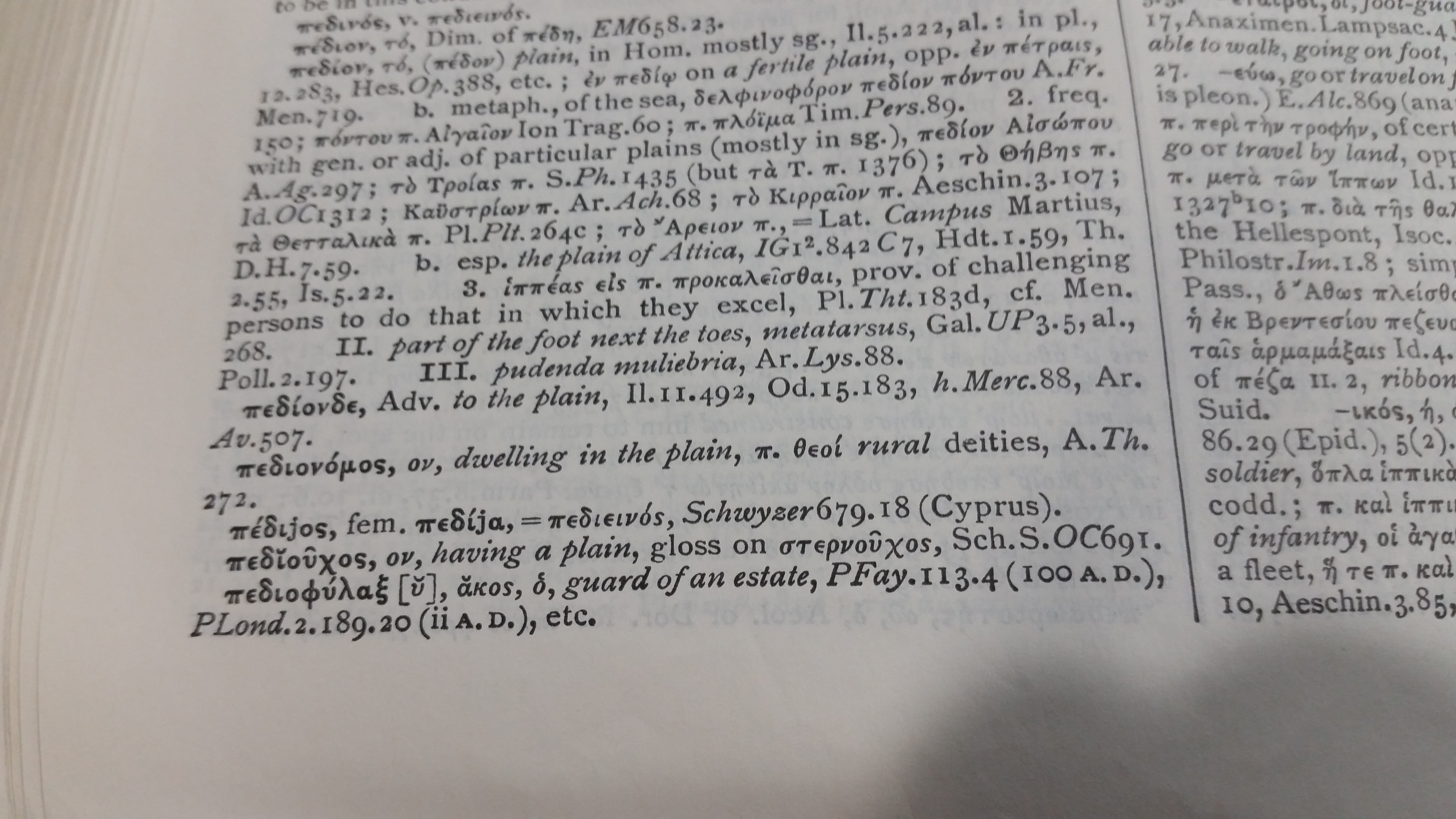
So next we look at the entry.
\= πεδιεινός
Now, if you happen to look up the page, you see πεδινός is also listed as equivalent to πεδιεινός. So it's also worth looking at πεδιεινός, which finally yields an actual gloss and meaning: *flat, level, of the plain*.
But back to πέδιjος. We clearly need to look at the source:
E. Schwyzer, *Dialectorum Graecarum exempla epigraphica potiora*, Leipzig 1923\. 679.18 (Cyprus).
Sadly this doesn't appear available online. A copy resides in my erstwhile institutional library, controlled by robots. But in this case an easier alternative is at hand, a more recent collection of Cypriot inscriptions (*Les Inscriptions chypriotes syllabiques*, O. Masson, Paris 1964 \[1985 with Addenda nova\]. And we are after 217, the Tablet of Idalion, B side, line 18, and [this can be accessed online](http://kyprioscharacter.eie.gr/en/scientific-texts/details/inscriptions/tablet-of-idalion-ics-217?ref=thepatrologist.com)! (This last sleuthing by none other than J. Tauber again).
So 217 B18 gives us the syllabic transcription *pe-ti-ja-i*, and the alphabetic transcription πεδίjαι
And so the j represents a consonantal iota preserved in Cypriot epigraphy, and there's no mistake in the betacode headword anyway. Thus we carry on. In my next installment of LSJ adventures, we shall discuss the mystery of the upside-down smiley face.
### Two Tiered Faculty as the product of Online Education Models
URL: https://thepatrologist.com/two-tiered-faculty-as-the-product-of-online-education-models/
Last updated: 2018-01-29T20:00:02.000Z
I suspect that one of the outcomes of current development of tertiary online education models, at least in the models I’m most familiar with (which is a few), will be an entrenchment of a divide between permanent faculty and the continued subsistence of an academic underclass of adjuncts.
I won’t go into the economic side of things so much in this post (I always simply feel bad because ‘at least this isn’t America’), as a different dimension.
The nature of online education delivery is that to a large extent you can create “content” that is delivered to students. Lectures/Readings/Material can all be pre-packaged for students to digest. That material, if done well, can be done once and left for several cycles of the course. Do it well enough, and the length of its ‘digital lifetime’ gets extended. Eventually, if you care about it being up to date in the field at all, and it will need revising.
Who gets to create this content? Primarily established academic staff who have a good deal of experience in teaching the course and can produce a quality course.
But any such course still needs human interaction, otherwise you’re not selling a course, you’re selling content to be delivered. Which is fine but it’s a different thing. Students don’t fare very well when you just give them ‘content’. They need learning activities, they need to engage with the material, discuss, do assignments, get feedback, and of course ‘get graded’ (do they?)
Who does that? Rarely the person who created the content. They are off doing other things, research included. Online courses are generally administered by casual academic staff, who do all those things: engage online with students, facilitate discussions, mark papers.
In many ways, this is simply the replication of a model of two-tiered academia that already exists in plenty of brick-and-mortar institutions, especially those with large classes. Tutors/TAs do the grunt work, faculty do the lecturing. So it’s not new, but online exacerbates that division.
It makes it worse because the only people creating content are older, established academics, and those employed casually as tutors (a) do not gain teaching experience per se, because they are not content creators, (b) are economically unable to effectively pursue research in the conditions of their employment because (i) they are not paid to research, (ii) the gap between full-time-hours as a casual academic and full-time hours as a full-time employ actually means there is no “casual loading” benefit to casual work.
It seems to me that the direction this heads in is, on the one hand, content driven more and more by older, established, and high-profile scholars, who increasingly have no need to interact with actual students. On the other, course delivery by lower paid, junior academics with insecure employment status who by the conditions of their employment may never be able to leave that class. That’s a two-tiered class system, and its long term effects on higher education will be deleterious.
### Digital Nyssa Project: From OCR to Plain Text
URL: https://thepatrologist.com/digital-nyssa-project-from-ocr-to-plain-text/
Last updated: 2026-07-15T22:58:04.000Z
So the first step in my project is getting from a print text to a digital text.
There are a few options for doing OCR. Bruce Robertson at Mt. Allison University is involved in [LACE: Greek OCR](http://heml.mta.ca/lace?ref=thepatrologist.com), a large scale project to produce high quality OCR of ancient Greek texts. But apart from submitting a request, this is not really scalable to personal use.
[Antigraphaeus](https://dcthree.github.io/antigrapheus/?ref=thepatrologist.com) allows you to do Greek OCR in your browser. It’s the child of [Ryan](https://twitter.com/ryanfb?ref=thepatrologist.com) [Baumann](http://ryanfb.github.io/?ref=thepatrologist.com), and basically instantiates online what I describe below.
[Ancient Greek OCR](https://ancientgreekocr.org/?ref=thepatrologist.com) provides a number of options (platform dependent) for using the Tesseract OCR engine trained for Ancient Greek. It’s the work of Nick White.
I followed the [instructions](https://ancientgreekocr.org/windows.html?ref=thepatrologist.com) to install and set-up [gImageReader](https://ancientgreekocr.org/windows.html?ref=thepatrologist.com) and found it pretty straightforward.
For a pdf input, I grabbed Patrologia Graeca 46 of Archive.org. I then created a pdf of only the pages I needed for *DDAE* (6), to save loading time. Here’s an image with the first page open, and about to click “Recognize” which will run the OCR process on the selection and output it to the sidebar on the right.
[](https://storage.ghost.io/c/c3/a0/c3a0413d-4382-4ac4-8466-79746977fc2a/content/images/2026/07/greekocr1-1.jpg?ref=thepatrologist.com)
It takes around 3 minutes to run a full page (well, half-page) of Migne. I cut and paste the results to a text editor so that I could save the result as a UTF-8 encoded .txt, rather than the default in the program which appears to generate an ANSI file (which is not useful).
[](https://storage.ghost.io/c/c3/a0/c3a0413d-4382-4ac4-8466-79746977fc2a/content/images/2026/07/greekocr1a-1.jpg?ref=thepatrologist.com)
Then I worked with pdf and text side by side to manually correct the OCR results. This is slightly laborious, and using some kind of editing process like Robertson has up on the Greek OCR Challenge page would probably speed this process.
[](https://storage.ghost.io/c/c3/a0/c3a0413d-4382-4ac4-8466-79746977fc2a/content/images/2026/07/greekocr2-1.jpg?ref=thepatrologist.com)
Instead, I did this:
[](https://storage.ghost.io/c/c3/a0/c3a0413d-4382-4ac4-8466-79746977fc2a/content/images/2026/07/greekocr3-1.jpg?ref=thepatrologist.com)
The general quality of the OCR was good, but it did need corrections. I’d love to speed up this process, because it takes me circa 10 mins to do a page.
So, 13 mins a page, 6 pages, looking at almost 80 mins work to do the OCR work to produce a corrected text. Then a bit of quick editing to remove line breaks and generate a single continuous text.
### Know/Don’t Know: the myth of binary knowledge in language learning.
URL: https://thepatrologist.com/know-dont-know-the-myth-of-binary-knowledge-in-language-learning/
Last updated: 2018-01-22T21:00:03.000Z
The other day I was in a conversation and couldn’t for the life of me retrieve the Gàidhlig word for “question”. All I could think of was *freagairt,* which is “answer”. I had to ask what it was. It’s *ceist*, of course. Duh. That’s a word I “know”, or “am meant to know.”
But the real question is never ‘do you know this “word/phrase/structure/chunk of language”?’ It’s always, ‘can you comprehend this chunk of language right at this instant, or produce this chunk in a way that effects communication?’
Which means the strongly binary model most of us inherit of language learning, which includes “Teacher taught word X, therefore student learnt word X” (wrong not just for languages, but for instruction in general), and “You memorised word X, therefore you know word X in all circumstances” or even “you once got X right on a multiple choice question, therefore you can actively recall X for communication production”, and so on – these are just wrong.
‘Knowing’ is a lot fuzzier. It’s a huge range of contextualised, circumstantial, bits and pieces that determine whether communication is going to take place in any particular instance, and how well a message is going to go from producer to receiver.
Which is why, at the end of the day, “vocab testing” is mere approximation. It’s testing, “can you on particular occasion X, recall particular word Y (actively? passively?) in particular context/decontext Z which may or may not bear much relation to any genuine language encounter?”
It’s also why we should basically ‘lighten up’ on students. “I taught you this” has no real place in a language teacher’s *teaching vocabulary* (except maybe as a joke?). Students don’t really need to feel shame/guilt/frustration at not knowing a chunk of language *in that moment*, they just need the minimum amount of help to make the utterance comprehensible, so they can get on with *getting meaning* and so acquiring language. And the next time they encounter, or need, “chunk X”, it will hopefully come a little easier. Or the next time. Or the time after that. Or however many times.
### Diary of a Digital Apprentice (2): First, a Unix tutorial
URL: https://thepatrologist.com/diary-of-a-digital-apprentice-2-first-a-unix-tutorial/
Last updated: 2018-01-18T22:00:05.000Z
([Here](https://thepatrologist.com/diary-of-a-digital-apprentice-1/) for the blog-series kick-off post).
We’re playing catch-up a little, and these are things I did in the tail end of 2017.
It’s been a long time since I’ve done anything with Unix. About 10 years, actually, and my unix experience was limited to running Ubuntu at the time and being forced to troubleshoot a lot of things mainly by googling answers. That was frustrating and satisfying at the same time. A memorable highlight was the time that my system switched to Ancient Greek at some fundamental level so that I couldn’t log in because it would only input Greek characters and it was not as simple as ‘change keyboard’.
Anyway, Jedi master Tauber decided I should learn to manipulate text files in Unix and set me the following tasks. You can [see them over here](https://jktauber.com/2017/12/24/some-unix-command-line-exercises-using-morphgnt/?ref=thepatrologist.com):
This is what I call “hunt”-learning. The teacher isn’t pushing, and the learner isn’t actively trying to pull things from the teacher, rather the teacher is setting up tasks which the learner must then go and problem-solve. I think there’s a lot to be said for such a method, and it works particularly well for something like this.
Also, by the end of 7 tasks, I had not only an appreciation for how to do these things, but a sense of both (a) the kinds of things that could be done just by manipulating appropriate data sets, (b) that so much is possible if you just have the data.
Of course, having the data, or having a text in an actionable form, is itself half the struggle.
If you’re a totally beginner like me, and want to follow through those 7 tasks, go ahead, and feel free to drop me a line if you get stuck. There’s lots I don’t know, but I know enough to hint you along the path.
### Project: Shepherding a text from print to digital
URL: https://thepatrologist.com/project-shepherding-a-text-from-print-to-digital/
Last updated: 2018-01-16T20:35:56.000Z
One of my projects for 2018 is to take a text and shepherd it, or curate it, all the way through an open source pipeline from 'print' to 'digital edition'. This is part of my 2018 year of digital humanities. Here I talk a little bit about the envisioned process.
The text I have in mind is quite short, just over 2000 words. It's Gregory of Nyssa's *De Deitate adversus Evagrium (in vulgo In suam Ordinationem*). I've done some work on *De Deitate Filii et Spiritus Sancti* and this will be a nice complement to that.
My checklist of things to do:
The Pipeline
Step 1: OCRing a print text
Step 2: Correcting the OCR output
Step 3: Create a TEI-XML version.
Step 4: PoS Tagging/Lemma tagging/Morph tagging
Step 5: Produce a translation
Step 6: Alignment
Step 7: Annotations and commentary
Then, voilá, open-sourced text freely available with useful data attached. Half of these things I don't actually know how to do yet. Maybe more than half. That's part of the fun. And, presuming it goes well, will make it a pilot project for future texts through a similar pipeline.
### Moving to project-based management: todoist and todo.vu
URL: https://thepatrologist.com/moving-to-project-based-management-todoist-and-todo-vu/
Last updated: 2018-01-14T22:00:17.000Z
Since my life/work balance, and my work/work balance, has become more and more fractured, I’ve felt the need to organise it more effectively. Last year I started using [todoist](http://todoist.com/?ref=thepatrologist.com), which I love because there’s nothing I quite enjoy as much as ticking off a to-do list, and todoist has a ‘karma’ counter built in that racks up meaningless numbers as you tick things off.
This week I’ve started trialing [todo.vu](https://todo.vu/?ref=thepatrologist.com), and I’m now kind of using the two in tandem. It’s helped mentally organise the things I do, and todo.vu includes time-tracking in it, which is really helpful for me.
So, this post is just kind of a run-down of how I’m organising things and using these tools.
todo.vu has a hierarchy of Clients > Projects > Tasks.
This isn’t ideal, but I’ve just adapted it as seems good. todoist has Projects and Tasks, but Projects are endlessly nestable (well, I’ve never gone past about 4). So this is aligning nicely.
My Clients list looks like this (And my top-tier todoist now mirrors it):
- Internal
- Self-Education
- (College)
- (2nd College)
- (3rd College)
- Academic Career
- Church
- Online Tutoring
- (A Business)
*Internal* was a pre-existing client, I’ve repurposed it for ‘life management’, whereas *Self-Education* is more specific educationally/professionally directed projects. The 3 colleges are institutions I do work for. Academic career is here I place things specifically academic: research papers, phd to monograph, etc.. *Online Tutoring* is self explanatory; if I were using this as a billing platform I’d create each person as a separate client, but since I don’t, I prefer this breakdown.
One of the things the whole schematisiation process helped me with was sorting through ‘recurring open-ended projects’ and ‘defined, goal-oriented projects’. For example, under Self-Ed I have separate project for “Latin studies”, “Greek studies”, “Gaelic studies”. These are all very open ended ‘projects’. Previously I had just set them as recurring tasks in todoist. Now, I’ve created individual Tasks for each component in todo.vu, e.g. reading Athenaze, working on a specific course, etc.. I can still set these as recurring tasks in todoist, (e.g. daily reading tasks), but it means I can log time on todo.vu, and when I finish an individual task, I can complete it while keeping the open-ended project going. So all book reading is also set up in the same fashion. Truly open-ended ongoing tasks, I’ll set on a year-by-year basis. For example, “Online Tutoring > Student 1 (2018)”, and just log hours against the task and close it at the end of the year. But, complementing this in todoist, I might also have “OT > Student 1 > this week’s prep” as an individual task.
I’m hoping that the net effect of this will be to give me greater awareness, control, and discipline over the disparate projects and tasks on my plate. That, combined with tools to limit/block-off various distractions, and here’s to a productive 2018\. (I’ll just set a reminder now to blog on this again in 6 months…)
### Diary of a Digital Apprentice (1)
URL: https://thepatrologist.com/diary-of-a-digital-apprentice-1/
Last updated: 2018-01-11T23:46:02.000Z
One of my goals for 2018 is to acquire a working skillset in areas of Digital Humanities. As I do so, I plan to blog regularly on that ‘mission’. In today’s post, I provide some context for the start of that journey.
I’d say I’ve long had a user-side interest in Digital Humanities. I’ve appreciated, and used, the considerable resources that things like Perseus, TLG, PHI, and other packages have presented. And I’ve always envisioned ‘more’ being possible. But, being relatively short on the technical side of things, DH has always been a bit of black-box wizardry to me.
A couple of years back I made the acquaintance, first digitally, of [James Tauber](https://jktauber.com/?ref=thepatrologist.com). Some of our initial overlap and discussion had to do with tools for language learning and teaching. We met briefly at AARSBL in 2015, and conversed a bit more since then. Another face to face meeting at AARSBL in 2017 helped solidify things and we have launched both some collaboration, but also some apprenticing.
That ‘looks like’ two things. Firstly, a combination of push-learning, pull-learning, and hunt-learning. Pull, where I ask, “how do we do X?” or “is Y possible?” and then get a crash course on how to make certain things happen. Or an explanation of “yes, Y is possible, look, Dr ABC has been working on this for umpteen years, see!”. Push-learning is where you learn things you didn’t know you could learn, e.g. “Hey, Seumas, did you know you can use E to accomplish F, G, and H!” And hunt-learning is when James says something like, “Seumas, figure out how to do M, N, O, and P, and then tell me how you did it or when you get stuck.”
Part of this relates to the work that Eldarion is doing on developing the Scaife Viewer for Perseus. Which is incredibly exciting because (a) Perseus! (b) have you seen the Scaife Viewer demo’d? (c) it’s great to see inside the black-box so to speak, to see how something like this gets developed and figure out how it works.
Another side of it is my digital Nyssa project for the year.
“Digital Nyssa” is my project to curate/shepherd a text ((initially just one, but maybe more)) through an open, free, digital pipeline from print to digital edition. It’s both a means of acquiring practical DH skills across a range of tools (OCR, TEI-XML marking, PoS and morph tagging, digital edition creation and then commentary/annotation/translation). You’ll be hearing more about it as the year goes on, and I’ll outline a little bit more next week.
So, each week I’ll be posting up a bit of what I’ve been doing/learning/working on, as part of a bigger project to self-document the learning process for myself, and hopefully encourage others that DH is not so scary. The first few weeks will play some catch-up too on things over the past few weeks.
### Translation is not meaning
URL: https://thepatrologist.com/translation-is-not-meaning/
Last updated: 2018-01-09T22:00:06.000Z
One of the downsides of training students to translate in order to understand, is that they very often develop the erroneous notion that translation *is* meaning. "The meaning of Greek word X is English word Y", or slightly more complex versions of the same.
No, no, no.
Greek (or whatever language) means what it means, with reference to Greek, with reference to reality, with reference to its referents. Sure, I can concede that "Greek X means English Y" is sometimes just shorthand for "English Y is a suitable translation of Greek Y in this context", but very often it's not, it's shorthand for "Greek X really means English Y, why didn't they just write in English in the first place and make my life easier."
Don't fall for the trap. Figure out meaning first, then figure out *how to render that meaning* in your other language. That's what translation is.
(I'm going to start trying to micro-blog more language/Greek/Latin/etc. mini-posts like this)
### Can you teach a language with no native speakers via ‘immersion’?
URL: https://thepatrologist.com/can-you-teach-a-language-with-no-native-speakers-via-immersion/
Last updated: 2018-01-03T23:00:02.000Z
A question I was asked recently on twitter.
Yes, but it depends what you mean by ‘immersion’ and what you think the goal is.
I don’t normally use the term ‘immersion’, because that normally, strictly, pertains to a method that involves full-time immersion in a language, so all day, all week. That’s simply not possible long-term, unless we set up little Latin-speaking (or Attic, or etc) villages. I suppose immersion is possible in short term venues like the SALVI Rusticationes
The goal, I would think, is also not to produce a new native speaking community. Though that is theoretically possible. See, the revival of Hebrew as a modern language, and also revival efforts of indigenous languages. But that’s not our goal for historical languages. If we revived a whole community of Latin speakers or Attic speakers, and allowed them to ‘continue on’ as a community and the language evolved, we would miss the point of learning ‘Latin’ or ‘Attic’, or ‘Koine’.
But there’s nothing *inherent* in Latin, or Koine, or Biblical Hebrew, that means they can’t be learnt as active, communicative languages. There’s nothing inherent in them that means people can’t become competent second-language speakers of these languages.
There’s a pedagogical challenge – how do you get people to this level, if few people are *at* that level? I think this requires careful research and considered pedagogy. We ought to take due effort to make sure that we are teaching language that is correct, as correct as possible, to what we know of the historical corpus. And we should recognise that teaching Ciceronian Latin, or Demosthenic Greek, or the like, *is* an artificiality. But it’s an artificiality that we already embrace in other methods anyway, and an artificiality that is desirable to the extent that we want people to read those kinds of texts and discuss those kinds of texts.
In terms of pedagogy, it’s about learning, and then using, those pieces of acquired language confidently and correctly. And perhaps the humility to say, “Well, I don’t know how to say X, Y, Z, let’s research together and get it right.”
### Grammar/Translation, Communicative methods, and comparisons…
URL: https://thepatrologist.com/grammar-translation-communicative-methods-and-comparisons/
Last updated: 2018-01-01T23:00:07.000Z
This is me picking up some pieces and adding nuance to one of my usual hobby horses, that is communicative approaches to ancient/classical/historical languages.
1. Does Grammar/Translation ‘work’?
I think this partly depends upon what we mean by ‘work’. My main interest is developing students who can read effectively in their second language – without translating in order to understand, and mentally operating in the second language.
I don’t think G/T normally produces this for most students, or even most students who respond well to G/T. It seems to me that G/T produces primarily students who translate *in order to understand* (as opposed to translating messages they have already understood). I don’t deny, that some long-time practitioners of G/T end up being very competent readers. I’ll get back to that below.
1. Are communicative methods better than grammar/translation?
It’s hard to make a proper comparison, because really this requires a controlled, data-driven study in Second Language Acquisition, and while there is obviously some work going on, on that question, I have yet to read a full-blown comparative study on the question.
However, everything I’ve seen in SLA suggests that G/T isn’t ‘the way to go’. And given that G/T dates back about 200 years, and has been largely abandoned in modern language programs, and the contrast between G/T products and modern language programs, I think we need to consider that pound for pound, G/T is not the best method.
1. Is it far to compare seminary programs with classics programs?
No, not really. But that’s because a typical seminary program fits Greek grammar into a single year, and then (if you’re fortunate enough to have a robust program) 2-3 years of New Testament texts in Greek. This is ¼ to 1/6 of a program. And it’s focused on intensive, not extensive, reading; on analysing texts at a micro-level and exegeting for meaning; on accessing technical discussions at a verse-by-verse level.
A classics program is 3-4 years of language and literature in that language. If it’s a traditional classics program, that’s at best a 50/50 split (if you do nothing but lang and lit in Greek/Latin). Having done a full Latin sequence, I have a fair idea of what that looks like and produces. Yes, classics produces better readers, but largely because it’s a *lot* more exposure to texts in the target language.
And this, I’d contest, is ultimately why G/T produces readers – not a superiority of method per se. Translating *is* a way of making a target language message comprehensible, and sheer volume of comprehensible input is what produces language acquisition over time. G/T will do that. I’m just not convinced it does that as effectively as it could.
My main push-back to G/T is driven by the fact that G/T has this “grip” on both classics educators, and biblical language instructors. There’s a conservatism that thinks G/T is (a) the way it’s always been, and (b) the tried and true method, that (c) ancient languages are ‘different’ and cannot be taught communicatively, (d) etc., etc..
I have plenty of appreciation for grammar, for translation, for G/T methods, but I have no appreciation for traditionalist views that are ignorantly dismissive of alternatives, and critiques, of G/T.
### Lemma vs. Token frequency in John's Gospel
URL: https://thepatrologist.com/lemma-vs-token-frequency-in-johns-gospel/
Last updated: 2017-12-29T00:00:30.000Z
In this post I discuss, in brief and embryonic form, the difference between lemma and token frequencies for John's Gospel. At the bottom of this post you'll find an unwieldy table. I haven't quite figured out a good way to do tables.
Anyway, these days I'm doing lots of thinking about language teaching, reading and text based approaches, etc. etc.. And I thought it would be useful for my super-baby-coding skills to pull up a list of words in John's Gospel sorted by frequency, both the lemmata, and the actual instances. That's what's on the table at the bottom (only covering the 100 most frequent lemmata, and then the 100 most frequent tokens sorted accordingly). The left-most two columns are frequency and lemma, and all the columns to the right of that are tokens.
About 5 words down things get interesting. It's much more useful to learn εἶπεν and εἶπον than filling out the Pres.Act.Ind. paradigm of λέγω. Similarly, the two highest frequency forms of εἰμί are ἐστίν and ἦν. σύ is the most interesting, because it's two highest tokens are actually the plural, which looks nothing like σύ. ἔρχομαι is also interesting, because I actually thought its aorists forms would turn up with higher frequency, but it's ἔρχεται that is the star performer in John.
There's much more to be done, but since I was messing around with this, I thought it would make a good little post between Christmas and New Year.
| Freq | Lemma | Freq | Token | | | | | | | | | | | | | | | | | | | | | | | | | | |
| ---- | ----------- | ---- | -------- | --- | -------- | --- | ------ | --- | ------ | --- | ------ | --- | ----- | --- | ---- | --- | -- | --- | --- | -- | --- | -- | -- | -- | -- | -- | ---- | -- | ---- |
| 2159 | ὁ | 557 | ὁ | 242 | τοῦ | 240 | τόν | 145 | τό | 141 | οἱ | 140 | τήν | 120 | ἡ | 112 | τῷ | 107 | τῶν | 82 | τῆς | 82 | τά | 72 | τῇ | 55 | τούς | 37 | τοῖς |
| 813 | καί | 813 | καί | | | | | | | | | | | | | | | | | | | | | | | | | | |
| 751 | αὐτός | 171 | αὐτόν | 170 | αὐτῷ | 169 | αὐτοῦ | 99 | αὐτοῖς | 34 | αὐτῶν | | | | | | | | | | | | | | | | | | |
| 507 | ἐγώ | 129 | ἐγώ | 102 | μου | 99 | με | 40 | ἐμέ | 39 | μοι | 29 | ἐμοί | 26 | ἐμοῦ | | | | | | | | | | | | | | |
| 473 | λέγω | 122 | λέγει | 112 | εἶπε(ν) | 40 | εἶπον | 36 | λέγω | 34 | ἔλεγον | 26 | εἶπαν | | | | | | | | | | | | | | | | |
| 443 | εἰμί | 166 | ἐστί(ν) | 96 | ἦν | 54 | εἰμί | 26 | εἶ | | | | | | | | | | | | | | | | | | | | |
| 406 | σύ | 103 | ὑμῖν | 68 | ὑμεῖς | 60 | σύ | 47 | ὑμῶν | 37 | ὑμᾶς | 29 | σου | 23 | σοι | | | | | | | | | | | | | | |
| 279 | οὐ | 279 | οὐ | | | | | | | | | | | | | | | | | | | | | | | | | | |
| 270 | ὅτι | 270 | ὅτι | | | | | | | | | | | | | | | | | | | | | | | | | | |
| 239 | Ἰησοῦς | 193 | Ἰησοῦς | 26 | Ἰησοῦν | | | | | | | | | | | | | | | | | | | | | | | | |
| 237 | οὗτος | 61 | ταῦτα | 52 | τοῦτο | 49 | οὗτος | | | | | | | | | | | | | | | | | | | | | | |
| 220 | ἐν | 220 | ἐν | | | | | | | | | | | | | | | | | | | | | | | | | | |
| 201 | δέ | 201 | δέ | | | | | | | | | | | | | | | | | | | | | | | | | | |
| 197 | οὖν | 197 | οὖν | | | | | | | | | | | | | | | | | | | | | | | | | | |
| 182 | εἰς | 182 | εἰς | | | | | | | | | | | | | | | | | | | | | | | | | | |
| 165 | ἐκ | 165 | ἐκ | | | | | | | | | | | | | | | | | | | | | | | | | | |
| 159 | ὅς | 38 | ὅ | 36 | ὅν | 30 | ἅ | | | | | | | | | | | | | | | | | | | | | | |
| 155 | ἔρχομαι | 38 | ἔρχεται | | | | | | | | | | | | | | | | | | | | | | | | | | |
| 144 | ἵνα | 144 | ἵνα | | | | | | | | | | | | | | | | | | | | | | | | | | |
| 136 | πατήρ | 51 | πατήρ | 37 | πατέρα | 27 | πατρός | | | | | | | | | | | | | | | | | | | | | | |
| 118 | μή | 118 | μή | | | | | | | | | | | | | | | | | | | | | | | | | | |
| 110 | ποιέω | | | | | | | | | | | | | | | | | | | | | | | | | | | | |
| 102 | ἀλλά | 102 | ἀλλά | | | | | | | | | | | | | | | | | | | | | | | | | | |
| 100 | πρός | 100 | πρός | | | | | | | | | | | | | | | | | | | | | | | | | | |
| 98 | πιστεύω | | | | | | | | | | | | | | | | | | | | | | | | | | | | |
| 86 | ἔχω | | | | | | | | | | | | | | | | | | | | | | | | | | | | |
| 83 | θεός | 46 | θεοῦ | | | | | | | | | | | | | | | | | | | | | | | | | | |
| 80 | οἶδα | | | | | | | | | | | | | | | | | | | | | | | | | | | | |
| 79 | τίς | 47 | τί | | | | | | | | | | | | | | | | | | | | | | | | | | |
| 78 | μαθητής | 36 | μαθηταί | | | | | | | | | | | | | | | | | | | | | | | | | | |
| 78 | κόσμος | 26 | κόσμου | 23 | κόσμον | | | | | | | | | | | | | | | | | | | | | | | | |
| 78 | ἀποκρίνομαι | 57 | ἀπεκρίθη | | | | | | | | | | | | | | | | | | | | | | | | | | |
| 75 | δίδωμι | | | | | | | | | | | | | | | | | | | | | | | | | | | | |
| 72 | ὁράω | | | | | | | | | | | | | | | | | | | | | | | | | | | | |
| 71 | Ἰουδαῖος | 30 | Ἰουδαῖοι | 25 | Ἰουδαίων | | | | | | | | | | | | | | | | | | | | | | | | |
| 70 | ἐκεῖνος | 39 | ἐκεῖνος | | | | | | | | | | | | | | | | | | | | | | | | | | |
| 67 | περί | 67 | περί | | | | | | | | | | | | | | | | | | | | | | | | | | |
| 64 | πᾶς | | | | | | | | | | | | | | | | | | | | | | | | | | | | |
| 64 | γάρ | 64 | γάρ | | | | | | | | | | | | | | | | | | | | | | | | | | |
| 59 | λαλέω | | | | | | | | | | | | | | | | | | | | | | | | | | | | |
| 59 | ἐάν | 59 | ἐάν | | | | | | | | | | | | | | | | | | | | | | | | | | |
| 59 | διά | 59 | διά | | | | | | | | | | | | | | | | | | | | | | | | | | |
| 59 | ἄνθρωπος | 22 | ἄνθρωπος | | | | | | | | | | | | | | | | | | | | | | | | | | |
| 58 | ἀκούω | | | | | | | | | | | | | | | | | | | | | | | | | | | | |
| 56 | τις | 31 | τὶς | | | | | | | | | | | | | | | | | | | | | | | | | | |
| 56 | γινώσκω | | | | | | | | | | | | | | | | | | | | | | | | | | | | |
| 55 | μετά | 55 | μετά | | | | | | | | | | | | | | | | | | | | | | | | | | |
| 54 | υἱός | 26 | υἱός | | | | | | | | | | | | | | | | | | | | | | | | | | |
| 51 | οὐδείς | 26 | οὐδείς | | | | | | | | | | | | | | | | | | | | | | | | | | |
| 51 | κύριος | 32 | κύριε | | | | | | | | | | | | | | | | | | | | | | | | | | |
| 51 | γίνομαι | | | | | | | | | | | | | | | | | | | | | | | | | | | | |
| 50 | ἀμήν | 50 | ἀμήν | | | | | | | | | | | | | | | | | | | | | | | | | | |
| 49 | εἰ | 49 | εἰ | | | | | | | | | | | | | | | | | | | | | | | | | | |
| 45 | λαμβάνω | | | | | | | | | | | | | | | | | | | | | | | | | | | | |
| 43 | πάλιν | 43 | πάλιν | | | | | | | | | | | | | | | | | | | | | | | | | | |
| 41 | πολύς | | | | | | | | | | | | | | | | | | | | | | | | | | | | |
| 41 | ἐμός | | | | | | | | | | | | | | | | | | | | | | | | | | | | |
| 40 | μένω | | | | | | | | | | | | | | | | | | | | | | | | | | | | |
| 40 | λόγος | | | | | | | | | | | | | | | | | | | | | | | | | | | | |
| 40 | ἀπό | 40 | ἀπό | | | | | | | | | | | | | | | | | | | | | | | | | | |
| 38 | εἷς | | | | | | | | | | | | | | | | | | | | | | | | | | | | |
| 37 | δύναμαι | | | | | | | | | | | | | | | | | | | | | | | | | | | | |
| 37 | ἀγαπάω | | | | | | | | | | | | | | | | | | | | | | | | | | | | |
| 36 | ζωή | 23 | ζωήν | | | | | | | | | | | | | | | | | | | | | | | | | | |
| 34 | Πέτρος | 23 | Πέτρος | | | | | | | | | | | | | | | | | | | | | | | | | | |
| 34 | παρά | 34 | παρά | | | | | | | | | | | | | | | | | | | | | | | | | | |
| 34 | ζητέω | | | | | | | | | | | | | | | | | | | | | | | | | | | | |
| 33 | μαρτυρέω | | | | | | | | | | | | | | | | | | | | | | | | | | | | |
| 33 | ἐπί | 33 | ἐπί | | | | | | | | | | | | | | | | | | | | | | | | | | |
| 32 | ὑπάγω | | | | | | | | | | | | | | | | | | | | | | | | | | | | |
| 32 | πέμπω | | | | | | | | | | | | | | | | | | | | | | | | | | | | |
| 32 | ἄλλος | | | | | | | | | | | | | | | | | | | | | | | | | | | | |
| 31 | καθώς | 31 | καθώς | | | | | | | | | | | | | | | | | | | | | | | | | | |
| 31 | ἡμέρα | | | | | | | | | | | | | | | | | | | | | | | | | | | | |
| 30 | ὡς | 30 | ὡς | | | | | | | | | | | | | | | | | | | | | | | | | | |
| 30 | ὅπου | 30 | ὅπου | | | | | | | | | | | | | | | | | | | | | | | | | | |
| 30 | κἀγώ | 27 | κἀγώ | | | | | | | | | | | | | | | | | | | | | | | | | | |
| 30 | ἑαυτοῦ | | | | | | | | | | | | | | | | | | | | | | | | | | | | |
| 29 | ἐξέρχομαι | | | | | | | | | | | | | | | | | | | | | | | | | | | | |
| 28 | νῦν | 28 | νῦν | | | | | | | | | | | | | | | | | | | | | | | | | | |
| 28 | ἀποστέλλω | | | | | | | | | | | | | | | | | | | | | | | | | | | | |
| 28 | ἀποθνῄσκω | | | | | | | | | | | | | | | | | | | | | | | | | | | | |
| 27 | ἐρωτάω | | | | | | | | | | | | | | | | | | | | | | | | | | | | |
| 27 | ἔργον | | | | | | | | | | | | | | | | | | | | | | | | | | | | |
| 26 | ὥρα | | | | | | | | | | | | | | | | | | | | | | | | | | | | |
| 26 | ἄν | 26 | ἄν | | | | | | | | | | | | | | | | | | | | | | | | | | |
| 26 | αἴρω | | | | | | | | | | | | | | | | | | | | | | | | | | | | |
| 25 | Σίμων | | | | | | | | | | | | | | | | | | | | | | | | | | | | |
| 25 | ὄνομα | | | | | | | | | | | | | | | | | | | | | | | | | | | | |
| 25 | ἀλήθεια | | | | | | | | | | | | | | | | | | | | | | | | | | | | |
| 24 | πνεῦμα | | | | | | | | | | | | | | | | | | | | | | | | | | | | |
| 24 | θεωρέω | | | | | | | | | | | | | | | | | | | | | | | | | | | | |
| 24 | ἄρτος | | | | | | | | | | | | | | | | | | | | | | | | | | | | |
| 23 | φῶς | | | | | | | | | | | | | | | | | | | | | | | | | | | | |
| 23 | Ἰωάννης | | | | | | | | | | | | | | | | | | | | | | | | | | | | |
| 23 | θέλω | | | | | | | | | | | | | | | | | | | | | | | | | | | | |
| 23 | δοξάζω | | | | | | | | | | | | | | | | | | | | | | | | | | | | |
| 22 | ἐκεῖ | 22 | ἐκεῖ | | | | | | | | | | | | | | | | | | | | | | | | | | |
| 21 | ὕδωρ | | | | | | | | | | | | | | | | | | | | | | | | | | | | |
| 21 | ὅτε | | | | | | | | | | | | | | | | | | | | | | | | | | | | |
### A language-learning autohistoria
URL: https://thepatrologist.com/a-language-learning-autohistoria/
Last updated: 2017-12-27T00:00:49.000Z
In today's post I rambling self-reflect on my history as a language learner. I don't suppose that has a broad appeal as a topic of interest, but if you already know me, you might find it of interest. I sat down to write this out as part of a kind of "patient history" to diagnose where I'm "at" in this lifelong process.
### High School
This was my first exposure to learning languages. In our years 7 & 8 we did 5 languages in rotation: French, German, Italian, Spanish, and Japanese. I was good at all of them, except German and that was mainly because (as I distinctly recall), they held a test on adjectives the day I returned from a bout of illness and I simply hadn’t been taught the content we were tested on.
I went on to pursue Japanese in years 9-12 and sitting the exams for the HSC. I think I was a fairly average student at it, but I didn’t have a real sense of language possibilities beyond the classroom.
### Forays
post high school included some attempt to learn Spanish from some independent course materials. My first purchase of “Teach Yourself Gaelic”, and a bit of Latin from Wheelock’s grammar. None of these led much of anywhere.
## Spanish
In 2002 I took a trip to Guatemala and spent a couple of weeks in 5hrs a day, 5 days a week language instruction. Spanish seemed relatively easy, grammatically, to pick up, and I progressed rapidly. I was only in central America for about 2-3 months, but I learnt enough Spanish to manage daily interactins, and even to start reading ‘Interview with a vampire’ in Spanish. This language ability mostly dissipated once I cam back to Australia, not least because I had nobody, and no reason, to maintain it.
### Latin
In 2003 I enrolled in a Graduate Diploma of Humanities at the University of New England. the GDH required 8 units at post 100-level, and I had enrolled to study Latin, which meant 2 units at 100 level and then a further 8\. UNE, being based in Armidale, was a pioneer in distance ed in Australia, and this was fairly true for Latin. My instructor was the larger-than-life Charles Tesoriero (1973-2005), and instruction took place via course materials that he had prepared, with us mailing in 6 assignments a semester, and longer essays, and exams. In the middle of each semester was a residential intensive, which was optional, but encouraged. It was a real delight, though, to travel up to Armidale and spend 2 weeks with Charles and my fellow students. I proceeded through all the Latin units with Distinctions and High Distinctions. I took a single 2nd year subject in Greek, as well as a prose composition unit with Paul Roche.
### Greek
In 2001 I took a course of self-directed study towards a Licentiate in Theology, including the equivalent of first-semester Greek. This basically involved me studying Mounce’s *Basics of Biblical Greek* on my own, and sitting an exam. I did quite well, though not well enough to read Greek by myself. I was good on nouns, not so good on verbs (probably because Mounce delays them fairly late in his book). In 2003, while studying Latin, I also decided to go to seminary, and started meeting with a pastor at my church to do some Greek.
All of which put me in good stead when I went to seminary in 2004\. I was enough ahead of the curve for NT Greek that I breezed through first-year. I learnt vocab through electronic flash cards, brute-forcing my way down very low on the frequency list. I blitzed grammar, and aced exams.
### Hebrew
So, between 2004-2006 I was simultaneously taking Latin, Greek, and Hebrew courses. Hebrew I did fine at, but I was never a top student. I perhaps could have been, but I was doing too much. Indeed, I took on an additional external subject in Mandarin at one stage, attempting a full seminary load plus a 75% university load. I passed intro Mandarin, but did not continue.
### 2006-7: a turning point
In 2006 I finished up by GDH in Latin, and I was pretty deep into my NT studies, and pretty decent at Greek. I had begun listening to the early Latinum podcasts by Evan Millner, and reading and learning from discussions among Latin teachers online like Bob Patrick, John Piazza, Ginny Lindzey. This in turn led me to Ørberg’s Lingua Latina, and a fundamental question – why after 4 years of university Latin, did I still struggle to do anything more than translate with a dictionary in hand, and students of Modern Languages *read* their literature and *discussed it* in the target language? I began to read more and more in the area of Second Language Acquisition, and lean more and more towards ‘communicative methods’ (my usual term for what people call a whole range of things).
I became a ‘convert’ to Ørberg and started reading Familia Romana first of all. I likewise explored Randall Buth’s materials, and began trying to boot-strap my way into a better language proficiency.
In 2007, while in my final year of seminary, I also started (in theory) an MA in Classics as U. Sydney. That never became an MA, because a coursework MA there was terribly disorganised at the time. I enrolled in subjects that only existed in the system, only to turn up and be told no such class existed. I ended up taking 4 subjects – a classical Greek course, a historiography course, and 2 more Latin reading subjects, and then exiting with a Graduate Certificate. Not wasted learning, but perhaps not the most efficient use of my time.
### 2008-2011
During the next four years, my language studies continued relatively informally. I was still doing some formal Latin stuff in the first year at U.Sydney, and I did work on an MTh with a fair amount of Greek involved (Matthew, John, Revelation, and Chrysostom).
Thanks to summer and winter intensive schools, I did short courses in Latin and Greek most years, and had a chance to take some Gaelic in person. This really kicked-off my long dormant interest. I enrolled in online classes with the Atlantic Gaelic Academy, which were 3-hr group classes. Largely grammar-translation driven, but with much more oral participation than I’d have previously. I ended up taking 3 years with them, and it moved me from ‘grammar aware novice’ to ‘intermediate who doesn’t speak enough’. In 2011 I then moved to some private online classes, which weren’t bad but I was less than satisfied with the person who delivered them (he didn’t use a webcam and didn’t sound that engaged with me, and it seemed that he ‘counted’ some of our classes as being done even when cancelled (even when cancelled on his end).
I also had chances to tutor/facilitate Latin, and Greek, in a few small contexts. All in all, though, it was mostly self-directed studies and ongoing learning. I got better at reading, though slowly.
### 2012-2014
Mongolian adventures! In 2012 I moved (with my wife) to Mongolia. In the first year, I studied 1 to 1 with an experienced Mongolian language teacher, 4-5 hours a day, 5 days a week (incidentally, this was also the first year of my PhD enrolment…). Although she had a textbook (written by herself), which a grammatical ‘bent’ (but not ‘grammar-translation’, thank God), the instruction was guided by the teacher, not the book. Actually, there were three instructors in our small school, and we would cycle between them. The head of school spoke decent English, and would start with beginners. The second spoke very basic English, the third barely above none.
So classes became Mongolian-only after about a week, and my fairly extensive knowledge of grammar across languages and basic linguistics helped me figure out a lot of things ‘going on in the background’. I learnt a lot in those classes, and progressed quite well.
In 2013 I started teaching, initially part-time (and still doing part-time language). I taught 2 classes to begin with, one with translator, but the other entirely on my own. Thankfully, I had a few students with excellent English, because I did often need in-class translation. Our class was Greek exegesis, and this made it relatively easier than it could have been – I knew the Greek text well, I had a Mongolian text to refer to, and I acquired the sub-field of ‘Mongolian grammar terms’ fairly extensively. All my exegesis classes were solo-taught, and by the 3rd semester in I felt pretty confident with that.
Moving into teaching, part-time, and then full-time, put me into an immersed environment, and my spoken Mongolian improved strongly. It was, however, pretty tiring operating in a foreign language most of the day. Highlights for my Mongolian were eventually preaching a number of times in Mongolian, and taking a mission trip with a group of students into the countryside.
Meanwhile, I kept on with other languages in various ways. I took another AGA Gaelic class at an advanced level. I started working on a literal translation of Familia Romana into Greek. I discovered the Conversational Koine Institute and did a sequence of 5 courses with Halcomb. Christophe Rico’s Polis book first appeared, and I began to be interested in his work. Where are your Keys came to my attention, and I first trialled that approach with a group of Korean high schoolers (the idea of Korean high schoolers taking a summer trip to Mongolia to practice English remains odd to this very day), and I started work on Patristic Readers.
### 2015-2017
At the end of 2014 we returned to Australia more permanently, so that I could work on completing my PhD. This led to a few developments in my language learning. I started teaching summer and winter intensive weeks in Koine literature. That gave me a context for teaching texts at a high level and expanding some of my own reading. I started dong Gaelic sessions online (individually, and with a chat group). I also took on a role providing ‘tutor support for tutors’ in a local seminary, helping to provide training support for those who are working with struggling Greek students. I took on a number of jobs as a private tutor, mostly online, teaching Mongolian, Latin, and classical Greek. These have all been useful to me as a teacher, but also in reflecting on pedagogy. One of the things I’ve struggled with is how to do ‘communicative’ methods via webcam. I’ve dabbled in teaching some basic Greek via WAYK, and some Gaelic too.
So here I am at the end of 2017\. I’m finally (in my life) looking at the chance to teach an intro Greek class, and get some classroom experience putting communicative approaches into practice. I’m still looking to develop my online-tutoring practices. I want to improve my own reading, and active/communicative abilities in Greek, Latin, and Gaelic (with some interest in improving Mongolian, French, German as well).
### The Pilot and the Mechanic
URL: https://thepatrologist.com/the-pilot-and-the-mechanic/
Last updated: 2017-12-21T23:00:22.000Z
(These are some notes I am drawing up for an Intro Greek class; the proximate source the analogy is Mike Aubrey over at [koine-greek.com](http://koine-greek.com/?ref=thepatrologist.com). It's a very versatile analogy, when you put it to use; like all analogies, it has points of dis-analogy though.
Welcome to flight school! Before we get going in learning Greek, I want to talk about two *type* of learning, and the type of approach we’ll be taking in this course.
Languages are incredibly interesting things, and they can also do incredibly useful things. In this way, a language is a bit like a plane. Planes can fly, which is amazing, but it’s also what they were designed to do.
When it comes to *learning* a language, what do we mean? Researchers in the area of Second Language Acquisition (that is, learning any language that you did not learn by growing up with it from childhood) distinguish between (a) learning a language, and (b) learning *about* a language.
The first is actually acquiring the ability to use a language – to speak/hear/read/write the language. Many of you may know several language like this. Most of us learnt our first language like this. This is language **acquisition**.
The second is learning about how a language works. That is, things like grammar (the rules governing a language), or more broadly linguistics (the scientific analysis of language). This is language **learning**.
These two things are not the same. They are related, they can influence each other, but they don’t lead to each other directly. Language acquisition is like going to flight school, and language learning or Grammar, is like going to mechanical school.
A pilot knows how to fly a plane. They can take it up in the air and control it. They may not even really understand how their plane *works* on the inside, but they know how to fly it. So too with languages – people speak, read, understand, all the time, often without knowing how their language ‘works’, indeed they can even have *lots of wrong ideas* about how their language works, and still use it perfectly well.
A mechanic knows how the plane works. They understand the pieces, how they fix together, how it all functions. That’s a lot like being a linguist – a trained linguist understands how languages work, and often in detail how a particular language or group of languages works. They don’t need to speak those languages (and very often don’t!). But they might! A mechanic might also know how to fly a plane, but that’s not what it takes to be a mechanic. A pilot might learn about the mechanics of their plane, which is really helpful, but not the same as flying.
##### Pilots, Mechanics, and You.
A lot of ancient languages, including Koine Greek, have traditionally been taught using the ‘mechanic’ approach, for various reasons. This tends to produce people who are successful at analysing Greek passages. It is a very slow way of producing people who can read and understand Greek texts.
I take it that our goal here is primarily two-fold:
- to learn to read Greek well enough to read the New Testament with some degree of fluency and ease (and other Koine literature).
- to learn to analyse Greek in order to talk *about* the grammar of texts, and to interact with scholarly work on the New Testament (and other Koine literature).
The first is a *flying* goal, the second is a *mechanical* goal. You might lean more towards one or the other, you might find one or the other easier. You might find one or the other intimidating. Those are perfectly normal and fine reactions to have.
In this course, then, I’m trying to both teach you to fly, and teach you the mechanics of how planes work. That is, I’m going to be trying to teach you to understand Koine Greek as a proper, living language that you can not only read, but speak/hear/write a little bit (though our focus in the end will be reading). I’ll also be teaching you the nuts and bolts of how Greek works.
I expect that most of you want to be better pilots, and if you've ever studied an ancient language, I also expect that you think studying mechanics is the way to get there. That's the biggest myth I want to dispel today - studying the blueprints of a plane does very little to help you fly it. So, too, the rate of return on studying grammar to understanding a language fluently is marginal. Not zero, but definitely not high.
### Some reflection on Sanders and Swain's "Retrieving Eternal Generation"
URL: https://thepatrologist.com/some-reflection-on-sanders-and-swains-retrieving-eternal-generation/
Last updated: 2017-12-18T21:53:13.000Z
I didn’t realise we needed to retrieve this doctrine until I picked up this book, despite all the blogosphere hullabaloo in 2016 about trinitarian doctrine and complementarian theologies in evangelical circles. And yet, as the editors, Fred Sanders and Scott R. Swain, put forward in their introduction, the doctrine has suffered neglect in recent years, and in some cases, been rejected.
The book falls into three parts, treating biblical, historical, and systematic concerns. In this review I offer reflections, and some engagement, chapter by chapter.
**Part 1**
Chapter 1 (**Scott R. Swain**) offers us a lucid treatment of how divine names (and especially Father-Son) treated in light of analogical relations (creature-creature, Creator-creature, and Divine Father-Divine Son) properly attenuated, illumine the dynamic of the Father-Son relationship, by establishing a pattern of “(1) two relatives, (2) the activity of one relative that defines the relationship between the two relatives, and (3) a similarity that obtains between the two relatives” (40-41). In doing so, Swain offers a sharp and perceptive entrée into the rest of the volume.
Chapter 2 (**Matthew Y. Emerson**) revisits the biblical locus of Proverbs 8, the venerable site of so much conflict in the fourth and fifth century debates. His treatment gives a solid overview of patristic interpretation, though it perhaps suggests more uniformity than is strictly accurate by highlighting commonalities and failing to explore differences. For example, we lack any mention of Chrysostom, who seems to take a non-Christological reading. Or, perhaps more forcefully, despite relying on DelCogliano’s important article on Basil’s understanding, one could be left thinking that Basil was more definitive on the passage than he actually is. Nonetheless, Emerson rightfully leads us on to consider the very different shape of modern interpretations, before moving into systematic considerations. It is this interplay of systematic that seems to lead Emerson back to arguing that the patristic reading of Proverbs 8 ought to be (at least partly) normative. Stronger, though, is Emerson’s pointed barb that modern denials of eternal generation as ‘lacking biblical warrant’ tend to evince a hermeneutic more akin to Arius and his ilk, than the pro-Nicenes.
Chapter 3 (**Mark S. Gignilliat**) leads us in a similar vein to Micah 5.2, considering to some extent ancient and modern interpretation, but this time setting our historical compass for the engagement between John Owen and the Socinian John Biddle.
Chapter 4 (**Don Carson**) reflects a careful consideration of Jn 5.26 and its exegetical options. Carson’s intimate knowledge of the 4th gospel shines through, and he deftly leads the reader into both the interpretive options proposed, and the contextual concerns that must guide a decision. Carson’s argument is that “life in himself” refers to self-existent life, which the Son has by an eternal grant.
Carson engages somewhat with Irons’ contribution, though (awkwardly?) with its pre-published version in digital forms, on *monogenes*. It seems to me that Carson, like Irons, continues to be unclear about “only-begotten” vs. “only” (with a referent), and wants to maintain “only” for passages such as the Lucan occurrences. More on this below.
Carson is mostly right to recognise that Arians were happy to call the Son *monogenes*, but with different outcomes, and that *monogenes* does not in itself ground the doctrine of eternal generation. I say “mostly”, because I think the claim that “both Arians and the orthodox appealed to the ‘only begotten’ understanding of μονογενής...” is not quite a right understanding of μονογενής or ‘only-begotten’.
Thirdly, Carson critiques Irons for understanding Heb 11.17 as ‘only-begotten’ as not making good sense. This is because, as I argue, ‘only begotten’ as a translation unjustly throws emphasis on ‘begetting’, where ‘only child’ as the meaning of μονογενής does not.
The final section of Carson’s chapter is “Further Evidence and Reflections”, which seems to provide Carson with room for a somewhat scattered group of general thoughts connected loosely with his treatment of Jn 5.26\. These are valuable, but some tighter organisational thinking might be desired.
Chapter 5 (**Charles Lee Irons**) on μονογενής I dealt with at length in a separate post, [so I’ll refer you to that](https://thepatrologist.com/a-response-and-critique-of-charles-lee-irons-a-lexical-defence-of-the-johannine-only-begotten/). In short, I agree with Irons that μονογενής does not mean ‘only’ in John, but I disagree that ‘only-begotten’ is a useful translation, as I remain unconvinced that μονογενής foregrounds the concept of ‘begetting’ as much as Irons does, and I don’t think ‘only-begotten’ conveys any real meaning in contemporary English. Nor do I agree that the word carries as much theological weight in fourth century discussions as Irons suggests.
Chapter 6 (**Madison N. Pierce**) continues the same “take a verse and show how you can still hold its value for EGS” line, turning to Hebrew 1:5 and the use of Psalm 2:7\. Pierce’s argument depends partly on reading Hebrews as reading Psalm 2 Christologically, partly upon creating temporal tension between decree and inheritance, and lastly upon the use of ‘today’ in Hebrews 3-4 to support an “eternal” reading of the “today” language.
The seventh and final chapter in the first section of the book (R. Kendal Soulen), discusses the patterns of speech used to discussion eternal generation, ironically raising to prominence Latin terminology so beloved of systematicians. It forms a nice inclusio with Swain’s opening chapter by discussing naming conventions for God in the Scriptures. By identifying three kinds of names (proper, kinship, and common), Soulen turns to examine how these categories function in discussing EGS, in terms of Wisdom theology, Father-Son correlation, and the divine name in John (especially Jn 17). Soulen sees these three categories as complementing and ‘solving’ each other’s problems, particularly in that the gift of the divine name resolves issues inherent in the first two categories.
Soulen’s reflections are themselves generative, and helpfully so. They invite consideration on why the Scripture’s utilise three different modes of speech in this way, and how the Spirit (named with common nouns, not kinship terms) relates into the mix, and lastly how all three might be necessary in our conceptions of the Trinity.
**Part 2**
As we move into the second part of the book, attention moves to the historical.
Chapter 8 (**Lewis Ayres**) provides an extra-evangelical voice, and a weighty patristics one at that. Ayres takes us skilfully into the origin of the doctrine, with Origen himself, and places the development of that doctrine within the “constellation of scriptural texts” (150) on which Origen draws. The chapter serves as a probing meditation not only upon Origen’s doctrine, but how Origen does exegesis, and in the broader context of *this* volume, Origen’s exegesis invites us to reflect upon the narrow Biblicism of some evangelicals which denies EGS, but also the way the first half of the volume pre-occupies itself with a narrow defence of those same alleged ‘proof-texts’.
Pertinent to my own work is the first of conclusion, that “the title μονογενής is, for Origen, not *by itself* the source of the doctrine of the Son’s eternal generation”. But it is the third that is perhaps most interesting – that while 4th century pro-Nicenes will find things to fault, and let go of, in Origen, they do not let go of the principles that pushed Origen to formulate EGS in the first place.
Chapter 9 **(Keith E. Johnson**) takes us to the other end of antiquity, with Augustine. Johnson rather helpfully (not least in his generally accessible writing style) takes us into both Augustine’s theo-logic but also his exegetical treatment. This include John 5.26 (though it seems unfortunate that Johnson has to quote Carson, at length from 1999 on the topic, rather than refer to Carson’s own essay on the subject in this very book), as well as illuminating two exegetical principles in play. The first is what I would term “partitive exegesis”, though Johnson formulates it primarily in terms of the form of God, form of a slave language (p167-8), which is common throughout the Latin tradition for this principle. The second he terms the “from another” rule, which governs those passages which do not fall into the first, but reflects an ordering of things *from the Father* and *through the Son*.
Chapter 10 (**Chad Van Dixhoorn**) takes me beyond any area of my expertise, in examining the debates of the Westminster Assembly. It is, I must sadly note, the first chapter in which I noted a number of typographical errors. That besides, Van Dixhoorn relates the most fascinating incident of an anonymous visitor knocking on Thomas Gataker’s door in the late of night to make an underhanded shibboleth test concerning divine eternal relations. What a different world they lived in!
Setting that anecdote aside (which does play an important role in Van Dixhoorn’s argument), this chapter is a useful, and enlightening, sortie into real, live debates about how eternal generation functioned both in theological argument in the 17th century, but also teasing out the nuances of alternate positions within post-reformation protestants. The nuancing of a ‘tradition A’ that “the essence of divinity of the Godhead needed to reside in one of the persons of the Trinity (the Father) because if it did not, then it became a fourth thing” vs a Tradition B, that “any one of the three persons is that Being \[…\] essence or divine nature” (187), is a technical, but important, distinction.
As I moved into the later portions of the book, and more and more away from my ‘comfort zones’ academically, I confess that I found sections less interesting. That’s to be expected in an edited volume covering so much material.
Chapter 11 (**Christina N. Larsen**) takes us to Jonathan Edwards, the most notable American theologian, without doubt. While this chapter may be of particular interest to systematicians or Edwards’ scholars, I found it difficult to relate to, since the psychological model of Trinity and generation that Edwards operated with seems relatively removed from both biblical and patristic concerns, and modern dogmatic ones. Nonetheless, Larsen does an engaging job in showing a genuine mismatch between different phases of Edwards’ writings, and the apparent (and real) disconnect between his earlier “Discourse on the Trinity”, Miscellany 1062, and *Religious Affections*.
Chapter 12 (**Michael Allen**) suffers some of the same affliction – a detailed and engaged treatment of EGS in relation to Barth, which is difficult to follow if you are not familiar with Barth or Barthian scholarship and post-Barthian developments. Allen’s chapter is at its most accessible when he moves beyond his two preliminary issues, to connect EGS with *theologia* and *oikonomia* in Barth, and particularly with the connection between the two.
Reflecting back on the first two sections at this point, it seems to me that the first section is dominated by a concern to individually ‘retrieve’ certain texts that have been seen as (a) traditional supports for EGS, and (b) under attack as not supporting EGS, so that section 1 is still dominated by the agenda of Biblicist opponents, that stripe of evangelicals whose rejection of EGS is that “it’s not found in Scripture”. This is unfortunate, both for them, but also for this book, because it still seems to play partly to that agenda. To which I would reply (perhaps echoing Ayres’ beat them over the head with a catechism approach), that EGS doesn’t arise from proof-texting any more than the Trinity does, but to a doctrinal synthesis that emerges from the Scope of Scripture as a whole and the ‘grammar’ of Scripture’s discussion of the Triune God.
The second section wrestles with a common issue of edited volumes like this – a broad collection of historical/systemic chapters, each of which may engage deeply with its subfield, but may struggle to connect to the other chapters in the collection. While I, personally, feel that about Edwards and Barth, I suspect others might have felt that about Origen.
**Part 3**
Moving into the third section, chapter 13 (**Mark Makin**) demonstrates how to do philosophical theology in a lucid and accessible manner. He presents three ‘models’ of EGS that ought to answer philosophical objections to it. Those three are causal, grounding, and essential dependence. While it’s clear that there are significant, and nuanced, philosophical debates in the background of this contribution, these are not foregrounded, and Makin presents these models and their viability with a considerable degree of accessibility (though, again, I ought to confess the bias of having trained in philosophy and perhaps other readers will not find it so).
Chapter 14 (**Fred Sanders**) offers a beautiful triadic structure in which Sanders connects EGS with Soteriology. In doing so, he demonstrates something of the ‘fittingness’ of EGS as part of a richer Trinitarian theology in connection with a rich doctrine of salvation. He also demonstrates, I believe, what it looks like to write systematic theology that remains accessible without being shallow. His treatment of soteriology as a ‘supporting witness’ to EGS is also appropriately cautioned and restrained, especially in foregrounding that its basis must be scriptural first, not doctrinal.
Sander’s point that “If we are to believe in the Trinity, we ought to do so on the same grounds as the church fathers did: because it is a biblical doctrine, not because it is a patristic doctrine” (265) echoes my fundamental interest in the intersection of biblical exegesis and doctrinal developments in the patristic era. It is no good, as many contemporary protestants do, to jettison patristic exegesis and hold on to patristic confessions (the creeds, for instance). A confessional Christianity that undermines the basis of its own confessions is not conciliar, nor does it have any anchor against a troubling liberalism. And, to return to my earlier point, a biblical defence that plays on the same ground as a narrow Biblicism is doomed to failure precisely because it ignores the possibility that patristic theologians *read their Bibles well*.
Getting back to Sanders, though, of his three connecting themes, it is the discussion on 266-7 that I found most engaging, where he considers to proposal of some to accept ‘mere sonship’, though genuine sonship at that, but let go of generation. Though Sanders considers that debate in a different historical framework (19th and 20th century), I would say that the Nicene Father wouldn’t have a bar of that. For them, Sonship and Fatherhood become, no longer genuine, but purely metaphorical, and no longer ‘purified’ of unfitting earthly conceptions, but stripped of any conceptions, if you have a Son that is not begotten from a Father.
Equally enlightening, and perhaps *more* connected to soteriology per se, is Sander’s discussion of the connection between eternal processions, and temporal missions, on 268-9\. This alone, in his chapter, is worth the price of admission.
The last chapter, 15 (**Josh Malone**) forms a nice conclusion to the volume. This is not least because, for a book on EGS, it’s the first that explicitly attempts to trace the pattern of pro-Nicene logic that undergirded EGS in the 4th century (which for a book entitled ‘Retrieving…’ seemed a curious absence so far). Moreover, the meditation that leads Malone from ad intra relations to ad extra works and how God’s processions are seen in his economic acts, forms an important, and rich, dogmatic insight and resource.
To reflect, then, on the volume as a whole. I am not quite convinced that this book does offer us a ‘retrieval’, so much as a commendable compilation of forays into EGS and associated topics. In terms of the intra-evangelical debates, the biblical section is a welcome, indeed refreshing, set of approaches, though with my earlier caveats about simply defending isolated verses. The historical section, while a collection of fine essays, suffers a little from lacking integration into the sweep of the book, and at times locating their material within their own historiographical conversations to the detriment of an uninitiated reader. The return to broader dogmatic, and contemporary, concerns is well executed, in a non-polemical tone.
An important contribution to ongoing conversations.
### The Hedge Knight and the Adjunct Professor
URL: https://thepatrologist.com/the-hedge-knight-and-the-adjunct-professor/
Last updated: 2017-12-16T09:33:35.000Z
There’s a lot of similarity between the casual/adjunct/temporary-contract academic, and the Hedge Knights of George R.R. Martin’s *A Song of Ice and Fire*. For, in Martin’s fictional world, Hedge Knights are indeed knights, they have the title (having been knighted by another knight), but having no secure place of employment and allegiance – they are not bound to a Noble Lord, and are not provided with regular support. Instead, they must travel from place to place, taking employment as they can, gathering their meagre resources to attend tourneys from time to time where they compete with other knights for glory and wealth.
The adjunct too: having received a PhD, a title bestowed only by fellow PhDs. And indeed, as with Hedge Knights, ‘who knighted you’ matters. Lineage matters indeed. Lacking allegiance, I mean, “academic affiliation”, and support, “full-time long-term contract, or a TT”, they travel from place to place, picking up whatever work they can find (adjuncts fill out a surprisingly large amount of university teaching rosters, they also pick up the grunt work – marking, TAing, etc. – that other, more prestigious academics are ‘beyond’. They too gather, at great personal cost, at the annual rounds of tourneys, I mean conferences, where they hope to make a name for themselves, enough to build their research profile, get noticed by some noble lord, (aka Hiring Committee), and finally land a place in a hall, under the shield of a prestigious Lord, who will outfit them properly and stave off the Hedge Knight, aka adjunct’s, greatest (and real) fear: destitution and death.
There’s nothing romantic about this, and casting adjucts as Hedge Knights may have that deleterious effect. But adjunctification of Higher Ed, as a product of neoliberalism and a (by?)-product of capitalism, does no favours to adjuncts, but rather relies on a continuous, hungry pool of them. Hedge Knights are no romantic fantasy, indeed they're just a (a-historical) fantasy. Adjunct life, however, is not.
### A response and critique of Charles Lee Irons' "A lexical defence of the Johannine 'Only Begotten'"
URL: https://thepatrologist.com/a-response-and-critique-of-charles-lee-irons-a-lexical-defence-of-the-johannine-only-begotten/
Last updated: 2017-11-29T12:10:13.000Z
Charles Lee Irons, "A lexical defence of the Johannine 'Only Begotten'" in *Retrieving Eternal Generation.* Edited by Fred Sanders and Scott R. Swain (Zondervan, 2017), 98-116.
In the course of writing a response and review of this book as a whole, I thought it worthwhile to respond to this chapter individually, as it is a chapter that I’ve thought a great deal about, having read some of Irons’ pre-published work on the topic and engaged with all of the same data.
Irons’ argument is that *monogenes* in the Johannine texts should be understood as “only-begotten," not "only" or similar translations that have dominated NT scholarship for the past 60 years (largely thanks to Dale Moody's 1953 article).
Irons does not provide any explanation of what “only-begotten” means. In my view, this is problematic precisely because “only-begotten” is not contemporary English and has no meaning for most English speakers outside a theological jargon phrase applied to the second person of the Trinity. That in itself suggests that “only-begotten” carries more semantic “freight” than we’d like. Connected to this, it suggests a significance or ‘weight’ upon the “begotten” part of that phrase that I’m not convinced is borne out by the data.
On page 99, Irons provides an occurrence count for μονογενής in fourth century fathers. This data affirms the prevalence of the term, but Irons offers no interrogation of those usages. A problem I will return to at his conclusion.
While Irons is generally correct that μονογενής is first translated into Latin as *unicus filius* (p100), his conclusion that this “suggests the *\-genēs* stem was taken as communicating the notion of sonship or offspring” is too confident. It assumes that Latin translators attempted to divide μονογενής and render it by its constituents, which is unlikely
Irons’ fundamental argument that the historical development of a position that it mans “only” or “one and only” or “unique”, which he traces on p100 to 101, is accurate for that development. Similaraly, he is quite correct on p103 in arguing that Arians were more than happy to accept μονογενής differing only on the word’s interpretation. I believe that Irons’ attempt to clear away the etymological objection (p103-105) is well done, though anticipated mostly by Büchsel’s entry in the TDNT.
While Irons is correct that “only-begotten” does not develop in response to Arianism, his reliance upon Latin terminology on p102 is misleading, because *unigenitus* carries more *genitus* “weight” than μονογενής does.
Irons gets closest to what I believe to be the case when he writes, “the earliest meaning of *monogenēs* was biological, in reference to an only child.” (105) I puzzle why he did not stick with “only child”, which is the meaning I propose, but instead opts for the problematic “only begotten”. When he expands this to “*monogenēs* is used most basically and frequently in reference to an only child begotten by a parent, with the implication of not having any siblings,” the import of “begotten” seems to me problematic. “Only child” is all that is needed here, and the absence of siblings is the key factor in that. Every child is begotten, that’s a corollary of being a child, it doesn’t need to be imported into the definition. Indeed the definition is the absence of siblings, not the begottenness which is by necessity true of every child, only or otherwise.
Irons provides a raft of 4th century references in note 28, p106, some of which overlap my own recent SBL paper. I would suggest, though, that he at points confuses definitions from explanations, with some of these designating ‘what’ μονογενής means, others exploring and explaining the significance of the term.
Irons coverage of the classical occurrences of the term is comprehensive, and having covered all these texts myself, I can confirm the basic correctness of the claim that these use the word in a basic sense to refer to (in my terms) an only child.
Irons goes on to interpret the use in the case of Isaac, as a “nonliteral” extension. This is, going back to Carson’s chapter, the point Carson stumbled at because Isaac is not “literally” an “only-begotten” or an “only child”. Honestly, this is not really a stumbling block if you just have some common sense – anyone can call someone an only child, even if they aren’t, and by doing so they suggest a raft of implicatures. In the case of Isaac, he is the only child that counts, the child of the promise, or in Irons’ terms, the legitimate heir.
Irons sees the other uses of μονογενής as further metaphorical extensions (p110) I’m not so sure that they are extensions of the begetting concept, as it seems entirely possible that on the basis of the γένος etymology, they could arise as appropriate independent uses of μονογενής. But in any case, Irons is correct that when applied philosophically to the universe or similar, it designates it as unique. I do not think “only-begotten” works here as well as he does. Stronger, however, is the scientific use (p111) applied to trees and birds.
Returning them to John 1.14 and 1.18, the key texts, I think Irons’ argument is half-correct. For, the word “son” being absent many English translations must supply it, for “only son”. Irons thinks this is not far enough, and “only begotten son” is better. This, I feel, is part of his over-emphasis on “begottenness”, and part of the difference between meaning and translation. μονογενής on my argument means or designates “an only child”, but in attributive usages “child” is often specified with a noun – παῖς, θυγάτηρ, υἱός, in which case in translation you have to substitute that noun for “child”. But as a substantive, “only child” will work fine *depending on context*. Here, it is most natural to supply “son”. Adding “begotten” into “only son” to form “only begotten son” lays an unnatural emphasis on “begotten” in English.
Irons goes on to discuss Jn 1.18 and both NIV and ESV renderings. I concur that the ESV rendering gets it wrong, and to be honest Dale Moody is probably to blame. The NIV is slightly having a bet each way.
My final critique rests with Irons’ final conclusions. “The five occurrences of the term in the Gospel and first Epistle of John thus provide part of the exegetical basis for the traditional doctrine of the eternal begetting or generation of the Son, which is in turn a crucial linchpin for the pro-Nicene doctrine of the Trinity.” (116) Part, perhaps, but a small part. I refer you to my SBL presentation for the argument that these five occurrences do not directly provide an exegetical basis for the doctrine of eternal generation, and do not do so because they do not lay the emphasis on begetting that Irons does. He goes on, “the importance of the Johannine *monogenēs* for the construction of the doctrine of the eternal generation of the Son cannot be underestimated.” I presume he means “should not be underestimated”. In any case, again I must demur, because the reliance upon the Johannine *monogenēs* is not as great as suggested, and to return to the table on p99, this is misleading because actual reliance upon these Johannine texts is much, much less than Irons makes it out to be.
In conclusion, I am largely sympathetic to Irons' argument that "only" or "unique" is a wrong understanding of the term μονογενής. Like Irons, I would point to the overwhelming body of Greek textual evidence that suggests that whenever it refers to a person, it designates a child without siblings (or intends a child *with* siblings to evoke the associations of an only child). I differ from Irons in three main, but important respects. Firstly, I think "only-begotten" ties us to a Latin trajectory that places weight upon the "begotten" part of that phrase more than that Greek term itself does. Secondly, that use of "begotten" reads more into the Johannine texts that is warranted of a doctrine of *eternal generation* per se. Thirdly, and the subject of my recent SBL paper, neither μονογενής as a term itself, nor the Johannine texts, provide as much direct grounding for pro-Nicene doctrines of eternal generation as Irons suggests.
### Monogenes in pro-Nicene exegesis (SBL paper)
URL: https://thepatrologist.com/monogenes-in-pro-nicene-exegesis-sbl-paper/
Last updated: 2026-07-15T22:58:09.000Z
Download [monogenes-in-pro-nicene-exegesis.mp3](https://thepatrologist.files.wordpress.com/2017/11/monogenes-in-pro-nicene-exegesis.mp3?ref=thepatrologist.com)
As mentioned in my last post, I was in Boston last week for AAR/SBL 2017\. More than a few people have expressed interest in my paper, and so I arranged for it to be recorded (My thanks to Charles Meeks!)
You can watch a video of it [here](https://youtu.be/ceQG1GYK3UE?ref=thepatrologist.com).
You can also download an audio of it [here](https://storage.ghost.io/c/c3/a0/c3a0413d-4382-4ac4-8466-79746977fc2a/content/media/2026/07/monogenes-in-pro-nicene-exegesis.mp3?ref=thepatrologist.com). (which may be slightly clearer, as it was recorded separately)
I hope to turn it into an article or two, but those things take time. In summary, my paper argues:
1. That μονογενής in Greek literature up to the 1st century CE refers to an 'only-child' when talking about a person, or very occasionally to an only-son or only-daughter (in contrast to the other gender. i.e. an only daughter when there are many sons). This makes best sense of the use fo the word.
2. That 'only-begotten' throws too much emphasis on 'begotten' in a way that is misleading for the word's signification.
3. That while reference to the 5 Johannine texts containing *monogenes* is prevalent throughout the pro-Nicene authors, closer examination reveals a number of interesting, key facts, which are:
4. That those statistics are misleading because very often the verse is referenced but not to draw upon the word *monogenes*.
5. That some of those instances are in fact not the authors under which they are listed.
6. That pro-Nicenes actually rarely, if ever, base an argument for a doctrine of eternal generation on an exegesis or explanation of one of those Johannine texts.
7. Rather, pro-Nicenes regularly use *monogenes* in a denotative or absolute sense to name the second person of the Trinity, in a way similar to the English expression "God the Son". This does not necessitate reading a strong version of eternal generation into every one of those nominal uses.
8. pro-Nicenes both understand *monogenes* to mean 'only-child' as above, but understand the implication of the Son's status as only child to be a part of the evidence that his filiation is both genuine and unique, and this is part of a broader theological argumentation in favour of eternal generaiton
9. The argument that eternal generation emerges from a misunderstanding of *monogenes* in the fourth century is itself a misunderstanding both of the word *monogenes*, and of the weight put upon it (or not) by the fourth century Fathers.
Happy to hear comments/questions/feedback.
### A brief report from SBL2017
URL: https://thepatrologist.com/a-brief-report-from-sbl2017/
Last updated: 2017-11-20T23:39:37.000Z
As you might know, I'm currently in Boston for the AAR/SBL 2017 Annual Meeting. I arrived on Friday evening after a fairly long journey (but reasonably pleasant), and managed to sleep a full night and not suffer any particular jet lag.
This time round I realised there was not real value in trying to fill out my schedule with as many papers and sessions as possible, and instead have been more selective. This has meant (a) that I can't really think of a paper that I didn't enjoy (oh, wait, except for one!), (b) that my general energy levels have been better, (c) more time for socialising.
It's been a good opportunity to catch up with some old friends, connect with some people whom I only know from conferences, and corporealise the friendship I have with others via the internet. A real pleasure in every instance.
Today I gave my paper, "μονογενής in pro-Nicene exegesis", which I have been endlessly spruiking on twitter, and which was well received and helpfully engaged. Some solid work ahead, but I can see a clear path to producing an article or two on it.
The twin factors of considerable discounts and zero shipping have induced a few book purchases, only one of which was not pre-planned, so I consider that a fairly restrained and respectable book-buying-endeavour.
Tomorrow I have a bit of time in the morning, and then I'll begin the long trip home, in which I also lose a day, the price to be paid for having gained a day the other way.
Overall, an enjoyable and successful conference.
### Sweeping plagiarism under the rug
URL: https://thepatrologist.com/sweeping-plagiarism-under-the-rug/
Last updated: 2026-07-15T22:58:10.000Z
In 2016 the sad news emerged that three commentaries written by Peter O’Brien, a respected New Testament scholar, had been pulled following an investigation finding them guilty of plagiarism. See Eerdmans’ [post here](https://www.eerdmans.com/Pages/Default.aspx?ContentID=59043&Title=Commentary-Statement&ref=thepatrologist.com).
Sad, because it’s clear to all who know him that Peter is indeed a formidable scholar and gracious Christian person, and this is a major academic transgression. But it was not treated as such. It was quietly ‘dealt with’. The books were pulled, a few people made some mutterings about how it was indeed possible to ‘unintentionally’ plagiarise, especially in the realm of commentary writing, and everyone ‘moved on’.
(No one who has taken notes ought to find it difficult to believe that poor note-taking practice could lead to unintentional plagiarism, but this is merely to understand the fault, not to excuse it)
More recently, and with much, much less attention, Andreas Köstenberger’s Baker commentary on John has been ‘declared out of print’ for the same reason ([here](https://community.logos.com/cfs-file.ashx/%5F%5Fkey/CommunityServer.Discussions.Components.Files/77/2804.OP-Notification.pdf?ref=thepatrologist.com)). I only heard about this from Jim West, and the [accusation has existed since 2011](https://thepatrologist.com/content/files/2026/07/carson-or-kostenberger-on-johns-gospel.html). Nick Norelli quotes from Köstenberger himself on the vice of plagiarism here.
It’s worth repeating a key paragraph from Köstenberger here:
> What is more, once a scholar’s reputation has been marred by plagiarism, it is virtually impossible to regain credibility. Even if those whom you harmed by plagiarism forgive you and you avoid losing your job and you avoid being expelled from an academic program or institution, you can never turn back the clock, and your reputation will likely suffer permanent damage. What is more, you bring dishonor to the God whom you serve and with whom you have chosen to publicly identify. Of all students, it is those engaged in biblical and theological studies who should hold to impeccable standards when it comes to respecting and referencing the work of others.
Plagiarism is a vice and transgression that would destroy a student’s career, but it is a blemish to senior scholars. Köstenberger is apparently working on a new commentary that will correct the misdemeanors of the tainted one.
Really, this simply won’t do for Christian scholarship. It’s not that I feel some sort of vindictive persecution of these two writers needs to take place, indeed I wish them no ill will of any sort. Nonetheless, this ‘go gently’ attitude of quietly removing books from sale, with an almost impossible to locate statement of the transgression, and no repercussions, is itself undermining the righteousness of all parties.
As for me, in my small corner of the world I deal with students still reading and utilising these works. No longer, I decided. My new policy is to (a) warn students that these works are condemned to oblivion, and (b) treat all citations and reliance upon these works as ‘unsourced material’, as if they simply failed to exist. While we may, and indeed ought, forgive authors their sins, to do so we must acknowledge (genuinely) the wrongness of the plagiarism done.
**Update (Dec 4th):**
I note that today Zondervan has [released a statement](https://zondervanacademic.com/blog/statement-from-zondervan-academic-on-dr-andreas-kostenbergers-john-commentary/?ref=thepatrologist.com) that they are pulling Köstenberger's commentary on John that is part of the Zondervan Illustrated Bible Commentary series. Presumably Köstenberger reused material from his Baker commentary, and that material was part of the content plagiarised from Carson. At least Zondervan have undertaken to re-assign that volume to a new author, and not just give Köstenberger a chance to revise his work.
### Triangulating curriculum design
URL: https://thepatrologist.com/triangulating-curriculum-design/
Last updated: 2017-11-02T22:02:01.000Z
The only useful thing I ever learned about curriculum design was at a staff development day while in Mongolia. Thankfully the presenter spoke in English and it was translated for the Mongolian staff. I say, “thankfully”, because this (a) reduced my overall cognitive load, and (b) meant I could process the material twice.
Anyway, the big take-away I had was designing your courses backwards, and triangulating three things:
1. Goals
2. Methods
3. Assessments
Goals are what you think your students should know/be able to do, at the end of the course. It’s the point B you’re trying to get them to. Working out your point B (and, for any possible course that has real or implicit prerequisites, the point A they start from), is essential because you can’t get students where you want them to end up if you don’t know what that is.
Then you need to work out appropriate methods to get to those goals. It’s no good saying you want to get to B, if you teach via a method that leads to C. For example, if your goal is grammatical analysis abilities of Greek in English, then teaching communicatively in Greek only will not get you there. And, vice versa, if your goal is an oral ability in Greek, then written translation exercises will not get you there. And so on.
Then you need to design assessments that will test whether you got to those goals. In effect, you are testing (a) did the student(s) reach your goals, (b) did your teaching get them there? That is, assessment assesses both students and teaching. It’s important to get this right because (i) if your assessments don’t actually assess your goals, you have no idea whether you reached them, and (ii) how you assess inevitable influences what students do.
That first issue is part of what I was driving at with the NT translation post – does translation function as a useful assessment for most NT Greek courses’ goals? No. It would be perfect if the class’s goal were translation though, say, a class in translation!
That second issue is also incredibly vital, especially where a lot of student “time” is directed by the students. What a teacher does in 2, 3 contact hours constitutes one part of the teaching method, but students will inevitably shape their own practices around how they will be assessed. So if you have, say, communicative methods in 3 hours of teacher-led interaction, *but the class is tested on translation and vocab tests*, guess what students will spend their time doing? That’s right, prepping for translation and rote-learning vocab.
Which is why you need to triangulate all three of these things, to make them line up perfectly. And, because that’s going to fail, to do it iteratively. That is, to get to the end of a course of teaching, and evaluate as a teacher whether you reached your goals, and why it is you failed: were the methods wrong? did the assessments do what they were meant to? Did the assessments corrupt your methods and mislead your students? Were there other factors? How to fix these?
(Of course, I have zero control over all three of these factor in almost all my current variety of roles, so don't blame me!)
### Assessing NT students on translations of NT texts is a waste of time
URL: https://thepatrologist.com/assessing-nt-students-on-translations-of-nt-texts-is-a-waste-of-time/
Last updated: 2017-10-30T09:00:42.000Z
Asking New Testament students to provide a translation of a known (chapter/verse) NT text in an exam or exegetical paper is a waste of time. It tests nothing and it discriminates nothing.
Every student ought to be getting 90-100% on this part of an assessment anyway, because either:
- they are smart enough to check any translation they do with several English versions and realise their errors beforehand
- they are smart and a little unscrupulous and are just going to vary an existing English version anyway.
- if it’s an exam situation, and it’s a set text, then all we are testing is their preparation, not their ability to read Greek.
Why are we even asking them to do translations anyway? They are unlikely to create a translation that is genuinely better or meaningfully different from the hyper-abundance of English versions already in existence. And, assuming that this is a paper and not an exam, as an examiner I gain almost zero insight into their Greek ability or their understanding of the text, unless they stuff it up horribly. Even on an exam, I am testing an unrealistic environment and their ability to read Greek under pressure but with the real question of “what did they prepare and how well?”
Consider what translation is meant to be testing.
1. Their ability to read Greek.
2. Their ability to translate
3. Their understanding of grammar.
**In reverse order:**
Understanding grammar: Yes, it’s true that asking someone to translate something is a fast and relatively effective way to see if they understand it. But a set translation doesn’t do that, and a set text doesn’t do that either. Knowledge of the English is too strong an interference.
And, if we are asking students to translate in a way that demonstrates their knowledge of the grammar (as I unfortunately have to instruct some of my tutoring students to do), we are training them to be bad translators.
If you want to test explicit grammar knowledge, just ask explicit grammar questions. It’s that simple.
**Ability to translate:**
Translation is a skill, and it’s a high order one, not a low order one. It requires a real and comprehensive ability in both the source and target languages. Most translation exercises are a test in the students ability to reproduce “Biblish” English.
If we genuinely wanted to test (and train!) translation ability, we would set translation tasks/assessments in which the translation target was specified in demanding ways: [Basic English](https://en.wikipedia.org/wiki/Basic%5FEnglish?ref=thepatrologist.com), [Anglish](https://en.wikipedia.org/wiki/Linguistic%5Fpurism%5Fin%5FEnglish?ref=thepatrologist.com), a specific Flesch Reading Ease score, Poetry, highly idiomatic, highly regionalised, etc., etc..
**Ability to read Greek:**
In some ways it’s difficult to easily, accurately, and comprehensively assess someone’s ability to read Greek. It’s certainly possible to, for instance, ask questions in Greek. But then you are also testing their ability to comprehend the questions. And, you run into ‘form’ problems – if you understand the form of the question, and the answer, you can answer a foreign language question without actually understanding the question or its answer. I did this a great deal in Mongolian because of my “fake it till you make it” philosophy.
I think you might till test this via translation, if you want to, but by varying a few factors. Firstly, in exams simply remove all chapter *and* verse markings. maybe even punctuation. You don’t need to make them read undivided uncials though, unless you are cruel.
Secondly, you could also provide texts that are single-manuscript sources, rather than eclectic texts. Students easily get used to the sanitised versions of ‘text’ that critical editions give them. Throw them into the wild and have them read something more like this:
ειπ\]ε\[ν ουν\] αυτοις ο ι̅η̅· α\[μην αμην λεγ\]ω̣ υμιν̣ \[οτι εγω ειμι η θυρα των
π̣ροβατ̣ω̣ν· παντες οσοι̣ \[ηλθον κλεπτα\]ι εισιν και λησται· α̣\[λλ ουκ η
κουσεν αυτων τα προβατα\[· εγω ειμι η\] θ̣υ\[ρ\]α· δι εμου εαν τις εισ\[ελθη σωθη
σεται· και εισελευσεται· και εξ\[ε\]λ\[ε\]υσεται· και νομην ευρησει· \[ο κλεπτης
ουκ ερχεται ει μη ϊνα κλεψη και θυση και απολεση· εγω η̣\[λθον
ϊνα ζωην εχωσι· και περισσον εχωσιν·
(John 10:7-10 from P45)
If they were classical Greek students tackling a NT class, you can be meaner. Convert a NT text into Ionian, or similar mean tricks.
Anyway, my point is simple – asking students to produce a ‘standard’-esque translation of a Greek NT text is not a very useful assessment tool because it doesn’t test anything very useful, and doesn’t provide any real discrimination among students. So it’s neither providing any valuable feedback to me as a teacher, nor is it spreading the student field in any meaningful way, so giving them all 10/10 is the same as giving them 0/10 for it. Yes, by all means students should probably go on translating NT texts as part of their studies, it won’t harm them (much), but let’s give up assessing them with it.
### On being a "hard marker"
URL: https://thepatrologist.com/on-being-a-hard-marker/
Last updated: 2017-10-24T12:00:45.000Z
I am known as being a "hard marker", apparently.
And I am coming to terms with that, not as a perverse badge of honour, as if I get some delight over punishing students with low marks. Actually, I work hard to grade consistently, in line with the rubrics I'm given, and with some eye to consistency across other markers. It's not certain that I'm actually a hard marker, but certain student bodies certainly perceive me to be.
Good think I'm not in the States, where mark inflation means the actual marking range is about 10-15 percentage points higher than the Australian range. Here I make most assignments as somewhere between 55 and 90\. 85 is my usual benchmark for amazing. 55 is a pass. Below that I usually need to mark it as a failure and make sure it's below 47.
But all these numbers mean nothing, in the end, which is what I'm coming to terms with. If I give a 65, or a 75, does this matter, except relative to my own grades? That is, if I awarded you a 65 on one assignment, then a 75 on the next, *that* should mean something - *that* should mean that your second assignment was better. But if I award you a 65 and someone else awards you a 75 on something else, who actually cares? You do, because you put numbers on your self-worth as a student.
Most of my marking energy (and time) goes into commenting. I genuinely want students to succeed as students, to improve, to grow, and that includes the area of academic writing. So, yes, I'll keep on commenting on every little thing you could do to improve, and I'll keep on marking as I do, without trying to be a student-pleaser, but rather with an eye to overall consistency.
And if that means you think I'm a "hard marker", all the more reason for you to be diligent, work hard, and earn my respect by turning in exceptional work.
### The Schaff paradox
URL: https://thepatrologist.com/the-schaff-paradox/
Last updated: 2017-10-19T12:00:13.000Z
I usually give Philip Schaff a hard time, but let’s be honest – the ANF and NPNF series of translations (the former edited by Alexander Roberts and James Donaldson, the latter by Philip Schaff, and later with Henry Wace) – were amazing feats of translation and publishing for their times. They were, for the English speaking world, the Migne of their age, and animated with a little bit of the spirit of Migne, I would say. Let me quote from Schaff’s preface to the NPNF series 1:
> My purpose is to furnish ministers and intelligent laymen who have no access to the original texts, or are not sufficiently familiar with ecclesiastical Greek and Latin, with a complete apparatus for the study of ancient Christianity. Whatever may be the estimate we put upon the opinions of the Fathers, their historical value is beyond all dispute. They are to this day and will continue to be the chief authorities for the doctrines and usages of the Greek and Roman Churches, and the sources for the knowledge of ancient Christianity down to the age of Charlemagne. But very few can afford to buy, or are able to use such collections as Migne’s Greek Patrology, which embraces 167 quarto volumes, and Migne’s Latin Patrology which embraces 222 volumes.[\[1\]](#%5Fftn1)
The ANF/NPNF series, dating from the end of the 19th century, has now passed out of copyright, and been promptly digitised and made available in a number of places. It is also readily available in print volumes in libraries. And so it is now the most readily accessible translation of patristic texts available to most English-language readers.
Which is both its blessing and its curse. Because, just as with Migne’s PG and PL, and as similarly with, say, the Battles’ edition of Calvin, time is not its friend. There are better, more recent trnslations that deserve to be read, but they generally won’t be by most, because they cost money, and they are not digitised. I know that, even for myself, the quickest way to look up a patristic text covered in the NPNF series, is to use NPNF rather than anything else.
I’m not sure there is any easy solution to this, beyond the ongoing, vast, complex challenges fcing the ‘publishing industry’ in an increasingly post-print age. It is, perhaps, increasingly possible that we could make public domain or at least Open Access translations available free, online, for widespread use. Indeed, that is exactly what the texts that Roger Pearce’s [*tertullian.org*](http://tertullian.org/?ref=thepatrologist.com) site holds. And yet, of course, translation takes time, it takes developed skill, and in this case it requires the translator to forego both the financial gain of selling a translation, and the academic-prestige ‘profit’ of producing a translation for an academic market (e.g. monograph/series/journals/etc..).
Hence the Schaff paradox – we will all keep using Schaff et al. because it’s free, it’s accessible, even though it’s not best. Because free and easy will win almost every time.
[\[1\]](#%5Fftnref1) Philip Schaff, ed., [“Preface,”](https://ref.ly/logosres/npnf01?ref=biblio.at%3dPreface&off=704) in *The Confessions and Letters of St. Augustin with a Sketch of His Life and Work*, vol. 1, A Select Library of the Nicene and Post-Nicene Fathers of the Christian Church, First Series (Buffalo, NY: Christian Literature Company, 1886), v.
### Collaborative Co-Annotation for Asynchronous Reading
URL: https://thepatrologist.com/collaborative-co-annotation-for-asynchronous-reading/
Last updated: 2017-10-02T11:00:33.000Z
I’ve very recently started some of that endless list of Greek reading discussed in the last few posts, joined by one brave soul determined to get along with some Greek with me while the sun yet shines. However, what happens when the sun shines at radically different times? What does it mean to “read” as a pair, or a group, when you are not together “reading”, and what would make that beneficial?
The typical classics class runs like this:
Teacher assigns a text, say our old friend Tacitus. Sections are assigned for each class. Each student diligently prepares (!) the set portion for the upcoming class. They met, and students take turns to read aloud the text in Latin, and then their translation. Queries about grammar are made, corrections offered, insights and learning dispensed from the instructor, and on to the next student.
I doubt this pattern differs that much from institution to institution, except for online contexts which necessarily must vary. I have all sorts of reservations about this as a useful pedagogical practice, but I’m yet to unearth a genuinely useful alternative for text-focused discussions.
Anyway, such a set-up is not really possible for asynchronous groups who can’t meet, even virtually. Nor is it really desirable if you’re trying to avoid a teacher-led set-up (I imagine it would the live version might work for groups with comparable high-level abilities and good group dynamics).
Enter collab co-annotation.
Here’s the basic set-up we’re using at present. The text is imported into a google doc. It’s already sectioned nicely, but for other texts you might need to section them up. Each of us takes alternating sections (1, 3, 5, etc.) as ‘ours’. We write notes, just like one would either on one’s own or for a class – noting anything that either *we* needed to figure out, or that we think someone else would need to figure out. So, that’s meanings, parsing, syntax, discourse-features, relevant historical or literary information. And some translations. We also write in questions in our notes, if there’s things we’re not sure about.
Then along comes your partner, who uses the helpful comment feature in google-docs, and highlights and comments on anything in your section - suggestions, critiques, questions of their own, alternatives. You can then come back, interact with those comments, carry on a discussion, and add/edit notes as necessary.
You still need to ‘do the work’ on other sections, but you aren’t the “lead voice” for those sections, so that alleviates some of the burden.
**My thoughts**
It’s very early days in how this is working for us, and we’re only two. But we’re also working with some other tools, and it’s part of a broader experiment in how to enable reading better/faster/deeper. I imagine that a similar process might work in quite a few situations, including small reading groups up to 4-5 people (I think past 5 the alternation might be too large).
I think this, or a similar process, has a lot of potential though. I’d be keen to hear feedback, thoughts, input.
I even wonder if this might not be a way to do collab on texts in preparation to make reader’s editions of them, a la Patristic Readers. I need to think more on this though.
If you think you might be interested in a collab-read-through of Cicero's *1st Catiline,* that text is currently top of my to-read list, so get in touch.
### A Latin Patristic Reader?
URL: https://thepatrologist.com/a-latin-patristic-reader/
Last updated: 2017-09-30T22:30:37.000Z
If you want to read a nice selection of Greek patristics with some helps, there’s Rodney Whitacre’s 2007 *A Greek Patristic Reader*, which I had until recently forgotten that I owned. If you want to read Latin, tough luck, no one will help you.
Hence a recent tweet asking if there were anything, and the silence that followed.
I’ve been thinking, and tinkering, towards doing a Patristic Reader volume in Latin, but it’s been slow and neglected. One of the problems is work-flow. Latin has a *lot* more ambiguity in its endings, and this impacts the way I create vocabulary lists. For Greek, I can usually parse most forms in isolation. The only common confusion in Greek is between a 3rd singular verb ει and a cognate 3rd declension dative noun in ει. Latin, not so, so many forms could be either noun or verb, and have several options between them. Only context helps sort them out, but that reverses the process that I currently use to create the vocabulary lists.
Anyway, what if we made a Latin Patristic Reader?
Since I like side-projects and never-going-to-bed, I started to scrounge up a way to generate a suitable ‘selection’ of texts. There are 4 books of interest:
Willis, *Collectanea Graeca et Latina* 1865 – has a range of patristic selections in both languages
H.M. Gwatkins, *Selections from Early Writers illustrative of Church History to the Time of Constantine* 1897 – with texts in both languages and translations
R. Maloney, *Selections from the Latin Fathers*, 1900 – relatively brief but with selections from 6 Latin Fathers
Crehan, *The Osterley Selection from the Latin Fathers*, 1968 – too recent for me to get a public domain scan.
There might be more, and if you have them, I’d love to hear from you. My rough plan is to collate these selections and then start a slow process of ‘reader-ising’ them. I will probably invert the vocabularisaton process that I use though. I’ll release individual texts as free-standing pdfs as I go.
### So, you too think reading myriad classical texts sounds like a fun hobby?
URL: https://thepatrologist.com/so-you-too-think-reading-myriad-classical-texts-sounds-like-a-fun-hobby/
Last updated: 2017-09-15T20:00:56.000Z
So [earlier this week](https://thepatrologist.com/least-of-the-classicists-as-to-one-born-untimely/) I wrote about my desire to read a lot more canonical classical texts, and plan to use a university reading list to do so. This caused the minorest of flutters among my minute circle of acquaintances, which prompts me to write a second post today. How to leverage everything possible to make a mountain into a mole-hill?
My approach to reading texts is to use every tool possible to make the job of comprehending a text easier. Anything that makes a text easier to understand, is good.
So here are some of my thoughts/intentions for my own studies.
1. Start easy.
2. Use and abuse intermediate versions/books/commentaries
3. Grade whole texts, read whole texts.
**Start easy**
... means what it sounds like. Particularly if you’re transitioning from a Koine background (!). In this case, Lysias 1 is a very common transition to intermediate text for 2nd year classical Greek students (and I’m pretty sure I read at least selections of it in such a class). It’s also well resourced. So, for myself, *Lysias* 1, and then Plato’s *Crito*, are first on my reading list. For Latin, Cicero’s *1st Catiline*. If you want a reading-buddy, let me know.
**Use and Abuse resources.**
If you aren’t already familiar with them, (a) [Geoffrey Steadman’s texts](https://geoffreysteadman.com/?ref=thepatrologist.com) with vocabulary and grammatical commentary are (i) free to download pdfs of (you should buy some print copies to support him though), (ii) well-made and helpful, (iii) cover a considerable amount of text (9 whole books of Homer!); (b) [The DCC commentaries](http://dcc.dickinson.edu/?ref=thepatrologist.com); (c) the old BCP texts, now published by Bloomsbury (I believe) are also at the right level.
Essentially, no one should have to start by reading Oxford Classical Texts or Teubners or whatever. Sure, you might want to, but I would never start a student there. And, while many a grad student has got through their list with a healthy dose of Loebs, in general I don’t recommend using a facing-translation text (it’s not the worst thing in the world; I’d at least rather someone attempted the Greek/Latin by itself, and then consulted a translation post-lectum).
My plan at present is to work through Steadman texts, and some BCPs, see what I’ve covered by that point, and then work on filling out the CUA MA-list (thanks to some useful resources tailored to that list).
**Grade whole texts, read whole texts.**
I’d also suggest working from easier to harder texts, but not easier to harder passages. Chopping and changing authors might work in an assembled transitional reader, but for this kind of enterprise, getting into a single author and persevering through a whole text is worthwhile. Exceptions would be poetry though. I do think you can do single epic books and then take a break, no-one needs to read 24 straight books of Homer.
**What about Patristic texts?**
You know, I don’t know of any “Set reading list of patristic authors” for a grad program anywhere. If you do, please tell me. In any case, I have some brain space ticking over this question, because I think reading a canonical core of patristic texts in the original would do wonders for me as well.
### Least of the classicists, as to one born untimely
URL: https://thepatrologist.com/least-of-the-classicists-as-to-one-born-untimely/
Last updated: 2017-09-11T20:00:20.000Z
I'm not really a classicist, I don't pretend to be. Patristics isn't Classics anyway, and my route to where I am was very, hmm, "liberal arts". Across my studies I accumulated majors, or their equivalents, in Philosophy, Creative Writing, Latin, and Theology. My doctoral studies took place in a system which doesn't have comps or the like. I, *sort of*, did something similar in my Masters. The assumption, in the Australian system, is that if you're not competent in your field your thesis would reveal that anyway.
All of which leaves me feeling a little under-done in the area of classical literature in the original languages. And by classics I really do mean the canonical core of big-C Classics. Which is why I am thinking about (maybe have started?) trying to work through one of the reading lists for Classics students from a US college.
Not that US degrees are somehow better or worth more or whatever, but certainly the structure of US degrees is more rigid. And, fortunately, they tend to just post lists of the expected reading their students are meant to have covered. It's not at all hard to compile such a list (I've included a selection at the end).
I don't have a time-frame on this, I just plan to start, read what's interesting, cover a great deal of Greek and Latin, and fill in some of those holes. I suppose, given that doctoral students might cover these in 2 years, I might do it in 8?
While I can't imagine anyone sitting at home is thinking, "Yes, I too would like to do so", I'll have some related thoughts/suggestions on this later in the week.
Easily accessible Classics reading lists (no particular order or sorting):
John Hopkins: [Greek](http://classics.jhu.edu/wp-content/uploads/sites/20/2013/06/Greek-Literature.pdf?ref=thepatrologist.com); [Latin](http://classics.jhu.edu/wp-content/uploads/sites/20/2013/06/Latin-Literature-2013.pdf?ref=thepatrologist.com)
[Washington](https://classics.washington.edu/phd-reading-list?ref=thepatrologist.com)
Florida: [MA List](http://classics.ufl.edu/programs/graduate/ma%5Freading/?ref=thepatrologist.com) , [PhD List](http://classics.ufl.edu/programs/graduate/phd%5Freading/?ref=thepatrologist.com) (assumes MA)
[Harvard](https://classics.fas.harvard.edu/philology-reading-list?ref=thepatrologist.com)
[Boston College](https://www.bu.edu/classics/graduate/current-students/reading-lists/?ref=thepatrologist.com) (MA, PhD)
[Berkeley](http://www.classics.berkeley.edu/programs/graduate/policies/reading-exams?ref=thepatrologist.com)
[Princeton](https://www.princeton.edu/classics/graduate/reading/classics/?ref=thepatrologist.com)
[UCLA](http://classics.ucla.edu/graduate/ph-d-reading-list/?ref=thepatrologist.com)
[Brown](https://www.brown.edu/academics/classics/graduate-program/phd-program/reading-list/reading-list?ref=thepatrologist.com)
Colorado: [Latin](http://www.colorado.edu/classics/graduate/graduate-exams/phd-reading-lists/latin-phd-reading-list?ref=thepatrologist.com) ; [Greek](http://www.colorado.edu/classics/graduate/graduate-exams/phd-reading-lists/greek-phd-reading-list?ref=thepatrologist.com)
[Michigan](https://lsa.umich.edu/classics/graduate-students/current-students/ph-d--reading-list.html?ref=thepatrologist.com)
[Yale](http://classics.yale.edu/graduates/phd-reading-lists?ref=thepatrologist.com)
### Review of Paradigms Master Pro
URL: https://thepatrologist.com/review-of-paradigms-master-pro/
Last updated: 2026-07-15T22:58:17.000Z
\[*Disclaimer: I was given a complimentary license key to this program in conjunction with doing this review*\]
I think it’s a brave person who asks me for a product review. Especially if you know the general tenor of my reviews, and general views on pedagogy. So, I had to really wrestle with whether I should do this in the first place!
[Paradigms Master Pro](http://paradigmsmasterpro.com/?ref=thepatrologist.com) is a relatively clean, straightforward program that allows you to test your knowledge of paradigms. It currently has options for Biblical Greek, Biblical Hebrew, and Modern Spanish. I tested out the Biblical Greek option.
When you first load it up, you’re shown a greeting screen:
Then can choose from a range of options:
[](https://storage.ghost.io/c/c3/a0/c3a0413d-4382-4ac4-8466-79746977fc2a/content/images/2026/07/2-1.png?ref=thepatrologist.com)
Testing comes with a limited range of options. You can subdivide your categories, for instance, which allows you to focus in on what you’re currently studying (presuming your studies proceed in the traditional morphology by morphology route). You can also choose between multiple choice responses, and full parsing.
[](https://storage.ghost.io/c/c3/a0/c3a0413d-4382-4ac4-8466-79746977fc2a/content/images/2026/07/3-1.png?ref=thepatrologist.com)
The multiple choice format looks like this. You are presented with an inflected form, and you need to select out of 4 options. Generally I find these a little too easy – you can usually work out from a selection of 4, which is correct. Of course, students will find this more difficult. You are given immediate feedback on each question: whether you got it right, and if you were wrong, you are told the correct answer. In the case of forms that could have multiple right answers, any are accepted.
[](https://storage.ghost.io/c/c3/a0/c3a0413d-4382-4ac4-8466-79746977fc2a/content/images/2026/07/4-1.png?ref=thepatrologist.com)
There are also some ‘Ultimate’ tests, which just throw anything and everything at you. These are useful, because when you are just focused on studying a narrow range of something, the number of ‘things’ an inflected item could be are restricted. But, ‘in the wild’, you need to identify everything.
[](https://storage.ghost.io/c/c3/a0/c3a0413d-4382-4ac4-8466-79746977fc2a/content/images/2026/07/7-1.png?ref=thepatrologist.com)
Here’s the example of what ‘full parsing’ looks like. You need to be a little extra careful, since (a) the full parsing table includes categories not applicable (here: gender, case) for all forms. Also, the program distinguishes middle, passive, and middle/passive, and will not accept ‘middle’ for ‘middle/passive’. Given my views on the passive, that tripped me up a few times!
[](https://storage.ghost.io/c/c3/a0/c3a0413d-4382-4ac4-8466-79746977fc2a/content/images/2026/07/9-1.png?ref=thepatrologist.com)
**What’s PMP good for?**
I’d say, that if your approach to learning language involves or requires a great deal of memory work, learning paradigms, and drilling them, PMP could be a great go-to program for you. When I first learnt Greek, even though I now advocate different methods, I did a lot of memory work. Mainly by writing out tables by hand, and using electronic flashcards for vocabulary. These methods, in my view, are not ideal, but they are not worthless either.
Especially for the student enrolled in a course who is going to be expected to parse things by sight, and/or parse things without context, PMP is quite useful. Having a program generate forms, test you, and provide immediate feedback, is invaluable. It’s the language version of an automatic ball machine firing shots at you.
**What’s PMP not good for?**
I don’t fault programs for not doing what they’re not designed to do. PMP has not much to offer if you are pursuing a completely alternate pedagogy based on communication, oral or written. It’s firmly a construct useful for explicit grammatical identification and analysis, and it’s a good tool for that.
If I had some mild criticisms, they would be:
- a feature to reverse the inputs: to be presented with a set of parsing information, and required to enter the Greek (with the option of accents required/optional; even though I think you should learn accents, it’s brutal to keep failing questions because you misplaced an accent).
- multiple choice is often too easy to guess. Because ambiguity of forms often comes across categories, some more ‘cross-category’ groupings would let you test this a little more rigorously.
- I think I’d redesign how the test accepts middle/passive answers. But that’s perhaps just me.
- Use of more varied vocabulary. The program presents all the paradigms you need to know, but it does so with ‘paradigmatic’ verbs. It’s all very well and good to know your λύειν, ποιεῖν, εἶναι, etc., but testing a broader range of vocabulary, or at least having the option to, would also benefit students to move away from, “here are the textbook forms” to “here are a host of other words that follow the same patterns”.
Would I recommend PMP? Yes, but only to certain people. To students of biblical languages enrolled in a standard-style language course, or pursuing a traditional approach, I would definitely say that PMP would be of good use to them, as a tool for the necessary memory work in those programs.
The link, once more: [Paradigms Master Pro](http://paradigmsmasterpro.com/?ref=thepatrologist.com)
### The colonial baggage of teaching EFL as a mission strategy
URL: https://thepatrologist.com/the-colonial-baggage-of-teaching-efl-as-a-mission-strategy/
Last updated: 2017-08-25T10:00:42.000Z
Within the orbit of evangelical mission activity, teaching English overseas seems like an easy and perfect fit. People 'overseas' want to learn English. You already know English. They often prize a native-speaker over accreditation or experience. And English provides a vehicle to the Bible and to the Gospel. Great?
Maybe not so great.
By teaching English as a foreign language, you engage in a host of complex issues and practices, and the unequivocal 'goodness' of this as mission quickly unravels. Teaching English as a foreigner easily buys into a set of assumptions - that you bring English to the table as a gift from a globally dominant language-and-culture, that they will be enriched and ennobled by learning English, that it provides them an entry to a broader world, that learning English is economically enabling, that Christianity is tied to English, that Christianity is tied to English-dominant countries, that the Bible is to be read in English, that Christianity is to be practiced in English, that Christianity is culturally and linguistically foreign to their native culture and language, etc..
All of these ought to trouble us. And to the extent that actual EFL practices of missionaries continue to embody such problems, requires considerable critical analysis. The Gospel, if it is truly translational, has to translate into a host culture. And to the extent that non-native-English-speakers become English-language Christians, they then face the difficult challenge of culturally translating that faith and identity across to their native identity-and-language, which is no easy thing.
This is not to say that EFL has no place in mission work. There is a danger of reacting by saying, "Well, we won't teach you English at all!" This is colonial exclusivism - it presumes to tell people that they can't have access to English, and to all that the Anglosphere provides. It acts as a gatekeeper to exclude, and to impoverish, and to dictate *just as much* to people what they can and can't have. To put it in historical terms, would refusing to let anyone learn Latin have been any better than refusing to translate the Scriptures out of Latin? It's patronising and just as much an exercise of power to refuse to teach English.
Which is why this is a conflicted and complicated issue, that is not so easy. Teaching English can be a colonial and imperialist act, but in some ways *not*\-teaching English can be as problematic. Which is why I started writing this short piece - to complicate the picture.
### So-called “Rigour” in teaching
URL: https://thepatrologist.com/so-called-rigour-in-teaching/
Last updated: 2017-08-21T11:00:47.000Z
I semi-regularly hear the term “rigour” applied to teaching programs, and worse, language programs, as if it were a kind of virtue. It might be, but what is usually meant by “rigour” is not virtuous at all, it just sounds like it.
What is “rigour” anyway, and why would you want it in your pedagogy.
If you mean “rigour” in the sense of precision, thoroughness, and exactness, then probably I’d want that too. But if you mean severity, strictness, harshness, ordeals, suffering, these things have nothing to do with learning and no place in teaching.
Often when people talk about “rigour” it means, “We teach (language X) by traditional grammatical methods, insist on the ability to formally reproduce tables, paradigms, and minutely dissect grammatical minutiae, and we don’t have any time for nonsense like fun, communication, active language use, or new-fangled methods.”
The result of this is a miserable class, with minimal learning, where “rigour” means most students fail to learn, or drop out, or pass and don’t continue. But languages aren’t meant to be trials by ordeal – this isn’t the entrance exam for an elite special forces unit where we’re *trying* to eliminate people.
This is why I think “rigour” is a rhetorical term designed to reinforce one, traditionalist, form of pedagogy at the expense of other, competing, pedagogies.
What if the mentality of language programs wasn’t about minimising who made the grade, and was more “no student left behind” (and not in a stupid NCLB way)? What if we measured rigour simply by hitting language acquisition milestones, not by the severity or misery of students? What if we recognised that tables, paradigms, and grammatical analysis are not themselves measures of thoroughness anyway, or at least they are measures shaped to a different pedagogical goal, one that is not directly correlated to the ability to read and understand in a target language.
Then, maybe, we’d think that “rigour” didn’t equate to “better”, or at least that it didn’t equate to traditionalist pedagogies.
### What are we marking for anyway? (2) Essays
URL: https://thepatrologist.com/what-are-we-marking-for-anyway-2-essays/
Last updated: 2017-08-07T10:00:42.000Z
(And we’re back. Being sick threw my blogging schedule out the window.)
What’s the point of marking essays?
So often in humanities we make essay-writing the examinable element of a course, and the more I both read up on this, and reflect on this, the more problematic it seems.
Student A comes into my course, and they’re an average writer, they score credits (65% ish) usually. The work hard, do pretty well on course content, write a final essay, and they get a Credit. Why? Because that’s their benchmark ability in essay-writing.
What does this actually tell us about their mastery of course content and syllabus outcomes? Nothing. It tells me they write Credit essays. Maybe they work a little harder, get a Distinction (75%ish). Maybe they have a bad semester, only manage a Pass. But I’m marking their essay, and so really I’m marking their essay-writing ability, not their (insert course X here) ability and learning.
Isn’t this problematic, unless your course actually is a Composition class on Essay writing?
By all means, I can mark their essays, I can give feedback and work hard to help them improve as essay-writers, and master this particular genre of academic discourse, and be better essay-writers for future humanities courses. But this doesn’t get away from the fact that I’m marking their ability to write essays, a general skill that isn’t going to move that much over a semester, not truly their engagement and mastery of whatever course I happen to be teaching. And, given that essays are usually “hand in, get some feedback and a mark, move on”, they are unlikely to review or workshop that essay in a way that improves it anyway. The moment of *marking* is too late for most students to become about *editing* and *improving*.
I don’t really have a solution to this, but I do know that something is broken.
### Reading for courses, how much and how fast?
URL: https://thepatrologist.com/reading-for-courses-how-much-and-how-fast/
Last updated: 2017-07-17T10:12:31.000Z
Recently I’ve been trying to figure out some guidelines for setting readings for university courses.
There seem to be a number of complicating factors:
- Do students read?
- How much time can you expect students to read each week?
- How fast can students read?
- How dense is the reading material?
- What level of engagement are they expected to have in the reading?
On question 1, I think this is similar to the question about lecture-attendance. These days, for some types of courses anyway, students simply do not turn up to lectures. They know that the content is fixed, that the lecture is a delivery system for that content, and that it will be recorded. They’d much rather listen to the recording at 1.5 – 2x speed and write down notes from that, than turn up and be bored by a droning robot. Attempts to circumvent this by essentially using ‘content protection’ rackets – not recording lectures, not doing handouts, trying to force students to turn up, are all pointless because they are attempts to salvage a stupid method of content delivery.
Anyway, that’s my tangent about lectures. While there may be good *strategies* for getting students to do readings, those shouldn’t amount to *tricks and manipulation*. In the end, if a student doesn’t *want* to do the readings, they are probably taking the wrong class.
Question 2 is generally fixed at a higher level than the subject level. The ol’ Carnegie Unit expectation is 2 hrs out of class for every 1hr in class. But that’s probably not going to be 2 hrs of reading. It is meant to encapsulate *all* the class’s external demands. It also depends upon how much set reading dovetails with assignment and assessment demands across the subject.
Assuming you have a class that fits the standard ¼ of a full-time work load, and has 2-3 hr of class per week, anywhere between 3 and 6hrs of reading could be reasonable.
Questions 3-5 are interrelated. The most useful site I [found was this one her](http://cte.rice.edu/blogarchive/2016/07/11/workload?ref=thepatrologist.com)e, which contains not only a discussion of the question of reading and workload, but a calculator built off self-reported data, that allows you to input Pages per week, Page Density (for different types of texts), Difficulty of Text, and Purpose of Reading (Survey/Understand/Engage) to produce estimated pages/hour.
From this, my rules of thumb going forward are 10 pages/hr estimate for texts to be discussed/engaged, 15 pages/hr for texts to be learnt/absorbed. On this proviso, a textbook chapter + a relatively short primary doc a week is more than feasible for an undergrad subject; a longer section of a scholarly secondary text could substitute for both.
### Zuntz revisited
URL: https://thepatrologist.com/79145/
Last updated: 2017-07-14T10:00:56.000Z
I’ve been spending more time with Zuntz’s textbooks, and I thought I would write some follow up thoughts (subsequent to [this earlier post](https://thepatrologist.com/zuntz-the-greatest-grammar-you-never-knew/))
Firstly, [over on this post](http://www.textkit.com/greek-latin-forum/viewtopic.php?f=2&t=66193&ref=thepatrologist.com) from 2016 in Textkit (a surprisingly active forum, given how terrible its interface is. In fact, most forums should have gone the way of usenet. Much better architectures for discussion around. #sorry #sidetracked), are a very useful and interesting set of links. They include
- PDFs of the 3 volume German edition of the *Griechsicher Lehrgang*
- Some articles about Zuntz
- A few articles *by* Zuntz about other textbooks.
Reading these is very insightful. In particular, the [obituary by Hengel](http://www.britac.ac.uk/pubs/proc/files/87p493.pdf?ref=thepatrologist.com) linked at the top of the page is fascinating, and Zuntz’s comments in his article on Chase and Phillips. The picture that emerges in relation to his own text is dominated (in my perception) by (a) his commitment to original text, not made-up Greek, and (b) the very long gestation period it had. The text really did have a long period of development, the culmination of both his own considerable classics experience, and explicitly teaching. It is somewhat ironic that it had to come out in Germany first, given his life as a scholar in England.
I have mixed feelings about the insistence upon ‘original’ Greek. On the one hand, this is commendable because Greek students (and in particular Greek students, I would say, compared to other languages I work with) often have a tough time transitioning from ‘textbook’ Greek to real texts. So, exposure to real ‘artefacts’ of the language, early, with minimal adaption, is fantastic.
On the other, there is nothing *wrong* with Greek written by those who weren’t, e.g., 5th century BCE Athenians. And there’s no linguistic reason ipso facto that contemporary speakers/writers couldn’t/can’t write ‘genuine’ Greek, if we mean Greek texts free from solecisms and barbarisms. Indeed, if a comprehensible input approach is to be taken, this is absolutely necessary.
Which is one reason why that textkit poster, rmedinap, has really hit upon something in suggesting Zuntz and Italian Athenaze as a *paired resource*. They don’t seem like a natural pair, but they are the two best resources for Greek students ‘on the market’, even though they are not really on most people’s ‘market’ at all.
Zuntz in English is very difficult to obtain, except through libraries. One can use the German text, but not without (a) German, or (b) help. Similarly, It. Athenaze must be ordered from Italy (at least easier these days), and also requires either (c) Italian, or (d) help. For English language monoglots, it’s difficult to access one, let alone both, of these resources.
A few more comments about Zuntz in particular. Zuntz has some other features that are commendable:
- Zuntz provides a philologist’s cornucopia of information about how forms derive. This includes the presence of digamma, and how its loss affected word formation. It also includes a lot of other ‘letter dropped out’ changes. This in particular helps students go from Attic to Homeric, because Homeric is so often the uncontracted forms.
- Zuntz’s exercise section is frustratingly brilliant. Exercises for each lesson include both the skeleton structure of oral Q&A work, as well as oral drills, adaptable for a communicative approach, *and* old-school parse the heck out of this, write out some paradigms, and re-translate sentences back into Greek.
- Zuntz also includes an anthology of easy texts for use later in the course/after the lessons.
- Zuntz doesn’t neglect poetry, and includes poetic texts throughout the lessons.
Less helpful, perhaps:
- That in the print versions, the vocabulary is in the same volume as the text. Since the text is not graded to inculcate vocabulary, either a lot of page-turning needs to be done, or else some other work around.
So, yes, get Zuntz. Get the German and work around that difficulty if you must. It is well worth the effort.
### What are we marking for anyway? (1)
URL: https://thepatrologist.com/what-are-we-marking-for-anyway-1/
Last updated: 2017-07-10T10:00:23.000Z
I’ve thought a lot about marking, and I have never come up with any good answers.
What exactly are we marking *for*?
The topic that got me thinking on this recently was a question about learning relatively rare irregular noun paradigms in Greek. Language instructors, I feel, have a tendency to include the irregular patterns as something students are tested on, sometimes to a level of perverse sadism. And so, is it fair that, say, ναῦς should be weighted the same as λόγος? What would the effect and the rationale of altering the weighting be? For example, if we scored a full paradigm of ναῦς on a test as 1 compared to λόγος as, say, 8\. Suddenly we de-emphasise the importance of *less common* forms, reflecting that they are *less important* for reading. The argument might go the other way, that we should *reward* students who put in the extra work and learn something less common. Then λόγος would be 1, and ναῦς would be worth bonus points for difficulty.
Actually, neither of these is good solutions, really. Though, if I had to choose between 1-1, 1-8, and 8-1, I would probably argue that weighting less common forms with less marks makes the most sense.
The thing that really matters, is the question of what we are testing for. If we are testing to see whether students have learnt material, then our marking is diagnostic. In which case, all marking ought to do is go back into our teaching – students haven’t mastered the forms of ναῦς? I need to produce more content and expose them to more comprehensible repetitions of ναῦς in its forms until they do. Oh, wait, they’re not on top of λόγος? We need to backtrack and not move forward.
In this sense, the semesterisation of education is deleterious. When testing and marking that ought to be diagnostic becomes instead evaluative, all this tells me is that some students mastered the material to a greater degree than others. And yet, apart from fail grades, this has zero impact on pedagogy and pacing. If a Greek course were divided up into discrete ‘bite-sized’ pieces of atomised information, and students couldn’t proceed without mastering the material to that point, this would be fine. But a semester’s worth of material is not a suitable point to say, “no, not enough, do-over.” That is actually stupid. Imagine a language tutor getting to the end of 100 hours, and *then* deciding that you hadn’t learnt enough, so they were going to repeat the whole 100-hour block.
So long as you have a cohort of students, language instruction ought to be open-ended to the extent that a class does not move on unless students genuinely comprehend content. 90% at 90%. Testing is not the only way to diagnose that, but it’s one that is difficult to eradicate in formal contexts. What is imperative, however, is that we actually test both what they ought to learn, and what they have been taught. Which is why paradigm testing is actually terrible.
In a later post I’ll talk about my issues with essay-marking as an evaluative practice.
### Greek Intensive round-up
URL: https://thepatrologist.com/greek-intensive-round-up/
Last updated: 2017-07-07T10:00:23.000Z
In lieu of the many other posts I have floating around my brain and yet to make it to the digital page, I offer some reflections on the week just gone.
This week, and now for the 6th time in a row, as a tutor at least, I was teaching at the [Macquarie Ancient Languages School](http://mals.org.au/?ref=thepatrologist.com), which operates twice a year, summer and winter. Each session I've taught what was formerly labelled Koine, now Biblical/Patristic Greek course. Actually, I've never covered a Biblical text per se, on the rationale that there's no shortage of resources to help students read New Testament texts, but there is a considerable dearth of help to read anything non-canonical (or even LXX), especially if you come from a Biblical background and not a Classical one (I have always found classical students to do rather well, which I generally attribute to the combination of a broader experience of Greek, and for those who have gone through several years of classical study, much more exposure to the language).
Over those six sessions, I have instead taught the Martyrdom of Polycarp, The Passion of Perpetua (in its Greek recension), Selections from Josephus, The Infancy Gospel of Thomas, Acts of Thecla, Nazianzen's Oration 29, Nyssen's *De Deitate Filii et Spiritus Sancti*, and in this week just complete, Hermas' *Visions*. I had originally planned to do Visions 1-4, as a discrete unit, but we moved at a rapid pace, and I had full days instead of half-days, so we also covered Vision 5, which itself is the start of the second 'half' of the book, and in our last day read some of Polycarp's Martyrdom as well.
It's always good, and refreshing, to spend some time just teaching Greek. There are not enough opportunities like this around, for me in teaching, but also for those keen to spend time in the language and in texts. I had a small but enjoyable group of four this time around.
Anyway, that's it for this week. Plenty of other things to get on with for the present.
### So, you want to know about the Italian Athenaze?
URL: https://thepatrologist.com/so-you-want-to-know-about-the-italian-athenaze/
Last updated: 2017-07-03T10:00:11.000Z
The Italian version of Athenaze, *which first appeared all the way back in 1999*, has long remained something of a mythical creature for a lot of English language students. Athenaze, of course, is the venerable Oxford produced Classical Greek course first produced in 1995 and now into its third edition. It isn’t without its own problems, but apart from JACT, it remains one of the best attempts to produce a reading lead, inductive-ish course with a hybrid, explicit post-factum grammar explanation.
A lot of people, rightfully, have found great benefit in using Ørberg’s *Lingua Latina per se Illustrata* course for Latin. It remains the best executed example of a Direct Method text I’ve ever laid eyes on – the more time you spend with it, the more you see how carefully and consciously it has been composed on DM principles.
So, a lot of people started thinking, “Hey, why isn’t there an Ørberg for Greek?” To no avail. Until 1999, when L. Miraglia and T.F. Bórri of the Accademia Vivarium Novum released *Athenaze: Introduzione al greco antico*, in 2 volumes. This was an adaptation and Ørbergisation of the 1st edition of the Athenaze course. It is, sadly, not a complete Ørberg-style Direct Method Greek course. You can view a description of the volumes and view a generous, extended preview of the texts, on the Vivarium Novum site here: [volume 1](https://vivariumnovum.it/catalogo/athinaze-athenaze?ref=thepatrologist.com) and [2](https://vivariumnovum.it/catalogo/athinaze-v-athenaze-ii?ref=thepatrologist.com).
Miraglia and Bórri took the Athenaze text, formatted it in an Ørberg style, added side-column illustrations and Greek notes. They also (a) doubled (so far as I can estimate) the amount of Greek text per chapter, and (b) added Italian glosses for some vocab at the foot of pages; (c) rewrote the grammar sections in Italian for their own purposes, and (d) reproduced the exercises in Italian <> Greek rather than English <> Greek.
Out of those 4 things, (b) is a departure from Ørberg. (a) is both amazing and incredibly helpful, because more graded reading is what most learners need. (c) is understandable but also unfortunate, because grammar is not taught in Greek as it is in Ørberg, and (d) is neither here nor there. This is why I said before that it is not a “complete” Greek Ørberg. But it is more than anyone else has done, or will do for some time I suspect. It is also a major feat itself, and of great help to us, if we take the opportunity to work with what we have.
So, besides the main two volume (506 and 588 pages respectively), there are also two workbooks of exercises (Μελετήματα I and II), and two additional workbooks for volume 1, *Quaderno d’esercizi* I and II, and lastly a similar-style version of The Tablet of Cebes. All those supplementary works, I have not seen personally and can’t comment on.
It used to be much harder to order these outside Italy, but if you can navigate Italian Amazon, you can get them.
Who could/should get the Italian Athenaze, who would it benefit?
1. If you read Italian and want to study Greek, get this.
2. If you have done a Greek course before, and want a sustained reading-based approach, you could make use of this without great difficulty. That is, if you have the grammatical background knowledge, the absence of Italian won’t slow you down that much.
3. I wouldn’t recommend trying to use this if you’re *both* new to Greek and *don’t know* Italian, *unless* you had a guide/teacher. Athenaze (the English version) was never designed to be *per se illustrata*, and the Italian version hasn’t made up that deficit. Go and read this post [here](https://magisterp.com/2017/02/08/cant-read-greek-unsurprised-but-angry/?ref=thepatrologist.com) (and the comments!) for an analysis of how problematic the vocabulary introduction is in Athenaze. There’s no getting around the fact that *no good Greek course exists*. Athenaze is the best of the worst, and Italian Athenaze is a huge, huge improvement on English Athenaze, but the scaffolding is Italian!
I think Italian Athenaze could be adapted back to an English market, but it never will be commercially, because the whole licence provision that allowed the unique Italian version to come into existence was/is (as I understand it) a restriction of it to the Italian market.
That said, with a competent teacher, you could re-scaffold the text for a non-Italian speaker. Either by using English where the text uses Italian, *or* by putting together Greek language resources for grammar and exercises (probably they would require some English too, to be honest, because Greek grammar terms are a long way from being as evident as Latin ones).
Lastly, before I finish up here, let me say that I have some interest in teaching/facilitating/leading a small group of interested people in working all the way through Italian Athenaze, and this would involve developing a dual English/Greek ‘scaffold’ to support the text. If that would interest you, get in touch with me by email thepatrologist@gmail.com
I have more to say about Italian Athenaze, but I will save that for another day.
### Why learn Greek and Hebrew? A friendly rejoinder
URL: https://thepatrologist.com/why-learn-greek-and-hebrew-a-friendly-rejoinder/
Last updated: 2017-06-30T10:00:24.000Z
Recently an acquaintance of mine blogged this post, [What is the Benefit of Greek & Hebrew?](https://brianwdavidson.com/blog/2017/6/26/what-is-the-benefit-of-greek-hebrew?ref=thepatrologist.com), in which he says, “\[r\]eading in Greek and Hebrew slows me down and helps me rummage around in the text and reflect.” And goes on to reflect on this.
I think this is half-right and half-wrong, and both halves are interesting to think about. Firstly, half-right: learning to read in a foreign language does slow you down, and if your interest is the Scriptures, this is a great thing! I too have had that experience and benefit of being forced to slow down, to explore, to make connections, to dwell on the text. These are all good and positive outcomes of the process of learning a foreign language.
But I don’t think that’s the why, the ἵνα τί so to speak. Because it contains a contradictory seed of its own destruction within itself. Presumably we want to “get better” at reading in Greek and Hebrew. And as we get better, as we read more fluently, we can read faster. And so imagine you achieve the dream, you read Greek or Hebrew fluently, or near-natively, or even just “as fast as English”. Suddenly you have progressed to a point where that benefit is gone, and if that benefit of forced-slowed reading was your reason, you’ve outwitted yourself!
To put the same point in a couple of other guises – is it not possible to learn to read slow and rummage around the text in English? What about the Greek Fathers, for whom the New Testament was not a foreign language at all – what benefit to them of reading in the original?
This is the half-wrong, in that I think it confuses a benefit with a purpose (to be fair, Brian doesn’t call it a purpose, he just calls it the main benefit). I think the purpose is to rummage around in the text *without a veil*. Anyone who has learnt any second language knows the inherent difficulties of translation, difficulties that will never go away. To access the original languages is to deal with the texts as they are, at the source. this is the why. Slow reading is a skill in itself, you can learn it, practice it, in English if you like. In another foreign language, if it please you. But it’s not the why, it’s a by-product of the long and slow road towards language proficiency.
### Review of “Going Deeper with New Testament Greek”
URL: https://thepatrologist.com/review-of-going-deeper-with-new-testament-greek/
Last updated: 2017-06-26T10:00:06.000Z
All textbooks have flaws, and this one does too.
When I studied Koine Greek in a seminary context, the 2nd year course was given over to working our way rigourously through Wallace’s *Greek Grammar Beyond the Basics*, a scary book.
In recent times two texts have appeared attempting to capture this kind of intermediate/2nd year/Greek grammar market for evangelical seminaries, Elodie Ballantine Emig and Dave Mathewson’s *Intermediate Greek Grammar: Syntax for Students of the New Testament* (a book I have no personal knowledge of), and this volume, *Going Deeper with New Testament Greek*, by Andreas J. Köstenberger, Benjamin L. Merkle, and Robert L. Plummer.
The Preface sets us firmly in what I consider a slightly odd context for a language textbook – this is a grammar textbook written for not just students of New Testament Greek, but seminary students of an evangelical persuasion looking at NT Greek. I’m very sympathetic to that group of people, but I have reservations about whether what they need is a view of Greek that’s any different from anyone else’s view of Greek. Language is not religious.
This feeds into a more general criticism I have of the book, which emerges in a few places below – while the new testament may be viewed as an authoritative religious canon, it does not follow that you can make theological arguments about linguistic principles. New Testament Greek has the unfortunate ‘history of scholarship’ that continues to isolate it from broader studies of linguistics, and even Ancient Greek itself. This reveals itself in quotations, with approval, of texts like Dana and Mantey’s 1927 grammar. Really, no better source of fundamental linguistic concepts than a 90 year old NT grammar?
Chapter 1 is devoted to an overview of a history of the Greek Language, with not very much there, though why a student interested in expanding their Koine knowledge to classical is encouraged to pick up a 1961 textbook also bewilders me (p 21). So too, collapsing everything between 2230 and Modern Greek as ‘Byzantine’ (p 23) is a disservice. The very brief note on pronunciation (p24) continues to recommend Erasmian, as favoured by “the vast majority of NT professors”; that is only the weight of an erroneous consensus.
Textual criticism deserves its section, though really a student should have recourse to a more comprehensive treatment than this half chapter. Although I don’t have any particular sympathy to the Byzantine priority position of Robinson, et al, the authors don’t do enough to undermine their own guilt-by-association of this position with the KJVonlyism they mention (even though they *do* specifically disassociate it, they undermine this disassociation by repeatedly associating them).
Coherence Based Genealogical Method (CBGM) is summarized briefly (p 28), which is obviously difficult, but since it is such an important development it should have perhaps been given more space (because of the difficulty in grasping what is occurring, and the way it challenges and makes problematic traditional TC practices as practiced by students).
Chapter 2 moves on to the case system, and the main practice of the book: to provide as many (and no more) labels for grammatical usages as necessary. This ‘label’ approach has its own pedagogical problems, but that is a debate for another day.
I am surprised that any space is given to outlining, even if they dismiss it, the 8-case system (p 51-2). 8 cases is arbitrary, based on notions of PIE, and not good practice, it doesn’t need even a dismissal (in my view).
Another odd feature appears in the treatment of the nominative, with the suggestion that the nominative somehow mystically emerged to specify the subject of 3rd singular verbs (p 52). Black is cited in connection to this, which is surely insufficient. It reveals a view of language in which verbs head everything, and nouns modify. Is this any more fundamental than viewing subject-nouns as fundamental and everything else as ‘predicate’? I feel like some grammatical essentialism is lurking under the bed. Citing Dana and Mantey to suggest that the Nominative as Subject is somehow Appositional does nothing to allay my concern.
Categories in general are treated reasonably well, though with much simplification from, e.g., Wallace (who honestly had too many categories). Again Dana and Mantey are cited to suggest the accusative is “probably the oldest” case (p 63). Is a 1927 grammar our best source on this? The collapse of two accusative structures (personal object + impersonal object) and (object + accusative predicate) into a category of “Double Accusative” is, I would say, confusing for the sake of simplification. Those structures are different enough that a student doesn’t gain that much pedagogically by having a single label. Meanwhile, relegating lesser-used accusatives to a footnote (p68, n69) and then including one in the practice exercises (p 72) is poor pedagogy.
The Genitive case gets a whole chapter (3) as it should since its usage contains the most variation and categorization is difficult. Indeed, the exercises for this chapter (p 108) had the most number where I felt the answer could be debatable. (And indeed, what on earth you get for exercise 8 when you split τοῦ ἀνθρώπου of from τοῦ υἱοῦ is particularly questionable, if not headache inducing). The dative similarly take a chapter (4), and has similarly difficult overlaps of usage (sphere vs reference vs respect?). Also, what they mean by the dative of possession being a “unique construction” (p 126) evades me – unique in relation to what? Other languages? Because that’s factually false.
When we get to verbs, it seems odd to me to start with an overview, and then turn to subjunctives and imperatives first. Perhaps they chose to do so because they have less categories. At least there is a section recognising that deponency is done and dusted, though it appears the authors rely heavily on Pennington alone, . Footnote 27 on p 197 points to Pennington’s sources, but the authors of this book do not appear to “dig deeper” themselves. One of the reasons the chapter sequence seems odd at this point is that a discussion of tense and aspect is delayed until the next chapter 7\. There we get a discussion of aspect, largely informed by discussions in the NT grammatical field. The book adopts the view from Ellis and Dubis, that the perfect tense-forms are stative, and that this is “combinative”, combining perfective and imperfective. Personally I think this is problematic, because while “stative” may amount to the same thing as other ways of thinking about perfects, calling it a combination of perfective and imperfective seems to confuse the perfect tense-forms as some kind of simple combo of the other two aspects, instead of a genuine 3rd aspect.
Much of the verb chapters are taken up by identifying the “Type of Action” of indicative verbs. I suppose this is something close to Aktionsart. This leads me back to one of the main criticisms of this kind of book for 2nd year Greek students: they can’t read Greek anyway.
Most 2nd year Greek students went through a crash course of basic NT Greek grammar, learnt to parse a whole bunch of forms, and have to play “decode the verse” when they encounter Greek, helped by a good dose of English Bible knowledge. Then they get to 2nd year, and instead of being trained to read Greek, they get this whopping dose of Grammar Categories. Suddenly they’ve got a big bag of labels, and they’re told, “Okay, now (i) parse everything, (ii) label it with these fancy new categories you’ve got”. But the labels in the second box are driven by meaning – the only way you really know that an Imperfect is ‘Tendential’ (hey, what happened to Conative?) instead of ‘Inceptive’ is if you can read the Greek. Labelling doesn’t help you work out what things mean, it just lets people who understand meaning put labels on it.
To be fair, knowing what *possible meanings* there are for a structure does help, but that’s not what this book does, and it’s not what most NT departments are doing. I suppose it’s worth saying that this book includes “guided readings” at the end of each chapter. But these are really grammatical commentaries on NT texts. I’m not sure they rise to the level of what I’d call “training in reading”
Back to the book. Participles are in chapter 10, and it’s a disaster. There’s no discussion of participles in predicate position, even though this is surprisingly common. Instead they’re broken down into Adjectival vs. Verbal, and the main category of Verbal is Adverbial. But all the Adverbial examples I can see are nominative. So students get to the end of this chapter having no clue how to read an anarthrous participle in an oblique case.
Particles get shoved into two pages (420-421), which is a shame because learning to read particles well is a really important skill. Discourse Analysis almost gets a run – well it’s there in chapter 13, but it reads to me like, “hey, there’s this thing called DA, and it’s really cool. you should read about it, like in Runge or something” (p461).
There’s also a *whole chapter* devoted to word studies. My goodness, haven’t we killed them yet? I know word studies used to be a big thing, in certain circles, and I suppose that’s why there’s a chapter here. Even in Mongolia I had to deal with students doing word studies, using Strong’s usually. At least this chapter has some helpful advice on how not to overinterpret your word study conclusions.
Finally, there’s a chapter about “Continuing with Greek”, which I think every textbook ever written ought to have (mutatis mutandis). There are some good suggestions here, but oddly enough none of them are “learn to read Greek without analyzing grammar to death”, “learn some classical Greek”, or even “read outside the New Testament corpus”.
We all know I have my biases, and if you’ve made it this far in my review, you probably knew them before we started. Is this a better replacement than Wallace? Probably not. Yes, it does update the things from Wallace that need updating, but (a) its attempt to simplify categories often comes at the price of precision, and collapsing things into categories that don’t belong together, or else relegating them to difficult to find footnotes; (b) it’s not clear to me that the simplification of Wallace’s categories is a successful improvement.
Perhaps my major criticism is that I simply don’t believe that this kind of grammar instruction makes better readers of Greek, NT or otherwise. Its deliberate isolationism from broader Greek, *even Koine*, continues a worrying trend in NT Greek books. Its presentation of aspect is reasonable, but a choice among competing views (not the worst option, though!), and leads to a new death-by-category of subjecting students to the definitely-subjective death-by-category labelling of Type of Action.
### Why aren’t there more Evangelicals in Patristics (5): Some Evangelicals in patristics end up no longer Evangelical
URL: https://thepatrologist.com/why-arent-there-more-evangelicals-in-patristics-5-some-evangelicals-in-patristics-end-up-no-longer-evangelical/
Last updated: 2017-06-23T10:00:17.000Z
This is a difficult one to write about, because as I initially added in my tweets, “The causality of that is complex though, and not easily generalised.” But it remains true, that some who start off as Evangelicals end up ex-Evangelicals.
Firstly, correlation isn’t causation, and in the cases in which this occurs, every individual case is going to be a mass of factors. I don’t think you can blame “Patristics” for this, unless you are an apologist for other traditions (which I do hear from time to time, from RC and EO apologists who think “oh, good, you’re studying Patristics – you’ll realise the error of your Protestant Heresy and come back to the true Church”).
Nonetheless, for some individuals it probably is a contributory factor. And yet, even so this has a complexity to it. Studying Patristics opens a researcher up to a whole new theological field that is only dimly glimpsed for more evangelicals, even evangelical academics. To really enter into it as an historical theologian, and not a pirate marauder there to carry off translated one-liners for their systematic theology, requires a genuine attempt to deal with patristic authors on their own terms.
That demands, I would say, a broad ecumenical spirit. Not a suspension of one’s own convictions, necessarily, but a determination to treat with the past “in good faith”. And some, no doubt, come to view Protestantism as a deviation from the Early Church, and begin to find RC and EO arguments for their position persuasive.
Others, I suspect, are pushed in that direction – as they explore different “vistas” so to speak, they find themselves more and more estranged from the evangelical safe-playgrounds (which is not helped at all by the marginalisation of patristics in evangelicalism – they may indeed be pushed *away* because they are doing patristics), and more and more welcomed by other traditions (the *pull* of RC and EO, which says, “yes, we have a home for you”).
In one sense, I want to say, it’s not possible to be an evangelical and patristics researcher *and remain unchanged in your evangelicalism*, and that’s a good thing. If evangelical Protestantism is ever going to be more than just the rebellious teenage child of 15th century Medieval Catholicism, refracted through its short and revivalist history (and it ought to be more than both these things), it can and must have a claim, for its own sake, on Early Christian History. Otherwise evangelicalism really is a religion of but recent invention. And that past, if we truly think early theologians are genuine Christians, should shape our beliefs. Not just our patristic scholars though!
So, yes, some Evangelicals who head down the patristics path end up not-evangelical. That’s a complex problem, but part of the solution ought to be that evangelicalism doesn’t push them away, and out, ever so subtly, simply because patristics.
### Brief Review: Ossa Latinitatis Sola : Encounter 1
URL: https://thepatrologist.com/brief-review-ossa-latinitatis-sola-encounter-1/
Last updated: 2017-06-19T10:00:32.000Z
This is the first part of however many parts. The book I’m talking about today is *Ossa Latinitatis Sola: ad mentem Reginaldi rationemque* (The mere bones of Latin: according to the thought and system of Reginald), by Reginaldus Thomas Foster, and Daniel Patricius McCarthy.
If you’ve never heard of Reggie Foster, you’ve been living under a rock, I presume. For a long time the Pope’s Latinist, Reggie became famous for his Latin, and particularly for his Latin summer schools, held in Rome, at which he initiated people into a vibrant, and living, language. For all sorts of reasons, Reggie now resides in the US, where he is involved with some Latin initiatives. One of which is taking his vast quantity of knowledge and ‘getting it down on paper’ so to speak. Hence this 831 page volume, envisaged as the first of five volumes to come.
One of the difficulties in approaching this book is that 154 pages in, I still haven’t worked out who or what it’s for. More on that in a second.
This first volume lays out 5 “Experiences” (series of lessons? But they’re not lessons), which represent several years’ worth of Latin for a student. Each Experience is made up of a series of “Encounters” (‘lessons’ but they are not lessons because that doesn’t fit Reggie’s pedagogical ideas). I’ve read through the first Experience, which is a student’s first set of encounters wiith Latin.
Each (mostly) of the encounters introduces some piece of elementary grammar, in a discursive style. There are no tables, but there is an emphasis on strict learning with precision. This is one of the things I find pedagogically confusing in Reggie’s method – one must, obviously, learn the endings (say), but the book studiously and repeatedly rejects tables, charts, memorisation, or the like. Actually, I half understand the rationale, but a table probably wouldn’t have done a student any harm.
Some of the presentations are pedagogically interesting. Reggie groups all 1st/2nd declensions together as “Block 1” and 3rd declension as “Block 2”. I can see the advantages of that. On cases, though, he insists on calling them by functional names: to-for-from for dative, by-with-from-in for ablative. Again, there is some good reason for this, but the relentless avoidance of traditional terminology is sometimes taken to extremes. This is most clearly seen in calling the tenses T1-6\. Now a student must learn what T2 stands for, and what T4 stands for, without any labelling at all.
There are no lessons here though. How does one go from the narrative description of grammatical items, to the language itself? Through the “reading sheets” – that is, in every encounter Reggie states something along the lines of “No it is up to the teacher to look around and find in any source or any monument of Latin literature examples of these things which are very frequent and which will allow the students to master this idea immediately.” and directs both student and teacher to look at Latin texts. Some of which are included in the book, and with great variety. But without any attempt to moderate difficulty at all.
So, this brings me back to the question of who this book is for. Not for a student, well not an auto-didact, because there isn’t enough here to learn Latin from. You will not acquire the content of the encounters, if you pick up random and indecipherable texts. No, Latin texts require *being-made-comprehensible* if they are to be comprehended and if a learner is to learn Latin from them! So a teacher is necessary for this book. But this is not, in itself, a book you could teach from, unless you’d learnt from Reggie yourself perhaps. Every encounter would require a lesson to be prepared from that material, and reading sheets of Latin selected, and prepared by the teacher to demonstrate the content of those encounters. While this is certainly possible, is it feasible.
Scattered throughout are Reggie’s oddities. Linguistic fallacies abound, e.g. "rather careless modern languages" (p. 28), "the influence of modern faulty English" (p. 38). But among those, there are equally useful gems. Chief among these, is Reggie’s observations of patterns, and use of these to lay down precepts. The 80/20 rule applied to 3rd declension nouns in terms of ablatives in i/e reversed for adjectives. Some neat tricks for explaining and learning verb patterns.
At the end of the first encounter is 44 pages of reading sheets – a selection of interesting Latin well beyond any Latin reader/learner without a good deal of help, I would think. Or a good deal of time to work through them painstakingly, which is perhaps the intention.
So far, I think OLS is a phenomenal book, but of questionable utility. It may be that that question will be resolved, for me or in general, in due course. There are certainly many things here I could use and adapt. I remain grateful to see *mens Reginaldi ratioque* in print. But this certainly is *ossa sola*, and a great deal of enfleshment remains.
More thoughts on this volume, and subsequent volumes (!), in due course.
### Why aren’t there more Evangelicals in Patristics (4): The mainstream of Evangelical scholarship thinks patristics is marginal, and correspondingly marginalises patristic researchers
URL: https://thepatrologist.com/why-arent-there-more-evangelicals-in-patristics-4-the-mainstream-of-evangelical-scholarship-thinks-patristics-is-marginal-and-correspondingly-marginalises-patristic-researchers/
Last updated: 2017-06-16T10:00:37.000Z
In many ways, this reason is related to reasons three and four, and so I have correspondingly less to say about it.
Evangelicals involved in academic pursuits, theology in particular, tend to clump their interests around biblical studies, systemics, and practical areas of ministry training. And the first two among these tend to garner the most interest (for obvious reasons, perhaps). Historical interests tend to limit themselves to the Reformation period, because it is identity-forming for Protestantism, and denominational interests. Again, there are totally understandable reasons for these things. It also helps explain the hiring practices I discussed in my third post. However, it also means that Patristics is a marginal field for evangelicals in theological academics.
This de-emphasis is regrettable, for all sorts of reasons. It skews evangelicals’ broad ability to construct a plausible historical narrative of church history in general, and of themselves in particular. To the extent that evangelicalism wants to situate itself as a historic and confessional Christianity, and to ‘claim’ the doctrinal legacy of the early church (at least in part) for itself, it cannot naively neglect and mischaracterise that past.
It also has a pragmatic effect on evangelicals involved in patristics. Because the discipline is marginalised, research and scholars in it also feel marginalised. This doesn’t have to be so, but I suspect it is broadly so. Patristics is seen as a marginal area, and so not merely its relevance to core evangelical concerns, but its status/prestige/esteem in general is diminished, and those of its practitioners also. And since academia in general, and ecclesial academia in its own peculiar and particular ways, is very much a prestige-game, this marginalises and devalues patristic researchers themselves.
So why go into a field when there are no jobs and no respect and no real place for you in evangelical polite society except as an oddity?
### Teaching in Mongolia, some reflections almost 2 year on
URL: https://thepatrologist.com/teaching-in-mongolia-some-reflections-almost-2-year-on/
Last updated: 2017-06-12T10:00:27.000Z
I don’t like to be the kind of person who starts every conversation with, “Well, when I was in Mongolia….” It gets tired, fast, and it’s not like I’m an expert or have any special insights or anything. Nonetheless, it’s an important and formative factor of my experience, and that’s what I’m writing out of today.
For background, I was in Mongolia 2012-14 and a little bit in 15\. Not very long really. In 2013, I started teaching in an interdenominational, evangelical seminary. Initially I taught a half-load (two subjects) for the semester, before teaching a full-load (four subjects) for the next three. They were almost always new-preps, and at least half were for a Masters level degree. In 2015, I returned twice and taught intensive courses. I was also trying to write a doctoral dissertation part-time during this whole period.
Mongolia is a [high-power-distance](http://en.wikipedia.org/wiki/Hofstede%27s%5Fcultural%5Fdimensions%5Ftheory?ref=thepatrologist.com) culture, and I come from Australia, where I would say the power-distance is about as low as possible. To illustrate just on the “how you address your professor” front, in Australia I would always refer to them by first name, it would be socially awkward not to. In contrast, in Mongolia I was referred to as “Teacher” (*bagsh*, багш). Sometimes, to distinguish, “Seumas-Teacher”.
The teacher-student dynamic in Mongolia is one of respect, it tends to override other social relationships, and it’s lifelong. For example, I had some students who were older than me, pastors, and who in any other setting I would use a formal “you” form in speech (Mongolian has a [T-V distinction](https://en.wikipedia.org/wiki/T%E2%80%93V%5Fdistinction?ref=thepatrologist.com), but it’s almost entirely age based). However, as their teacher, I had to speak to them with the informal/younger person pronoun.
In terms of lifelong, once you’ve entered into a teacher-student relationship with someone, even after that situation ends, they are still your teacher, and you will keep referring to them as teacher. So, even today I receive messages from students addressing me as teacher. In my own case, I always refer to my language teachers by the same title.
The high-power-distance was both easy and difficult to navigate. On the one hand, I appreciated that teachers were highly respected, and my students would go to considerable lengths to do things for me, take care of me, and even prevent me from doing certain things for myself. On the other hand, *this was highly uncomfortable for me*. Especially when students simply did not let me do certain things because they considered them too menial – this violates a deeply ingrained Australian cultural norm. At other times, I knew that the cost to them was significant, whereas as a foreigner I could well afford not to have them do/perform certain expectations. In some of these situations, the best approach for me was to circumvent the issue. It was never in my interests to try and alter/subvert their cultural paradigms. Indeed, I would consider that a cultural imperialism out of line with my role.
One of the particular benefits of my teaching situation was that I had very small classes, particularly for the Master’s program. Ten or so was my maximum class size, and I taught those students around half their program, as well as being something like a “form teacher” for them. So, the bond we developed was quite close, though it was, and is, always as teacher-to-students. I did form connections with other students, including the undergraduate year-cohort which I accompanied on a mission trip to rural Mongolia. Forming connections with other faculty was much more difficult for me, for a few different reasons.
There were other dynamics to teaching in Mongolia. The educational system my students were raised in, in state schools, was highly weighted towards rote-learning, and cheating was rife and normalised. They were studying now in a Christian context, in a curriculum and model set up upon Western lines. Plagiarism was sometimes a problem, though I think I somewhat circumvented that by assessments that were resistant to such issues. Critical thinking, though, is a hard skill to foster when you haven’t developed (for x many years) in an educational system that fosters it.
I don’t think I ever could, or would want to, try to replicate the Mongolia teacher-student dynamic in a different setting, but there are some things that I think are invaluable about it. Firstly, there is, in my view, a great value in seeing the teacher-student relationship as lifelong, and in embedding that in our language of respect. It engendered not only respect, but also responsibility – I was and remain ‘responsible’ for my students. Our relationship was not merely transactional, or worse commercial.
Secondly, that respect/responsibility dynamic also put onus on teachers for students’ learning. If a student fails to learn, that is much more my problem than theirs. I don’t think that’s an absolute, but I think the weighting should be much more to the teacher side of the equation than many Western paradigms in which teachers seem to provide material and students are responsible to learn or drown.
### Why aren’t there more Evangelicals in Patristics (3): Evangelical seminary curricula usually have one Early Church History course, and it's intro level, so they overwhelmingly get a non-specialist to teach it.
URL: https://thepatrologist.com/why-arent-there-more-evangelicals-in-patristics-3-evangelical-seminary-curricula-usually-have-one-early-church-history-course-and-its-intro-level-so-they-overwhelmingly-get-a-non-speci/
Last updated: 2017-06-09T10:00:41.000Z
(Parts [1](https://thepatrologist.com/why-arent-there-more-evangelicals-in-patristics-1-some-evs-arent-sure-there-were-any-christians-between-paul-and-luther/), [2](https://thepatrologist.com/why-arent-there-more-evangelicals-in-patristics-2-evangelicals-have-a-deeply-problematic-tendency-to-read-early-church-history-through-a-reformation-lens/))
Patristics is, I confess, a research-oriented field for most of us. It’s not the most directly relevant to all aspects of training future ministers and missionaries, so it’s not a surprise that in Evangelical seminaries, focused for the main part on training people for those works, Patristics doesn’t have a high teaching profile.
Nonetheless, the structure of programs in Evangelical seminaries is also a factor in the dearth of Evangelical scholars in this field, because scholars require jobs to pay their bills, and most scholarship takes place in the context of combined research-teaching posts. No jobs, no research.
And the typical structure of a lot of Evangelical seminaries looks something like this:
Early church history is one subject, at best. It’s an overview subject, covering 4-5-6 hundred years, and it’s taught at an entry-level. That’s at best, at worst it’s wrapped up in an even broader survey course of 1500, or 2000 years, of church history.
Then you’ve got, probably, a Reformation history subject (so pity the Medievalists among us, who will never get a job in an evangelical seminary), and perhaps a Modern/Denominational-focused subject.
Even those three subjects are an ‘at-best’ for evangelical seminaries in general. Occasionally, if you are truly blessed, you’ll get an upper-level or Masters subject that looks at Patristic thought.
This means that, in terms of teaching load and job design, a Patristics scholar is looking at 1 subject in their specialty. No one is hiring people for a 1-0 load. Not that a Patristics scholar couldn’t teach other things, necessarily. The faculty make-up of evangelical seminaries doesn’t ‘run’ in that direction though. Just go and pick a seminary, and look through their faculty pages, and their course allocations, and the vast majority of positions are OT and NT faculty, and some theology. And who teaches their Early Church History? Nine times out of ten it’s a reformation or denominational history person. Who teaches their Greek? A NT professor. Rarely do you find a patristics person teaching in the other direction, even though they are as qualified to teach, say, reformation history as the reformation history prof is to teach Patristics.
Now, of course, there are exceptions to this, and there are evangelical seminaries, and perhaps more significantly, universities, with Evangelicals doing patristics. Which is great. But this doesn’t change the fact that the curricula design and faculty distributions of evangelical seminaries leave little space, and less hope, for evangelicals in patristics. And scholarship doesn’t happen without money, because scholars need to eat too.
### Upcoming ‘brief reviews’ and why it’s so hard to review language textbooks anyway.
URL: https://thepatrologist.com/upcoming-brief-reviews-and-why-its-so-hard-to-review-language-textbooks-anyway-2/
Last updated: 2017-06-05T10:00:20.000Z
I have an inordinate affection for language textbooks. They always promise so much. And, having worked with more than a few, both as a learner and a tutor, the more you get to know them, the more you get to know their ins and outs.
Unfortunately, it’s very hard to fairly review a language textbook. In theory, two types of people would be ideally suited to reviewing them. Firstly, a review by someone who used the textbook all the way through starting with no knowledge of the language. But, those people are hard to find for every book, and once you’ve started on a language, you’re no longer a candidate for that category. Secondly, a full review would ideally be done by someone with a lot of experience in the language, who taught someone else using the textbook. This, of course, requires a great deal of time, and an appropriate setting.
This is why I don’t really offer “full reviews” of textbooks – to really know the strengths and weaknesses of a textbook in its minutiae, I think you need to teach with it or work through it to a fair degree. You need a fair amount of in-the-trenches time with it. Time that I often do not have.
I do have some upcoming brief reviews, and my aim with them is really to introduce a book, to give a sense of what it has, what it does, what it’s apparent strengths and weaknesses may be. For two of them, they are going to be the first of multiple brief reviews, because they are long, long books. I have in mind to write some thoughts on *Ossa Latinitatis Sola*, by Foster et alii, having now read pleasantly through the “First Encounter”. Likewise, having spent a little bit of time getting acquainted with the rather lengthy Italian *Athenaze*, I have some first impressions to offer. And then, some thought on other textbooks to follow.
My reviews tend to skew to the Greek side, if only because I have worked with and dealt with more textbooks! For Latin, I was taught with in-house notes from my lecturer, and have only really dealt with *Lingua Latina*, which I eternally recommend, and the Oxford and Cambridge series, which are ubiquitous. But perhaps I’ll start reviewing some other Latin things in the future.
### Upcoming ‘brief reviews’ and why it’s so hard to review language textbooks anyway.
URL: https://thepatrologist.com/upcoming-brief-reviews-and-why-its-so-hard-to-review-language-textbooks-anyway/
Last updated: 2017-06-05T10:00:16.000Z
I have an inordinate affection for language textbooks. They always promise so much. And, having worked with more than a few, both as a learner and a tutor, the more you get to know them, the more you get to know their ins and outs.
Unfortunately, it’s very hard to fairly review a language textbook. In theory, two types of people would be ideally suited to reviewing them. Firstly, a review by someone who used the textbook all the way through starting with no knowledge of the language. But, those people are hard to find for every book, and once you’ve started on a language, you’re no longer a candidate for that category. Secondly, a full review would ideally be done by someone with a lot of experience in the language, who taught someone else using the textbook. This, of course, requires a great deal of time, and an appropriate setting.
This is why I don’t really offer “full reviews” of textbooks – to really know the strengths and weaknesses of a textbook in its minutiae, I think you need to teach with it or work through it to a fair degree. You need a fair amount of in-the-trenches time with it.
I do have some upcoming brief reviews, and my aim with them is really to introduce a book, to give a sense of what it has, what it does, what it’s apparent strengths and weaknesses may be. For two of them, they are going to be the first of multiple brief reviews, because they are long, long books. I have in mind to write some thoughts on *Ossa Latinitatis Sola*, by Foster et alii, having now read pleasantly through the “First Encounter”. Likewise, having spent a little bit of time getting acquainted with the rather lengthy Italian *Athenaze*, I have some first impressions to offer. And then, some thought on other textbooks to follow.
My reviews tend to skew to the Greek side, if only because I have worked with and dealt with more textbooks! For Latin, I was taught with in-house notes from my lecturer, and have only really dealt with Lingua Latina, which I eternally recommend, and the Oxford and Cambridge series, which are ubiquitous. But perhaps I’ll start reviewing some other Latin things in the future.
### Why aren’t there more Evangelicals in Patristics (2): Evangelicals have a deeply problematic tendency to read early church history through a reformation lens.
URL: https://thepatrologist.com/why-arent-there-more-evangelicals-in-patristics-2-evangelicals-have-a-deeply-problematic-tendency-to-read-early-church-history-through-a-reformation-lens/
Last updated: 2017-06-02T11:03:31.000Z
(See first post in this series [here](https://thepatrologist.com/why-arent-there-more-evangelicals-in-patristics-1-some-evs-arent-sure-there-were-any-christians-between-paul-and-luther/))
Evangelicals, like all Protestants, tend to define themselves in terms of Reformation distinctives, which has its pros and cons. I think the Reformation (re)discovered important theological and biblical truths and rightly called for a reform of the Catholic Church as it then stood in Western Europe. However, it also had the consequence that Protestantism continually defines and locates itself as a movement over/against Roman Catholicism. If Catholicism ended, what would Protestantism be?
It also had and continues to have a debilitating effect on Protestant scholarship more broadly, and Evangelicalism in particular. That is, it has made the Reformation period both normative and norming for historical theology. This is seen, for one, in the fact that those who teach, write on, and interpret Patristics within Evangelical institutes and for Evangelical audiences are often (a) those whose specialty is Reformation history, and (b) Systematic theologians.
Not, of course, that those trained in other disciplines can never or should never dare to comment or produce scholarship, but taken as a whole, it skews Patristic studies by evangelicals in a certain direction. One in which the ‘normal’ view of things is shaped by those trained in 16th century theology, history, and 20th century concerns. There is a real danger of anachronism here, that we would read Early Church Theology not on its own terms, not in the context of Late Antiquity, but subject to our own agendas, and our own colonialising narratives, as we try to make a history of early Christianity fit our doctrines of, for example, decline and reform, or Pristinism, and so on.
Asking questions like, “Where is justification by faith in the early church?” or “What evidence is there for penal substitutionary atonement in the Fathers?” are valid questions. But they are not the right questions to start with. They reflect our concerns, and in particular they reflect our concerns *as shaped by 16th century ones*. They are second-order questions, and if you ask them first, you distort early Christian theologies by (mis)leading the witnesses. Better by far, it is, to attempt to enter into the historical context of those believers, and attempt to understand what they wrote, and what they did, on their own terms, in the matrix of how they themselves articulated it.
How does this contribute to a lack of Evangelicals in Patristics? In three ways, as I see it. Firstly, if Reformation and Systematics researchers can do the job, why bother training Patristics scholars? (I’ll have more to say on this in my next post). Secondly, if you continually explain and mine the field of Patristics in service to other agendas, there’s no value in Patristics *per se*. It’s a means to other ends, and those ends dictate where students will place their studies, and how the evangelical context ‘values’ Patristics. Thirdly, simply doing Patristics well will involve a partial rejection of this paradigm of evangelicalism, which is going to lead into my fourth post.
### Why aren’t there more Evangelicals in Patristics (2): Evangelicals have a deeply problematic tendency to read early church history through a reformation lens
URL: https://thepatrologist.com/why-arent-there-more-evangelicals-in-patristics-2-evangelicals-have-a-deeply-problematic-tendency-to-read-early-church-history-through-a-reformation-lens-2/
Last updated: 2017-06-02T10:00:20.000Z
Evangelicals, like all Protestants, tend to define themselves in terms of Reformation distinctives, which has its pros and cons. I think the Reformation (re)discovered important theological and biblical truths and rightly called for a reform of the Catholic Church as it then stood in Western Europe. However, it also had the consequence that Protestantism continually defines and locates itself as a movement over/against Roman Catholicism. If Catholicism ended, what would Protestantism be?
It also had and continues to have a debilitating effect on Protestant scholarship more broadly, and Evangelicalism in particular. That is, it has made the Reformation period both normative and norming for historical theology. This is seen, for one, in the fact that those who teach, write on, and interpret Patristics within Evangelical institutes and for Evangelical audiences are often (a) those whose specialty is Reformation history, and (b) Systematic theologians.
Not, of course, that those trained in other disciplines can never or should never dare to comment or produce scholarship, but taken as a whole, it skews Patristic studies by evangelicals in a certain direction. One in which the ‘normal’ view of things is shaped by those trained in 16th century theology, history, and 20th century concerns. There is a real danger of anachronism here, that we would read Early Church Theology not on its own terms, not in the context of Late Antiquity, but subject to our own agendas, and our own colonialising narratives, as we try to make a history of early Christianity fit our doctrines of, for example, decline and reform, or Pristinism, and so on.
Asking questions like, “Where is justification by faith in the early church?” or “What evidence is there for penal substitutionary atonement in the Fathers?” are valid questions. But they are not the right questions to start with. They reflect our concerns, and in particular they reflect our concerns *as shaped by 16th century ones*. They are second-order questions, and if you ask them first, you distort early Christian theologies by (mis)leading the witnesses. Better by far, it is, to attempt to enter into the historical context of those believers, and attempt to understand what they wrote, and what they did, on their own terms, in the matrix of how they themselves articulated it.
How does this contribute to a lack of Evangelicals in Patristics? In three ways, as I see it. Firstly, if Reformation and Systematics researchers can do the job, why bother training Patristics scholars? (I’ll have more to say on this in my next post). Secondly, if you continually explain and mine the field of Patristics in service to other agendas, there’s no value in Patristics *per se*. It’s a means to other ends, and those ends dictate where students will place their studies, and how the evangelical context ‘values’ Patristics. Thirdly, simply doing Patristics well will involve a partial rejection of this paradigm of evangelicalism, which is going to lead into my fourth post.
### 2-track and 3-track revision strategies
URL: https://thepatrologist.com/2-track-and-3-track-revision-strategies/
Last updated: 2017-05-29T10:00:10.000Z
[Last week](https://thepatrologist.com/reading-in-3s/) I shared a simple strategy for reading, by grouping your reading in section of three units, and advancing one unit at a time, thus ensuring you read each unit three times over.
This week I have another strategy to share, which is similar in process, in that it’s designed to encourage multiple repetitions of the same material. I use it for more traditional type textbooks or other materials, rather than straight reading material. In fact, I’m using it with a French for Reading book I’m working on.
So, say we’re working through a textbook, and we reach chapter six. Once we start chapter six, our new material, we incorporate a revision portion to our studies, starting back in chapter one. So now we’ve got 2-tracks to our study – new material moving from chapter six forward, and revision starting from chapter one and moving forward. The revision material is/should be far enough back that it’s feeling familiar, not overly difficult, and not too time-consuming. So it shouldn’t be as taxing to go through it, and it should be consolidating that information.
Generally, I’d say keep the pacing the same – so by the time you hit chapter ten, your second-track hits chapter five. Then, if you like, you can add a third track, beginning back at chapter one. So now your third-track of revision is much further back in your course, and should feel super-easy (hopefully!).
You can, of course, increase the pacing of the revision sections, to catch up to the new material. If you do that, then you can start new “revision tracks” as the older ones catch up to your new material. This will provide even more opportunity for revision.
This is also a good strategy for students who are finding new material difficult, but don’t want to fall further behind. Treat your “new material” track as a light preview/introduction and take some of the pressure of yourself from learning it completely. Then, the second time you hit that material, that can be the occasion for really wrestling with it and solidifying it. And then, the third time through will be revision.
Obviously, there is nothing new or amazing about this, and neither is it limited to languages! But it’s a strategy I find useful and I thought it worth sharing.
### Why aren’t there more Evangelicals in Patristics (1): Some Evs aren't sure there were any Christians between Paul and Luther.
URL: https://thepatrologist.com/why-arent-there-more-evangelicals-in-patristics-1-some-evs-arent-sure-there-were-any-christians-between-paul-and-luther/
Last updated: 2017-05-26T10:00:26.000Z
Recently on [twitter ](https://twitter.com/jeltzz/status/864954122046390272?ref=thepatrologist.com)I suggested a number of reasons why there are relatively few Evangelicals involved in Patristics as an academic field. I felt that it wouldn’t be a waste of time to expand some of those thoughts into more considered reflections (as did [Brandon Smith](http://www.patheos.com/blogs/brandondsmith/2017/05/the-dearth-of-patristic-theology-in-evangelicalism/?ref=thepatrologist.com))
Saying that, these are big generalisations. There are evangelicals in patristics, and there are obviously exceptions to my observations. Moreover, I write from a particular perspective; I observe American Evangelicalism primarily from a distance, and the term “evangelical” itself can be a problematic nomenclature. However, I’d rather deal with caveats post-factum.
One of the reasons there aren’t many evangelicals in patristics is because of a strong, prevailing tendency among evangelicals about who counts as a Christian and how the Church History story ‘goes’. Those tendencies is that (a) only people with a genuine personal converted faith in Jesus Christ are Christians, (b) failure to articulate a doctrine of justification by faith alone contradicts (a), (c) that after the New Testament the church ‘fell’ and lost its genuine grasp on a salvific doctrine of faith, and (d) that doctrine, and so genuine belief, was only rediscovered at the Reformation (or worse yet, the birth of your denomination!).
If you read history like this, and you do theology like this, then you can understand why, even if evangelicals don’t *say* this, they may well act like it’s true – that there were New Testament believers, and then there were Roman Catholics (because protestants tend to read themselves over against Roman Catholicism), and they all believed in justification by works, and then there was the Reformation. So why would we bother doing Patristics when it’s just reading the works of Roman Catholics we know are *a priori* wrong anyway?
The problems in this ought to be painfully apparent, and if you’re reading this you’re almost certainly predisposed to agree with me anyway. Nonetheless, let me articulate the fundamental flaws in this way of thinking.
1. This is very poor historiography. It doesn’t take seriously the history of the early church, it doesn’t engage early Christian theology, it refuses to engage or else prejudges everything between 90 and 1517 AD.
2. This is a poor theology of God’s sovereignty and of the church. Do you really think that the Church disappeared for 1500 years?
3. It renders Protestantism a historically groundless *de novo* movement.
4. It severs all connection with conciliar Christianity. That is, why would you affirm the creeds of Nicaea and Constantinople, and the Chalcedonian Definition, if you thought they were penned by heretics?
5. It turns Justification by Faith alone into “Justification by an explicit mentally-assented doctrine of Justification by Faith alone”; which is Protestant’s Gnosticism. If you think that justification is by faith, then you cannot make a criterion of that to be an explicit knowledge and affirmation of that same doctrine a salvific requirement without undermining your own doctrine. This, by the way, is the grounds on which evangelicals can engage in genuine ecumenism.
Evangelicals have a strong, related tendency to think of Patristics as “Catholic” or “Orthodox”, which is a half-truth at best. It is true that within those traditions, a higher degree of importance and authority is placed on early church authors. And it is true that the academic landscape of Patristics has, in the past, generally been dominated by scholars coming out of those traditions. But it is not somehow “exclusively” their dominion, despite what some apologists out of those traditions claim, and despite how evangelicals themselves distance Patristics from theology.
### Reading in 3s
URL: https://thepatrologist.com/reading-in-3s/
Last updated: 2017-05-22T10:00:20.000Z
This was mentioned to me by a student recently in a small group class that I am kind-of mentoring, and I think it’s worth adapting and sharing. The original idea, or at least where the student got it from, is Daniel Wallace, [here](https://danielbwallace.com/2013/12/29/reading-through-the-greek-new-testament/?ref=thepatrologist.com). It’s the idea that you should translate each chapter of the New Testament three times, and rotate chapters in and out of rotation.
Now, I don’t really think you should be translating, I think you should be reading passages at a level you can comprehend with just a little bit of help. But I do think this idea has a lot of merit. Here’s how I’m implementing it in my own readings: the rule of 3s (see also Where Are Your Keys technique: Three Times)
So, say I’m reading a text, like Ørberg’s *Roma Aeterna* (which I happen to be. Everyone raves about the first book, *Familia Romana*, and for good reason, but the second book might be even more well-thought out than the first, for different reasons). I decide that reading 3 pages of text is enough for each reading session (i.e. each day or so), and so I read like this:
Day 1: Pages 1, 2, 3.
Day 2: Pages 2, 3, 4
Day 3: Pages 3, 4, 5 etc..
This is a really helpful reading strategy for comprehension and for repetition. After you “get-going” in a text, 2/3 of your reading will be re-reading. So you get a chance to tackle that material two extra times before leaving it behind. It should be easier those times, right? So you’re getting repetition, and slightly spaced repetition, but you shouldn’t be getting bored or overwhelmed, because you’re moving forward.
Also, your new material for the day is contextualised. You don’t have to pick it up and wonder where you were and what was going on. You create your own lead-in to the new section of material.
You can do this on a page level, or multiple pages, or sections, or however your text is divided and however you want to carve it up. Just remember that you’re probably better underestimating your ability to get through text, than being gung-ho ambitious at the start. You can always scale your reading *up*, but if you start with overly high expectations you may end up giving up rather than scaling down.
This is one approach I’m trying for extensive reading with a few texts I’ve got “on the slow burner” at the moment. Try it out and let me know how it goes for you.
### From a recent talk on the creeds
URL: https://thepatrologist.com/from-a-recent-talk-on-the-creeds/
Last updated: 2017-04-28T04:25:19.000Z
Creeds originated as a confession of faith for believers to express their core convictions, especially in the context of instruction for, and the practice of, baptism. They took the essential elements of the Christian faith, as taught and held by the church consistently across the world, and framed that around a trinitarian structure that expressed belief in the God of the Scriptures, and a narrative frame that retold the Gospel story in its salvific significance.
And yet, Creeds were not static eternal mysteries which proclaimed a timeless, unalterable truth. They arose in specific historical contexts, shaped by local forces. No single person or council ever sat down and made the Apostles’ Creed what it is, but a process of some 650 years. The Nicene creed *was* shaped by a council, and that was something new and unique. And yet it too was specific – a test of orthodoxy to exclude and destroy Arius and his theology. They never imagined themselves to be promulgating a creed for the ages. Nor is the Nicene creed as they wrote it what it became. Similarly, and even more so, the Creed of Constantinople was not the Nicene creed revised, was once more a product of its occasion, and never intended to even displace the Nicene creed. Indeed, for more than 70 years it remained dormant, until produced to great effect at Chalcedon. Nonetheless, it gained wide acceptance and became the creed that simultaneously united, and divided, the great church East and West. For it too was not immune to alteration, with the *filioque* clause driving a small, but significant, wedge between the two great traditions.
The significance of the creeds thus lies not in what their framers thought they were doing – as if the bishops in each situation sat down to write a creed of eternal and lasting significance and authority – but in what their inheritors *thought* them to have done. For it is how creeds are received, that turns them from the occasional to the timeless. Christians throughout the ages treasured these creeds as expressing inalterable truths of the Christian faith.
And here lies the great value of creeds, if we are willing to hear it. That their value lies not in some carved in stone *form*, but in their carefully guarded *content*. For creeds mark out what has been, and remains, worth guarding well – the deposit of faith. Creeds from the 4th century onwards were born in controversy and set forth the convictions of their authors – this is true, and *that* is not. To depart from the historic creeds of the church is not justifiable as “well, they are only temporary documents made for specific occasions”, but is to abandon the very core of Christianity as we have received it. To paraphrase one memorable lecturer of mine, you can decide that the Nicene creed isn’t Biblical, but you won’t end up with Christianity! The Christian faith is a credal faith.
### Thoughts on copyright and ancient texts in modern editions
URL: https://thepatrologist.com/thoughts-on-copyright-and-ancient-texts-in-modern-editions/
Last updated: 2017-03-30T04:56:56.000Z
What exactly is the copyright status of ancient texts in modern editions?
Nobody knows and most of us are too afraid to find out. I'm not a lawyer, and this is not a legal opinion, but it is an opinion about legal matters. Also, copyright legislation differs from country to country, and I am speaking more generally.
Personally I'm of the view that copyright is a bad way to solve the problem of protecting authorial rights, creatives' incomes, and intellectual property. I am all for authors having rights, creatives generating income for their labour, and intellectual work being rewarded, I am unconvinced that intellectual property law is the best way to do it. Particularly, the analogue of intellectual property to real property is problematic, in that theft involves the deprivation of a good from someone, and copying by definition does not involve theft, but replication.
Nonetheless, we are all living with copyright regimes at the moment, the question is whether they apply to ancient texts. The initial answer would seem to be "no", because all those texts are well out of the time allowed for copyrights, and have fallen into the Public Domain. Aristotle's right to protect his work does not persist down to this age.
And yet, ancient texts appear in modern editions - edited volumes put together by textual critics who attempt to present something like (a) a critical edition best conjecturing the original text (with necessary caveats about discussions in the field about what 'original text' means, and whether this is even possible/desirable), or (b) an edition edition best conjecturing a single manuscript or a manuscript family, where the author isn't trying to necessarily construct (a).
Almost every modern edition I've seen claims a copyright. On what basis?
Most jurisdictions allow that a derivative work can gain copyrightable status on the basis of creative work, but not on the basis of mere labour, however intensive. The question then becomes, is textual criticism sufficiently 'creative' to constitute a new work?
I would argue no, it cannot be on the basis of the purpose of textual criticism itself - to present a text that isn't new, that doesn't deviate, that attempts to best faithfully represent what it believes the prior text to be. While textual criticism can, indeed does, involve creativity in decision making, it ought not involve authoring new content *ab initio*.
This seems to be the finding that occasioned Roger Pearse's [blog post ](http://www.roger-pearse.com/weblog/2014/04/14/copyright-and-critical-editions-a-french-court-says-the-text-is-not-copyright/?ref=thepatrologist.com)of 2014 on the topic, though I have no follow up on that French case.
To be clear, this view would only apply to the actual text of the ancient work, not to apparatus and critical material, which are indeed copyrighted. Nor am I implying that editorial work is not difficult, laborious, involving intelligence and education, and worthy of decent payment. Copyright is not the answer to that, and it does disservice to those desiring to work with ancient texts.
There are more egregious problems with copyright on ancient texts. I want to close with mention of two glaring ones that irk me particularly. The first is BHS, at least some editions, which claim to basically follow a single text, the Leningrad codex, of the Masoretic Text of the Old Testament. To the extent that an edition preserves and presents a *single* manuscript, it cannot be copyrighted or copyrightable - reproduction of a text does not create a copyright. Claiming that it does is intellectually dishonest and probably fraudulent.
The second is digitisation. Digitisation is an expensive, laborious, and surprisingly time-intensive task to do. But it does not create copyrights. One notable database of ancient texts, actually more than one, claims not merely to control usage through licensing and Terms of Service (which are other, legally legitimate, but sometimese morally dubious ways to control what users do with texts), but copyright-holder status over its texts, *including texts which are clearly in the public domain* such as the Migne Patrologia volumes. Digitisation definitely does not count as creative labour, and does not create a copyright for the digitiser. This is fraudulent.
And yet, this is unlikely to be resolved any time soon. Copyright law is big business, is mired in modern concerns that are equally problematic for other reasons, and gets expensive very fast for those found guilty of infringement. To put some of these claims to the test requires financial backing to take them to court, and a willingness to risk academic censure. Simply put, few people who care about these issues are in a position to put this to the test.
The solution, though it is hardly that, is to work around these problems, editions, and institutions. To produce truly open-access texts that are not locked up under copyright, but are freely usable by the scholarly community at large. To do that, too, requires funding, but at least funding that will go into creating usable resources for subsequent generations and not fueling legal fights that may achieve nothing short or long term.
### Some rambling thoughts on an ideal ancient languages classroom
URL: https://thepatrologist.com/some-rambling-thoughts-on-an-ideal-ancient-languages-classroom/
Last updated: 2017-03-25T06:56:21.000Z
A response to Fran’s comments [here](https://thepatrologist.com/orbergs-lingua-latina-an-introduction-for-the-uninitiated/).
I don’t think anything I have to say here is particularly new, from my perspective, in that I haven’t changed my views *that* much in the past couple of years. An [old but still valid post on this topic is here](http://jeltzz.blogspot.com.au/2013/06/if-i-ran-your-language-department-ii.html?ref=thepatrologist.com).
I’m convinced pedagogically, and experientially, that an ancient languages class ought to major on comprehensible input and communicative methods *even if* the main orientation of study at a macro level is the reading and interpretation of texts. The not-as-traditional-as-presented Grammar/Translation methodology does not produce good readers of texts, except almost accidentally among those who do enough G/T to get a relatively large among of ‘exposure’ to comprehensible input.
It does produce students, among those who survive, capable of commenting on texts using grammatical jargon. This is not totally useless, but teach grammar and you produce grammarians.
Meta-language discussions (linguistics/grammar) I would want to (a) teach in the medium of the language itself, (b) teach in (English/other) separately to the language classroom.
I do think there’s a difference between seminary settings and college/university/other settings. That primarily has to do with time available to students for languages, and scope of their target texts. Seminary students primarily want to read a very limited corpus (e.g. the New Testament), which is understandable but problematic (from a language perspective), and they have more restricted time (a Greek course sitting precariously amidst myriad other commitments). Students in, say, a classics program (or parallel situation, but I’ll stick to rambling about Classics for now) ought to do a lot more language, a lot earlier, and shift their upper level courses into using the target language as medium of discussion.
What else would I want to say? I don’t think it’s true that most teachers of Greek at theological colleges have only one year of actual Greek study. Based on my analysis of staffing practices, Greek is almost always taught by New Testament lecturers with PhDs in New Testament. The problem there is not lack of Greek, but that how much Greek you need for a PhD in New Testament is surprisingly limited.
I don’t do enough communicative work in my own limited teaching, partly my own failings, partly due to the fact that I predominantly tutor students enrolled in other people’s programs who need to conform to those expectations not my own. I do think with a free hand, a radical overhaul is worth it.
### Mastronarde's Introduction to Attic Greek
URL: https://thepatrologist.com/mastronardes-introduction-to-attic-greek/
Last updated: 2017-03-20T10:56:30.000Z
Well let's have another brief review, shall we?
Mastronarde's *Introduction to Attic Greek* dates back to 1993, at least, and has long been in use at UC Berkeley, and elsewhere. A second edition was released in 2013, though I am only familiar with the first edition. Both editions are well supported with some internet resources at [http://atticgreek.org/](http://atticgreek.org/?ref=thepatrologist.com) (2nd edition; [a site for the 1st edition](http://ucbclassics.dreamhosters.com/ancgreek?ref=thepatrologist.com) thankfully remains online. (A list of changes between editions can be found [here](http://atticgreek.org/downloads/IAG2%5FDifferences.pdf?ref=thepatrologist.com))
Mastronarde outlines his pedagogical beliefs in his preface, saying, "My presentation is based on the belief that college students who are trying to learn Greek deserve full exposure to the morphology and grammar that they will encounter in real texts and full explanations of what they are asked to learn." And the textbook does just that. Mastronarde does not hold back on quite full explanations, and expects (or at least presents) the panoply of Greek morphology through.
Personally, I came to Mastronarde twice - first as an independent learner trying to transition myself from a Koine background to Classical Greek, secondly as a student picking up a class to 'fix' my Greek (it was a class covering the second half of Mastronarde, and it was probably worth it though perhaps unnecessary).
Each chapter presents a thorough treatment of new grammatical material with in depth explanations of the reasons for morphological changes and examples of usage patterns. This is followed by vocab to be learnt and then exercises. Exercises include reading/translation passages (Greek > English) and translation exercises (English > Greek).
Mastronarde also states in the preface his aversion to a reading/inductive methodology where students are exposed to a reading text and meant to figure it out by themselves. However, he certainly doesn't disavow reading itself. The textbook constantly brings the student into encounters with real Greek texts, and the expectation of the author is that the textbook may be used alongside, especially in the second half, the reading of a first Greek text (Xenophon being an obvious candidate).
Personally, I still turn to Mastronarde if I want an explanation for something. It's in-depth, and yet user-friendly enough that it's often more useful to read Mastronarde's treatment of a grammatical topic, than to turn to a reference grammar like Smyth. For those who like a rigourist approach of grammar/morphology/reading/translation, I do recommend Mastronarde to them, as it's a lot more friendly than, say, H&Q, though no less a stern taskmaster. I'm not sure I'd teach from it, but as usual that's more due to my pedagogical preferences. Mastronarde is probably one of the better offerings on the market for traditional Classical Greek introductory textbooks.
### PhD passed: some initial reflections
URL: https://thepatrologist.com/phd-passed-some-initial-reflections/
Last updated: 2017-03-19T20:36:21.000Z
Late last Wednesday I received the email from our Higher Degree Research Office informing me that my doctoral dissertation had been passed, "subject to some corrections".
It was a while later before I was able to begin to read through the examiners' reports. In our Australian system there is no *viva*, and dissertations are sent out to three external examiners for comment. I suspect this is a result of the tyrannies of distance, and also a relic of an age when theses had to be sent back to Oxbridge because God-forbid an Australian give a degree to an Australian.
The examiners were very positive, with two out of three being exceedingly so, and one employing such outrageously laudatory language that it became a little embarrassing. This was very pleasant to hear, naturally. Moreso, because a lot of my dissertation had been done in relative isolation - I didn't have a good peer-group in my field on-campus, and my supervisor had been so overwhelming positive and un-critical that I was beginning to think my work must be genius or nonsense but who could tell?
A number of typos slipped through to the end, which is a shame, but almost inevitable despite careful proofing. I was heartened, though, that when someone corrected the accent on a Greek infinitive, they were as wrong as I was, and the correct form was something else!
On a substance level, the examiners were also very positive (indeed, emphatic) on the move to publication, and gave strong feedback on areas to address and improve in moving from thesis to book.
So at present I'm making those final edits - mostly the correction of typos - which will see the PhD 'completed' properly. The next graduation is not until September, sadly. I'm feeling very buoyed by the positive reception of the thesis though, and will move on to turning it into a book as quickly as is reasonable.
### State of the Projects, March 2017
URL: https://thepatrologist.com/state-of-the-projects-march-2017/
Last updated: 2017-03-03T09:47:01.000Z
I don't know if anyone enjoys these or not, but they are helpful for me to write.
**PhD**
Still waiting on examiners’ reports. It will be 3 months on Monday, so I really do expect to hear shortly.
**#Jobsearch**
Continues to be unsuccessful. 9 rejections and 1 job cancelled to date. Still have a few 'out there'. I have picked up an array of casual positions (some adjunct work, some language tutoring, some marking, and some other things), so at least there will be some money coming in.
**Articles**
I sent off one article for a journal about a week ago. I have the core of a second article done but it needs another revision and strengthening. No shortage of other things to write on, but time is very short these days.
**Translations**
I'm almost finished a first pass through Gregory of Nyssa’s *De Deitate*. It's not difficult, it's quite enjoyable, but again time is short. The second pass will be much quicker, and I should be able to get a patristic reader text, a publishable (?) translation, and maybe some thoughts for an article or two.
**Blogging plans**
We got started on our textbook review series. I missed this week though. Still, good to be blogging a bit more, and hopefully more to come.
### Ørberg's Lingua Latina: an introduction for the uninitiated
URL: https://thepatrologist.com/orbergs-lingua-latina-an-introduction-for-the-uninitiated/
Last updated: 2017-02-20T15:00:42.000Z
Alright, let’s get to a textbook I really enjoy. Hans Ørberg’s Lingua Latina per se Illustrata: Pars I: Familia Romana
This is, without exaggeration, the best Latin textbook on the market. It’s not perfect, it’s not the be all and end all, but there’s simply nothing better as a book to teach/learn with.
Firstly, how I came across it and used it. It was towards the end of my 4 year sequence of Latin at university, and a sense of growing frustration that modern language students would be reading their languages ‘fluently’ by this stage, but here I was painstakingly analysing/translating my way through Roman literature. What had gone wrong?? Like many products of the philological tradition and Grammar/Translation methodology, I knew a great deal about Latin, but I couldn’t read Latin straight.
At the time I started listening to Latin teacher online a great deal, and that’s how I first got plugged-in to the world of comprehensible input, communicative methods, etc., etc.. And that’s how I heard about LL – a holy grail of textbooks, in that it taught Latin *entirely through Latin*. I ordered a copy post-haste.
I recall reading the first chapter and being a little in awe both at how much I understood, and how well it is paced. Of all the “readers” that exist for classical languages, LL truly accomplishes its goal of initiating the student into the language without recourse to outside aids or a second language. From page 1 it is possible to go all Latin, all the way.
The text carries the student from the fundamentals of Latin ‘grammar’ through everything they would cover in a standard class, over 34 chapters. Plenty of repetition of vocabulary and structure helps too. “Grammar” is not entirely neglected, as each chapter ends with grammatical notes *in Latin*. Exercises end each chapter, of three types: fill in the ending, fill in the word, and respond to *latine* questions, with answers *latine.*
Some criticisms can be made: it’s still a textbook, and some students will not find the text engaging. It proceeds by a ‘grammar’ sequence, not a natural one. It introduces too much vocab, too quickly, and this is a slight problem. It wasn’t written for active, communicative Latin (Ørberg himself expressed surprise in learning that students were using it for this! He envisaged it as a direct method text for reading).
Nonetheless, it remains unsurpassed. It always tops my recommendations, and I’d teach from it at the drop of a hat. Even advanced students would benefit from ‘going back’ and picking it up to increase their reading fluency.
Today’s review really only treats of volume 1, Familia Romana. I’ll talk a little about the other volumes and resources another time.
### Latin Pedagogy: thoughts on the conversation between Gallagher, Dickey, and Fontaine
URL: https://thepatrologist.com/latin-pedagogy-thoughts-on-the-conversation-between-gallagher-dickey-and-fontaine/
Last updated: 2017-02-16T15:00:48.000Z
There was a great recent article on Eidolon, “[What is the Best Way to Learn Latin?](https://eidolon.pub/what-is-the-best-way-to-learn-latin-5eb32ac4fadd?ref=thepatrologist.com#.a91qo0a6f)”, which is a conversation between Daniel Gallagher (student of Foster) and Eleanor Dickey, mediated by Michael Fontaine.
The article is great for a few reasons. Firstly, Dickey has done some great work on ancient pedagogy, both Latin and Greek. Lately I’ve been working through her Greek Composition Book as well. So ED is really ‘up there’ in a knowledge of (a) ancient pedagogy and rhetorical school practices, (b) her own Greek and Latin!, (c) teaching. Gallagher, on the other hand, ‘represents’ the Reginald Foster ‘school of thought’. Having been slowly reading through Ossa Latinitatis Sola myself and trying to understand that school, it was great to see him in dialogue here.
The early discussion of *chreia* type exercises – the systematic substitution of elements in a sample sentence and manipulation of those forms (case/number), is interesting because this type of exercise has become *more* popular in recent years in textbooks, but I’m yet to be convinced that it is truly pedagogically effective. I do think it’s a more effective way to force students to master morphological forms through active manipulation, but I’m yet to be convinced that this pushes us in the right direction overall.
Both Dickey and Foster emphasise “total philological mastery”, though they differ in how they think this should be achieved. Foster’s approach eschews reliance on rote memorisation of tables and charts, but it still appears to end up in an ability to take any form and manipulate it any which way. It remains hard to see how this is emphatically different than a rote mastery of those forms.
Dickey is on file elsewhere as not being a fan of communicative methods, and thinking that the “tried and true” ways of grammar remain the best. For that, I likewise remain sceptical.
There’s a great line from ED about halfway through:
> There is definitely something that I do not understand about Reginald’s method, namely what the students are actually doing.
Yes, I have often wondered the same thing. Gallagher goes on to give a decent example of what Reginald *would* be doing in class.
> Another great line comes later on, this time from Gallagher:
Although the ability to speak Latin used to be the goal, today it is literacy. Developing our students’ ability to understand and digest ancient texts is the reason most of us have dedicated our lives to teaching Latin.
I whole-heartedly agree. The goal for almost all our students is literacy – an ability to fluently read target texts in their target language. However, *speaking Latin*, or more precisely, an oral/aural communicative fluency developed of comprehensive input, is (I am convinced), the *best*, *fastest*, and *most effective* way to reach that literacy goal.
That’s where my pedagogy is headed – active communicative Latin/Greek/whatever is a primary outcome because it’s a better guarantor of reading fluency than merely aiming for reading, or worse yet, aiming for grammatical analysis + translation.
### Hansen and Quinn, An Intensive Course: an even briefer review
URL: https://thepatrologist.com/hansen-and-quinn-an-intensive-course-an-even-briefer-review/
Last updated: 2017-02-14T15:00:54.000Z
The copy I have of this, from the library is from 1980 and is described as a “Preliminary Edition.” A quick look at Amazon tells me that there is a 2nd Revised edition from 1992 though I can’t comment on what changes were made.
Originally written for Summer Greek Intensives in New York, the text certainly lives up to the “Intensive” in the title, trying to deliver 2 years of college level material over 11 weeks (six weeks to cover all the grammar, 5 weeks spent reading Plato and Homer: the book only covers the grammar).
The structure of the material is unrelenting grammatical information, in a classic instructional style (no inductive learning here), with each unit followed by grammatical drills of the Grammar-Translation method: translation, parsing, morphological manipulation, grammatical analysis.
Admittedly I have never used H&Q as a teaching text, nor have I put myself through all its rigours. It *does* make a handy volume to go through and make one’s own grammatical notes, because the grammar is laid out very clearly through units and numbered sections, and the contents page tells you where to find everything. This is very pleasing to see (if you’re going to have a grammar-based approach, a really clear contents is critical, in some ways more important than a good index).
Would I recommend it? No. It’s like Wheelock’s Latin, but less forgiving.
That said, if you want an old-school, master-all-the-forms approach, H&Q is attractive if only because they lay it out so well. The text lacks up-to-date linguistics, but the exercises are also a smorgasbord of traditionalist training, if that’s what you’re after.
### Some thoughts on Social Media, Twitter, and Engagement
URL: https://thepatrologist.com/some-thoughts-on-social-media-twitter-and-engagement/
Last updated: 2026-07-15T22:58:19.000Z
This little piece is me responding in my own way to Alison Innes’ post “[Thoughts on Twitter Outreach](https://thepatrologist.com/content/files/2026/07/thoughts-on-twitter-outreach.html)” and it in turn bounces off Michael Fontaine’s “[Promoting Classics to the Public – what worked, what didn’t what couldn’t](https://classicalstudies.org/scs-blog/michael-fontaine/blog-promoting-classics-public%E2%80%94what-worked-what-didn%E2%80%99t-what-could?ref=thepatrologist.com)”
Firstly, I find “Outreach” a funny thing in the Classics world. I certainly ‘get’ it – if the discipline is to survive it needs to connect with people outside its own little bubble, it needs to continue to demonstrate relevance, and it needs to attract new people to be involved in it (in the church we call this evangelism!). All interest-groups have this same imperative – to engage outsiders of the interest-group for the sake of the interest-group’s survival. Classics is just another version of this *and it’s unclear to me why Classics thinks it has any more warrant on public attention than any other interest group*.
Anyway, this is all besides the point. Outreach is primarily about (a) increasing visibility (remember how hard it was to find out things in the pre-internet age? Of course, you don’t), (b) leverage visibility to create engagement, (c) turn engagement into buy-in.
So, on to Fontaine’s article. I quite like Fontaine’s Latin-related pieces, but this was a bit bizarre. Basically, he says he just tried everything that he thought would work or even things that wouldn’t work. The weirdest part is this:
> My experiment with Twitter proved to be a failure. I began by obeying the rules of etiquette, then breaking them deliberately to see what worked.”
Of course, it didn’t work. Twitter, like all social media, evolves its own set of social norms (well, really multiple sets of social norms because Twitter is not itself a monolithic culture, but a series of related sub-cultures. I understand the “exploratory” desire to break social norms on Twitter, but turning up to a party and breaking all the rules doesn’t work (unless, apparently, you are trying to become the US President.
Fontaine’s goal, and the SCS’s, was to reach *non-*classicists. Innes’ post goes on to interrogate Fontaine’s approach. It critiques the vague idea of ‘outreach’, and prefers “humanities communication” and engagement. Innes’ article is interesting on its own terms, and most interesting to me when she discusses Twitter.
Twitter, in my own social media engagement, has become a fabulous place. Every social media “place” has its own vibe, culture, demographics, and sub-groups. Also, how one chooses to use those platforms may change. I have very peculiar usage patterns for Facebook, for instance. Twitter, however, is a free-for-all.
What Twitter *has* done for me is to bring me into conversations with a wide range of people in my disciplines. And particularly, having the (un)fortunate circumstance of a single foot in several disciplines, it engages me in conversation with a range of people I would never have come across without Twitter. Twitter is the virtual equivalence of the conference, the coffee shop, and the seminar room. It doesn’t replace any of those particularly well, but it mediates global (and national) communities for me in patristics, classics, biblical studies, and classical languages/linguistics.
I don’t have a social media strategy, or at least a super-well-thought-out one. However, I do think social media is a great invention because it is essentially social – the conversation of people, and a *medium* – a means by which that conversation takes place. It’s ability to mediate that conversation (removing the necessity of *unmediated* access, i.e. in person relationship) is precisely what makes it invaluable.
### Oxford Latin Course: a brief review
URL: https://thepatrologist.com/oxford-latin-course-a-brief-review/
Last updated: 2017-02-06T21:34:13.000Z
The Oxford Latin is not quite as well known as the Cambridge Latin Course, the latter appearing firs tin the 70s, the OLC not until the 80s. It is primarily the work of Maurice Balme, and James Morwood. I had the pleasure of meeting Morwood a few years back. As I recall, he said that the OLC was produced really to ‘fix’ the problems they perceived in the CLC. Regardless, the OLC is now one of several ‘staples’ on the Latin market, and enjoys particularly wide usage in schools.
My own experience of it is linked to this. I tutor a student whose school utilised OLC and I teach him likewise through these materials.
As with CLC, OLC attempts to adopt a reading-based approach, mostly inductive. However, I have to say that the main difference between ‘inductive’ and ‘deductive’ reading approaches is whether they place the grammar before or after the reading. OLC is divided intro three main Parts, with a main storyline following Horace’s life, interwoven with related passages. In the final text, now a 4th volume, there are selected reading passages from Classical authors.
Each chapter begins with a short cartoon, which frankly does little to engage the reader and mainly serves to illustrate a grammar point. It is then followed by a reading, with both ‘new vocab to learn’ on the page, and ‘necessary vocab helps’ on the side for things needed in the reading, but not needing to be learnt yet. The reading is followed by a few (not enough) questions in Latin responding to the content of the text. Then a secondary, related, reading is given, with some questions on content in English. Finally, most chapters then have a page or two of History/Culture notes.
In the rear of the book is found the Grammar and Exercises. The procedure through the grammatical concepts of Latin is much the same as most courses. Exercises include standard fare: translation Latin > English, and English > Latin, parsing, manipulating forms.
Overall OLC is a pleasant, and reasonably well-executed textbook in its style. Its faults, then, are the same – the pacing of material is probably too quick, the space for repetition and exposure too little, the exercises not enough and too traditional. The narrative itself does benefit from being based (except for the childhood) on Horace, and helps students to grapple with the main historical events of the death of Julius Caesar and the rise of Octavius; likewise having a single continuous narrative is a positive.
Verdict: The Oxford Latin Course does what so many of its vintage tried to do: combine ‘newer’ reading-based approaches with traditional pedagogy. It succeeds as well as most of its rivals did, which is to say not-quite well enough.
It does make for a pleasant read for the experienced Latinist though.
### State of the Projects, February 2017
URL: https://thepatrologist.com/state-of-the-projects-february-2017/
Last updated: 2017-02-01T15:00:37.000Z
**PhD**
Still waiting on examiners' reports. They nominally have 3 months, so I don't expect a result before the start of March anyway. I'm feeling less anxious, mainly because I have other things to worry about.
**#Jobsearch**
Totally unsuccessful so far. 7 rejections and 1 job cancelled to date. I have a few more applications out there, but expect them to fail as well.
**Articles**
I revised what I think of as my 'major' article on partitive exegesis, and sent it back to a colleague for a second read-through. This month I'm working on turning my paper on Chrysostom from a conference last year into a paper, and it's progressing well enough. I hope to churn through the rest of it in the next two weeks.
Beyond that, I have a good 6 or 7 other articles to work on this year. Some are revising old material and turning them into publishable material. Others are just ideas or things I think could be articles.
**Translations**
I said previously I was working on a translation of Gregory of Nyssa's *De Deitate*. That's continuing at a slow pace. I did teach a short intensive course on the text, which was helpful for me personally. My main 'slow-down' is that I am also preparing the text to be a [patristic reader](http://www.patristicreaders.com/?ref=thepatrologist.com) text, which takes more time but gives me a more useful resource.
I've also started work, with a friend, on producing an English version of Hilary of Poitier's *Tractatus Mysteriorum*. I expect that will take us most of the year.
**Blogging plans**
I plan to blog more this year, and more than just these updates. Weekly you should get a nice series on Greek and Latin textbooks, and also weekly I intend to write about what I've been reading, hopefully starting in a couple of days time. So that will be fun for all.
### Reading Greek: a review
URL: https://thepatrologist.com/reading-greek-a-review/
Last updated: 2017-01-30T15:00:56.000Z
**A short foreword:** I thought, thanks to a suggestion, that I'd start blogging my way through reviews of introductory materials in Greek and Latin. I don't pretend to thoroughness or rigour, just my thoughts on textbooks and readers I've dealt with in some way or another. I'll alternate between Greek and Latin as best I can for the duration of the series. I'm also open to requests.
**No further ado required**:
Another product of the late 70s, Reading Greek appeared as a joint project (a second edition, much improved, appeared in 2007) under the auspices of the Joint Association of Classical Teachers. It aimed to produce a reading-method text via a “continuous, graded Greek text, adapted from original sources”, and then accompany this with grammar explanations, and exercises. In the first edition, this was done in two volumes, with running vocabulary notes put into the second volume, the first being the main text alone.
The text itself is a tour-de-force. It has nineteen sections, with various subsections, and moves quite rapidly from a heavily adapted ‘framing’ story, to more lightly-adapted material drawn from classical texts (primarily 5th century Attic material, but not entirely). The spread of material through the nineteen section suffers from being uneven (some sections are shorter, others longer), and on the whole moving to too complicated Greek too quickly (a problem with most readers). The removal of the vocabulary to a second volume was a mistake, rectified in the second edition which (a) moved the vocabulary to the same volume, and (b) fixed another glaring problem, the linking device. The first edition had ‘connected works’ marked by a ‘linking device’, and then listed those words as a group in the vocabulary. This was fine in principle, except using the article this way made the vocab a mess.
The grammar presentations in the first edition are cramped, and not particularly user-friendly. They are followed by the usual Grammar-Translation exercises. The formatting in the second edition improves some of the first issue – grammar is presented more readably and with better formatting.
My own experience with RG is really using it as a post-introductory refresher for reading. I haven’t taught from it, and I probably wouldn’t choose to do so. A graded reader is a great idea, but it needs to be incredibly well-formulated if it’s to meet fundamental pedagogic needs, and those require very careful sheltering of vocabulary and scaffolding of grammatical structures, and a ton of repetition. RG doesn’t accomplish this, because it chooses (for some good reasons) to use as much original classical Greek text as it can. This is commendable (students *do* need to grapple with original texts early, and not with merely ‘composition Greek’), but at the same time difficult (most of our literature that classical Greek students aim to read is ‘high literature’, they need ‘easy’ Greek for pedagogical reasons).
For these reasons, I wouldn’t recommend RG as a primary book for introductory learners. I think it makes a great supplementary reader for introductory learners at least into a second semester, or as a great source for post-introductory learners who should be getting some more extensive reading in. For this purpose, the second edition text + vocabulary book by itself should be sufficient.
There are some follow-on volumes that tackle (1) Homer, Herodotus, and Sophocles, and (2) Euripides, Thucydides, and Plato, as well as a (3)rd Anthology volume. I haven't read my way through any of these but if I do I promise to give them their own review.
### Zuntz: The Greatest Grammar You Never Knew
URL: https://thepatrologist.com/zuntz-the-greatest-grammar-you-never-knew/
Last updated: 2017-01-24T22:56:52.000Z
The other day I mentioned Zuntz, and I realised later that many do not know about this wonderful text. So in this post I'm going to introduce/overview it for you.
[Günther Zuntz](https://en.wikipedia.org/wiki/G%C3%BCnther%5FZuntz?ref=thepatrologist.com) (1902 - 1992) was a phenomenally gifted classical philologist and scholar. You can read about his life [here](http://www.britac.ac.uk/pubs/proc/files/87p493.pdf?ref=thepatrologist.com) in the Proceedings from the British Academy.
He also wrote a Greek primer, originally in German in 3 volumes. An English translation was done by Stanley Porter, and released as a two volume work, "Greek: A course in Classical and Post-Classical Greek Grammar from Original Texts", and published by Sheffield Academic Press. It's very difficult to track down, but you do find it in libraries. Online it will cost you an arm and a leg.
The text consists of four sections:
1. Greek Lessons: These are a series of texts, all taken from original texts covering a fairly full range of Greek literature. In the early stages, some texts are *very, very* minorly adapted. Zuntz is no fan of composed, non-original Greek, and thinks you should learn from original texts as much as possible. This makes part 1 a delectable smorgasbord of carefully selected Greek. It is followed by an Anthology of readings, and the *Fasti Graeci*, which gives dates and facts to grant historical contextualisation.
2. Exercises: As valuable as part 1 is, the exercises complement this well. Firstly, Zuntz writes, "Language is speaking" (20), and the first section of each lesson's exercises consists of material for oral practice. The second, also, aims towards oral practice, but in questions and transformations based on the readings. Only section 3 turns to "conventional" exercises: parsing, paradigms, translation.
3. Vocabulary: a running list of vocabulary to help render each lesson intelligible.
4. Grammars. The grammar is divided into a running Appendix Grammatica, with grammar explanations for each lesson, and a Summa Grammatica at the end.
Now, what to say about this 1000-odd page "Primer" in Greek?
Firstly, it has peculiarities you will not find elsewhere and may not enjoy. Zuntz, for instance, prefers students to learn texts with iota adscript instead of subscript. (i.e. instead of θεῷ you will regularly find θεῶι). However, these are mostly excusable on the grounds that you will survive them. Secondly, Zuntz explains things no one else does. His grammatical explanations constantly compare with Latin, and then give reference to (Proto)-Indo-European, and you are just left with answers to questions you always wondered (or didn't know to ask). For example, I have always simply accepted that α-stem feminine nouns always accent as -ῶν in the genitive plural, but it took Zuntz to explain that it is because the form was -άων and that contraction has occured, fixing the accent regardless of where it occurs in other cases.
So Zuntz leaves no stone unturned, which make for a "rigorous" course. However, it's not for the faint-hearted. In the introduction he says you can get through the whole and still have time to read Plato's Apology, in a year with six lessons a week. Provided that you also follow 2 hours private work for each hour of class. So that's (assuming 1hr lessons?) 18 hours a week for 2 semesters.
One shouldn't mistake Zuntz for a traditional grammar-translation textbook, that's not how it works and not, I think, what he envisioned. But neither is it an inductive reader. It's more a traditionally grammar-driven anthology of hand-picked texts to initiate you into the big, bad, wide world of Ancient Greek, with a second course of orally-drive exercises that ought to be done in a communicative fashion to make you a modern Demosthenes, and a third course of classical philology on steroids so that you're not only well-versed in ancient Greek, but properly drenched in why Greek does what it does.
Don't go rushing out to buy a copy, you're looking at $200 minimum if you can even locate a real copy. But do check your library. It's never likely to get another print run, and so sadly never likely to get much classroom use either. The best thing that could happen to this wonderful primer is to see an open-access high-quality pdf of it released to the Internet.
### The importance of the beginner-level language teacher
URL: https://thepatrologist.com/the-importance-of-the-beginner-level-language-teacher/
Last updated: 2017-01-24T02:21:55.000Z
Yesterday I tweeted a quote from the preface to Günther Zuntz's monstrous "A Course in Classical and Post-Classical Greek". It's only monstrous because of its size. Zuntz leaves no stone unturned, not even the tiny crushed ones that were what was left of your ego before you started Greek. Also, the two volumes in the English edition are enough to start weight-training as well as break the bank at current prices.
Anyway, Zuntz writes, "Rather than being for the spare hours of a novice, teaching Elementary Greek is a demanding task for a conscientious professor; as difficult as it is important."
I think this is dead right. There's a tendency to think of the introductory levels of language instruction as something that can be palmed-off to the less advanced. And, in one limited sense, that is true - you only need enough Latin/Greek/whatever to teach those knowing less than you do. However, this is short-sighted.
Assuming, as is most common these days, that your students arrive at a tertiary level without their requisite languages, their first language teacher has a vital role. They are responsible for introducing them to the language, and so their task involves two essential elements. Firstly, students must learn to love the language enough to learn it. Our whole appreciation and attitude towards a language is bound up tightly with the person who teaches it, their approach to teaching, the ambiance of the classroom. Introductory Latin, Elementary Greek, these are the gateways for Classics students. They will almost always have larger numbers than any intermediate or advanced courses, because you will only drop numbers from your beginning enrolment. Any hope of seeing good retention of students depends upon students actually enjoying their first-year language course.
Secondly, how well they learn language in that first year is critical to their success. Any deficiencies in their acquisition in the first year will be felt throughout the rest of the program. One simply cannot go on to the reading of texts without the language ability to handle those texts. This is the cause of Zuntz's comment - he goes on to say that a one-off bad lecture on Paul or Plato won't do that much harm, but failure to learn the language of Paul or Plato will do much harm.
This is why the choice of the first-year teacher is so important. It should not necessarily be the most junior person, because that person may well lack the depth of language to teach it effectively. Neither should it be the most lauded researcher, for language acquisition is not necessarily aided by research in fields that depend upon language. Indeed, even being a specialist in, say, Greek linguistics, is no guarantee of solid pedagogy for the beginners' class.
No, I contend that the teacher of the elementary levels of a language ought to be someone passionate and committed to applying the best practices and latest research in second language acquisition, and bringing that to bear on the classroom experience. You want someone who *wants* to teach first year Latin, and who zealously pursues the best methods to do so. Whatever else is in their portfolio, archaic religion, Attic politics, post-Augustan poetry, they need to be someone who is hell-bent on seeing beginner students thrive and acquire the language as best as possible.
### Early Christian Studies/History in the Australian tertiary context
URL: https://thepatrologist.com/early-christian-studieshistory-in-the-australian-tertiary-context/
Last updated: 2016-12-18T02:00:50.000Z
I have a vested interest in this topic, since I’ve just completed a PhD in the field and would like a job in it. So, I thought it would be interesting to look at the place of ECS/ECH (Early Christian Studies/History) in Australian tertiary institutions.
By ECS, I specifically mean post-biblical material, anything from the Apostolic Fathers through to the early middle ages. I exclude New Testament studies as a specific discipline for reasons that ought to be relatively apparent.
I divided my survey into three categories: Evangelical institutions, non-Evangelical religious institutions, and Universities (generally state, but not always).
1. **Evangelical institutions.**
I examined 12 different colleges across Australia, drawing my data from publically available Faculty profiles, and course descriptions. Of these 12, 11 are affiliated with the Australian College of Theology, a kind of umbrella accrediting organisation. This is important, as I will explain below. I defined ‘primary specialisation’ by examining the doctoral thesis of faculty, and considering listed research interests and publications where available.
Of these 12, only 4 staff have a primary specialisation in an ECS/ECH area. 2 of those faculty are at the same institution, so 3/12 colleges have a faculty member with an ECS/ECH specialisation.
I also considered what the primary specialisation was of the faculty responsible for teaching ECH. For members of the ACT, ECH is a single overview subject of “Church History to 1550” in the undergraduate and graduate programs. Of the 12, the 9 who did not have ECH specialists have the subject taught by someone whose specialty is either (a) systematic theology, or (b) reformation or denominational church history.
Furthermore, at 3, or possible 4, of these institutions, ECH is currently taught by someone without a doctoral degree (generally an MTh).
That’s the data of Evangelical Colleges. I would now like to speculate as to why. Firstly, ACT exerts a controlling influence on the course structures and units provided, so that ECH is, in a 24 unit 3-year degree, a single unit, which is either (a) The Church to 1550, or (b) Early Church History (30-451). There is no single unit that covers 451-1550, so all periods of medieval and byzantine theology are excluded.
The ACT also provides for these same 2 modules to be taught at varying levels (200, 300 representing undergraduate subjects, 500 being MDiv equivalents. Theology of Augustine may be taken as a higher level subject for an MA, 700 level.
Nonetheless, for most member institutions, ECH represents a single, undergraduate overview subject. It is difficult to put forward a specialist ECS hire for a teaching load of 1-0, and such a hire would have to teach outside their specialty. This in itself is not a problem, but I suggest that Evangelical institutions are far more likely to hire a reformation/denominational history specialist, or a systematic theologian, and ask them to teach ECH, than vice versa.
Of the 4 faculty with ECS specialisations, one is the principal and has a strong NT and Greek profile. One presents more as a systematic theologian whose primary doctoral research happens to be in ECS. One was in their faculty position prior to completion of their ECH doctorate, and the last is a focused ECH specialist.
I mean these observations primarily as observations, and my critique should be considered very mild at best.
1. **Non-Evangelical Institutions**
To survey these religious colleges, I examined member institutes of the Sydney College of Divinity, and the University of Divinity (formerly the Melbourne College of Divinity). These two do not represent all such colleges, but I believe they are a representative group. In each case I looked at who the primary faculty responsible for ECH studies/courses were. This approach is justifiable since these institutes are generally too small to field research-only faculty.
This generated 17 institutes, 4 of whom are Catholic in identity, 3 Eastern (one Eastern Orthodox, two Coptic), and the rest a mix of protestant denominations (including liberal and conservative groups).
Out of these 17, 3 faculty members have identifiable ECH specialisations, and they teach in the Orthodox/Coptic colleges. These colleges, likewise, have more than 2 ECH subjects as part of their standard curricula.
In all 14 other non-Orthodox and non-Coptic colleges, ECH is taught by a non-specialist, and typically occupies a single subject, or 2 at most (often ECH forms a single subject taught at multiple levels, or else is subsumed in a larger survey history subject). Even at Catholic institutes, where one might have expected more ECH expertise, ECH is taught by specialists in other periods.
1. **Universities**
To understand the place of ECH in Australian universities, one needs to understand how religion is differently situated in Australian higher education, compared to say the USA or Britain. The founding of the University of Sydney, in 1852, occurred at a time of significant religious conflict in that Oxbridge entry was restricted to Anglicans. Australian universities avoided sectarian conflict by pursuing a deliberate secularisation strategy, excluding theology from their purview and ordained clergy from faculty. ‘Religion’ was apportioned out to the ‘member’ colleges, which now primarily serve as residential colleges for the university rather than true colleges in the Oxbridge model.
This explains why, unlike the USA or Britain, almost no major university has a theology department in Australia. That has changed since the 60s and the Martin Report, and some universities such as Flinders (SA), Murdoch (WA), and Charles Sturt (NSW) do include theology, often in partnership with local religious colleges and faculty.
Religious studies has re-entered some institutions, such as U.Sydney, but not in a significant way. At U.Syd, for example, ECH occupies a single subject, taught by Iain Gardiner, whose specialty *is* ECH areas.
This leaves two universities where ECH is flourishing: Australian Catholic University, and Macquarie University.
ACU is the host of the Centre for Early Christian Studies, which includes such powerhouses as Pauline Allen, Wendy Mayer, Geoffrey Dunn, and many others. It is a research focused centre with considerable funding. It sits within the Theology and Philosophy Faculty of ACU, which lists at least 13 faculty staff with Patristics or ECH as specialist areas.
Macquarie University’s Ancient History department took on an ECH focus largely due to the pioneering influence of Edwin Judge. That work continues in the broader setting of a large Ancient History faculty, with at least 5 faculty/staff that I can identify working primarily in ECH or Late Antique patristics. Particular research has focused on papyri.
So, that’s a wrap. University wise, almost all ECH work is being done out of two places in Australia – ACU and Macquarie, and they have different foci. The larger of these is definitely ACU and that is unlikely to change. Reflecting back across the religious colleges, only the Orthodox and Coptic colleges can be said to have a major interest in ECH in their curricula and faculty, while the number of protestants, evangelical or otherwise, specialised in ECH is very low.
### PhD complete (ish), and summer projects
URL: https://thepatrologist.com/phd-complete-ish-and-summer-projects/
Last updated: 2016-12-08T09:33:12.000Z
Well, if you didn't hear by other media, I've completed the dissertation and submitted it for examination!
Now a few months of waiting semi-anxiously for external examiners to read, digest, and decide my fate.
In the meantime I've been applying for jobs, a depressing task. In the meantime-meantime, I'm revising one paper, working on Nyssen's *De Deitate*, devising a third, continuing with a bit of tutoring, and enjoying the Australian summer.
### Direct method Latin and Greek books (repost/update)
URL: https://thepatrologist.com/direct-method-latin-and-greek-books-repostupdate/
Last updated: 2016-12-08T09:25:24.000Z
Back at my former blog, I made a list of books for Latin and Greek, generally related to the Direct-Method, Rouse, etc., that it would be good to source. Some of them already exist on google books, or other places, but some of them are proving hard to track down. Since then I received a few new links which I've added to this one (thanks to that commenter!). Feel free to comment if you have located any others, and I'll incorporate the link into this page.
WHD Rouse [*Demonstrations in Greek Iambic Verse*](http://www.archive.org/details/demonstrationsi01rousgoog?ref=thepatrologist.com) (1899)
- , [*Demonstrations in Latin Elegiac Verse*](http://www.archive.org/details/demonstrationsi00rousgoog?ref=thepatrologist.com) (1899)
- , [*A Greek reader*](http://www.archive.org/details/greekreader00rousuoft?ref=thepatrologist.com) *(1907)*
\-, [Latin Stories for Reading and Telling](https://vivariumnovum.it/edizioni/libri/dominio-pubblico/Rouse%20&%20Appleton%20-%20Latin%20on%20the%20direct%20method.pdf?ref=thepatrologist.com)
Rouse and Appleton, [Latin: on the direct method](https://vivariumnovum.it/edizioni/libri/dominio-pubblico/Rouse%20&%20Appleton%20-%20Latin%20on%20the%20direct%20method.pdf?ref=thepatrologist.com)
E.H. Scott and Frank Jones, [*A first Latin course*](http://www.archive.org/details/firstlatincourse00scotuoft?ref=thepatrologist.com) (1913)
WHS Jones, [*First Latin book*](https://vivariumnovum.it/edizioni/libri/dominio-pubblico/Jones%20-%20First%20Latin%20book.pdf?ref=thepatrologist.com) (1919)
- , [*Via Nova; or, The application of the direct method to Latin and Greek*](http://www.archive.org/details/vianovaorapplica00jonerich?ref=thepatrologist.com) (1915)
RB Appleton and WHS Jones [*Initium* ](https://books.google.com/books?id=X9pFAQAAMAAJ&ref=thepatrologist.com)(1916)
- , [*Puer Romanus*](http://www.archive.org/details/puerromanus00applrich?ref=thepatrologist.com) (1913)
- , [*Pons Tironum*](https://vivariumnovum.it/edizioni/libri/dominio-pubblico/Appleton%20&%20Jones%20-%20Pons%20tironum.pdf?ref=thepatrologist.com) (1924)
- , *Perse Latin Plays* (1913); 2nd edition (?) RB Appleton, [Ludi Persici](https://vivariumnovum.it/edizioni/libri/dominio-pubblico/Appleton%20-%20Ludi%20Persici.pdf?ref=thepatrologist.com)
Edward Adolf Sonnenschein [*Ora Maritima*](http://www.archive.org/details/oramaritimalatin00sonnuoft?ref=thepatrologist.com) (1914)
- , [*Pro Patria*](http://www.archive.org/details/propatrialatinst00sonnrich?ref=thepatrologist.com) (1907)
WL Paine and CL Mainwaring, [*Primus Annus*](http://www.archive.org/details/primusannus002006mbp?ref=thepatrologist.com) (1912)
Paine, [Fabulae virginibus puerisque](https://sg.answers.yahoo.com/question/index?qid=20071226011240AA3xIcv&ref=thepatrologist.com)
TA Wye; WL Paine [*Primus Annus: Vocabula explicata*](http://www.archive.org/details/prmusannusvocbu00paingoog?ref=thepatrologist.com)
WL Paine, *Decem fabulae pueris puellisque agendae* (1927)
Frank Stephen Granger, *Via Romana* (1915)
A wealth of texts, out of copyright, enjoy and use!
### Chasing red herrings: μονογενής as “only-begotten” vs. “unique”
URL: https://thepatrologist.com/chasing-red-herrings--ce-bc-ce-bf-ce-bd-ce-bf-ce-b3-ce-b5-ce-bd-e1-bd-b5-cf-82-as-only-begotten-vs-unique/
Last updated: 2016-11-24T23:58:02.000Z
Recently Charles Lee Irons [posted on TGC](https://www.thegospelcoalition.org/article/lets-go-back-to-only-begotten?ref=thepatrologist.com) a defence of the translation of μονογενής in the New Testament as “only-begotten”, instead of the modern consensus that it means “unique” or “one of a kind”. Why? I can only presume, and the article indicates as much, that it’s in response to the ongoing controversy in Evanglical circles over Grudem and Ware’s “Eternal Relations of Authority and Submission” (ERAS) and problems with Eternal Generation (EG). One should also look at Daniel Wallace's [musings in response](https://danielbwallace.com/2016/11/24/%CE%BC%CE%BF%CE%BD%CE%BF%CE%B3%CE%B5%CE%BD%CE%AE%CF%82-only-begotten/?ref=thepatrologist.com).
Grudem, as I hear it, has affirmed EG at the recent ETS conference, but without retracting his position on ERAS. I wasn’t there, so I don’t know what he has said most recently.
Nonetheless, if you go back to Grudem’s *Systematic Theology*, he makes a clear case *against* EG in Appendix 6\. He basically states that μονογενής derives from μονός and γενός rather than μονός and γεννάω. He also states that it as misunderstood, to mean ‘only-begotten’, and that this is the erroneous usage found in the Nicene Creed.
Grudem also states, erroneously, that the Greek Fathers should have used μονογέννητος! (One should exercise more caution in telling Greek theologians how to use their own language)
Let me quote Grudem at length:
> If the phrases “begotten of the Father before all worlds” and “begotten, not made” were not in the Nicene Creed, the phrase would only be of historical interest to us now, and there would be no need to talk of any doctrine of the “eternal begetting of the Son.” But since the phrase remains in a creed that is still commonly used, we perpetuate the unfortunate necessity of having to explain to every new generation of Christians that “begotten of the Father” has nothing to do with any other English sense of the word *beget*. It would seem more helpful if the language of “eternal begetting of the Son” (also called the “eternal generation of the Son”) were not retained in any modern theological formulations. Similarly, to refer to Jesus as God’s “only begotten” Son—language that derives from the King James translation—seems to be more confusing than helpful. What is needed is simply that we insist on *eternal personal differences* in the relationship between Father, Son, and Holy Spirit, and that the Son eternally relates to the Father as a son does to his father.[\[1\]](#%5Fftn1)
The main problem with Grudem’s view is that the pro-Nicene articulation of the doctrine of Eternal Generation does not depend upon how they read μονογενής. And this is why Irons’ article is chasing a red herring – you don’t need to defend μονογενής as “only-begotten” to defend EG.
When Grudem says that ‘eternal begetting’ means we have to keep re-explaining what ‘beget’ means in this context, this is no different than the pro-Nicenes in the fourth century. *They* have to continually say that the relationship of ‘generation’, i.e. that the Father is father to the Son, and the Son is son to the Father, *does* mean that (a) they are of the same essence, and (b) that the Son’s origin is in the Father in a causal sense, but that it *doesn’t* mean there is any temporal beginning to the Son, change or diminishment in the Father, difference in essence of the Son, or materiality or even sexual intercourse involved in the Son’s coming into being.
That is, for the Father-Son language of the Scriptures, the pro-Nicenes articulate how the analogy works – what parts are actually analogous, and what parts are not analogous. All good analogies work by providing a comparison between two things, but two things that are alike in every respect are in fact the same thing! Saying that an apple is analogous to an apple is true, but unhelpful. Analogy works when something is alike in a pertinent respect, and unlike in other respects. That’s why a careful use of analogy distinguishes its points of analogy, *and* its points of disanalogy.
Does μονογενής mean ‘only-begotten’ in the New Testament in the sense the fourth century Fathers understand it? I don’t think so. I actually don’t want to go down that linguistic path today, but my point is that *it doesn’t matter for Eternal Generation of the Son*. It’s similar to, though perhaps more contentious than, the fact that Hebrews 1:3 uses the word ὑπόστασις in a way totally uninformed by late fourth century discussions of God existing in three ὑποστάσεις. The fourth-century pro-Nicenes are “free” to use μονογενής to mean only-begotten in the context of their debates, without having to either import that meaning back into the New Testament texts, or us thinking that their articulation of Nicene Trinitarianism depends upon such a reading being present in those texts.
It’s certainly true, I should say, that those same pro-Nicenes make arguments from those Johannine verses; it’s also true that the pro-Nicene arguments are exegetically propelled. But in this case, understanding μονογενής as “unique” does no harm to this position. Though thinking that understanding μονογενής as “unique” was an argument for rejecting Eternal Generation does great harm to orthodox trinitarianism (and is one reason Grudem was wrong).
[\[1\]](#%5Fftnref1) Wayne A. Grudem, *Systematic Theology: An Introduction to Biblical Doctrine* (Leicester, England; Grand Rapids, MI: Inter-Varsity Press; Zondervan Pub. House, 2004), 1234.
### The Bridge - customisable Greek and Latin vocabulary lists
URL: https://thepatrologist.com/the-bridge-customisable-greek-and-latin-vocabulary-lists/
Last updated: 2016-11-17T01:06:11.000Z
Recently I came across a project I hadn't heard about before, the [Bridge](http://bridge.haverford.edu/?ref=thepatrologist.com), and a [new version](http://new-bridge.haverford.edu/?ref=thepatrologist.com) of the same. It's a site, and an interface, that lets you build customisable vocabulary lists based on Greek and Latin textbooks and texts.
In general, I don't believe rote memorisation of vocab is the most effective or pedagogically sound method for expanding vocabulary, but it's not without merits. This tool is incredibly useful for that purpose (and others). Especially it allows you to build a list from (a) the text your working on, excluding (b) texts/textbooks/lists you've already learnt. That allows you to stage your learning of vocab, or target what you don't know. You can also design a list *including* words from another list only, so you could create a list of words, for example, you *should* already know.
If you wanted to brute force your way to a very solid Greek or Latin vocabulary, here's how to do it.
Steps:
1. Download or otherwise install [Anki](http://ankisrs.net/?ref=thepatrologist.com).
2. Set up an Anki account online for syncing.
3. Create a single list at the Bridge, starting with the DCC Core vocabulary, or your textbook.
4. Export that list as a TSV (tab separated values) file.
5. Import that file into Anki (make sure you get the right entries to line up for the correct front/back fields).
6. Start learning these words rigorously using Anki.
There's very good reasons to start with the [DCC Core vocabulary lists](http://dcc.dickinson.edu/vocab/core-vocabulary?ref=thepatrologist.com). They (each) represent a curated and carefully composed list that draws upon corpus analyis and frequency of occurence to generate a core list that is 'biggest bang for buck.' The Greek list is probably not quite as useful if you're purely a NT Greek student, but you shouldn't be so fixated on the New Testament corpus anyway (but if you are, you will get best value by learning a frequency list of NT occurences only).
If/when you learnt/mastered/totally conquered the DCC list, then I'd create a new list - a particular text minus all the words from DCC. If you did DCC first, then I'd do your primary textbook second. Then repeat: new list, minus all the previous lists. If you want to read through a particular actual text, then same process - new list, minus all previous lists.
Voila, you are now on your way to brute forcing your vocabulary acquisition. Is it ideal? No, but if your disciplined it will work and it will pay off.
### Process for preparing Patristic Reader texts
URL: https://thepatrologist.com/process-for-preparing-patristic-reader-texts/
Last updated: 2016-11-08T23:42:13.000Z
I'm not sure I've written about this before, but here's how I prepare a text for a patristic reader (and if I plan to teach it closely).
**Step 1:** I obtain a clean, digitised version of the text. Depending on the text, that changes where and how I try to obtain it. Basically, I want a version without any copyright claims on it. Personally, I don't think copyright inheres in edited or critical editions anyway, but I don't have the legal resources to test that kind of claim in a court. So, open texts it is.
**Step 2:** If I can't get a digital copy of an open text, I'll use a text with claims on it, and re-edit it based of an open text. Texts are copyrightable, not origins, so conforming it to a rights-free edition removes any legal issues. Usually this means a PG or PL version. Thanks Migne, you were a hero in your own way.
**Step 3:** I alphabetise the base text. I then open up two files: the alphabetised base text, and a "Master Patristics Vocab file". The latter has every word I've written a vocab entry for in previous texts. The current Greek file has 1911 entries. I then work through the base text file and (a) cut and paste entries for which I've already got data, (b) analyse any words that don't have entries, (c) compile frequency numbers as I go, (d) note any words that are morphologically ambiguous. At the end of this, I revisit (d) words and look at them in context. Resolving (d) words is usually much easier for Greek than Latin.
Occasionally there are (e)-class words: words that aren't easily analysed/parsed. For these I will find them in context in the text, look at a translation, run a parsing program, and then try every parsing-trick that I know. Usually I can resolve them, but some are tricky little suckers. Those are the cases where you need to undo some unusual vowel contractions/formations and run guess versions of a lexical form through a couple of dictionaries. Sometimes it's a fairly unique or neologistic word that you need to backwards derive. That's always fun.
**Step 4:** Once this is done I have a master vocab list for the individual text. I then open up the clean base text file again, as well as a template document for the reader's edition. I work a page at a time, copy and paste 10 lines of text into the template, mark the cut-off point in the base text, and then work on that page.
**Step 5:** for an individual page, I work through these steps:
(a) alphabetise the vocab and cut and paste entries out of this document's vocabulary file, thus producing a vocab list for this page. I eliminate high frequency vocab.
(b) I work through the text, producing a translation of my own. If a pre-existing translation exists, I'll leverage that for speed of comprehension.
(c) make notes on any grammar I think is interesting or difficult
(d) tidy up the page and move on.
**Step 6:**
Each page is on average 90-100 words. It takes 20-30 mins to work through a page, depending on complexity and issues. So it's not a fast process to produce a full text. But it does get me up close and personal with a text. At the end of all the pages, I go through and convert them all to pdf, and compile into a single file. I then add front material (introduction) and end material (vocab lists).
And that's pretty much it. That's how I produce a patristic reader text.
### State of the Projects, Nov 2016
URL: https://thepatrologist.com/state-of-the-projects-nov-2016/
Last updated: 2016-11-06T22:03:13.000Z
Well the big news is that I'm almost done with the PhD dissertation. I'm sitting on a fairly full draft, a proofreader is working through it, I've had a good friend read the whole thing, and my supervisor is working their way through this version. If all goes well, I'll do some final edits, supervisor will sign off, copies will be printed and sent off to my three external examiners, they will read it and be convinced it's up to scratch, and it will 'Dr. Patrologist' from here on in.
In January, as my last post mentioned, I'll be teaching a 1-week course again at [MALS](http://www.mq.edu.au/about%5Fus/faculties%5Fand%5Fdepartments/faculty%5Fof%5Farts/department%5Fof%5Fancient%5Fhistory/macquarie%5Fancient%5Flanguages%5Fschool?ref=thepatrologist.com), and I plan to work through Nyssen's *De deitate filii et Spiritus Sancti et in Abraham*. This means that for the rest of November and December, I'll be preparing that text, which also means I'll be producing (a) a Patristic Readers edition of the text, (b) an English translation (there isn't one), and (c) since this will be a third Nyssen text of suitable length, I plan to incorporate it with *Ad Ablabium* and *Ad Simplicium* to produce another print version. Sales of my first reader have been unsurprisingly miniscule, but I'm not bothered by this. My market is niche, and I derive a lot of benefit from the preparation of these texts.
My other plan for summer here going forward is to turn attention back to article writing and really get a few articles submitted over the next 4 months. I don't lack for materials, but I do need to turn them into submissables.
I have no idea what I'll be doing in 2017\. I'm applying for jobs, obviously, but I have an unhealthy pessimism about employment in contrast to my otherwise general optimism. If I can find a few more online students, I'd be happy to take them on for the year ahead. We'll see.
### State of the Projects, October 2016, and how I plan to fix my publication record
URL: https://thepatrologist.com/state-of-the-projects-october-2016-and-how-i-plan-to-fix-my-publication-record/
Last updated: 2016-10-01T10:53:21.000Z
It's a warm Saturday night and I've just polished off some delicious milo as I type this. In the morning the lords of time and date decree that we will lose an hour to make summer more bearable (they are wise, because I've been getting up at 5:30 this week, and without daylight savings time, it'll be 4:30 by the middle of summer, which reminds me of Mongolian summer which was very productive).
This, if you haven't realised, is me at my rambling best.
Very little to report on 'the projects'. I did receive a lovely email a few weeks past asking about my shelved Greek Ørberg work. Happy to share that around, such as it is.
I, of course, am about waist-deep in trying to bring my thesis to completion by mid-November. This is stymied by the delightful distraction of only studying 3 days a week and looking after a beautiful 6 month old for 2 days a week (out of 5, if you're confused by my maths).
That thesis is coming along well, but a metric tonne of work remains to be done. A lot of editing, revising, formatting, following up references, incorporating some material, and a bit of writing.
I'm also applying for jobs for which I have great anti-enthusiasm and a fair share of pessimism. I'm hyper-aware of the defects in my c.v. and my applications, which are generally fixable but I can't fix them right now.
One of those is my lack of publications. I have just an odd assortment of 'things' I've published, but I am missing those stand out bejewelled peer-reviewed prestige journal articles. Partly, I believe, because my doctoral candidature never pushed me hard enough to publish.
I can literally count up about six articles worth of material that I have sitting in digital form. Some of these need more work than others. One has been rejected once so far. All need sustained attention to bring them to fruition. But time and the self-review has never been my friend here.
So right now, I have been carving out a minimal but important amount of time to diligently work through Wendy Laura Belcher's *Writing Your Journal Article in 12 weeks*. Though I've read a couple of really helpful books about article writing, this is a workbook designed to get you *doing* the process. So I've got a single article that parallels some thesis material that I'm working over for resubmission.
Once the thesis is done my secondary plan is to start working over those other article materials at a staggered schedule and just keep at it until I (a) fix the deficit in my c.v. (b) become habituated to a work flow that results in journal articles.
Of course, this is all future plans, which helps my current job applications not one whit. Hence, healthy pessimism.
Then, too, I have some good 'projects' lined up to resume - again, once that thesis is done and submitted. Until then, almost everything else must wait.
### Conference on Chrysostom, and a paper by myself
URL: https://thepatrologist.com/conference-on-chrysostom-and-a-paper-by-myself/
Last updated: 2026-07-15T22:58:22.000Z
Download [chrysostom\_presentation.mp3](https://thepatrologist.files.wordpress.com/2016/09/chrysostom%5Fpresentation.mp3?ref=thepatrologist.com)
On the just passed Friday and Saturday I was delighted to attend the Seventh Saint Andrew's Patristic Symposium at St Andrew's Greek Orthodox Theological College, Sydney. The topic was Chrysostom, and the keynote speakers were Wendy Mayer and Pauline Allen. Top class speakers!
Anyway, I have uploaded a recording of my own presentation, "[Chrysostom: Proof Texts and Problem Texts](https://storage.ghost.io/c/c3/a0/c3a0413d-4382-4ac4-8466-79746977fc2a/content/media/2026/07/chrysostom%5Fpresentation.mp3?ref=thepatrologist.com)" which you may listen to at your leisure. I think with a bit more work it will turn into a nice article of its own.
### A thesis snapshot
URL: https://thepatrologist.com/a-thesis-snapshot/
Last updated: 2016-09-03T01:04:04.000Z
This is my introductory paragraph and my written description of contents:
The following study compares the exegetical practices of two authors, Basil of Caesarea and Hilary of Poitiers, in two of their most significant works, *Contra Eunomium* and *De Trinitate*, in order to demonstrate that one of the features of fourth century theologians that are traditionally identified as ‘Orthodox’ or ‘Pro-Nicene’ is their common exegetical practice. It thereby explores the larger question, of whether pro-Nicene exegesis is a consistent phenomenon, in light of a small question, of the extent of similarity between Basil and Hilary writing in the early 360s.
The study proceeds in two sections. In the first, I survey recent revisionism around the concept of pro-Nicenism and the general historiography of the fourth century theological debates, examine the work of Hanson, Behr, Ayres, and Anatolios, and move towards a synthesis of this recent revisionism. This provides the basis for the construction of the idea of pro-Nicenism and the context in which pro-Nicene exegesis may be configured. In the following chapter, I provide a historical contextualisation of the fourth century debates leading up to the writing of the two focus texts, a survey of approaches to Basil and Hilary, in these two texts and in relation to exegetical practice and Trinitarian doctrine, and lastly a brief synopsis of the argument structures of the two texts.
In the second part, we turn to a series of analyses of primary themes, practices and texts in the two authors, placing their treatment of Scriptural passages in comparison to each other, as well as situating them in relation to other key authors of both pro-Nicene and non-Nicene theologies. These analyses focus on key texts and themes, including Partitive Exegesis (chapter three), the Johannine prologue (chapter four), the language of ‘made’ applied to the Son and its associated texts (chapters five and six), the relationship between power and nature and ‘equality’-texts (chapter seven), and John 14:28 as a problem text (chapter eight).
### Thesis: table of contents
URL: https://thepatrologist.com/thesis-table-of-contents/
Last updated: 2016-08-26T05:52:12.000Z
I'm trying to wrap up chapter 8 right now. Here's what's in my thesis (more or less...)
an overly long and complicated title: "An analysis and comparison of the exegetical practices of Basil of Caesarea in his *Contra Eunomium*, and Hilary of Poitiers in his *De Trinitate*, in relation to their doctrine of the Trinity".
1. Introduction: Pro-Nicenism in the light of recent scholarship
2. Hilary and Basil in their historical context and recent scholarship
3. Economy and Theology: Partitive Exegesis in Practice
4. John 1: A theology of the eternal Son
5. The 'made' Son (1): Approaches to Proverbs 8 among fourth century authors
6. The 'made' Son (2): Basil and Hilary on Proverbs 8 and Acts 2
7. Names, Nature, Nativitas: John 5 and 10
8. Causality and Economy: John 14
9. Conclusion: Basil, Hilary, something something pro-nicenism something something.
### Reading S. Elm's "Sons of Hellenism..." (1)
URL: https://thepatrologist.com/reading-s-elms-sons-of-hellenism-1/
Last updated: 2016-08-02T23:09:50.000Z
On the continual raving of my friend Ryan, I picked up Susanna Elm's book, "Sons of Hellenism, Fathers of the Church: Emperor Julian, Gregory of Nazianzus, and the Vision of Rome", and I thought I'd offer my thoughts as I read through it.
The introduction opens with this:
*This is a book about two powerful, enduring, and competing visions of universalism in the fourth century: Christianity and the Roman Empire. Yet, I will argue that these visions were in fact one, since Christianity was essentially Roman. Christianity's universalism lasted because it was, from the beginning, deeply enmeshed in the foundational ideologies granting Rome's supremacy.*
This is an intriguing thesis, and one I'm inclined to agree with and interested to see it argued-out in the course of the book. It also contains a fundamental flaw in the way it's constituted. "Christianity was essentially Roman" is a false statement. While I'm very invested in understanding and articulating the Christianity that was mostly co-terminous with the Roman Empire, I'm very aware and sensitive that this was not all Christianity, and that Christianity spread *early*, *widely*, and *successfully* beyond the bounds of that empire. Most notably, Christianity made its way, and its home, into the Syriac sphere very early, and thus into the Sasanian Empire, and the Church of the East existed as a successful, autonomous, and missionary enterprise from very early on. The integration of Christianity into Roman identity had, on the whole, a negative effect on Christianity outwith the Empire, because by tying Christian-identity to Roman Imperialism, it became more difficult for Christians outside the Empire to protest their non-allegiance to the 'Roman' *religio*. That is a big caveat that I would stamp on the introductory and dominant thesis of Elm's work.
Nonetheless, insofar as *Roman* (in the Imperial, not the Papal sense) Christianity goes, it did indeed come to consitute its self-awareness of universalism in terms of that Imperium, thus giving rise to a very Greco-Roman ideal of *Christianitas* as *Romanitas.*
Elm's method is to bring into conversation the writings of Gregory of Nazianzus and Julian (aka the Apostate). I think this is a novel idea and a good one. Particularly, I appreciate the way Elm rejects the notion that Gregory was a failed ecclesiarch and personally lackluster figure. Such a person does not become bishop of Constantinople, nor the most influential Greek theological writer of his age. By understanding Gregory's *writings* as rhetorical perfomance that instantiates prestige, and by aligning the 'true philosophical life' as a performance of civic engagement for the social elites, Elm helpfully brings Gregory out from the purely 'theological' sphere and places him appropriately in the socio-cultural context of late-antique bishops as 4th century urban elites.
However, I have a second criticism of Elm here, when she writes, "Focusing on what unites rather than divides Julian the emperor and Gregory the Theologian reveals that the boundary between pagan and Christian was so porous that theses terms lose their analytical value." In my mind this is a tautological statement that is also misleading, because it appears to mean, "Disregarding the distinctions between pagans and Christians and highlighting their similarities reveals that they are actually much more similar than they are different." This is, *ratione ipsa*, true: abolishing their distinctions abolishes their distinctness. Does it have an analytic value to flatten some of those differences to highlight for us their similarities? Oh yes, certainly. And that is well-needed in this case, because Gregory and Julian are not figures brought into conversation and their similarities do need to be highlighted. To do so, however, and suggest that their differences are thus almost irrelevant is to do a disservice, I think, to those real differences.
### State of the Projects: August 2016
URL: https://thepatrologist.com/state-of-the-projects-august-2016/
Last updated: 2016-08-01T04:52:21.000Z
Well, July was a busy month, what with Trinity debates all over the internet to keep up with, teaching a Greek intensive on Gregory of Nazianzus' *Oration 29* (a lot of fun, though we did not finish the text), and being sick for the last two weeks (an ear infection, which has left me with blocked Eustachian tubes which remain blocked 'til this very day...).
Nonetheless, we are progressing. The thesis is progressing I should say. I finished up a draft of chapters 5 and 6, which are kind of a double-header that looks at Proverbs 8 in Patristic interpretation, with a focus obviously on Hilary and Basil, and Acts 2:36\. This month I am diligently at work (and 7000 words words in) to a second double-chapter, chapters 7 and 8 which look at the use of John in Hilary and Basil (excluding John 1, which received its own chapter earlier on; I suppose that weights my thesis towards interpretation of John, but only on the basis that pro-Nicenes spend an inordinate amount of time talking about John themselves).
My goal is to have these chapters 7 & 8 drafted by the end fo the month, as well as a conclusion chapter. That will bring us to a full first draft. I'll then launch into a barrage of (a) secondary reading, (b) revision and proof-reading.
In the meantime and on the non-thesis side of life, I am simultaneously looking for a place to live for the short term, and looking for a place of employment for the long. We shall see! I am sure the good Lord has them both in hand.
### A brief non-update on my Patristic Readers
URL: https://thepatrologist.com/a-brief-non-update-on-my-patristic-readers/
Last updated: 2016-07-11T22:22:56.000Z
I was very glad to awake this morning and see that Geoffrey Steadman as returned to his [Greek and Latin texts with Facing Vocabulary and Commentary projects](https://geoffreysteadman.com/?ref=thepatrologist.com) with some very fine new additions.
It has reminded me that I do need to return to my inspired-by-the-above Patristic Readers. Really, my work on these ground to a virtual halt due to the twin pressures of a thesis and an infant child.
It also hasn't helped that I have so far worked on relatively short texts which do not provide enough material for a print volume in themselves.
I do have hopes though! I have already made a decent start on the third Gregory of Nyssa text, and that should not take forever, which could see the three of them put together for a printable volume.
Also, teaching Gregory Nazianzus Oration 29 this week, I normally format my own teaching materials in the same style as the readers. So that would be a headstart there for a next volume. It would be nice to offer all 5 Theological Orations together.
Even after just a day of teaching with some experienced students, I'm reminded how great the gap is for those wanting to transition into Patristic texts. It is not easy, and good help is hard to come by. I myself have had recourse to ask more than a few questions about Gregory's Greek to an associate.
Anyway, we live in hope, and particularly I hope to put this dissertation to bed in a few months...
### A few more thoughts on the recent Trinity Debates
URL: https://thepatrologist.com/a-few-more-thoughts-on-the-recent-trinity-debates/
Last updated: 2016-07-06T23:40:51.000Z
One of the interesting things about the intra-Evangelical Complementarian Trinity Debate with a really-long-name, is that people's positions appear to fall out along some very clear party lines.
The leading American ERAS/ESS/EFS proponents all come from very particular backgrounds. There's not a lot of surprise in their positions. When you line up other defenders of the same position in the UK, and Australia, it becomes very obvious that there are party lines.
What I think is a most telling fact, even though it's not a compelling argument in and of itself, is that (so far as I can tell), historical theologians and the like whose field is Patristics, and particularly 4th century Patristics, almost universally reject ERAS as a valid reading of Nicene Orthodoxy. Whether ERAS is right or not, it's not what historians think pro-Nicene theologians were wanting to say.
That, if anything, ought to give doctrinal theologians a pause. ERAS clearly *is* novel. It's a set of categories and an attempt to think about *ad intra* relationships in a way that our predecessors did not. Even if you think it's right, you should at least come clean and recognise that it's new. If you want to argue that it's 'in line' with the tradition, that's another argument. It's not the same argument as trying to rustle up some Patristic supports.
Every time someone trots out a quotation in this debate, my critical alarm bells start ringing, "What's the context of this quotation? What is the overall shape of that author's theological argument? Is this quotation true to *their* authorial intention?" Language about Trinity can get really confusing, really fast. And 4th century Greek writers are not easy to translate into clear, comprehensible, nuanced English (pick 2 of 3). It's easy to find quotations that sound like they support your position, but do they really?
For my part, I think the onus is very much on ERAS proponents to make a case. Classical Trinitarianism doesn't need to defend itself here - no one on that side of the Nicene fence is trying to say "hey, the Son *doesn't* submit to the Father", but rather, "hey, why are you trying to shoe-horn in authority-submission relations into the *ad intra* relations of the three hypostaseis? We don't need that in here thanks very much." The problems of ERAS remain: how is it not a rejection of a single Will in the Godhead? How does it not violate Divine Simplicity? How is it not over-privileging authority-submission as a paradigm to understand Trinitarian relations?
In terms of the most recent posts, I think Ware did a very admirable job in clarifying his own views. I am sympathetic to his statements that it is 'hard to see' the direct Biblical basis for Eternal Generation, but that it still remains a compelling account. It seems to me that Ware is wrong, but has shifted to be less wrong over time.
I have less sympathy for Grudem's position, because quite frankly Grudem continues to demonstrate to me in his writing and thoughts that he is far from competent in this area: his systematic doctrine textbook is notorious for prooftexting. Appendix 6 in it shows me he doesn't understand μονογενής in the Fathers, even if he is technically right about John 1\. His reasons for rejecting impassibility show me that he has not understood the classical formulation of that doctrine. His prooftexting of historical support for ERAS continues to call into question his ability to read historical texts accurately. And his frank admission that he doesn't understand Eternal Generation but thinks it would be better replaced by ERAS just seems to confirm this trajectory - Grudem doesn't understand Nicene Orthodoxy.
I think we'll see this topic simmer down in the next few weeks. My post chronicling blog-posts on the subject has hit 72 different posts, and that is not even all of them! But it seems this civil war is going to cool down for awhile. I suspect Grudem will formulate something more specific and 'weighty' at his ETS presentation, and I think his opponents are going to rip it to pieces, but this isn't going away. Neither, sadly, are some of the hysterics.
### X cannot be understated
URL: https://thepatrologist.com/x-cannot-be-understated/
Last updated: 2016-07-06T06:02:05.000Z
I became intrigued by this modal construction recently, after I berated some undergraduates in my comments on their essay that what they really meant was ‘X cannot be *overstated*’. However, greater reflection leads to me to believe that, while *they* were probably wrong, the structure is ambiguous.
It turns on the meaning of ‘cannot’, and whether you take it to mean “must not be allowed to be the case” or “is an impossibility that will never occur”. If the former, then “X cannot be understated” means something like “*I* can’t and won’t allow it to be stated as of less importance than it actually is.” If the latter, then “X cannot be understated” means something more like, “It is impossible to state the importance of X any lower than it actually is” (hidden premise: the importance of X is incredibly low).
The problem with the latter option, is that it is exactly the opposite of what the speaker presumably intends, especially if they meant the former. They might have chosen to construct the opposite statement, “X cannot be overstated”, but it too suffers from the same ambiguity.
I'm still not convinced that "X cannot be understated" means "X is highly important" so much as it means "X is so unimportant that it is not possible to understate it", but I'm prepared to start giving students the benefit of the doubt, or at least start pointing our the ambiguity of the construction.
### Some humble thoughts from me on the Complementarian-Trinitarian debate
URL: https://thepatrologist.com/some-humble-thoughts-from-me-on-the-complementarian-trinitarian-debate/
Last updated: 2016-06-14T05:57:45.000Z
*(I'd never planned to get into this, but here are a few thoughts on the current debates, from mostly a historical perspective. I may (or may not) wade into the theological argument more seriously later.)*
1. It’s much more difficult to accurately portray the 4th century controversies than you’d like. That’s why it’s a whole field of studies in and of itself. What escapes a lot of people is that Nicaea in 325 solved very little. It did deal with Arius. However, it never fixed ‘Nicene orthodoxy’, nor finalised the debates that followed in its aftermath. homoousion did not become an important term until the late 350s. Athanasius isn’t as important as 1st year students think. ‘Lines’ between ‘parties’ are much, much blurrier than textbooks make them out to be. The Creed of Constantinople 381 is so different to Nicaea 325 that JND Kelly doesn’t think you can even call it a revision. For all this, I do think something called ‘Nicene Orthodoxy’ on the Trinity comes to exist. However, its emergence is late, its synthetic, its primarily Cappadocian, and it still contains theological variety within itself.
2. Whether it’s proper to speak of order within the Trinity or not, it’s not proper to tie this to gender debates or ecclesiology (in this case, what women may or may not do in churches). In fact, it’s probably heretical to make those moves. I can see why these moves have come about on both egalitarian and complementarian sides, but they are bad moves to make.
For example, some egalitarians have a theology that tightly links function to being. Woman are the same being as Men, and therefore you can’t exclude them from certain functions, without suggesting difference at the level of being. Therefore, they can’t conceive that in the Godhead there is any difference of function without difference of being. In that view, for the Son to submit to the Father would be Arianism – because it would imply the Son’s inferiority to the Father. That’s why some egalitarians are so committed to proving Eternal Functional Subordination wrong.
It goes the other way too. Ware, Grudem, et alii, are so committed to seeing functional differentiation between men and women, that they want to see it in the Trinity in order to ground their gender arguments.
These are both wrong ways to argue. Wherever you are on the gender and ecclesiology issues, just stop dragging the Trinity into it because you are making a mess of your Trinitarian theology and it’s not helping your anthropology nor your ecclesiology.
3\. Reading 4th century theology accurately is really hard work. And systemic theologians and protestant reformation historians often do it less-than-well. Not always, but more than I’d like to see. It’s not that I think non-specialists in this field should just go home, but a recognition that they’re playing an away game would be helpful. The problem, as I see it, is a tendency to read 4th century debates in alien terms of their own frameworks, which gets in the way of reading these theologies on their own terms and in their own contexts.
1. Configuring the debates as primarily ‘Orthodoxy’ vs. ‘Arianism’ misses a huge component: Marcellus of Ancyra. While Marcellus was an early ally of Athanasius, his theology came to be seen as modalist, and the consensus of Eastern bishops was always against him. This tarred Nicaea with guilt by association, and Athanasius as well (though he was opposed for political reasons as well). The final consensus emerged as much from a continuing regard to exclude modalist and Marcellan theology, as it did from ‘defeating Arianism’; for almost all parties, Arianism was dead in 325, Marcellus was the problem moving forward.
The whole ‘Arian’, ‘Semi-Arian’, ‘Neo-Arian’ set of terms is now virtually dead in Patristics. Because after Arius and possibly Asterius, it’s just inaccurate to call other theologians Arian. This is a legacy of over-realising Athanasius’ importance, because it’s he who both constructs ‘Arians’ as the enemy, polemically, as well as champions Nicaea and homoousios from the late 350s onwards.
1. Nicaea wasn’t envisioned as offering a solution. Indeed, beyond being a council that deal with Arius and his heresy in particular, its participants did not give it the kind of status common today. As Sieben argues, the view of the Council itself develops over time, becoming only latter a confession of faith of enduring value, and eventually seen as embodying revealed truth that is essential to the church’s faith-confession. What’s most intriguing about Nicaea is its absence from the debates for at least 25 years following. It’s prominence in introductory church history courses, textbooks, and popular Christian historical imagination is in large part due to Athanasius later writings and his construction of ‘Arianism’ as a threat and ‘Nicaea’ as the solution.
2. With Ayres, I recognise that the range of options is more than just ‘eternal functional order in the Godhead’ vs. not. The danger, as I see it, of EFS/ERS is that it appears to create problems with divine simplicity and the will of God. The danger without it, is that it may be impossible to say anything about intra-hypostatic relations at all.
### Blogstorms, digital teacups: New Calvinists and Nicene Trinitarianism
URL: https://thepatrologist.com/blogstorms-digital-teacups-new-calvinists-and-nicene-trinitarianism/
Last updated: 2026-07-15T22:58:24.000Z
(nota bene: I *was* updating this post about daily with any new contributions I came across. I am no longer doing so, as the debate has largely moved on. \[It's certainly not over, people are indeed still writing and blogging about it. I would say the initial storm of discussion has subsided though, and I am no longer actively monitoring it\]
The posts below are in roughly chronological order. New additions welcome!)
Blog posts galore have flown back and forth this week over whether certain persons in contemporary reformed Calvinist circles are pushing their Trinitarian barrels in a non-orthodox direction because of gender debates between Complementarian and Egalitarian positions. Here's a collation of posts so far:
Liam Goligher kicked things off with two fiery posts:
1. [Is it okay to teach a Complementarianism based on Eternal Subordination?](http://www.alliancenet.org/mos/housewife-theologian/is-it-okay-to-teach-a-complementarianism-based-on-eternal-subordination?ref=thepatrologist.com#.V1od%5Fbt95hE)
2. [Reinventing God](http://www.alliancenet.org/mos/housewife-theologian/reinventing-god?ref=thepatrologist.com#.V1od-7t95hE)
They were particularly fiery posts in that they didn't stop short of saying that using Eternal Subordination to prop up complementarianism was a departure from Nicene Trinitarian theology and thus tantamount to a heretical view of the Trinity.
Carl Trueman then followed up from Goligher's post:
1. [Fahrenheit 381](http://www.alliancenet.org/mos/postcards-from-palookaville/fahrenheit-381?ref=thepatrologist.com#.V1od-bt95hE)
Michael Bird weighed in:
1. [The Coming War: Nicene Complementarians vs Homoian Complementarians](http://www.patheos.com/blogs/euangelion/2016/06/the-coming-war-nicene-complementarians-vs-homoian-complementarians/?ref=thepatrologist.com)
Mark Thompson gives us:
1. [ERS: Is there order in the Trinity?](http://markdthompson.blogspot.com.au/2016/06/ers-is-there-order-in-trinity.html?ref=thepatrologist.com)
and promises a second post.
Michael Bird gives a second post outlining some of his own thoughts on the issue:
1. [More on the Calvinist Complementarian Divide on the Trinity](http://www.patheos.com/blogs/euangelion/2016/06/more-on-the-calvinist-complementarian-divide-on-the-trinity/?ref=thepatrologist.com)
Wayne Grudem gives a defence of his position:
1. [Whose Position on the Trinity is really new?](http://cbmw.org/public-square/whose-position-on-the-trinity-is-really-new/?ref=thepatrologist.com)
As does Bruce Ware:
1. [God the Son--at once eternally God with His Father, and eternally Son of the Father](http://www.reformation21.org/blog/2016/06/god-the-sonat-once-eternally-g.php?ref=thepatrologist.com)
Denny Burk gives a few follow-up comments to Ware and Grudem:
1. [A brief response to Trueman and Goligher](http://www.dennyburk.com/a-brief-response-to-trueman-and-goligher/?ref=thepatrologist.com)
And Trueman offers some brief rejoinders to Ware and Grudem:
1. [A rejoinder to Wayne Grudem](http://www.alliancenet.org/mos/postcards-from-palookaville/a-rejoinder-to-wayne-grudem?ref=thepatrologist.com#.V1od-Lt95hE)
2. [A surrejoinder to Bruce Ware](http://www.alliancenet.org/mos/postcards-from-palookaville/a-surrejoinder-to-bruce-ware?ref=thepatrologist.com#.V1od-Lt95hE)
Mike Ovey's comments in support of Eternal Subordination:
1. [Should I resign? On the eternal subordination of the Son](http://www.credomag.com/2016/06/11/should-i-resign-on-the-eternal-subordination-of-the-son-mike-ovey/?ref=thepatrologist.com) ([original post here](http://oakhill2.ablette.net/blog/entry/should%5Fi%5Fresign/?ref=thepatrologist.com), reblogged at Credo)
See also posts by
1. Scot McKnight: [Is it New? Yes. It is Orthodox? No.](http://www.patheos.com/blogs/jesuscreed/2016/06/09/is-it-new-yes-is-it-orthodox-no/?ref=thepatrologist.com)
2. Darren Sumner: [Some Observations on the Eternal Functional Subordination Debate](https://thepatrologist.com/content/files/2026/07/some-observations-on-the-eternal-functional-subordination-debate.html)
3. Mark Jones: [God's Will and Eternal Submission](http://newcitytimes.com/news/story/gods-will-and-eternal-submission-part-one?ref=thepatrologist.com)
Michel Barnes, a renowned Patristics scholar, added some comments apparently on facebook, reproduced by Michael Bird (with permission):
1. [Comments from Michel R. Barnes.](http://www.patheos.com/blogs/euangelion/2016/06/patristics-scholar-michel-r-barnes-weighs-in-on-the-intra-complementarian-debate-on-the-trinity/?ref=thepatrologist.com)
There is also a bit of a response from Patristics scholar Lewis Ayres, on the same facebook post. Here's the repost on Bird's blog:
1. [Lewis Ayres' comment](http://www.patheos.com/blogs/euangelion/2016/06/patristics-scholar-lewis-ayres-weighs-in-on-the-intra-complementarian-debate/?ref=thepatrologist.com). ([Original facebook comments from Barnes and Ayres](https://www.facebook.com/VenerableBede?hc%5Flocation=ufi))
There's also a summary post by Andrew Wilson
1. [Submission in the Trinity: A quick guide to the debate](http://thinktheology.co.uk/blog/article/submission%5Fin%5Fthe%5Ftrinity%5Fa%5Fquick%5Fguide%5Fto%5Fthe%5Fdebate?ref=thepatrologist.com)
My friend Ryan Clevenger has a great post on Gregory Nazianzen's view of the subject:
1. [Gregory of Nazianzus on the Submission of the Son](https://patristicsandphilosophy.wordpress.com/2016/06/13/gregory-of-nazianzus-on-the-submission-of-the-son/?ref=thepatrologist.com).
Luke Stamps has a tidy contribution that brings in Calvin and Gregory of Nazianzus together:
1. [The Trinity debate and the history of interpretation](https://secundumscripturas.com/2016/06/13/the-trinity-debate-and-the-history-of-interpretation/?ref=thepatrologist.com)
Fred Sanders offers his own related contribution here:
1. [18 Theses on the Father and the Son](http://scriptoriumdaily.com/18-theses-on-the-father-and-the-son/?ref=thepatrologist.com)
Mike Ovey responds with quite a bit of sass to Michael Bird's take on his position:
1. [Can Michael Bird read my mind? Alas it seems not.](http://www.credomag.com/2016/06/14/can-michael-bird-read-my-mind-alas-it-seems-not-mike-ovey/?ref=thepatrologist.com)
Owen Stracham, a self described advocate of "Eternal Relations and Authority Submission" defends his position here:
1. [The Glorious Godhead and Oroto-Arian Bulls](http://www.patheos.com/blogs/thoughtlife/2016/06/the-glorious-godhead-and-proto-arian-bulls/?ref=thepatrologist.com)
A second post from Mark Jones:
1. [Eternal Subordination of Wills? Nein! Part Two](http://newcitytimes.com/news/story/eternal-subordination-of-wills-nein?ref=thepatrologist.com)
A third post from Mark Jones, really getting stuck into Strachan:
1. [Biblicism, Socinianism, and "Arid" Scholarhip](http://newcitytimes.com/news/story/biblicism-socinianism-and-arid-scholasticism?ref=thepatrologist.com)
TGC Australia have decided to write a whole series addressing it, by Andrew Moody and Mark Baddeley
1. [The Ordered Godhead: (1) Commending Nicaea](https://australia.thegospelcoalition.org/article/the-ordered-godhead-1?ref=thepatrologist.com) \- Moody.
Luke Stamps also shares some thoughts on the divine will:
1. [Further reflections on the unity of the divine will.](https://secundumscripturas.com/2016/06/15/further-reflections-on-the-unity-of-the-divine-will/?ref=thepatrologist.com)
There's a post from Derek Rishmawy,
1. [On Trinitarian controversy: why it's not always terrible and how to go about it.](https://derekzrishmawy.com/2016/06/13/on-trinitarian-controversy-why-its-not-always-terrible-and-how-to-go-about-it/?ref=thepatrologist.com)
Andrew Perriman:
1. [The subordination of the Son, and why it has nothing to do with gender.](http://www.postost.net/2016/06/subordination-son-why-has-nothing-do-gender?ref=thepatrologist.com) (and a whole bunch of related posts there)
D. Glenn Butner, Jr.:
1. [Eternal Submission and the Story of the Seven Ecumenical Councils.](http://www.reformation21.org/blog/2016/06/eternal-submission-and-the-sto.php?ref=thepatrologist.com)
And a recent round-up post by Alastair Roberts:
1. [The Eternal Subordination of the Son Controversy: The Debate so Far](http://www.reformation21.org/blog/2016/06/the-eternal-subordination-of-t.php?ref=thepatrologist.com).
Darren Sumner again, with:
1. [What is the Immanent Trinity? A Clarification for the Eternal Subordination Debate](https://thepatrologist.com/content/files/2026/07/what-is-the-immanent-trinity-a-clarification-for-the-eternal-subordination-debate.html)
Matt Emerson, with:
1. [What makes a Doctrine "Biblical"? On method](https://secundumscripturas.com/2016/06/15/what-makes-a-doctrine-biblical/?ref=thepatrologist.com).
Matthew Barrent, with:
1. [Better late than never: The Covenant of Redemption and the Trinity Debates](http://www.credomag.com/2016/06/16/better-late-than-never-the-covenant-of-redemption-and-the-trinity-debates-matthew-barrett/?ref=thepatrologist.com).
Michael Bird points out the line-up for a section at ETS this year:
1. [The 2016 Evangelicals and Gender Study group session on the Trinity](http://www.patheos.com/blogs/euangelion/2016/06/the-2016-evangelicals-and-gender-study-group-session-on-the-trinity/?ref=thepatrologist.com).
And lately the 'civil war' has even made it to Christianity Today: Caleb Lindgren writes
1. [Gender and the Trinity: From Proxy War to Civil War](http://www.christianitytoday.com/ct/2016/june-web-only/gender-trinity-proxy-war-civil-war-eternal-subordination.html?ref=thepatrologist.com)
A guest post by Scott Harrower on Michael Bird's Blog:
1. [Why Trinitarian Debates Really Do Matter!](http://www.patheos.com/blogs/euangelion/2016/06/why-the-intra-complementarian-debate-on-the-trinity-matters-theological-cultures-and-tragic-lessons-from-anglicanism/?ref=thepatrologist.com)
Another good descriptive post, by Mike Riccardi:
1. [Making sense of the Trinity (EFS) debate](http://thecripplegate.com/making-sense-of-the-trinity-efs-debate/?ref=thepatrologist.com).
Andrew Moody's second post over at TGC Australia:
1. [The Ordered Godhead: (2) The Beauty of Ordered Willing](https://australia.thegospelcoalition.org/article/the-ordered-godhead-2?ref=thepatrologist.com)
And finally a response from Goligher to Ovey:
1. [Dr. Liam Goligher responds to Dr. Mike Ovey](http://www.alliancenet.org/mos/housewife-theologian/dr-liam-goligher-responds-to-dr-mike-ovey?ref=thepatrologist.com)
Grudem combed through some evangelical scholars to prove the lineage of his view:
1. [Another Thirteen Evangelical Theologians Who Affirm the Eternal Submission of the Son to the Father](http://www.reformation21.org/blog/2016/06/another-thirteen-evangelical-t.php?ref=thepatrologist.com)
Then Owen Strachan wrote what I would call a snarky "see told you we were right" post following on:
1. [Wayne Grudem Critiques Liam Goligher's Historical Theology](http://www.patheos.com/blogs/thoughtlife/2016/06/wayne-grudem-critiques-liam-golighers-historical-theology/?ref=thepatrologist.com)
There's also a helpful post here from Alistair Roberts giving some reading for those playing at home:
1. [The Eternal Subordination of the Son Controversy: Survey of Some Relevant Material](http://www.reformation21.org/blog/2016/06/the-eternal-subordination-of-t-1.php?ref=thepatrologist.com)
Goligher also as a response to Ware and Grudem, here:
1. [A Letter to Professors Ware and Grudem](http://www.alliancenet.org/mos/housewife-theologian/a-letter-to-professors-grudem-and-ware?ref=thepatrologist.com)
Keith Johnson has a post over at TGC:
1. [Is the Eternal Generation of the Son a Biblical Idea](https://www.thegospelcoalition.org/article/is-the-eternal-generation-of-the-son-a-biblical-idea/?ref=thepatrologist.com):
Mark Jones offers a response to Wayne Grudem's list of evangelicals in support of his position:
1. [Wayne Grudem's Historical Theology Analzyed](http://newcitytimes.com/news/story/wayne-grudems-historical-theology?ref=thepatrologist.com)
Carl Trueman gives what he promises to be his last response to Grudem (for now?):
1. [Once more unto the breach...and then no more: A final reply to Dr. Grudem](http://www.alliancenet.org/mos/postcards-from-palookaville/once-more-unto-the-breach-and-then-no-more-a-final-reply-to-dr-grude?ref=thepatrologist.com)
Over at Cripplegate, there's a whole bunch of useful posts. This most recent one is quite helpful and promising:
1. [The Complementarian Trinity Debate: A summary of its beginnings](http://thecripplegate.com/the-complementarian-trinity-debate-a-summary-of-its-beginning/?ref=thepatrologist.com), by Wyatt Graham.
Wyatt Graham continues with
1. [The Complementarian Trinity Debate: A chronological Summar Part II.](http://thecripplegate.com/the-complementarian-trinity-debate-a-chronological-summary-pt-ii/?ref=thepatrologist.com)
Christopher Cleveland has an interesting post, outlining a case for a long-term background in evangelical scholarship, here:
1. [Why the Trinitiarian Controversy was Inevitable](https://mereorthodoxy.com/trinitarian-controversy-inevitable/?ref=thepatrologist.com)
Scot McKnight hosts a post from Jamin Hübner at CBE, with plenty of 'quotation marks' to undermine Complementarianism and EFS:
1. [Subordinationism: Some Major Questions/](http://www.patheos.com/blogs/jesuscreed/2016/06/24/subordinationism-some-major-questions/?ref=thepatrologist.com)
Carl Trueman continues, tangentially:
1. [The Ecumenical Consequences of the Peace](http://www.firstthings.com/blogs/firstthoughts/2016/06/the-ecumenical-consequences-of-the-peace?ref=thepatrologist.com)
Malcolm and Karen Yarnell start in with a baptist perspective:
53.[ Trinity and authority, part 1 of 5.](http://baptisttheologians.blogspot.com.au/2016/06/trinity-and-authority-part-one-of-five%5F24.html?ref=thepatrologist.com)
A mini-essay from Matthew Crawford:
1. [Clarifying Nicene Trinitarianism with Cyril of Alexandria](http://www.patheos.com/blogs/euangelion/2016/06/matthew-crawford-clarifying-nicene-trinitarianism-with-cyril-of-alexandria/?ref=thepatrologist.com)
Carrying on from Andrew Moody, Mark Baddeley at TGC Australia writes:
1. [The Ordered Godhead: (3) Speaking of God...](https://australia.thegospelcoalition.org/article/the-ordered-godhead-3?ref=thepatrologist.com)
Luke Stamps tries to take stock of things:
1. [The Trinity Debate: Where do we stand?](https://secundumscripturas.com/2016/06/28/the-trinity-debate-where-do-we-stand/?ref=thepatrologist.com)
Wend Alsup (and Hannah Handerson) at theologyforwomen.org write:
1. [The Eternal Subordination of the Son (and Women)](http://www.theologyforwomen.org/2016/06/the-eternal-subordination-of-son-and.html?ref=thepatrologist.com)
While Coutney Reissig at Christianity Today writes:
1. [Why Complementarian men need Complementarian women](http://www.christianitytoday.com/women/2016/june/why-complementarian-men-need-complementarian-women.html?ref=thepatrologist.com)
Al Mohler offers his thoughts with:
1. [Heresy and Humility - Lessons from a Current Controversy](http://www.albertmohler.com/2016/06/28/heresy/?ref=thepatrologist.com)
To which Carl Trueman offers his response here:
1. [A Reply to Dr. Mohler on Nicene Trinitarianism](http://www.mortificationofspin.org/mos/postcards-from-palookaville/a-reply-to-dr-mohler-on-nicene-trinitarianism?ref=thepatrologist.com)
Mark Woods gives a piece for Christianity Today:
1. [Complementarianism and the Trinity: Is Wayne Grudem a dangerous heretic?](http://www.christiantoday.com/article/complementarianism.and.the.trinity.is.wayne.grudem.a.dangerous.heretic/89445.htm?ref=thepatrologist.com)
Matt Emerson gives us two fine pieces:
1. [A Summarized Biblical Case for Eternal Generation](https://secundumscripturas.com/2016/06/29/a-summarized-biblical-case-for-eternal-generation/?ref=thepatrologist.com)
2. [An Attempt to Arbitrate the Trinity Debate](https://secundumscripturas.com/2016/06/30/an-attempt-to-arbitrate-the-trinity-debate/?ref=thepatrologist.com)
Lewis Ayres contributes another guest post on Mike Bird's blog:
1. [On the meaning of Nicene Orthodoxy](http://www.patheos.com/blogs/euangelion/2016/07/lewis-ayres-on-the-meaning-of-nicene-orthodoxy/?ref=thepatrologist.com)
Kyle Claunch, doctoral candidate under Bruce Ware, responds to use of their work in critiquing ERAS, with:
1. [Some Clarifications from @kdclaunch on Bruce Ware and the Trinity Debate](https://secundumscripturas.com/2016/07/01/some-clarifications-from-kdclaunch-on-bruce-ware-and-the-trinity-debate/?ref=thepatrologist.com)
Some new contributions...
Mark Baddeley continues at TGC Australia:
1. [The Ordered Godhead: (4) Athanasius and Nicea](https://australia.thegospelcoalition.org/article/the-ordered-godhead-4?ref=thepatrologist.com)
Meanwwhile Mark Jones offers up a reading list!
1. [A (Somewhat Annotated) Bibliography on the Trinity.](http://newcitytimes.com/news/story/annotated-bibliography-on-the-trinity?ref=thepatrologist.com)
Clarification from Bruce Ware over his views:
1. [Knowing the Self-Revealed God who is Father, Son, and Holy Spirit](https://secundumscripturas.com/2016/07/04/knowing-the-self-revealed-god-who-is-father-son-and-holy-spirit/?ref=thepatrologist.com)
Here's Nick Norelli offering us:
1. [Some Scattered Thoughts on the EFS/ERAS Debate](https://thepatrologist.com/content/files/2026/07/some-scattered-thoughts-on-the-efseras-debate.html)
Mike Bird has three questions in response to Bruce Ware's post (68):
1. [Bruce Ware's Clarification on EFS/ERAS and Nicene Orthodoxy](http://www.patheos.com/blogs/euangelion/2016/07/bruce-wares-clarification-on-efseras-and-nicene-orthodoxy/?ref=thepatrologist.com)
Mark Jones, after some heated twitteractions, responds with an article engaging Ware's latest post:
1. [Guest Post from Mark Jones](http://www.alliancenet.org/mos/postcards-from-palookaville/a-fulfilled-prophecy-and-another-guest-post-from-mark-jones?ref=thepatrologist.com) (includes some free commentary on 'tone' and 'fallout' by Trueman.
Mark Baddeley wraps up the series at TGC Australia
1. [The Ordered Godhead: (5) Final Reflections](https://australia.thegospelcoalition.org/article/the-ordered-godhead-5?ref=thepatrologist.com)
Todd Pruit just fired a salvo, with a post quoting extensively from Ware and showing some real problems in his book 'Father, Son, and Holy Spirit: Relationships, Roles, and Relevance':
1. [Let's all be Nicene](http://www.alliancenet.org/mos/1517/lets-all-be-nicene?ref=thepatrologist.com)
Bruce Ware gives another guest post defending his position and trying to contextualise statements in the aforementioned book:
1. [An Open Letter to Liam Goligher, Carl Trueman, and Todd Pruitt, on Trinitarian Equality and Distinctions](https://secundumscripturas.com/2016/07/08/an-open-letter-to-liam-goligher-carl-trueman-and-todd-pruitt-ontrinitarian-equality-and-distinctions-guest-post-by-bruce-ware/?ref=thepatrologist.com)
Matt Emerson and Luke Stamps offer a nuanced response to Ware's latest two posts:
1. [Responding to Bruce Ware with Charitable Criticism](https://secundumscripturas.com/2016/07/09/responding-to-bruce-ware-with-charitable-criticism/?ref=thepatrologist.com)
A response letter from Goligher, Trueman, and Pruitt
1. [The Looking Glass War: Responding to Bruce Ware](http://www.alliancenet.org/mos/postcards-from-palookaville/the-looking-glass-war-responding-to-bruce-ware?ref=thepatrologist.com)
An engagement with Ware's recent post from Geoff Holsclaw:
1. [Holsclaw responds to Ware](http://www.patheos.com/blogs/jesuscreed/2016/07/07/holsclaw-responds-to-ware/?ref=thepatrologist.com) (a little cluttered since it quotes Ware's post in full and responds point by point.)
A response from Steven Wedgeworth offers a critique of Ware's position:
78\. [Bruce Ware's "Essential Properties of Personhood": Social Trinitarianism and Pro-Nicene Logic](https://calvinistinternational.com/2016/07/11/bruce-ware-social-trinitarianism-pro-nicene-logic/?ref=thepatrologist.com)
### 10 things I did while you were at NAPS 2016
URL: https://thepatrologist.com/10-things-i-did-while-you-were-at-naps-2016/
Last updated: 2016-05-30T02:57:15.000Z
I was disappointed not to go to the North American Patristics Society' conference for 2016, but I do not regret my decision not to go this year. Here's what not-going did for me:
1. I saved about $2000-3000 dollars and 4 days worth of air travel.
2. I spent some quality time with my 11 week-old daughter.
3. I visited my 90-year-old grandmother.
4. I made some good progress in my rapidly overgrown and overgrowing treatment of 4th century exegesis of Proverbs 8.
5. I gave a presentation about my time teaching in Mongolia.
6. I followed as much of the conference as I could via twitter.
7. I finally had a gym bro compliment me on my strong deadlifts.
8. I saved myself the abomination of drinking the american excuse for coffee.
9. I heard a local paper comparing the Johannine Epistles and with Philodemus and Plutarch.
10. I got to experience the very belated arrival of 'autumn' in Sydney.
No, but semi-seriously, I wish I could have been there, but I'm glad I decided not to go this year.
### Why I teach Latin from the Vulgate
URL: https://thepatrologist.com/why-i-teach-latin-from-the-vulgate/
Last updated: 2016-05-20T02:23:54.000Z
When I teach students who have (some) Greek (these are usually biblical studies/theology students), my go-to method is to use a text-based approach and in particular I tend to get them straight into John's Gospel in the Vulgate.
Some classicists seem a little down on reading the Vulgate. They seem to think we should just stick to the classical canon and that 'nothing good came from later Latin'. What nonsense. I love some good Cicero too, but let's not get caught up on *Latinitas*.
Teaching this student population from the Vulgate has three powerful advantages.
1. It leverages off their knowledge of Greek. Not that they need to know the Greek underlying the Vulgate necessarily, nor even by particularly familiar with John in the Greek. But having done Greek gives me something easy to which I can relate Latin syntax and vocabulary. Telling a student that *ut* here is mostly correspondent to ἵνα is a short-cut to comprehension. Similarly, it helps explain some Vulgate oddities, like *quia* being used for ὅτι when really it shouldn't.
2. It leverages off their knowledge of both English and the English Bible. When students clue in to the passage they're reading, it gives them a context to 'cheat' - to render the text comprehensible because they know what it 'ought' to say. This isn't cheating, it's using what you know to understand a text. Similarly, Latin's influence on English is more profound than Greek's, and the number of cognates and derivatives also helps a great deal.
3. It gives students a sense of achievement early on. Even filling in meanings and structures for students, they get a sense that 'hey, reading Latin isn't so hard! I can understand this.' That's a powerful motivator to keep going instead of 16 weeks of grammar all so we can know about poets and sailors giving roses to girls
I wouldn't teach all students this way. If I had them in person I'd be inclined to a more communicative oral method. If they didn't have a biblical studies, Koine Greek background, it wouldn't work as well. But for this population of students, the Vulgate is a great entry point. And you don't need to stick to something easy like John forever. Reading Old Testament, and deuterocanonical or apocryphal texts, makes for some fun forays into some more difficult terrain.
### Non-state of the non-projects
URL: https://thepatrologist.com/non-state-of-the-non-projects/
Last updated: 2016-05-11T21:24:13.000Z
It's been a few months since I wrote one of these posts. Honestly, I have little to report - all my side projects have slowed to almost nothing at present. Most of my time is currently devoted to thesis-writing, the small amount of tutoring I do, and looking after the baby.
I do have a beta-version of a reader's edition of the Acts of Thecla. It's mainly vocabulary without many grammatical comments. I might post that up soon.
### Reflections on online language instruction
URL: https://thepatrologist.com/reflections-on-online-language-instruction/
Last updated: 2016-04-08T01:03:11.000Z
I've had the experience of alternately learning and teaching languages online for about 5, hedging on 6, years now. I've learnt, and taught, 1-to-1, 1-to-many, though never many-to-1 (I'm not sure that's a model that helps anybody!). I've worked in classes in 5 different languages. All of this, I think, gives me a little bit of insight into some of the ups and downs of online teaching of languages. Here are some of my reflections.
- Video is not essential, but it's very helpful
I say this because actually looking at someone and engaging with them is tremendously helpful. We're engaged in communication here, and putting faces to voices is part of what elevates this from talking on the phone. I do have students and teachers who leave video off, often for reasons of increasing internet reliability and speed, and that is fair enough. But to the extent that it is possible, having video on and having that the main thing on screen is the optimal set-up.
- It's easy for any party to be distracted
Which is related to number two. It's very easy, sitting in front of a computer, to be 'distractable'. To drift off to other things. On the part of the teacher this is very unprofessional, and on the part of a student it's to your own disadvantage. I suggest shutting down every other program you can. Don't leave things minimised or running in the background.
It *can* be useful to have other files open, so there is an argument for some minimal use of other windows/tabs. If so, it's not a bad idea to be up-front about this - because if you can tell that the other person appears to be 'doing' something rather than interacting with you directly, this is very off-putting. For my part, I sometimes have the text under discussion up, and sometimes I'll have a dictionary program or webpage open for checking things on the fly.
- Not all teachers are created equal
I've had great teachers and I've had bad ones. The worst had no video, appeared distracted, and I am pretty sure counted some lessons that were cancelled as part of our 'block'. I didn't continue with him. Great teachers are knowledge, friendly, engaged, and are making a good go at the online platform work.
I don't think I'm a great online language teacher. I don't think I'm terrible, but it's not my preferred medium, as I explain below.
- Timezones!
Assuming that participants are at least in northern and southern hemispheres (typically my experience), the time difference can alter by up to 2 hours (as one timezone starts Daylight Savings/Summer Time, and the other timezone ends it). Here are my tips for dealing with this: (1) plan in advance. Don't leave it up to the other person to work out these details, make sure you're on top of them yourself (whether you're instructor or student). (2) Calendar programs can help - I use google calendar, and it has a feature to set the time-zone of an event. So I'll often put in tutoring sessions based on the *other person's timezone*. Then, when timezones shift, it automatically appears shifted in my calendar and I can either adjust when it is for me or for them, with discussion. (3) http://www.timeanddate.com/ is a great website that let's you save your own personal clocks, and it has a feature called "International Meeting Planner" that helps you line up times across zones. This is my go-to tool for keeping track of multiple timezones and meetings.
- It's not ideal, but it can work.
Why online language learning at all? Often there's not a better option. My Gaelic improved immensely from online classes, because I gained a *speaking* context for a language I'd predominantly learnt with books. I have one Mongolian student who just doesn't have many other options for learning Mongolian. The internet makes possible language learning that otherwise could not take place, and it enables *communication* and a verbal exchange that might otherwise not exist. That's why it can work.
But it's not my ideal. Personally I'd rather teach languages in small groups of 4-6, in person. All the TPR, TRPS, CI, WAYK type stuff that I love is quite difficult to do online. Without shared space, shared context, and physical embodiment, many of the things that make the first levels of language instruction concrete and comprehensible, I find, are forced to recede and a more 'grammatical' approach takes over. For some of my students, that's fine - I'm tutoring them alongside or in conjunction with a grammar approach and so I'm not trying to fight that. I wish I could solve all the problems of online language instruction, but I suspect that for me to do so would require more in-person teaching experience first, to bring to the online platform.
I'd love to hear some other thoughts, experiences, questions.
### Language shift, Communicative Methods, and community end-goals
URL: https://thepatrologist.com/language-shift-communicative-methods-and-community-end-goals/
Last updated: 2016-03-28T23:47:27.000Z
Lately I’ve been reading a bit about bilingualism in children, and some academic articles relating to language shift in Gàidhlig. They caused me to also reflect a little about what the broader goals of teaching classical languages, e.g. Latin, Greek, κτλ., via communicative methods are.
It’s *not* to create a new native-speaking community. And it’s also *not* because a direct method or natural method ‘replicates’ L1 acquisition as children learn. Granted, some of the early, pre-critical, proponents of Direct Method and Natural Method, spoke in these terms, but neither of those Methods depending upon that assumption, nor do their modern heirs. We aren’t advocating communicative approaches because we think they replicate ‘how a child learns’.
And neither are we trying, then, to create a living language community in which Neo-Latin or Neo-Koine becomes a viable, ongoing linguistic *res* which picks up from the 1st century and then continues on a new, language-evolutionary arc. No, for the very reason that these languages are primarily studied for the texts preserved in them, the goal of language acquisition of a classical language is to acquire the static form of the language relative to the period of texts studied.
The ideal, from a broad perspective, would be for educated speakers of classical languages, as L2s, to be able to read, function, and discuss, texts in those languages. Much as, say, Latin functioned as an ecclesial and academic *lingua franca* in medieval Europe. A learned mode of discourse, but still very much an active one.
The reason, then, for continuing to advocate for communicative approaches, is the conviction that this provides the best way of acquiring language in a comprehensive and meaningful manner, allowing L2 acquisition to the point of reading interesting and significant texts without filtering through grammar/translation, but via direct comprehension. That’s the pitch, that’s the claim.
But one more reason for relating this discussion to Language shift may be pertinent. Communicative approaches (generally) rely upon making input comprehensible without resorting to explanation in a 2rd language. One of the weaknesses of grammar-based approaches to classical languages is that students (and masters) are wont to analyse grammar based on a classically-derived grammatical construct of English. This is problematic for at least 3 reasons:
1. The grammatical analysis that most classical languages students bring to English is based on a once rhetorical, then philological, tradition of analysing English in categories derived primarily from Latin. It is not a nativist linguistic analysis of English and if you take the time to read a descriptive grammar of English written by linguists, you’ll realise there is a considerable gap. Latinate-grammarised-English is a construct, and not always a good one.
2. While not all students of classical languages are English-dominant, our world is, and certainly academic discourse is. This tends to seeing classical languages through the grid of English, which combined with (1) is misleading. Analyses of Greek texts through Latinate English lenses is distorting, and more distorting than it needs to be.
3. Forcing minority language students to learn Greek, Latin, Hebrew, or other classical languages, through the medium of a majority language (English or otherwise), by compulsion or simply by availability of resources, continues academic complicity in language shift away from minority languages to majority languages. It does so *unnecessarily*, if we recognise that these languages could be taught directly. We would serve minority language speakers better if classical languages were available to them directly, rather than via English or other majority languages.
### Things I'm working on, March 2016... (mostly thesis)
URL: https://thepatrologist.com/things-im-working-on-march-2016-mostly-thesis/
Last updated: 2016-03-23T00:48:57.000Z
Not really a state of the projects, since most of my projects have been sidelined recently...
My wife and I just had a baby girl, [Sorcha](https://en.wikipedia.org/wiki/Sorcha?ref=thepatrologist.com) ([here](http://forvo.com/word/sorcha/?ref=thepatrologist.com#ga) if you want some pronunciation help), who turned up a few weeks early. Wonderful times but it did throw a spanner in my scheduling. So I've been off for 2 weeks, and have been investing my time in first-language acquisition by doing my best to talk to her in Gaelic.
Alas, now I am back at the office, and back to work on the thesis. I finished up a draft of chapter 3 a few weeks prior, which focuses on partitive exegesis in Basil and Hilary. Everyone talks about partitive exegesis, but no one actually talks about it, they just mention it in passing and assume that 'all the cool (pro-Nicene) kids are doing it these days'. So I'm currently working on a journal article that surveys partitive exegesis across pro-Nicene authors. This is my big plan to change the 0 pertinent journal publications to the magical 1 figure on my underserved resume.
I've almost finished drafting chapter 4 as well. Chapter 4 examines the exegesis of the Johannine prologue in Hilary and Basil. I'm hopeful that I can finish a draft of that just after Easter, and that this will put me close to 50% drafted. Given that I still plan to submit in August if humanly possible, it's a busy time ahead.
### Is over-interpretation a product of grammar based instruction?
URL: https://thepatrologist.com/is-over-interpretation-a-product-of-grammar-based-instruction/
Last updated: 2016-03-17T21:21:36.000Z
I don't know if it is, but I suspect that it might be. (You'd need a fairly wide-ranging study to establish it)
This past week I've been marking some exegetical papers by new second-year Greek students, and as they struggle to turn their grammar-heavy first year knowledge and nascent syntactical analysis into meaningful comments, one of the things that struck me is how repeatedly students would draw theological or other significant conclusions from grammatical features. Very often without warrant.
Partly it might just be the pressure to say intelligent things about grammar that contribute to meaning and fill up one's word count. But my suspicion is that, having been taught to analyse the grammar of a single language for a single, highly important (for theological reasons) corpus, they are awash in a sea of significant 'signs', and so everything has meaning! But not just regular meaning, deep theological truths are concealed in the choice of tense-form, aspect, vocabulary, etc..
I think I am of a different school of thought - grammatical minimalism. I certainly do think that grammar is a very useful way to analyse a text, and it's a helpful set of meta-jargon for discussing linguistic choices. And some grammatical choices do encode 'significant' meaning. But on the whole I'm reluctant to press these points. Restraint and caution are the order of the day. What does the text say? What does it mean? Let's allow the firmness of our conclusions to rest on the strength of their evidences, and not build castles in the air.
For, in the end, this fanciful grammaticalisation of meaning is the historico-grammatical equivalent of unbounded Allegorism. And equally irresponsible.
### Don't use "means" when you mean "translates as"
URL: https://thepatrologist.com/dont-use-means-when-you-mean-translates-as/
Last updated: 2016-02-29T03:21:14.000Z
I'm trying to cultivate a new habit, and the title is it. Everytime I find myself writing something like, "the word ὑπόστασις means "blah de blah blah'", I stop and rewrite it to something more like, "the word ὑπόστασις translates as 'blah' or 'blech'".
The reason is that 'means' in these cases tends to perpetuate an implicit approach to language that treats it as mere code or cipher, as if other languages really encode 'meaning' that is genuine in English. Which is patently false. ὑπόστασις doesn't mean "subsistence" or "person" or "being".
On this issue I'm not trying to be some kind of hardline "no, you can never say X in one language 'means' Y in another", but I do think it would serve our writing better to avoid the construction because of its implicit connotations.
This is particularly a problem with Biblical Exegetes and their tendency to say, "Ah, yes, the Greek word 'means'...English." Let's at least start killing that.
### Semi-regular rant on Greek language pedagogy
URL: https://thepatrologist.com/semi-regular-rant-on-greek-language-pedagogy/
Last updated: 2016-02-26T01:28:02.000Z
(I'm mostly in the midst of doing a lot of thesis writing, but thought I could take some time out to ride a hobby horse).
- Knowing a language isn't a qualification for teaching a language.
We usually think that knowing something is a pre-requisite for teaching it, and generally that's true. But it's also not a sufficient pre-requisite. Plenty of people know skills or competencies which they do not have the ability to teach very well. This is why teachers get trained. So they know (a) how to teach as well as (b) the material they will teach.
Why would you think a language was any different? Monoglots Anglophones are particularly susceptible to this delusion: "Oh, you know Spanish, teach so-an-so." If you're a monoglot L1 English speaker, have you tried to teach English? It's not that easy.
Why then do we think that merely being a successful student of Greek or Latin or X-language turns one into a qualified teacher of the same?
- Having a PhD in Greek linguistics or in New Testament studies indicates almost nothing about how well you can teach Greek.
Most seminaries use their New Testament faculty to teach Greek, on the theory that they've studied a lot of Greek and did PhDs with Greek. But following on from point 1, this is only incidentally related to knowing how to teach Greek. This guarantees that the methodologies used in seminary-based education for Greek will continue to passively reproduce 'they way I was taught' from generation to generation. Which is not best-practice in the field at all.
- Knowing a language and knowing about a language are two fundamentally separate things.
Anyone who gets to the end of a grammar-translation based program ought to realise this. Knowing about a language - whether in the terminology of (traditional) grammars or in the jargon of the discipline of linguistics, is not the same as possessing a communicative ability in the language to read/write/listen/speak directly in the language. They are two separate things, and they are acquired separately. Most speakers of an L1 do not develop any significant ability to speak about the grammar of their own language, unless taught it explicitly and formally. Students whose primarily educational content is a grammatical description of their target language should end up with an ability to analyse and interpret it, but any genuine acquisition of the language is incidental, and sometimes accidental.
- The cost of pursuing acquisition doesn't mean surrendering analysis.
One of the arguments I most commonly hear against communicative-based approaches to language acquisition for languages such as Greek is that it means students will not learn to do the kind of linguistic analysis that is currently taught. That would only be true if a program were designed exclusively to provide language acquisition and deliberately avoided any meta-language discussion. There is no intrinsic reason why students could not be taught meta-language skills in addition to actual language acquisition. Nor, if we are honest, would it be *that* problematic or time-consuming to teach them to do so.
- The cost of pursuing acquisition doesn't mean "too long, too slow, too little."
Another of the objections I commonly hear, is that while communicative-based approaches may be possible, they would take too long and too much time to reach their destination, time which programs and students don't have. To which I have several replies. Firstly, this is largely untested for classical languages - there are so few programs running full-blown communicative-based pedagogies that evaluating whether it *actually* takes too long is not seriously possible. Assuming that it would is bad research methodology. Secondly, I suspect this is not a concern at the pedagogy of language level, but at the curriculum design of seminaries level. If students and programs don't have time to actually teach Greek as a language, that's a decision at the level of what's important for seminary graduates, and a wrong one in my view.
- There is a point to pursuing acquisition.
The third common objection that I hear and feel like rambling about today is that there is simply no point or value in developing a communicative ability in Greek. Honestly, I find this baffling. I would never feel like someone whose English corpus was limited to 20,000 Leagues under the sea, and their ability to understand it was limited to sentence diagramming and word by word glossing, was someone who 'knew English' and could reliably understand English-language texts. For every modern language we expect Acquisition, not Grammar-Knowledge. Ancient Languages are not categorically different.
- We do ourselves and our students a disservice by perpetuating Grammar-Translation
The overwhelming consensus in Second Language Acquisition theory and applied linguistics is that G-T is a poor method, and it produces sub-standard results. It's not best-practice, and we're kidding ourselves if we think that it is. Continuing to teach generations of students Greek, Latin, insert-other-ancient-language-here via Grammar-Translation, when collectively we *know better*, is a dishonesty, and the cognitive dissonance should cause us mental discomfort. Demand something better from yourself and for your students.
### International Mother Language Day
URL: https://thepatrologist.com/international-mother-language-day/
Last updated: 2016-02-22T00:54:28.000Z
Yesterday (well, today if you're living in the past like the USA) is/was [International Mother Language Day](http://www.un.org/en/events/motherlanguageday/?ref=thepatrologist.com), and I thought I'd write some thoughts about it.
My mother tongue is English. I sometimes wish it wasn't, but it is just an accidence \[sic\] of history that it is so, and in terms of the geopolitical state of the 21st century, a pretty good advantage to have. English, for various historical reasons, is our world's dominant language and conveys huge benefits for those who possess it. It also achieved that dominance through a complicated and ethically-fraught history involving a lot of colonialism, subjugation, and linguistic oppression.
Which is why IMLD matters. We still live in a world where linguistic prejudices are very strong, and often only marginally different from racism. We still live in a world where the freedom and the opportunity to speak one's mother language without discrimination is denied, under-threat, and contested. We continue to live in a world where, for reasons 'neutral' but also many reasons that could be changed, minority languages are under threat and disappearing rapidly. The support and use of minority languages is, in my view, an issue of justice and fundamental human rights.
So I commend you to read the [Background page](http://www.un.org/en/events/motherlanguageday/background.shtml?ref=thepatrologist.com) on IMLD, and consider what part you might play in the support of linguistic diversity and preservation.
### Protestantism, Patristics, and the Practice of Exegesis
URL: https://thepatrologist.com/protestantism-patristics-and-the-practice-of-exegesis/
Last updated: 2016-02-11T02:24:48.000Z
Most of my training in biblical studies occurred in a Reformed Protestant context, for which I am quite thankful. However, one of the problems of Protestant perspectives on early church history is a tendency to think, "right doctrines, dodgy exegesis". The narrative constructed is that the early church did alright, except they 'declined' more and more from the golden age of the apostles, until the glorious restoration of the Reformation put everything right.
That's not a very accurate historical picture, and it's not good historiography either. It also introduces an acute crisis into Protestant theology - how can Protestants confess the same doctrinal and creedal formulations, if they reject as unsound the methods that produced them? Did the fathers at Nicaea and Constantinople come up with the right answer from the wrong working? And if so, is that okay?
One of the questions behind my research questions is concerned with this very problem. If, as the popular notion goes, patristic exegesis was deeply flawed, then the results of that exegesis, namely Classsical Trinitarianism, are open to severe doubt, and the claims of Protestant churches to be creedally Nicene becomes problematic since they reject the foundations of Nicene (well, Theodosian) orthodoxy.
But, of course, the reality is a much more complicated affair.
For one, patristic exegesis isn't a monolithic 'thing'. While there are indeed far-flung examples of rampant allegorism, this is not the only or even the predominant method for reading scripture in Late Antiquity. The practice of those trained in Greek and Latin rhetoric looks quite a bit like historico-grammatical criticism (although it would be a mistake to equate the two).
Which is great, until you realise that very often fathers produce 'correct' doctrine from incorrect texts. There's a whole example in Hilary where his text appears to have a negation where they major textual tradition has a positive statement. Hilary thus spends a considerable amount of time proving an 'orthodox' doctrine from a text of scripture that affirms the exact opposite of what most Christians would consider to be the authoritative version of the text.
The good news, at least so far as those pesky people who keep asking what the result of my PhD studies is, is that patristic exegetes are much better at exegesis than 1st year seminary students think they are.
The bad news is, a large basis of that exegesis is built on a soteriology that most Protestants, and probably a large portion of Roman Catholics, would find problematic. The rejection of the non-Nicene soteriologies built around the Son being a creature who acts as revealer, exemplar, and model of salvation, is part-and-parcel of the victory of a pro-Nicene soteriology in which salvation occurs as human nature, conceived in a universal and collective sense, is assumed by the Logos, sanctified, and ultimately deified through the resurrection and ascension, resulting in the glorification of humanity in Christ. While, theologically speaking, I think this is true and compatible with other soteriological motifs in scripture, it is a long way from the predominance of justification and substitutionary atonement in modern reformed circles.
No doubt at this point many would like to know, 'so, what does this mean?', 'what are the implications for contemporary Christian doctrine and practice?', to which I am not ready to give an answer by any means. I think the challenge is to work at the two-fold task of being an excellent exegete of Scripture, for what it says in and of itself, **and** to work at the task of reading the Fathers faithfully, to exegete their works for what they say, in the historical context in which they write, so as not to distort them for ulterior purposes.
### Thoughts on Logos' new "Readers Edition" feature
URL: https://thepatrologist.com/thoughts-on-logos-new-readers-edition-feature/
Last updated: 2016-02-02T00:35:46.000Z
A few days ago [this post appeared](https://academic.logos.com/2016/01/27/the-open-secret-to-mastering-greek-and-hebrew-vocabulary-its-not-flashcards/?ref=thepatrologist.com) highlighting a new feature for Logos users, at least those on the subscription Logos Now model (which I am not).
As a big advocate of reader's editions for students to move into more fluent and extended reading, I was pleased to see this step taken. A reader's edition, well designed, rapidly aids a reader of an original-language text by providing helps (usually vocabulary glosses) for parts of the text that are odd, unusual, low frequency, etc., that would slow down comprehension to the point where the reader couldn't understand and thus the benefits of attempting to read fluently are lost because the percentage of 'unknowns' becomes too high to process.
The post says, "Ideally, there would be multiple levels of reader's editions", tailored to individual learners' levels. This would indeed be ideal, and digital texts with tagging and a reader's edition feature would be an ideal solution for this. Printed volumes, or even static digital texts, have to guestimate the level of help a reader will need, and cannot adjust that level with any degree of ease.
Watching the video though, a number of limitations of what Logos is offering become apparent.
1. The texts available are only those for which an Interlinear exists. This is problematic because the number of those texts is really quite limited - Greek NT and LXX, Hebrew OT, and Greek Apostolic Fathers are the main ones; I am not sure if there are other interlinear texts on Logos because frankly I have no use for interlinears and wouldn't recommend them as a tool for anybody, even in a digital format. This is a fairly considerable restriction of reader's editions to a small corpus of texts.
Because it's built on interlinears, it's less useful. If it were built simply on morphologically tagged texts, that would (a) open up so many more texts that exist within the Logos datasphere, (b) in theory be infinitely expandable by user effort (even crowdsourced effort) to morphologically tag new texts.
1. The display is built upon the interlinear, so unlike the very fine reader's editions published for the NT and OT, with footnoted vocab helps at the bottom, these digital reader's editions suffer from the same problem that print interlinears do - they're interlinears! They stick the gloss directly on a line underneath the main text. This is distracting and unhelpful. I would warrant a guess that anytime you see text in two or more languages, your eyes are usually drawn to the language you read more readily (your native language, if that's an option) and away from the one you're learning. I can't see how this helps a learner to read more fluently and comprehend more directly.
The solution would require running the reading text with some kind of annotation in a side window or footer bar. I don't know how Logos software is programmed or how their interlinears are encoded, so I don't know how that would work.
1. The choice of words displayed/not displayed is based either on a pre-existing frequency list for the whole corpus (i.e., all the NT, not just the book you're reading) or else a pre-existing word list. You can generate word lists, but this is not the fastest process. What is really lacking is a 'personalised, dynamic word list', to which you could add and subtract words 'on the fly', representing your own personal, internalised lexicon. That is the level of individual tailoring that is needed.
2. Vocab helps, but not grammar helps. In my view, unfamiliar or difficult grammar can also be tackled in a good reader's edition, which is one more feature lacking here. Much more difficult to implement and to scale to individual readers, but a desideratum nonetheless.
Is it a good idea? Yes. But it will need some development I suspect.
### Codeswitching in Academic writing
URL: https://thepatrologist.com/codeswitching-in-academic-writing/
Last updated: 2016-01-28T23:24:00.000Z
Hi, I'm Seumas and I'm a chronic codeswitcher.
Code-switching occurs when a speaker alternates between two or more languages or language varieties in a single discourse event. It's not a bad thing necessarily, indeed when I was in Mongolia and speaking with competent bilinguals, codeswitching made a lot of sense - there were just words and expressions that were better of not being translated to enforce monolingualism in a single conversation.
But it is a problem when it comes to academic writing. My thesis work involves a far bit of working with Greek and Latin, and I work on the assumption that anyone dealing with my writing in these fields (certainly my examiners) ought to have at least the competency in these two languages that I do. It is thus fairly natural to code-switch a lot of Latin phrases, and Greek ones, into my English writing.
Personally, this goes beyond a string of Latin idioms, *id est, ad hoc, ipssissima verba*, καὶ τὰ λοιπά. I find myself prone to wanting to start a sentence in English and finish it with a whole clause in Latin.
Generally I resist, or edit out, such tendencies. Because a written document has less control over its readership and less possibilities of 'clarification' than an oral conversation. Almost everything I want to say can be said in English, if I make the effort to phrase it in English. Restricting my writing to a single language broadens my theoretical audience and generates a less cumbersome text. And certainly one ought to avoid those monstrous texts of the polyglot codeswitch addicts, who begin in English, wander into allusions and citations of Greek and Latin verse, and then add commentary in French and German. Assuming an audience of pentalingual readers does not a work for posterity make.
So I'm doing my best to keep my ὁ Χριστὸς κατὰ τὸ ἀνθρωπινόν and *qui secundum hominem secondum Deum in duobus naturis una res est* to a minimum. If you knew the struggle, you'd thank me for it.
### The Acts of (Paul) and Thecla: a romance about chastity
URL: https://thepatrologist.com/the-acts-of-paul-and-thecla-a-romance-about-chastity/
Last updated: 2016-01-18T01:08:27.000Z
This past week I’ve been leading a small group (quite small!) through the 2nd century text, ‘The Acts of Paul and Thecla’. It’s a very interesting text which relates the story of how a young betrothed woman in Iconium meets Paul, becomes entranced by the teaching of Christ, goes through various trials, and emerges as an independent Christian teacher and leader.
One of the very intriguing features of the text is that it is essentially an ‘Ancient (Christian) Novel’, drawing on the structures of other ancient novels of the same period, but refracted through a Christian lense. That creates a very interesting dynamic, because ancient novels are, by genre, romances involving a pair of paramours who go through various trials to be united at the end. The Acts of Paul and Thecla is similarly constructed, so that it is a romance between Thecla and Paul. But with a twist! Already by the time of this text a strong strand of early Christianity is placed on sexual chastity, and particularly virginity and abstinence. While Thecla and Paul are depicted in romantic terms, they are in a romance that is united primarily by a devotion and affection for Christ. The sexual undertones are employed to depict the triumph of chastity, and the threats to Thecla repeatedly center around threats to her virginity. In this way the text artfully (re)combines what appear to be two disparate motifs (romance and perpetual chastity) into a romance about chastity in which the narrative climax and resolution is not the sexual union of the two protagonists, but the tension and danger of sexual threat to the female protagonist, and the conquest of that threat and the victory of virginity.
There’s much, I’d say, to find theologically problematic, even disturbing, in this novel, but that’s no reason not to read it. As I keep saying, our knowledge of ‘Koine’ as a language, and our understanding of early Christianity, are only ever enhanced by stepping outside the Canonical Garden.
### 4 Myths about Christmas and Late Antiquity
URL: https://thepatrologist.com/4-myths-about-christmas-and-late-antiquity/
Last updated: 2015-12-24T10:28:42.000Z
Perhaps not the most common myths about Christmas, but these are the ones I regularly have to interact with online.
1. Christmas is a Christianisation of celebrations for Sol Invictus
Given that the first indisputable *dating* for Christmas to Dec 25th is the same document (the Chronicon of 354) that first attests to a birthday for Invictus, possibly Sol Invictus, it's impossible to assert that Christmas is derivative of Sol Invictus' birthday, any more certainly than the opposite.
1. Christmas involved a deliberate strategy of taking over Pagan holidays
Patristic authors never talk about such a strategy, pagan opponents never accuse such a strategy, and Christian theologians generally spend their time telling believers to stay well away from pagan holidays. The earliest argument for this view is not until the 17th and early 18th century, with proponents like Paul Ernst Jablonski and Jean Hardouin. The earliest suggestion of deliberate 'takeover' or 'replacement' of pagan holidays is Gregory the Great commissioning Augustine in the mission to the Angles. Apart from this there is a 12th century Syrian suggestion from Dionysius bar-Salibi that it was shifted from Jan 6th to Dec 25th to replace Sol Invictus, but I think we can consider the 12th century far enough removed that this may not reflect what actually happened in the 4th century.
1. Christmas is just a take-off of Mithras.
Justin Martyr is the first to make a connection between Mithras and Christianity, and he's accusing Mithras followers of copying Christian elements. Given that the Mithras cult appears to be a mystery-type cult, involves only the broadest typological parallels to Christianity, and was restricted to initiated males, it's unlikely that Christmas took off from Mithras. Add to that, it's not even clear that Mithras should be identified with Sol Invictus either.
1. Christmas is Saturnalia
Given point 2 above, Christians had no known interest in rehabilitating Saturnalia. Saturnalia also ended *before* Christmas, so if they wanted to co-opt it they should have moved Christmas earlier.
Wishing you all a merry Christmas...
### Why you need to read outside the NT corpus
URL: https://thepatrologist.com/why-you-need-to-read-outside-the-nt-corpus/
Last updated: 2015-12-16T21:36:04.000Z
Here's the shortest case I can make. There are, depending on edition, 138,020 Greek words in the New Testament canon. Here are some comparable English works:
134,462 - The Return of the King, J.R.R. Tolkien
134,710 - Schindler's List, Thomas Keneally
135,420 - A Tale of Two Cities, Charles Dickens
138,098 - Snow Falling on Cedars, David Guterson
138,138 - 20,000 Leagues under the Sea, Jules Verne
Would you really trust the interpretive abilities of someone whose entire knowledge of English was limited to reading *one* of these novels, and who had never read anything in English apart from their selected novel?
### State of the Projects, December 2015
URL: https://thepatrologist.com/state-of-the-projects-december-2015/
Last updated: 2015-12-01T12:23:08.000Z
**Patristic Readers**
At the start of November I published the first volume, the *Martyrdoms of Polycarp and Perpetua* (Available now at [createspace](https://www.createspace.com/5071015?ref=thepatrologist.com), and [Amazon](http://www.amazon.com/Martyrdoms-Polycarp-Perpetua-Patristic-Readers/dp/0994198507/ref=sr%5F1%5F1?ie=UTF8&qid=1446683327&sr=8-1&keywords=the+martyrdoms+of+polycarp+and+perpetua&ref=thepatrologist.com)). This month I've been doing three things: I've just finished proofing the third Gregory text, and started compiling the vocabulary. I also finished up the vocabulary file on the first Latin project. Thirdly, I've had some chats about going to a more digital format, and been doing some experimenting in the last few days at www.perseids.org with morphology tagging a digital text and then doing syntactic tree-banking. The first part is okay but I'm still figuring out the second part.
**Thesis**
Doing the church retreat and the trip to Atlanta made a bit of a dent in dedicated thesis time. Nonetheless I am still making forward progress. At present I'm doing some revision work on chapters one and two and trying to bring them into a decent shape. I'm also working through my footnotes and conforming them all to a single style. I hope to turn back to some more substantive work in the next few weeks.
**SBL**
Well, I don't have anything to say about SBL that I didn't say in my previous post.
**Summary**
All in all, going well, not too many projects on the boil now and really going to be trying to bring my dissertation to fruition with the majority of my efforts now.
### Reflections on AARSBL15
URL: https://thepatrologist.com/reflections-on-aarsbl15/
Last updated: 2015-11-26T05:11:45.000Z
Well, I'm wrapping up from the American Academy of Religion/Society of Biblical Literature Annual Meeting 2015, and thought I'd compile some thoughts from it.
**Travel to/from**
Since I had to foot the bill for my own flights, I flew Korean Air from Sydney to Atlanta, via Korea. That is not very direct. I do really like KAL though, and a layover in the Grand Hyatt Incheon was very welcome on the way over. There's only a 1hr layover on the way back, which wasn't so bad in the end, particularly as my first flight (Atlanta to Seoul) was fairly empty and I had multiple seats to enjoy. 23/25hrs travel time is a lot, and people ask if it's worth it. I don't know, because I don't know how one actually quantifies the value of conferences.
**Atlanta**
My first impression of Atlanta is that the airport is huge, since it took 20 minutes to walk from my gate to Immigration control. The conference took place in Downtown Atlanta, which is a weird phenomenon in itself. I understand *why* US cities have deserted inner cities, but it's still odd because in Australia the center of cities remain a hub of activity. Here, it was actually difficult to find shops/restaurants/anything that would actually serve you. Still, I managed to make do.
**My Paper**
I arrived on the Friday and my paper was on the Saturday afternoon, so nice and early in the program. I presented a portion of my research with the title, "Is Basil a pro-Nicene exegete? Patterns of scriptural usage in *Against Eunomius*". Overall I think it went well, and was well received. The question time and discussion afterwards was also valuable (more so than the single question I had at Oxford Patristics), and gave me a few things to think through/follow up in my research.
**Other sessions**
On the Saturday morning I attended a session in the Religious Competition in Late Antiquity section, and listened to a range of papers on martyrdom that were quite interesting. Also on Saturday I attended some papers in the Theological Interpretation of Scripture section, focused on the Trinity and/in the Bible. I was particularly interested to hear Matthew Bates speak, and that was indeed all I had anticipated.
On the Sunday I attended two sections in the Applied Linguistics section, which allowed me to meet quite a few people that I had interacted in with online about Greek, Linguistics, and Pedagogy. So that was good all round. There was then a second section of the Development of Early Christian Theology looking at tools and practices of Exegesis, that was again quite rewarding, though I ducked out of the last paper because I was too tired to pay attention properly.
I took Monday morning off (see below), and attended a single section on the Monday afternoon, again in the Development of Early Christian Theology section, a review panel of David Michaelson's book, 'The Practical Christology of Philoxenos of Mabbug', which is something I knew virtually nothing about (apart from having met David earlier in the year at Oxford Patristics). I was richly rewarded by all the speakers and appreciated having my horizons broadened outside my narrow 4th century world.
**Tourist Life**
I have a lot of thoughts about America and Americans, but this isn't the place for them! You'll have to elicit them in a less public forum. On the Monday I did get out and went to the Martin Luther King Jr. National Site, along with Ebenezer Baptist Church, King's tomb, and the King Center. I found this really interesting and moving. The history of race relations, injustice, and racism in Australia has parallels to America, but really they are very different histories in many respects.
Anyway, now I am back in Sydney and tomorrow I will be back into thesis writing.
### Off to SBL 2015
URL: https://thepatrologist.com/off-to-sbl-2015/
Last updated: 2015-11-16T14:41:38.000Z
This Thursday I'm off to SBL Annual in Atlanta. I'll be presenting in the Development of Early Christian Theology section on
the Saturday at 4pm. Feel free to come along if you like hearing about exegesis in Basil.
It's been 13 years since I last visited the States. Who knows when I might be back. If you're going to be at SBL and would like to catch up, leave me a comment or message.
### State of the Projects, November 2015
URL: https://thepatrologist.com/state-of-the-projects-november-2015/
Last updated: 2015-11-04T00:21:24.000Z
October went by too quickly, in my opinion. I delayed this post a few days to get some important things done:
[**Patristic Readers**](http://patristicreaders.com/?ref=thepatrologist.com)
The great news is that a few minutes ago I approved the final proof and now you can purchase a print copy of the [Martyrdoms of Polycarp and Perpetua](http://patristicreaders.com/2015/11/04/print-version-of-the-martyrdoms-of-polycarp-and-perpetua-now-available/?ref=thepatrologist.com)! It has taken me a lot longer to get the first volume to print stage, but not to fret. I think the Gregory reader can be done by early next year.
Available now at [createspace](https://www.createspace.com/5071015?ref=thepatrologist.com), and [Amazon](http://www.amazon.com/Martyrdoms-Polycarp-Perpetua-Patristic-Readers/dp/0994198507/ref=sr%5F1%5F1?ie=UTF8&qid=1446683327&sr=8-1&keywords=the+martyrdoms+of+polycarp+and+perpetua&ref=thepatrologist.com).
**Thesis**
I was actually very productive through October. I wrote about 15000 words doing analysis of Basil's exegesis, but I reached a point where I decided that I was doing too much 'tree' work and not enough 'forest' work. Essentially, it felt like going through a forest and individually tagging *every single tree*, which was an enlightening experience but not very workable for a thesis. Also, I thought this would turn into a very boring, and overly long, thesis. So I stopped that and rethought my whole structure. That was helpful, but also slowed me down somewhat.
Currently I've been working over some of the material for chapter 1, but with an eye to the broader structure of the thesis. I've also been doing some more secondary reading more broadly.
**Talks**
I agreed early on the year to do a series of talks for a friend's church's retreat weekend. I wouldn't say I regret agreeing to it, but now it's coming up quickly and of course I am busy as usual. Not the least, I said I would speak on 'Living in a post-Christian world' and that is hardly a simple series of talks! Anyway, it is coming together and must come together because there is a deadline!
**SBL**
Likewise, I am off to the annual SBL conference later in November, and looking forward to it. It will be another good chance to present on Basil and to interact with the broader scholarly community, something a little difficult here on the bottom of the world. I did say I would re-write my draft paper though, and that is something that needs to happen over the next two weeks.
So, lots done, and lots to do.
### What my thesis is actually about
URL: https://thepatrologist.com/what-my-thesis-is-actually-about/
Last updated: 2015-10-29T11:30:21.000Z
Or, 'what I think my thesis is actually about'.
I don’t post much about my thesis work, for a few different reasons, but here’s part of a draft introduction that I can pretty safely share.
If you’d *like* to read some portions of my thesis in progress and offer some critical feedback, feel free to ask me directly (via email). I could do with a couple of external sources of review at this stage.
Anyway, here is what I'm working on:
The following study compares the exegetical practices of two authors, Basil of Caesarea and Hilary of Poitiers, in two of their most significant works, *Contra Eunomium* and *De Trinitate* respectively, in order to demonstrate that one of the features of fourth century theologians traditionally identified as ‘Orthodox’ or ‘Pro-Nicene’ is their common exegetical practice.
Throughout this study I use the term ‘Pro-Nicene’ in a self-consciously anachronistic *post-factum* manner.[\[1\]](#%5Fftn1) As I discuss further in this chapter, the traditional divisions and typologies of theologians and theological positions within this period has undergone significant revisionism, and is open to considerable critique. The 325 Council of Nicaea didn’t define a theological position in regards to the later debates, and only from the 350s does it emerge as a significant ‘claimant’ for a theological solution to these latter questions. However, insofar as later authors contend ‘for’ Nicaea, and the theological tradition after 381 accepts and solidifies some authors as being orthodox precisely because their theological positions line up, more or less, with what the church throughout the Roman Empire came to accept as normative, ‘pro-Nicene’ does work as a post-factum label.
In that regard, I broadly consider theologians such as Athanasius, Hilary, the three Cappadocians, Chrysostom, among others, to be ‘pro-Nicene’ in their formulation, while at the same time recognising that such a label does not mean either that their theologies were the same, or even necessarily related. The label as such is not meant to unduly assume theological unity, but rather provide a functional point of departure in examining their theological diversity.
The question I investigate is one of exegetical practice, in relation to doctrinal formulation. This combination highlights certain features, and sets others aside. The main emphasis of this study is not a thorough-going treatment of either author’s exegetical practices, and especially I do not delve into a treatment of their works generally considered ‘exegetical’, such as their commentaries on various biblical texts. Equally so, although this study interacts considerably with doctrinal formulations in the context of mid-fourth century theology and late antique philosophy, this is not its primary focus either. Rather, in the combination of the two, I examine how these two authors use biblical texts and practices of interpretation in order to support, articulate, and argue for a particular theological position in regards to the Trinity.
For this reason the texts under primary consideration are Basil’s *Contra Eunomium* and Hilary’s *De Trinitate*. Both works are primarily doctrinal in character, rather than exegetical, and yet both involve extensive use of the Biblical scriptures. Both texts, likewise, emerge in polemical contexts: Basil, quite consciously writing against Eunomius and his *Apologia*, and Hilary writing against opponents both real and constructed. However the arrangements of their works and their emergent contexts and audience are different. Basil’s work is patterned closely on citation and refutation of Eunomius’ argument in *Apologia* and so is far more driven by doctrinal questions. Hilary’s treatise is occasioned by polemic, but is structured to address broader theological propositions by treating portions of Scripture at greater length. It is, at the same time, a composite document and considerably longer than Basil’s work. Furthermore, Hilary writes out of the experience of exile and contact with the theological currents of the East, and yet for a Western audience and shaped by Latin authors prior to him. In contrast, Basil’s work is thoroughly Eastern in both context and audience. Lastly, both works emerge in a very close temporal connection, as I will argue in relation to the dating of *Contra Eunomium* below.
These considerable similarities and differences serve to highlight the advantage of this comparative study. For if the question is one of identifying *common* exegetical practices that are found among notionally ‘pro-Nicene’ authors, then similar documents by different authors, with different contexts and influences, would go a long way to demonstrating that one of the features that unites ‘Pro-Nicenes’ and indeed forms the basis for speaking about the abstract ‘pro-Nicenism’ as a *thing*, is precisely this shared exegetical practice.
[\[1\]](#%5Fftnref1) I prefer pro-Nicene to Nicene for the reasons that Ayres outlines his use of the term. Lewis Ayres, *Nicaea and its Legacy: an approach to fourth-century Trinitarian theology* (New York: OUP, 2004), 236-40.
### Dichotomising the Fourth Century
URL: https://thepatrologist.com/dichotomising-the-fourth-century/
Last updated: 2015-10-19T05:47:53.000Z
There are two types of people in this world: those who dichotomise everything, and those that don't.
Back when you took Church History 101 (You did take Church History 101??) you were told a story. It was a lying lie of a story in which the Orthodox were trundling along just fine until the Heretic Arius appeared out of nowhere, hoodwinked half the church, and the rest of the century was a battle between Athanasius (aka Gandalf) and the Arians (aka Hordes of Orcs) in which Orthodoxy prevailed. Or maybe you went to some new perspective college that taught you that Athanasius was the wicked witch of the West and suppressed all those vibrant diversities and is the source of Western Christendoms enduring penchant for violence and totalitarianism.
Either way, it's a way of schematising the 4th century, and it flattens everything onto a single axis. Which is what we do, we carve up terrains and we tend to polarise theologians into opposites.
When I first read Ayres' *Nicaea and its Legacy* it was a big bombshell, 'There are no Arians!" Instead, there was a complexity to the period that required more (and more nuance). The problem with dichotomies is that they over-simplify, but the problem *without* dichotomies is that you can't make sense of things. We want to categorise thinkers and groups of thinkers because it makes sense of them. So even as we realise that Arians vs. Orthodox is a defunct polarity, and so too is Eastern vs. Western (at least within the Greek-Roman context) as well as Antiochene vs Alexandrian, we keep coming up with other ways to try and categories the terrain of theology.
As far as my work goes, Khaled Anatolios has a pretty good summary of recent attempts in this area in his *Retrieving Nicaea*. He reviews Joseph Lienhard's division between miahypostatic and dyohypostatic theologies. The problem with Lienhard's dichotomy, apart from being a mouthful, is the weight it gives to *hypostasis* as the characterising distinction. The Ayres/Barnes approach, at least as Ayres works it out, is to talk about trends towards emphasising sameness and diversity between the Father and Son. This, of course, is problematically vague. Alternatively, in *Nicaea* Ayres works on a 'Four Trajectories' scheme which has the advantage of more complexity, but one of the great problems of complexity is that it reduces one's ability to get a grasp on what's going on.
(Of course, the "most" accurate mapping of the controvers(ies) would be to explore each individual author and their writings uniquely. But that is like having a map that is on a scale of 1:1, which is not a useful map at all! The whole point of having a map is to have something to navigate the actual terrain by, not to reproduce that terrain).
Anatolios' own proposal is to situate the dichotomy as Unity of Being vs Unity of Will. Personally I think this is a persuasive schema for dichotomising all the theologies in play, though it's not perfect.
In my own work I use the labels Pro-Nicene and Non-Nicene, generally. Pro-Nicene is helpful because, even though I recognise that certain theologians don't necessarily depend nor derive their theology from/on Nicaea itself, they represent a trajectory that *comes to be* 'pro', i.e. favourably disposed to Nicaea as a solution and an expression of their broad theology that gets worked out, and from the post-Constantinopolitan perspective, such theologians get grouped together as 'orthodox' precisely in this element. Meanwhile, Non-Nicenes do not regard Nicaea so favourably, but neither are the defined by their opposition to Nicaea as a theological construct. At the same time, use of such labels to some extent sidesteps some of the questions that dichotomisation raises - 'Pro-Nicenism' is not, in this usage, a label for theological unity, but for ecclesio-political alignment.
When it comes down to it, the map of the theological terrain has to be more textured than a simple polarity. That's the whole point of nuanced reading and research on these figures, to bring out their distinctives and show their differences instead of collapsing them into a single category. At the same time, dichotomisation, perhaps along *several* axes, helps to get one's head around these groupings, their similarities and differences, which is just what the human mind does.
### The New understandings in Greek, Part 4: Voice
URL: https://thepatrologist.com/the-new-understandings-in-greek-part-4-voice/
Last updated: 2015-10-18T23:50:06.000Z
This week we’re going to talk about voice in Greek and ‘deponency’. In some ways this is the most radical element of the new understandings, for those training in a traditional scheme. And yet, on the other hand, it is one of the elements about which there is the most consensus.
Here’s how traditional grammars tend to teach voice, overly simplified to what students normally take in.
Active voice refers to sentences where the Subject *does* the action of the verb.
I *study* the Greek language. (study is a verb in the active voice).
Passive voice refers to sentences where the Subject *receives* the action of the verb.
The Greek language *is studied* by me. (*is studies* is a verbal phrase in the passive voice).
So far so good, for English anyway. But when we take students to Greek we have the disconcerting problem that there appear, *in some tense forms*, to be not 2, but 3 voices.
The aorist, in particular, has three voice forms, traditionally labelled active, middle, and passive.
That middle voice is the one hardest for English speakers to grasp, and it’s often taught as ‘kind of in the middle between active and passive, with some idea of the Subject doing the action with some kind of respect to themselves and please figure it out from context.’
Then you have two more features that appear as problems: (1) Quite a few of the tense-forms, including the present, have no distinction between so called ‘middle’ and ‘passive’ forms. (2) Important verbs appear with a middle but no active voice form. ἔρχομαι is a very good example. Traditional grammars borrow from Latin and have called these *deponents*, meaning a verb that is active in meaning but uses a middle/passive form for the active.
This may well describe how you were taught Greek. Here are the bombshells if you’ve never heard this before:
- The primary voice contrast in Greek is between ‘active’ and ‘middle’, not ‘active’ and ‘passive’.
- There are no such thing as deponents.
I would say that the consensus, more or less, is that Greek developed with two voices, one of which we could call ‘active’, though ‘default’ or ‘common’ would also describe it. The focus, if there is any, is on the Subject rather than the action per se.
The second is the middle, which we could also call ‘subject involved’ or ‘subject affected’. The Subject is involved in the action in some way that affects themselves. The focus tends to shift from the subject to the action itself. The subject may or may not have an active role.
The passive, as a voice (not as a morphological set of forms) exists and develops as a subset of the Subject-Affected voice. It is one possibility for it.
Furthermore, the θη forms of the aorist are not strictly passives, and do not always ‘maintain clear boundaries’ between themselves and the aorist middle forms.
Forms that we have traditionally labelled ‘deponent’ did not lose an active, they generally never had one. They *might* in some cases develop active forms. But the reason they are ‘middle only’ or Subject Affected-voice only is because inherent in their meaning is something about subject-affectedness. To return to ἔρχομαι, it’s one of a number of movement verbs that ‘involve’ the subject in their own propulsion. That’s why the Greek language consistently treats it as middle.
Often this understanding of Greek voice is difficult to show in translation. Because however well you understand *Greek* voice, if you’re tasked with translation to English, you still have to translate into an English active or passive. So don’t feel like you somehow need to preserve ‘Subject-affectedness’ at all costs. You don’t.
But realising this about Greek voice opens up the possibility of understanding Greek better *as Greek* and reading middles more ‘naturally’. Get used to their Subject-Affectedness. Dwell in it. Learn to love it.
Two final things:
- If you want a bit of a map to the different *kinds* of middle usage in Greek, here’s a [link to my summary](https://thepatrologist.com/the-middle-voice-greek-thoughts-and-pedagogy/) of Rutger Allen’s work.
- If you want some further reading on the deponency issues, here’s a list:
- Carl Conrad, 'New Observations on Voice in the Ancient Greek Verb' [http://www.artsci.wustl.edu/\~cwconrad/docs/NewObsAncGrkVc.pdf](http://www.artsci.wustl.edu/~cwconrad/docs/NewObsAncGrkVc.pdf?ref=thepatrologist.com)
- Miller, Neva F. 'A Theory of Deponeny Verbs' pp 423-30, Appendix 2 in *Analytical Lexicon of the Greek New Testament*. eds. Barbara Friberg, Timothy Friberg, Neva Millar. 2000.
- Pennington, Jonathan T. 'Deponency in Koine Greek: The Grammatical Question and the Lexicographical Dilemma.' *TJ* 24 (2003): 55-76\. Alternatively you can read his SBL 2002 paper [here](http://jonathanpennington.com/wp-content/uploads/Pennington%5FMiddle%5FVoice.pdf?ref=thepatrologist.com).
- Allen, Rutger J. '[The Middle Voice in Ancient Greek. A study in Polysemy](http://dare.uva.nl/record/1/198742?ref=thepatrologist.com)'
### The New understandings in Greek, Part 3: Aktionsart (revisited)
URL: https://thepatrologist.com/the-new-understandings-in-greek-part-3-aktionsart-revisited/
Last updated: 2015-10-09T06:00:40.000Z
I’m going to have a second go at talking about Aktionsart.
I would begin by saying Aktionsart is simply a way of describing the type of action indicated by a predicate. As such ‘Aktionsart’ is a very wide-open term, no doubt contributing to its ambiguity.
We might talk about Aktionsart as inhering at three levels.
Firstly, the lexical Aktionsart would refer to the type of action indicated by a verbal lexeme. E.g., what ‘type’ of action is ‘walk’.
Secondly, we can talk about the pragmatic Aktionsart of a predicate in a sentence. E.g. \[a\] ‘John walked to the park on a sunny day’ or \[b\] ‘John used to walk in the rain for the past few years’.
Thirdly, we can talk about objective Aktionsart as the ‘reality’ of the predicate out there in the world apart from any utterances.
1 and 2 are clearly linked. But *how* they are linked is not so clear. I would put it this way: the lexeme allows and disallows various Aktionsarten. See more on this below. 2 and 3 are clearly linked as well, but at a philosophical level, not a linguistic one. Sentence \[b\] describes an iterative activity, but it is not the only way to describe an iterative activity, and recognising that an utterance about a (verbal) predicate is not the same thing as the reality of that predicate is a fundamental feature of modern linguistics (signifier/signified).
The reason it’s worth thinking about Aktionsart as the type of action indicated *by a predicate* is because verbs themselves can be modified, and so if we want to use ‘Aktionsart’ as our term to describe types of actions *in actual sentences*, then we need to shift to talking about predicates.
If you’re unfamiliar with the term predicate in this sense, let me explain and illustrate. In a clause (or sentence) there are two things: the Subject, and the Predicate. The Subject is what we are talking about. The Predicate is everything else, i.e. what we are saying about the Subject.
\[a\] John walked to the park on a sunny day
Subject: John
Predicate: walked to the park on a sunny day
In my previous post on Aktionsarten I went through a 6 category system of talking about predicates. The advantage of this system as opposed to the relatively open and ad hoc way of talking about various Aktionsarten, is that it is built on clearly defined polarities. Let me review it briefly here:
| | Static? | Dynamic? | Telic? | Punctual? |
| ------------------ | ------- | -------- | ------ | --------- |
| State | + | \- | \- | \- |
| Activity | \- | + | \- | \- |
| Accomplishment | \- | \- | + | \- |
| Semelfactive | \- | ± | \- | + |
| Achievement | \- | \- | + | + |
| Active Achievement | \- | + | + | \- |
Here we have six categories, with four polarities. For every predicate we ask: is it a state? Is it dynamic? Is it telic? Is it punctual? The combination of these four permits identification in one of these six categories:
State: I am hungry.
- a state indicates a condition, it has duration, but no end point, no dynamic element, and is not punctiliar.
Activity: I was writing.
- an activity is not a condition, it is dynamic, but has no end point, and is continuing rather than instantanteous.
Accomplishment: I am writing a bog post in ten minutes.
- an accomplishment, rather than an activity, has an end point, but has a duration.
Achievement: I had an idea
- an achievement differs from an accomplishment in that it doesn’t have duration, but it does have an end point. The ‘idea’ is the outcome of the action, but it is instantaneous in realisation.
Active Achievement: I walked to the park.
- the combination of an activity with an achievement is an active achievement. Here we have both an ongoing action that by itself has no end point, coupled with an end point (‘to the park’) that realises a change of state that is itself instantaneous (one moment I’m outside the park, next moment I’m *in* the park).
Semelfactive: I glistened in the sunlight (due to my glitter body paint).
- a semelfactive represents an instantaneous or punctiliar occurance, that doesn’t involve an end point, and likewise doesn’t involve a change of state. Glistening, like flickering and other such events, occur as punctiliar, without duration, and without change of state.
Those six categories are workable, they are clear, and they are bounded by the polarities. They could, perhaps, be expanded, but not without showing clearly how and why they should do so (i.e. showing that there was a class of predicates that did not fit the six, or else subdividing existing classes based on an additional polarity).
This is why we can talk about the categories that a lexeme *disallows* while moving forward to a clausal level resolution of which category a predicate instantiates. For ‘walk’ can be an activity, but ‘walked to the park’ is an active achievement. As a lexeme ‘walk’ *disallows* State, Achievement, and Semelfactive. But it (at least to me) appears to allow Activity (I was walking), Active Achievement (I walked to the park), and Accomplishment (I walked a marathon in 8 hours). Note carefully how AA and Accomplishment differ: the former involves an instantaneous realisation of the change of state (outside/inside the park) which ends the activity, the latter involves a progressive accomplishing of an object (the marathon).
I *think* I’ve got all that right, and I trust that a linguist will show up and correct me if wrong.
So ‘walk’ allows three out of six categories, it is then at the level of predicate in a clause that one ought to determine which of these it is. This roughly aligns with Campbell’s suggestion of working from uncancellable semantics through to pragmatics in identifying the Aktionsart of a predicate, but with the modification of using a clear set of polarities to arrive at a bounded set of final categories.
What this doesn’t do is deal with such categories as ‘conative’ or ‘iterative’. I need some more thinking time to consider whether that’s important or not. The critical question is how those notions are indicated or marked in a language, how one determines that, and how one produces a classificatory scheme that adequately addresses it.
Okay, enough about Aktionsart, next time we’ll talk about Voice.
### Review of Advances in the Study of New Testament Greek (C. Campbell)
URL: https://thepatrologist.com/review-of-advances-in-the-study-of-new-testament-greek-c-campbell/
Last updated: 2015-10-05T10:20:00.000Z
This is a relatively short volume from Campbell, which can easily be read in a few days. It is pitched at what I would call the ‘Seminary and Biblical studies’ market. That is, seminarians, pastors, and others involved in biblical studies at a degree level or higher. It generally doesn’t reach the depth needed to engage those already involved in Greek scholarship at a significant level, though depending on their area of expertise, some elements of Campbell’s book will be of interest. It is, on the whole, very introductory in its level.
The book grew out of Campbell’s class *Advanced Topics in Biblical Greek and Exegesis* which he taught at Moore Theological College. Although I was there for some of the time Campbell taught there, he did not start this class until after I had finished, so I did not have the benefit of that. I have had some association with Campbell in the past though.
The book contains 10 main chapters, including a (quite) brief combined history of Greek studies and Linguistics to the present day (1); an overview of the field of Linguistics (2); Lexical semantics; the Middle Voice; Aspect and Aktionsart; Idiolect, Genre and Register; two chapters on Discourse Analysis; a chapter on pronunciation issues; and a chapter on pedagogy.
The first chapter is quite brief, and very introductory, but it does do its best to set up the rest of the book. For those with little knowledge of a history of either Greek scholarship *or* Linguistics, it will give them a sense of the field that the rest of the book builds upon. But it does not pretend to do more than that, and it doesn’t. However, I don’t want to fault Campbell for not doing things he wasn’t trying to.
I will critique the introduction to chapter 2 though. Campbell distinguishes between ‘the study of *language* and the study of *linguistics*’ (emphasis his), and quite rightly. But, and I will return to this point under chapter 10, the way that the traditional method of grammar-translation teaches is in fact to teach *about* language, not to *teach* language. In this, I would disagree that ‘Language study is simply the study of the “content” of a particular language’, precisely because there is a large gap between what’s going on in biblical Greek studies programs, and what anybody else in language education thinks language study is. Of course, this is one of my hobby horses, so let’s move on.
Campbell’s overview of Linguistics in general is relatively good, though I think his own preference for Functional Linguistics tends him to treat Generative Linguistics too briefly and set it aside too quickly.
For anyone unfamiliar with Lexical Semantics and Lexicography, chapter 3 is not a bad introduction. but it is a relatively brief chapter and amounts to little more than ‘lexicography is hard and a lot of it has been poorly done’ alongside ‘people don’t really understand how hard it is and have a bunch of unexamined fallacious ideas about meaning and lexemes’. Both of which are true and need to be fixed! I suppose my complaint is that there was simply not more content in this chapter.
Chapter 4 turns to deponency and the middle voice. This chapter looks briefly at the history of the discussion, and notes the contribution of major authors to dismantling the idea of deponency, and more importantly reconfiguring our whole notion of the voice system in Greek. This is truly an area where there is an ‘advance’ – there is a considerable consensus on the core issue that there isn’t such a thing as deponency, and quite a bit of consensus about how to reconfigure our understanding of the active vs. middle voice dichotomy. Helpfully, Campbell includes some discussion of remaining issues in this area towards the end of the chapter, ‘mixed deponents’ and ‘passive deponents’. Indeed, working out these two areas will greatly clarify our understanding both of voice in Ancient Greek, and of diachronic changes in the language.
Campbell’s own main area of scholarly work in Greek linguistics has been in dealing with (Verbal) Aspect and Aktionsart, and so it’s not surprise that chapter 5, on this topic, is the longest, most in-depth, and probably best-written section of the book.
Here, Campbell carefully delineates the distinctions between tense, aspect, and Aktionsart. He then offers, again, a brief history of contributions to the issue. Campbell surveys debate over whether *tense* per se is cancellable or uncancellable (semantic vs pragmatic), and then moves on to outline the dominant understandings of the Perfect tense-form (Traditional, Fanning, Porter, Campbell).
All this is pretty fine. I want to critique some of the next section, in which Campbell offers a compact version of his simplified method for dealing with Aspect and Aktionsart drawing from his *Basics of Verbal Aspect in Biblical Greek*. To summarise, this involves a four step process:
1. Identify semantics: aspect? spatial value?
2. Lexeme: punctiliar? stative? transitive? etc.?
3. Context
4. Work out Aktionsart.
I have a few problems with this. And my first issue is that we need to talk about verbs and predicates more clearly. A verbal lexeme, I would suggest, allows and disallows a range of predicate possibilities:
John walked, John was walking, John walked to the park.
‘walk’ is not stative. That’s a feature of the lexeme. It’s uncancellable and its semantic. But ‘walked’ and ‘was walking’ are both activities, while ‘walked to the park’ is an active achievement. The addition of ‘to the park’ modifies the verb, so that the *whole predicate* becomes telic. In sentence (3) ‘walked’ is the verb, but ‘walked to the park’ is the predicate.
My point is that steps 2 and 3 of Campbell’s approach need to be integrated better, because the semantics of verbal lexemes are not enough to establish Aktionsart, they must be integrated directly with other elements of the context to establish the Aktionsart of the predicate, not the verb alone.
My other criticism is that Campbell considers ‘Aktionsart’ to be a description of the type of action ‘out there in the world’, so objectively. It’s not that I necessarily disagree with this, but I suspect more nuancing of how Aktionsart itself is a term susceptible of various meanings would help.
Chapter 6 deals with Idiolect, Genre, and Register. This is another relatively brief chapter, which mainly serves to introduce these terms and concepts to those totally unfamiliar with them. it does that, but not much more, and I am not sure the introductory student of this level will necessarily know what they should do with this information, except read the Further Reading suggestions.
The fact that two whole chapters are dedicated to Discourse Analysis demonstrate its importance as one area of emerging work in Greek studies. The first chapter deals with Halliday in particular, and gives a reasonably good overview of Halliday’s approach to DA. If I had a criticism of this chapter it’s that Campbell repeatedly draws attention to the fact that Halliday and Hasan’s approach has yet to be properly applied to Greek, or Koine Greek in particular. I suspect the reader will end this chapter wondering why Halliday’s approach is so significant and what value it has, particularly since coherence and cohesion are yet to appear as particularly interesting topics to most of those engaged in exegesis.
The second of these chapters focuses on Levinsohn and Runge, work much closer to home for most Greek students/scholars. Campbell’s chapter offers a fairly thorough and condensed overview of both of these authors, and again I am left wondering why, but for a different reason. Essentially, Campbell works through Runge’s *Discourse Grammar* in a chapter overview manner, much like this review. Wouldn’t it have been better to perhaps overview a little more, and provide some pointed examples, and convince the reader that they needed to read Runge, rather than what Campbell does, which is overview, exemplify, and give a virtual contents list of Runge’s whole *Discourse Grammar?* My second criticism of this chapter is that the main problem that Campbell raises, from Porter, with Levinsohn and Runge is that they are mainly confined to the sentence level, rather than larger discourse blocks. This is a weak criticism, because it is really just a complaint that their work didn’t do something else which it wasn’t doing anyway. Both scholars readily acknowledge the need to move from what they have done so far, to larger units in the work of Discourse Analysis. This is a mis-aimed criticism.
Some will wonder why a whole chapter of this volume needed to be given over to pronunciation, but Campbell is right that it has been a hot topic for a little while among Greek scholars. He gives a historical treatment of how the Erasmian pronunciation came about, the evidence against it for Koine, and a presentation of Lee’s reconstruction of Koine Greek, ‘essentially that of Modern Greek’ (p198). I would have liked Campbell to more clearly outline the three positions of Erasmian, Reconstructed Koine (Buth, et alii), and modern (Caragounis, Lee, et alii), but he treats Buth as virtually modern.
There’s no doubt in my mind that Erasmian should be abandoned, and there is virtual agreement amongst scholars in the field, as evidenced at the 2011 SBL conference. It is very difficult to defend the continuing practice of Erasmian, despite Wallace’s best efforts to do so on the grounds of ‘convenience’.
The final chapter deals with ‘Teaching and Learning Greek’, obviously a field I have long had an interest in and have a bunch of informed, but quite firm, opinions about. Campbell demonstrates some familiarity with emergent approaches in the field, including ‘fresh ideas for traditional methods’, and the contrast with what he calls ‘Immersion method’. Personally, I don’t think that’s the best descriptor for Communicative based methods, but it’s not terrible. I disagree that this movement traces its roots to French immersion for English-speaking Canadians in the 1960s, this is a rather truncated history of second language acquisition theory and application, and somewhat erroneous (I’m not doubting that it happened, I’m just doubting that this is the origin of communicative approaches overall); I suspect this is because of the choice to think of this methodology as *primarily* about ‘immersion’.
Campbell treats Buth primarily, as the best known representative in this field, with some awareness of Halcomb, and draws on material from Daniel Streett on his blog. All good sources, but again this appears to be a field where Campbell is not himself well educated, and so there is some deficiency, i would say, in his depth of knowledge of the area of SLA.
His main criticism is the difficulty in making this work on a large scale, and on a long scale. It is the critique of ‘this is too idealistic’, but also a hope that maybe it could possibly work.
The last section of this chapter deals with Greek retention, with a nod to Campbell’s own book *Keep your Greek: Strategies for Busy People*, a volume that I am still bewildered every became a print book, since it’s more or less a glorified collection of blog posts with a bunch of hints that you could probably brainstorm yourself if you had some time. I’m not sure this section adds much to this book either, since it appears to be a description of the other books contents and a mild plug to buy it and keep reading Greek.
Overall, Campbell has succeeded in this volume to do what he set out to – introduce some issues of current Greek scholarship to those who ought to know about them but perhaps do not and furthermore, need a helping hand to even start to approach these areas. However the book as a whole lacks some depth, and parts of it appear too cursory, perhaps too surface overall. Campbell’s book is to be applauded for indeed finding and filling a hole, and we can only hope that these areas of research reach a broader audience.
### State of the Projects, October 2015
URL: https://thepatrologist.com/state-of-the-projects-october-2015/
Last updated: 2015-10-02T00:24:10.000Z
Wow, September. It went by.
**Mongolia**
I spent the first two weeks of the month over in Mongolia. It was a busy trip, though perhaps a little less busy socially than my last one in April. I taught a small Masters’ class, taking them through selected portions of Luke’s gospel in Greek. Overall it went quite well. My Mongolian is definitely getting worse, and this was frustrating for me at times, to not be able to express myself as fluently as I’d like or as I’d previously been able. I also had occasion to preach three times, and was able to join in the celebration of the seminary’s 20th anniversary. A good time all round. I was sick for 10 days though.
**Thesis**
Since my return I have settled directly into a steady work-focus. Each day I set aside the first portion of the day to directly working on the thesis, and in the last two weeks, that means I’ve written 6653 words of what I think will be chapter 3\. Right now it’s labelled chapter 6\. I’ve been analysing every scriptural reference that Basil makes in *Against Eunomius* (284 of them), under three major types, and so far I’ve completed one of those three sub-types (the smallest one, roughly 15% of references). However, I’d say it’s on track and going well. I should have most of Basil completed by the end of the year, leaving Hilary for the start of next year, and scheduled to complete on time.
**Patristic Readers**
Not much progress here, though in the last two weeks I’ve begun to set aside some time to move my current texts forward. Hopeful (as always), that this month can finally sort out the cover and move volume one to print.
**Other**
Not too much else going on project-wise. I’ve scaled back a little bit of my tutoring, which is helping focus on the thesis. I’ve got two journal articles I’m working up over the next month or so. I’d like to get back to some other fun things like a Greek Reader, but these things take time and leisure and most of my leisure is spent either in the gym so I don’t go crazy in the office, or trying to master French and German before my candidacy finishes so that I don’t seem like an ignorant PhD graduate who only reads English literature.
### The New understandings in Greek, Part 2: Aktionsart
URL: https://thepatrologist.com/the-new-understandings-in-greek-part-2-aktionsart/
Last updated: 2015-09-28T12:34:00.000Z
So last time I talked about the shift from thinking about Greek as *tense* based/focused to *aspect* focused. Another term that you can hear a lot about these days is *Aktionsart*.
**But what is Aktionsart?**
The bad news is that people use this term in different ways. The word Aktionsart means ‘type of action’. So we’re interested in what type of action a verb is describing.
The main disjunct is that Aktionsart is sometimes used for the type of action *embedded in the meaning of a word*. This is Lexical Aktionsart. Here’s an example: **eating a pizza**. This action has a natural endpoint (when all the pizza is gone and in my belly). Compare, **sitting at my desk**. ‘sitting’ does not have a natural endpoint. I could sit at my desk forever. Lexical Aktionsart is invariant, and it’s probably more common to talk about Aktionsart as Lexical Aktionsart outside the Greek grammar world.
Sometimes Aktionsart is used to describe Aspect. This is a problem in some older Grammars, and is mainly just a terminology confusion. If you encounter this, just be clear about what the Author is actually discussing.
Thirdly, Aktionsart can be used to describe the ‘type of action’ “as it happens out there in the real world”. I.e., the action that our words are talking about, as an external, objective, action, what *sort* of action is/was it?
Lexical Aktionsart and this third type of Aktionsart are considerably different: L.Ak is *intrinsic* to the word (lexeme). This third type, which at least for today I’m going to call ‘Objective Aktionsart’, depends primarily on the action/event itself, and has to be figured out from context. But then there’s a kind of *fourth* way of talking about Aktionsart that is (1) Lexical Aktionsart possibilities + (2) Aspect and Tense-Form + (3) Usage in a clause/context = (4) ‘Aktionsart’. This I would call something like *pragmatic Aktionsart*. It’s an analysis of ‘type of action’ conducted post-factum once you put together everything you know about the verb and its context.
**So, how do we get to some actual Aktionsarten?**
Vendler classified verbs into four categories:
1. Activity: has duration but no end point (progressive, atelic): I am sitting
2. Accomplishment: has duration and end point (progressive, telic): I am writing a blog post
3. Achievement: no duration but has an end point (instantaneous, telic): I had an idea
4. State: has duration but not a process
You can often test whether a verb/clause works for a category by the type of adverbial phrase you can add:
Activity: I sat *for 10 years* (duration of time without a telos)
Accomplishment: I wrote a blog post *in 10 minutes* (fixed duration of time with end point)
Achievement: I had an idea *at 2:37am* (specific instant of time)
But wait… what about something that has no duration, and is also atelic? Bernard Comrie came up with a category for this: *semelfactive*. This includes actions like ‘sneeze’ and ‘knock’. They are instantaneous but they do not have an ‘end’ per se. Another way to put this is that the difference between an *achievement* and a *semelfactive* is that the former has involves a change of state (idea-lessness, idea+fullness), whereas the latter does not (before and after I sneeze, I am still in the same condition of being).
Another category is added in RRG (Role and reference grammar), ‘active achievements’; one does this by creating a *complex* or *compound*, i.e. by taking an activity and adding an end point:
Mike Aubrey wrote for months – Activity
Mike Aubrey wrote a thesis – Active Achievement
(I use Aubrey because that’s where I stole the last category from in writing this post) So now we’re up to six categories.
| | Static? | Dynamic? | Telic? | Punctual? |
| ------------------ | ------- | -------- | ------ | --------- |
| State | + | \- | \- | \- |
| Activity | \- | + | \- | \- |
| Accomplishment | \- | \- | + | \- |
| Semelfactive | \- | ± | \- | + |
| Achievement | \- | \- | + | + |
| Active Achievement | \- | + | + | \- |
Okay, so that’s a linguistics-derived model of Aktionsart. How does this feed into Koine Greek grammar?
What I tend to see in writing about Greek grammar is a kind of blend of lexical, pragmatic, and objective Aktionsart. This is confusing! For example, two Aktionsarten often mentioned are *iterative* and *conative*. These are repeated actions, and attempted actions, respectively. These certainly aren’t (usually) lexical Aktionsarten; they can be objective Aktionsarten. Usually they are talked about as pragmatic Aktionsarten. What’s a poor student to do?
Here’s the type of list you might encounter among Greek grammarians:
1. Conative: The action was attempted but not accomplished. (from the Latin *conari*, to try, attempt, endeavour). ex. **I tried to study (Greek grammar, but it was too hard)**
2. Gnomic: The action is universal/timeless/generic. ex. **Those that study, learn.**
3. Ingressive: The action began and is in progress. (Latin *ingredi*, to undertake, begin) **. Ex. I began to study.**
4. Iterative: The action occurs repeatedly (though not constantly). (Latin, *iterare*, to repeat, redo) **I keep studying Greek (to no avail)**.
5. Progressive: The action is in progress**. Ex. I am studying Greek (fruitlessly)**
6. Punctiliar: The action is presented as instantaneously done. **I handed in that exam paper**.
7. Summary: The action is presented as a unitary or summary action. **I studied Greek.**
Some of these categories are pragmatic, but not all.
**Take home value for the Greek reader**:
1. It’s really important that you understand the difference between Lexical Aktionsart and ‘pragmatic’ Aktionsart. Lex.Ak. is all about the lexeme, about the level of the word. *It doesn’t change*. Because it’s lexical. It’s actually better to think about Lexical Aktionsart as a range of possibilities, because a single verb (such as *to study*) can have different Aktionsarten depending on how it’s used:
A: I have been studying Greek all year. – Activity.
B: I studied this Greek text book. – Accomplishment.
But at the same time there are some Aktionsarten that *to study* cannot have. For example ‘study’ is not stative.
1. So you need to think through what’s inherent to the word, and what is variable.
2. Then you need to think through the use of the word in a clause and context. In Greek, this is going to mean considering the aspect and the tense-form, and the modifiers if any, and the context of the clause. All of these are going to shape how you understand the ‘objective occurrence in the world’ that the utterance is referring to.
3. Only then can you really slap some kind of Aktionsart label onto something like ‘conative’ or ‘iterative’.
This is why I said at the start you can almost ignore Aktionsart. Aktionsart doesn’t actually *tell you anything*, it helps you articulate what you ought to already know. It gives you a set of categories and a grid of perception to think through what is actually being described, i.e. the ‘type of action’. And then, when you’ve thought that process through, you have a label to stick on it. But Aktionsart is not a category that actually gets you there – it’s not like tense-form or aspect or even person, number, mood, etc..
To put this another way, if I tell you something is perfective or imperfective, it changes how you look at that verb and think about it. If I tell you its Aktionsart, I haven’t told you anything that you couldn’t put together from the pieces of the puzzle in the first place, and so you haven’t necessarily gained any new information. Pragmatic Aktionsart is a post-factum description of what’s going on *once you know what’s going on*, not a prior piece of working out what’s going on.
I’m not sure I’ve really quite succeeded in this post to explain Aktionsart in a way that’s clear and accessible. I might need to give it another go. Let me know how this helped you or didn’t.
### The New understandings in Greek, Part 1: Verbs, Aspect and Tense
URL: https://thepatrologist.com/the-new-understandings-in-greek-part-1-verbs-aspect-and-tense/
Last updated: 2015-09-22T13:38:19.000Z
A couple of people asked me how to go about getting up to speed on the ‘newer ways’ of talking about Ancient Greek that have become current in the last few years. In this and subsequent posts I will try my best to provide a relatively accessibly explanation of the major shifts in some of these areas, particularly for those who were trained in Koine Greek in traditional classes and are mostly used to older terminology.
This week we’re talking about the Greek verbal system.
If you pick up a traditional grammar textbook, the presentation of Greek verbs tends to break things down primarily by tenses: Present, Imperfect, Aorist, Future, Perfect, Pluperfect. Often introduced in that order too (The future gets moved around a little bit). Basically you’re taught to treat these like English tenses, with some minor modifications:
Present = English General Present & Present Continuous
Imperfect = English Past Continuous (and Past General)
Aorist = English Simple Past (and gets talked about as ‘punctiliar’, even ‘once for all’)
Future = English Future
Perfect = English Past Perfect (have verbed) (and gets talked about as ‘past with present consequences)
Pluperfect = English Further Past Perfect (had verbed)
There are advantages to this system: it actually works reasonably well as a short-hand guide for translation. It also makes things readily accessible to someone who only knows English.
But, there are several problems with this approach. Firstly, it does a very poor job of explaining tense-choice outside the indicative. Secondly, it is the outcome of an attempt to impose a Latinate grammar structure onto Greek. And that’s not good for Greek. As a Latinist, let me say *this isn’t Latin’s fault*. In English textbooks, it is often the relic of having tried to impose *Latin grammatical* *categories* onto English (also a bad way to do English grammar) and *then* onto Greek.
Introducing Aspect
Somewhere along the line grammarians woke up and realised linguistics existed. And that Latin was not the ur-language of the heavens (Gaelic is). And that other languages functioned with a category that we call Aspect. Aspect, as you can tell if you think about the word itself, is about *how you view the action*. In languages that have aspect, one reasonably common dichotomy is between a *perfective* and *imperfective* aspect.
*perfective* aspect means looking at the action as a whole, from an exterior viewpoint, as a complete entity
*imperfective* aspect means looking at the action in process, from an internal viewpoint, as an ongoing entity.
Both of these are choices of the speaker in describing the action, not features of the action itself. I can describe the same reality in two ways. For example,
1. I studied Greek
2. I was studying Greek
Sentence 1 is perfective, it describes this action as a whole, complete entity. Sentence 2 is imperfective, it describes this action as an ongoing process. This has nothing to do with tense.
Now, the closer we looked at Greek, the more we realised that Aspect was far more important to Greek than grammatical time (tense), and that the way Greek organised itself made Aspect (a) more fundamental, (b) not optional. By ‘not optional’ I mean that every time you use a Greek verb, you make a choice about aspect, you *must* make a choice about aspect. You don’t have to make choices about time.
As a consequence, the categories we call ‘tenses’ are not always tenses. That’s why you see a shift to calling them ‘tense-forms’, to highlight that they are *forms* more than simply *tenses*.
So we can reorganise those Greek verbs based on their aspect:
**Perfective**: Aorist
**Imperfective**: Present, Imperfect
Great, except this is only 3 out of 6 tenses. What about the other 3?
The perfect and pluperfect, when viewed in terms of aspect, turn out not to be *perfective* or *imperfective* but something else. And there isn’t consensus about how to describe that. It’s not helped that now we have some real terminological confusion: we’re talking about the ‘perfect’ tense-form, but it’s not *perfective* in aspect! One, fairly common, approach is to call it ‘stative’ in aspect, i.e. referring to a state of being. Con Campbell’s hypothesis is that both are actually *imperfective*, but that the perfect tense-form has ‘heightened proximity’ and the pluperfect tense-form has ‘heightened remoteness’. Personally, I’m persuaded by Mike Aubrey’s recent thesis, in which he says, ‘the perfect aspect refers to internal temporal structure that is either completed (completive) or exists as achieved state (resultative). It is inherently telic and will either assign an endpoint to a situation or event or denote the resultant state of that situation or event. As such, the perfect is both telic and bounded.’ (Appendix B, p199). That’s a bit complex and you can let it go over your head for now.
So there’s relative consensus that the perfect and pluperfect are doing their own thing, but there’s some discussion about what that thing is.
What about the future? Again, there’s some discussion, though generally the drift seems to be towards seeing the future tense-form as properly *time* significant before it’s aspectual. That is, because what demarcates the future is its time reference, there aren’t two or three different aspects for the future, there’s just the future that incorporates whatever aspect for the future tense.
What does this mean for the average Joe?
1. It’s more important for Greek verbs to think about their aspect, *before* you think about their tense.
2. Tense is almost always marked either by (a) the presence of the augment (i.e. usually the ἐ augment or its counterpart), or (b) determined contextually by things like adverbs or other indicators.
3. The significance of choosing a tense-form lies first in considering its aspect, not in notions like ‘once for all’, ‘past with present consequences’, etc., which are almost always misleading suggestions.
Did this help you? Could something be explained better? Do you want to correct something I’ve said? Let me know in the comments below.
Next time I’ll talk about Aktionsart and why you can mostly ignore it most of the time.
### An (incomplete) guide to Journals in Patristics
URL: https://thepatrologist.com/an-incomplete-guide-to-journals-in-patristics/
Last updated: 2015-09-07T13:30:15.000Z
One of the difficulties of Patristics as a field is that there are not many journals, and it is not necessarily so easy to get a sense of what journals there are. Certainly, compared to say New Testament studies, it is difficult.
In this post I have tried to compile an annotated list of journals that I’m aware of in the field. I would welcome your input to improve and expand this post into a useful resource for those entering the field. So please let me know what I've missed, and any details I should add.
[Journal of Early Christian Studies](https://www.press.jhu.edu/journals/journal%5Fof%5Fearly%5Fchristian%5Fstudies/?ref=thepatrologist.com)
JECS is the official journal of the [North American Patristics Society](http://patristics.org/?ref=thepatrologist.com), and is one of the premier journals that focuses on the area of Patristics. It is published quaterly by John Hopkins University Press. [Submission Guidelines here](http://patristics.org/journal/submission-guidelines/?ref=thepatrologist.com), and [Editorial board here](http://patristics.org/journal/editorial-board/?ref=thepatrologist.com).
[Vigiliae Christianae](http://www.brill.com/vigiliae-christianae?ref=thepatrologist.com)
Is the other flagship English-language journal for the field. It is published by Brill, and accepts articles in English, French, or German.
\*[Studia Patristica](http://www.peeters-leuven.be/search%5Fserie%5Fbook.asp?nr=51&ref=thepatrologist.com)
Studia Patristica is something of a Hybrid. Since 1955 it has published conference papers from the four-yearly Oxford Patristics conference, but those papers are peer-reviewed, so it is not exactly 'conference proceedings' simpliciter. It is published by Peeters. A companion imprint, Studia Patristica Supplements, publishes monographs in the field.
[Zeitschrift für antikes Christentum](http://www.degruyter.com/view/j/zach?rskey=WTuC19&result=1&ref=thepatrologist.com) (Journal of Ancient Christianity)
A tri-annual published by De Gruyter, with articles in German, English, French, or Italian. A particular focus on interdisciplinary work on Christianity in Antiquity.
[Journal of Ecclesiastical History](http://journals.cambridge.org/action/displayJournal?jid=ECH&ref=thepatrologist.com)
Published by Cambridge University Press, a quarterly that is very highly regarded. Article length no longer than 8000 words. The scope of the journal is not strictly limited to Late Antiquity, but the breadth of Church History.
[Church History](http://journals.cambridge.org/action/displayJournal?jid=CHH&ref=thepatrologist.com)
Put out quarterly by the [American Society of Church History](http://www.churchhistory.org/?ref=thepatrologist.com), but published by CUP, this is more or less the US equivalent to the Journal of Ecclesiastical History (see above). Submission details can be found from [this page](https://www.churchhistory.org/church-history-journal/?ref=thepatrologist.com). Article length is 6-11,000 words, so on the longer end of journal submissions.
[Journal of Theological Studies](http://jts.oxfordjournals.org/?ref=thepatrologist.com)
Published by Oxford University Press, twice a year. Has a fairly broad scope. Length of article is also is quite broad too
[Journal of Roman Studies](http://journals.cambridge.org/action/displayJournal?jid=JRS&ref=thepatrologist.com)
JRS is another Cambridge publication. Its focus is less from the theological slant, but its diverse focus on Roman history and Latin literature provides some scope for Patristics.
[American Benedictine Review](http://www.osb.org/abr/abrinc.html?ref=thepatrologist.com)
A quarterly published by the American Benedicitine Review..
[Harvard Theological Review](http://hds.harvard.edu/faculty-research/research-publications/harvard-theological-review?ref=thepatrologist.com)
HTR is published quarterly, also handled by CUP on behalf of Harvard. Significantly, they will not accept articles that "will likely be published as part of a book within the next three years or so", so not a place for articles that will turn into chapters. On the other hand, their OA policy is not too bad. The purview of the journal is Theology fairly broadly, but Patristics finds its place.
[Studia Monastica](http://www.pamsa.cat/pamsa/revista/sm.html?ref=thepatrologist.com)
Published by Publicacions de l'Abadia de Montserrat, a European journal with a focus on monastic studies, accepts articles in a number of languages.
[Theological Studies](http://theologicalstudies.net/?ref=thepatrologist.com)
Published by the Society of Jesus, out of Marquette University. No strict submission length, but guidelines suggest ca. 10,000 words.
[Catholic Historical Review](https://www.achahistory.org/chr/?ref=thepatrologist.com)
Published by CUA Press, this is the journal of the American Catholic Historical Association. Publishes across the breadth of church history.
[Scottish Journal of Theology](http://www.ptsem.edu/sjt/?ref=thepatrologist.com)
Also published by CUP. Average word length of 5-6000, with a hard limit of 8000\. Bills itself as an ecumenical forum, covering systematic, historical and biblical theology.
[Augustinian Studies](https://www.pdcnet.org/augstudies/Augustinian-Studies?ref=thepatrologist.com)
From the Augustinian Institute at Villanova University. Unsurprisingly, the focus of this journal is Augustine of Hippo, and articles focused on him, or at least topics related to him. Articles 4-8000 words.
[Journal of Theological Interpretation](https://www.eisenbrauns.com/ECOM/%5F4ME1F4H86.HTM?ref=thepatrologist.com)
Published by Eisenbraums, twice a year. Started in 2007, focuses on issues related to the intersection between hermeneutics and interpretation, and the recent turn to 'theological interpretation', which opens up many fruitful conversation possibilities for Patristics and exegesis. Standard article length up to 7,500, but submissions up to 10,000 considered.
**The Patristic and Byzantine Review**
Published by the American Institute for Patristic and Byzantine Studies. I can't find any current information for this, it may have ceased publication. The most recent volume appears to be 2012.
### State of the Projects, September 2015
URL: https://thepatrologist.com/state-of-the-projects-september-2015/
Last updated: 2015-09-01T15:30:21.000Z
I see that I haven't written one of these for awhile. Not too much to report just at present.
**PhD**
Is going along well, though it could be going moreso. July was a productive month, and the start of August was not bad either, though things became more focused on writing the paper for Oxford Patristics. That was a helpful experience (writing the paper), as it also crystallised a few things not just about content but about approach and methodology that will be useful going on.
**Patristic Readers**
Sorry, nothing to report here. My ability to allot time here has been undercut by other concerns. This very day though I will finish up a small piece of administration that hopefully will move the print volume forward in its timeline.
**Looking ahead**
I'm off to Mongolia for another 2 weeks, which at this stage is quite a chunk of time. I've laid out my best plans to resume activities quickly on my return, including a timeline for completing draft chapters, as well as a small amount of dedicated time for Patristic Readers.
### Academia as an Honour/Shame society
URL: https://thepatrologist.com/academia-as-an-honourshame-society/
Last updated: 2015-08-20T10:00:00.000Z
It's blindingly obvious that Academia runs as a microcosmic honour/shame society because the one thing that ranks just below actual scholarship in scholars' concern is *prestige* or *honour* as accorded them by their peers.
This is what drives almost all academic endeavours (beyond the actual desire to study): conference papers, journal and monograph publishing, etc..
Every act of publishing is an attempt to gain the symbolic capital of prestige among academic peers, via an act of heroism, which is the public display of scholarly prowess.
In conference format, this is open to 'counter-claims', where others offer criticism, questions, push-back which can provide the initiator with further opportunities to demonstrate prowess and thus increase their prestige. Alternatively, failure to respond well to interaction will render their attempt to gain honour into a shameful dismantling of their scholarly prowess, and so a loss of honour, with some corresponding gain in prestige to the interlocutor.
In journal format, the initiator likewise places forth a piece of scholarship in order to gain social prestige from their peers. The more prestigious the journal, the more honour accumulates to the scholar.
The monograph likewise, though on a greater scale. The monograph, however, invites more extended interaction in the form of reviews, etc., which provide the opportunity for counter-claims and rebuttals. However the sheer prestige-gain of a monograph usually outweighs the risk of publishing (prestige wise, not economically/monetarily).
Understanding academia in this respect also helps make sense of why academics trade off their intellectual labours to publishing houses that sell their works in closed access formats for ridiculous sums: academics trade their capital for social prestige from their peers, with a socially calculated disdain for market economics. Publishers trade on that disdain to fund their business model.
One should also remember that prestige and quality are not synonymous. Prestige operates as a short-hand calculator for quality: i.e. scarcity economics means that *in theory* the best material ends up in the best journals, presses, etc., but in reality the system is rigged to social-networks that promote internally correlated scholars and scholarship, so that quality and prestige may actually be divorced from each other. A top-quality scholar who is not socially connected lacks the pre-requisite social capital to gain the prestige that their work 'deserves'.
### More scattered reflections from Oxford
URL: https://thepatrologist.com/more-scattered-reflections-from-oxford/
Last updated: 2015-08-12T21:52:36.000Z
I hope you don't mind these rambling conference dispatches:
Day 3 at Oxford Patristics. I enjoyed some interesting papers on Gregory of Nyssa. It's always tricky at a conference to go to papers that are not directly tied to your interests, but are tied enough that you will (hopefully) learn something new and broaden your understanding. Hearing a paper that quite directly touches on your interests, that's a rare find!
I went to one paper about the debates among Evangelicals over Eternal Functional Subordinationism, which was (and still is a bit) a hot topic for some sectors of Evangelicals. This paper was looking at how accurately both sides have read Augustine. I had hoped for more from it, I didn't learn anything I didn't already know.
I spent some more time with the Digital Humanities session, and then sat around with a few powerhouses of DH afterwards. It was fascinating and enlightening to listen to them bounce ideas of each other in this intersection of geekdom and humanities/classics/patristics.
One of the great things about conferences is those moments when you realise that (most?) scholars are just like you: whenever one thinks about one's own work there are many caveats, insecurities, and sense that it's only barely 'just there'; whenever you think about someone else's, you assume there is this huge wealth and depth of knowledge of everything that backs it up. No, usually they're just barely there like you. It's comforting. I mean, sometimes there is a vast knowledge of everything, and that's both scary and good. And sometimes there's people who act like they have a vast repository of all knowledge, and you should just not worry about those people and move on with your life.
Part of me feels like I could write a series of posts deconstructing imperial and academic culture and empire of Americans, but this is probably not the time or the place.
Here are things that make conference life better (not just this one):
Presenters:
1. Have a clear structure to your paper
2. Have a clear handout for your paper
3. Talk loudly, at a measured pace, with confidence
4. If English is not your native language, speaking softly will not improve this problem.
5. Respect your audience. They choose to give their precious attention and time to listen to your obscure and not-really-relevant-topic paper (all papers are like this, in the end. If it was universally relevant you would have written a monograph already and done a book tour).
Audience:
1. Don't shift to let people through to a seat, move over so they can sit where you are.
2. Don't leave unnecessary empty seats - they're unnecessary!
3. Do your absolute utmost for the cause of silence. Of course some noise is unavoidable throughout the whole conference area, but noise accumulates quickly. Whether in a session or out, keep quiet.
4. If you don't have a good question, don't ask it. We don't need your soapbox issue.
More rambling tomorrow, or the next day!
### Some scattered reflections from Oxford
URL: https://thepatrologist.com/some-scattered-reflections-from-oxford/
Last updated: 2015-08-12T05:23:30.000Z
It's the morning of the 3rd day of the conference here.
Firstly, one could play 'beard bingo' here. There are several different types to watch out for: 1\. Hipster theologian, 2\. American college professor, 3\. 18th century gentleman, 4\. Orthodox priest, 5\. American college professor 'alternative'.
But more seriously, yesterday was the first full day of talks. My paper was on the first slot, and I had a good number turn up, 20-30, which I thought was very generous. I didn't deliver as well as I'd have liked, but it was okay. I had one question, which I think I answered quite competently. So overall it went well.
I spent the rest of the morning primarily listening to papers on 'Varieties of Arianism'. The topics listed interested me more than most of the other Basil presentations.
It must be quite challenging for non-English-native speakers. I know that many of them have excellent English, but the choice to present in English and face the difficulty of trying to speak at a high level in not your native language, or else to speak in your native language but then have a much smaller audience, must be difficult. I did sit in on one paper in Italian of which, I confess, I understood very little.
Since I'm staying with a student friend here, I took a couple of hours off and did some touring around the colleges with him. He's a reformation history guy, and quite a good tour guide to boot.
In the afternoon I attended a workshop session on Digital Humanities. An area of great interest to me but about which I am not very well informed. It wasn't the most enlightening, but it was enlightening.
Two back to back receptions in the evening and then another dinner in an English pub. Yes, I can see why English pubs are popular in a way that Australian ones are not.
I've enjoyed a good chance to meet a range of people, and had some fruitful discussions with some researchers in my area, which has been encouraging.
### Oxford Patristics 2015
URL: https://thepatrologist.com/oxford-patristics-2015/
Last updated: 2015-08-06T22:28:11.000Z
Well, today I'm off to Oxford. I'm attending the XVII. International Conference on Patristic Studies, where I'll be giving a paper on Tuesday morning about Basil's exegetical practice in Against Eunomius, very specifically on Acts 2:36 and how this interacts with other authors and Basil's broader hermeneutical methods. Or something like that.
This conference only happens once every four years, I guess that makes it the Olympics of Patristic conferences. It will be my first time there and I'm looking forward to it, though I admit to being a little intimidated by the sheer size of the conference and the caliber of people who will be there. Presenting first up on the first day doesn't help, except in the knowledge that it will be over and done with quite quickly!
I'm looking forward to visiting a friend of mine and staying with him during the week. I think I'm looking forward to presenting, though taming my presentation into a sharp 15 minutes that still has meaningful content is proving... unruly. I'll get there though.
### The problem with closed-access peer-review academia
URL: https://thepatrologist.com/the-problem-with-closed-access-peer-review-academia/
Last updated: 2015-08-04T10:24:00.000Z
Recently I've enjoyed reading two unrelated but stimulating discussions taking place. The first example you can read [here](http://cruxsolablog.com/2015/07/29/do-online-resources-belong-in-academic-footnotes-skinner/?ref=thepatrologist.com) and [here](http://cruxsolablog.com/2015/08/03/peer-review-biblical-studies-and-the-web-skinner/?ref=thepatrologist.com). I would summarise Skinner's concerns in the second post that in a democratised (and that's probably not the right word) sphere, everyone feels the right to have an equal opinion, and it's difficult to give expert opinions their due weight. The remedy is (and I'm not saying this is Skinner's view), traditionally, to point to the process of peer-review. Publishing is the sifting and sorting process that lends publications their authoritative weight. It's why academia is a closed shop, it's what the PhD is for: proving you're ready to take a seat at the secret-society of peers who know about such and such a field.
The other discussion I've been listening in on is in the area of Digital Humanities and calls for greater open-access to research, data, etc.. One correspondent pointed to two articles that deal with the natural sciences:
Ioannidis, 2005 "[Why most published research findings are false](http://journals.plos.org/plosmedicine/article?id=10.1371/journal.pmed.0020124&ref=thepatrologist.com)", and,
Burembs and Munafò, 2015, "[Deep Impact: unintended consequences of journal rank](http://journal.frontiersin.org/article/10.3389/fnhum.2013.00291/full?ref=thepatrologist.com)".
Now, while those are quite a different field to Biblical Studies or Classics, or any Humanities discipline, we'd be fools if we thought that similar problems arising from journal ranking, bias, social pressure, and confirmation bias, we're going on in Humanities disciplines.
Peer-reviewed closed-access publishing is run for the profit of publishers, and it's paid for by the *unpaid* labour of academics. Is rigorous peer-review a great thing? Undoubtedly. Ought it be the gate-keeper to the conversation? Probably not. We do live in a more democratised world, and although everyone probably would admit theoretically that the only guarantee that you're reading something worthy of critical acceptance *is to read it critically for yourself with the pre-requisite knowledge to evaluate it*, we're all lazy and would much rather see the imprimatur of authority and say, 'good enough for them, good enough for me'. But the result of that is richer publishers, elitism in academia, and a circle of bias that diminishes the value of peer-review to zero guarantee of truth or quality.
### Composition Exercises: some thoughts
URL: https://thepatrologist.com/composition-exercises-some-thoughts/
Last updated: 2015-07-30T02:00:23.000Z
Last week I got to some chatting about the difference composition exercises might make between classical Greek students and Koine/Seminary students' learning outcomes. Here I share some thoughts on composition exercises.
If you look in most traditional textbooks for classical languages, exercises typically focus on translation. The bulk of exercises involve translation of sentences from a target language into a native language. Then, depending on the style of textbook, and the pedigree of the pedagogy, they might include some native to target language exercises.
Sitting on my desk right now is Mastronarde, who has both directions, I know Duff does, and if I dug up a few more, we would find that they do to. *Some* textbooks don't have them, notably I have Mahoney's *First Greek Course* which focuses more on reading, writing, and composition, than translation per se. Decker's *Reading Koine Greek* doesn't bother with it at all. I suspect that textbook wise, classical Greek textbooks tend more towards 'translation as practice' than Koine textbooks have.
1. Translation is only a minimal learning experience.
That is, the actual practice of tranlsation doesn't provide much in the way of meaningful input for the student. It only asks them to perform transformations using the knowledge they already have. It is *skills-practice* not *learning-input*. Furthermore, the main learning that goes on is looking up and checking words and forms. Which isn't negligible, but it's not significant.
I suspect if we dug a bit more into the history of composition exercises, we would find that they emerged at a time when Latin education was under pressure from German philology, and speaking Latin was going into decline, but there was still as sense that students should learn some 'practical, active' Latin, and that the solution was to teach them to 'compose'.
1. 'Composition' exercises are not really composition.
To be fair, all those volumes that are called composition very rarely involve composition. They are almost entirely translation, starting at the short sentence level and working up to connected paragraphs. I also happen to have a folder on my computer that is pdf scans of a range of Greek and Latin composition books. Only the most advanced go on to paragraph length texts and discuss matters of style and expression. So let's not delude ourselves that students are doing composition when really they are learning the reverse of overly-literal translation skills, simply reversing the direction of the languages.
1. Even minimally helpful things are helpful.
However, let's keep in mind that even if composition isn't that *great*, because it doesn't provide much in the way of genuine comprehensible input, it does provide some valuable things: practice in using the language, testing of one's knowledge, and reinforcement of forms. Especially where other forms of this kind of articulatory practice are absent (oral conversation, for instance, or target-language-only written communications), translation exercises *are* of benefit to students.
1. Translation is a high-level skill, not a low-level one.
I have to confess, I use translation in teaching students far more than I am happy with. Why? Because it's a very easy and non-intense way to test whether comprehension of a target-language text has taken place. To do so by other means requires more creativity, more set-up, and more effort. But that doesn't mean that it's a good way.
If you forget classical languages for a moment and think about languages that you know actively, communicatively (assuming you know any), you'll know that translation is actually a very difficult skill to do well, orally or written. It requires a solid grasp of both languages, idioms, culture, field-of-reference, and moving between the two. We are all familiar with the fact that translation is tricky! (and treasonous). So let's not pretend that translation is actually an entry-level skill for language learning. It's a high-order skill that demands a lot of language before it can be truly effective.
What's the answer? I don't think composition is bad. But I do think it's inferior. I think there are *better options* for what composition exercises do. Those better options are: question and answer in the target language, target language comprehension questions, target language composition (without translation), and so on. But they require more set-up, more from the teacher, and more from the student.
How to get there? If you're already working in a text-based, translation-oriented set-up, the first step I recommend is to get down some basic grammatical vocabulary and questions and begin to introduce them one by one. For example, *quo casu?* is probably one of my most used questions for Latin students. It's the first step towards discussing the grammar of the text in the language of the text.
### Technology doesn't per ipsa make for better pedagogy
URL: https://thepatrologist.com/technology-doesnt-per-ipsa-make-for-better-pedagogy/
Last updated: 2015-07-27T21:00:50.000Z
I don't really like to spend my time criticising pedagogical approaches, but last week a sponsored post by Dr. Kinneer appeared over at [http://www.challies.com/sponsored/ancient-greek-for-the-digital-age](http://www.challies.com/sponsored/ancient-greek-for-the-digital-age?ref=thepatrologist.com)
Now, I am all for digital tools, and I think what Dr. Kinneer goes on to describe (and there is a link to a sample lesson ([https://youtu.be/1zJ7twvimdM](https://youtu.be/1zJ7twvimdM?ref=thepatrologist.com))), is a great step forward, but if you do watch the video, I think it tells you that this line in the article, "Multimedia resources allow for new and better ways to learn an ancient language." is actually false. Because this is not a new way to learn an ancient language, nor in my opinion is it a better way. It is the same traditional approach embedded into multimedia presentation.
Is it an improvement? Probably. Does using bite-sized multimedia presentations and tools help? Undoubtedly (for some, though I have more and more concerns about how the connectedness of devices contributes to inability to concentrate on the presence of the present). But this isn't pedagogical novelty, it's the same **very** well-travelled train being re-gauged and put on a new track.
If we really want to improve the teaching of Greek there is only one thing for it - to engage in the very best practices in second language acquisition, learn from the research in SLA, and be prepared to change at a fundamental level the pedagogical approaches used, rather than carry on down a path that sees hours of blood and sweat poured out for very little reward.
### Why Classical (Greek) students are better at Greek than Seminary students
URL: https://thepatrologist.com/why-classical-greek-students-are-better-at-greek-than-seminary-students/
Last updated: 2015-07-21T01:00:00.000Z
I have taken courses in both disciplines, and taught students who have come out of both processes, and Classical students almost always have better Greek than NT students. There's a very simple set of reasons for this though, and it doesn't really have to do with NT students only doing Koine.
Classical students generally train in classical grammar, which on the whole is slightly more complex than Koine grammar. That's just the reality of the process of koinification going on in the history of the Greek language.
They then move on to reading fairly demanding literature: Plato, Homer, Greek plays, Attic oratory. These are all high-level literary texts that demand a lot from their students. It's functionally equivalent to taking a grammar class in English and then in your second year reading Shakespeare and the like.
Thirdly, depending on how they acquire their Greek, they are very likely in a multi-year program that involves reading a considerable amount of such Greek. If they're a classics major, this is over 50, and up to 100% of their course-load for several years.
Seminary students, though, move from a a grammar class to reading the newspaper. The NT is not a high-register set of documents. It's sophisticated, challenging, but its level of language isn't and isn't meant to be 'Shakespearean'.
Secondly, they read a fairly closed corpus. Seminary students very rarely read outside the NT at all. In fact, it's quite possible for them to get through Masters degrees without reading outside the NT. Only the few who are outliers, for whatever reason, will read outside that closed corpus, and even then it can be quite a limited foray.
Thirdly, working in Greek texts amounts to a small amount of most seminary programs. It would rarely rise about 25% of the course load, and overall may be somewhere closer to 10% of a whole degree program. That would only really change if there was some NT specialisation going on.
No one should be surprised then that seminary students come off poorly against students trained in Classical greek. It has very little to do with 'rigour' or approach, and mostly to do with sheer time and volume of material, and secondarily type of literature read, which is bleedingly obvious. Should seminary students 'do more Greek' and 'read more widely'? Well, it wouldn't be a bad thing, but most seminary students are training to be NT scholars, and just piling on more Greek has to mean less of other things.
There's no punch-line to this post. No agenda or solution or suggestion. I'm just observing that this is the way things are and it's entirely reasonable that things are this way.
### Bridging the gap: some reflections on teaching Josephus
URL: https://thepatrologist.com/bridging-the-gap-some-reflections-on-teaching-josephus/
Last updated: 2015-07-14T00:48:43.000Z
As I mentioned earlier, I spent the last week taking a small group through some selections of Josephus' *Antiquities*.
In the course of doing so, it again struck me the great gap there is between training in Greek grammar and fundamentals, and reading actual texts. This was highlighted in the case of Josephus because there are so few actual resources to help the reader of the Greek. Indeed, I suspect that apart from Early Christianity scholars who dip into select passages for contextual purposes, most of Josephus doesn't get read much in the Greek. It is far easier to rely on the translations by Thackery and Whiston, both of which are quite dated and so readily available. Josephus is quite long, and he is not in the 'canon' of classical texts.
If a student goes on to read a canonical text (Biblical or otherwise, I speak of the well-trod road of favoured classical texts to read), there are usually boundless helps available. For example, the student desiring to read Iliad book VI may well turn to the Bristol Classics Edition which will have invaluable aids, or the beloved Green and Yellow series of Cambridge, which will include more technical and literary commentary, or Steadman's more recent volume with Vocabulary and Grammar notes.
The student who wants some commentary on Josephus could perhaps purchase one of the Brill commentary volumes, which retail for $100+ and cover at most 4 books from a work. While Feldman's work is undoubtedly top-notch, it will not make it into the hands of many students, and few people are likely to read Josephus in any case. They certainly will not be *encouraged* to do so by the publication of these volumes.
I suspect the 'old school' mentality was that scholars would just 'keep on reading Greek', and consult their reference works, and figure out everything for themselves. But for anyone who hasn't obtained this mastery with 15 years of reading and work, the gap remains too large, too difficult to leap by one's own ability. All that is needed is a little bridging, a note here and there on usages that are unfamiliar, vocabulary that is odd, constructions that are difficult to understand, and students (and journeymen too!) could be reading a lot more texts, a lot more fluently.
### "It depends..." - Some thoughts on translation
URL: https://thepatrologist.com/it-depends-some-thoughts-on-translation/
Last updated: 2015-07-07T02:49:21.000Z
As I mature as both a reader of ancient texts and a teacher, I find myself saying a lot more, "It depends...", as well as "You could translate it that way", "That's one way to render it", and a lot of "it depends on the target audience of your translation."
Most students who study Greek or Latin in a traditional program are taught to translate, and to translate *in order to show their knowledge of the underlying grammar*. That is, the goal of their translation is not 'word for word accuracy' or 'literal rendering', but 'demonstration of grammatical knowledge in the target language'. Later on, they are told, you can use freer translation, but for the beginning stages we want to see that you know grammar like we know grammar.
Which, from that school's philosophy, makes perfect sense. But we all know (we do all know) that translation is an intricate art and is always betrayal. Translation isn't even simply a spectrum from 'literal' to 'dynamic' with some super-holy synthesis in the middle where the HCSB lives.
When we translate we are trying to convey something of the base text to something of the translated text. Usually that is 'meaning'. But even meaning is a bit nebulous - do we want to preserve the meaning of words, or of phrases, or of clauses, or the gist of the whole passage, or sometimes the socio-communicative *function* of the text? It's never simple.
Likewise, our translation can be *familiarised*, that is we can try and render elements of the socio-cultural context of the base text into immediately understandable analogues in the target language's culture (for example, what do you do with the Good Shepherd in a culture that doesn't have and never has had sheep?), or your translation can be *alienised*, preserving idioms and cultural references that won't be immediately understandable to the reader and will require them to acquire new information about the base text's culture, or even *defamiliarised,* as in taking elements of a text that are comfortable and familiar, say in an already existing translation version, and rendering them in a way that is jarring and dislocating so as to force the reader into a new act of reading.
Personally, the way I try and train readers of ancient texts is to focus as much as possible on getting htem to read *what is right in front of them*. Read the text "as it is". When I bring this over to translation, my philosophy is "best represent the text as you can" - if it has ambiguities, try to render them ambiguously, if it has clarity, express that clarity, if it has foreignness, preserve the foreignness. I think of this as fidelity in translation, but I recognise that there are other ways to do that, and that even a single translator (myself!) translates differently for different contexts and purposes.
Poetry is a great place to test translation philosophy. If you accept Jakobson's [functions of language](https://en.wikipedia.org/wiki/Jakobson's%5Ffunctions%5Fof%5Flanguage?ref=thepatrologist.com) and even some modicum of structuralism, then poetry is a form of language in which the focus is on the actual code, the language used to mean is the focus. Poetry is language highlighting language (but not language talking about language, that's the metalinguistic function!). Anyway, what do you translate in poetry? If you focus on meaning, you lose poetics, but if you focus on poetics, you must betray meaning! And even if you focus on poetics, you still face the difficult choices.
Say we're translating classical Greek poetry into English. Do we choose an English verse form? Free verse? Alliteration? Metre? Even if you choose metre, you're doing a 'disservice', since Greek metre is quantitative but English metre is stress-based. But doing so is also, and indeed has, created an English metrical traditional. Whereas the further back you go you see a more alliterative tradition in English. But if you translate into a contemporary poetic medium, you might end up with Free verse. And whatever you do, you are in fact creating as well as translating, and inevitably betraying. One could focus on meaning, but then you will betray the poetic function of the text. You have no choice but to fail! And yet translations succeed. That is the amazing thing about translations, that it's actually possible.
What are your thoughts? How do you feel about translation and translation-philosophies?
### Patristic Readers – Gregory of Nyssa’s Ad Simplicium
URL: https://thepatrologist.com/patristic-readers-gregory-of-nyssas-ad-simplicium/
Last updated: 2015-06-19T05:44:44.000Z
As promised, I have a new short pdf text up at [Patristic Readers](http://patristicreaders.com/?ref=thepatrologist.com), it's Gregory of Nyssa's [*Ad Simplicium, De Fide*](http://patristicreaders.com/2015/06/19/gregory-of-nyssa-ad-simplicium-de-fide/?ref=thepatrologist.com).
I decided to tackle this short text after finishing up *Ad Ablabium*, partly because the latter is too short for a print volume by itself, partly because I thought it would prove a very manageable short text dealing with a related topic, i.e. continuing in the vein of Gregory's Trinitarian theology. The Greek is not overly difficult, and the high amount of repetition should be of great benefit to students with less developed skills. I commend it to your reading leisure!
### Hilary, verse-flipping, and the true Scotsman.
URL: https://thepatrologist.com/hilary-verse-flipping-and-the-true-scotsman/
Last updated: 2015-06-09T09:01:01.000Z
[No true Scotsman](http://en.wikipedia.org/wiki/No%5Ftrue%5FScotsman?ref=thepatrologist.com) is a form of (informal) logical fallacy, of the type where having set up definition X of something, e.g. “A scotsman is blah, blah, blah”, and faced with a particular example, “Well then, so-and-so is a scotsman, based on your definition”, the interlocutor moves the goalposts, “Well, no *true* scotsman would (insert characteristic of aforementions so-and-so”), thus excluding them from the refined definition X1.
A similar thing is going on in Hilary’s debate(s) with (unnamed) opponents, which he tackles in Book 5 of his *De Trinitate*. Having spent Book 4 tackling the confession drawn from the Letter of Arius, and arguing from the Old Testament that the Son is God, he then spends Book 5 arguing that the Son is *verus Deus*, “true God”, against the contention that the Father alone is *verus Deus*.
In sections 25-31, Hilary turns his attention to the combination of Deuteronomy 6:4, “Hear O Israel, the Lord your God is One” (*audi, Israel, Dominus Deus tuus unus est)* Isaiah 65:16 “they will bless \[you\] the true God” (*benedicent* \[*te*\] *Deum verum*). Modern translations render the Hebrew of that verse differently (So that he who blesses himself in the land shall bless himself by the God of truth (ESV)Whoever pronounces a blessing in the earth will do so in the name of the faithful God (NET)), but let’s stick with the Latin for now.
Hilary’s response is very interesting. Firstly, he suggests that *te* is an addition, and a very problematic one. “if *te* is read, the pronoun appears to signify a second person; otherwise if the pronominal word is absent, then the noun\[1\] refers to the speaker of the statement itself.”\[2\] Now, actually, Hilary is very interested in two related questions every time he does this kind of exegesis: who is the Speaker, and who is the Addressee. Furthermore, when the *Speaker* is God in the Old Testament, and the Addressee is called ‘God’, Hilary understands this to be indicative of the difference in the Trinitarian persons, for otherwise God should (properly speaking) refer to himself in the First person alone.
The next thing Hilary does is to quote Isaiah 65:13-16 at length. He does this because he considers proper interpretation to depend upon proper contextualisation. (To those who think the Ancients didn’t know anything about exegetical method, take note!) The introduction of this passage clearly indicates that the Lord is speaking through the Prophet. Hilary further argues for *why* the adjective ‘true’ is supplied here, and argues that it is in reference to the ignorance of the Jews who worshipped God *simpliciter*, not as Father, and so were ignorant of the Son and did not recognise him as God in his incarnation.
Then (wait for it…) he commences a clause-by-clause analysis of the whole passage, giving his thoughts on what each element means. Especially important is his understanding of verse 15, “You will leave *your* name for a rejoicing unto my elect, but the Lord will kill you” \[3\]. Anyway, differences aside, Hilary interprets the first part of this in terms of Romans 2:29 and the elect, i.e. Christian believers, as the new Israel. The second part, “The Lord will kill you”, he interprets in line with his principle that a mention of God *by* God must indicate a difference of persons. Thus the *Dominus* who will kill is the Son. This allows him to take the ‘new name’ of Isaiah 65:15b, “but my servants will be called by a new name”, to refer also to Christ. All of which leads to the key verse, 65:16\. Having established *by the context* that the God referred to within the passage is God the Son, the words *verum Deum* refer not back to God the Father, *Deus solus verusque*, but to God the Son. Thus one cannot use the adjective *verus* to exclude the Son, for the very verse they call upon to do so, actually refers to the Son as *Deus verus*!
\[1\] i.e. Deum
\[2\] Personae enim alterius videtur esse pronomen, ubi *te* est: caeterum ubi pronominis syllaba non erit, ibi ad auctorem dicti refertur et nomen. V.26 with a slightly freer translation.
\[3\] Relinquetis enim vos nomen vestrum in laetitia electis meis, vos autem interficiet Dominus; again, significantly different from Modern translations, such as “You shall leave your name to my chosen for a curse, and the Lord God will put you to death (ESV)”; “Your names will live on in the curse formulas of my chosen ones. (NET)”
### Writing and Speaking for comprehension, some ideas.
URL: https://thepatrologist.com/writing-and-speaking-for-comprehension-some-ideas/
Last updated: 2015-05-25T09:01:58.000Z
Here are some ideas I was tossing around with some students last week. Let me list the exercises first.
1. Read a passage, 10 or so verses or more, at a measured pace. No analysis, just ask yourself, “what percentage of that did I understand?"
2. Read a passage and translate meaning word for word without analysing forms or trying to put into English word order.
3. Listen to someone else read a passage aloud that you’re unfamiliar with.
4. Listen to someone else read a passage aloud that you are familiar with.
5. *Transcribe* out a passage by sight.
6. *Transcribe* out a passage by dictation.
I think of no.1 as a kind of gauging exercise. It gives you a sense of where your language is at in relation to a text/author. Generally I think you want to do free reading at around the 90% and more range, with some work in the 90%-80% range. Below 80% the amount of comprehension drops significantly that it's hard work and not as rewarding, below 70% and you begin to miss too much to be really worthwhile for free reading. If it's 100% then, on the one hand 'Great!', but on the other hand you are not really stretching yourself to acquire new input, though you are reinforcing and solidifying your current competency.
I like to do no.2 with students sometimes because it forces them to stop parsing, analysing, and especially *second-guessing*. I want them to blurt out what they are thinking, and move on. If we get to the end of the sentence/passage and it's all a mess, then we can say, "okay, let's back up, let's see where this language train de-railed."
3 and 4 are really challenging, especially if you're working in a language that you primarily focus on text-based work (Greek, Latin, etc..). If you're the listener, you are doing something you're not really used to, and that's giving you input in a different way to reading. The use of familiar passages is going to give you better comprehension and so it's going to work at a different level. Meanwhile, working with similar but unfamiliar texts (Apostolic Fathers, narrative portions of the Greek OT translations, etc..) is going to put you in a familiar field, but out of your comfort zone. On the reading side, students have a tendency (I think), to subvocalise, but not to vocalise, and there's a big difference! The reader gains benefits in being forced to read aloud *for someone else's hearing*. As this kind of exercise developed, you would work more on phrasing, emphasis, diction, discourse and rhetorical analyses.
5 and 6 are things I'm experimenting with. On 5, I have recently started an ambitious project to transcribe my own copy of the Greek NT. I think it will take about forever, but copying out a text is again a different kind of practise. It's input, because you are getting the language, and it's a kind of highly structured output, since you are reproducing it. Having written out ...δὲ ἐγέννησεν more than a few times in Matthew 1, I have the written form of that particular verb inflection really solid! I suspect the pay-off of a lot of transcription would be much better composition and probably speech.
I haven't done 6, but I suspect it would be a nice and very challenging combination or 3-5\. In fact, I would assign exercises 5 and 6 to those parts of NT/Greek courses that deal with textual criticism. There's no better way to experience the kind of errors scribes make than to face the challenges of scribing oneself. Give them a copy of a majuscule manuscript and ask them to transcribe it, perhaps even to put it into miniscule with accents, or whatever, you could have a lot of fun and variation on this.
### Language as problem-solving
URL: https://thepatrologist.com/language-as-problem-solving/
Last updated: 2015-05-21T09:01:07.000Z
One way to look at language as a phenomenon is to realise that it solves problems.
That 'problem' is communication, and so language solves a set of problems that range from the most simplistic (I want you to give me a rock), to the incredibly complex (I want you to have the same knowledge of Hindu ontologies that I do). But whatever it is, it's a problem for which language provides a tool to solve.
If you think of language this way, it also helps makes sense of why languages are so similar - they have to solve the same set of problem-types. There might be infinite 'problems', i.e. infinite purposes to which you can apply language, but they ultimately can be typed as a finite set of purposes or problems. And so we can classify language patterns across languages by what they solve.
For example, things that generally fall under the 'Imperative' label solve a fairly basic problem: how do I tell you I want you to do something? I use something that functions as an imperative.
This is a good example to talk about. Let's say I'm sitting at dinner with you and I want you to pass the salt.
I might say, "Pass the salt". We would call this, grammatically, an imperative. But English linguistic cultures generally don't like plain imperatives.
We might instead say, "Please, pass the salt." I don't know what grammarians call 'please'; we could analyse it historically and etymologically, and talk about, 'if it please you'; or we could talk about it functionally and say that it softens the directness of the imperative.
Or we might say, "Would you please mind passing the salt", in which case we have added a verb ("mind") and a modal phrase ("would") to make the imperative more indirect. Grammatically most people would not parse this out as an imperative. But it's functionally an imperative.
Now, when you come to a different language, you can ask yourself this question, "How do I get someone to pass me the salt?"
Do you see how the problem gives you an acquisition tool? Or to rephrase, *thinking of language like this allows you to set up situations to acquire language*. Want to learn the imperative? Create situations where you can elicit it and where you can use it and be corrected.
Mongolian is an example close to my experience, and a good counter-example. It's useless to translate something like, "Could you pass me the salt?". You get something like Чи давс надад өнгөрөж болох уу? This is not even a proper sentence, because you can't use 'pass' in that way. Nor something indirect like, "I would like the salt". Even "I want to get the salt" is not appropriate, Би давс авмаар байна. In Mongolian this is an indicative statement that expresses the fact that you want the salt. There is no socio-linguistic sense that makes it an implied imperative. You are simply telling the other party about your volitional state.
To get the salt, you need to say something like давс аваад огооч, which translates as something like "take the salt and give \[it\]". The combination of "take, then give" is the proper expression for the English "pass", and the -ооч ending there is one form of imperative.
This is on the simple side of examples, but I'm trying to illustrate that thinking of language as a set of ways to solve problems allows you to:
1. Ask the question, "How does my language solve problem X?" often *instead* of "how do I translate X?"
2. Set up and look for situations that elicit certain structures, by thinking through what problems there are.
### How I stopped blogging and started writing a thesis
URL: https://thepatrologist.com/how-i-stopped-blogging-and-started-writing-a-thesis/
Last updated: 2015-05-18T10:01:32.000Z
Not entirely, but I am writing here a lot less, and it's probably (at least partially) a good thing?
This isn't (entirely) a 'sorry for not blogging more' post, it's 'here's how I raised my own productivity' post.
Firstly, I don't take my computer home at night and don't have any internet at home anyway. So I don't write up thoughts and posts in the evening which is one time I normally would. In fact, I try not to do anything too much work-related at home, even on weekends.
Secondly, and I've talked about this a little before, I have two measures on my computer to stop procrastination. One is that I have a filter set up on my web browser to stop me using time-wasting sites for more than 25 mins a day between 8am and 5pm. Secondly, I use [Freedom](https://macfreedom.com/?ref=thepatrologist.com) to basically shut down the whole internet for myself. Previously this has been frustrating, since I often need some minimal web functionality and I've used anti-social to block only some sites, but now I just shut down the lot and defer anything that needs 'checking'.
Thirdly, and this is the new development for me; I've upped the ante in using Freedom, I now block out about 2hours at a time. And throw my phone into a drawer as well. This way it's just me, itunes, and my work. Overall it means I get around 6 or more productive, focused hours per day. Today I read and annotated almost a whole book, and achieved some other sundry tasks too (patristics and language related mainly).
So that's what's working or me. Disconnecting from lots of things to just connect with the one task in front of me.
### Patristic Readers - Gregory of Nyssa's Ad Ablabium
URL: https://thepatrologist.com/patristic-readers-gregory-of-nyssas-ad-ablabium/
Last updated: 2015-05-11T10:02:55.000Z
Just now I've [posted up and released](http://patristicreaders.com/2015/05/11/gregory-of-nyssa-ad-ablabium-pdf-release/?ref=thepatrologist.com) a pdf version of my Patristic Readers edition of Gregory of Nyssa's *Ad Ablabium*.
Altogether, the number of hours for this volume is not staggering, but it has taken quite some time. I've refined my process for Greek quite well, and when I'm on task and working I get through things at a decent pace. However, there are many gremlins that slow things down, and working on something like this is distracting for the doctoral research, so I suspect it will be a little while before the next volume. The next one will involve a Latin Father, and so there is also some more 'set-up' time on the Latin front as well.
I'm moving towards some print volumes, my hold-up remains cover design but I think we're making progress there. I'll let you know.
### State of the Projects, May 2015
URL: https://thepatrologist.com/state-of-the-projects-may-2015/
Last updated: 2015-05-01T10:01:55.000Z
I spent a considerable amount of time in April writing up material on Ephesians, and then 2 weeks in Mongolia teaching Ephesians. That was useful, productive, but not very PhD related.
**Patristic Readers**
As I write this update I am quite seriously about an hour's worth of work away from launching a second pdf volume. So let me go ahead and tell you that the text is Gregory of Nyssa's *Ad Ablabium*. I just need to compile and format the final vocabulary list, and format a few pages into proper shape, and then compile the pdf. So that should be done by early next week.
**PhD**
Has been a bit slow. I have a good 3.5 month run now before any other major obligations, and finishing of the Gregory volume will free me up too. So I am going to be reading and writing a great deal on Basil and Hilary for the next 3 months and should make some substantial progress.
**Teaching**
Perhaps one reason for less side-projects is that I have 7-10 hours of tutoring work going on each week, and that is about the right amount for me. It means less of those delightful projects get done, but conversely it means more income, and I do quite enjoy teaching languages and reading texts.
**Conferences**
Next on my list is International Patristics at Oxford in August. You can read my [paper abstract here](http://oxfordpatristics.blogspot.com.au/2015/04/seumas-macdonald-contested-ground.html?ref=thepatrologist.com).
### State of the Patrologist
URL: https://thepatrologist.com/state-of-the-patrologist/
Last updated: 2015-04-27T02:16:28.000Z
No, not state of the Projects. That would be in a few days. Today I'm just going to write about what's been happening, what's coming up, etc..
On the weekend I flew back home from Mongolia, where I taught Greek exegesis of Ephesians over two weeks. It was a good time, both the teaching and the chance to reconnect to many friends, Mongolians and foreigners, in country. I was also glad to be among brothers and sisters at my two churches there. I have another trip planned for September.
Obviously posting has been slow here; I have a few more posts to work through talking about figurative language. And an insight or two on language learning based on my recent trip.
Disappointingly, I missed out on grant money to head to SBL this year, so I'm now looking at self-funding my way over there. I suspect that's where most of my tutoring money will be directed for the next six months. I think, having already written a paper, and just the timing of presenting this year with a section theme that is spot-on for my thesis topic, it is probably worth the money (if conferences are ever worth the money).
I'm really hopeful to get the next Patristic Reader done within the next 2 weeks. I would say 1, but that may be too ambitious. It's quite close to finishing. There has been no real progress with my cover design though, which is a little frustrating. That is almost all that's holding back print editions.
Tomorrow (or today, depending on when you get this), Latin 1 with Conversational Koine Institute kicks off. I'm working over the material for the first lesson this very day, and it will be a lot of fun. If you've been thinking about some Conversational and Introductory Latin, don't miss out, [go and enrol now](www.conversationalkoine.com/p/learn-classical-latin.html).
No more trips planned until August, so looking forward to settling down and writing a chapter or two of the thesis over the next 3 months.
### Triple language overload
URL: https://thepatrologist.com/triple-language-overload/
Last updated: 2015-04-20T11:11:09.000Z
The Patrologist has been quiet lately because he's in Mongolia teaching Ephesians in Greek. It's really a test of one's linguistic competencies to explain the intricacies of Pauline grammar and theology in a third language while your notes are in your first. But it doesn't leave much time for blogging. Some semi-regular thoughts on all things Patrology will resume the following week. In the meantime, let me just say what's up with the crazy thought process behind Ephesians 4:16! That sentence is all over the place.
### How do you get an ancient language 'right'?
URL: https://thepatrologist.com/how-do-you-get-an-ancient-language-right/
Last updated: 2015-04-13T10:01:28.000Z
You know, at the end of last week I put up that youtube video with an invitation to come and learn some Latin with me through CKI. I knew before I posted it that there would be errors, because I know that anytime I speak in a non-native language I generate errors and it is impossible for me to catch them all. Indeed, I even make errors in my native tongue, so it’s not really a surprise.
I could launch into a defense, self-deprecating or self-justifying, of the kinds of errors I made int hat video, or why, but I don’t really think that’s helpful. If you want to learn Latin through CKI, go and enrol. If not, don’t. If you have specific questions about my Latin or my credentials, you can write to me.
No, I want to talk about something else today, and that’s the issue of how do we know if we’re getting an ancient language ‘right’? If Communicative Greek, Latin, or any other now ‘classical’ language is going to be taught along these communicative lines, with an aim of “accurate speech that reflects the linguistic norms of a certain time period”, how do we go about that?
I was asked this a while back in person, and then I gave a double-barrelled answer, but I think one of those barrels can be elaborated on.
So, we don’t have a living, breathing, talking language community to norm our own speech behaviours. Therefore we must use other means:
1. Explicit Grammar Check and Correct
2. The Textual Corpus
Let’s talk about 1 first. We do have a pretty good grammatical knowledge of Latin (let’s stick to Latin in this post). So we can pre-check and post-check things we say/write. Pre-checking is what I try and do before a teaching session – I look at what I want to teach, I double check forms, patterns, usages, even vowel lengths and accents. I’m trying to make sure in advance that what I present is right. Post-checking is what happens afterwards. So many things might arise in the course of using the language, some of which I think I know, some of which I half know, some of which I’m less sure of. All of which I want to review later. It’s almost certain I make mistakes. Explicit checking allows us to go away, mark what wasn’t correct, and then correct it the next time around.
The second element is that we have a large textual corpus. It must stand in for a speaking community. But we can use it in several ways. One way is simply to be reading as much authentic material as we can manage. This exposes us to natural patterns of usage that we wouldn’t think of ourselves, and ingrains in us the phrases, idioms, structures of the language at both a grammatical and discourse level.
We can also use the corpus more explicitly. We can run analysis on words, forms, phrases, etc., to try and actively work out how some things might be expressed. This I do not really do enough of, it’s not really my area, but I still think it’s important.
We cannot become native Latinists, native Koine speakers, and in fact even if we achieve vaunted ‘fluency’ there is always more to be learnt, more mastery to be acquired. Learning to norm our own speech according to an objective norm is what helps us stay on track.
### Figurative Language
URL: https://thepatrologist.com/figurative-language/
Last updated: 2015-04-06T10:01:03.000Z
I’ve been trying to figure out how to write about this for a while, and I don’t think I’ve got it worked out yet.
Firstly, what’s the gap between literal and figurative language? Literal language is generally thought of as ‘according to the proper meaning of a word’. Figurative language, then, is when words are applied *not* according to their ‘proper’ meaning.
Unfortunately words cross their ‘proper bounds’ all the time, and the figurative can become literal. Is referring to the ‘leg’ of a table a proper or a figurative usage? Was it perhaps once figurative but its usage has now become literal, so that within the bounds of this lexeme’s semantic domain one must include ‘one of several generally-vertical portions of a table used to elevate the horizontal portion off the ground’?
When it comes to the Bible, nobody reads literally. And calling oneself a ‘literalist’ is itself a figurative use of the word, because it usually means ‘someone who holds to a higher concept of inspiration/authority/etc. than that group of Others’. The attempt to distinguish between ‘literal’ and ‘literalistic’, while sometimes helpful, it itself this kind of exercise in Othering. Those who want to frame themselves as ‘literal’ refer to the genre of a text, the intention of an author, the ‘normal’ ways of meaning applied in language; i.e., the recognise that the Scriptures contain figurative usages.
Our real points of contention come when we try and work out where does Figurative language ‘start’, where does it ‘end’, and where is ‘too far’? Does Figurative interpretation have ‘proper limits’? This is the concern with ‘allegory’.
What is allegory? Typically, allegory is understood to be a figure of speech involving a sustained or extended metaphor (itself not a very helpful word, “a word or phrase applied to an object or action to which it does not normally refer, to create an implied likeness or comparison”) in which multiple points of comparison are made, transforming the original text into a highly symbolic or coded text.
Rather than giving you an example of allegorical interpretation *of* Scripture, I want to illustrate with an allegory used *within* Scripture:
Judges 9:8-15
*“The trees were determined to go out and choose a king for themselves. They said to the olive tree, ‘Be our king!’ But the olive tree said to them, ‘I am not going to stop producing my oil, which is used to honor gods and men, just to sway above the other trees!’ “So the trees said to the fig tree, ‘You come and be our king!’ But the fig tree said to them, ‘I am not going to stop producing my sweet figs, my excellent fruit, just to sway above the other trees!’ “So the trees said to the grapevine, ‘You come and be our king!’ But the grapevine said to them, ‘I am not going to stop producing my wine, which makes gods and men so happy, just to sway above the other trees!’ “So all the trees said to the thornbush, ‘You come and be our king!’ The thornbush said to the trees, ‘If you really want to choose me as your king, then come along, find safety under my branches! Otherwise may fire blaze from the thornbush and consume the cedars of Lebanon!’* (NET Bible)
Actually, you probably need to read all of 1-20 to get the proper context, but this is an allegory that is easily understood. It’s an extended metaphor with multiple points of comparison, giving a vivid symbolic narrative. The allegory is *controlled* by the author – he gives us the points of comparison and the limits of the allegory itself, in vv16-20.
The problem, generally, with allegorical interpretation of Scripture is that it is *uncontrolled* because the text and its author have no scope for limiting the points of comparison or analogy.
Those who rail in favour of ‘literalism’ often do so against allegorical interpretation and especially its excesses and caricatures. But attacking the extremes of figural language is no more convincing than attacking literalism by constructing a straw man of ‘literalists’ who refuse to accept even the most common figures of speech.
I think we need to do ‘better’ in this area. We need a more thorough-going thoughtfulness about how figurative language works, and how it is bounded. I hope to keep exploring this in some future posts, which I will get to whenever I get to them. But feel free to add some thoughts and questions in the comments.
### State of the Projects, April 2015
URL: https://thepatrologist.com/state-of-the-projects-april-2015/
Last updated: 2015-04-01T10:01:28.000Z
Apparently I didn't write a March edition? Probably because I spent the end of February madly trying to complete a paper and several grant applications.
It’s really a daunting discipline to write monthly updates like this. it makes me aware of how painfully slow progress can be!
**Patristic Readers**
I finally released some revisions to *Perpetua*. I should have tackled that immediately while teaching through the text. Lesson learn.
The next volume is actually not that far off completion, but I have not been able to carve out enough time to finish it off. I have less than ten pages worth of text to go, and then just checking some frequency numbers, writing some introductory material, and compiling the pdf version. *If* I can find the time, it could be done by the end of April.
Getting these to print is proving slower than anticipated. I guess this is the downside of working with a designer who is doing it as a side-project. I will try and get it moved along.
**Papers and PhD**
I worked quite hard towards the end of Feb to finish off a paper that was accepted for SBL Annual in November, so that was quite pleasing. I’ve been making slow but steady progress this month on the PhD, with some interesting reading on Basil and on Origen.
**Upcoming trip**
This month I’m travelling back to Mongolia for a 2 week intensive teaching block on Ephesians. So I have spent a quite considerable time writing materials on the book. Actually, I write a kind of ‘working commentary’ similar to what I have posted up for Galatians. This is incredibly time consuming – it takes me anywhere between 1-3 hours to comment on about 10 verses of text. It is ‘easy’ writing in once sense, i.e. I am not weighed down with the demands of writing a for publication volume and don’t really need to do all that much wide reading, but it just takes a lot of time to write very detailed comments on the Greek text. (Let alone the preparation I have to do to help my students understand Paul’s Greek in the Mongolian language).
But the long-term pay-off is certainly worth it. Having a self-written commentary is a highly productive way of organising one’s own thinking and notes for the future. I can just ‘refer to myself’ when I teach or preach upon the same material in the future.
**Other**
To be honest, I haven’t found time for anything else. I've been doing some tutoring here and there, very enjoyable, and try and squeeze some not-quite-on-topic reading in, but time is a scarce resource at the moment especially for side-projects. Once back from Mongolia I have a good 3.5 month block without large engagements or overseas travel, so I am optimistic that will be a very good working block.
### How many languages do you speak/know/etc? Acquaintancy vs. Competency vs. Proficiency vs. Fluency
URL: https://thepatrologist.com/how-many-languages-do-you-speakknowetc-acquaintancy-vs-competency-vs-proficiency-vs-fluency/
Last updated: 2015-03-27T10:01:05.000Z
It’s not infrequently that I get asked a version of the first question. It happened a week or so ago, a girl in my research office casually started conversation with, “So, how many language *do* you speak?”
My reaction varies a little based on the question, or more precisely the verb chosen in the question. Generally speaking, I don’t like to launch into a discourse on the difference between knowing/speaking/acquisition/etc.. That’s what this place is for!
I think one of the difficulties is that we have a Native Language concept that interfers or influences how we think about L2s. That is, we generally think we ‘know’ our L1(s), and treat them as a singular entity that is “known”. Even though, of course, Native speakers often don’t ‘know’ some things about their language, or make errors, or any number of things. Let’s not even get into the idea of idiolects and each language as an idealisation. We *tend* to think of Languages as Idealised Units, and knowledge as binary: you take a course of instruction and then you “know” TL. Even when we know this is wrong, we still have this tendency. We, ironically, need better vocabularies for talking about knowing Languages!
I like the term “Acquaintance” to mark any general knowledge about a language and an ability up through the beginner stages. It’s a useful tag for saying, “I’ve come into contact with TL (target Language), know a little bit *about* it and know a little bit *of* it.” It’s vague enough and humble enough to cover a wide range of levels below the rest. I would say that I’m acquainted with German, French, Italian, Spanish, and ‘well-acquainted’ with Biblical Hebrew.
Let’s skip forward to “fluency”. This is probably the most difficult term. It’s used for such a broad range of abilities. Bennie Lewis of Fi3M fame pins it as low as B2 (in his “Fluent in 3 Months, kindle loc. 674). I suspect most people think of it as higher than this, C1 at least. For most people, fluent means something close to Native-like: an ability to speak about a broad range of topics, in depth, without any errors that hinder communication. It’s, frankly, difficult to reach such a level for an L2, primarily because the sheer *time* to go from B2 to C1 and then to C2 is really quite vast, and requires a lot of time functioning *in the L2*. I rarely say I’m fluent in a language (except English!)
What’s between the two? I like to use the terms “competent” and “proficient”. Recently I’ve been reading Alice Omaggio’s *Teaching Language in Context: Proficiency-Oriented Instruction*, which is an interesting book for all sorts of reasons. Although these terms could be used interchangeably, or with various nuance, I treat ‘competent’ as lower than ‘proficient’; “competent” in my mind is someone who can understand the language without frequent miscommunication, and can manipulate the language to express what they want. It’s a lower-intermediate level. “Proficient” in my view is more what Bennie thinks of as “fluent” – they speaker has a mastery of competency, so to speak. They are able to discourse about a range of topics, and have socio-communicative strategies for managing when they are out of their depth. They are not near-Native, but they can function and survive in a wide array of TL settings, without needing to resort to their L1s.
Generally I would say I am competent in Gaelic. I would say I (was) proficient in Mongolian, though it’s probably slipping. Depending on audience I am usually happy to say I’m proficient in Ancient Greek and Latin. Primarily because, although my conversational skills are low, I am rarely called upon to speak in these languages, and my high level reading abilities mean I am equipped for what I do in them.
Of course, in an ideal language-learning world we would have unlocked all secrets and have a fast-track method for moving students rapidly from A1 to C2, from acquaintance to ‘fluency’. But we don’t, we just make up these labels to try and categorise a range of phenomena, our raw data on those times when we succeed or fail in communication, whether transmitting or receiving. What’s more important, in my view, is the simple principle of Language learning momentum, to keep moving forward rather than backward in one’s L2s.
Sometimes I just say 5 and move along with my day.
### The interpreter's task
URL: https://thepatrologist.com/the-interpreters-task/
Last updated: 2015-03-25T10:01:58.000Z
The first thing an interpreter needs to do is to examine the text under consideration in order to establish the text. We call this the work of Textual Criticism.
Next, the interpreter must read the work. This involves understanding the correct phrasing of the text, and if necessary making decisions about appropriate breaks in words and phrases.
Third, the interpreter should move to analysis of the text at the level of grammar. They should explain the meaning of any difficult words, whether because they are rare, have heightened significance, or contain an ambiguity that must be discussed. They should also discuss the technical elements of grammar, illuminating any difficult constructions or explaining their sense. If the text is poetic, they should likewise give an account of its metrical features; if prose, they may give an account of elements of genre and discourse.
At this stage the interpreter may also relate the text to any historical issues, debating its relation with other historical texts, intertextuality, archaeology, and other findings of the scientific disciplines that may bear on our understanding of the text. They should also explain at the textual level the functioning of figures and tropes.
The last stage of the interpreter’s work is interpretation proper. Here they will explain not merely the meaning of the text, but its significance. What is the author’s purpose, how does the text function for its original audience, how has the text been understood and utilised since, how is it reframed in a canonical context, what is its theological significance, what does it teach us about God, Christ, and the history of salvation, how may believers today understand and appropriate it.
Does this sound like a reasonable description of, say, contemporary historico-grammatical exegesis? Because the outline I have just written is pretty much the template of literary studies in Late Antiquity. It’s what someone like Dionysius Thrax discusses briefly in his “Grammar”. It’s the methodology of that too-easily dismissed theologian, *Origen*. It’s a description that applies equally well to the so-called ‘Antiochene’ and ‘Alexandrian’ traditions.
I’m going to have a bit more to say on this shortly, but I am tossing around a few ideas at the moment. One is that a large chunk of what is being called ‘Nicene Culture’ is in fact just standard Late Antique literary studies, and what makes it Nicene is not as expansive as we sometimes take it for. Another is that the real difference between interpretative ‘schools’, ancient and modern, has very little to do with most of the above elements, and rather has to do with the area of interpretation of figures, tropes, and non-literal referents. More on this in a forthcoming post.
### Why accents matter
URL: https://thepatrologist.com/why-accents-matter/
Last updated: 2015-03-23T10:01:44.000Z
In this post I want to talk about why I think learning accents for Ancient Greek is important, and shouldn't be put off.
**The Case Against**
First, let's consider a case **against** accents. In Duff, "The Elements of New Testament Greek", we are given three reasons:
1. Accents were not present in written Greek in the New Testament period.
2. The rules of accentuation are complicated, and you have enough to learn.
3. Accents don't help you translate or understand Greek.
Duff immediately recognises that 3 is not strictly true, there are a few cases where accentuation does matter. However I am not convinced that 1 and 2 are really good reasons either. To discuss 1, I think this is a false appeal to NT writing. We don't read 1st century manuscript writing anyway. Unless you do papyrus work, most students aren't doing that. Most scholars aren't doing that. So to be truly consistent on point 1, shouldn't you teach Majuscule texts with no word divisions, and instruct students how to make word divisions on their own? I don't think an appeal to 1st century "authenticity" will work on one basis (writing) when used to argue against another basis (pronunciation).
I also think 2 is a very poor pedagogical principle. It does match very well with what Duff writes on p1, that the aim of the book is "\[t\] help you learn enough Greek to read the New Testament". That is a very truncated goal in itself. The NT is, give or take, 138,020 Greek words. That's like one of the later books in the Song of Ice and Fire, or an overly long PhD dissertation. Imagine you learnt enough of a language to read one dissertation and that was it. How odd, we would say.
Principle 2 would, in my view, be equivalent to 'admitting', "hey, Greek is hard, it's a language, and languages are hard, let's teach you *just enough* to act like you *almost knew* Greek".
**A Case For**
Here's why I think accents should be taught from day 1:
Greek was not a 'written-only' language; there exist a very few languages that are designed not to be spoken, and Greek is not one of them. So that should remind us that there is an interplay between a once-spoken language and its written representation. Accent marks were added later, yes, but they were added to preserve information that is present in spoken Greek, and this is particularly useful to learners.
Latin actually provides a really good parallel here. We know that Latin has a distinction between short and long vowels: a, e, i, o, u, ā, ē, ī, ō, ū. But Latin writing doesn't use macrons, only we do, in learner's texts. Why didn't Latin writing use macrons (in general, that is)? Because this information didn't need to be marked - if you learnt to speak Latin you knew, by the sound, what was a long and what was a short vowel. But here is what's key: vowel length carries semantic significance. Not always, and I'm sure L2 speakers made Latin blunders all the time and were yet understood, but *est* and *ēst* are two different words.
English readers generally have difficulty taking note of diacritical marks on letters, because we are used to operating in a Latin script that doesn't utilise them, and in English they aren't tremendously meaningful, because we, who speak English, already know how to pronounce English words. Though actually [English proununciation is hell on earth](http://pauillac.inria.fr/~xleroy/stuff/english-pronunciation.html?ref=thepatrologist.com).
Learning accentuation in Greek is forcing you to learn how to pronounce words accented correctly. It is an authenticity criterion just like Duff's principle 1 is, but it goes the opposite direction: learn to accent correctly and you could read unaccented text fine, learn to read unaccented text and you will always struggle to accent correctly (like most of us!).
Hebrew vowel pointing provides a partial analogy. Everyone learns vowel pointing for Biblical Hebrew. Then, when you read an unpointed text, you can usually work out what's going on. No one learns to read unpointed Hebrew, *unless they learn to speak Hebrew* in which case the Hebrew 'is' pointed, i.e. the vowel information is already encoded into the speaker's mind.
It's much harder to learn accentuation later. That's because we treat it as 'extra' and so 'extraneous' data. By teaching it from day 1, we teach is as *significant* and as *semantic*, it carries differences in meaning that actually matter in the Greek, which is why if we're actually teaching the Greek language, and not just hoping to pass a grammar exam and forget about Greek until the next sermon insight comes along, I argue for accents from the start.
### How do you ‘fix’ textbooks? (with some thoughts on Aspect in Greek)
URL: https://thepatrologist.com/how-do-you-fix-textbooks-with-some-thoughts-on-aspect-in-greek/
Last updated: 2015-03-20T10:01:21.000Z
I mean, the answer is kind of simple. You edit and reprint them. If you’re the author.
I’ve had occasion this week to consult what Mounce, that most widely used Greek textbook, says about aspect.
Similarly, I also dipped into Duff. Now Duff is unfortunately a revision of Wenham which is a revision of Nunn. I’m sure some places out there are still using Wenham. I hope no one is still using Nunn! Duff’s 3rd edition from 2005 discusses Greek verbs on p66\. It begins with tenses, and at least discusses aspect, saying that verbs encode both time and aspect. It lists the aspects like this:
- Present tense: process or undefined
- Future: undefined
- Imperfect: process
- Aorist: undefined
It also says that undefined is either ‘undefined’ or punctiliar in contrast to process.
I won’t hammer Duff on other issues (deponency, for one), at least today.
The perfect doesn’t appear in Duff until 16.1 (p179), he says the aspect is “completion”, which isn’t too far off, really. And he says the time is **past and present**, which is a little confusing I would think.
My problem with Duff is that the terminology is inconsistent, and that the presentation of aspect is muddled. Although I think Campbell is wrong about the perfect, one very helpful thing he achieved was to disentangle *aspect* from *Aktionsart* and to help people think of these separately. Punctiliar is a type of action, *aktionsart*, it doesn’t help us to use it for an aspect. “Undefined” is not a helpful label for an aspect, because it *actually doesn’t tell you anything*. The aorist tense-form is *aoristic*, i.e. undefined, but only in the language of Greek grammarians. In our language ‘undefined’ could be perfective or imperfective!
There are things we might disagree about, and there are things we just need to get clear. For instance, I think Duff is just wrong about the Present being ‘either’ “process or undefined”. But I think there are a number of things that have become reasonably clear in the last few years, and NT textbooks could serve us all well by revising themselves for their next reprint.
Adopt a clear terminology of, say, perfective vs. imperfective, divorce time from aspect, get rid of deponency language, and then use a clear terminology to state points of ‘position’.
Decker does this pretty well in his work, I don’t see why a revised Mounce or Duff couldn’t do likewise. If you want to say that time is encoded in verbs tense-forms, fine, just state it clearly. If you want to say that the perfect is imperfective in aspect, fine, just make it clear that that’s what your textbook is doing. Conflating categories and muddling terminology is not helping students in this field and isn’t going to set them up well for later on.
### Software for ‘reading’ foreign language texts (2)
URL: https://thepatrologist.com/software-for-reading-foreign-language-texts-2/
Last updated: 2026-07-15T22:58:34.000Z
Okay, Let’s look at [Learning with Texts](http://lwt.sourceforge.net/?ref=thepatrologist.com), and how to get set up and going with it.
A lot of information in this post is totally derived from [this post](http://diyclassics.com/2014/04/11/learning-with-texts-for-classical-languages/?ref=thepatrologist.com) over at DIY Classics. I 100% tell you to go and read that post. My aim is to supplement that post by giving some more specific details and talking through some of the details of FLTR and how to use the two sites.
Your first port of call should be the [LWT page](http://lwt.sourceforge.net/?ref=thepatrologist.com), which is full of a lot of information, including what to do if you want to set up your own localised version, which involves running a server version of it. That’s not most of us, and so thankfully Benny of “Fluent in 3 Months” fame runs a free hosting service. So next stop is to go to his website:
[http://www.fluentin3months.com/wp-login.php?action=register](http://www.fluentin3months.com/wp-login.php?action=register&ref=thepatrologist.com)
and register a username and password, then use this to go to:
[http://lwtfi3m.co/](http://lwtfi3m.co/?ref=thepatrologist.com)
and use it to log in.
For all the set-up details, follow the rest of that [post as DIY Classics](http://diyclassics.com/2014/04/11/learning-with-texts-for-classical-languages/?ref=thepatrologist.com) (though **note point 5 below**), here is the link again. But if you are feeling lazy and want to stay here, here’s a brief run-down:
1. Click on *my Languages*
2. Click on the Green plus sign or ‘*New Language*’ and add Latin/Greek
3. For dictionary, you want to add:
Latin: [**http://www.perseus.tufts.edu/hopper/morph?la=la&l=###**](http://www.perseus.tufts.edu/hopper/morph?la=la&l=&ref=thepatrologist.com###)
Greek: [**http://www.perseus.tufts.edu/hopper/morph?la=gr&l=###**](http://www.perseus.tufts.edu/hopper/morph?la=gr&l=&ref=thepatrologist.com###)
I would delete the Google Translate URI because it doesn’t exist for Ancient Greek, and isn’t good for Latin.
1. For Character Substitutions: ´='|\`='|’='|’='|...=…|..=‥|«=|»=
2. Especially for Greek, you want:
RegExp Split Sentences: **.!?:;•**
RegExp Word Characters: **a-zA-ZÀ-ÖØ-öø-ȳͰ-Ͽἀ-ῼ**
These two values make sure that LWT correctly works out (a) what starts and ends words, and (b) make sure it uses the Unicode set that includes polytonic Greek characters. Both are important in getting Greek to display and function properly. Notice that the RegExp Word Characters is different from what DIY Classics said; I found that didn’t work for me.
1. Select your Language from the home screen
2. Click “My Texts”
3. Click “New Text”, and enter a title, paste in your text, and tag it as you please.
Okay, you should be all set up for Greek and or Latin. Once you’ve done that, go to “read”, it’s the first icon listed on the text page. You’ll get a screen with 4 components:
[](https://storage.ghost.io/c/c3/a0/c3a0413d-4382-4ac4-8466-79746977fc2a/content/images/2026/07/lwt-1-1.png?ref=thepatrologist.com)
In the top left is your LWT menu. Notice that it lists 839 “To Do” – those are untagged/unknown words in the text. Next to it is an “I know all” button. Basically click this is you know every single word in a text and couldn’t be bothered tagging them.
Below this is the reading pane. In this is the text you’re working with. You can see in the first screen shot that I’ve left-clicked on ἀπόστολος, which has given me several options.
In the top right pane I’ve got the option to edit this term; it’s listed as a new term, and I can add in both a translation, as well as some tags, perhaps I would add: noun, masculine, nominative, singular. *Romaniz* is for a Romanisation of foreign alphabets. At the bottom is a coloured status bar: 1-5 of unknown to well-known, then “WKn” for actually so well known you don’t want to worry about it ever again, and “Ign” for Ignore this term, useful if your text contains non words or words not in your target language.
The bottom right pane that’s opened up is the dictionary look up, based on what you listed in Dictionary 1 in the settings. In this case, it’s gone to Perseus just like I told it too. The bottom frame just works like an inset webpage, so you can click through to the LSJ or Middle Liddell entry as you please.
Foreign Language Text Reader
I also want to talk about Foreign Language Text Reader (FLTR). FLTR is like a slimmer, maybe-dumber, version of LWT. But its two greatest strengths are that it’s on your computer (without running a server!) and that it’s super simple.
For FLTR head to [https://sourceforge.net/projects/fltr/](https://sourceforge.net/projects/fltr/?ref=thepatrologist.com)
Follow the download and installation instructions, they are pretty straightforward.
Open up the program and you’ll see a very basic interface.
First you’ll want to find the line of options that starts with Language, click on New, type in your language, say “Greek”, and then we want to edit the settings for the language.
Pretty much the settings are the same as for LWT, so here’s what I use for for Greek:
Char Substitutions: ´='|\`='|’='|’='|...=…|..=‥|«=|»=
WordCharRegExp: a-zA-ZÀ-ÖØ-öø-ȳͰ-Ͽἀ-ῼ
DictionaryURL1: [**http://www.perseus.tufts.edu/hopper/morph?la=gr&l=###**](http://www.perseus.tufts.edu/hopper/morph?la=gr&l=&ref=thepatrologist.com###)
You may want to come back and increase the text size later as well. I find the default is often too small.
Then you need to add some texts. Personally, I add them via this method:
Each language will have a subfolder wherever you installed FLTR, open this up, and you’ll find a folder like Greek\_Texts; save a text file (\*.txt) in UTF-8 format in here, and you can use it in FLTR. So, for example, grab a copy of say, 1 Peter, put it into a text editor, switch to UTF-8, and then save to here. Open up FLTR, select Greek, and then select the text. If it hasn’t appeared, click refresh and double-check for it in the right folder. Here’s a screen-shot of some Greek text open with FLTR:
[](https://storage.ghost.io/c/c3/a0/c3a0413d-4382-4ac4-8466-79746977fc2a/content/images/2026/07/fltr-greek-1.png?ref=thepatrologist.com)
You can see that I haven’t used it a lot with Greek, as most of the text is blue, which means a new word you haven’t tagged. Green words are well-known, Yellow words are level 4, pretty well known; the colours shade down to a red which is level 1-2 not very well known. A left click will bring up two pages:
[](https://storage.ghost.io/c/c3/a0/c3a0413d-4382-4ac4-8466-79746977fc2a/content/images/2026/07/fltr-greek-2-1.png?ref=thepatrologist.com)
Firstly it will bring up the editing screen for that word, and you can edit this with relevant information; it will also open in a web browser the linked dictionary. A right click on a word brings up a smaller dialogue box, and I can edit from there as well, without having it force open the web-browser/dictionary option. Here’s another screenshot with a short text about Bonnie Prince Charlie in Gaelic; you can see I’ve worked both with Gaelic and with this text before, because most of the text is coloured in.
[](https://storage.ghost.io/c/c3/a0/c3a0413d-4382-4ac4-8466-79746977fc2a/content/images/2026/07/fltr-greek-3-1.png?ref=thepatrologist.com)
What’s the point? Or, Pros and Cons
A student helpfully asked me how this was better/different to using, say, morphologically tagged Bible-software, a la Accordance, BibleWorks, Logos, etc..
- It’s personalised, and testable. Every entry is put in by you, and so it’s filled with whatever you wanted to include.
- It’s geared towards *reading* and *familiarity*. It doesn’t mindlessly tell me all the information for each word as I scroll my cursor across, it colour-codes to how well *I* know the word, and what information I have included.
- It’s faster than doing this manually. Reader’s editions are great, writing on paper is great. This lets you tag your own texts digitally, and it saves those tags across languages, which is great when you’ve encountered a word once, and then find it again 3 years later in a difficult text.
- It’s easy to work with the same interface across multiple languages. This is my preferred way of dealing with foreign texts. I use it for Gaelic, Mongolian, French, German, Italian, and am exploring its use for Greek and Latin.
Cons:
- There’s no real way to do actual morphological tagging. So every inflection of ἀπόστολος is going to be a separate entry. LWT does nothing to alleviate this. FLTR does have a little drop down when you’re entering a new word that lists similar words, so if you have entered, say, a different form of the word, you can more or less copy what you had elsewhere. I suspect there isn’t an easy way to fix this, since you would need some way of teaching the software to do morphology for multiple user-inputted languages.
- It’s slow to get started. Opening up 1 Peter and seeing 839 new words to tag, if you already have some experience in Koine, is not a thrilling experience, because this takes time. If you were starting from scratch in a language, it would be more rewarding. But if you’re already ‘on the way’, then it’s slow to get going. But it pays off. This week I opened up a new Gaelic text I’d never tackled, and at least 90% of words were already tagged. This is the pay-off.
Conclusion:
So that’s it. I’d be interested in your feedback, if you’ve had some experience or if you go and try it yourself now. Let me know if you have any difficulties in set-up or need a hand.
**Tips and Advanced usage**
Tip #1: You can select a string of words as a group; this is great if you want to tag a whole phrase that, for instance, might function idiomatically.
Tip #2: FLTR allows you to select “Vocabulary” as a text. This will let you filter a range of vocabulary by ‘knownness’, from a specific text or all texts, with a number of entries, sorted either alphabetically, by status, or random.
Tip #3: You can also access your FLTR vocab as two sets of files in your main FLTR directory, one is a plain text, say Greek\_Export.txt, while the other will be a comma separated version, Greek\_Words.csv. These files aren’t very useful to look at, but they are the same as the LWT TSV export, so you can actually move between the two programs.
Tip #4: You can import these exported files (from FLTR or LWT) into an Anki deck, if that’s how you like to operate.
### The Middle Voice (Greek): Thoughts and Pedagogy
URL: https://thepatrologist.com/the-middle-voice-greek-thoughts-and-pedagogy/
Last updated: 2015-03-16T10:01:55.000Z
Recently I’ve been thinking and reading more about the middle voice. It was first occasioned by some by-the-way comments in Aubrey’s thesis, p204-6\. There he gives a typological table derived from Kemmer. Also, in some email exchange, he suggested I check out R.J. Allen’s doctoral thesis, “[The Middle Voice in Ancient Greek. A study in Polysemy](http://dare.uva.nl/record/1/198742?ref=thepatrologist.com)”, as well as Rachel Aubrey’s forthcoming thesis dealing with it.
I also had the chance to think about the middle in my “Methods” class, since the 1st year students are just hitting the issue of voice, and so I had the opportunity to interact with 2nd and 3rd years students and talk about the difficulty of teaching Greek voice.
I’m going to briefly summarise the typology of the middle voice that you find in Kemmer and Allen. Allen basically gives us 11 or 12 categories:
1. Passive Middle: The Patient has subject status
2. Spontaneous Process Middle: the subject undergoes an internal change of (physical) state.
3. Mental Process Middle: The subject experiences a mental affectedness.
4. Body Motion Middle: The subject causes a change of physical position to themself.
5. Collective Motion Middle: The (plural) subjects move, i.e. gathering or dispersing.
6. Reciprocal Middle: The (plural) subjects act so that A does to B what B does to A.
7. Direct reflexive middle: The subject acts upon themself, usually in a habitual/customary action.
8. Perception Middle: The subject perceives by means of the senses and so is both *agent* and *experiencer*.
9. Mental Activity Middle: The subject acts within and upon their own mind, and so is both *agent* and *experiencer* (and possibly *patient*). This differs from 3 in that 9 is more reflexive, whereas in 3 the process may have an external stimulus.
10. Speech act middle: The subject acts as speaker, but is involved also as *beneficiary* or *experiencer*.
11. Indirect Reflexive Middle: The subject performs a transitive action but also functions as beneficiary of the action.
12. At some point, Allen seems to treat δύναμαι as a distinct group.
I think having this kind of typology helps a student in their intermediate stages see *how* middles “involve the subject”, rather than the often place-holder explanations given in a beginner’s course. In each of these, except 1, you can begin to understand how the subject of the verb also takes a role as *patient, experiencer,* or *beneficiary*. This helps relate how these ideas are “middle” in the ‘logic’ of the Greek language.
It also helps to explain why deponency is a bad explanation for middle-only verbs. Middle-only verbs are ‘middle’ in the internal-logic of the Greek. We would call them middle verb-forms with middle ‘meaning’. It’s only in, say, English, that they are “middle in form but active in *translation*”. Translation and native-language meaning are two different things here.
One of the problems, pedagogically, is that when the middle voice is introduced in most textbooks, they have a fairly unclear way of explaining what to do with it. Basically, students are usually told: look at the active meaning of the verb, and come up with a way to ‘make it middle’. This doesn’t really help that much, I would say. It’s often better to (a) look up the word in a lexicon and check if there’s an entry for the middle, (b) consider the context of the word and how middleness might function, (c) if you’re a “think of the category” type person, having the kind of typology above would help you actually think through the various options.
The other thing about Allen’s thesis that’s nice is that it is about the diachronic changes in Greek, and he maps out some of the shift of the θη passive stem. I think it’s deadly confusing for Koine students in particular to talk about the passive as the passive. I can see now why it is that textbooks call this a passive stem; I would conjecture that it’s because when θη appears, it appears as a subset of the *middle* voice, but particularly expressing category 1, the true passive. But English learners function with an active/passive dichotomy, and so are more likely to overstate the passivity of the middle category. Learning/teaching that the passive is a subset of the middle helps to dislodge this idea.
On page 110, and 123, Allen has a couple of diagrams that show how, chronologically, the θη stem is ‘eating up’ other middle usages, a trajectory that continues beyond classical Greek, into the Koine period and beyond, until the middle gets devoured. θη is like the ‘cancer of the middle voice’ that cannibalises and colonises the other usages. Realising this for NT students is important because *the passive marker isn’t distinctly passive* and so *does not necessarily carry exegetical significance*. I think R. Buth made this point somewhere about ἐγείρω and the form ἠγέρθη(ν). (Sorry, I can’t recall where, and apologies if it wasn’t Buth). What’s the difference between Christ “being raised” and Christ “arose” (in the middle sense)? The θη doesn’t tell you which is meant. Exegetical restraint demands that you don’t try and make a theological point from a grammatical feature that won’t ‘bear that weight’.
What to do in the classroom? I’m still figuring that out. I think, personally, that I would go with these things though:
- Teach two voices: Active and Subject-Reflexive.
- Teach the passive as a subset of S-R.
- Teach θη as an alternate middle stem, and give some reading material for advanced/interested students explaining its history.
- Teach middle-only forms as just middle only, without making a big deal out of them.
### Software for 'reading' foreign language texts (1)
URL: https://thepatrologist.com/software-for-reading-foreign-language-texts-1/
Last updated: 2015-03-13T10:01:40.000Z
So, particularly if you’ve come from a Greek/Latin/Classics background, most of what one is taught is how to do a lot of *intensive reading*. Intensive reading involves talking relatively small segments of texts and analysing, grammatically, each word and segment, mentally parsing and tagging things, and then understanding how the clause and sentence and paragraph fits together.
There’s a place for that. But it’s generally not the best way to move towards a more fluent reading approach. On the other hand, the grammar-translation approach almost never employs something at the other end of the spectrum, extensive reading ([http://en.wikipedia.org/wiki/Extensive\_reading](http://en.wikipedia.org/wiki/Extensive%5Freading?ref=thepatrologist.com)). There’s lots of good material and research arguing for the efficacy of extensive reading.
One of the barriers for reading particularly classical languages is that there is simply not *enough* and not *appropriate enough* texts for reading. There aren’t really graded readers, Lingua Latina being a sole exception. There certainly aren’t extensive series of readers pitched at stable levels designed to move readers slowly and surely to greater proficiency and expand their vocabulary. And, a great gap is that there isn’t any YA literature. YA literature, I would say, is actually amazingly important; it’s language is just a step below ‘adult’ literature, but it’s interesting (usually) and engaging and adults can read it with genuine enjoyment while at a slightly lower language level.
Anyway, to read extensively in a way that *works* requires a fairly high level of comprehension. One needs to be recognising upwards of 90% of what’s going on in order to figure out the other 10% from context. Maybe more, maybe less. Certainly there’s a point at which there are two many unknowns and the reader gets lost.
So what if there are no texts suitable for your reading level? This is where I think some reading tools will help a great deal. Basically, we want to remove the barriers that *slow* reading down to the point of frustration. The main difficulty to be overcome is vocabulary – how do we raise our vocabulary to a level where more and more is comprehensible? What if we accelerated and integrated the ability to look up words, and if we made readily available on the same reading ‘page’ the meanings of every word we’ve ever encountered? That is the premise of the reading software I’ll be looking at in the next two posts. By recording and tagging *every single word*, you can see at a glance what you know, what you have previously encountered, and what you’ve never encountered.
If someone is mainly working with texts that have already been tagged to death, i.e. biblical texts, classical texts in the Perseus collection, then maybe something like this isn't so necessary, but once you're outside those corpora, essentially one is tagging one's own texts. This is a digital way to do it across texts, instead of covering a sheet of paper in notes (I'm sure plenty of us have done that), or some ad hoc software solutions.
In my next post I'll talk through Learning with Texts and Foreign Language Text Reader
### Gaelic, the present tense and ‘X is Y’
URL: https://thepatrologist.com/gaelic-the-present-tense-and-x-is-y/
Last updated: 2015-03-11T10:01:39.000Z
I was having a chat the other day to someone about differences between Gàidhlig (Scottish Gaelic) and Gaeilge (Irish Gaelic), and also some of the issues with the grammar introduction sequencing in Duolingo.
Duolingo, as far as I can tell, built its core model tree on mapping English to the main European languages: Spanish, French, Italian, and German. In quite a few of those languages, the Present tense doubles as a Present continuous/progressive. So English “I eat” and “I am eating” can both be, say, “(Io) mangio” in Italian. Usually English speakers don’t have *too* much problem with this. Similarly, in most of those languages, the Present tense is fairly simple morphologically. So the first few lessons involve the present tense, and later on in the DL learning trees, you encounter other tenses. Participles come quite late.
Though, if you’re an English speaker, you don’t actually use the present tense for present continuous/progressive actions. You use the Present tense primarily for habitual/gnomic statements. “I eat cheese” is a habitual/general statement. We use participles, “I am eating” to form our present continuous/instantaneous tense.
This is problematic if one were to build a Gàidhlig course, because Gàidhlig doesn’t have a present tense except for the two “to be” verbs. So it’s actually quite difficult to build a course that starts with the ‘present general/habitual’ tense, so this would in fact be the non-past a.k.a. future/habitual tense. Most Gàidhlig courses teach the ‘to be’ verbs first and then introduce the ‘participle’ (actually a verbal noun), since all progressive/continuous tenses are formed with this combination of periphrastic tense.
At the same time, when you look at Direct Method readers of the kind of which I am so fond, one of the fundamental structures is something like “This is a boy”, “Donald is a man”, etc, X is Y. Unfortunately, Gàidhlig has what appears to be a grammatically complex way of expressing this. Firstly, there are two verbs to express “to be”, as in some other languages, but secondly the type of expression is varied based on whether the “Y” component is (i) adjective, (ii) definite noun, (iii) indefinite noun. And since people often want to start with (iii), this becomes:
‘Se duine a th’ ann an Dòmhnall
In literal English: It is a man that is “in” Donald.
If you parse out that sentence, it’s:
Contraction (Se + e), which is Copula Verb *Is* \+ pronoun marker *e*
noun: *duine* (man)
relative pronoun: *a* (who/that)
verb: *tha* (“to be”)
preposition: *ann an* (in, used existentially for phrases of the type “there is X)
noun: *Dòmhnall* (proper noun)
(This is part of a strong tendency to use cleft-structures and fronting in Gaelic, if you're wondering)
That’s not easy to grammar out, certainly not for a beginner, but it’s the standard way to say X is Y (indefinite noun).
These two reasons are part of the reason I’ve never really embarked on writing a Direct Method reader for Gàidhlig. You would just have to start differently to circumvent these two issues which lead to accelerated complexity at just the very point one doesn’t want such complexity.
### Hunting with Where are your Keys?
URL: https://thepatrologist.com/hunting-with-where-are-your-keys/
Last updated: 2015-02-24T10:57:45.000Z
I had an interesting (new) wayk experience over the weekend, and thought I would share it with you this week. Most of the time that I’m using WAYK it’s to try and communicate pieces of language to someone else. That is, I’m in the role of a teacher, and I’m trying to give bite-sized-pieces to a learner to assimilate and acquire language.
But that is only one side of the equation with wayk – you can equally use the techniques of wayk to obtain language when you’re a learner. Because ‘all’ wayk is is a set of techniques to facilitate and accelerate language acquisition. So over the weekend I sat down with a friend of mine, who is a non-native but fluent German speaker (former German teacher, lived in Germany, has a German wife). He was my ‘fluent-fool’ for the session.
I explained very briefly what I was going to do, and then set up a table. To be fair, I already had some vocabulary and grammar and initial sentences, and knowing “Was ist das?” probably really helped too, but other than that my German is really at a low level.
It was very interesting once we shifted into German. He quickly understood generally what I was trying to do, and specifically what I was trying to elicit. I did have a prop problem in that I didn’t set up red-pen/black-pen clearly, and so I could draw out adjectives from him. At the same time, the difference in *types* of pens that I had on the table launched him into a fully German explanation of different words for ‘pen’ in German!
One of the things I appreciated was that he mainly stayed in our target language, and would often go on in Deutsch for quite a while. I think in different contexts the learner would need to control this, but for me it was entertaining, and mostly comprehensible. When I wanted to bring it back to earth, I would just go back to constructing simple sentences to check ‘is this right?’
A couple of times he veered into English language grammar explanation. Again, for me this was fine, partly because I don’t mind learning grammar, partly because of the informality of our session. I think in a more focused series I would want to encourage him back into the German more frequently.
One of my reflections is that when you stay in the TL, and you’re trying to elicit certain structures, it really becomes apparent more quickly when things aren’t going to plan. I.e. you had a bad set-up, you can’t get the piece of language you want, and you can’t express what it is you’re trying to elicit. So much is about set-up, get it right and you’ll get the language you’re hunting.
### Theory Friday: Flashcards
URL: https://thepatrologist.com/theory-friday-flashcards/
Last updated: 2015-02-20T10:01:39.000Z
One of my sidelines this year is to tutor an hour a week for students who are tutoring *other* students in introductory Greek. It always seems complicated to explain that. We are only in our second week, and in fact the student-tutors have not yet commenced their tutoring of *their* students, so we have taken the opportunity to do a little bit of meta-thinking about language acquisition/teaching and methods. Of course, you know this is just the kind of thing I like to do.
What follows is a post-factum write-up of some of the things I covered.
This week we spent some time thinking and talking through Flashcards. Good old flashcards!
What is the quintessence of the flashcard, physical or digital? I take it, that it is the direct correspondence of one discrete unit of information with another. This is both the genius and the weakness of the flashcard approach. For, the flashcard can never get away from this 1:1 correspondence model, even when it becomes something like X:y,z,a,b,c – it is still operating on a correspondence model. At the same time, this segmentation and compartmentalisation is what allows it to work so well for massive rote-processing. Once we accept this limitation, we can think through two related questions:
1. How do we mitigate the traditional weaknesses of flashcards?
2. How do we complement the use of flashcards for better learning outcomes?
I’ve gone back and forth on flashcard use. I think that overall they are an inferior method of learning vocabulary in general. But they do have their uses, which is why I swing back to using them occasionally. Their advantage is that they allow massive rote learning of vocabulary by a relatively automatic process. This is very useful for initial stages, at which constructing materials or finding texts that allow high comprehension is difficult. This is one reason flashcards should, in general, be built on corpus frequency – high frequency vocab initially acquired by flashcards can rapidly be both solidified and nuanced by extensive comprehensible input.
The weaknesses of flashcards include some of the following:
1. Encouraging a correspondence/translation approach to language
2. Reinforce native-language thinking patterns
3. Present words in a decontextualized manner
4. Prioritise Visual-Textual learning processes
5. Ineffective for structures
Point 1 is the most difficult, because of the quintessence of flashcards. I think it best to mitigate this through complementary approaches. Point 3 can be mitigated by including contextual information on one side of the ‘card’ – a sentence, clause, or even a phrase, can contextual new information in a way that provides more language-oriented material than just ‘mental factoid’ gloss. This sentence or phrase should be relatively simple, it should be something the learner can process without any great mental difficulty – i.e. they shouldn’t operate in a sentence beyond what the learner is already comfortable with and the rest of the words should be familiar and immediately understood.
Point 4 and point 2 can be mitigated in relatively complementary ways: by replacing native-language glosses with pictures, and/or using audio information. Pictures have two downsides: they require a very large ‘up-front’ cost in generating a deck with relevant pictures (I’m thinking digitally here), and specificity of pictures can be problematic. One has to think carefully how to use a picture to represent a concept in a way that is non-ambiguous. I’ve never seen an audio-to –text deck, but I think it would be brilliant, if one whole ‘side’ of the deck were *just* audio material. I suppose the extreme would be audio-to-pictures.
Point 5 has to do with things like untranslatable particles/modal markers, etc., things that need to be understood as part of a larger unit. In Greek ἄν is my default example. Practically useless on a flashcard. This can be mitigate by embedding these kinds of words/structures into sentence level units and highlighting/underling/otherwise marking the targeted information. The learner then is responding to some actual language use, while being reminded of the target information.
On to my second question, how to complement flash-cards. As I said earlier, flashcards are really like intense boot-camp for acquiring a basic vocabulary. Personally, I think they make best sense when used solo, when other materials are not available. I would complement it by carefully constructed graded reading material, which is going to establish contextually comprehensible input and increase reading proficiency, and verbal practice of some sort. Flashcards would then be used to pass your time on the bus or something, reinforcing this basic information in another form. Next time I’ll talk about intensive and extensive reading practice and gradation.
Would love to hear your thoughts/experiences/relevant research on the topic of flashcards.
### Reading Aubrey's Thesis (6)
URL: https://thepatrologist.com/reading-aubreys-thesis-6/
Last updated: 2015-02-12T10:01:03.000Z
Chapter 5 of Aubrey’s thesis returns to the stratosphere, as he takes the analysis done on the perfect in Koine Greek and then considers what this has to say/contribute to how RRG works as an approach for linguistics. Particularly, he wants to consider how the Bybee-Dahl approach of look at grams without prejudging meta-categories of aspect/tense/mood, can mesh with Bhat’s typology of looking at languages in terms of A/T/M prominence. An initial diagrammatic relaisation of that is given on p138\. This realisation itself has problems, in that it is an idealisation. A more concrete, though still rather abstract, diagram of Koine Greek comes on p140.
p141 offers a diagram that goes back to typology of verbal operators in RRG. Can the approach to categories presented in Aubrey’s synthesis of Bybee-Dahl-Bhat be realised within this typology? Aubrey says perhaps not, and perhaps it’s not necessary anyway.
If you’re after some key pay-off for understanding Greek, p143 has some good material. Aubrey says that the perfect, like the future, is a peripheral category, and that as such they “are not inherently tense or aspect”. As far as this analysis goes, the perfect functions within the aspect system, because Greek is aspect prominent. The future appears ambiguous, because it almost doesn’t know whether it’s aspectual or temporal.
Chapter 6 is the Conclusion chapter, and if you’ve been lost, here is a chance to catch up. I’d like to emphasise the first sentence here, “The goal of this thesis was not so much to solve a problem, but to fill in a gap.” (p145) Aubrey’s thesis doesn’t ‘solve’ the Greek perfect, it seeks to expand the usefulness of RRG for certain areas of language description. But obviously this thesis has important implications for understanding Koine Greek. Indeed, note the sentence on p150 under “Possibilities for future research”, where he says, “If we evaluate the grammars of the past century in terms of Chomsky’s types of linguistic adequacy, they fail to even meet the standard of *descriptive* adequacy, much less explanatory adequacy.” ouch.
I won’t offer a read-through of the two appendices. Appendix A lists of all the verbs examined and their predicate classes. It **is** worth reading, because of the way it helps you understand that typology of predicate classes and how it relates to actual verbs and the actual research Aubrey has done.
Appendix B is probably of more interest to my general (minute) readership. It is an overview of the Greek verbal system. Why do you need to read this? Because probably all you have read is those inadequate grammars we mentioned above! The overview here is “independent of the traditional grammatical tradition in terms of categories and terminology” (p187) and so well worth your reading.
And that’s a wrap. Take home message: Greek perfects are resultative/completive grams operating in the aspect system. Or, to uncover Aubrey's view of aspect from Appendix B (p199):
*The Koine Greek verbal system has three aspects: perfective, imperfective, and perfect. The perfective aspect makes no reference to internal temporal structure and is contextually bounded in its interpretation. The imperfective refers to temporal internal structure that is incomplete. It is contextually unbounded. If it appears in a clause with a goal periphery, there is nothing to suggest the goal was achieved. Lastly the perfect aspect refers to internal temporal structure that is either completed (completive) or exists as achieved state (resultative). It is inherently telic and will either assign an endpoint to a situation or event or denote the resultant state of that situation or event. As such, the perfect is both telic and bounded.*
### Reading Aubrey's Thesis (5)
URL: https://thepatrologist.com/reading-aubreys-thesis-5/
Last updated: 2015-02-10T10:01:55.000Z
Apologies that these come out slowly, I am mostly busy trying to get a paper written by month’s end. Here are links to the earlier posts: [1](https://thepatrologist.com/reading-aubreys-thesis-1/), [2](https://thepatrologist.com/reading-aubreys-thesis-2/), [3](https://thepatrologist.com/reading-aubreys-thesis-3/), [4](https://thepatrologist.com/reading-aubreys-thesis-4/).
Today we’re picking up at 4.2.3, which deals with “Gram-specific tests part II: Predicate classes”. Probably you’ve had a mental blank and have no idea what Aubrey is talking about. Basically what Aubrey does in this section is take the idea of “anteriors” (indicating a thing that happened prior to another thing, “resultatives” (indicating that an action with a goal (a telic predicate) has created a new state (result), and “completives” (indicating that an action has, you guessed it, come to its inherent end point).
In this section Aubrey goes through Greek perfects and looks at how they match up with these gram types: First he looks at State Predicates (verbs that indicate a state of being); he finds that generally they do not appear in the perfect. The main contrast he does find is Type IV grammatical contrasts (i.e. the difference in forms means that the event is conceptualised differently). In which the perfect indicates *entrance into the state*. he also finds some involve an “intensive usage” indicating that the participant “experience\[es\] the state to the highest degree” (p99). Verbs with a meaning of strong emotion are also found in the perfect with such an intensive sense. Generally speaking, these findings correlated with resultative and completive ideas.
The other set of atelic predicates (semelfactives and activity), are easier to talk about. Semelfactives basically do not appear in the perfect. Activity predicates generally only appear in the perfect as *active achievements* with an endpoint. I.e. you don’t get “marched” in the perfect, but you do get “marched to the city”. This is followed by some stuff about negative clauses which we will skip today.
The next section (4.2.3.2) deals with telic predicates. i.e. verbs which involve or end with a change of state. Following the RRG typology, Aubrey looks through achievements, active achievements, and accomplishments. If you forgot what those are, you can revise them in [my first post](https://thepatrologist.com/reading-aubreys-thesis-1/) in this series.
Active achievements involve an activity that has a duration, and then a change fo state (the achievement) that is instantaneous. You find Greek perfects with this idea. You do not find Greek perfects (usually) with Activity predicates (the activity with a duration, but no change of state at the end of it).
*I walked* or *I was walking* are activities.
*I walked to the park* is an active achievement.
Aubrey finds that only when an activity is given a specific (object) or end point is it likely to appear in the perfect rather than the perfective. He also finds the perfect used for “exhaustive” completion of an activity, and in conjunction with voice that the perfect middle is used “to refer to the achieved state of an active achievement”, a role the imperfective middle will not do.
Overall this section also supports the idea that resultatives and completives are dominant in comparison to anteriors.
Aubrey then goes on to look at achievements and accomplishments. This too supports the above conclusion. Finally this chapter looks at causatives along the same lines.
I have skimmed over a lot of examples and argumentation in this chapter to basically give an overview of what is discussed and what is found. In the conclusion of this chapter, Aubrey affirms that the Greek perfect is not *anterior* but is split between *resultatives* and *completives*. His tests have some relevance for adjusting the tests themselves, and how this typology may fit with RRG as well.
What does this mean for how you understand the perfect in Greek?
*“In sum, the Greek perfect is a synthetic verbal morpheme that patterns with other aspect morphemes and thus functions in the nuclear layer of the operator projection. Semantically, the morpheme conveys both resultative and completive meaning, depending on both the predicate being used and also the context of the predication. On many occasions, particularly with perfects derived from accomplishments and achievements, it is almost impossible to choose between resultative and completive readings.” (p131).*
### State of the Projects, February 2015
URL: https://thepatrologist.com/state-of-the-projects-february-2015/
Last updated: 2015-02-04T10:01:15.000Z
Wow, January flew past! I suppose two weeks of Greek school and one of Latin would do that.
**PhD**
I've settled into my desk space at university and begun to find my place in the research again. My desk is covered in books and a couple of computer screens, and I think I'm moving back to the point where I know what I'm talking about, which is great. It looks like I'm going to aim to present two papers this year, so hoping that (a) they get done and (b) they get accepted and (c) I don't get hammered into oblivion if (a) and (b) occur.
**Teaching**
I had hoped to get some online groups off the ground, but I didn't quite have enough interest, so that is on hold for now. I will be in at Moore college doing some work on tutoring tutors: helping 2nd and 3rd year students mentor 1st year students through Greek. This is exciting apart from the ill-fated persistence of Erasmian pronunciation.
**Patristic Readers**
I've just finished revising Polycarp and will upload a revised version shortly. I have some revisions to make to Perpetua as well. I've also completed 1/3 of the work for the 2nd reader, and now that things are more settled I think I'll make good progress on that.
**Not happening**
I haven't had much chance to do any audio or video recording lately, but it's something I'd like to get back to. I'd also like to get back to the Greek Natural Reader text.
### Reading Aubrey's Thesis (4)
URL: https://thepatrologist.com/reading-aubreys-thesis-4/
Last updated: 2015-02-02T10:01:31.000Z
Okay, if you’re coming at this from a Koine Greek angle like me, we’re now getting to the good stuff. In chapter 4 Aubrey takes his methodological work and begins to apply it specifically to the Greek perfect. Firstly, he reviews some of the disagreements about the perfect, and this is actually really helpful to. For example, he talks about the Perfect as historically a derivation of a PIE stative verb that is generally agreed in the Homeric period to be a resultative type gram. There is less agreement about the shift into Classical Greek, with most agreeing that it came to be a kind of anterior gram, but little consensus about when this took place, McKay puts it as late as Byzantine Greek! As for the Koine period, there’s no consensus at all. Fanning sees it as a state-predicate, Porter treats it as stative but then goes out on a limb and says that stativity is its own aspect. Evans and Campbell are the most extreme, claiming that it is in fact imperfective in aspect. What’s a poor Greek scholar to do!
Well, Aubrey says let’s go ahead and apply the methodology and tests previsouly outlined. p83 has a useful table that talks about Greek morphemes in a way maybe you hadn’t thought about before. Put the root in the middle: λυ, now what can come immediately after that? 3 options: nothing, σ, or κ, so this is a 3-way contrast between *imperfective*, *perfective*, and *perfect*. Note that the aorist **and** **the future** are marked by sigma for perfective aspect. Immediately before the root there is a slot for reduplication, and then further ‘out’ the front you have the tense marker (the ε augment), while on the end slot you have “everything else”. If you’re reading Aubrey’s thesis with me, the table really makes this clear.
Anyway, what’s the upshot? Perfect marking goes next to the root, and in an aspect slot. You can’t mark perfect and also mark perfect**ive** or imperfective. You *can* mark perfect and then mark past time. So this supports both aspect prominence for Greek, and aspect for understanding the perfect.
Moving on to grammaticalisation, paradigmaticity, obligatoriness, and pervasiveness (remember those long words!), aspect is more pervasive (p84) because aspect is marked in both indicative and non-indicate forms; tense is only marked in the indicative.
The next step is to test the perfect with quantification. We talked about this back in my second post, and it’s around page 50 or so of the thesis. Basically, we want to see whether the perfect takes certain types of adverbs and not others. Cardinal counting (once, twice, thrice) should occur with perfectives, frequency counting (always, twice a day, five times a year, etc..) should occur with imperfectives. You probably need to read this section (p85-88) to get a full scope of it. Aubrey talks about how the different types of quantifier adverbs appear with different semantic types of perfects (resultatives, completives, anteriors), and talks about how ἀεὶ appears to function with perfects to indicate persistence rather than frequency. Anyway, the conclusion is that this test too confirms that the perfect should be understood primarily in aspectual terms.
The next metatest (p89-91) looks at discourse function, with a passage from Josephus. The conclusion is that the perfect do not provide mainline information that moves the narrative forward, which is what the perfective aspect does. It provides background information. This does not mean, as Campbell concluded, that the perfect is in fact imperfective though. “They both do convey temporal internal structure (Comrie 1976), but the *type* of temporal internal structure is distinct. The imperfective has no inherent endpoint, while the perfect at times places the focus on the completion of a backgrounded event and other times presents an event as a persistent state that existed concurrently with the foregrounded narrative” (p92).
The next section looks at gram-specific tests (anteriors, resultatives, and completives). In this post I round out the shorter section, looking at adverb tests, and leave the second half of chapter 4 for the next post. Specifically, we should expect adverbs such as “just” and “already” with anteriors, and “still” with resultatives. The conclusion is somewhat inconclusive, because the data splits. But what Aubrey does claim is that the Greek perfect *allows* for resultative-like grams. However the adverb test does not help us with completives, so the status of completives and anteriors requires further testing. Which we shall see in the second half of chapter 4.
### What does the Patrologist do all day?
URL: https://thepatrologist.com/what-does-the-patrologist-do-all-day/
Last updated: 2015-01-30T20:50:43.000Z
The other day I was riding the bus to university and happened to be on the same bus as a fellow member of my church. They were expressing a typical sentiment about full-time research students: that they ought to be ‘incredibly disciplined’ since there are very few external constraitns on their time. This is, or ought to be, mostly true.
For myself, I aim to spend a full 5 days at my desk, minus an afternoon on which I do some Greek teaching. I get to the office 7:30 (if I drive) or 8:00 if I catch a bus, and leave between 5 and 6pm.
Generally speaking there are six things that fill each day. The first is primary, directly-related to writing the dissertation work. This includes sub-sections like reading secondary literature, working on my primary documents, and working on other ancient documents that are secondary to my thesis. Because this is the real work that is driving the thesis forward, I try and schedule blocks that total up to 4 hours a day for this work. Secondly, each day I spent a little bit of time (45mins usually) on some language work. Since I’m in an Australian context, I have no language exams, but I am supposed to be able to read and utilise secondary literature in relevant languages. For me that means German, French, and Italian. So most days I do a little bit of work on duolingo, and I am working faithfully through “German Quickly: A grammar for Reading German” by April Wilson, and “French for Reading” by Karl Sandberg. A third thing I do each week is spend some time more broadly on Greek and Latin, the two essential languages for my research. So I have about 4-6 hours spread across the week where I work on other texts, classical and patristic, that bear sometimes more sometimes less direct relationship to my field. Fourthly, I allot 30mins for lunch each day. Fifthly, I have about 3 skype calls each week, which involve some language tutoring that I do. They run for about 40 mins each. Sixthly, I do at least an hour’s worth of exercise each day, usually over at the university gym.
Once I slot in all those things, and the occasional trip to the library or the local shopping complex for various errands, and most of my day fills up with things to do. Let’s take a few example days:
Today (Friday): I got to the office at 7:30\. Overnight I had posted a reddit comment about relationship of early Christianity and Judaism that received a lot of attention and comments, so I spent 25 minutes responding to comments from the previous evening. Then at 8 I settled into some language work, which meant about 45 mins of French/German/Italian. About 9 I switched to working directly on thesis work, which today meant re-reading portions of Basil’s *Against Eunomius*, writing commentary on it, and producing material that (eventually) will form a significant chapter. At 10:30 I took a short break from that to work on Augustine’s Confessions in Latin. Normally I have a skype call at 11, but today the other party cancelled so I had some time open up in my day. From 12 I had lunch, and then I returned to thesis work, this time reading some recent secondary sources that my thesis interacts with.
Normally I would go through until later in the afternoon, but today I went to the gym at 2pm, which wasn’t the best timing it turned out. At 3 I came back to the office and did some more reading and tidying up of a few loose ends, before heading home via the supermarket about 4\. I then spent a couple of hours in the evening reading more on the Greek perfect and working on the Greek of *Ad Ablabium.*
So yes, grad student life for me is mainly about self-discipline and a lot of reading. So much reading. Always reading.
### Reading Aubrey's Thesis (3)
URL: https://thepatrologist.com/reading-aubreys-thesis-3/
Last updated: 2015-01-27T10:01:05.000Z
Are you having fun yet? You can read [parts 1](https://thepatrologist.com/reading-aubreys-thesis-1/) [and 2](https://thepatrologist.com/reading-aubreys-thesis-2/) first.
Today we pick up at section 3.2.1, in which Aubrey talks about 2 approaches to categorising up how the perfect ‘fits in’ to languages. But I’m going to flip things up a bit by talking about the second approach (3.2.1.2) first. The second approach Aubrey discusses is by Bhat, who suggests an idealised model in which languages give more prominence to either aspect, tense, or mood. So imagine there are these 3 ‘ideal’ (almost Platonic) languages, one which privileges Aspect above all else, the other raises Tense to the same degree, the third treats Mood with this importance. Each *actual* language doesn’t match on of these ideals, but it will triangulate and lean towards one of these more than the others.
How do you know which element is more prominent? Features like: *grammaticalisation* (i.e. is the element embedded into the grammar of the language?), *obligation* (i.e. are speakers given no choice about whether to express the element or not. e.g. in some languages one must indicate whether something is perfective or imperfective in aspect, there is no non-aspect-marked form), *systematic* and *pervasive* (i.e. is the element featured throughout the language’s \[verbal\] system without significant gaps).
So a language that forces and features past vs. non-past may be tense prominent, a language that obliges perfective vs. imperfective is more likely to be aspect prominent, etc..
Aubrey discusses this model second for certain reasons, that Bhat manages to encapsulate ideas from Bybee-Dahl in a way useful for RRG. But in my view Bhat is a lot easier to understand than Bybee-Dhal and thus to explain. Bhat also (p59-60) suggests that some elements may be ‘re-explained’ within an language from one type of system to another. This can be seen in the Future. Is the future ‘tense’ *modal* (expressing ideas like desire, obligation, ability) or *temporal* in its operation? This differs from language to language, but it also differs diachronically, and this is certainly true for Ancient Greek. Some have analysed the future as deriving from a PIE desiderative suffix (p61), while offers argue that it derives from a perfective aspect suffix. So, the question then becomes, ‘Historically, did the future tense-form arise from a modal form or an aspect one?’ Regardless, with reference to Dionysius Thrax, Aubrey points out that Ancient Greek *grammarians* analysed it as aspectual.
Similarly with the perfect. For tense-prominent languages (still p61), perfects can be analysed temporally, a “past even that has current (present) relevance” (quoting Bhat). This certainly works quite well for English. On the other hand (p63) an aspect-prominent language has a perfect form that is aspectual, not temporal, in both its *formation* and its general *significance*.
Okay, now that we’ve got our heads around Bhat, let’s step back to 3.2.1.1, Bybee-Dahl. These two sideline categories like tense and aspect, and instead look at “grams”. What are “grams”? Imagine you just came up with a word that signified varies tense-forms or aspect-forms or mood-forms, but you wanted it not to mean any of them in particular, just all those varieties of putting a verb into a particular ‘form’. That’s a gram (I think!), or a “grammatical morpheme” – it’s a tag or structure that identifies a particular grammatical feature, but remember we’re dealing with verbal systems. So it’s when we analyse these **grams** that we go looking for their tense/aspect/mood in relation to their *semantic content*.
This frees us to look at grams more broadly, and consider how a range of notions: aspectual, temporal, modal, aktionsart-ish, and so on, can or could be realised in a language’s systems. There’s a great, difficult to summarise, illustrative diagram on p55.
One of the advantages of this model is that it sidesteps ‘beginning’ with the Perfect. instead, they present ‘gram-types’ such as “resultatives, completives, and anteriors” which have “similar paths of grammaticalization” that typically result in “perfect” forms. But it allows both synchronic and diachronic analysis of what that perfect *means*, its *semiosis.*
By dispensing with the tense-aspect-mood categories as a starting point, it allows a better approach to the individual systematisation of languages, however the disadvantages are a lack of engagement with some other linguistic theoretical elements (p57) such as that grammaticalisation of *tense* is usually distinct from grammaticalisation of *aspect* as a system. The failure is largely a result of tending to look at things from a more micro rather than macro perspective.
So Aubrey moves on in 3.2.2 to talk about how using these approaches, we must discuss mortphosyntactic and semantic tests (p64). How does the perfect line up with tense grams and aspect grams? How do we categorise actual grams in a particular language? We need some tests! Tests for grammatical prominence are something I talked a little bit earlier in this post: grammaticalisation, systematic organisation, obligatoriness, pervasiveness. The second step to is test for tense and aspect in particular. We must consider whether a particular gram functions within the paradigm of the tense system or aspect system, unambiguously or not. In some languages tense/aspect is always ambiguous, or better yet intertwined.
Aubrey talks through a number of other types of tests, which are summarised in a table on p70\. Finally he talks about tests suitable for perfect-like grams (p71), which is the focus of the study. Bybee et alii set out two morphosyntactic tests for anterior and reultative grams: anteriors will take temporal adverbs like*just* or *already*, but not *still* (prior state-of-affairs vs. persistent situation). Anterior grams are likely to be tense-oriented.
Resultative grams function in reverse: they should take *still* but not *just* and *already*, and resultatives are aspect-oriented. Sadly, Aubrey notes, Bybee et alii don’t have any more good tests for these 3 grams. Instead, some test need to be derived. Resultatives, by their semantic content, “require a normally telic verb”, so there’s a test waiting to happen. Completive grams tend to “correlate closely with change of state predicates”; these, and a few others, result in 7 tests (p74) for Aubrey to apply to perfect-like grams in Greek.
Great! In our next post we’ll get to work on understanding how Aubrey went with applying this to the Greek perfect
### Reading Aubrey’s Thesis (2)
URL: https://thepatrologist.com/reading-aubreys-thesis-2/
Last updated: 2015-01-24T10:01:57.000Z
For [part 1 click here](https://thepatrologist.com/reading-aubreys-thesis-1/).
Today I’m going to talk my way through Chapter 3 of Aubrey’s thesis. What did Aubrey do in Chapter 2? He told you all about Role and Reference Grammar and then said, “hey, why doesn’t it do a good typology/classification of tense and aspect? Wouldn’t that be handy-dandy?” Chapter 3 sketches out what an approach to tense and aspect in RRG would/could/should look like.
Aubrey starts off by talking about some of the meta-issues; for example how categories relate to a particular language and to universal grammar, or at least a universalising concept of language (p29). Similarly, simply *choosing* what terminology to use, what distinctions or categories to draw up, is itself a step of interpretation, before we even get to the empirical questions (p30). There is, almost inevitably, a back and forth between the more theoretical and the more ‘on the ground’ levels of analysis here (p31). This issue of the “bidirectional relationship between” the two levels, quoting Bache, then gets applied to Porter’s analysis by way of critique. Porter introduces the label ‘remote’ to refere to the past/non-past distinction in Greek. But this choice of label, and especially *how* Porter uses it, do not match with more generalised applications of the term in linguistics. That is, *remoteness* is generally used to refer to temporal remoteness in languages, to temporal distance. But Porter repurposes the term to use it precisely for non-temporal remoteness that may be used temporally. This is idiosyncratic at best.
In the following section Aubrey considers a very interesting element of methodology. It has to do with example sentences, replacement, and minimal pairs. A typical way of teasing out linguistic differences is to use example sentences, and change a single element, to demonstrate the difference this makes in utterance. Drawing on Bache, Aubrey gives us a typology of 4 types: (I) Replacement is not possible due to a gap in the grammar, (II) replacement results in an ungrammatical sentence, (III) replacement results in a distinct change of meaning (non-synonymy), (IV) replacement involves slight to zero change of meaning (near synonymy). Aubrey runs through examples, with reference to English and to Koine, and demonstrates how all 4 categories need to be examined for linguistic typology, but also how the boundaries of these types are sometimes unclear. Further on (p.45f) he points out that generally Type II and III are the categories that best demonstrate claims about “morphological and syntactic forms”, but a responsible use of example sentences will be one that considers *what type* of contrast is in play, not merely what contrast is set up.
Careful attention to this typology of contrast sentences is important because misplaced emphasis on the wrong categories can lead to unjustifiable claims. This is seen in the Koine tense/aspect debates from the late 80s (p.47). Undue emphasis on type 4 contrasts supported claims that Greek was tenseless, whereas alternate understandings of the contrast pairs would support a different explanation that saw these as extensional differences. What’s the upshot at this point of Aubrey’s argument? That Porter argued for something on the basis of Type IV examples, when he should have given more argument on the basis of Types II and III, and that this undermines the strength of Porter’s analysis and conclusion.
Now Aubrey moves on (p.50) to a select examination of work on typology of tense and aspect. Here’s some real meat for you. First up, Comrie’s “definition of aspect as involving the grammaticalization of the ‘internal temporal constituency,’ of a situation” (p.51), then Bhat’s 3 classes: (1) perfective vs. imperfective, (2) phasal (distinctions of temporal *constituency*: e.g. ingressive, resultative, progressive, etc., (3) *quantificational* (distinctions of countability).
Almost everyone who has heard about aspect in Greek is familiar with the first distinction here. The second is a set of terms that many will be familiar with, and generally in Greek assign as ‘usages’, or ‘senses’ of particular verbs in context (so-called “ingressive imperfect” for instance). The third similarly so, “habitual present”, “iterative imperfect”). This has really just been a way for typological Intermediate grammars to explain/classify usages of Greek *tense-forms* that don’t match grammar-translationists default glosses.
This 3rd category of Bhat’s is also “difficult…in descriptive practice”. Languages just don’t neatly have/define/contrast their aspectual markings along lines that one would like.
When it comes to tense, things are more simply (p53), I mean you can only really have three deictic tense *references*: past, present, future, in relation to the point of speech. Any variation on this is only going to do one of two things: mark degrees of temporal remoteness from the point of speech, or using non-deictic reference, e.g. indicating past/present/future from a different point of time. Of course, one can combing deictic and non-deictic reference systems, to indicate combinations of temporal reference in relation to both time of speech, time of event, time of relative event, etc..
I’m going to stop here for today. In the next half of chapter 3 Aubrey goes on to talk about typology and the Perfect more specifically.
### Reading Aubrey’s Thesis (1)
URL: https://thepatrologist.com/reading-aubreys-thesis-1/
Last updated: 2026-07-15T22:58:34.000Z
I’ve started reading Mike Aubrey’s [masters thesis](https://www.academia.edu/9717384/The%5FGreek%5Fperfect%5Fand%5Fthe%5Fcategorization%5Fof%5Ftense%5Fand%5Faspect%5FToward%5Fa%5Fdescriptive%5Fapparatus%5Ffor%5Foperators%5Fin%5FRole%5Fand%5FReference%5FGrammar?ref=thepatrologist.com), which I suggest you do too. To get the statement of bias out of the way, I have vague sympathetic feelings towards Aubrey based entirely on internet interactions, and recommend his [updated-just-enough-to-keep-you-subscribed blog](https://thepatrologist.com/content/files/2026/07/evepheso-wordpress-com.html). Apart from that I have no vested interest in talking him up.
Why should you read his masters thesis? 1\. It’s about Greek. 2\. It applies linguistics, not just grrrammmar (I didn’t mean to write it like that, but my keyboard spat it out thus and I thought it worth keeping!), 3\. It’s about the perfect, kind of. And everyone loves to talk about the perfect these days. 4\. If nothing else, by the end of it you will have absorbed so much technical jargon that you will be able to bamboozle your interlocutors into silence on any topic, especially unrelated ones.
You should know, too, that I am not formally trained in linguistics. Studying 5.5 languages and having a perverse interest in the field turned me into a paralinguist, and leeching off my wife’s textbooks while she did an MA in applied linguistics have given me all the hubris of someone who thinks they know linguistics but probably would fail the intro course.
What’s Aubrey’s thesis doing? You can understand it as basically testing two things going in different directions: on the one hand, it’s testing some of the limits of Role and Reference Grammar on its ability to deal with “detailed semantics of distinctions” (p2, quoting Butler 2003), especially related to temporality and aspectuality (tense and aspect). So it’s a thesis putting RRG to the test. How? by applying RRG to the Greek perfect. In the other direction, it’s testing a hypothesis about the Greek perfect, so the outcome ought to be a better notion of RRG in the area of semantic distinction, and conversely a better understanding of the Greek perfect. Great!
In chapter 2 of his thesis, Aubrey sets to work to talk about what RRG is and what it does. RRG breaks things down around 2 ‘representations’, Syntactic and Semantic. What *I’m* going to do is try and give you a dummies guide to Aubrey’s thesis. So, syntactic has to do with how you arrange the relationships between words (and word-y things, linguistic units, but let’s just stick with words in this version), and semantics has to do with meaning. Good? Great. RRG has a bunch of neat ways of talking about different states, events, and processes, and a few ways to carve up the space of syntax.
RRG is basically realist about language. Language talks about stuff. To do that you must have ‘predication’ and you must have ‘reference’. I.e, you must talk *about* something (a referent), and you must say something about it (predication). Language is a tool to achieve communication: to say Xs about Ys.
So onwards, RRG treats semantics as the basis for syntax. How one talks about the structure of language utterances is determined by the ‘what’, the meaning, of that utterance. This is why the predicate is the syntactic nucleus. It’s the heart of the heart of what’s going on in a clause! Then you add in an argument or two, and voila! it’s a *core*. What’s an argument? it’s an X or a Y you substitute into sentence to make it work. e.g. John eats violins. ‘John’ is an argument. ‘violins’ is an argument. They are variables that we use with a nucleus, with a predicate, with ‘eats’, to make a core.
I’m going to skip some stuff about operators. Let’s go to 2.1.2 Semantic representation. In this section RRG breaks down “what verbs do” into different classes. Aubrey presents 6
1. States
2. Achievements
3. Accomplishments
4. Activities
5. Semelfactives
6. Active-achievements
A state just describes what is. “I am dead”. There is nothing *dynamic* about a state. It doesn’t have to be an unchanging state. “I am hungry” is a state, but not an eternal one. All the rest are dynamic, they involve action, movement, change. Achievements and accomplishments sound like they are the same thing, but they’re not. “The window shattered” is an achievement: something happened and a new state was achieved, but the action was ‘all at once’, or ‘punctual’. “The window froze” is an accomplishment: it didn’t all at once freeze, it underwent a process of getting colder until it *reached* a state of being frozen. Activities are dynamic, but they don’t necessarily have an end point. “I swam” describes an activity.
The last two are expansions, as you can see from *semel-factive*’s breakdown, it is an achievement that is simultaneous but doesn’t involve a change of state. Whereas an active achievement takes an Activity and adds an endpoint. “I swam to work” for example.
There’s a really great table at 2.4 which shows how all these 6 classes are divided up by whether they are +/i Static, Dynamic, Telic, Punctual. *Telic*, if it’s unclear, is whether it has an end point.
Not only this, but just after 2.5, Aubrey fills you in on various ways to ‘test’ to see whether a predicate can be classified into each of the 6 categories.
What does all this have to do with Aspect? Good thing we’re reading a thesis on it. In section 2.2 Aubrey notes that there is a pretty big ‘gap’ between RRG’s description of different types of predicates, and the question of aspect. It’s the problem that Aspect really lies in the realm of *operators*, things that ‘do stuff’, neat stuff like, ‘mark and show you the aspect of the verb’.
When you come to tense and aspect, these are part of “the difficult issues of peripheral and complex grammatical categories”. So what’s a poor Greek linguist to do? Aubrey says, that what RRG needs is some better categorisation and tools for classifying what’s going on with tense and aspect. And that’s chapter 3.
### What the Patrologist does for a summer break
URL: https://thepatrologist.com/what-the-patrologist-does-for-a-summer-break/
Last updated: 2015-01-12T10:13:38.000Z
It is, of course, the summer in the Southern hemisphere. We are now into the second week of the Greek summer school, and we've moved on from Polycarp's Martyrdom to Perpetua's. The text of Perpetua is quite a fascinating one. If you read the Greek recension, you get a number of interesting linguistic features, as well as an exposure to 'translation Greek'. At the same time, there are very interesting theological elements in the text: the idea of special benefit from prayer immediately connected to baptism, receptivity to visions and prophecy in keeping with Montanist tendencies, special efficacy of prayer connected with being a confessor, what appears to be a transfer from eternal punishment to heavenly reward for someone already deceased on the basis of Perpetua's prayer, and other such interesting elements.
It's also a pleasure to read with a group of students. They continue to both point out things I have missed or occasionally misunderstood, as well as ask questions I have not really thought of. I'm looking forward to revising the Patristic Reader edition.
In the rest of my time I have been trying to reorient myself in my studies, as well as prepare materials for a week of Latin the following week. In the midst of this I'm also trying to organise and plan out the year. So it's plenty busy here. And then on my downtime I'm tackling M. Aubrey's thesis on the Greek perfect.
### 2015, State of the Projects
URL: https://thepatrologist.com/2015-state-of-the-projects/
Last updated: 2015-01-07T10:01:11.000Z
And we're back...
I thought I better get back into the blogging saddle before too much of this year sailed by. I hope you all had an enjoyable break. Christmas and New Year fall in summer here in the southern hemisphere, so there is a lot of swimming going on.
**PhD**
As of Jan 1st my student status switched from part-time to full-time, so this is where most of my attentions will be from now on. There will no doubt be the war of staying-on-focus vs. beautifully tempting side-projects. I've picked up a desk at the uni and will be sitting at it for long stretches of time.
**Teaching**
This week and next I'm taking an Advanced Koine group at the Macquarie Ancient Languages School, we're reading through the Martydom accounts of Polycarp and of Perpetua and Felicity. A great benefit of reading through these texts with others is that they have lots of questions I don't know the answer to because I didn't think about it! So I'm making a lot more notes.
**Patristic Readers**
I'm still making slow progress forward on the 2nd reader; I will also be updating and revising the 1st reader. I am noticing quite a few things that can be improved as my class works through it, and there are some formatting issues with repeated text that are a real shame (that they got through my system, I guess even digital scribes make textual errors).
**Audio / Visual**
I have some more raw footage to edit and post, but it's always so time consuming. It's more WAYK Greek. Then we might see about some Latin too this month.
**Tutoring**
If you're one of my students, individual sessions should start again next week. As far as classes go, it looks like online Patristic Greek will go ahead for certain, just a matter of timing, and still exploring other options. If you're Sydney based and have an afternoon free, I might try and do a small group on campus at Macquarie as well.
It's going to be an exciting and great year, I can tell you. And this is the place to be for all your Greek, Latin, Patristic related rants and not-quite-rants.
### Why People continue to teach via Grammar-Translation
URL: https://thepatrologist.com/why-people-continue-to-teach-via-grammar-translation/
Last updated: 2014-12-24T11:01:20.000Z
*Foreword: this is our last post for 2014\. Enjoy your holidays and you'll hear again from the Patrologist in 2015.*
In this [second of twin posts](https://thepatrologist.com/why-people-teach-via-grammar-translation/) I’m exploring common ‘defeater’ reasons people give for sticking to GT as a method and rejecting approaches like Communicative Instruction. In each case I give a brief explanation of the belief, and some counter-points.
1. **It doesn’t work**
I.e. applying CI or other modern language approaches to Classical Languages ‘doesn’t work’. I’m not sure this is a sincere objection, I suspect it’s rather of the order of ‘I don’t want to engage this idea and I’m blanketing you out’.
The fact that it has not worked, or is not pervasive, or that sometimes it doesn’t go perfectly, are not arguments against it. In fact it has worked and it does work. A few timely videos of those few individuals with a decent speaking facility in Latin or Greek shows that it is by all means possible. It is not just possible for the elite either, it is possible for all students.
1. **Dead languages are different**
Not heard as often these days, but for quite some time people would say things like, “Latin is no longer spoken, therefore our method of learning must be different.” They were generally not making a comment on the *difficulties* of learning a language no longer spoken (i.e. lack of speakers to talk with) but asserting a fact about the *nature* of a no longer spoken language.
Which is absolute nonsense. Latin is not different from other languages insofar as it doesn’t have a speaking community (I don’t wish to debate whether it does have such a community at this time). Latin is a *language*. Which means it can be learnt *as a language*. The status of any language in regards to the number of speakers currently using it has zero bearing on whether it can be learnt as a language or must be learnt as a ‘something other’.
If, heavens forbid, all French speakers were wiped from the face of the earth tomorrow by some new, virulent, French-speaker-targeting super-virus, this would not alter the kind of language that French is. It would certainly create obstacles for anyone wishing to learn French. And, given their sudden fatality, I can’t imagine anyone rushing to do so, but French itself would not have changed.
So too with the classical languages: if they are languages, they may be learnt as such.
1. **It’s too hard**
And remembering arcane rules of grammar that appear once every 10,000 words isn’t hard?
Yes, I would say, learning a language is hard. It’s hard to learn it as a spoken language, and it’s hard to do GT. All GT students know that! And all students who acquired an L2 as adults know that it was hard too. It took hours, it was tiring, it involved a lot of interaction with speakers, probably embarrassment, and there were many highs and lows and plateaus as well.
But it’s not *harder*. GT is not only hard, it’s often incredibly *boring*. CT is hard because it requires more investment, but it yields greater satisfaction, it’s more interesting, it’s more motivating. It’s far better to go home from a lesson of CT having interacted in the Target Language for 1-3 hours, and have one’s head swimming in the TL, than to go home after 1-3 hours of GT with one’s head full of “The wicked sailors gave roses to the good girls.”
1. **It takes too long**
Basically this reason is saying that while CT might ‘work’, it is slower, takes longer, and in the end takes too long for the results it promises. Better, in their view, to stick with GT, which requires less hours and gets us ‘somewhere’ faster.
I am *almost* convinced this is a valid point. I’ve written several times about how many hours working with Comprehensible Input in the Target Language might be required to achieve decent levels of competency, and they are considerable. Anyone learning a modern L2 knows this. I think those invested in teaching classical languages need to be very up-front and honest that considerable time investment is necessary.
However, what I would say is this: I don’t think GT takes less hours to get to the same place. I think GT takes less hours because it teaches and achieves far less. For GT practitioners to achieve real reading fluency takes many, many hours, which is my contention under point 6\. In this instance we should not compare apples and pears. Furthermore, from what I generally hear from school teachers using CI based instruction, their results outstrip traditional methods, especially when (a) they spent a little bit of time prepping their students for the kind of tests that traditional methods favour. If that little bit of prep time isn’t their, CI students often simply don’t understand the jargon of grammar questions. No wonder, since they didn’t need it.
So let’s hold off on conceding that GT is ‘faster’, because it may not be faster and it may not even be to the same destination.
1. **It doesn’t match our goals**
What are ‘our’ goals? I think this is a really important question, or debate to have. Often it seems like the goal of classical language instruction is to do grammatical analysis, but I’m sure most people don’t actually think this *is* the goal. Isn’t the real goal to be able to understand, appreciate, interpret, texts in classical languages and so to discuss and engage their ideas and content? Isn’t ultimately the *content* not the *form* that interests us? And while content and form are never divorced, just as culture and language are inseparable, they are distinct things.
If our goal was to train grammarians, then grammar is what we ought to teach. There’s nothing wrong with being a grammarian, of English or of classical languages. And in fact, probably some people do want to study the grammar of ancient languages. We need those people! But that’s not the goal of most students, or of most programs.
CT approaches *do* match our goals, they drastically and desperately match our goals. The claim that no one needs to know how to order a latte in Koine is irrelevant. That’s not our goal either. The goal of CT is to produce competent users of the language with an active facility that enables reading and comprehension of texts *in the target language* without recourse to translation or grammatical analysis for the purpose of understanding. (Though translation and grammatical analysis may be done for *other* purposes).
1. **GT is how I learnt, so it works**
People who end up as teachers of classical languages via GT are the 4%. That is, they are often the small minority for whom GT ‘clicks’, who ‘get it’, who enjoy it, while the rest of the cohort is destroyed by a war of attrition fought with boredom and irrelevance.
And some of these teachers get *very, very* good at Greek, Latin, what have you. Especially those that do doctoral programs that require epic amounts of reading of primary language material. But this is my hunch – it wasn’t GT that got them to that point, it was using GT to render those texts comprehensible, and having a huge exposure to comprehensible texts over time. It was Comprehensible Input that gave them competency in reading directly, and this was only indirectly the result of GT.
I could be wrong, but I could be right too. People whose primary discipline is classics or the like, who studied primarily via GT, and who achieve marked ‘fluency’ in reading ability, often have a pop- or folk- view of language acquisition that is poorly informed by research or SLA theory, and dominated by the insular views of their own discipline and experience.
Even if it did work for you, why should we stick to a method that works for the 4%? What about the 96%? What if we used methods that meant classical languages were learnable by all, not the self-selective and self-satisfied ‘elite’? Wouldn’t that open up the field for the simple ploughman in the field in a whole new way?
### Review of Decker’s Reading Koine Greek, Part 4
URL: https://thepatrologist.com/review-of-deckers-reading-koine-greek-part-4/
Last updated: 2014-12-22T11:01:29.000Z
In this fourth and final part of my review of Decker’s book, I cover chapters 21-33, the Appendices, and some concluding comments.
On p386, introducing participles, Decker gives the example text “I will be *heading* to bed right after the game. (This verbal form has a subject, so it is not a finite verb)”. Firstly, this example is of English –ing forms that are not participles. Decker is presenting the view concerning English that *heading* in this use should be considered part of a tense/mood finite verb construction: future progressive. However I would parse that out differently and say that the English future progressive is formed with the active participle. Secondly, the text in brackets seems to just be a mix-up, it *has* a subject, therefore by Decker’s scheme, it *is* a finite verb. Perhaps he meant to write, “it is not a non-finite verb”. This is actually an error in the text (one of very few I have found).
In chapter 27 we get to the Genitive Absolute. In this I think Decker is a little bit behind the eight-ball, since he continues to list (p447) no grammatical relationship to the rest of the sentence as one of the normal elements. However he does note (p448) that this element is the one most often missing, however “\[t\]he function of the participle is to change the reference of the subject”. In this, even if Decker maintains the idea of *absolute*, his attention to the actual usage of Koine and familiarity with function and discourse, helps the student to see what a genitive absolute phrase is *effecting* in the discourse of the text.
I often wonder about the arrangement of textbooks. It’s not until chapter 28 that we reach the Subjunctive mood. Does that reflect usage? Or does it reflect a progression through forms for grammatical-pedagogical reasons. I also found it amusing how many times Decker reminds the student that there is no future subjunctive. No doubt Decker had many a student who regularly keep parsing verbs as Fut Subj!
Likewise, chapter 29 introduces the imperative and optative. A different philosophy of language instruction would probably introduce the imperative earlier. I cannot agree with the suggestion on p490 that third person imperatives should avoid translation with “let…” (in order to avoid the idea of permission) in preference to “must” language. While “let” for permission is common in English, the only option for formal equivalence is the slightly archaic “let…” construction, introducing a necessity construction does not alleviate the issue, it just replaces one misrepresentation with another.”
The optative is rare enough by the Koine period that it rightly takes up little space in a Koine grammar. Decker spares the student by teaching only what is essential for recognising them.
I was interested to read the historical divergence between Goodwin and Gildersleeve in describing Greek conditional statements, on p499, and glad for its inclusion. The section on informal conditions in the following chapter will also be of great help to students.
Another question about sequencing arises when we finally reach the –μι verbs in ch.32\. Decker even discusses the question about how much attention they need, and so his decision to leave them towards the end and give a more general survey. While a few –μι verbs are quite important, and quite frequent, they are so only in a restricted range of forms; right through this chapter and the following Decker often gives frequency data for *forms* of the word appearing in the NT, which assuages the student that for reading the NT and LXX a full knowledge of every theoretical form is not necessary.
**Appendices**
Decker includes several appendices, all of great utility. He first gives reference charts, which are exactly what you expect them to be. While generally laid out well, I do find that Decker’s idiosyncratic use of extreme abbreviation sometimes makes charts less ‘sight-readable’ than preferable. Similarly, while the Morphology Catalog (App B) could be useful, it just reads like a string of words with arcane abbreviations; I’m unconvinced this is really useful compared to other tools (i.e. computer based ones). App D (the vocative case), and E (Greek numbers and Archaic Letters) are both informative and useful. Especially the frequency data and forms for vocatives in the NT.
**Some Concluding Thoughts**
It’s difficult to assess a teaching textbook without actually teaching from it. However *Reading Koine Greek* represents a decisive and new contribution to the Koine Greek textbook selection. It includes up to date insights and approaches from linguistics and Greek research, incorporates and employs frequency data in a pedagogically helpful manner, as well as showing the wealth of experience Decker held in teaching Koine Greek. I hope the text sees widespread adoption. I know I will be using it for reference and to refer others to.
### Where are your Keys? Friday Fun edition
URL: https://thepatrologist.com/where-are-your-keys-friday-fun-edition/
Last updated: 2014-12-19T11:01:28.000Z
I might stop posting here about every video, but here's another one to brighten your Friday. I do a lot of talking in English about techniques in this one, but there's plenty of Greek too.
Next week I'll have some more videos in a whole new location!
\[youtube https://youtu.be/xy7DcSVuaoU\]
### Why People teach via Grammar Translation
URL: https://thepatrologist.com/why-people-teach-via-grammar-translation/
Last updated: 2014-12-17T11:01:12.000Z
In twin posts I’m going to explore some of the reasons people teach classical languages (by which I mean Ancient Greek, Latin, and similar languages that are mostly no-longer spoken and primarily of academic or historical interest) via the Grammar-Translation method (i.e. teaching grammar explicitly and training students to translate into their native tongue for the purpose of understanding). The second post will follow up on this one and tackle some issues more directly.
1. **That’s how the Ancients did it**
People often think that ancient students of foreign languages learnt primarily via Grammar Translation. I think this is incorrect. Firstly, it’s often prejudiced by the fact that the Rhetoric-based education system of Greece, then Rome, included explicit grammar instruction as the fundamental stage of language and literature study. However, this does not mean those students learn either their L1, or their L2s really, *via* that grammar instruction. in the case of upper-class diglossia among Romans, who often spoke Greek quite well, this should be tempered by the very fact of that diglossia – they had a living Greek-speaking community that they were being initiated into.
1. **That’s how we’ve (‘Classics’) always done it**
Again, largely untrue. This time for two reasons. I recommend anyone interested in this to read two books, Waquet’s *Latin: Or, The Empire of the Sign* which deals in part with Latin’s socio-cultural place in the 17th and 18th century, and explicitly talks about shifts in pedagogical practices. Secondly, James Turner’s *Philology: The forgotten Origins of the Modern Humanities* which discusses in depth how, in the Anglophone world, the practice of Philology ‘disciplinised’ into modern humanities, including classics, especially from 1850 onwards. ‘Classics’ as a distinct discipline along the lines we know it today, did not exist before then, and the revered pedagogical practices that dominate it often go back no more than 200 years, or less.
1. **That’s how my teacher did it**
The path of least resistance for teachers is generally to teach what they know, how they learnt it. For many, myself included, Second Language Teaching (SLT) was explicit grammar instruction paired with translation exercises. Regardless of beliefs about SLA, the pressures of teaching often ‘push’ us to simply teach with what is ‘easiest’, and what is easiest in many classes is to pull out a textbook and replicate our own teachers.
1. **That’s what worked for me**
Those that teach classical languages, no mistake, are often those who did really well at them. And with a culmination of points 1-3 the self-fulfilling elitism can be deafening.
In a recent discussion relating to why certain advocates of ditching G-T were so down on G-T, someone helpfully pointed out to a newcomer that *all* the people in the discussion who were down on G-T were those who had been very successful at G-T. This argument isn’t, generally, coming from those who failed because of G-T, but those who succeeded at the 4% method, and have come to consider it deeply flawed. *Just because* it worked for you, doesn’t mean it is a viable methodology in general. Indeed, the self-selection involved in ‘it worked for me’ actually really means, “it will work for *people like me* and that the only type of student I care about”.
1. **That’s what our goal is.**
I’m going to tackle this much more thoroughly in the next post on this question, but some people think G-T achieves the kinds of goals we want in these disciplines. What does G-T achieve? It produces Grammarians and it produces Translators. Those are two good things, but is that the goal of classics and related disciplines?
One of the problems is that grammarians often try and do linguistics, and when they do it’s usually second-rate linguistics because they’re grammarians. The problem with translators is that they learnt to translate from a language they’re not competent in, instead of achieving competency first and then learning the art of translation. Meanwhile, don’t we actually want to train people as things like *historians, litterateurs, theologians?*
### Reviewing Decker’s “Reading Koine Greek”, part 3
URL: https://thepatrologist.com/reviewing-deckers-reading-koine-greek-part-3/
Last updated: 2014-12-15T11:01:43.000Z
It’s not my intention to give you an exacting series of comments on every chapter, so I’ll move a little quicker now and spend more time discussing points of interest.
I was interested to see that in chapter 11, p200, Decker includes in his definition of χάρις “A disposition marked by generosity, frequently unmotivated by the worth of the recipient”; just the other day I was discussing with someone the view that Paul’s novel view of χάρις in the NT is precisely that God shows χάρις to the unworthy, not the worthy, in contravention of Graeco-Roman norms. The question then becomes, “does one include this in a *definition* of χάρις in Koine Greek, in NT Greek, in broader Greek?” For if we enter it into our definition, we would perhaps miss what Paul is doing and perhaps misread what non-Christians authors *were* doing with the word, but if we do not we are left perhaps to define all Koine words deliberately disregarding, say, NT usage. Thus the conundrum of lexicography.
Chapter 13 deals with “Verbal Semantics” in which we get to see the outcome of more contemporary approaches to Greek linguistics played out in an introductory grammar. As in several grammars (Mounce springs to mind), Decker illustrates concepts such as person, number, voice, mood, with English examples first. On p219 he does say that “imperatives do not have subjects” whereas I think they do, but that is neither here nor there. When he comes to discussing tense and aspect we see what we’ve longed for – a clear introduction in an introductory grammar to
1. tense forms encoding aspect primarily, time secondarily
2. an explanation of aspect for learners
Although Decker retains the term “verbal aspect” which is only really a phrase used in Koine circles. Decker adopts the mainstream and uncontroversial aspect scheme of Perfective (Aorist tense-form), Imperfective (Present and Imperfect), and Stative (Perfect and Pluperfect). He does not include the future since there is no consensus on it! Instead deferring discussion to chapter 19\. Decker also includes a brief paragraph explaining *Aktionsart* and referring the student to a more advanced Grammar for that.
We also see a re-casting of the issue of Voice. Decker, in part drawing on Conrad, contrasts *situation-focused verbs* with *subject-focused verbs* and then subdivides the second category into middle and passive. He does not bother at this point to explain how this newer view overturns traditional categories or do away with deponency, either from a desire not to confuse learners by introducing a concept that is not accurate, or else seeing no need to accommodate the fiction any longer.
Chapter 13 is central, not for learners, but for those with an interest in Greek text books. To see come on the market an introductory text that incorporates contemporary debate and findings in a clear and accessible way, not deferred to intermediate texts, and not requiring teachers to ‘unteach’ what their students learnt in first-year Greek, is most welcome.
Chapter 14 returns to the Present tense-form, with the information covered in 13 now in view again. Decker makes a strong effort to demystify the idea of the middle, though in a sidebar on p236 he does this by pointing to other languages with a middle voice. His aim is to make it ‘less weird’, but when he says that Classical Mongolian has 5 voices, this is not the best corollary, in my view, since Mongolian ‘voices’ are simply agglutinative suffixes that are *not exclusive*. One can stack 2 or 3 of them onto a verb.
In chapter 15 he discusses middle only verbs, (p252) which replaces the category of deponents with no comment on that terminology. Decker writes, “This is a set of verbs that typically has an inherent middle meaning in the very lexis of the word itself.” This is a much more helpful approach to middle-only verbs than the traditional one.
When introducing the Imperfect tense-form, Decker focuses on it differs from the present tense in terms of “remoteness” (p263), and “often has a *discourse function* in narrative: it supplies background information or sometimes introduces dialogue or summary statements” (p263). He then goes on to illustrate this. It’s, again, very pleasing to see this kind of material in an introductory Koine text. It also showcases Decker’s goal of teaching students *how* Greek conveys meaning. Similarly in chapter 17 Decker gets rid of the idea that the Aorist is ‘punctiliar’ in and of itself, or that the Aorist has any sense of “once for all” that yields exegetical ‘gold’.
When we reach chapter 19 we reach the unsettled waters of the Future. In the introduction to this chapter, p309, Decker remarks that “The Greek future tense-form is actually more closely related to the category of mood than of tense”, followed by a footnote that the same might be true of English. Likewise, Decker takes its aspect as “vague” (p310, following Porter. A footnote details some of the debate, with a nod to Fanning and Campbell).
As an aside, I appreciate that Decker notes at many points either “You need to memorise this”, “You don’t need to memorise this”, and “Your teacher may tell you otherwise”. He highlights what is essential for this approach, includes explanatory information while releasing the average student from overwhelming memory work, *and* defers to the reality of classrooms where instructors have preferences of their own. Related to this, Decker chooses to relegate the Pluperfect to ‘Advanced Information’ at the back of chapter 20, on the basis of it occurring only 86 times in the NT, and similarly few occurrences in LXX, OT Pseudepigrapha, and Apostolic Fathers. The very low frequency does indeed mean that mastering the pluperfect is less essential than other items.
### Reviewing Decker's "Reading Koine Greek", part 2
URL: https://thepatrologist.com/reviewing-deckers-reading-koine-greek-part-2/
Last updated: 2014-12-10T11:01:41.000Z
You can read the first part of this multi-part review [here](https://thepatrologist.com/reviewing-deckers-reading-koine-greek-part-1/).
In this second part of the review I offer thoughts and comments on the first 10 chapters of the text.
Decker demonstrates a great ability to write clear and communicative introductions to ideas that will strike English monoglots as ‘new’. This is a testament to his pedagogical experience and acuity. In the first actual content chapter, he introduces the alphabet. One pleasant feature is his inclusion of a sample of his own handwriting to give students an idea of what they should ‘aim for’ and ‘exceed’! In dealing with accents, he gives beginning students enough to know what they are doing, a little bit of history to contextualise them, and relegates more detailed rules to an appendix to the chapter. Wisely, he suggests that a student’s teacher will tell them how much detail they need to know.
Also in this chapter he discusses the difference between analytic, agglutinative, and synthetic languages. Although, I think he is confused, or writes a little confusingly, in that not all agglutinative languages are limitless in their construction, and agglutination is itself a form of inflection. Anyway, his introduction here sets the reader up for the syntax versus morphology ‘shift’ that English learners need to face.
A further very commendable feature of Decker’s volume is the decision to include actual *definitions* rather than simply *glosses* for vocabulary. While Decker doesn’t have much more to add to vocabulary acquisition beyond ‘memorise this’ and ‘flashcards have worked for lots of people’, the actual presentation of vocabulary for rote-memorisation is very well done.
Chapter 2 covers the Nominative and Accusative, Chapter 3 the Genitive and Dative. Excellent features in Decker’s introduction to case includes a good, linguistically grounded, introduction to the idea of grammatical gender, reading exercises that mix Greek and English words for the very beginner student; his treatment of the Genitive is well-managed. He avoids treating it as simply equivalent to English possessive or worse, ‘of’. Instead he spends time explaining how it functions to modify or restrict a word in relation to another. He spends a good deal of time showing the range of relationships with English examples and Greek ones. Also through these chapters he begins to teach a way of doing grammatical diagramming. Many teachers employ such a technique, although personally I do not find it *very* helpful, I am glad to see it taught within an introductory textbook from the start.
Chapter 4 moves on to personal pronouns, and Decker includes a well-rounded discussion of issues surrounding the third-person pronoun, gender, and generic pronouns. Although I think he is slightly misinformed in thinking that singular “they” is a relatively recent innovation, his insistence that contemporary translations aim to represent the antecedent accurately, in a way that is comprehensible for contemporary usage, is spot on.
Chapter 5 moves on to verbs. Unlike the (now) venerable Mounce who pushes verbs halfway back to his book, Decker deals with them almost as soon as possible, which I suspect will allow the text to construct or offer more meaningful example texts sooner. Decker opts for *tense-form* in place of the traditional term *tense*, showing his sensitivity to contemporary debates about tense and aspect.
As the chapter proceeds, Decker’s approach is not to introduce complete paradigms for every type of verb, rather to give a reduced set of charts to memorise (personal endings, for instance), and morphological formulae for each tense-mood-form. This is, in my view, a much sounder way to teach if one is adopting a deductive grammar approach. At least this way students are analysing each word for its distinctive markers.
I suppose this is as good a point as any to put in a mild criticism of the whole grammar approach. On p81 Decker proposes that learning the Present Active Indicative of λύω is so vital that one should be able to phone the Greek student at 2am, hear an immediate recitation of this paradigm, and then go back to sleep. In contrast, an oral communicative approach would never demand this. But presumably if I rang a student in the middle of the night and told them to open the door, they should likewise respond immediately – understanding and responding, rather than reciting rote material.
Anyway, Decker is certainly right that for someone taking this approach, they really should have such a degree of rote memorisation locked away.
Chapter 6 introduces Adjectives and Adverbs. At this point I began to feel that some of the chapters were quite long. I am not sure we needed both of these together. I was also a little surprised that comparatives and superlatives were relegated to an ‘additional information’ section towards the back of the chapter.
Chapter 7 then returns to verbs, and introduces the First Aorist Active Indicative. I think this is a real point of favour to Decker – the decision to introduce the Aorist as the second verb form learnt is a recognition that it is, as he says, “the most common verb form in the NT and in the LXX” (p117), it carries the main story-line, and is relatively ‘default’ or ‘unmarked’.
Chapter 8 moves on to introduce conjunctions, and as throughout the book contains some distinct ‘snippets’ that really enrich the book. For example, p144 he gives the text from Mark 2:1-5, with a translation that utilises (&) as a marker for untranslated καί which is so frequent in Mark. Then on p145 he gives an LXX selection and explains a feature of LXX syntax. Especially the attention given to LXX ‘oddities’ is most welcome in an introductory textbook.
I thought the amount of information included in chapter 9, on prepositions and the article, probably too much. It is at this point that one feels the divergent pulls of “introductory *reference* text for beginners” and “introductory *teaching* teach for beginners”. In a chapter supposedly introducing prepositions, the great bulk of the chapter seems concerned with uses of prepositions and articles, before the vocabulary on p166-7 which really gives the student some prepositions.
I have nothing too much to say about chapter 10, which deals more with pronouns, except that it too seems a little long and might have benefited from being a number of shorter chapters.
Overall my impression from the first ten chapters is favourable. There is a pleasing layout, clear explanations, though they do err to the ‘explaining too much’ side with concepts that will only be understood from later chapters, good illustration from a range of texts, and many interesting side-bars. It’s a little difficult for me to judge whether the exercises are sufficient for a learner, but my sense is that there is not quite enough for the ‘workbook’ element. These exercises would help a learner *understand* the information present, but not necessarily master the content for long-term usage.
### Reviewing Decker's "Reading Koine Greek", part 1
URL: https://thepatrologist.com/reviewing-deckers-reading-koine-greek-part-1/
Last updated: 2014-12-08T11:01:03.000Z
The late Rod Decker was a fine and outstanding academic, teacher, and although I never met him or had any interaction beyond his writings, I held him in considerable respect. His passing earlier this year was a loss for us, but great gain for him! I was grateful, then, that his "Reading Kine Greek: An introduction and integrated workbook" was able to be brought to publication by Baker.
In this post and some subsequent ones I will offer a review of Decker's new Koine Greek textbook. I am generally sympathetic, though obviously I have some methodological issues with the whole approach. In the first post I want to engage with some of the Preface (pages xix -
The first thing I appreciate about Decker's work is that on page xx he up-front 'outs' himself as a Christian "who accepts Scripture as an authoritative text." This, as he notes, has no particular bearing on his teaching of the Greek language, but at the same time he readily submits that even in a textbook on Greek language, some of his (theological) opinions on Koine texts will be apparent. If only more 'content' focused texts included a statement from the author claiming their subjectivity instead of pretending to impossible 'objectivism'.
Decker has chosen to include more material from the LXX as well as other non-NT texts in his volume, again a very commendable feature. Students of Koine, especially those in seminaries, too often narrow their gaze down to only the canonical NT texts. It's very good to see an introductory text broaden that back out again.
I'm very glad also to see the presentation of "Reconstructed Koine" presented alongside traditional Erasmian as a pronunciation scheme. As the author notes, pronunciation is best learnt by simply asking what one's teacher prefers and hearing it from them. All attempts to reproduce pronunciation values with "\_\_ as in English" are stymied by the significant variation in Englishes anyway. The decision not to simply eradicate Erasmian altogether no doubt reflects that Decker himself utilised Erasmian, and a great many places still do.
On page xxii Decker begins *A Word to Teachers*. He notes that this text follows the 'traditional approach' of up-front grammar and exercises. He then points to two 'alternatives' that have emerged - the push to use contemporary SLA techniques for the goal of oral fluency is the first. In Decker's view, such would only be possible if (a) the program were "to be a major in Koine Greek alone" (xxiii). He writes, "I do not think it is possible to provide sufficient instruction to reach the level of oral fluency within the limits of an undergraduate major or a seminary MDiv intended for ministry preparation." (xxiii).
I agree, though I disagree more broadly. I agree that communicative approaches are better suited to a major in Koine Greek. However, very few such programs, if any at all, exist. Nor are they likely. This is problematic in itself. If *no one* is teaching Koine Greek for the purpose of oral fluency, we will never have programs producing students who have *actually acquired* the language. Research masters and Doctoral candidates, in my view, must be required to have active fluency in the language of their target documents. Anything less is an ongoing farce. And, if such students come to graduate research via means of, not a Koine Greek major, but a seminary-type program, when will they acquire such language competency?
I have written elsewhere about the sheer problem of time - it requires very large amounts of time of comprehensible input in a language to achieve reasonable communicative competency. I agree that this is, generally, not possible in typical seminary programs. However, I think it's a mistake to keep thinking and talking as if the current model of Grammar-based instruction somehow achieves "more" in the lesser time it is granted. Teaching a grammar-based approach is not a short-cut, it's a different race altogether.
Decker goes on to explain the other approach new on the field - the attempt to basically teach students 'enough grammar' to make sense of Biblical software tools (e.g. Accordance, BibleWorks, Logos). In his view, this only teaches "information about Greek" rather than teaching Greek per se. I suppose that my rebuttal to this would be that in essence, teaching Greek via the so-called traditional method is actually the same - it teaches about Greek. The prime difference is that it commits a great deal of that information 'about Greek' into the brain's memory instead of leaving it on the computer's hard drive.
To return to Decker's method, he does not that he has attempted to modify his approach, to learn from the failures of the 'traditional' method. So, he attempts a more inductive approach, uses more real-Greek examples instead of 'classroom Greek', and attempts to integrate more dealing with Greek on its own terms. We'll consider this approach as we delve further into the textbook.
Further on in the preface, Decker explains why his grammar is so large. This is because (a) it includes a lot of 'workbook' material, and (b) he treats some topics that are more often deferred to intermediate texts/grammars. I think this is greatly to be praised. He notes that students often turn first to their introductory textbook when dealing with 'unknowns' later on anyway, so it's best to have this information included. My own experience confirms this - I and others will default to an introductory textbook to search out grammatical information. Withholding this information to an 'intermediate' textbook almost never aids. Especially since it's not clear what slot such intermediate textbooks are supposed to fill in the curricula ecologies.
So much for the preface! In the next post we will go on to consider some of the content and methodology of the actual textbook.
### State of the Projects, December 2014
URL: https://thepatrologist.com/state-of-the-projects-december-2014/
Last updated: 2014-12-05T11:01:42.000Z
I have to say, this has probably been the least productive month on record for quite a while here at The Patrologist.
**Greek Natural Reader**
No progress
**Patristic Readers**
Still negotiating with a graphic designer to do the cover for the first print edition. Minimal progress on the second text.
**Teaching**
I wrapped up teaching and exams, and have completed marking for a single subject, one more to go next week.
**PhD**
Minimal progress.
**Audio and Video**
I didn't do a lot of audio recording this month, but I did commence some video work, as you will have seen in the recent WAYK videos.
**Reasons (or excuses?)**
Nov 19-21 we flew back to Australia and this was very disruptive. On the Mongolian end there was a lot of leave-taking as well as wrapping-things-up to be done. I underestimated how disrupted things would be on the arrival end too. Without a permanent place to reside, it is much harder to settle, especially settle into productive academic routines. Also there have been numerous 'hellos' and other errands to deal with.
In good news, I have been successful in a scholarship application, which means I will indeed be able to study full-time on the doctorate next year. Over December I should be able to settle a little more and begin making forward progress with both 'main' things and side-projects.
### Where are your keys? Part 2
URL: https://thepatrologist.com/where-are-your-keys-part-2/
Last updated: 2014-12-03T11:01:18.000Z
Today I share with you two more videos showcasing and teaching Koine Greek through Where are your Keys?
1. Lesson 2
\[youtube https://www.youtube.com/watch?v=uwA5OMaE5xU\]
1. Lesson 3
\[youtube https://www.youtube.com/watch?v=UcHm\_SOokBY\]
### Where are your keys? - Koine Greek Edition
URL: https://thepatrologist.com/where-are-your-keys-koine-greek-edition/
Last updated: 2014-11-28T11:01:46.000Z
I have talked several times about [Where are your Keys?](http://www.whereareyourkeys.org/?ref=thepatrologist.com) and encouraged you to check it out. This week I started recording and uploading a series of videos to demonstrate or showcase how WAYK can work for Koine Greek. In this post I link to the first two videos, and I'll post up links in the following weeks to subsequent videos.
1. Introductory video
\[youtube https://www.youtube.com/watch?v=-ETMt\_qjfz0\]
1. Lesson 1 video
\[youtube https://www.youtube.com/watch?v=Xk-hdIEqXuw\]
### The Future of Seminaries (Part 2)
URL: https://thepatrologist.com/the-future-of-seminaries-part-2/
Last updated: 2014-11-27T12:01:06.000Z
Last week I wrote a little bit about the challenges facing higher education institutions, especially seminaries, and the future of such institutions as places. In this post I want to explore four things that I think are necessary ‘re-adjustments’ to our thinking, especially about seminaries, if they are to continue to be viable. Especially, these are a call for seminaries to stop modelling themselves on secular education institutions, because secular higher Ed continues to move to a model of Education that is driven by “delivering a product/service”, “students as consumers”, “professors as ‘education’ providers”, and “University as Business”. I don’t think this serves the genuine goals of education, and for seminaries I don’t believe it serves the church well.
**Learning as a process of developing competent practitioners**
If we stop thinking about education as primarily about transmission of content from knowledgeable sources (teachers) to empty buckets (students), how should we think about it? Our first re-adjustment is to think about the kind of people we want a school to produce. One aspect of that is to see the process of learning as about acquiring *competence*, not *knowledge*. This is a way of thinking backwards, and thinking about what that graduate should be able to ‘do’. For seminaries, the graduate is generally speaking going to be involved in various kinds of ministry, so we want them to be well-rounded competent people at ministry. Especially, I would say, we want them to be skilled handlers of Biblical texts – able to read and ‘exegete’ responsibly, well, to apply a sound hermeneutic, to deliver teaching and preaching to their communities and individuals, and so on. Some of that will involve acquiring a body of knowledge. But more of it will involve a process of:
1. Seeing those skills practiced by experienced practitioners
2. Experiencing those skills practiced *on them* by skilled practitioners
3. Attempting those skills in various configurations themselves
4. Gradually improving those skills through various forms of feedback
5. Demonstrating their competence in those skills through performance.
Notice that assessment (5) is not a knowledge test, it’s demonstration of competency through actual practice. And most of that development of competency is through 3 and 4, actual practice. I use the term ‘competency’ because we are not after ‘mastery’, i.e. a high level of honed excellence from years of practice. We are after a level of ability that warrants trust in post-graduation independent, unsupervised practice.
This is true across most traditional areas of seminary study: New Testament study, OT, Church History, Pastoral Skills, Discipleship, Preaching, etc.. We want people who can *do* these things, not just people who *‘learnt’* a bunch of stuff way back when, passed an exam, and forgot half of it.
**Learning as formation of persons in community**
Related to my former point, seminaries ought to be institutions that shape not just a person’s ability to practice a set of skills, but furthermore shape the character of that person. This will emerge only if seminaries are actual communities. There must be shared relationality that goes beyond the ‘classroom’, and it must be genuine, not superficial or artificial.
My seminary talked a lot about community, and I experienced genuine community while there, but the community they talked about was not the one I experienced, and in many ways the community they talked about was *undercut* by the actions of the institution.
How does a community shape the character of persons? By holding and practising common values and shared disciplines. A community that values prayer and seeks to shape prayerful persons must practice regular, disciplined, corporate prayer. Not just make a note about it in their glossy brochure.
Sometimes in the push for distance and online education options there comes the push-back, “I have community, local church community”. There is a profound and right truth about this. But it also means that that individual is not being shaped by the same community as the seminary community. It might be a gain in other ways, but it is a loss in this way. This is an opportunity cost that must be counted, not simply ignored.
**Learning as co-operation in research**
You’ll notice that the first two points are about things done in community. In fact, all my four points are about community. Because the key issue of the 1/8th of a second problem is the key issue of 2 and 3 John, “I have many things to communicate… but I hope to see you face to face”. Transcending time, space, and embodiment is good, but being physically present is *better*. As embodied beings we prize, value, and derive greatest value from embodied fellowship.
In contemporary and traditional schools, real professors do research, and teaching is a distraction and a burden, best left to second rate researchers. Students don’t come up with new things, they just digest regurgitated breakfasts from mommy bird. This needs to go.
What if ‘teachers’ and ‘students’ were about learning. About studying together. If we really implemented point 1, that teachers were teaching students *how to practice the craft of learning*, then part of that would be investigating topics, studying things old and new, seeing old knowledge from new perspective. Some of this might look like traditional essay writing, but some of it would be even more co-operative. In this view the seminary is community of research, in which students have come to share and participate in the work of the more ‘permanent’ members of that learning community. They didn’t come to get some pre-fab processed material that everyone already knows is ‘correct’ and ‘safe’ and can be reheated at home.
**Language Learning as a Language Community**
Of course, language acquisition is a soap-box issue for me. But it has a place here too. Seminaries ought to be about studying the Scriptures, and in the original languages. They should be places where Greek, Hebrew, Aramaic, and other languages too, are taught. This content in particular cannot be delivered through lectures. Or, to put it another way, you can make lectures about languages, but no-one will learn this way.
Languages aren’t even like other skills. I used to think this, but language as a phenomenon is too complex to reduce to a set of skills that need to be practiced until automated. We tried that, in the 60s and 70s with drills, audiolingual stuff, and it was *better* than some older pedagogies, but it’s still not up to scratch. Language is communication, and it needs ongoing communication to improve one’s ability.
The internet is amazing. In the last 4 years I’ve done 140 hours of online language classes, all with people thousands of miles away! Who would have thought this was possible. When I started learning Latin only 11 years ago, they *mailed* text book materials to me, and I *mailed* hand written assignments back. Crazy!
You can learn a language online, but you can acquire it better in person. And you acquire it better in a community of speakers. I also used to think language was just about an individual acquiring knowledge + skill, but it can never be that because language is about communication, and for that you need community. At least 2, but more is better. Small is okay, because it needs to involve all parties.
I think the tide is shifting in this area, I hope it will grab more people. Comprehensible Input, active proficiency, communicative strategies, etc., etc.. All these go best when there’s no 1/8th of a second dividing us. When language isn’t a ‘subject’, it’s the air we breathe.
**Last thoughts**
I haven’t said everything, I could probably think of more, but I’ve touched on four elements of the seminary as embodied, learning, community that I think need to be realised, grasped, adopted, incorporated, and set as the vision for the coming age. Seminaries that continue to adopt secular university models may not die immediately, but they will die. The small ones at first as the big ones consolidate and grow, but even then. And it’s not even simply these changing realities that ought to force seminaries to change. It ought to be a realisation that some of the *current*, not just *future*, practices of seminaries are in conflict with what they ought to be. It’s not merely education theory, it’s theological thinking about seminaries, that needs to drive some of this.
Enough from me, over to you.
### Exegesis as Reading
URL: https://thepatrologist.com/95/
Last updated: 2026-07-15T22:58:35.000Z
A little while ago there was an exchange that started on B-Greek, a place I generally read but do not interact, about Exegesis. Then there were a few blog posts, one by [D. Streett](http://danielstreett.com/2014/09/01/exegesis-vs-reading-or-how-to-dismantle-an-atomistic-bomb/?ref=thepatrologist.com), one by [B. Hofstetter](https://thepatrologist.com/content/files/2026/07/exegesis.html).
I often deliberately don’t engage in discussions that I don’t have time for, but obviously I have opinions. Particularly outrageous, bombastic ones. So part of my heart warms when [R. Buth](http://ibiblio.org/bgreek/forum/viewtopic.php?t=2705&p=17019&ref=thepatrologist.com#p17019) writes, “This is why I define "exegesis" as learning to extract meaning from a language that one does not control. “
Somewhat like Barry, I had already done a degree that was virtually Literature studies, as well as started down the Classics track, and taught myself the fundamentals of Koine Greek, *before* I got to seminary. One of the reasons “exegesis” is so problematic is that Biblical Studies got hived off, with so many other humanities disciplines, into a discrete ‘discipline’ about 200-150 years ago. On this regard, see the recent volume by James Turner, [Philology: The Forgotten Origins of the Modern Humanities](http://www.amazon.com/gp/product/0691145644/ref=as%5Fli%5Ftl?ie=UTF8&camp=1789&creative=390957&creativeASIN=0691145644&linkCode=as2&tag=linlatetgra-20&linkId=7F5EL6MFZ6SPUGA3&ref=thepatrologist.com)

, which among other things does a good job of explaining how humanities ‘disciplinised’.
Exegesis as practised by most biblical studies students is a process of analysis and interpretation of a text at a fine-detail level: grammatical, lexical, syntactical analysis of words, phrases, verses, put together at the level of a paragraph. It *rarely* moves beyond paragraph level. It is, as Buth points out, often done by students/scholars who actually have no “control”, that is no genuine active competency, in the target language.
Let’s just stop and say, “That’s odd.” We would find that incredibly odd for a modern foreign language student. “Oh, you can’t speak a word of French, but you can analyse to death the syntactic choices of individual sentences in Camus’ *The Plague*?”
I want to be really clear here: there is a place for fine-detailed studies of grammatical, lexical, syntactical elements of small units. Everyone else calls this linguistics. And many, many of these ‘questions’ disappear, or better yet are *disambiguated* by a genuine competency in the language.
Take a step back – what is the purpose or goal of exegesis? To acquire a better understanding of the *meaning* of the text. We can call this ‘exegesis’, but we may as well call it ‘reading’, though we must keep in mind that ‘reading’ here actually means something like ‘interpreting’, i.e. we are engaged in attentive, analytical reading at micro and macro levels. Or, “literary criticism”.
I don’t think calling it ‘reading’ is always helpful. In my school there were some teachers who used to say nonsense like “We don’t interpret the Bible, we just read it.” Which was always doctrinal dribble based on a claim to avoid the theological difficulties that the very idea of ‘interpretation’ generates. No, that won’t do. Reading itself is an interpretive act.
On the other hand, reading here is a higher order activity than *mere* reading. And it really must go beyond the sentence level. Unless you can get to a level of discussing a whole text – a whole book, then you are missing the integrity of the text and cannot complete your reading. That’s why discourse analysis, or just plain literary criticism, needs to work at the macro-level.
To wrap up, I am constantly amazed to interact with so called ‘critical scholars’ who look at, say, a book like John’s Gospel and see nothing but a pastiche of cut-up pieces that represent a proto-Gnostic text re-edited by a proto-Orthodox edited then re-edited again. Why do they see only that? It’s because they analyse a painting by looking at each blob of paint from a stroke of the brush and consider it a different source. They never step back and see the artistry. Whether they are right or wrong is irrelevant to the fact that they can’t step back and look at the whole, can’t discuss the meaning of the book, can’t discuss themes, genre, art, motifs. Because they can’t decide which of 400 types of genitives the proto-Gnostic redactor meant, and their competency in the language is like a tourist who got off the plane with an antique reference grammar of the language and nothing else.
### Reflections on Interviews with Communicative Greek Teachers
URL: https://thepatrologist.com/reflections-on-interviews-with-communicative-greek-teachers/
Last updated: 2014-11-24T12:01:32.000Z
Well, I have pretty much wrapped this series of posts up, though I won’t rule out adding some future interviews to it. I thought I’d take a moment to reflect on some things from the Interviews.
Although my interviews included some ‘clusters’, e.g. those involved or trained in part by Buth, and a small Rico-cluster, it’s clear that the ‘movement’ (not quite a ‘Movement’ yet, I would say) retains a diversity of people. Almost all participants felt or experienced a gap between their own language experiences in learning Greek/Latin/Hebrew, and other language acquisition processes. Moreover, several respondees wrote about their experiences in trying to produce better materials, for themselves and for others, and the general need to pull themselves up by their own boot-straps, for want of ready made materials. For some, the ability to use Buth’s Living Koine materials, and/or attendance at various immersion classes/workshops, proved very useful.
One other thing I would remark on, is that while my interviews were all with teachers, it certainly seems that it is those involved in teaching the language that are really ‘getting there’ in terms of fluency. Personally, this reinforces a working hypothesis that I have about language fluency and communities. Most students are not going to ‘arrive’ without considerable amount of time in the language, time that teachers get because they are the ones constantly teaching. If we want students to achieve anywhere close to these outcomes, we are going to need to keep raising the bar in this regard.
### The Future of Seminaries (Part 1)
URL: https://thepatrologist.com/the-future-of-seminaries-part-1/
Last updated: 2014-11-20T12:01:39.000Z
Today I want to talk a little bit about educational models, ‘distance ed’, the 1/8th second barrier, etc., etc..
One of the mainstays of tertiary education for a good two hundred years has been the model of a single professor presenting information via a lecture to a group of students, for 1-3 hours at a time. It hasn’t always been the only component, nor the only model, but it is common, widespread, and dominant.
In the not-so-distant past, physical attendance at lectures was a requisite for obtaining this content. Recording, even into the age of the cassette tape, was not an option. So physical proximity was required. But now we live in an age where all that content can be captured – at first audio, but now also video, and copied freely.
For those who think of education merely as the transmission of content, this opens all doors. Well, not all, but a lot. For example, the wonderful site [www.biblicaltraining.org](http://www.biblicaltraining.org/?ref=thepatrologist.com) hosts high quality materials, including audio lecture series, from top-class evangelical scholars, which are free to download and use. The artist formerly known as Logos, aka FaithLife, is in the process of producing “Mobile Ed”, video content for all sorts of seminary-type courses. Many other institutes and programs have invested or investigated expanding their ‘reach’ through distributing this kind of material digitally.
It’s wonderful. It’s also deeply problematic.
We (those who have read any studies in pedagogy) **know** that lectures are pedagogically woeful. Information retention is very low. It is one of the worst ways for students to learn. Students are better off doing almost any other activity to obtain that content rather than passively listening to it.
Digitising it and seeing it freely distributed solves one problem (access), but it does nothing to improve it. I think institutions that want to enter the digital age by doing primarily this are self-deluded about pedagogy and learning and might as well close up shop. Especially, the problem of the expert alongside the problem of the free will render this model unworkable.
By the problem of the expert I mean that in the past when such distribution models weren’t available, then each physical ‘place’ needed to have an expert – a NT person, an OT person, so on, an expert to teach that content. But when physical space and time is not the issue, then one person can deliver that content not just to hundreds, but to hundreds of thousands of students through recorded content.
The problem of the free is that copying on the internet costs almost nothing, and depending on the *funding* side of the recording of content, there will always be other providers offering cheaper, and even free, content. To *charge* for lecture content can only be done if there is something ‘extra’, something premium, or something bundled, to make it so. Even still, the combination of these two factors means that simply selling the distribution of electronic forms of recorded lectures will not survive as a ‘business’ model for educational institutions.
Kevin Kelly in his New Rules for the New Economy talks about the change from ‘places’ to ‘spaces’, because the internet basically makes everywhere 1/8th of a second distant. He writes:
*And for many things in life, that is too far away.*
*A kiss for instance. Or playing sports. Or getting to know flowers. Start-up companies selling futuristic multiplayer online games have discovered that the inherent delay in the speed of light circling the globe causes real-time experiences to fail. That noticeable gap makes no real difference in the transmission of a book order, or a weather signal, but enough of life thrives on subtle instantaneous responses that one-eighth of a second kills intimacy and spontaneity. Thus actual real-time face-to-face meetings will retain their irreplaceable value. Thus airline travel will increase as fast as online communication increases. Thus cities will endure as lag-free places where there are no one-eighth second delays.* ([http://kk.org/newrules/newrules-7.html](http://kk.org/newrules/newrules-7.html?ref=thepatrologist.com))
I have been thinking quite a bit about that 1/8th of a second. I think ‘the Elder’ in 2 and 3 John was thinking about the same kinds of issues, when he writes:
*I had many things to write to you, but I am not willing to write to you by means of ink and reed* (3 Jn 13)
If seminaries, and other higher education institutions, want to survive they need to offer more than ‘content’ if ‘content simply means a body of knowledge transmitted from expert to learner’. This is outdated pedagogy and will soon be unviable business model.
Next week I will write about my thoughts on the way forward.
### Why I do Sub-Optimal Language Exercises
URL: https://thepatrologist.com/why-i-do-sub-optimal-language-exercises/
Last updated: 2014-11-19T12:01:26.000Z
Why bother doing anything but the best types of language acquisition activities?
I’m a firm believer in Comprehensible Input, and fairly sold on Krashen et al., that CI is the key to language acquisition. I don’t *quite* buy Krashen’s “strong” version that nothing but CI is necessary, because I think he’s framing the question a little incorrectly. Krashen these days makes a strong claim that CI, only CI, is *sufficient* by itself for language acquisition. I think this *might* be true, but there are other aspects of language competency that are perhaps not quite ‘acquisition’. The ability to speak, write, produce *output* is probably a secondary outcome of acquisition, but in my view and experience one still needs some practice in these output skills in order to actually output.
Anyway, I do all sorts of activities that are not optimal CI activities. I read texts too difficult for me. I do ‘composition’ exercises that are really translation exercises of banal sentences from English to Greek/Latin. Lately I have been working on an idiosyncratic but modern translation of the New Testament (I’ll write more about that individually later on). Why? Why waste time?
1. Don’t wait for the best.
There is no way to get optimal CI in Greek or Latin. There’s no language community, there’s no children’s cartoons, there’s no 5 levels of graded readers about contemporary society, there’s no young adult extensive reading materials available. One will never derive enough genuine CI from currently available resources.
1. Output exercises are nonetheless moderately useful.
Because (a) they develop output automaticity, even if no new language is being acquired. And because (b) the process of doing the exercises does involve some CI even if suboptimal.
1. The art of translation is itself an art to be acquired.
While it’s generally and genuinely preferable, in my view, to work mentally in the target language, there are times when one will want to translate – in either direction. There are structures of phrasing and thought that come to one naturally, and in the absence of knowing a target language structure, you tend to code switch or break thought. Working systematically to acquire some of these structures will improve translation ability.
1. For others
I think a previous generation thought you acquired language competency largely by suffering and toil. They were wrong about that, but using sub-optimal methods requires suffering and toil because the amount of time required to get the same amount of genuine CI is so much more. The only way we will produce teachers who are competent enough to utilise more-optimal methods is if we have teachers who are prepared to suffer a little to acquire by the hard way, and generous enough to pass that on by an easier way.
### Like a broken record
URL: https://thepatrologist.com/like-a-broken-record/
Last updated: 2014-11-17T12:01:29.000Z
Q: Patrologist, why do you talk so endlessly about language acquisition?
A: Because our field is so broken. In no other field do so many people who know their target language so poorly talk with such authority. I honestly wish it wasn’t necessary, that we rather lived in a time, an age, a place, where we took for granted that people who studied ancient Greek literature *knew* ancient Greek, where people learned in Hebrew had learned Hebrew, where scholars of Latin had been schooled in Latin. But we do not live in such a mythical land, we live in its counterfeit where people peddle outdated methodologies to reach inadequate heights.
I believe this is changing, but slowly, and only because some are agitating – pointing out that the Emperor does indeed have no clothes. You can try it at home – approach a Greek professor or a NT one or whatever, and initiate a Greek language conversation. If you don’t get a quick χαῖρε, ὦ μαθητά, πῶς ἔχεις σήμερον; then there really is something wrong.
On the flipside, all I am saying is that we apply Best Practices from contemporary Second Language Acquisition to classical and biblical studies. This should be the least controversial thing in the world. And all I am discussing is *how* we can do that. There is a long road ahead of us. That’s why I keep talking about the same things over and over. Until the revolution comes.
### Days of the Week (Greek)
URL: https://thepatrologist.com/days-of-the-week-greek/
Last updated: 2014-11-14T12:01:54.000Z
Fridays are generally for specific language posts: Greek and Latin. Maybe some others thrown in from time to time.
One of the things it can be hard to learn in a language is things like ‘days of the week’. Actually, if you are using the language daily in communication, these will get high repetition. In this post I present not only days of the week in Greek and Latin, but some simple phrases and questions that are designed for daily usage, not for a one-off “learn the days” exercise. I present Greek first, then Latin.
**The week** ἡ ἑβδομάς, άδος
or alternatively τοῦ σαββάτου, or τῶν σαββάτων may be used for “of the week”
Sunday ἡ κυριακή
Monday ἡ δευτέρα ἡμέρα
Tuesday ἡ τρίτη ἡμέρα
Wednesday ἡ τετάρτη ἡμέρα
Thursday ἡ πέμπτη ἡμέρα
Friday ἡ παρασκευή
Saturday τὸ σάββατον, ου
**Relative days:**
the day before yesterday πρῴην
yesterday χθές, ἐχθές
today σήμερον (τήμερον in Attic)
tomorrow αὔριον
the day after tomorrow εἰς ἕνην, τῇ ἕνῃ (\*)
the previous day τῇ προτέρᾳ (ἡμέρᾳ)
the following day τῇ ὑστεραίᾳ
- rarely attested, but found in Antiphon’s speechs, 6.21 for instance.
**Some basic questions**
What day is today? ποία ἡμέρα ἐστὶ σήμερον;
What day was yesterday? ποία ἡμέρα ἦν χθές;
What day is tomorrow? αὔριον ἔσται ποία ἡμέρα;
What will you do on the weekend? τοῦ τέλους τοῦ σαββάτου τί ποιήσεις;
What did you do last week? τί ἐποίησας τῆς προτέρας ἑβδομάδος;
What are you doing the day after tomorrow? τί ποίησεις τῇ ἕνῃ;
Did you go to school the day before yesterday? πρὸς τὸν διδασκαλεῖον ἤλθες πρῴην;
I’ll do that the following day. τοῦτο τῇ ὕστεραίᾳ ποιήσω
Will you go today? σήμερον πορεύσει;
**How to practice**?
I would suggest each day just asking oneself, or a partner - what day is it, what was yesterday, what will tomorrow be. And, if you're writing anywhere, get into the habit of marking the day of the week and the date in Greek (I might do dates in a later post, you want ordinal numbers).
What do you think? If you notice any errors, please point them out.
### Why there's no communicative language approaches in classics in Australia
URL: https://thepatrologist.com/why-theres-no-communicative-language-approaches-in-classics-in-australia/
Last updated: 2014-11-12T12:01:22.000Z
1. Like most places, Classics and Biblical studies are dominated by teachers who didn't train in language teaching, know little about language acquisition, and never acquired an active ability in their chosen languages.
2. The population is comparatively small.
3. Modern language teaching in Australia does not have even the small dedicated movement of those interested in fully communicative approaches (TPR, TPRS, etc..), and so there is no possibility of spill-over into classical languages.
4. There's thus no opportunity for teachers to attend workshops, seminars, etc., to be exposed or trained in these techniques.
5. Most online classes are run in what, for Australians, is the middle of the night, or the mid-morning of the workday, limiting the possibility of participation.
6. Summer intensives, say like those run in the States, Europe, or Israel, all occur in the Summer. Which is not summer in Australia, and so is not the summer break. Due to the extreme distance involved in travel, to participate in one of those intensives (any of them) would cost, I have calculated, anywhere between $3300 and $6800 dollars, and generally one would not get away with less than $4500.
7. The (small) population that are interested in classical languages generally don't know about communicative approaches to these languages, don't realise the benefits, don't understand much about language acquisition, and are often monolingual to begin with, so there is little drive for such an approach.
Of course, there could be people doing things I haven't heard about. If you're in Australia doing communicative-type methods for classical languages, get in touch and tell me I'm wrong!
### Copyright, Critical Editions, and Ancient Texts
URL: https://thepatrologist.com/copyright-critical-editions-and-ancient-texts/
Last updated: 2014-11-10T12:01:32.000Z
I don't really like Copyright. No, let me rephrase it. I think copyright is often immoral, is rarely in authors' interests, and is primarily used to protect vested interests, not creators' rights or interests. There are multifaceted and complex reasons for this, which I do not intend to make the main aim of my post today.
Instead I want to talk about ancient texts and copyright. Here I think the moral issue is much, much clearer. Wherever you fall on contemporary copyrights, it simply cannot be disputed that it is of no value to Socrates, Cicero, or the mysterious author of Hebrews, to assert 'copyright' over their works. They are gone, done and dusted, and their works rightly belong in the public domain.
(Translations are another separate issue, I'll leave them aside.)
It's critical editions that are the sticking point. If I read 5 manuscripts and then decide which variants to include in an edition, the current default hypothesis is that I have somehow acquired a copyright over this work. This is the practice of various monopolising bodies, whom you know well, and the overpriced and underutilised editions of ancient works they release. This is, in my view, a fairly insidious example of 'enclosing' the public domain. Of taking what belongs to all, and putting a fence around it and re-privatising it.
I also suspect that if put to the test, it might well fail in court. Because while there is certainly *work* in assembling a critical edition, and more than that, there is skilled and detailed work, there is no creative work. Nothing is added to the work, nothing remixed, nothing generated. There is no new work done. Under many countries' copyright regimes this does not pass the standard tests for acquiring a copyright to a work. It's about on the same level as organising word lists or printing phone books. Sheer volume of labour does not copyright make.
There is another devious way that the monopolies lock things up. Not under copyright, but under 'terms of service'. Those malicious legalesque babellings that no-one reads because to do so would literally consume our lives in minutiae that no one genuinely has time for. Many of these could be found non-binding as well, especially those that require no 'active' assent beyond, say, using a website. Passive assent generally does not stand up well under legal scrutiny either.
Unfortunately the reality of our copyright tyrannies is such that few can afford to challenge such monopolies. So, like many other things in academia, closed shops and inaccessibility continues unabated. And, to be fair, I will not be the one to challenge this any time soon. I, also, have too much to lose.
Perhaps, though, there might be another way? I think there is. And that is simply to get as many public domain editions *accessible* as possible. To skirt and subvert these attempts to lock up ancient texts. There is, as well, the movement *away* from critical editions, to single manuscript editions, in some areas. These, definitively, *cannot* be locked up under copyright.
We live in the age of copying. The whole internet is one giant copying machine that excels at one purpose: duplication. Let's duplicate texts so that there are so many that no one ever needs to say, "Gee, if only I could enter that locked enclosure and read that highly priced text". Let's make knowledge free.
### Rethinking Paul
URL: https://thepatrologist.com/rethinking-paul/
Last updated: 2014-11-06T12:01:54.000Z
First, let me welcome you to Theology Thursdays. Posts on Thursdays will generally deal with issues of Theology, and/or Biblical Studies.
Today I want to think a little bit about Paul. Here's a caricature of a common interpretive strategy:
"Look, here's Paul's ministry methodology. It's in the Bible, it must be right! This is an inspired and authoritative way to do ministry!"
There are a lot of takes that basically follow this approach. Today I'm suggesting it's fatally flawed.
Paul is not Jesus, and even if he was this would be wrong. There are many aspects of Jesus' ministry we do not try and reproduce because (a) we're not Jesus, (b) our context is not Jesus', (c) the Gospels give us little indication that many of Jesus' *methodologies* are given for imitation. The same applies in Acts. Acts is not primarily written to be prescriptive for churches. There are very important lessons to learn from Acts, but *methodology* is rarely one of them.
Things are a little more tricky when it comes to Paul. Because he writes letters as an Apostle, designed to be authoritative, and their mode is generally didactic. The epistolary material is not descriptive in the way Acts is, nor does it occasion the same kind of reading Acts does. However, the fact that the letters are didactic does not mean everything in them is to be interpreted in the same way. Especially on this point - Paul's strategies and methodologies of church planting and leadership.
I repeat, Paul is not Jesus. So when Paul says, "imitate me as I imitate Christ" that second clause is vital, and Paul knows it. We are not bound to imitate Paul in respect of things in which Paul does not imitate Christ. Paul, no doubt, was a sinful man. He is held up as a paradigmatic believer, but not a sinless one. We should not easily forget this. Paul rarely teaches or directs others to adopt his methodologies or strategies. However very often we hear, "Paul did X, Y, Z, therefore we should do the same." I am suggesting that this is a lazy and misleading hermeneutic.
The Apostolic Age between Jesus' ascension and the death of the last Apostle (I take it to be John) was not a Golden Age. Many things went wrong immediately. If you received a resume from Paul of Tarsus, Church Planter, you would be horrified. Almost every church he planted had significant doctrinal issues, as well as some having serious schisms, and flagrant immorality. Granted, this was generally not attributable to Paul's teaching, but I believe it highlights something that Paul himself highlights - the weakness and frailty of these clay vessels through whom God is pleased to work. Paul is well aware of his own frailties and failings. For example, 2 Corinthians. As one gets to the end of Paul's life, letters like Titus, and 1 and 2 Timothy reveal that Paul is struggling very much to see the future in bright terms. There has been significant damage in the Christian communities either founded by him or under his oversight. 1 Timothy as a letter entrusting oversight of Ephesus to Timothy highlights how, in a church where Paul spend considerable time and energy, still succession was an issue and still false teaching arose. Reading 2 Timothy straight afterwards, it appears that Timothy for unknown reasons has not stayed in Ephesus. Did Timothy abandon his work there? 2 Timothy is very concerned that Timothy should 'keep the faith'; Paul exhibits his worry that Timothy, perhaps his closest disciple, will abandon both him and the gospel, like so many others. 2 Timothy in this light reads like the final letter of a man worried that everything he has worked for is in danger of coming to nought.
And yet it did not, did it? The church did not fail with Paul's death. Why? Because it didn't rest on Paul. Paul, like us, was a clay vessel containing a priceless treasure. That treasure was carried by other flawed, sinful human beings. In the end, I don't believe Paul himself despaired. He knew that it was not in Timothy's strength, or the Gentile churches' own strength, or even his own strength, that God's gospel would continue forth, but in the strength of God who had already carried a fallible and weak Paul so long, so far. And there is a lesson in that too.
### How fast can one learn a language?
URL: https://thepatrologist.com/how-fast-can-one-learn-a-language/
Last updated: 2014-11-04T12:01:58.000Z
I've written on this topic a few times previously, on my former blog, notably [here](http://jeltzz.blogspot.com/2014/07/how-many-hours-do-you-need-to-learn.html?ref=thepatrologist.com) and [here](http://jeltzz.blogspot.com/2014/09/some-reflections-from-fsi.html?ref=thepatrologist.com). Today I want to explore a different side of this question.
I’ve previously suggested that to get to a level of ‘fluency’ in Ancient Greek or Latin, we might estimate 1100 class hours (based on comparison with contemporary Indo-European languages). That might break down to something like
100-150 hours (A1)
160-220 hours (A2)
400 hours (B1)
600-650 hours (B2)
800-900 hours (C1)
1100 hours (C2)
Maybe. We just don’t know. While there are certainly *individuals* with exceptional Latin and Greek ability, we don’t have quanitifiable data on this.
Okay, so I’ve also said we probably need to get students to B2, at least, in a serious language program.
At 1 hour a week, 40 weeks a year, this is 15 years. Too Long.
At 3 hours a week, 40 weeks a year, this is still 5 years. Too Long.
At 6 hours a week, 40 weeks a year, we get down to 2.5 years. This would fit in a degree program.
If we wanted fluent speakers, i.e. that was the focus of the program, we need to raise the hours to, say, 1000\. Then we really need to make it a full-time course.
At 12 hours a week, 40 weeks a year, this is still 2 years. On a standard 12 contact hours per week per semester, that is a students’ full load. Probably our notion of ‘contact hours’ needs to be radically altered from the ‘lecture + tutorial/seminar’ model of Arts/Humanities Faculties.
At 24 hours a week, 40 weeks a year, a student would complete this many hours in a year. Of course, this is about 4.8 hours in the language, with a teacher, per day. That is going to be both an *intensive* and *extensive* course. We will probably not be able to teach them much else. If, heavens forbid, we design a two or three language program, then a year will not suffice.
All of this is a long, number-crunching prelude to say that *it takes too long*. As teachers, and even as learners, we must find ways to *accelerate* the process. To put it into Krashenesque terms, we want to work out how can students get maximum exposure to comprehensible input that is in the ‘sweet spot’, that is, input that is *interesting*, and *at the limit of their comprehension* so that they are always getting things that they *can* understand, while at the same time *acquiring* things they previously did not have, while providing *enough* repetitions, but not excessive repetition of previously acquired structures.
There are definitely no silver bullets for this. Indeed, it will vary for learner, for learning cohort, for life circumstance, and for teacher. However, of this I am certain – part of what it is to be *learning* as a *teacher* or self-reflectively as a language learning is figuring out ways to accelerate the language acquisition process. To become more efficient at using the time, and the inputs, available to us.
This is one of the things I *like* about Where are your Keys? Techniques, or "rules of the game", are designed to be accelerators of learning. That's why they exist. Every technique is built around that one facet: how to make language acquisition more efficient: more learning, less time. And, that's why there's no arbitrary 'cap' on Techniques. Sure, there are some, indeed quite a few standard TQs, but there's no definitive no-more-than-these list. TQs get invented when something doesn't work, and someone comes up with a way to make it work. TQs are formalising 'what works' and applying it. That's meta-learning.
### Interviews with Communicative Greek Teachers (8): Randall Buth
URL: https://thepatrologist.com/interviews-with-communicative-greek-teachers-8-randall-buth/
Last updated: 2014-11-03T00:01:40.000Z
Quite a few people were waiting to hear from Randall Buth in this series of interviews. Today I present Buth's answers to my interview questions! Thanks very much to Randall for taking the time to respond to this interview.
You can read the earlier seven interviews here: [Sebastian Carnazzo](http://jeltzz.blogspot.com/2014/07/interviews-with-communicative-greek.html?ref=thepatrologist.com), [Michael Halcomb](http://jeltzz.blogspot.com/2014/07/interviews-with-communicative-greek%5F28.html?ref=thepatrologist.com), [Christophe Rico](http://jeltzz.blogspot.com/2014/08/interviews-with-communicative-greek.html?ref=thepatrologist.com), [Stephen Hill](http://jeltzz.blogspot.com/2014/08/interviews-with-communicative-greek%5F18.html?ref=thepatrologist.com), [Casper Porton](http://jeltzz.blogspot.com/2014/08/interviews-with-communicative-greek%5F25.html?ref=thepatrologist.com), [Jason Weaver](http://jeltzz.blogspot.com/2014/09/interviews-with-communicative-greek.html?ref=thepatrologist.com), [Jordash Kiffiak](http://jeltzz.blogspot.com/2014/10/interviews-with-communicative-greek.html?ref=thepatrologist.com).
**1\. Randall, I wonder if you’d share a little about the environment and methods you were exposed to when first learning the biblical languages yourself?**
Before the biblical languages I was given traditional Latin and German high school training. The German was done as “grammar translation” in the first year by a teacher who could not speak the language. That was received well by students and reinforced what we had learned from Latin learning. The second year of German was a bit of a shock for us students because the teacher spoke German(!), had a German speaking wife, and spoke German in class. We just wanted to have things on paper and to give “correct answers.”
Both Greek and Hebrew were first introduced to me as “grammar translation” languages, no different than Latin, with maybe the one difference being that the Hebrew and Greek grammar books had fewer pictures and less cultural background information than was included in the Latin texts. I jumped through the hoops faithfully and even read half of the Hebrew Bible before adding an experience that led to a transformation.
Things changed when I went to Israel and learned to speak Hebrew fluently. In the process, I noticed that my reading of biblical Hebrew changed. It is difficult to fully explain this by analogy or words, but I will give a brief attempt. Basically, Hebrew changed from being very fast, instantaneous crossword puzzles to a real language, to reading a language for content from within the language. I was young, early 20’s, and naively assumed that the field would gradually move in this direction over the coming decades. I could not imagine a program ignoring the benefits involved, nor had I ever met anyone who had gone through this process up to a fluent level that regretted the time spent or did not see it as qualitatively improving one’s reading and access to the text.
Reading theory linguists attribute these outcomes to automaticity where the morphological nuts and bolts of the language are backgrounded and dropped below conscious focus, which allows more of one’s working memory to focus on interpretation and content. In a word, spoken fluency remarkably improves one’s reading skills.
**2a. Living Biblical Languages was one of the first real attempts to adapt contemporary models of Second Language Acquisition to Biblical Languages, what were the things that personally prompted you to go down that track?**
Probably the biggest influence was comparing Hebrew and Greek, though my African experience also helped and will be described below in the second part of the question. The results of the processes of becoming fluent in Hebrew led to a different perspective outside the traditional patterns for training in a classroom and training for Bible translators.
Twenty years after becoming fluent in Hebrew I could compare what I felt and experienced when reading the Hebrew Bible against what I felt and experienced when reading the Greek New Testament. There was a qualitative difference that had to be acknowledged. There was also a kind of brittleness and unnaturalness that I would perceive in discussions about biblical languages with colleagues or in commentaries. I would muse about ways to overcome that for the coming generation. There was no question that being able to think in a language and having the nuts and bolts automatized was an advantage. Unfortunately, automaticity is/was not achieved through grammar-translation. Trying to talk to myself in Greek was a definite wake-up experience in comparison to Hebrew.
The big challenge was finding a way to develop programs to internalize a language that could be run in a classroom. Fortunately, there are modern language programs that have done this successfully.
**2b. What role did your work in Africa play in shaping this?**
In Africa I was responsible for recommending training programs for occasional translation projects. One of the discoveries was finding out that there were no Christian institutions or seminaries to send students where optimal language learning methods were being taken seriously. African translators were multilingual and good language learners but intuitively they were often puzzled and frustrated by what would take place in “biblical language” classes. My sensitivity to the need of a radical, paradigmatic change in biblical studies was reinforced by watching Bible translators from Africa go off for two or more years of training in biblical language(s) and returning with skills far below what is possible, for example, in programs like Goethe Institute for German and German literature. So both the end product, what is achieved in twenty years, and the introductory phase, what is achieved in two years, fall far short of what is possible with human language learning.
Surely institutions interested in the Bible and Bible translation could do better and develop state of the art language learning. If twenty years of grammar-translation do not produce fluency, then what should be done? What could be done?
**3\. How did you first go about developing communicative methods for teaching biblical languages?**
Basically, it meant applying what was most efficient in second language theory. Put simply, this means doing what is known to work well, and avoiding what is known to hinder or work poorly for internalizing a language.
One widely recognized and tested introduction into a language is what is known as “Total Physical Response” developed by James Asher in the 1960’s and 70’s. Something similarly effective and able to be reduced to paper were the “Learnables” picture series developed by Harry Winitz. Both of those methodologies could be directly applied to ancient languages. Probably the first time I worked on the issue was running a Biblical Hebrew workshop for translators in a sub-Saharan African country in 1994\. Response was enthusiastic but follow-up became an immediate problem. The first time for Greek was in a one-night per week Greek class in Jerusalem in 1996-1997\. Again, class response was very positive and enthusiastic. During the Greek class we worked out the picture sequences that became Living Biblical Hebrew and Living Koine Greek 1, based on the Winitz system. We also worked out some of the classroom TPR sequences for Greek. The next question is connected. See below.
In more recent years we have adopted interactive storytelling techniques from Blaine Ray’s TPRS. This adds a lot of language production on the part of the student. It has also worked well in our fluency workshops which have focused on increasing teachers’ fluency.
**4\. What were some of the difficulties in developing teaching methods and developing materials?**
A big challenge was how to provide live, interactive materials for a self-study audience in a low-tech environment. I decided to build on a system that had grown out of the “army successes” of World War Two and later was adopted by the Foreign Service Institute. Those require good student motivation to be successful, something that frequently accompanies self-study learners. The result was what we call Living Biblical Hebrew Part 2 and Living Koine Greek Part 2\. These materials would carry on after our Part 1 introduction to the language through either TPR (in live classes) and/or “pictures” (in the Part 1 book). In Part 2, students were given dialogues to listen to and memorize, many audio drills, some grammar notes, and fully annotated readings from original texts, including insights from sophisticated text-linguistic readings. The materials in Part 2 were written on two levels, a main text that could be followed by students of a high school age and above, as well as footnotes that were intended for more of an academic and linguistic audience.
A bigger challenge, though, is in the classroom. Every year I meet teachers who say something along the lines of “yes, I know that you \[i.e. 'me'-RB\] are going down the right path, but I am not capable of running a classroom in the language. How do I jump the gap?” That is a big challenge, how does one jump the gap when the teachers have not been trained to speak or think in the language? Our “fluency workshops” have been a first attempt at helping teachers begin to tool up to bridge the gap.
We have been encouraged in the outcome. Quite a few participants, more than we expected, have gone home from the BLC fluency workshops with the confidence, beginning skill sets, and tools to start teaching “communicatively.” Some of these are included among those you have been interviewing.
Another difficulty emerges as one watches interest in this pedagogy grow. An inherent difficulty is making sure the language you are using and internalizing in the classroom is representative of good Biblical Hebrew and Koine Greek (which, unlike modern languages, are removed from us in culture and time with no mother tongue community to consult). This requires a high command of the biblical languages, deep familiarity with the biblical texts, and knowledge of how the languages developed over time. For Greek, this means researching the language in the whole corpa of Koine texts. For Hebrew, much more limited in outside texts datable to classical Hebrew, it means making decisions how to “fill in the gaps” of words or phrases which didn’t happen to find their way into the biblical text.
Teachers need to produce material and develop material that they do not yet control. This can be deceptively more difficult than teachers may assume. Fortunately, languages can self-correct in a kind of spiral fashion. As a person learns more and produces more language they encounter structures and vocabulary that they would not have used themselves. This is then integrated into their language use and so it goes. However, the lack of production in most traditional programs does not seem to benefit from this spiraling process of self-correction.
Let me illustrate with an anecdote from a meeting on biblical language pedagogy. I was sitting in an audience with another professor, an advocate of ‘grammar-translation,’ listening to a demonstration of communicative techniques that was frankly lacking in many respects. Afterwards, the professor turned to me and commented “*What was that? That misuse of the language is exactly why these professors shouldn’t be using communicative methods to teach the language*.” I responded, “*Please note that all of those up front have PhD’s and were trained in ‘grammar-translation’! You just got to see and hear what is actually going on in their heads when they try to process the language. Yes, it can be shocking. Without meaning to, they just demonstrated why the grammar-translation method does not produce desired or intended results. What the professors need is better materials and more fluency training*.” The professor agreed that that was certainly a wake-up call on the inadequacies of grammar-translation.
Let me give a another, small example. If a teacher tries to say (*ani*) *eshev* אשב for a simple “I am sitting,” they may not realize that they have just created something that is against biblical Hebrew. (This example really happens in the guild of Hebrew teachers, like in the anecdote above.) If they become more sensitive to the language they will run across patterns like *ani yoshev* אני יושב in the Bible. The point is that writing materials and putting things in print is a big responsibility for the coming generation and we are not doing this lightly at BLC. We have proceeded through several iterations up the language spiral. A tremendous amount of time is spent getting things correct, finding out how things would have been said in Greek in the first century or by Jeremiah in Hebrew if transported to our time period. The point is that communicative language teaching must be committed to the highest standards of language accuracy and cannot be left in the hands of whatever someone might extrapolate from a dictionary or from a theory about what Greek or Hebrew is alleged to be. We end up interacting directly with the ancient writers and users of the ancient language in ways that are quite heuristic.
As an aside to this question I should probably discuss orality and pronunciation. When someone aims at internalizing a language, that requires using the language rapidly and massively. Rapid use of a language means listening and speaking. And listening and speaking require decisions about pronunciation. The pronunciation needs to be something justifiable that a person can live with after internalizing the language. For Hebrew that was an easy call. We use an “oriental” Israeli system that includes a true pharyngeal *\`ayin* and *Het*, two sounds that were typically ignored in most biblical programs and that are considered desirable for best Hebrew reading in synagogues and official radio.
Greek was more of a problem. From papyri reading I had already known that Greek pronunciation in the first century was closer to modern Greek than the various artificial systems typically called Erasmian, including the “restored Attic” systems. My first assumption was that a modern Greek pronunciation would be best; it would connect to the Greek people and would be parallel to what was best in Hebrew. However, friends convinced me that seminaries and university profs would not consider using the language materials if they were done “modern.” So I asked my friends, “what if the materials were done in a *Koine* pronunciation?” Friends and colleagues agreed in principle, though it is probably fair to say that most of them were unaware how far their ‘seminary Greek’ pronunciation was out of sync with the Koine materials they were reading.
As a trained linguist that had worked out a phonology for a complex Nilotic language, I was able to distill the phonological system(s) of Koine Greek and produce a workable synthesis that could be justified and that I would be happy to end up with. The Koine system is accepted by modern Greek speakers as being “Greek” and it historically fits the expectations of what travelers and writers in the first century were exposed to. For modern speakers it only means adding a French “u” (German umlaut u, that is, a rounded high front vowel) and adding a clear \[e\] sound between the ι and ε. Probably a majority of those who are embracing the need to develop internalization and a spoken pedagogy have come to similar conclusions and are adopting a Koine pronunciation. That is the framework that people would have been using to listen to Paul, Mark, Peter, and Barnabas as they traveled and preached. See [here](http://www.biblicallanguagecenter.com/koine-greek-pronunciation/?ref=thepatrologist.com) \[[www.biblicallanguagecenter.com](http://www.biblicallanguagecenter.com/?ref=thepatrologist.com)\] for more details on Koine pronunciation.
**5\. Reflecting on the courses you’ve been involved in teaching, what sorts of outcomes do you see from students who go through BLCs programmes?**
Things depend on motivation, testing methods, and opportunities. We have also had beginning students as well as teachers go through the programs. Unfortunately, the field doesn’t have standardized testing for comparison and measurement.
First of all, if students do the Picture series and/or a first level program of a BLC course, then they are ahead of typical ‘grammar-translation’ students in terms of internalization. Their brains have started to process the language as a language rather than as a math formula. This is most easily seen when such students go on to a modern ulpan program like at Hebrew University. Those with a BLC background do better than a strictly grammar-translation “biblical” background.
Furthermore, if a student diligently uses the audio drills they can achieve quite remarkable levels of vocabulary acquisition. We have been surprised by this on occasion when students will go through the audio materials thoroughly in order to prepare for an intermediate level BLC program. They come into the intermediate level significantly ahead of other students, sometimes even those students who had gone through the first level BLC program. High motivation with multifaceted audio materials can go a long way.
So summarizing, the BLC programs produce a wider vocabulary acquisition and more internalization than “traditional” programs. Knowledge of morphological structure is similar to other programs. Knowledge of discourse structure may be enhanced through the communicative methods. To use metaphors, one may compare ‘grammar-translation’ versus ‘communicative’ to putting a stick in the ground versus growing a plant. The height of the stick or plant after the first year is primarily a reflection of students’ abilities to take tests. But the plant can keep growing into a tree. The stick, on the other hand, is stuck and doesn’t grow into a tree, though it may be replaced by slightly taller sticks at a few intervals. Grammar translation can build the frame of a house, communicative methodologies eventually allow someone to live in the house.
We do not encourage a focus on metalanguage in the beginning level since that actually impedes internalization. Students going into traditional second year programs sometimes need to learn how to spit out rapidly “third masculine singular la-di-da of the something binyan from the blankety root.” That process seems to take about a month to get used to, where such gymnastics are what many teachers and students consider “language learning.” Spitting out that metalanguage means breaking one’s comprehension and communication and stepping outside of the language for a brief moment with every word and every clause. The students from a communicative background have such knowledge available and discussing this rapidly is something fairly easily learned, but it, too, takes some time and practice. In addition, it should be noted that analytical abilities that are prized by academic programs are not something shared equally among language students. Language learning is something that should be available for all, it is part of being human in the image of God, but becoming an analyst is more specialized.
One may say that communicative methodologies “widen the gate” for more students to succeed at beginning levels, and something equally important, communicative methodologies “raise the bar,” they remove the ceiling in language fluency so that students may attain much higher skill levels in the language than are achievable through “grammar-translation.” Twenty years of “grammar-translation” cannot compare to twenty years of “communicative methodology and language use.” Productive fluency is a requirement for high level reading skills. What does this latter mean? It means that one can read directly to the end of a paragraph and know what was said, picturing the whole, without the distraction of having to continually reread every phrase along the way multiple times.
**6\. Lastly, given that there is a growing interest in this area, what are your hopes for communicative methodologies in this field for the next few years, and what do you think is some of the needed work going forward?**
In the last decade or so we have seen growing interest among Greek and Hebrew teachers at professional organizations like the Society of Biblical Literature and the Evangelical Theological Society in North America. Both organizations now have sections entitled “Applied Linguistics for Biblical Languages.” These provide a forum for discussing all of the issues that arise around language pedagogy. Pedagogy is not something that can be left in the hands of a grad student with a grammar and an attendance book. It is an academic endeavor in its own right that can reap benefits for the whole field of biblical studies down the road.
I would expect that within a decade there will be positions advertising for faculty with an included criterion “able to speak language X and teach in the language in a classroom.”
When that happens a few times in a few places, the upcoming generation of students will “smell the coffee” and endeavor to become fluent in their language BEFORE their dissertations and hitting the job market.
Until then, it would seem that most students and programs are treating fluency and communicative methodologies as “optional” and either ignoring the methodologies or using them only for widening the gate but not raising the bar. The field vitally needs the new methodologies and the greater fluency that they can produce. The internet is making more texts available to an interpreter and the next generation will need to be more fluent rather than less fluent than previous generations.
### State of the Projects, November 2014
URL: https://thepatrologist.com/state-of-the-projects-november-2014/
Last updated: 2014-11-02T00:54:13.000Z
This past month has been a little more productive. This current month I am relocating 10,000km so that will be a little disruptive.
**Greek Natural Reader**
Last month I wrote chapter 3 and recording chapter 1\. This month I hope to write chapter 4, and review and record chapter 2\. If all goes well, in December I will be able to write a bit more.
**Patristic Readers**
I successfully completed the first edition of [Passio Perpetuae et Felicitatis](http://patristicreaders.com/the-passion-of-perpetua/?ref=thepatrologist.com). Great! At present I am putting the finishing touches together for a combined volume of Polycarp and Perpetua, for a first print edition.
This month I’ve begun work on the next volume.
**Teaching**
One teaching class to go, and three exams to administer. Then marking, final grades, and done for this truncated semester.
**PhD**
No progress this past month, as planned. Have timetabled some slots in to begin work again this present month.
**Audio recording**
As you might see on the [Audio page](http://thepatrologist.com/audio/), I’m experimenting again with recording audio of texts. Some I’m doing systematically, others more haphazard (i.e. the NT). I try and do a session or two a week.
**Video recording**
This month I’m scripting up some WAYK videos for introductory Latin and Greek, to be recorded once I get back to Australia.
### I'm not fluent!
URL: https://thepatrologist.com/im-not-fluent/
Last updated: 2014-11-02T00:01:08.000Z
It's a common question, "Are you fluent?" or "How many languages are you fluent in?"
But it's not a very helpful question, because 'fluency' is a very difficult to define concept. Many people have the idea that you 'learn a language' and once you have learnt it you are a native-like speaker, with perfect pronunciation and complete mastery. This almost never happens for an L2 speaker.
Benny Lewis, of "Fluent in 3 months" fame, in his book of the same name, treats it as basically B2 on the CEFR and above. And he quotes "can interact with a degree of fluency and spontaneity that makes regular interaction with native speakers quite possible without strain for either party". It doesn't help that 'fluency' is part of this criterion! Personally, I think B2 might peg what most people mean by 'fluency' a little too low, I think C1 might match most people's perceptions a little better.
I'm not fluent in Latin or Greek. I don't even pretend to be. I have far too little experience in speaking and listening, and conversation, to make any claims like this. I can read very competently, I can write moderately well, and I can buy my theoretical groceries (i.e. I have had and can have routine conversations about things I am familiar with). I wasn't taught Latin or Greek communicatively, so it's no wonder I'm not very communicative in them. Instead, I studied both in very traditional philological styles, grammar + translation + analysis. So I'm very good at grammar, translation, analysis.
However, I think this was a mistake; I think analysis is better achieved by learning communicatively. So in this regard I think of myself as a journeyman, someone who has at least done their apprenticeship and is on the way. One day, perhaps, I will be a master. And I take it that those of us interested in this kind of learning are on a journey together. We're none of us perfect, but to quote a WAYK aphorism/technique, "We'll all get there together." Speaking a language isn't an individualistic enterprise, it's about a community of speakers. I'll help you get further on that journey, and you'll help me, even if we're not in the same place to start with, and don't end in the same place, we'll both get a little further along the journey, which means the *community* will grow a little bit too.
Fluency is not a point. There's no end goal where one arrives and says, "okay, I have learnt language X". Acquisition of a language is not a binary Yes/No state of being. A much better approach is to ask:
- Did communication occur?
- Was the communicative event successful? (or was it *failed* communication? or *miscommunication*?)
- How successful?
- How 'fluid' was the communicative act? (Yes, we could use the word 'fluent', but it will only distract us; we are asking whether it *flowed* or whether it was halting, segmented, disrupted)
- How 'comfortable' was the communicative act on both sides? (Was it uncomfortable? Did it feel strained?)
- How much accomodating behaviour was necessary by one party or the other? (i.e. adjustment of language in order to facilitate communication, say, when more precise or fitting terms or structures would be more appropriate but would be less successful)
When we start to evaluate communicative *acts*, *events*, and *discourses*, we realise that the same speaker may perform and communicate outstandingly well at one time, but dreadfully at another. Are they a 'fluent' speaker? Fluency tries to raise the bar and say, "you need to be competent in all situations and communicative events". I'm saying, junk that, let's just work out *how to learn from every communicative event that falls short,* and work on how to improve not only an individual's skills, but a language communities' whole system of communication.
### Introductions
URL: https://thepatrologist.com/introductions/
Last updated: 2014-11-01T00:01:02.000Z
Welcome to The Patrologist.
Why a new blog? Why this one? What's different? Why now?
I have been blogging now for many years, in various places. Lately I have been blogging very consistently and with some modicum of engagement on the interrelated topics of Greek, Latin, Classical language instruction, Biblical Studies, and Patristics. Meanwhile, in my own life, I am about to transition again from a full-time teaching position to full-time studies. Recently I also launched off an enterprise in Patristic Readers. All of which is accumulating and culminating to the launch of this site and this new web presence.
The Patrologist is going to be a new home for my thoughts on this diverse matters, as well as a site that will both host materials related to Latin and Greek studies, provide opportunities for on-line and in-person tutoring, and generally push for excellence in the study of Classics, Biblical studies, and Patristics.
The static pages here provide links and information about a number of these interrelated projects.
The blog will provide regular content on these various themes. It will take over from Subversive Compliance as my main blog for these kinds of matters. I will also be revisiting some of the posts I had previously posted there, hopefully with some fresh attention and thought.
Welcome, enjoy, stay for the ride. The first genuinely new content post will be up tomorrow!